





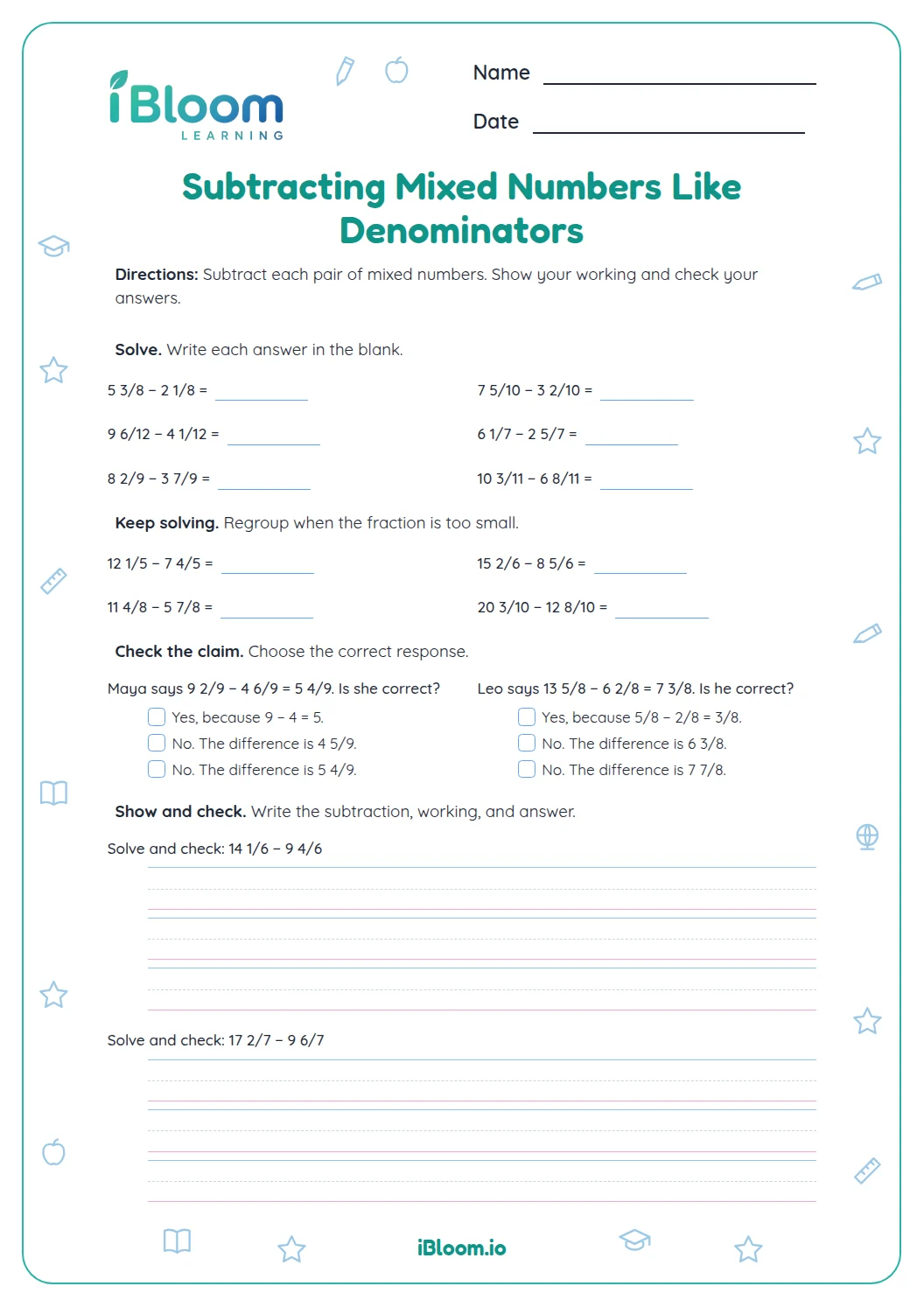
About this worksheet
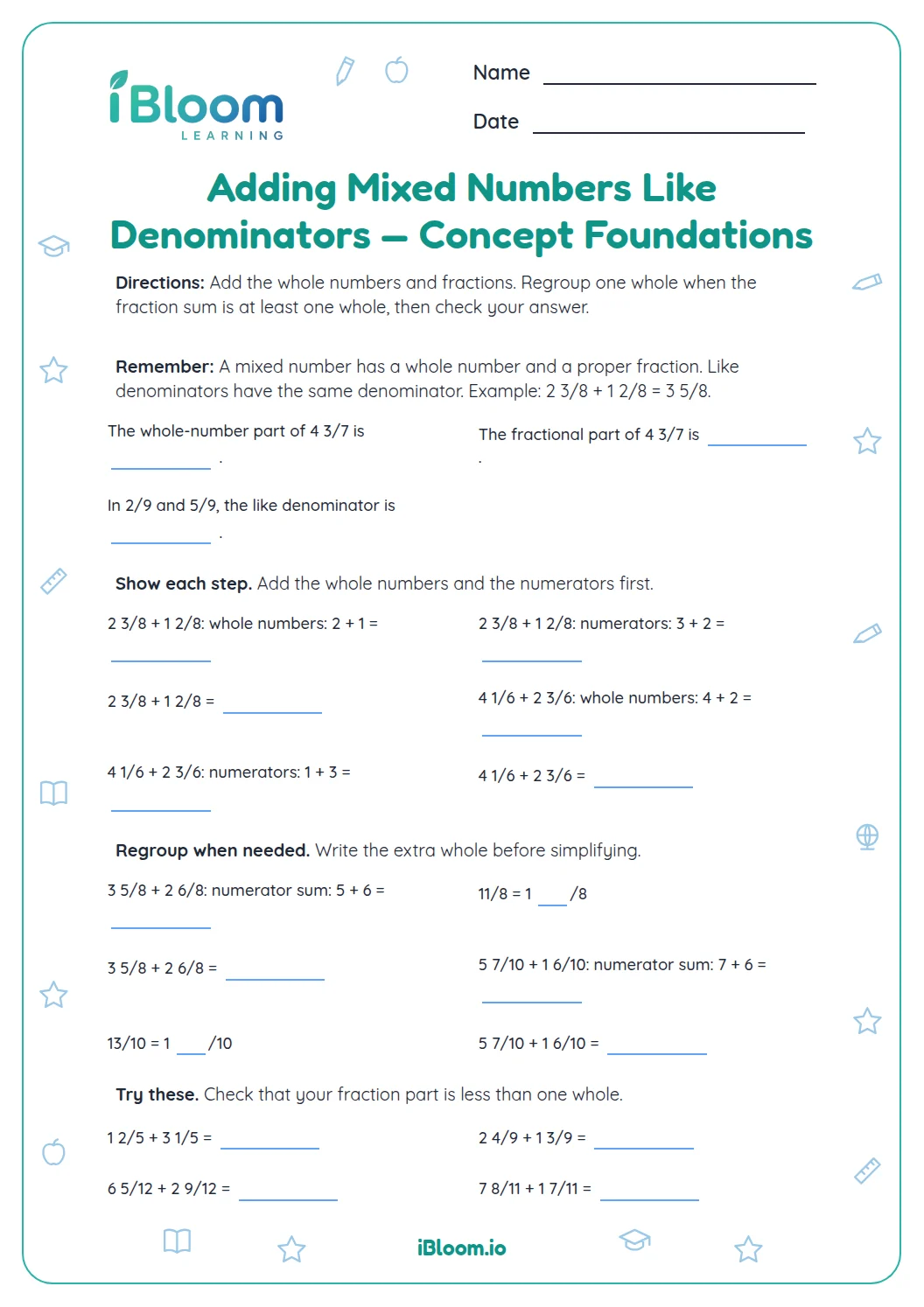
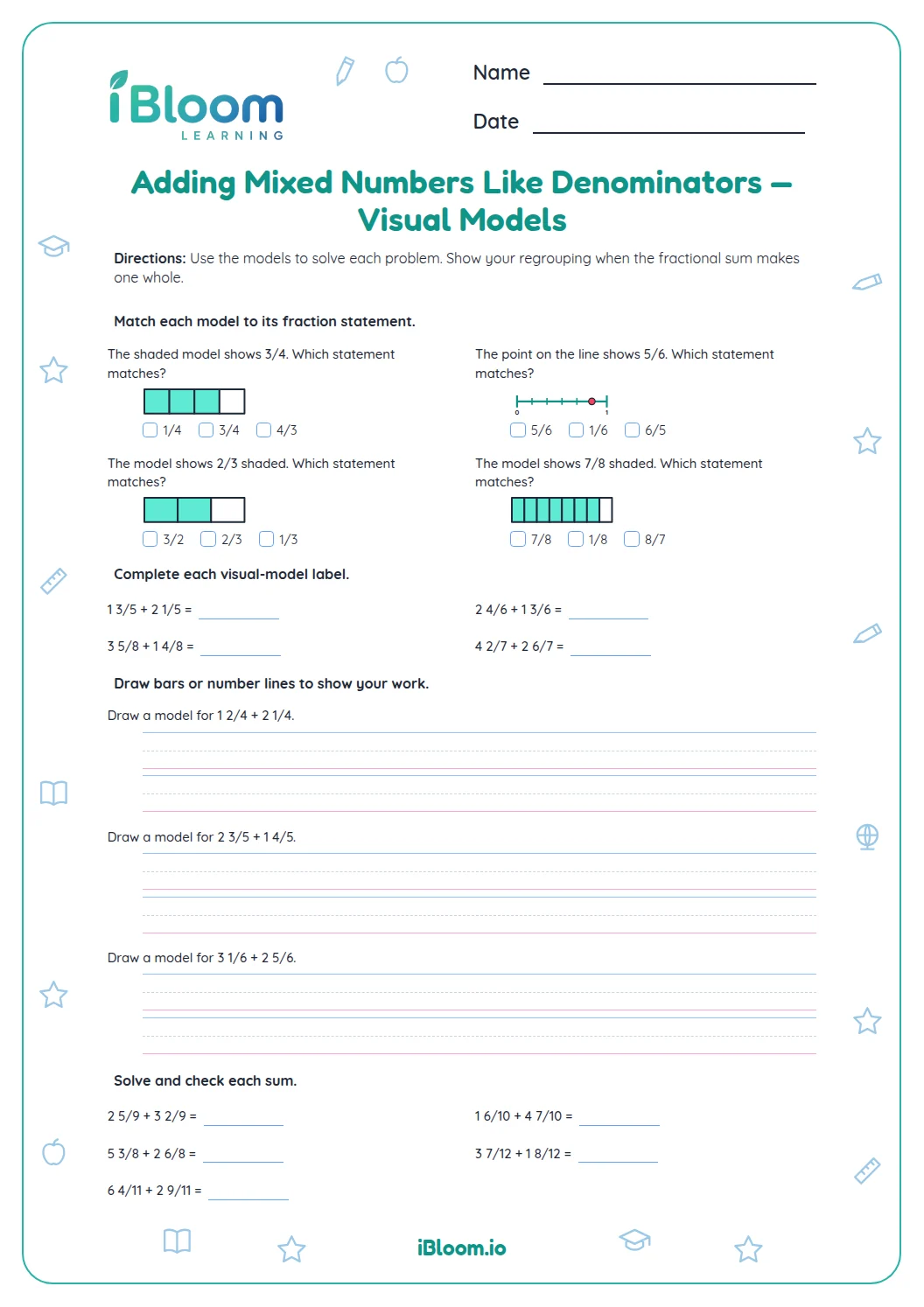
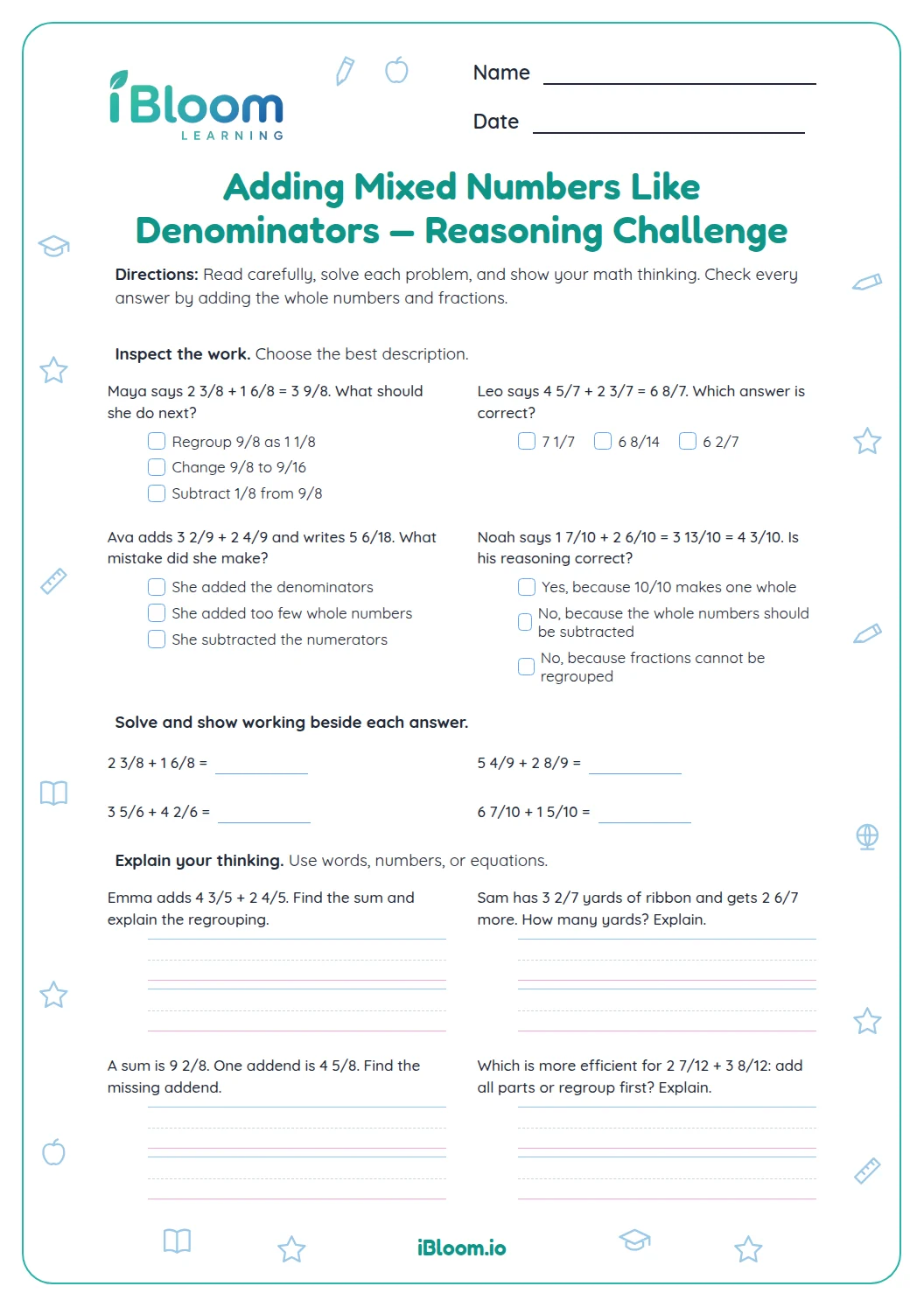
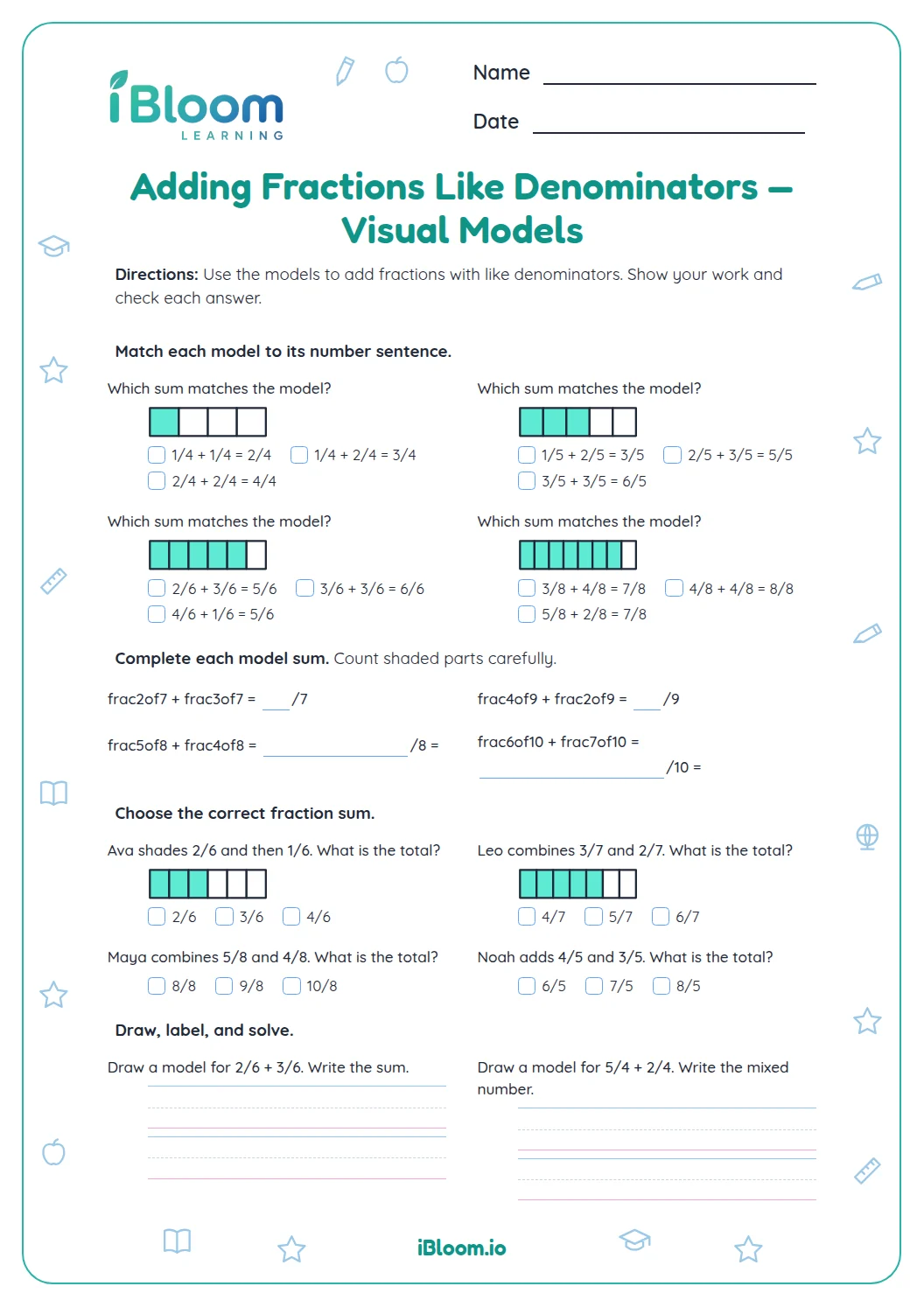
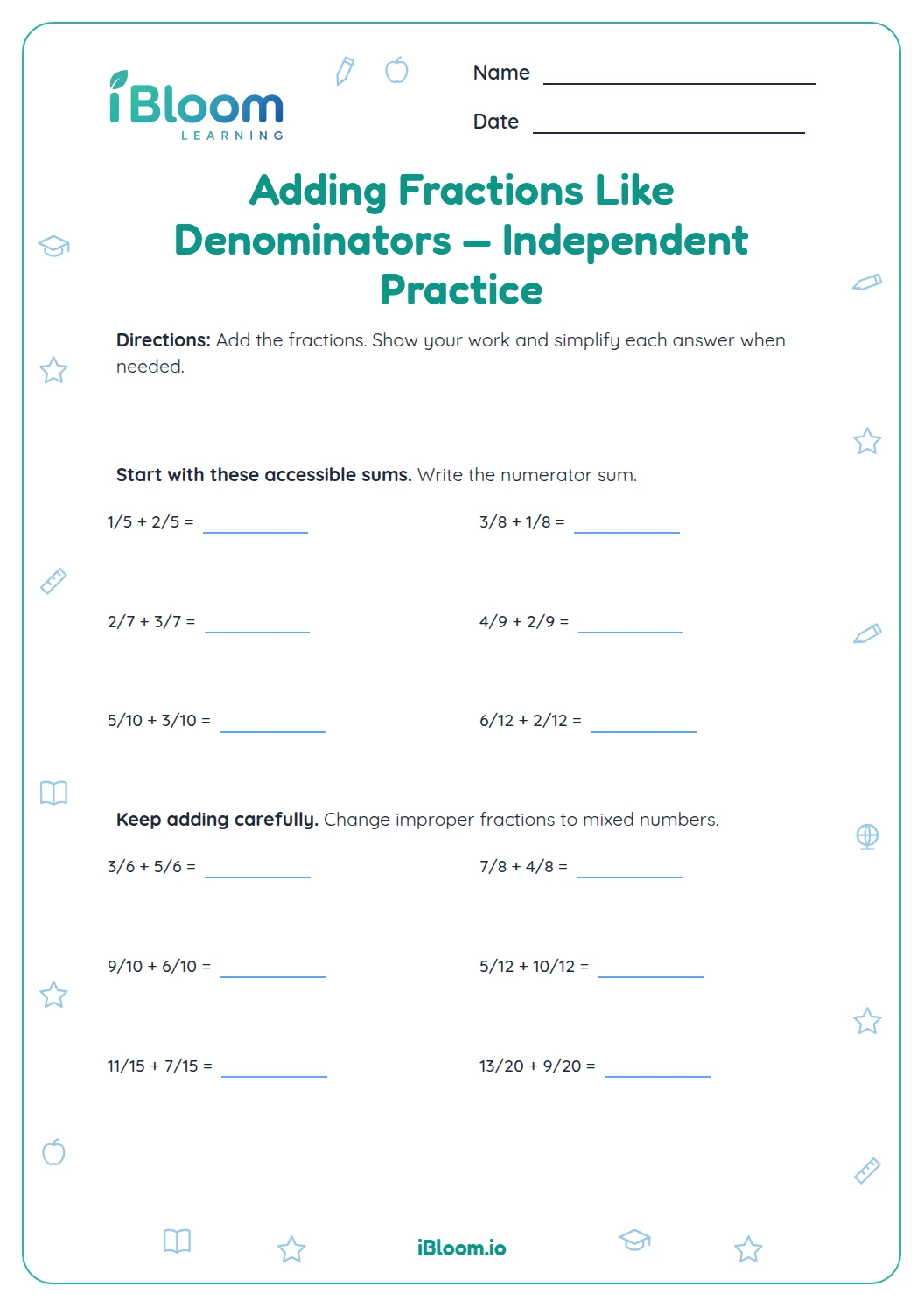
This free printable Grade 4 worksheet gives students 16 mixed-number addition problems with like denominators. Part A starts with sums whose fraction parts stay below one whole. Part B asks students to regroup, and Part C mixes both cases so students must decide for themselves. The denominators are 3, 4, 5, 6, 8, 10 and 12. Students write each result as a whole number or a mixed number in simplest form. The sheet practices Common Core 4.NF.B.3c and includes a separate answer key for checking independent work.
Aligned to 4.NF.B.3c
What will students practice in each part?
Part A has six sums with fractional totals below one. Some answers can still be simplified: 3 2/8 + 1 4/8 makes 4 6/8, which is 4 3/4. Keeping regrouping and simplifying separate helps students see what each step does.
Part B has six sums that make an extra whole. Two finish at a whole number. Part C has four sums with no hint about regrouping, including a sum in twelfths. Students use the size of the fractional total to decide what to do.
When does the fraction part make another whole?
A numerator equal to the denominator makes exactly one whole. A larger numerator makes one whole with a fraction left over. In question 7, six fourths can be split into four fourths and two fourths.
The two fourths left over simplify to one half. This final step changes how the fraction is named while preserving its value.
- 11 3/4 + 2 3/4
- 2Whole numbers: 1 + 2 = 3
- 3Fraction parts: 3/4 + 3/4 = 6/4 = 1 2/4
- 4Combine: 3 + 1 2/4 = 4 2/4 = 4 1/2
How can students check an independent answer?
First compare the answer with the whole-number sum. For question 7, the whole numbers total 3 and the fractions add more than 1, so the answer must be between 4 and 5. An answer of 3 1/2 is too small.
Next check that the fractional part is less than one and is in simplest form. The key uses simplified answers. An equivalent result such as 4 2/4 has the right value and needs one more simplifying step.
Use the sheet for independent practice
- 1Review that 4/4, 6/6 and 8/8 each equal one whole.
- 2Have students complete Part A and check whether any fraction can be simplified.
- 3In Part B, ask students to mark any fraction sum that reaches one whole.
- 4Let students complete Part C without a regrouping hint.
- 5Check against the key and have students redo missed sums on scrap paper.
Mistakes to watch for
The mistake
Adding the denominators and writing 1 3/4 + 2 3/4 = 3 6/8.
The fix
The parts remain fourths. Add 3 fourths and 3 fourths to get 6 fourths.
The mistake
Writing 3 2/4 for question 7 after taking 4/4 out of 6/4.
The fix
The removed 4/4 becomes an extra whole. Add it to 3 to get 4 2/4.
The mistake
Leaving 4 6/8 as the final answer in question 3.
The fix
Divide the numerator and denominator by 2 to write 4 3/4 in simplest form.
Common Core alignment
Add mixed numbers with matching denominators; regroup fraction parts into a whole when needed.
On this sheet: All 16 problems add mixed numbers with like denominators, including sums that make another whole.
Show the official wordingHide the official wording
Add and subtract mixed numbers with like denominators, e.g., by replacing each mixed number with an equivalent fraction, and/or by using properties of operations and the relationship between addition and subtraction.
What to practice next
Make more practice
Further reading
Questions parents and teachers ask
Does every problem need regrouping?
No. Part A keeps the fraction total below one, Part B requires regrouping, and Part C mixes the two cases. Students should compare the numerator of the fraction sum with its denominator each time. That check tells them whether to add another whole to the whole-number total.
Should answers be in simplest form?
Yes. The printed directions ask for a whole number or a mixed number in simplest form, and the answer key follows that rule. For example, question 3 gives 4 6/8 before simplifying. Dividing 6 and 8 by 2 gives the final answer, 4 3/4.
Can my child use improper fractions?
Yes. Converting both mixed numbers to improper fractions is a valid method for every sum here. For question 7, 1 3/4 becomes 7/4 and 2 3/4 becomes 11/4. Their sum is 18/4, which becomes 4 2/4 and then simplifies to 4 1/2.
What happens when the fractional parts make exactly one?
Add one to the whole-number total and write a whole-number answer. In question 9, 2 1/3 + 4 2/3 has whole parts totaling 6 and fraction parts totaling 3/3. Since 3/3 is one whole, the final answer is 7, with no fractional part left.
How should I use the answer key?
Check the value of each answer first, then check its form. The key gives all 16 results in simplest form. If a child writes an equivalent fraction, such as 4 2/4 instead of 4 1/2, acknowledge the correct addition and ask for the final simplifying step.