







About this worksheet
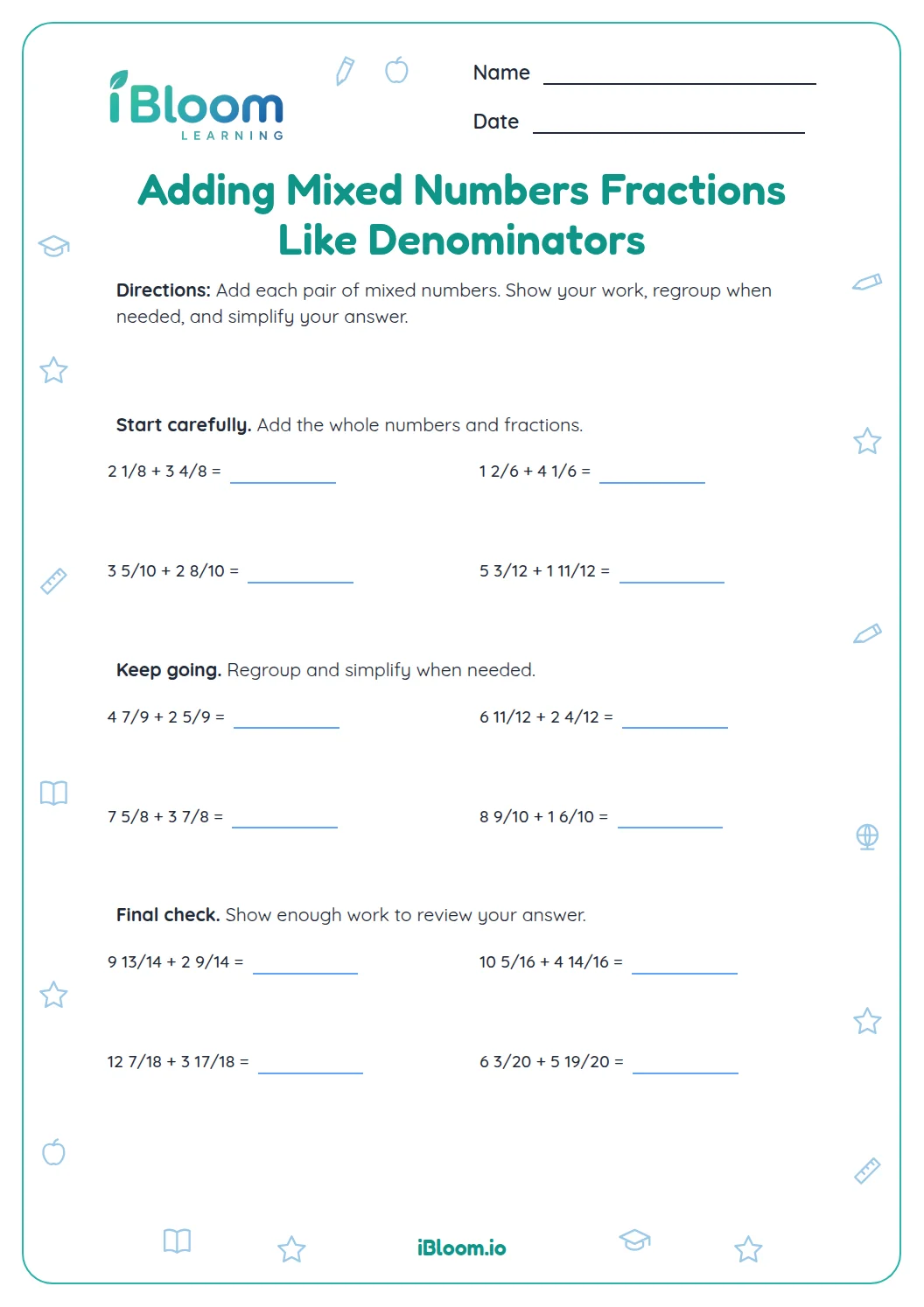
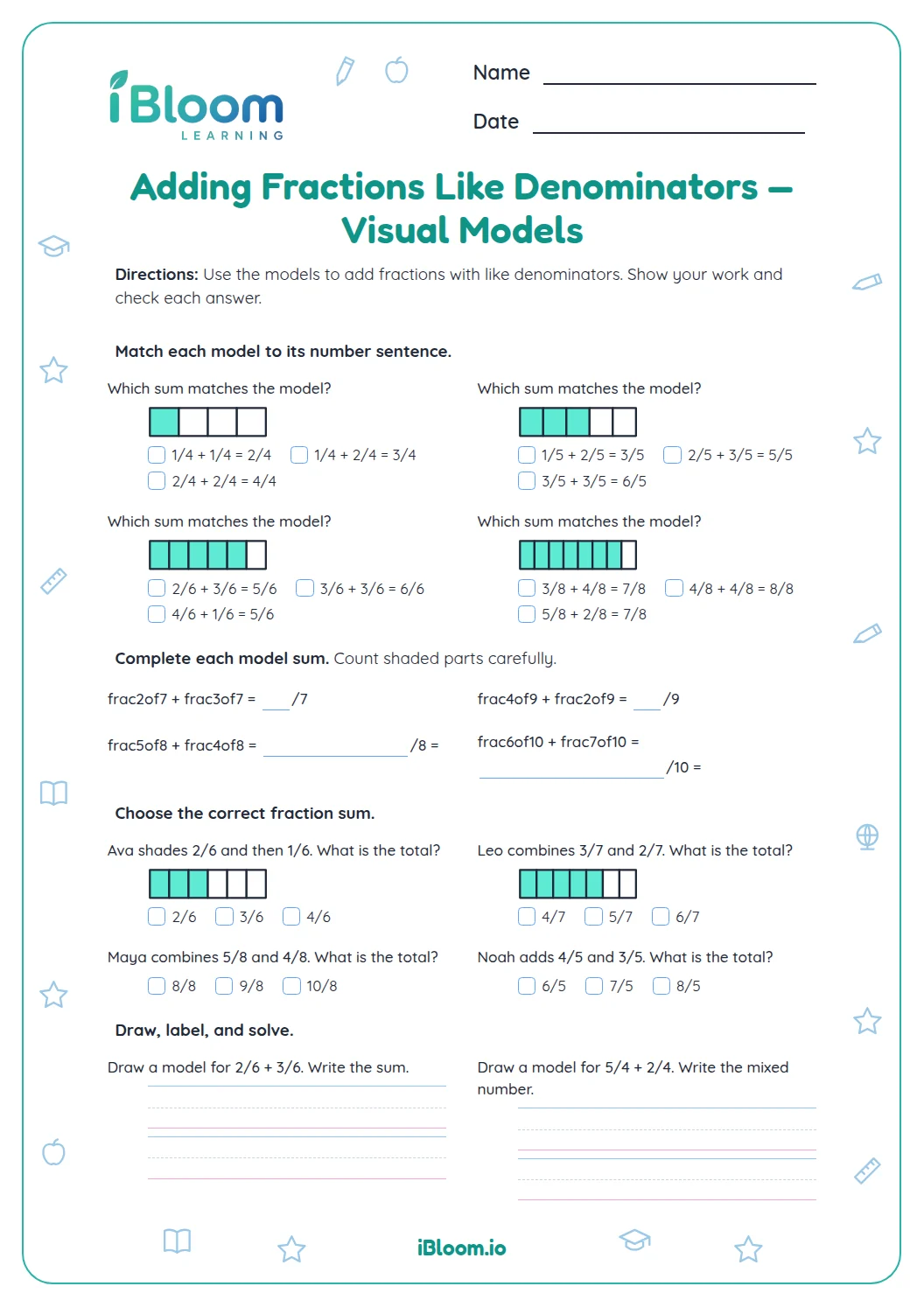
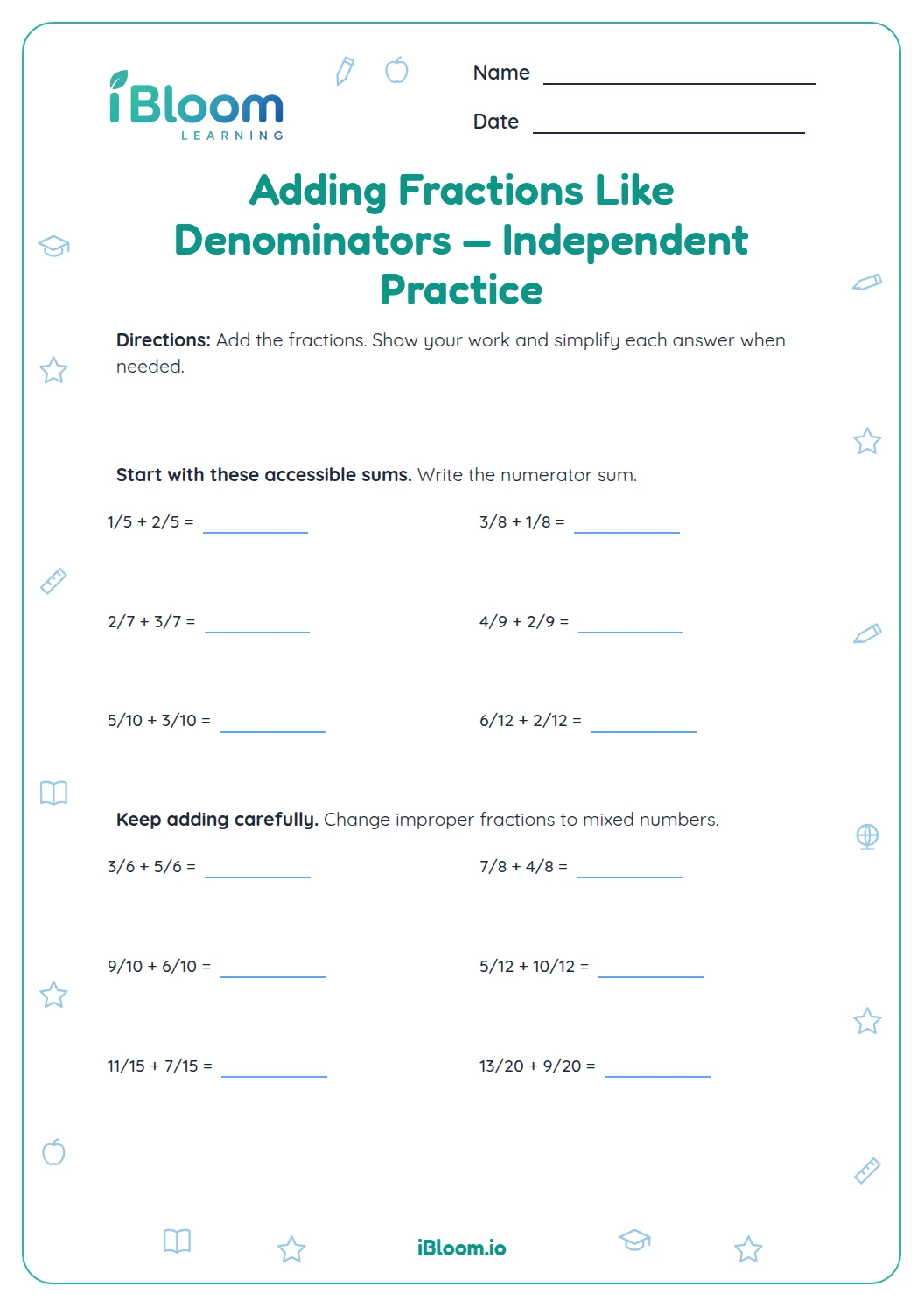
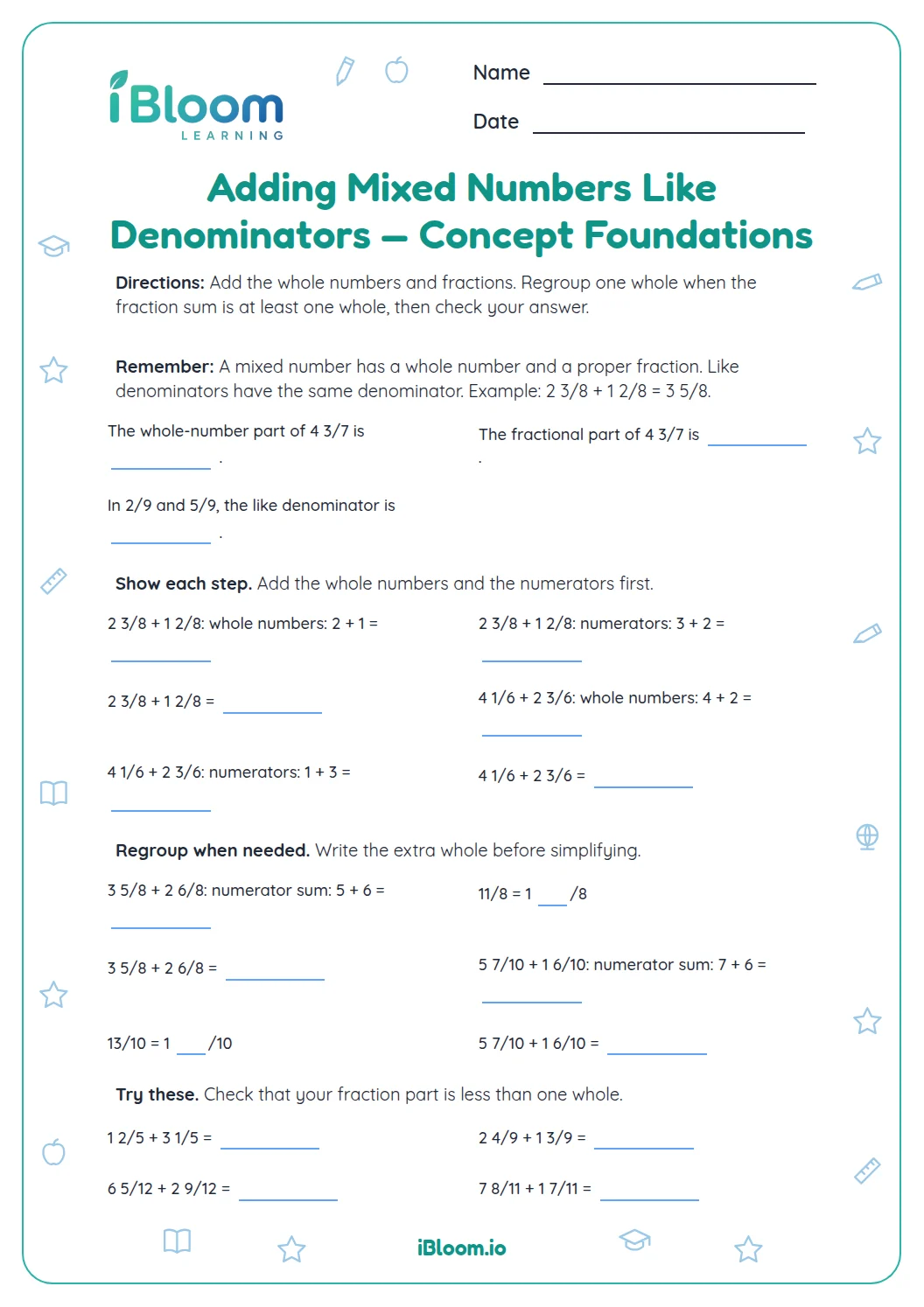
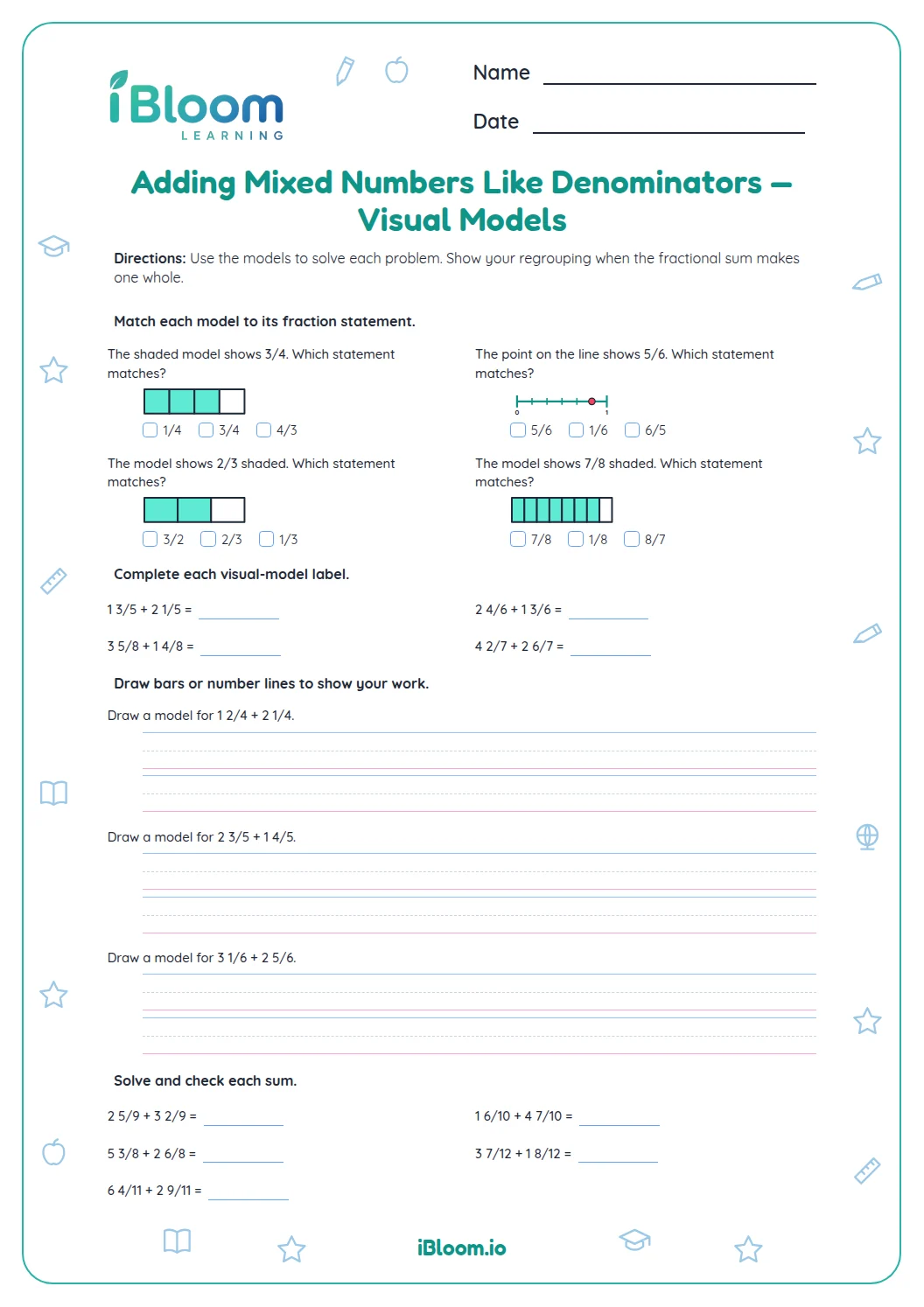
This free printable Grade 4 worksheet builds the idea behind adding mixed numbers with like denominators. Students read two fraction-bar models and answer two questions about denominators and wholes. Part C guides students through the steps: add whole numbers, combine fractional parts, and regroup an improper fraction. Part D gives eight sums to solve independently. The 16 questions practice Common Core 4.NF.B.3.c through whole-number and fraction addition. A separate answer key supplies every model value, choice, missing step, and simplified sum.
Aligned to 4.NF.B.3.c
What do the shaded bars mean?
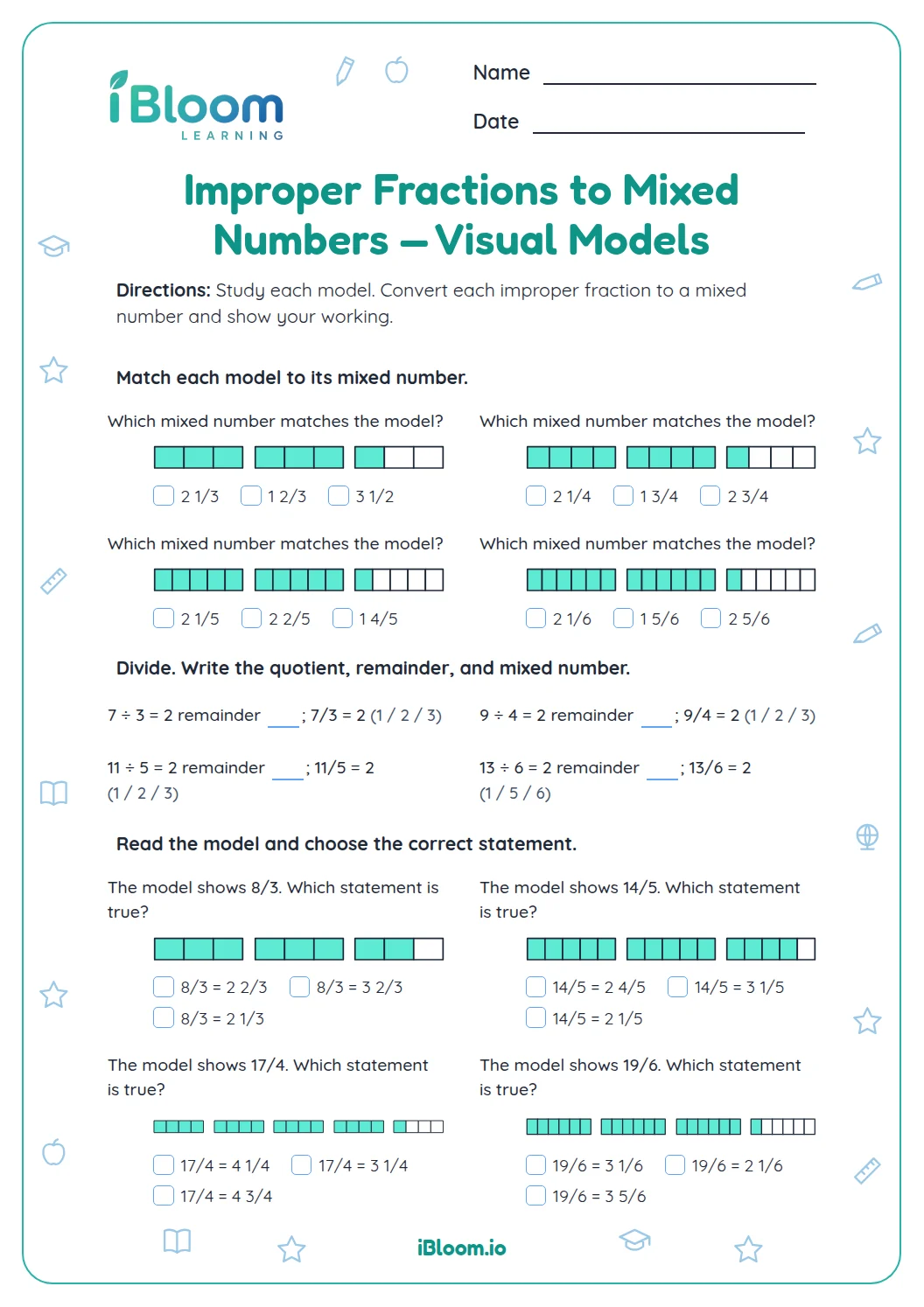
Each complete bar represents one whole, and every bar within a question is divided into equal parts of the same size. Count the fully shaded bars first. Then count the shaded parts of the remaining bar to read the mixed number.
Question 1 has one whole and one fourth. Question 2 has two wholes and three eighths. Saying these amounts aloud helps students separate whole-number parts from fractional parts before adding.
When does a fraction sum make another whole?
A numerator equal to the denominator makes exactly one whole. A larger numerator makes at least one whole plus any remaining fraction. Part C guides students through 10/8 = 1 1/4. In Part D, question 13 reaches a whole exactly; the last three sums go beyond one whole in their fractional parts.
- 11 4/5 + 2 3/5
- 2Whole numbers: 1 + 2 = 3
- 3Fractions: 4/5 + 3/5 = 7/5 = 1 2/5
- 4Combine: 3 + 1 2/5 = 4 2/5
How can students check a mixed-number sum?
Check three things: the denominators name the same-sized parts, the whole numbers have all been counted, and the final fraction is less than one and simplified. For question 15, 9/6 contributes an extra whole before the remaining 3/6 becomes 1/2.
Use bounds to check the size of a sum. In question 16, both 1 6/8 and 3 5/8 have fractional parts greater than 1/2. Those parts add to more than one whole, so the total must exceed 5. The exact answer is 5 3/8.
How to use this worksheet
- 1Read each bar model aloud as wholes and fractional parts.
- 2Use Part B to explain why equal-sized pieces keep the same denominator.
- 3Complete the two linked examples in Part C before trying the eight independent sums in Part D.
- 4For each sum, add the whole numbers separately from the fractions.
- 5If the fraction reaches one whole, move that whole into the whole-number total.
- 6Simplify the remaining fraction and compare the result with the answer key.
Mistakes to check and ways to help
The mistake
Adding denominators and turning fourths into eighths.
The fix
Keep the piece size: fourths plus fourths still count fourths. Add only the numerators.
The mistake
Leaving 3 wholes and 7/5 without regrouping.
The fix
Rename 7/5 as 1 2/5 and combine the extra whole with 3 to get 4 2/5.
The mistake
Regrouping correctly but leaving 3/6 in the final answer.
The fix
Divide the numerator and denominator by 3 to write the equivalent fraction 1/2.
Common Core alignment
Add mixed numbers with like denominators, regroup whole groups, and simplify the result.
On this sheet: Four guided steps and eight independent sums join whole-number parts and like-denominator fractions, including regrouping.
Show the official wordingHide the official wording
Add and subtract mixed numbers with like denominators, e.g., by replacing each mixed number with an equivalent fraction, and/or by using properties of operations and the relationship between addition and subtraction.
What to practice next
Make more practice
Further reading
Questions parents and teachers ask
What should students know before starting?
Students should be able to read a fraction as equal parts of a whole and identify the whole-number part of a mixed number. The first two questions provide bar models for that review. Familiarity with equivalent fractions also helps when simplifying answers such as 5 3/6.
Why do the denominators stay the same?
The denominator stays the same because the size of each piece stays the same. In question 9, one fourth and two fourths make three fourths. Adding the denominators would rename those pieces as eighths even though no pieces were divided into smaller parts during the addition.
Which independent sums need regrouping?
Questions 13 through 16 need regrouping because their fractional sums reach or exceed one whole. Question 13 has 4/4, which adds exactly one whole. Question 14 has 7/5, so students keep 2/5 after moving one extra whole into the whole-number part of the answer.
Should students simplify every answer?
Students should simplify a fractional part when it has a common factor in its numerator and denominator. Question 11 gives 5 3/6 before simplification, so the final answer is 5 1/2. The key uses simplified answers; an equivalent value can still show that the addition was understood.
How can the answer key help with a wrong sum?
Use the key to locate the difference, then ask the student to show the whole-number addition and fraction addition separately. For question 16, check 1 + 3 and 6/8 + 5/8. Finally, check that 11/8 contributes one more whole and leaves 3/8.