





About this worksheet
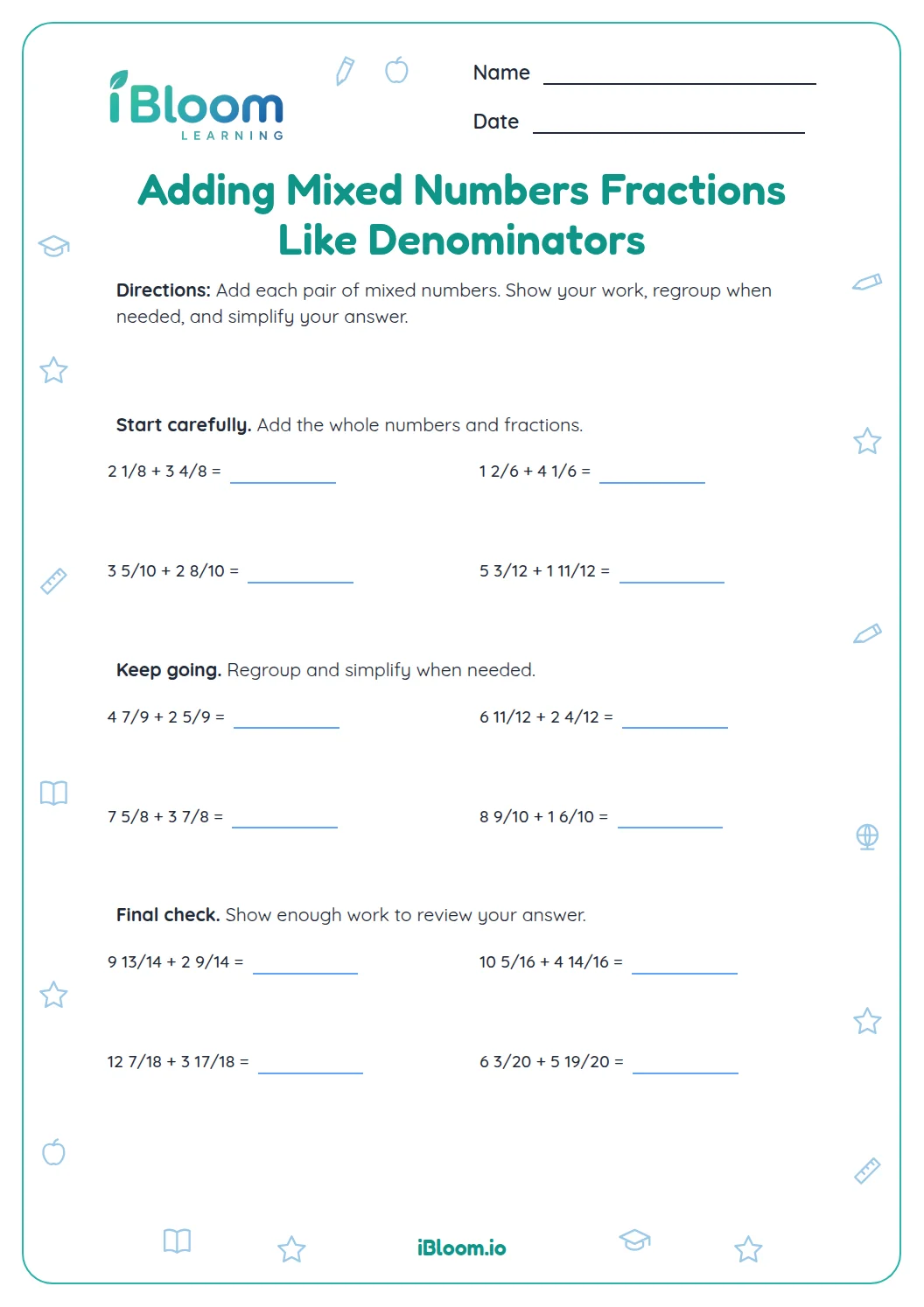
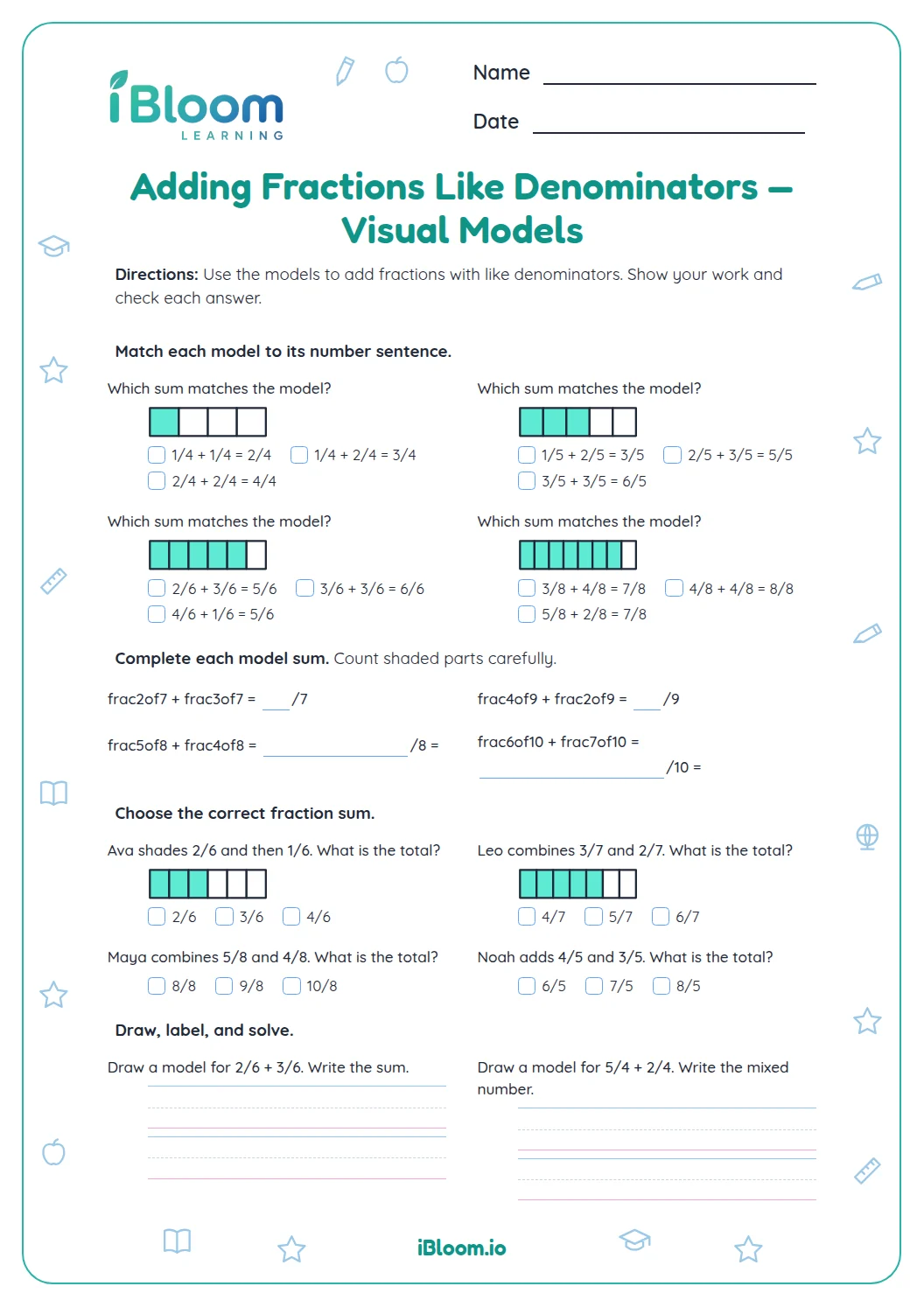
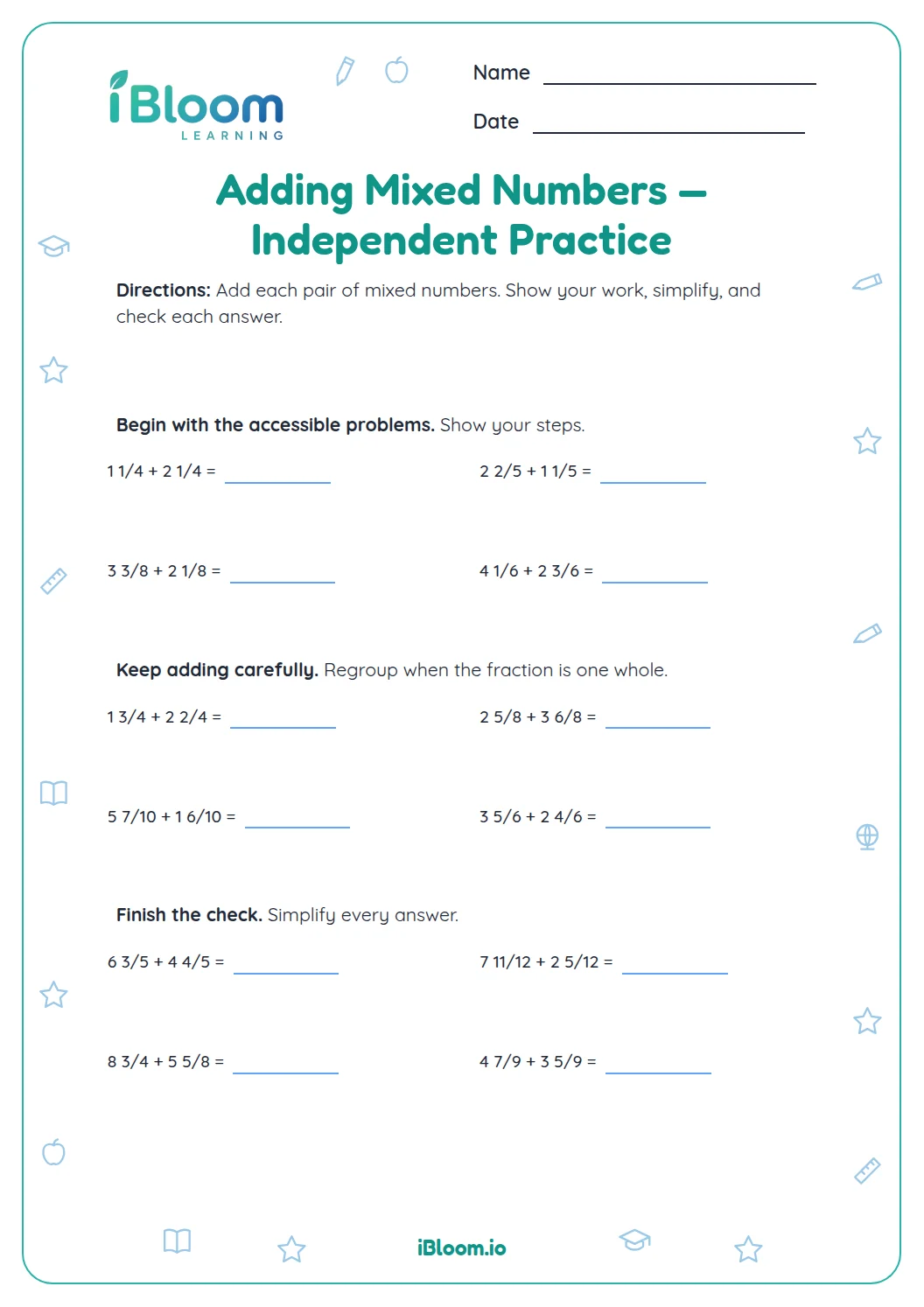
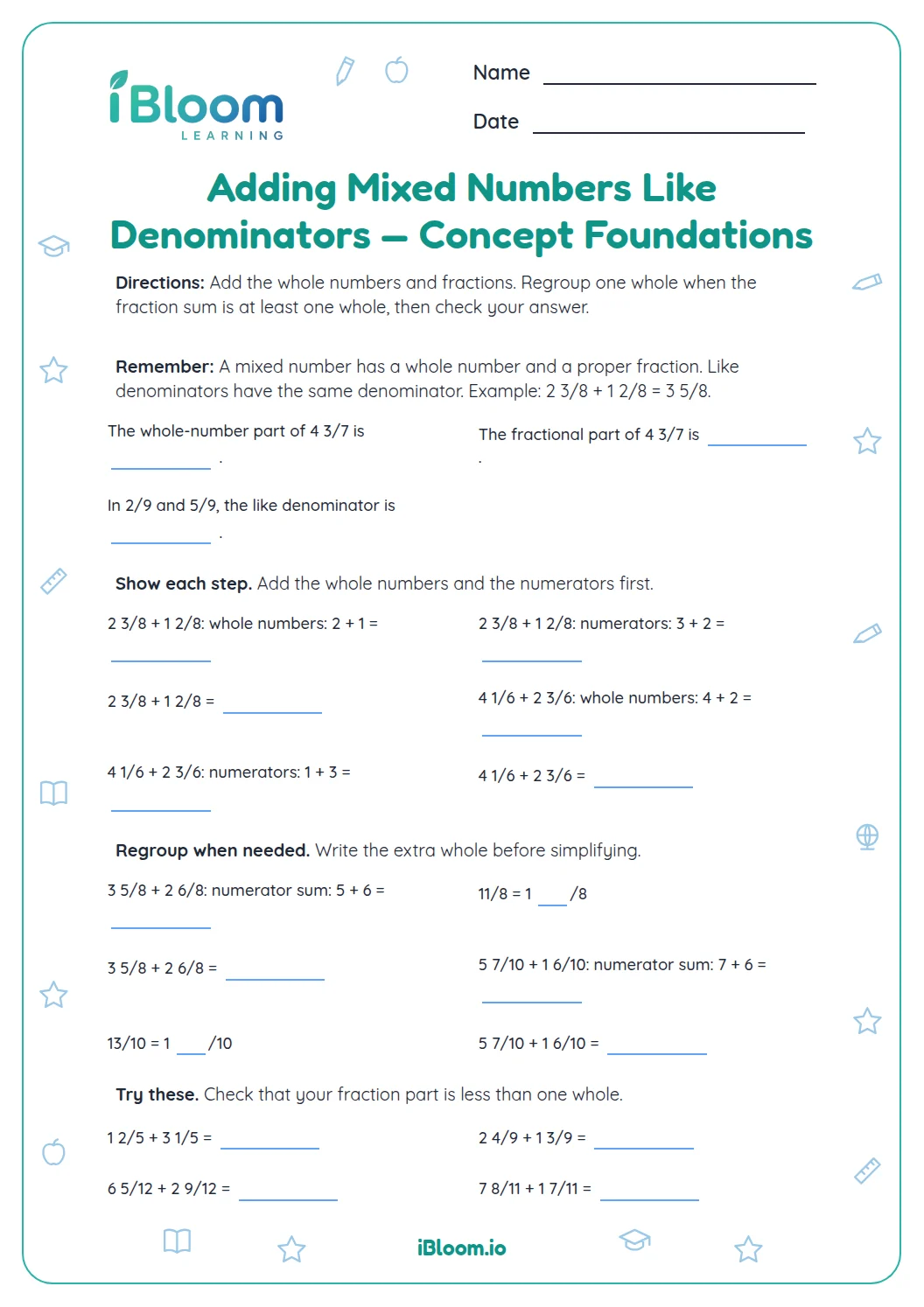
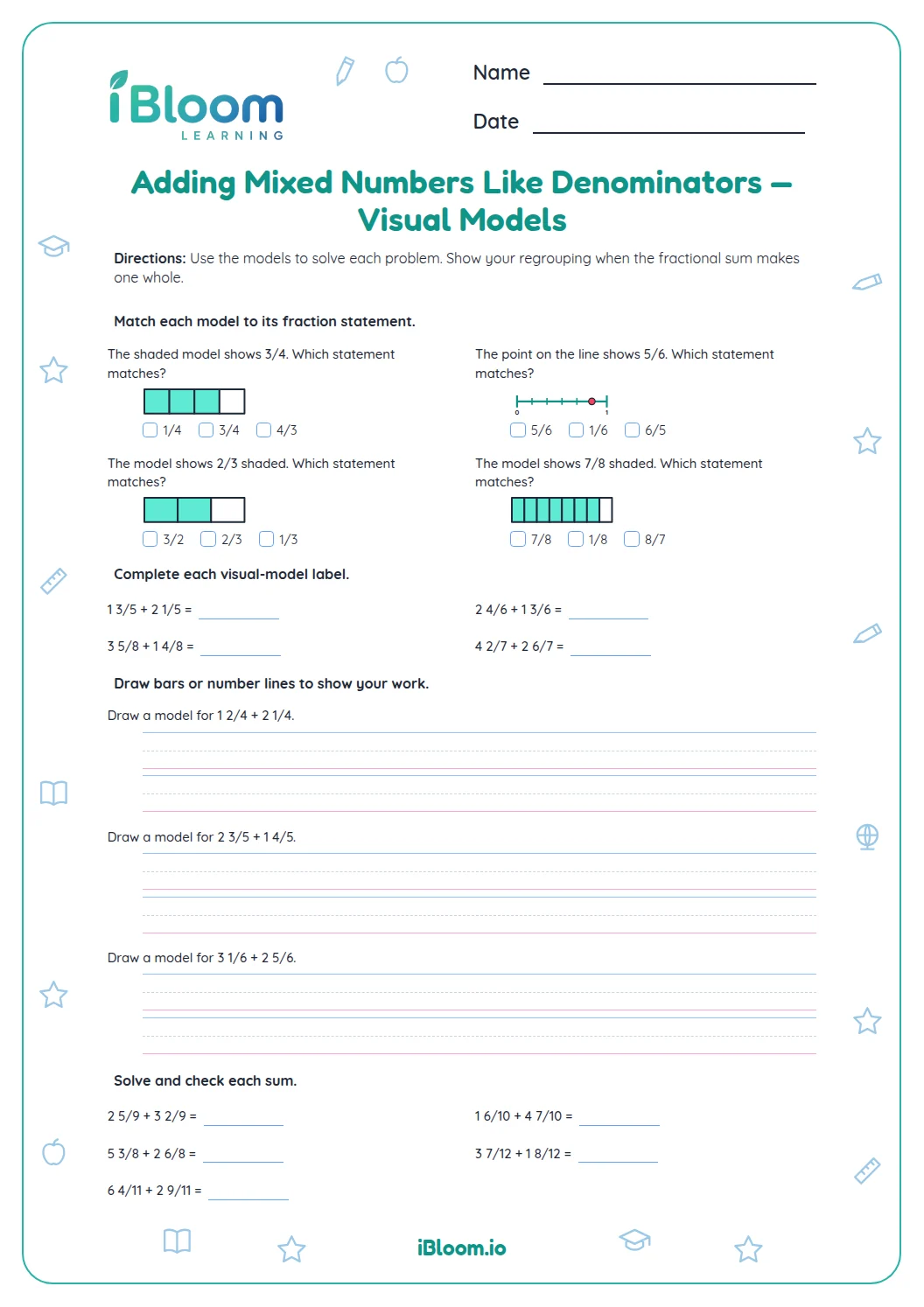
This Grade 4 worksheet practices adding mixed numbers with like denominators through practical stories about distance, recipes, and materials. Learners write an equation, add the whole numbers and fractional parts, and regroup when the numerator total reaches a whole. The 16 questions include totals that do and do not require regrouping, and a separate answer key. It aligns with CCSS 4.NF.B.3.d.
Aligned to 4.NF.B.3.d
What is the main idea?
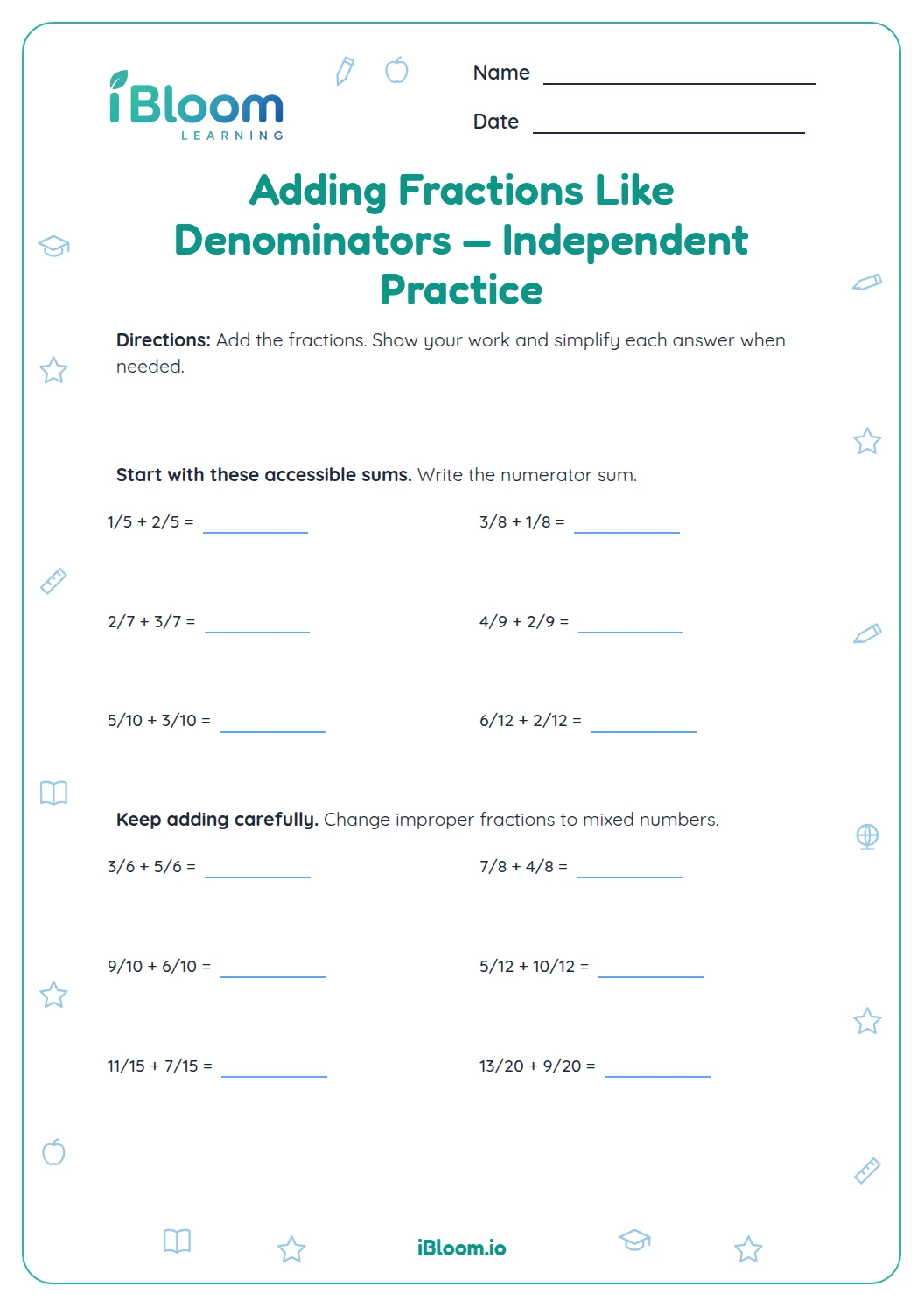
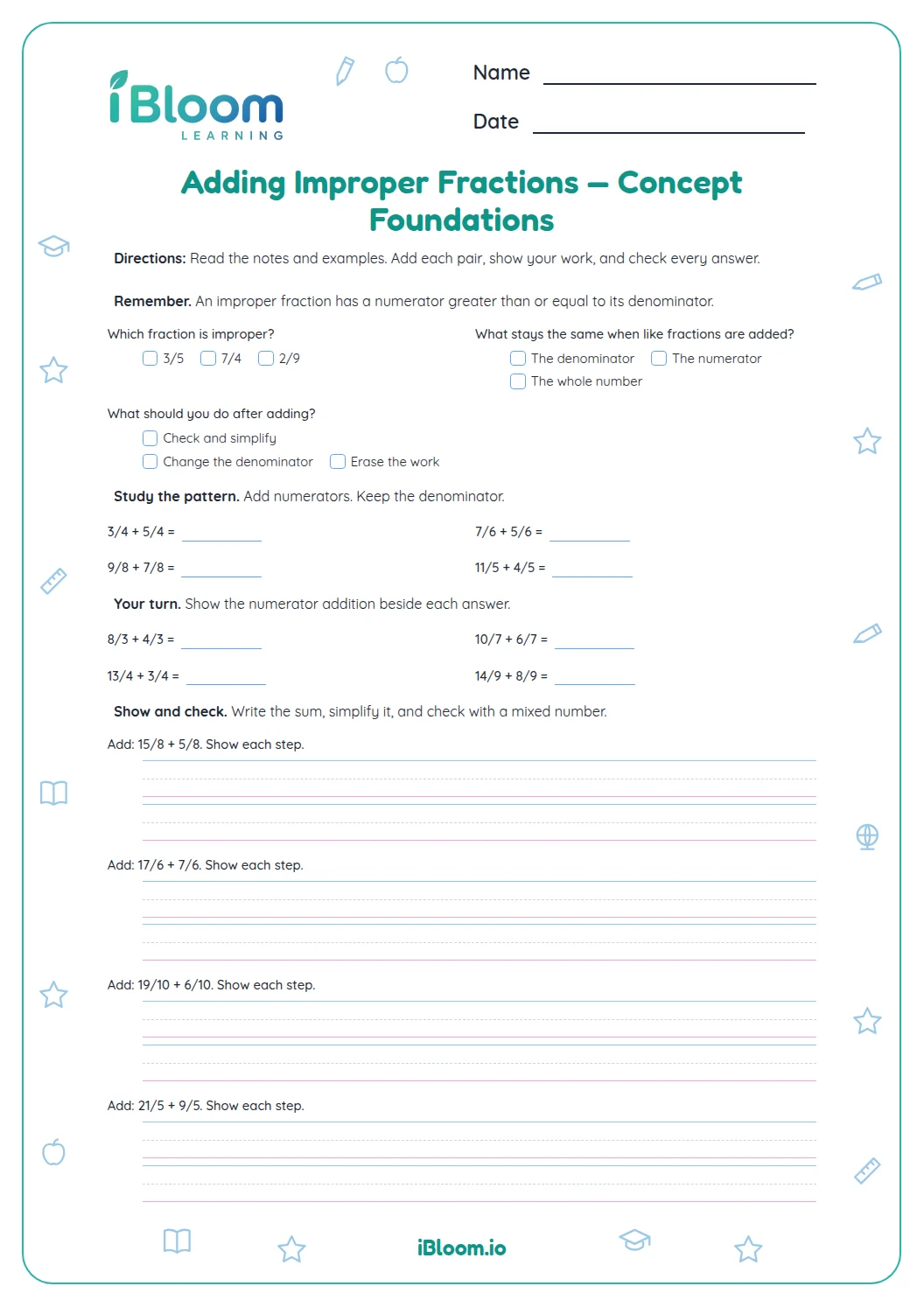
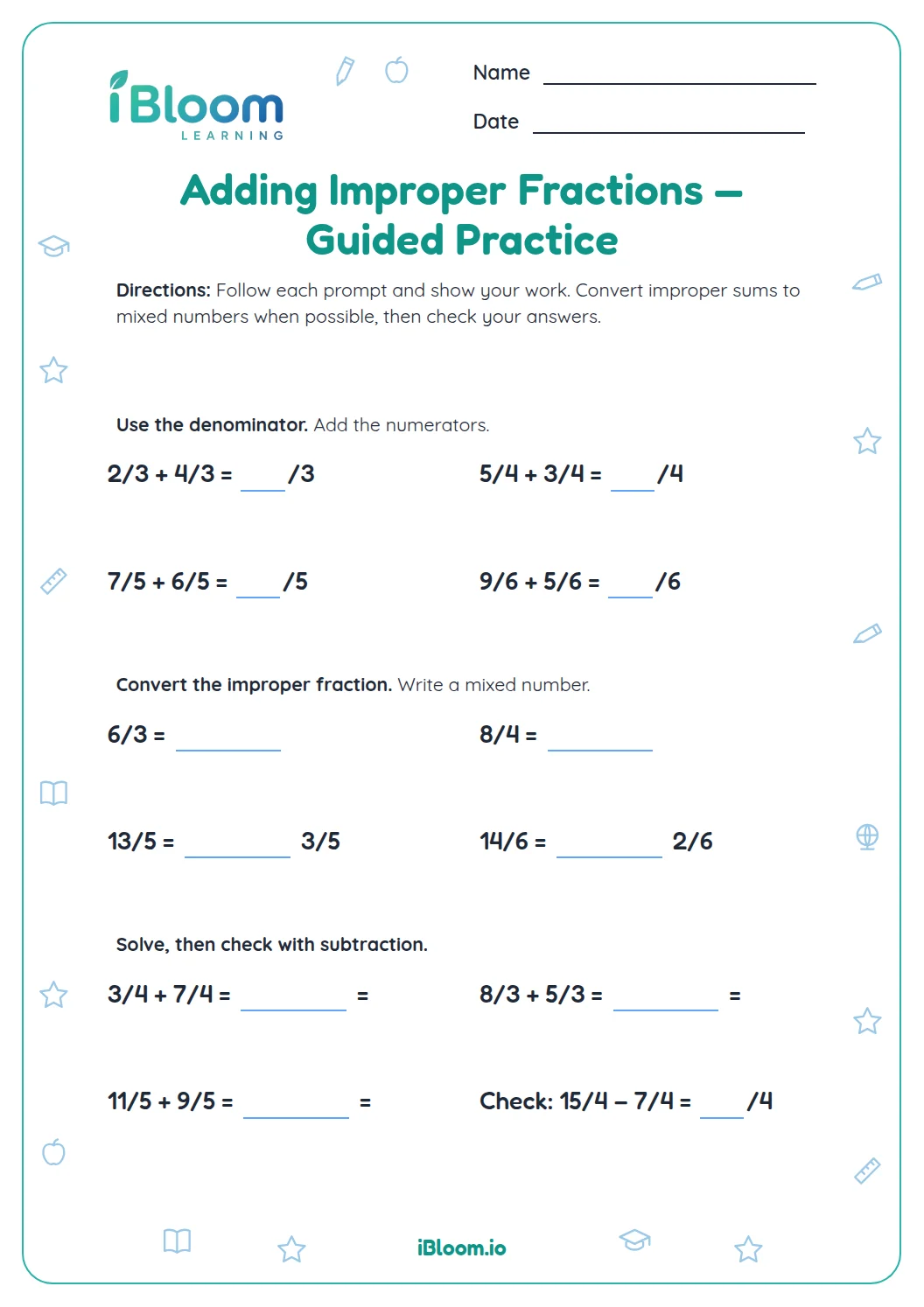
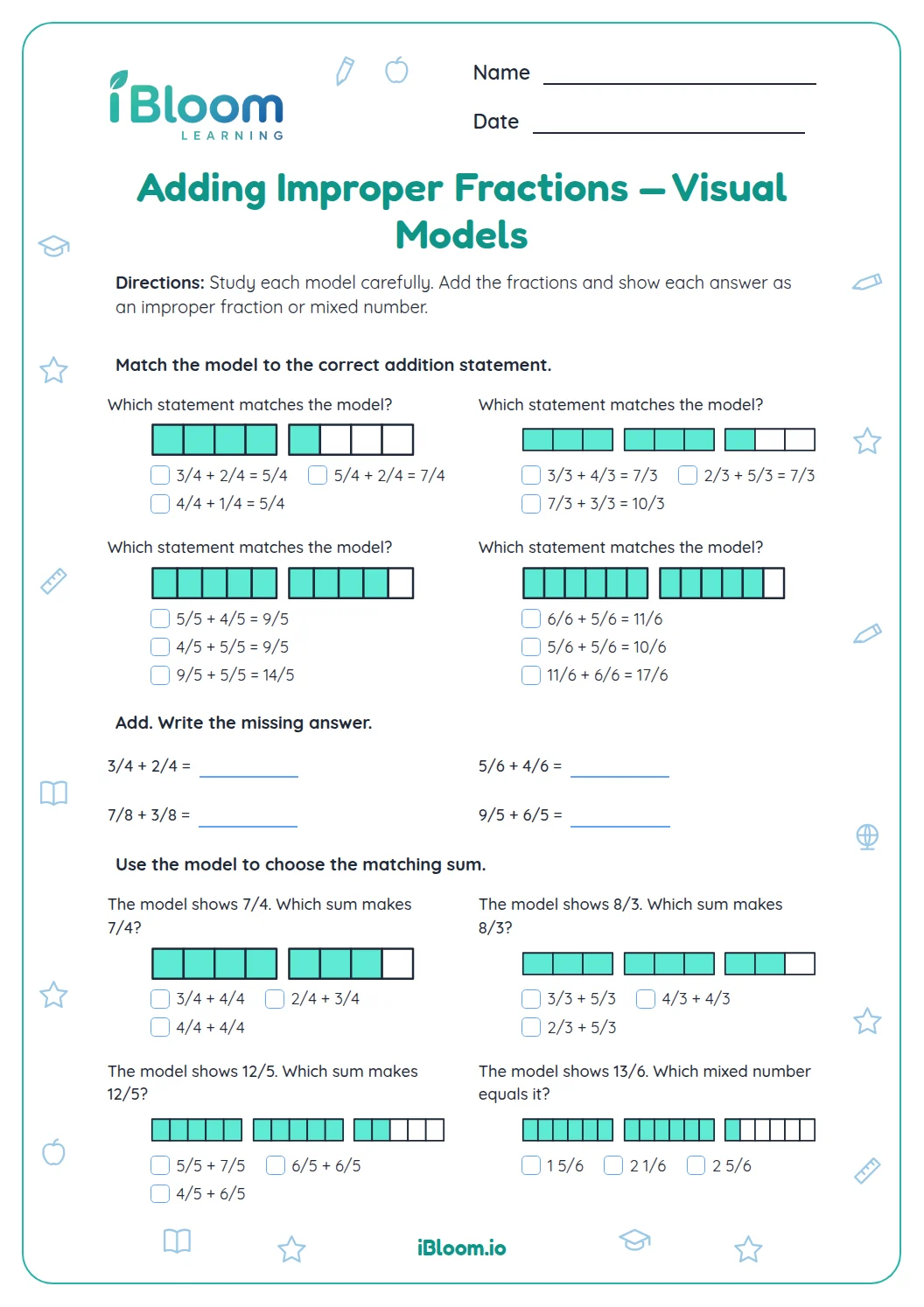
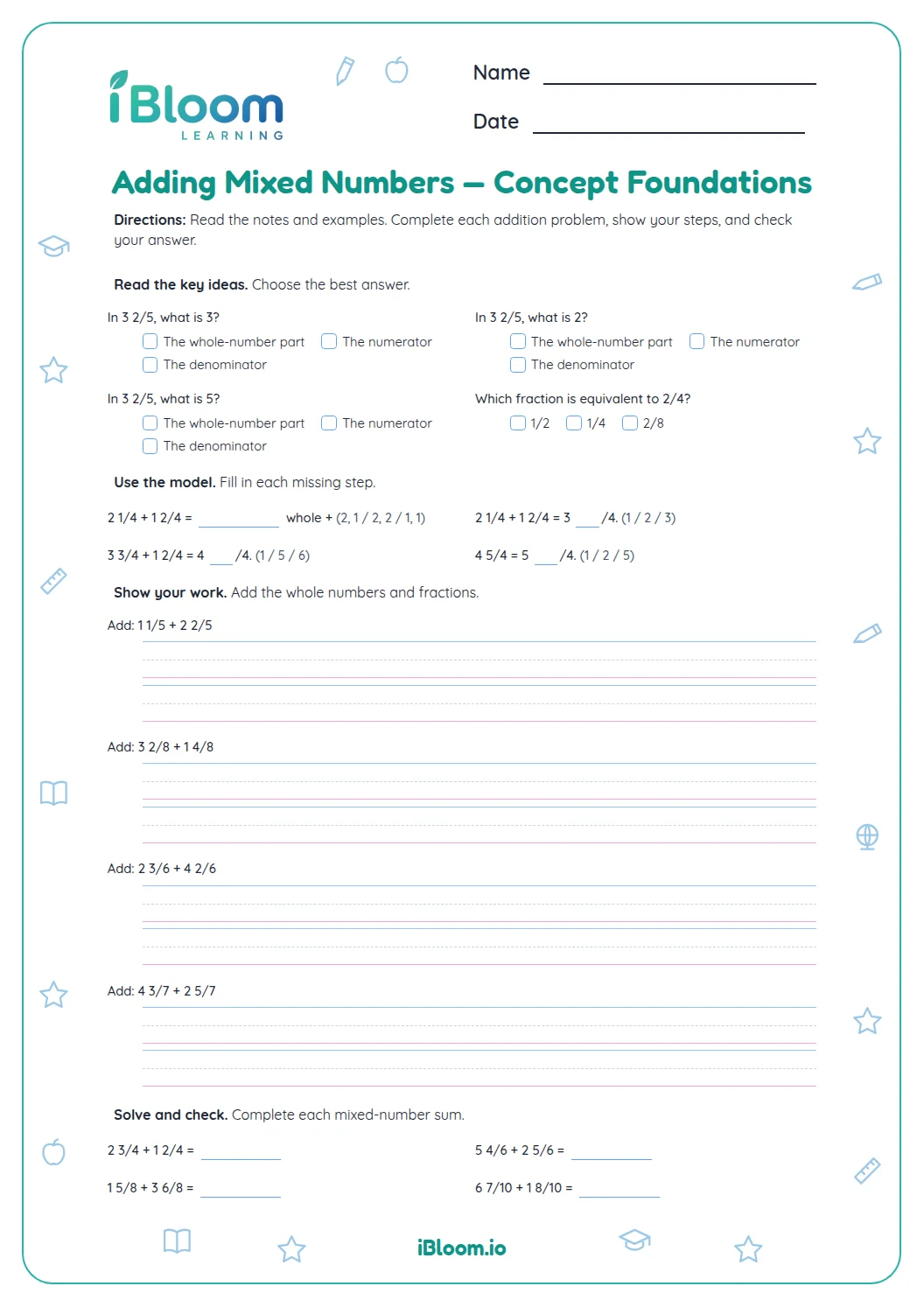
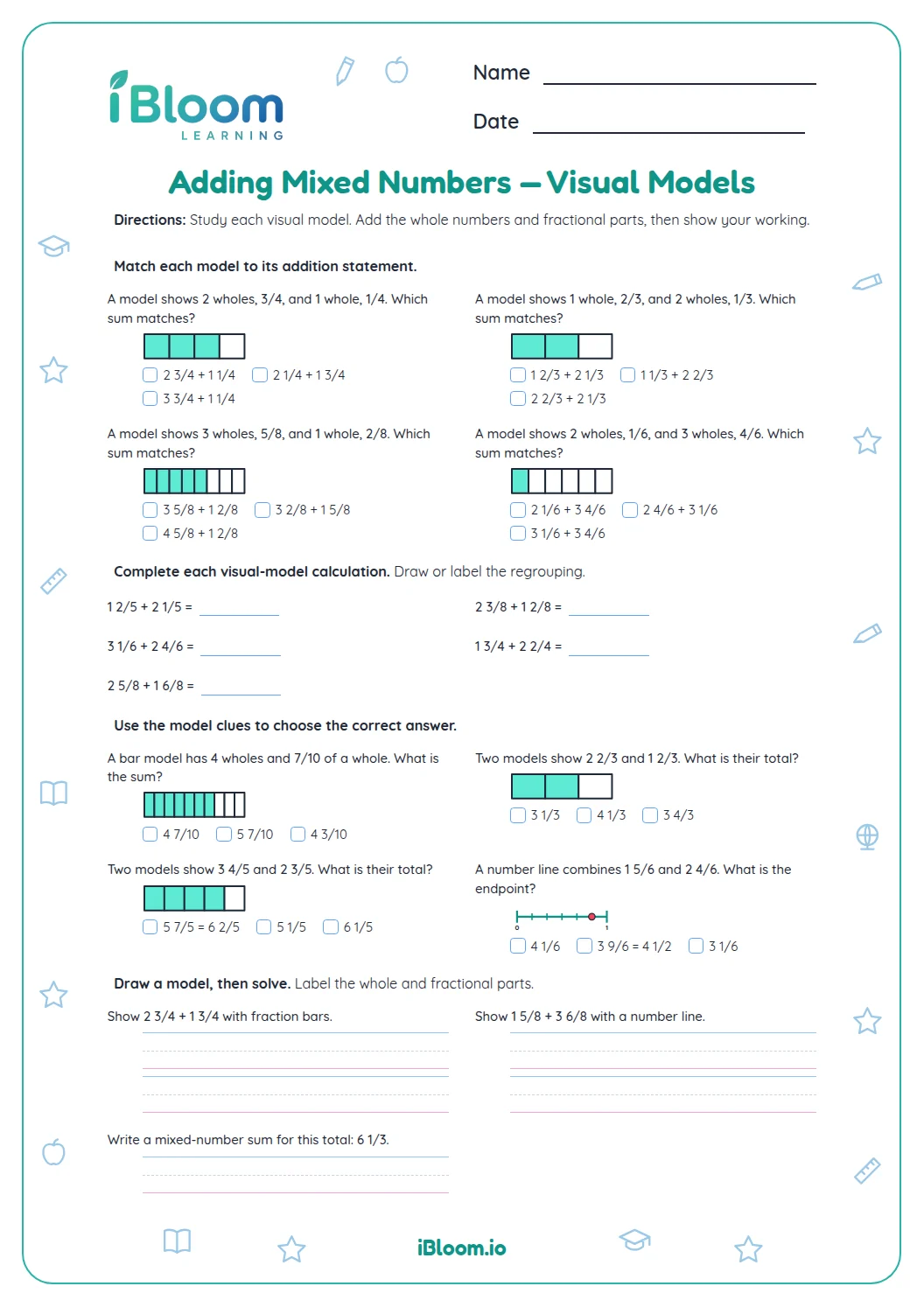
For like denominators, the fractional parts have equal-size pieces. Add whole numbers and numerators separately, then regroup if the numerator reaches the denominator.
In question 5, 1 3/4 + 2 2/4 = 3 5/4. Since 5/4 is 1 1/4, the total is 4 1/4 liters.
How does the practice build?
The first part gives a clear starting point. Later items ask learners to apply the same idea in a new form and check that the result makes sense. Use the answer key after independent work so the learner can explain any correction.
How can an adult support the practice?
Read the directions together, then ask the learner to name the first step before writing. Encourage a check with a second method when one is available. The short written responses leave room to put the reasoning into words.
How to use this worksheet
- 1Underline the two amounts and their units.
- 2Write an addition equation for each story.
- 3Add whole-number parts and fraction numerators separately.
- 4Regroup any fraction sum that reaches one whole.
- 5Check that the total is larger than each amount.
Common mistakes and quick fixes
The mistake
Add denominators instead of numerators.
The fix
keep the common denominator because the piece size does not change.
The mistake
Forget to regroup an improper fraction part.
The fix
trade 4/4 for one whole in fourths.
The mistake
Leave off the unit in a story answer.
The fix
copy the unit from the question into the final answer.
Common Core alignment
This worksheet gives focused practice with the standard below.
Solve same-denominator fraction addition stories with equations.
On this sheet: Solve same-denominator fraction addition stories with equations.
Show the official wordingHide the official wording
Solve word problems involving addition and subtraction of fractions referring to the same whole and having like denominators, e.g., by using visual fraction models and equations to represent the problem.
What to practice next
Make more practice
Further reading
Questions parents and teachers ask
How do you add mixed numbers with like denominators?
Add the whole numbers and add the numerators while keeping the common denominator. If the fraction sum makes a whole, regroup it. For example, 1 3/4 + 2 2/4 is 3 5/4, or 4 1/4. Invite the learner to point to the numbers or words in the prompt that support this answer, then check the completed item against the key.
When should a fraction part be regrouped?
Regroup when the numerator total equals or exceeds the denominator. In 3 3/8 + 2 6/8, the fraction parts total 9/8, which is 1 1/8; the whole-number total becomes 6 1/8. Invite the learner to point to the numbers or words in the prompt that support this answer, then check the completed item against the key.
What does like denominators mean?
The denominators are the same, so both fractions name pieces of the same size. Add the numerators and keep that denominator, then simplify if the fraction can be reduced. Invite the learner to point to the numbers or words in the prompt that support this answer, then check the completed item against the key.
What is on this word-problem worksheet?
It has 14 real-world addition stories involving distances, recipes, materials, and amounts. Every problem asks for a total and provides working space, with a separate answer key. Invite the learner to point to the numbers or words in the prompt that support this answer, then check the completed item against the key.
Why do the story problems use units?
Units show what the numbers measure and keep the answer meaningful. The answer key repeats the correct unit, such as miles, cups, yards, or liters. Invite the learner to point to the numbers or words in the prompt that support this answer, then check the completed item against the key.
How can a learner check a total?
Estimate first, then add the mixed numbers another way or use subtraction to check a missing part. The total should be greater than either amount being added. Invite the learner to point to the numbers or words in the prompt that support this answer, then check the completed item against the key.