





About this worksheet
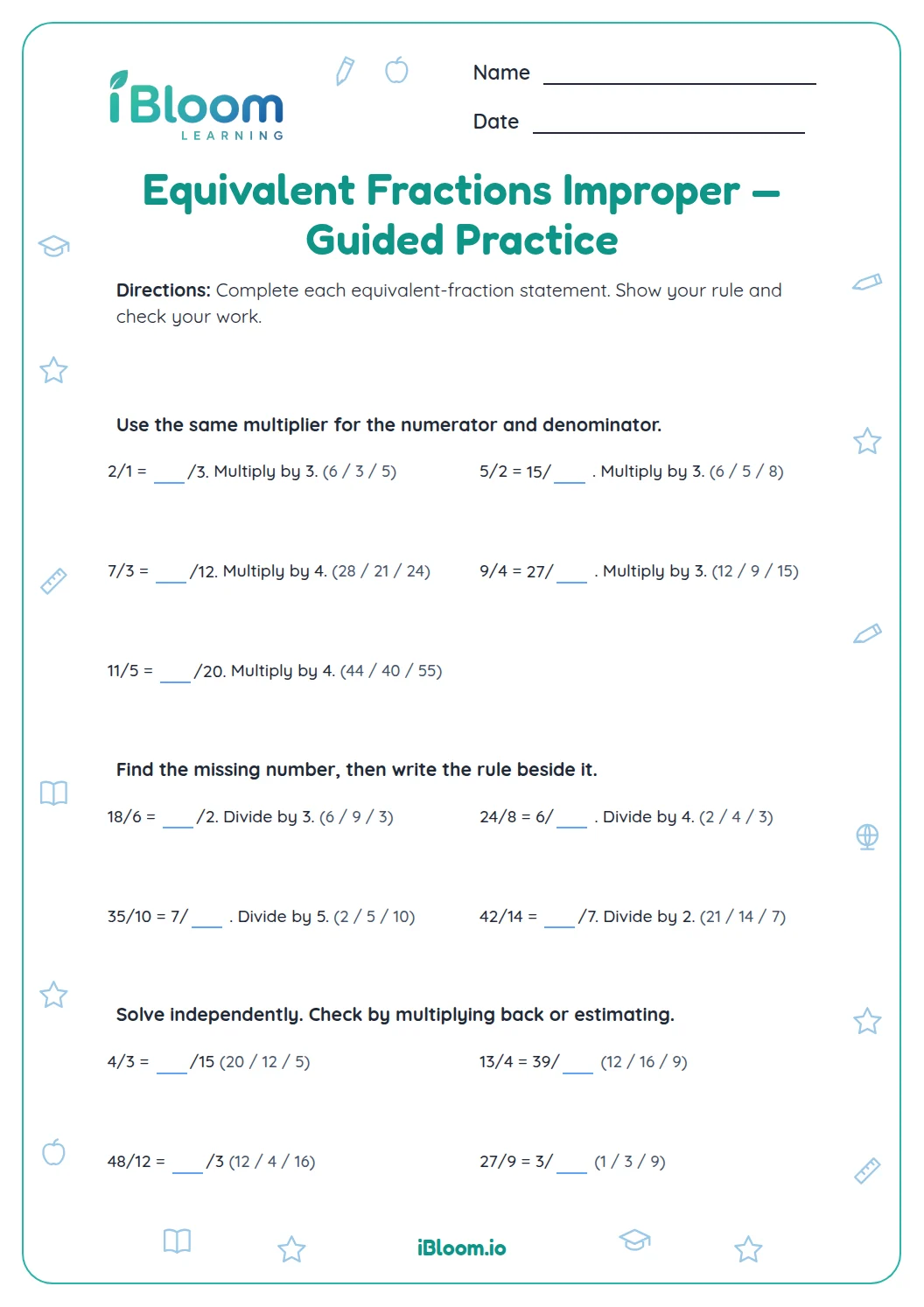
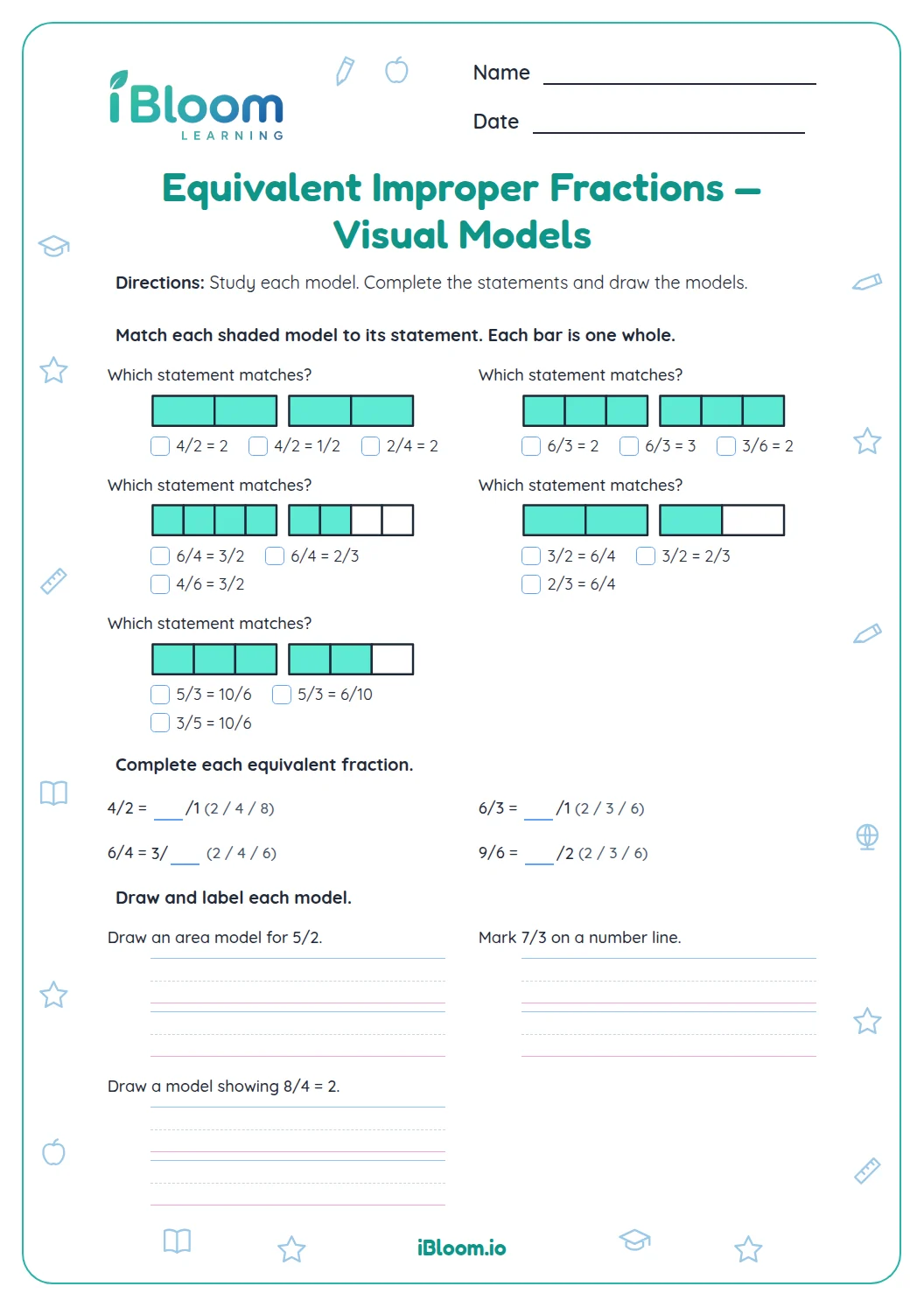
This Grade 4 printable practices writing equivalent fractions by multiplying or dividing the numerator and denominator by the same nonzero factor. Students complete 16 core equations, including four shaded fraction models, then try the printed three-item bonus challenge. A separate answer key lists each missing term. The visual models support the relationship between equal-sized fractional amounts in Common Core 4.NF.A.1.
Aligned to 4.NF.A.1
What makes two fractions equivalent?
Equivalent fractions name the same amount even when the number and size of the parts differ. To make an equivalent fraction, multiply or divide the numerator and denominator by the same nonzero factor. For 1/2 = ___/8, the denominator is multiplied by 4, so multiply the numerator by 4 too.
- 11/2 = ___/8
- 21/2 = 4/8
How do the fraction models help?
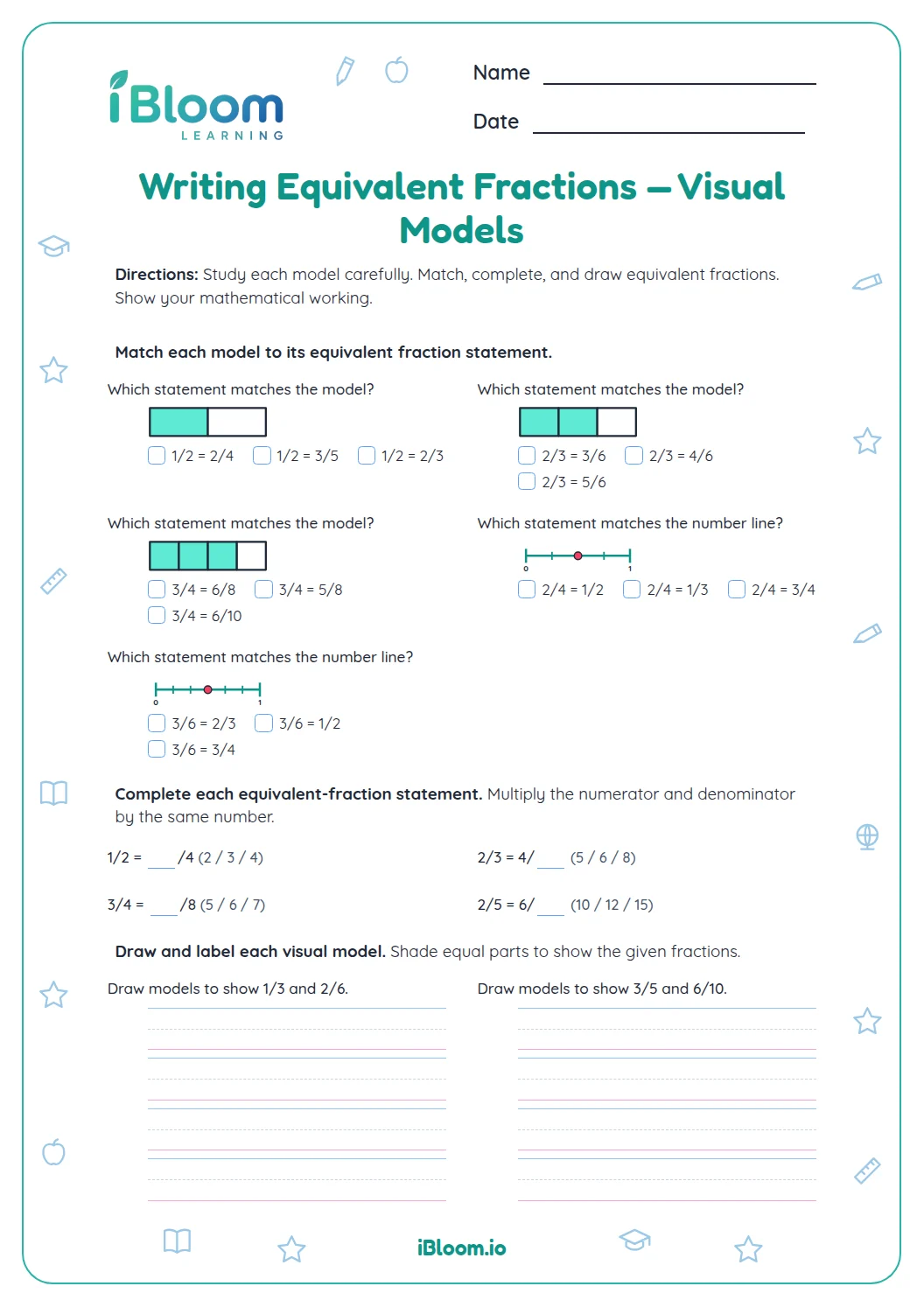
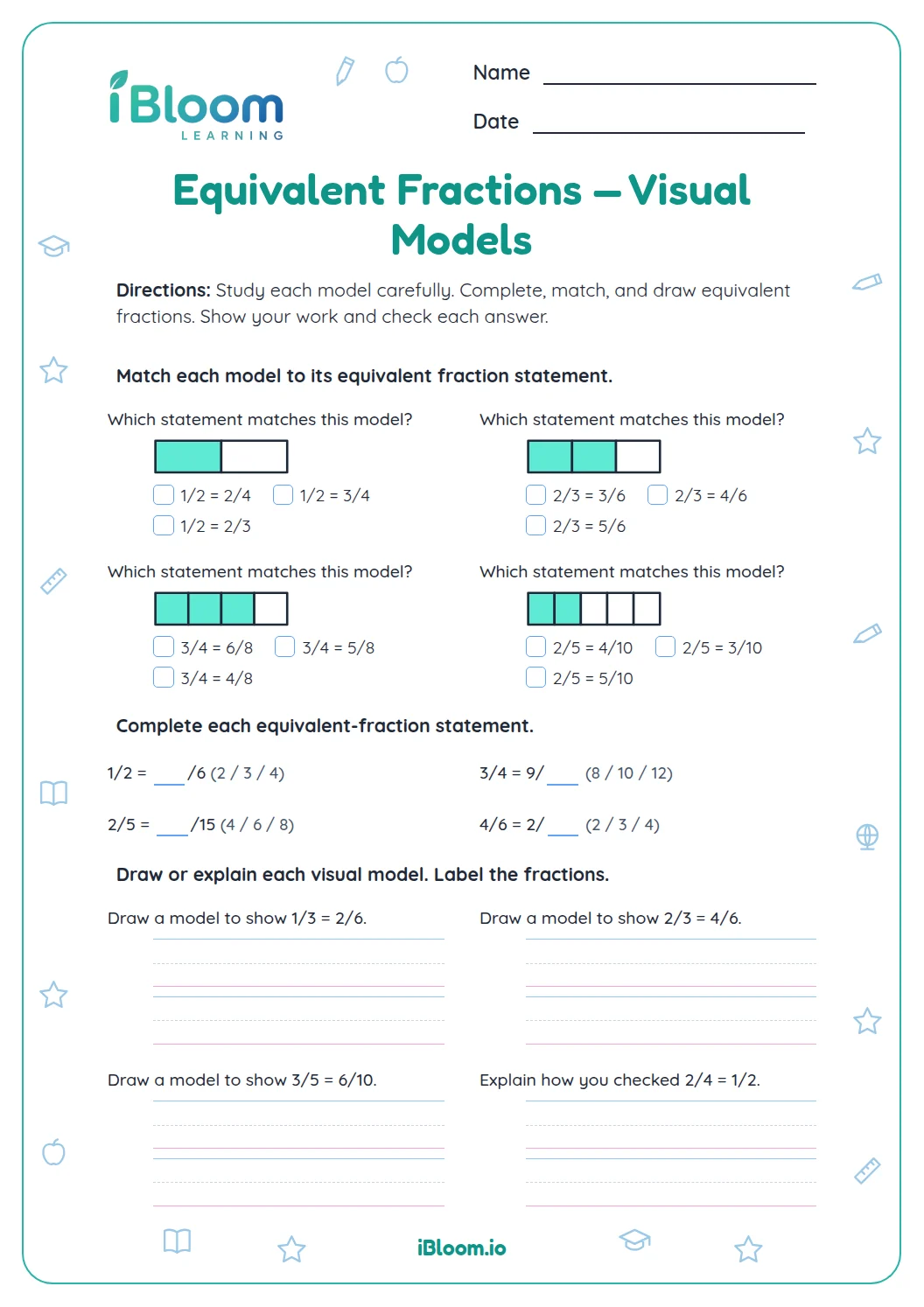
The first four equations include a shaded bar model of the starting fraction. The model shows the amount before it is divided into a different number of equal parts. Use the picture to reason about the equivalent numerator, then confirm that both terms changed by the same factor.
What is included in the 16 equations?
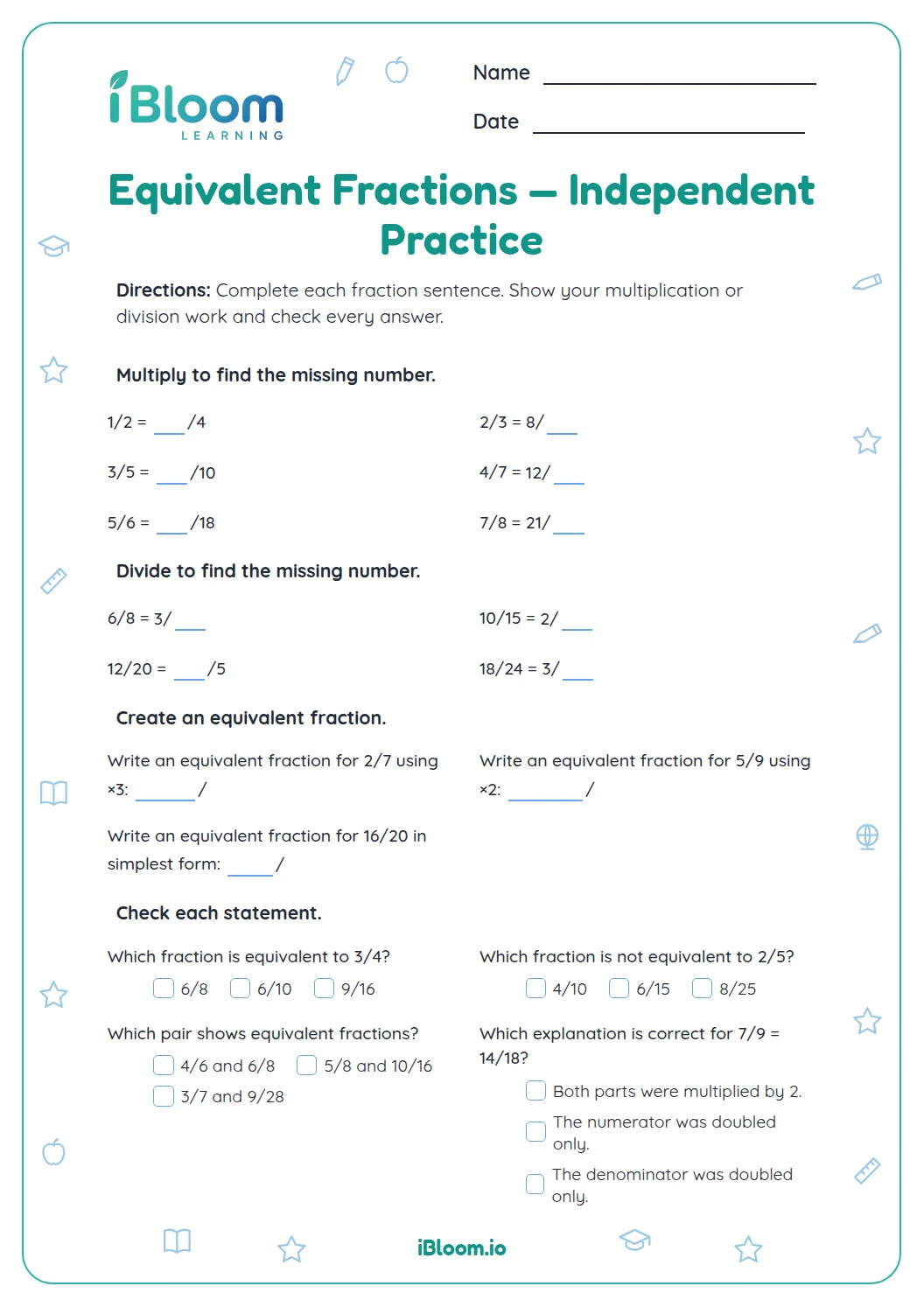
Part A has four numerator blanks paired with models. Part B has four missing denominators. Part C mixes both kinds of blanks for eight more equations. A printed three-item bonus challenge follows the core practice; the answer key includes its values too.
How to use this worksheet
- 1Look at the starting fraction and identify the missing numerator or denominator.
- 2Compare the known denominator or numerator with its matching term.
- 3Find the factor between those terms.
- 4Apply that same factor to the other term; use a division factor when reducing.
- 5Check that the completed fractions name the same amount, then compare with the key.
Common mistakes and quick fixes
The mistake
Changing only the denominator.
The fix
Multiply or divide the numerator by the same factor.
The mistake
Adding the same number to both terms.
The fix
Equivalent fractions are made by multiplying or dividing both terms by one factor.
The mistake
Using zero as a factor.
The fix
Use a nonzero factor so the fraction’s value is preserved.
Common Core alignment
Use fraction models and matching factors to write equivalent fractions.
On this sheet: Four items pair fraction equations with shaded models; all items ask for equivalent fractions.
Show the official wordingHide the official wording
Explain why a fraction a/b is equivalent to a fraction (n × a)/(n × b) by using visual fraction models, with attention to how the number and size of the parts differ even though the two fractions themselves are the same size.
What to practice next
Make more practice
Further reading
Questions parents and teachers ask
How many equivalent-fraction problems are included?
There are 16 core equations in three parts: four numerator blanks with shaded models, four missing denominators, and eight mixed items. A three-question bonus challenge also appears on the printed sheet, with answers in the separate key. Students may check the core work before attempting it.
What is the same-factor rule?
To write an equivalent fraction, multiply or divide the numerator and denominator by the same nonzero factor. For example, 1/2 becomes 4/8 by multiplying both terms by 4. Changing just one term would change the fraction’s value. The shaded models make the change in the number of equal parts visible.
How should students use the shaded models?
Use each bar to see the portion represented by the starting fraction. Then split the same amount into the number of equal parts named by the denominator in the equation. The model supports the calculation; students still need to apply the same factor to both terms.
Can a fraction have more than one equivalent fraction?
Yes. A fraction has many equivalent forms because both terms can be multiplied by the same nonzero number. This worksheet sets one term for each equation so the missing term has a single answer. For example, 1/2 can be written as 2/4, 3/6, or 4/8.
Is an answer key included?
Yes. A separate answer-key page gives the missing terms for all 16 core equations and the three printed challenge items. Students can compare the factor they used with the completed fraction, then check that both terms changed consistently.
Which standard does this worksheet practice?
CCSS 4.NF.A.1 asks students to explain equivalence using visual fraction models and attention to how part size and number change. The first four items pair equations with shaded bars, and all 16 ask students to complete equivalent fractions using matching factors.