



About this worksheet
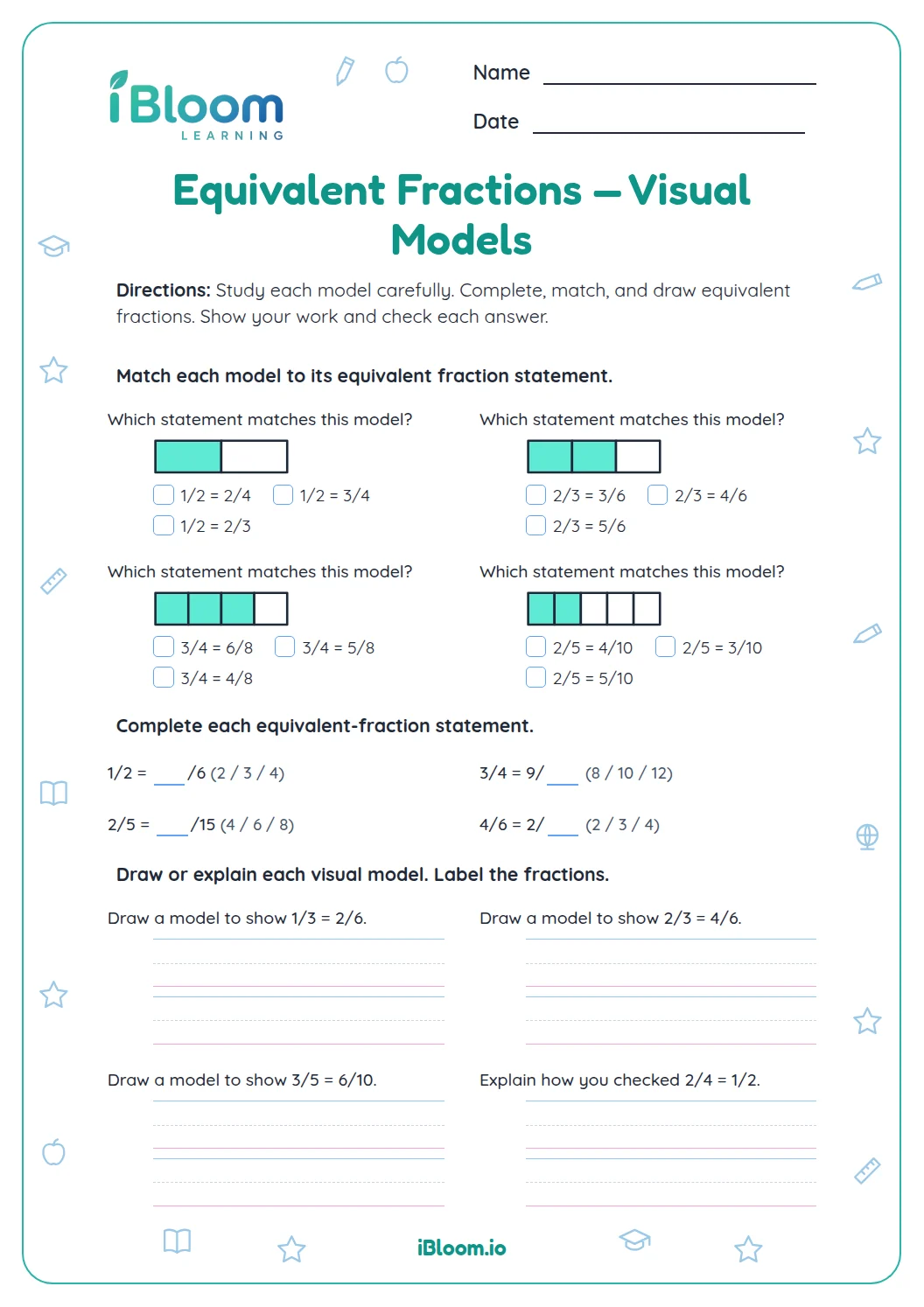
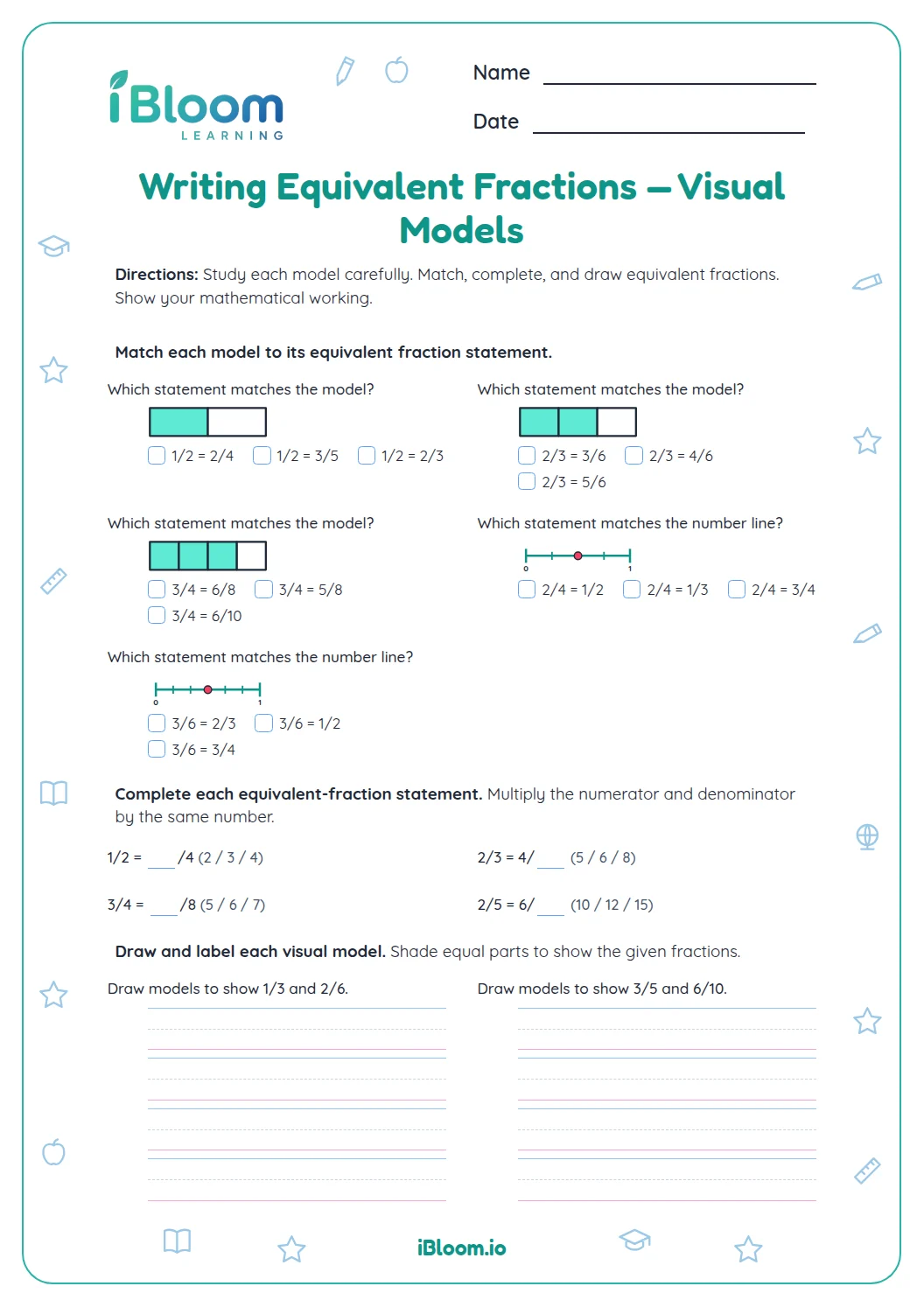
This free printable Grade 4 worksheet uses shaded circle models to make equivalent fractions visible. Part A has four questions about naming shaded amounts. Part B has four questions that ask students to write the same amount with a specified numerator or denominator. Part C has two short explanations about splitting pieces without changing the whole. All ten questions include a circle model. Drawn pieces range from halves to eighths, with equivalent answers reaching eighteenths. The work practices Common Core 4.NF.A.1. A separate answer key gives the fractions and sample reasons.
Aligned to 4.NF.A.1
How do students read a fraction circle?
The denominator counts all equal parts in one whole circle, and the numerator counts the shaded parts. In Part A, students use the pieces as drawn and write a fraction. Question 3 has six equal parts with four shaded, so its answer is 4/6.
Keeping the drawn denominator in Part A makes the visual counting explicit. Part B then asks for a different numerator or denominator, so students rename the amount instead of copying the number of visible pieces.
How can the shaded amount have two fraction names?
Split every equal piece into the same number of smaller pieces. The number of shaded pieces and the total number of pieces both change by that factor. The shaded area itself stays the same.
In question 7, three fourths of a circle is shaded. To name the amount in eighths, split each fourth in two. That gives six shaded eighths out of eight equal parts.
The factors vary across Part B. In question 6, one shaded third must be renamed with numerator 4. Multiply both counts by four to get 4/12. In question 8, multiply the shaded and total counts by three to rename 5/6 as 15/18.
- 1Three of four equal parts are shaded: 3/4.
- 2Split every fourth into two equal pieces.
- 33 × 2 = 6 shaded pieces; 4 × 2 = 8 total pieces.
- 4Write 6/8. The shaded amount stays the same.
What should students explain in the last two questions?
Question 9 asks why 2/3 and 4/6 name the same amount when each third is split in half. A useful explanation mentions the doubled piece count and the unchanged shaded area. Students can describe the splitting without drawing extra lines.
Question 10 presents the claim 1/2 = 1/4. Students explain that splitting each half in two creates two shaded fourths, so the equivalent fraction is 2/4. This checks whether they change both the numerator and denominator.
How to use this worksheet
- 1Name the whole circle, its equal parts and its shaded parts.
- 2Complete Part A using the number of parts actually drawn.
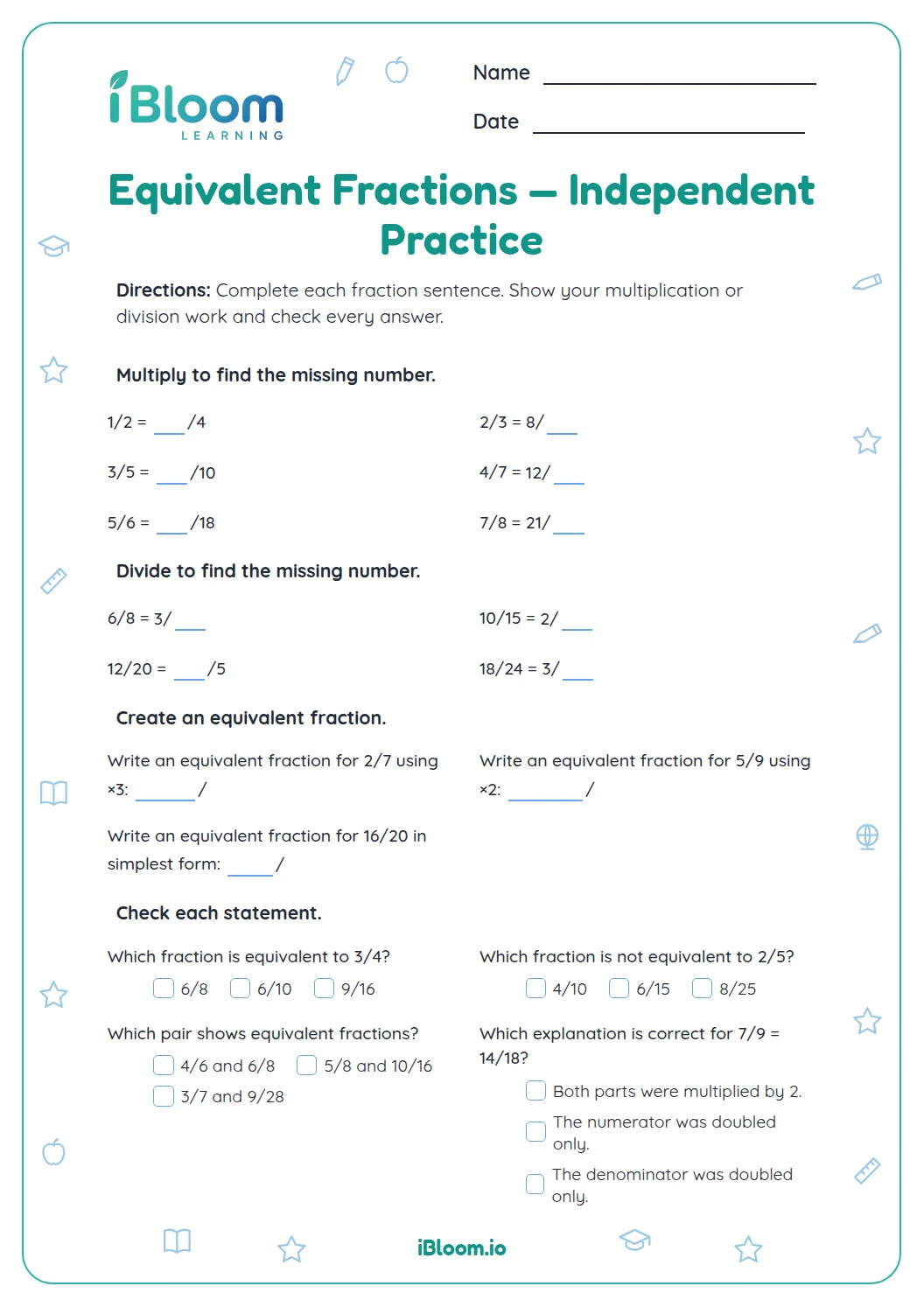
- 3For Part B, find the factor connecting the given numerators or denominators.
- 4Multiply the shaded-piece count by the same factor and write the full fraction.
- 5Explain the splitting in Part C, keeping the whole and shaded amount unchanged.
- 6Check the fractions and compare the explanations with the sample key.
Mistakes to notice and fix
The mistake
Counting only the unshaded pieces for the denominator.
The fix
Count every equal piece in the whole circle, shaded and unshaded.
The mistake
Changing 3/4 to 3/8 by doubling only the denominator.
The fix
Double both counts: each shaded fourth becomes two eighths, so 3/4 = 6/8.
The mistake
Assuming more pieces means more shaded area.
The fix
Describe splitting each existing piece. The pieces become smaller while the same region stays shaded.
Curriculum alignment
Use shaded circle models to generate equivalent fractions and explain unchanged amounts.
On this sheet: Students rename circle fractions using factors of two, three and four, then explain how splitting preserves area.
Show the official wordingHide the official wording
Explain why a fraction a / b is equivalent to a fraction ( n × a )/( n × b ) by using visual fraction models, with attention to how the number and size of the parts differ even though the two fractions themselves are the same size. Use this principle to recognize and generate equivalent fractions.
What to practice next
Make more practice
Further reading
Questions parents and teachers ask
Are these circle models the same as pie charts?
The circles are fraction models divided into equal slices, like a pie cut into equal pieces. Shading marks the amount to name. Students use the models to count parts and write equivalent fractions, so every slice in a given circle has the same size.
Should children simplify the answers in Part A?
Use the denominator shown by the drawn pieces in Part A. For example, the circle with four shaded sixths is recorded as 4/6. That form preserves the link between the drawing and the written fraction before Part B asks students to rename amounts with different denominators.
How does question 6 help students find a new denominator?
Question 6 gives a target numerator of 4 for a circle showing one third. Since 1 × 4 = 4, multiply the denominator by four too: 3 × 4 = 12. Students write the complete fraction, 4/12, to name the same shaded amount.
What is wrong with saying 1/2 equals 1/4?
One fourth is a smaller part of the same whole than one half. Splitting each half into two pieces gives four equal pieces altogether, with two of them shaded. That makes 2/4 equivalent to 1/2, which is the correction students explain in question 10.
Can students add lines to the printed circles?
Yes, students may lightly sketch extra dividing lines to help reason about the requested denominator. Each original piece must be split into the same number of equal pieces. Ask them to keep the original shaded region unchanged and count the smaller shaded pieces before writing the answer.