




About this worksheet
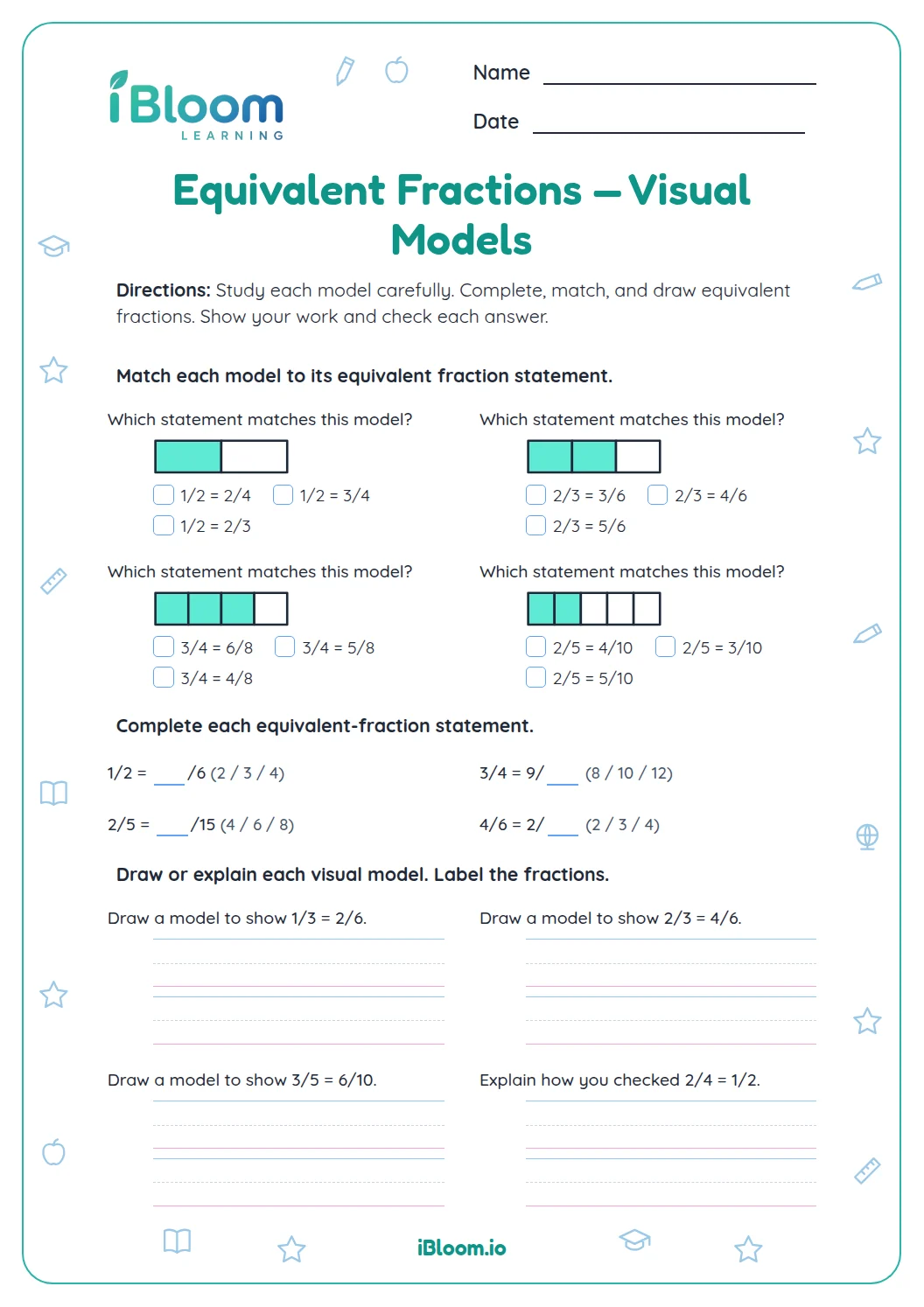
This free printable Grade 4 worksheet practices writing equivalent fractions with pie models and number sentences. Learners read shaded circles, find missing numerators or denominators, and use equal parts in short pie situations. It aligns with Common Core 4.NF.A.1 and includes 16 questions across three parts, plus a separate answer key. The pie drawings replace the old sheet’s pie-chart activity with printable fraction-circle models that the worksheet template can display clearly.
Aligned to 4.NF.A.1
How do the pie slices show the same amount?
Each circle is one whole. Count the equal slices in the whole and the shaded slices to name the fraction. When a model asks for eighths, split each fourth into two smaller slices.
- 13/4 = 6/8
- 2Each fourth becomes two eighths.
How can you find a missing numerator or denominator?
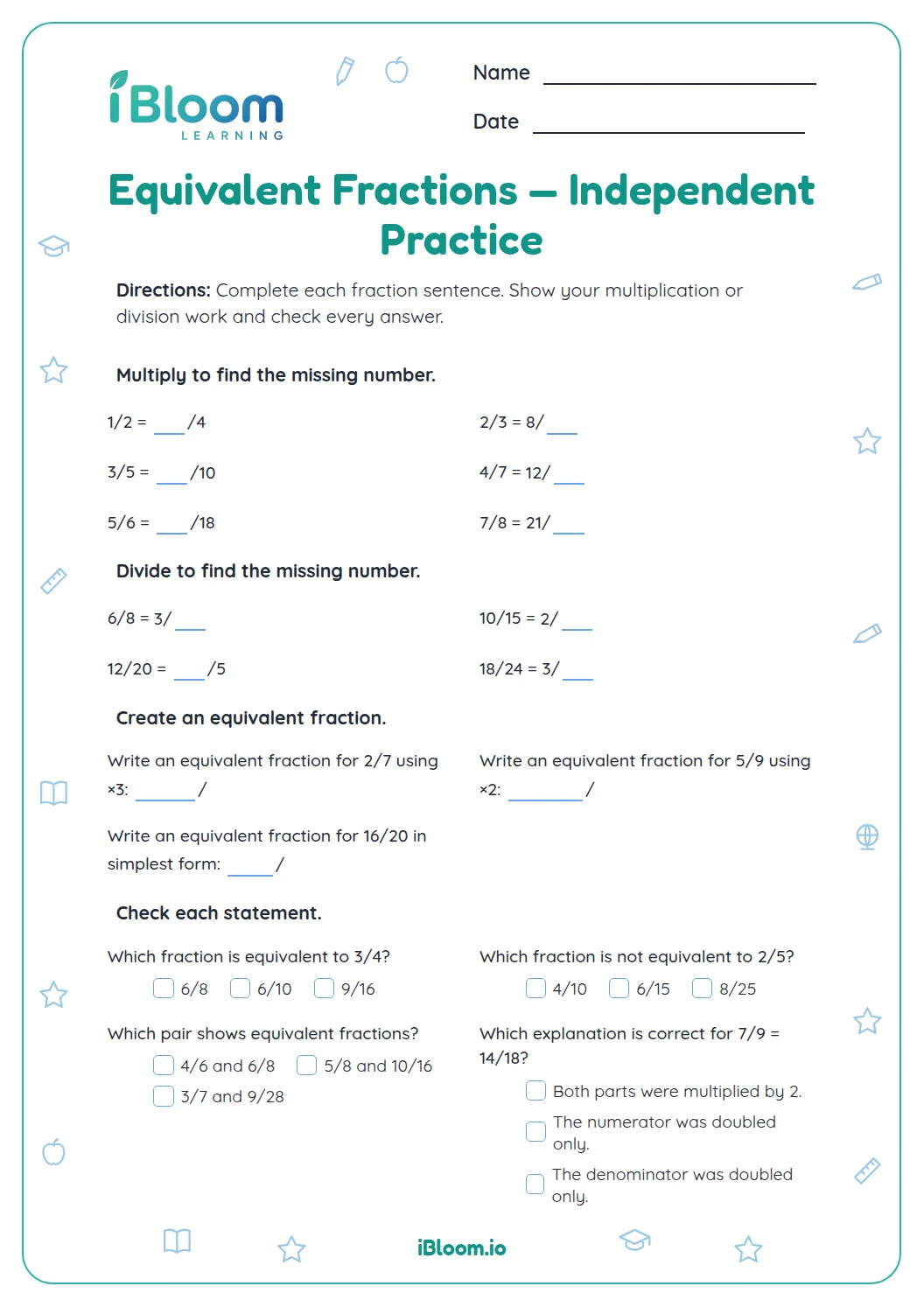
Use the same multiplier on the numerator and denominator. If a numerator is multiplied by 3, the denominator must also be multiplied by 3 so the fraction keeps its value.
How does the skill work in a pie situation?
Name the shaded or selected portion first, then rewrite it with the denominator the question requests. Keep the same whole in mind while counting equal slices.
How to use this worksheet
- 1Count total slices and shaded slices in each model.
- 2Compare the requested denominator with the starting denominator.
- 3Multiply or divide the numerator and denominator by one common factor.
- 4For a story, identify the part of the whole before rewriting it.
- 5Use the separate key to check each response.
Mistakes to catch and correct
The mistake
Changing only the denominator
The fix
Apply the same factor to both numbers; 3/4 = 6/8, not 3/8.
The mistake
Counting unshaded slices
The fix
Count only the shaded slices for the numerator.
The mistake
Treating unequal pieces as equivalent
The fix
Check that every slice in a model has the same size.
Common Core alignment
This worksheet gives focused practice with the skill named in each standard.
Generate equivalent fractions from equal parts in each pie model.
On this sheet: Each pie model and number sentence asks learners to identify or generate an equivalent fraction.
Show the official wordingHide the official wording
Explain why a fraction a/b is equivalent to a fraction (n × a)/(n × b) by using visual fraction models, with attention to how the number and size of the parts differ even though the two fractions themselves are the same size. Use this principle to recognize and generate equivalent fractions.
What to practice next
Make more practice
Further reading
Questions parents and teachers ask
How do I make an equivalent fraction?
Multiply or divide the numerator and denominator by the same nonzero number. For example, 3/4 becomes 6/8 when both numbers are multiplied by 2, so the amount represented stays the same. The pie models on this worksheet help children see why the pieces get smaller as their count increases.
What does the pie model show?
Each circle represents one whole pie split into equal slices, with some slices shaded. Children compare the shaded amount to another number of equal parts and record an equivalent fraction. In Part A, six circle models let learners connect the visual amount to a missing numerator or denominator.
How many questions are included?
There are 16 questions across three parts. Learners read six pie models, complete five equivalent-fraction number sentences, and answer five application questions about equal parts and equivalent fractions. The answer key is separate, so the practice sheet can be used on its own.
What is one example from the worksheet?
Question 1 shows 3/4 shaded and asks for an equivalent fraction with denominator 8. Each fourth is split into two eighths, so the shaded amount becomes 6/8. The key follows the same equal-parts reasoning for all six models.
How long should this worksheet take?
Plan for about 20 minutes, with extra time if a child explains how the slices match. A learner can complete the model questions first, then use the same multiply-or-divide rule in the number sentences and pie situations. Check the separate key after the learner tries each item.
Does this page include an answer key?
Yes. A separate key gives the missing numbers and equivalent fractions for all 16 questions. For written responses, ask the child to point out which equal-sized portions represent the same amount before checking the numerical answer together. Then revisit any item that needs another look.