






About this worksheet
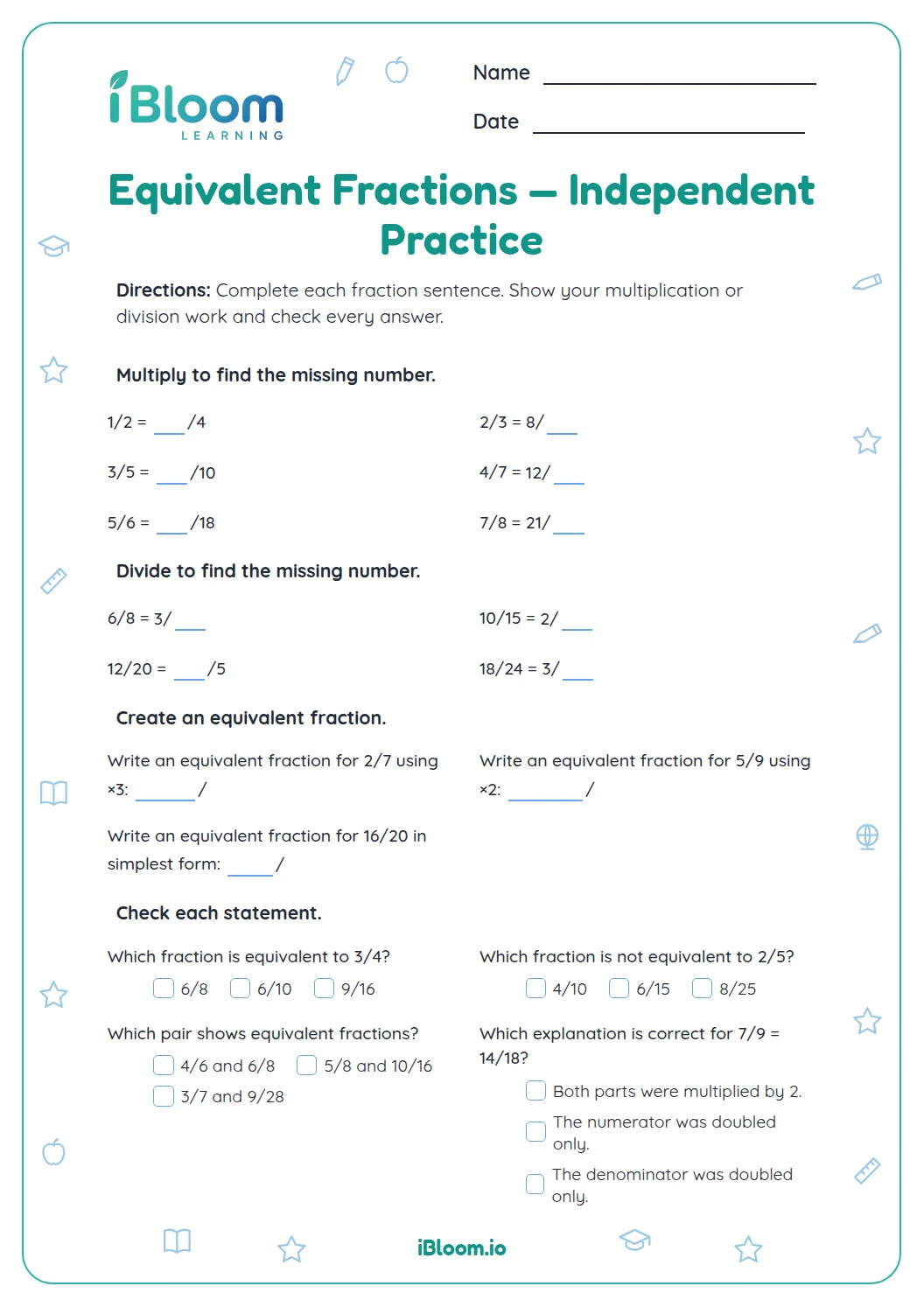
The worksheet gives 16 concise equivalent-fraction questions, moving from multiplying both parts to simplifying a fraction. Use the short number sentences for independent practice, then check the separate key.
Aligned to 4.NF.A.1
What practice is included?
Sixteen number sentences ask students to generate or simplify equivalent fractions. The sequence starts with familiar halves and thirds, then uses fifths, sixths, eighths, ninths, tenths, and twelfths.
How can a fraction be renamed?
Multiply or divide the numerator and denominator by the same nonzero number to make an equivalent fraction. For example, 3/4 becomes 6/8 when both parts are multiplied by 2.
How to solve the fraction questions
- 1Name the whole or unit in the situation.
- 2For a missing numerator, keep the denominator and multiply the numerator by the same factor.
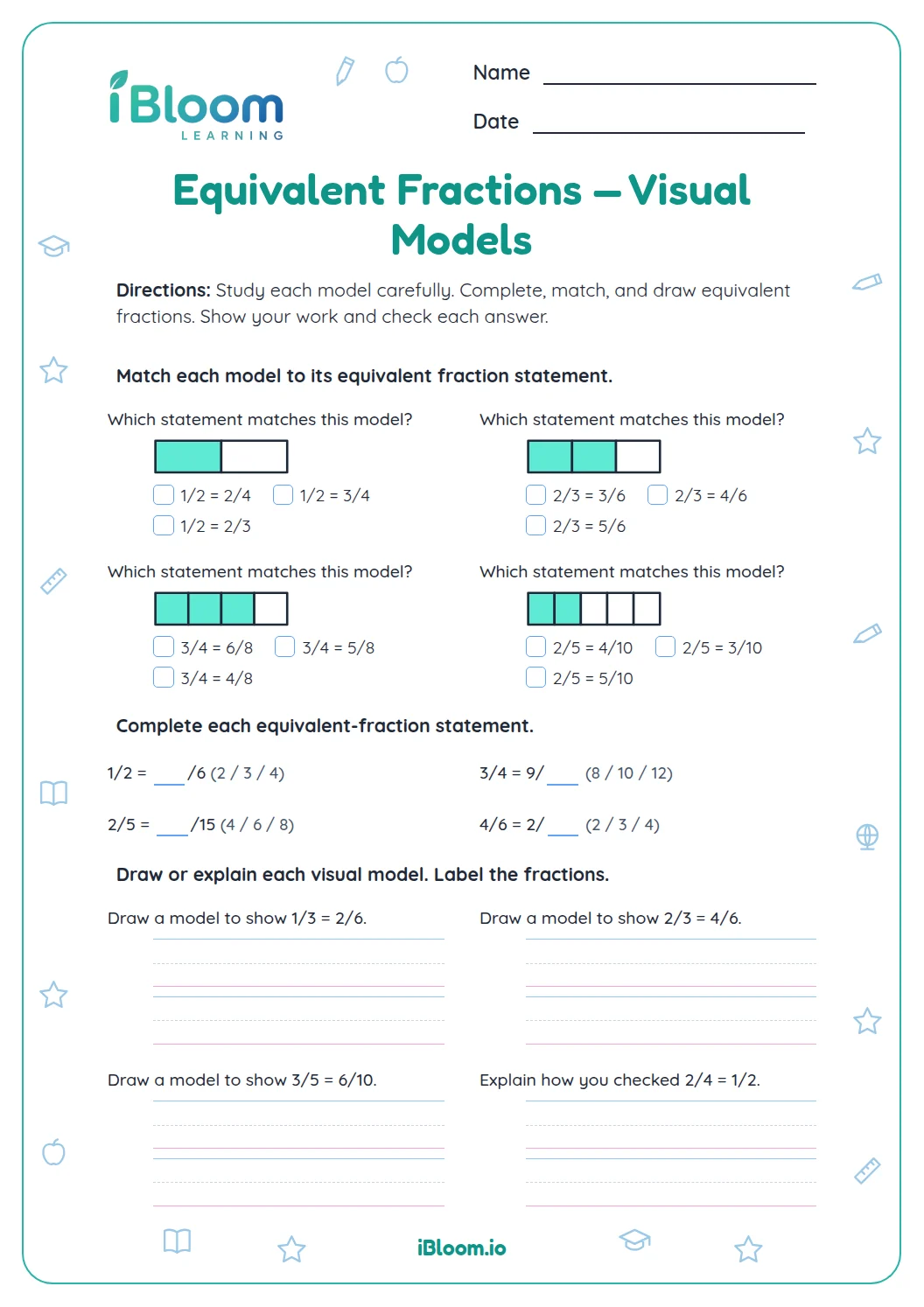
- 3Use the fraction drawing to compare shaded amounts.
- 4In a story problem, convert the fraction without changing the whole.
- 5Check an equivalence claim by using a model or simplifying both fractions.
- 6Write only what belongs in each blank and include units when the prompt asks for a quantity.
Common mistakes and quick fixes
The mistake
Changing the numerator but leaving the denominator unchanged.
The fix
Multiply or divide both parts by the same number.
The mistake
Thinking 4/8 is larger than 1/2 because 8 is larger than 2.
The fix
Compare the shaded amount in equal-sized models; the names can differ while the amount stays the same.
The mistake
Comparing fractions that describe different wholes.
The fix
Check that both fractions refer to the same cup, length, or whole before deciding they are equivalent.
Curriculum alignment
Visual models and contextual questions ask students to recognize and generate equivalent fractions.
Explain and generate equivalent fractions.
On this sheet: Students generate equivalent fractions and explain that the fractions name the same amount in real contexts.
Show the official wordingHide the official wording
Explain why a fraction a/b is equivalent to a fraction (n × a)/(n × b) by using visual fraction models, with attention to how the number and size of the parts differ even though the two fractions themselves are the same size; use this principle to recognize and generate equivalent fractions.
What to practice next
Make more practice
Further reading
Questions parents and teachers ask
What makes two fractions equivalent?
Two fractions are equivalent when they represent the same amount of the same whole. Their numerators and denominators may be different because the whole is divided into a different number of equal parts. A fraction model makes the shared amount easy to compare.
How can I find an equivalent fraction?
Multiply or divide the numerator and denominator by the same nonzero number. For example, multiplying both parts of 3/4 by 2 gives 6/8. The two fractions name the same amount even though the pieces in eighths are smaller.
Why does the worksheet include fraction drawings?
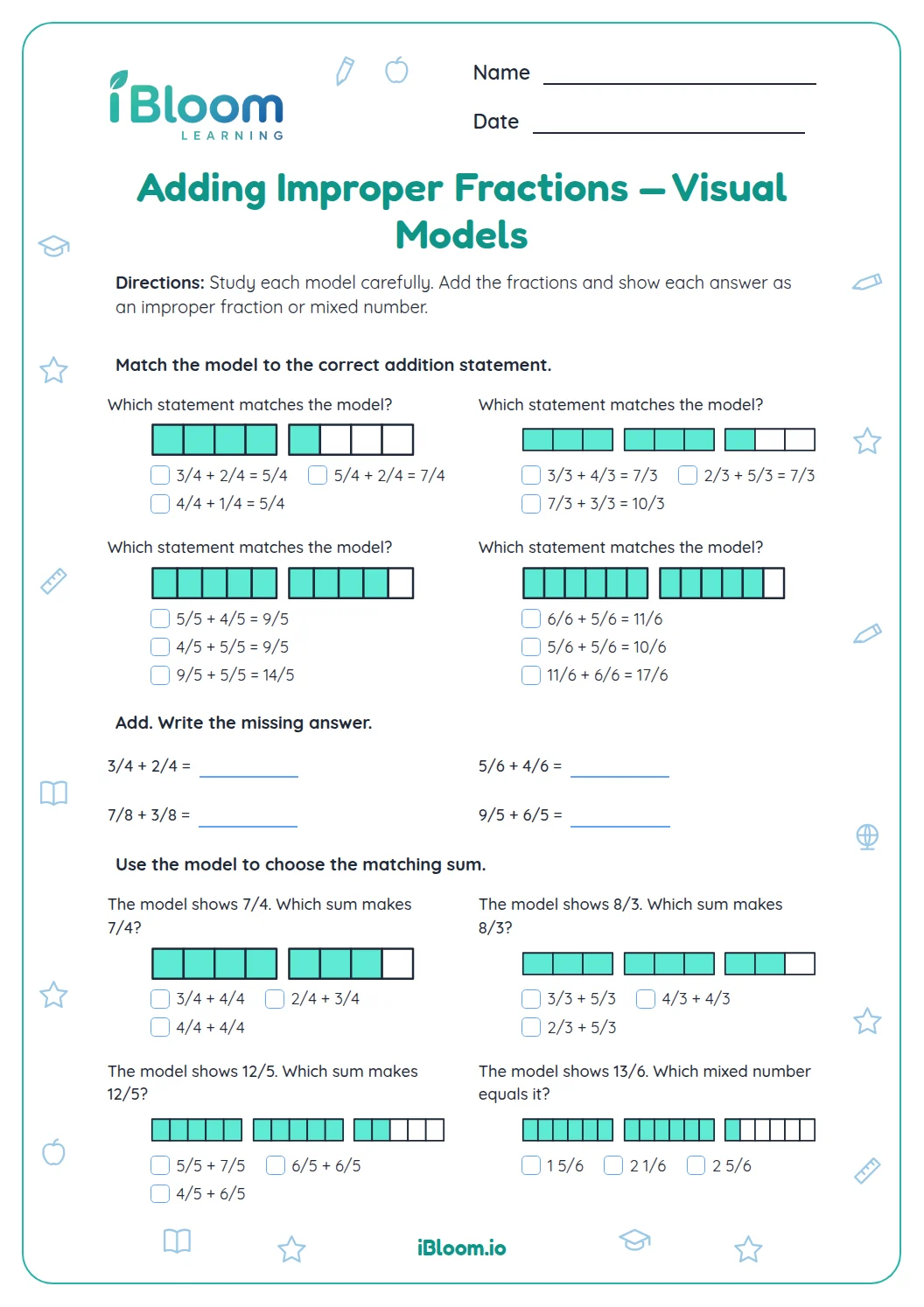
A fraction drawing keeps the whole visible while showing how its equal parts can be renamed. In this worksheet, bars and a square help compare shaded amounts, and the matching questions ask students to use the same idea without relying only on a picture.
What should a student do with the missing numerators?
Find the factor that changes the first denominator into the second one, then multiply the numerator by that same factor. For 1/2 = __/4, the denominator doubles, so the numerator doubles too. This keeps the fraction equal to the original amount.
How can a student check whether two fractions are equal?
Use a model or simplify both fractions and compare the amounts. For example, 2/4 simplifies to 1/2, so they are equivalent. Check that both fractions refer to the same whole; matching numerators alone does not prove equivalence. Students can also multiply across to confirm the relationship.