Free printable practice
Area Perimeter Grid Practice Activities
Grade 4 geometry worksheets for practising area and perimeter on square grids using counting, multiplication, and careful boundary tracing.
Free printable worksheet PDFs
Preview every available page, then download the free worksheet PDF for home, homeschool, tutoring, or classroom practice.
Preview the exact activity before downloading it.
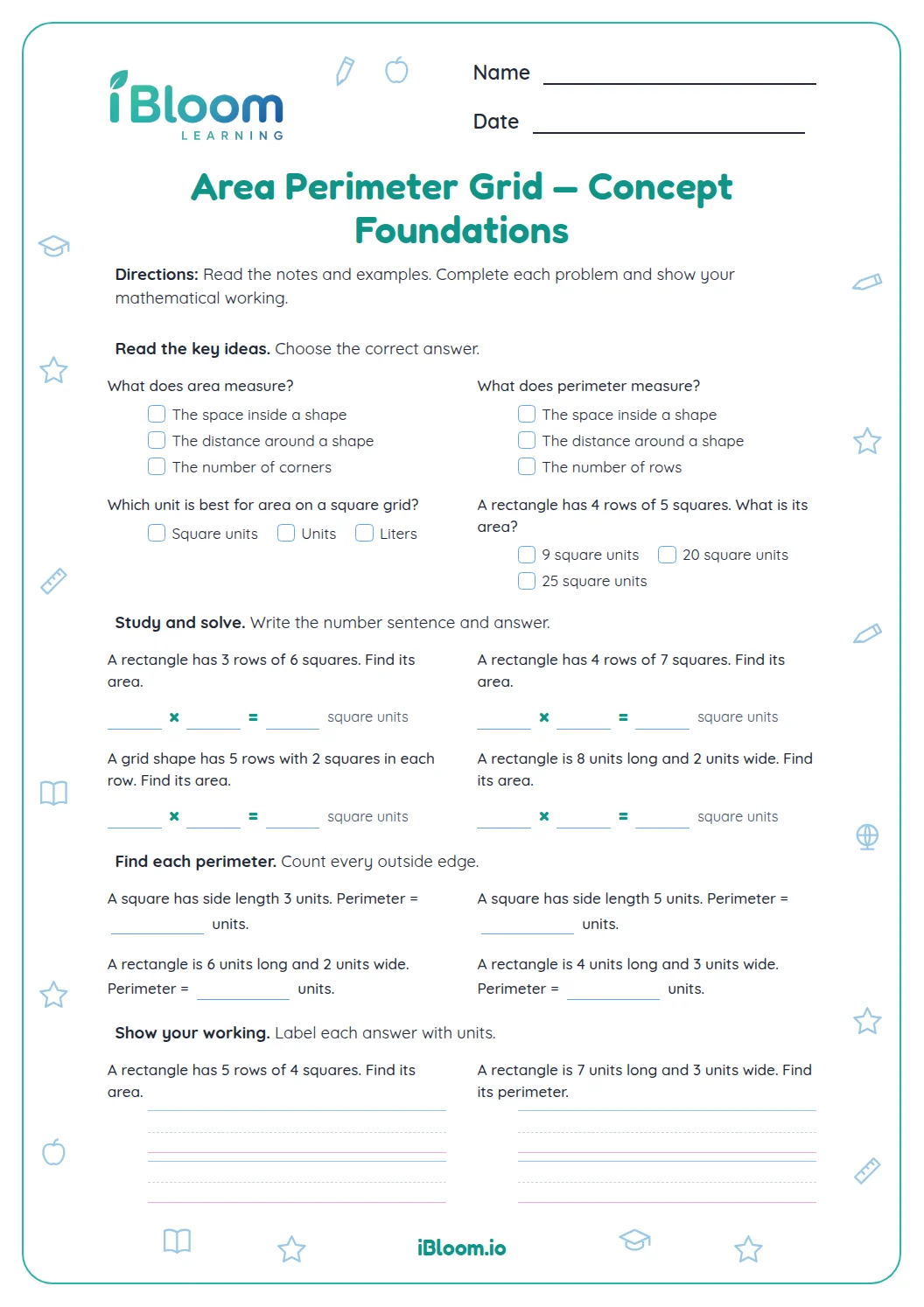 Area Perimeter Grid — Concept FoundationsGrade 4 geometry worksheets for practising area and perimeter on square grids using counting, multiplication, and careful boundary tracing. This Grade 4 foundations worksheet adds concise teaching notes, worked examples, and supported first attempts.Grade 4Free PDF preview4 pages
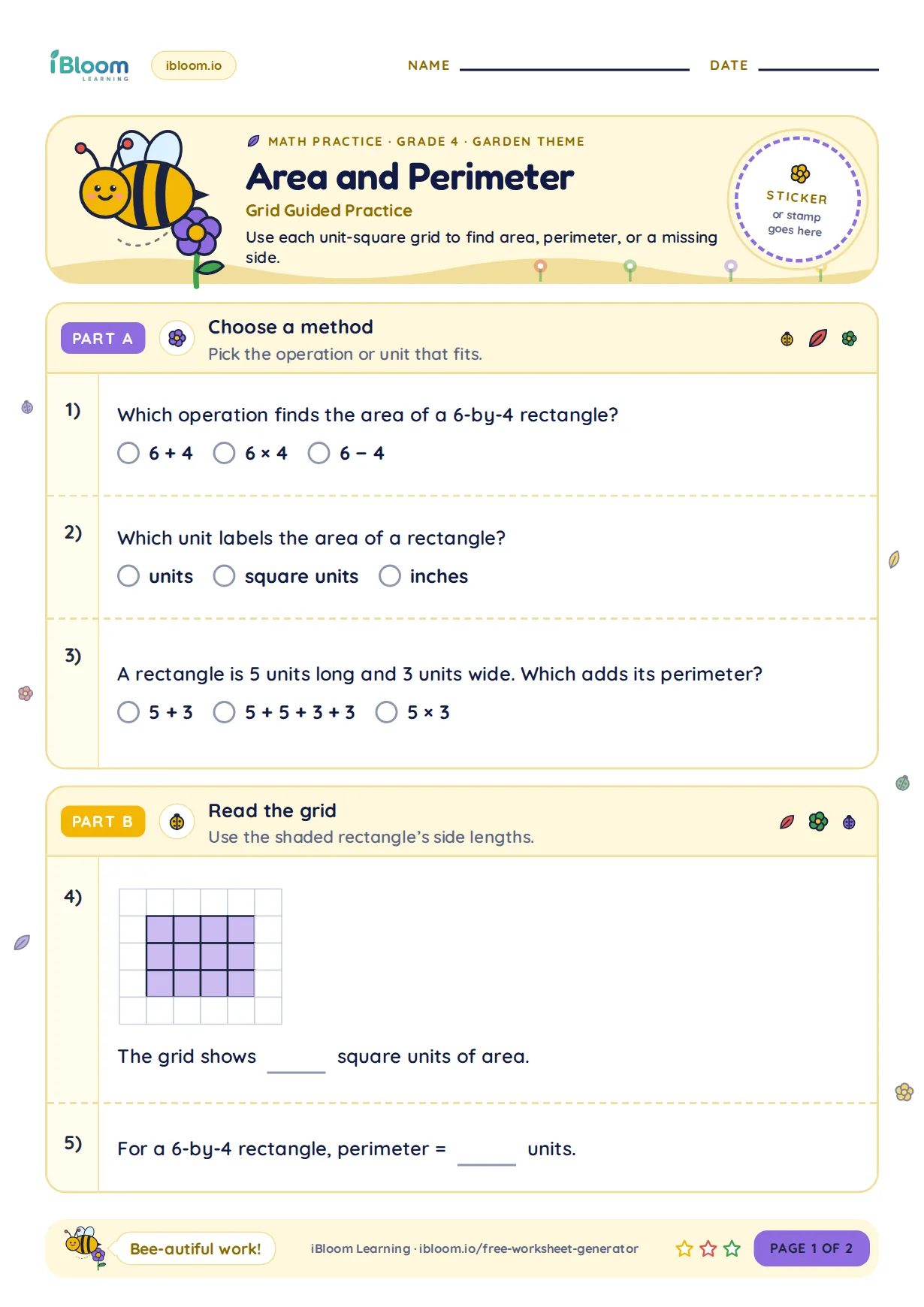 Area Perimeter Grid — Guided PracticeGrade 4 geometry worksheets for practising area and perimeter on square grids using counting, multiplication, and careful boundary tracing. This Grade 4 guided-practice worksheet progresses from prompts and checkpoints to independent questions.Grade 4Free PDF preview4 pages
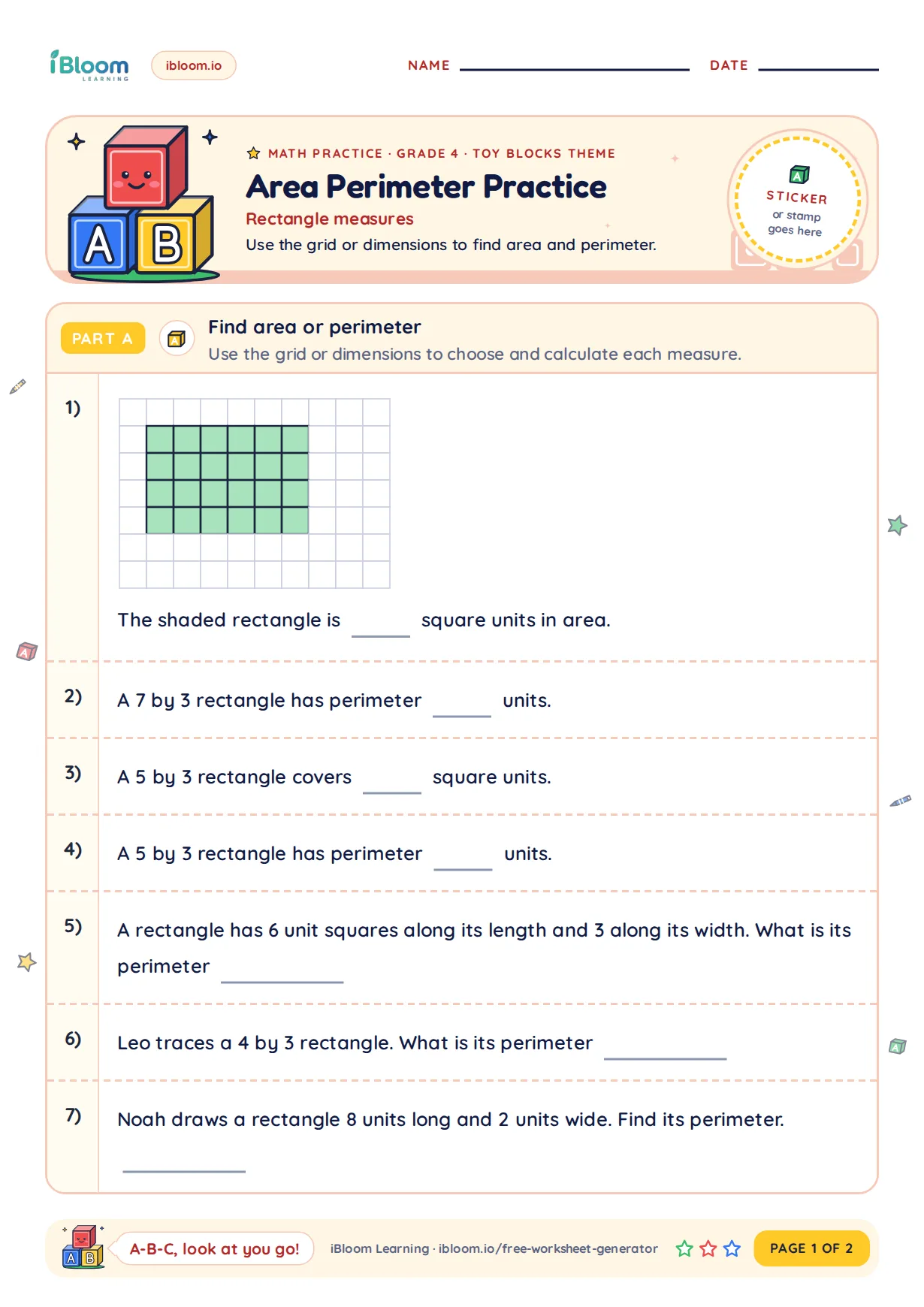 Area Perimeter Grid — Visual ModelsGrade 4 geometry worksheets for practising area and perimeter on square grids using counting, multiplication, and careful boundary tracing. This Grade 4 visual-model worksheet connects suitable diagrams, tables, number lines, or place-value models to mathematical notation.Grade 4Free PDF preview
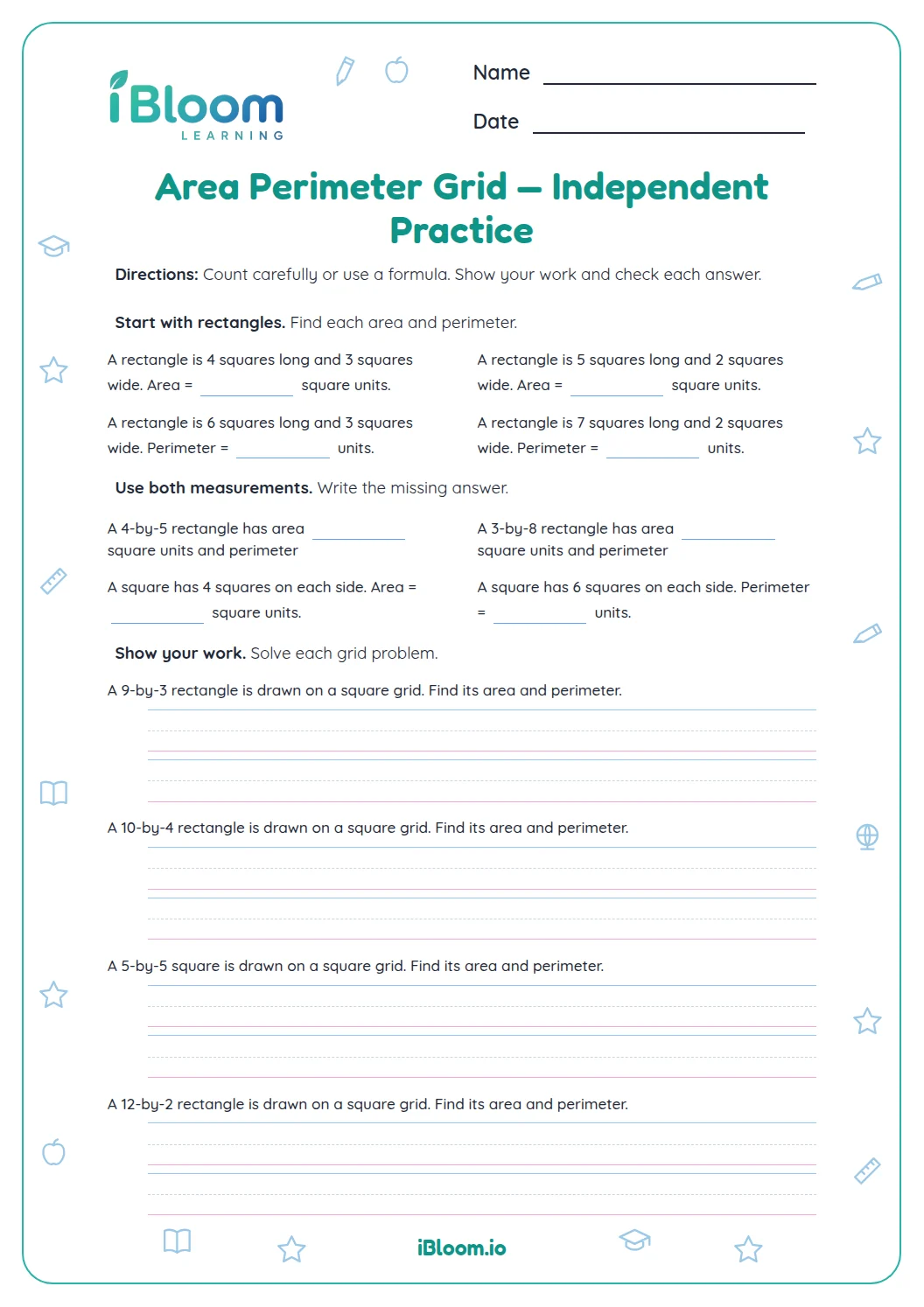 Area Perimeter Grid — Independent PracticeGrade 4 geometry worksheets for practising area and perimeter on square grids using counting, multiplication, and careful boundary tracing. This Grade 4 independent-practice worksheet provides a balanced sequence of accurate, grade-level exercises.Grade 4Free PDF preview4 pages
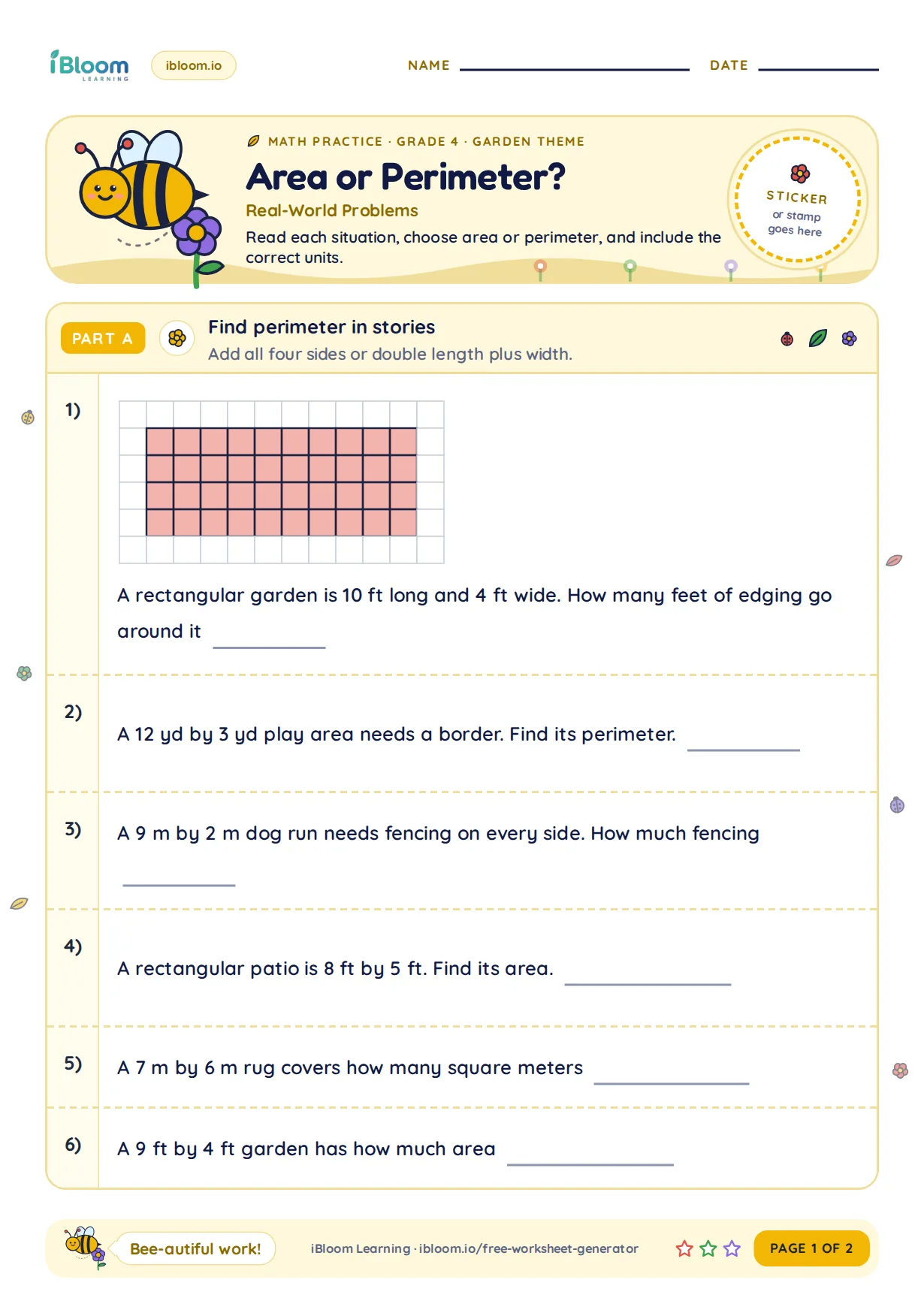 Area Perimeter Grid — Real-World ProblemsGrade 4 geometry worksheets for practising area and perimeter on square grids using counting, multiplication, and careful boundary tracing. This Grade 4 application worksheet uses realistic one-step and multi-step situations with room to model and solve.Grade 4Free PDF preview
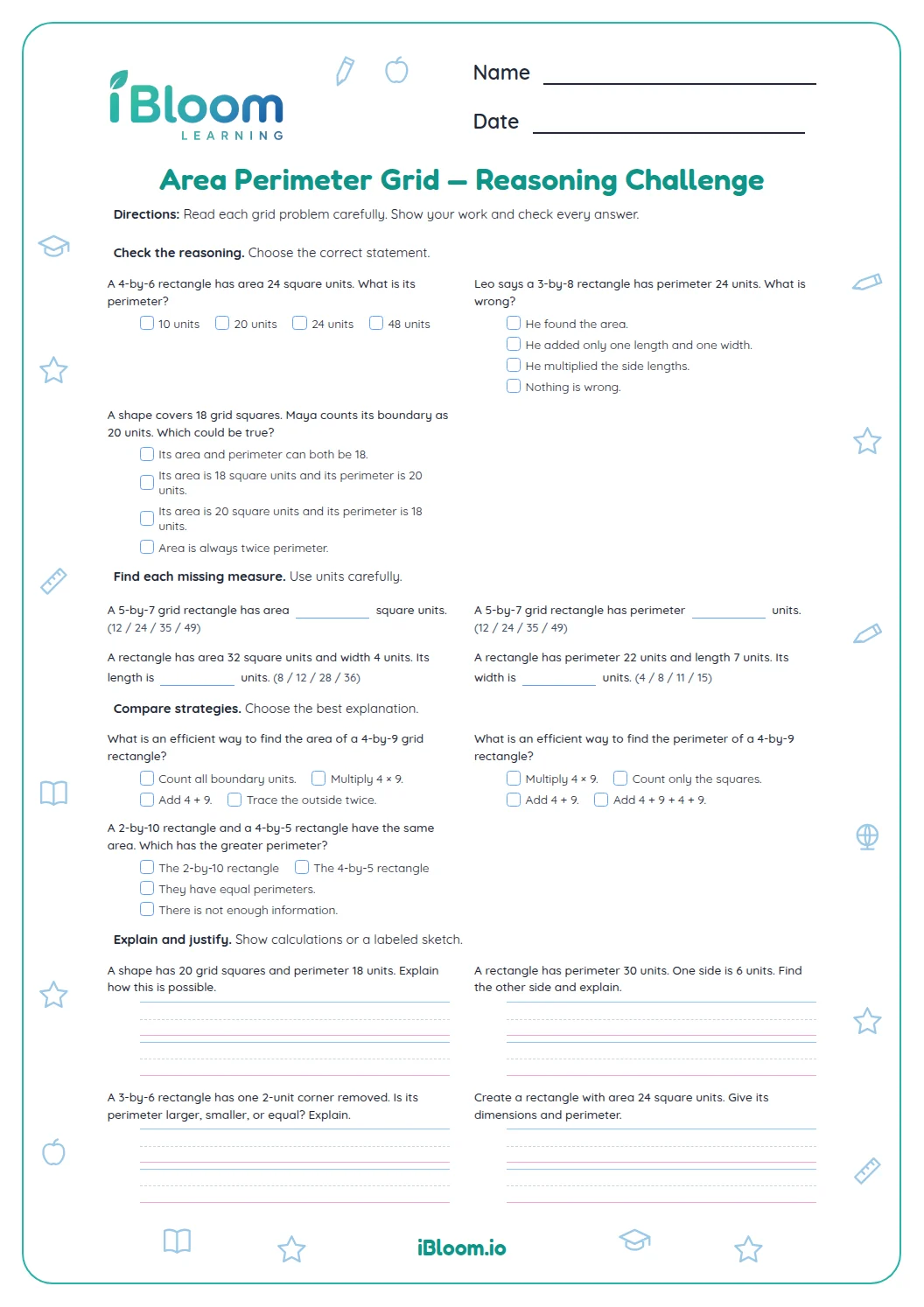 Area Perimeter Grid — Reasoning ChallengeGrade 4 geometry worksheets for practising area and perimeter on square grids using counting, multiplication, and careful boundary tracing. This Grade 4 reasoning worksheet combines error analysis, strategy comparison, missing information, and a gentle extension.Grade 4Free PDF preview
Practice that builds confidence
From counting squares to formulas
These Grade 4 math worksheets help children practise finding area and perimeter on square grids. Students count square units, follow the outside edge of shapes, compare figures, and connect grid models to the formulas for rectangles.
The printable activities include grid-based shapes with whole-number side lengths, missing measurements, and mixed questions where children must decide whether to calculate area or perimeter. They are designed for the Geometry > Area Perimeter Grid skill path.
Grid practice gives Grade 4 learners a visual bridge between concrete counting and efficient calculation. A rectangle that covers 4 rows of 6 squares can be counted as 24 square units, then recorded as length × width. For perimeter, children trace the boundary and add the side lengths, noticing that only the outside edge counts.

What students work through
The worksheets move from clearly drawn rectangles to irregular grid shapes and comparison tasks. Children may find the area by counting unit squares, multiply rows and columns when the figure is rectangular, or add exposed sides for perimeter. Mixed problems are important because the same drawing can have two different answers: area tells how much space is covered, while perimeter tells the distance around.
Parent routine for steady practice
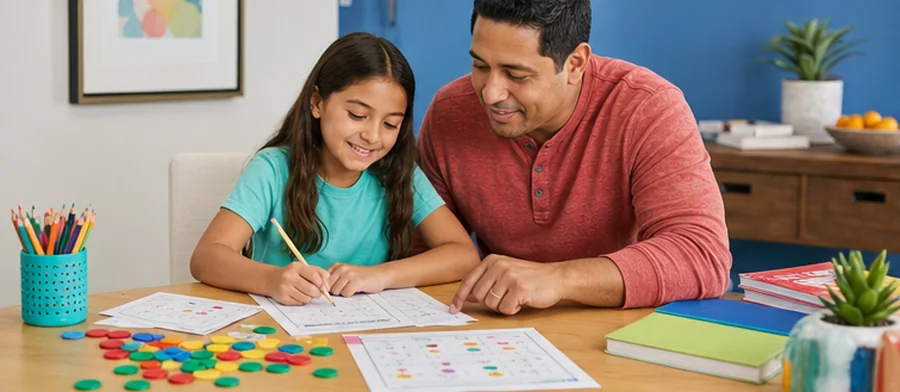
At home, start with one shape and ask your child to color the inside lightly before counting area. Then have them run a finger around the outside edge for perimeter. Ask two quick questions: What unit should the answer use? and Did you count inside squares or outside sides? This simple routine helps prevent mixing up square units and linear units.
Classroom uses for teachers
Teachers can use these pages for geometry centers, small-group reteaching, morning review, or exit tickets after a lesson on area and perimeter. Pairing students works well: one student explains the strategy while the other checks the grid. The sheets also support math talk using words such as unit square, side length, boundary, row, column, rectangle, area, and perimeter.

Common errors to watch for
Many students count the squares around the edge and call that perimeter, or add every grid line inside a shape. Others write the correct number but use the wrong unit label. Irregular shapes can cause skipped corners or double-counted sides. Encourage children to mark counted sides with small ticks and to label area answers as square units.
Free printable PDF download
Use this grade 4 area perimeter grid worksheet page to preview the activity, print it, or download it as a PDF for quick practice. It works well for homework, homeschool lessons, tutoring, morning work, revision, and classroom centers.
Answers and answer key support
After the child completes the worksheet independently, parents and teachers can use the answer support or answer key information to check the work, review mistakes, and choose the next practice step.
Why iBloom worksheets help
iBloom worksheets keep the focus on one Grade 4 geometry skill while varying the representation enough to build flexible thinking. The grids make errors visible, and the progression helps children move from counting to reasoning. A child-friendly strategy is: shade the space for area, trace the fence for perimeter, then check the unit.
Helpful answers
Frequently asked questions
What does area mean on a grid?
Area is the amount of space a shape covers. On these worksheets, students usually find it by counting unit squares or multiplying rows by columns for rectangles.
How should my child find perimeter on a grid shape?
They should trace only the outside boundary of the shape and count or add those outside side lengths. Interior grid lines are not part of the perimeter.
Why are area answers written in square units?
Area counts the number of unit squares covering a shape, so the unit is square units. Perimeter measures distance around the shape, so it uses regular units.
Are these worksheets only for rectangles?
No. Rectangles help students connect grids to multiplication, but the practice can also include irregular grid shapes where careful counting and boundary tracing are needed.
What is a common mistake in Grade 4 area and perimeter work?
A common mistake is using the area method for a perimeter question, such as counting inside squares instead of the outside edge. Reading the question and labeling units helps catch this.
Is this grade 4 area perimeter grid worksheet free?
Yes. You can preview it for free and use the printable worksheet for home or classroom practice.
Can I download this grade 4 area perimeter grid worksheet as a PDF?
Yes. Use the worksheet download option to save a printable PDF, or print the worksheet directly from the page.
Does this grade 4 area perimeter grid worksheet include answers or an answer key?
When the activity has fixed answers, iBloom includes answer support so parents and teachers can check the completed worksheet.