
About this worksheet
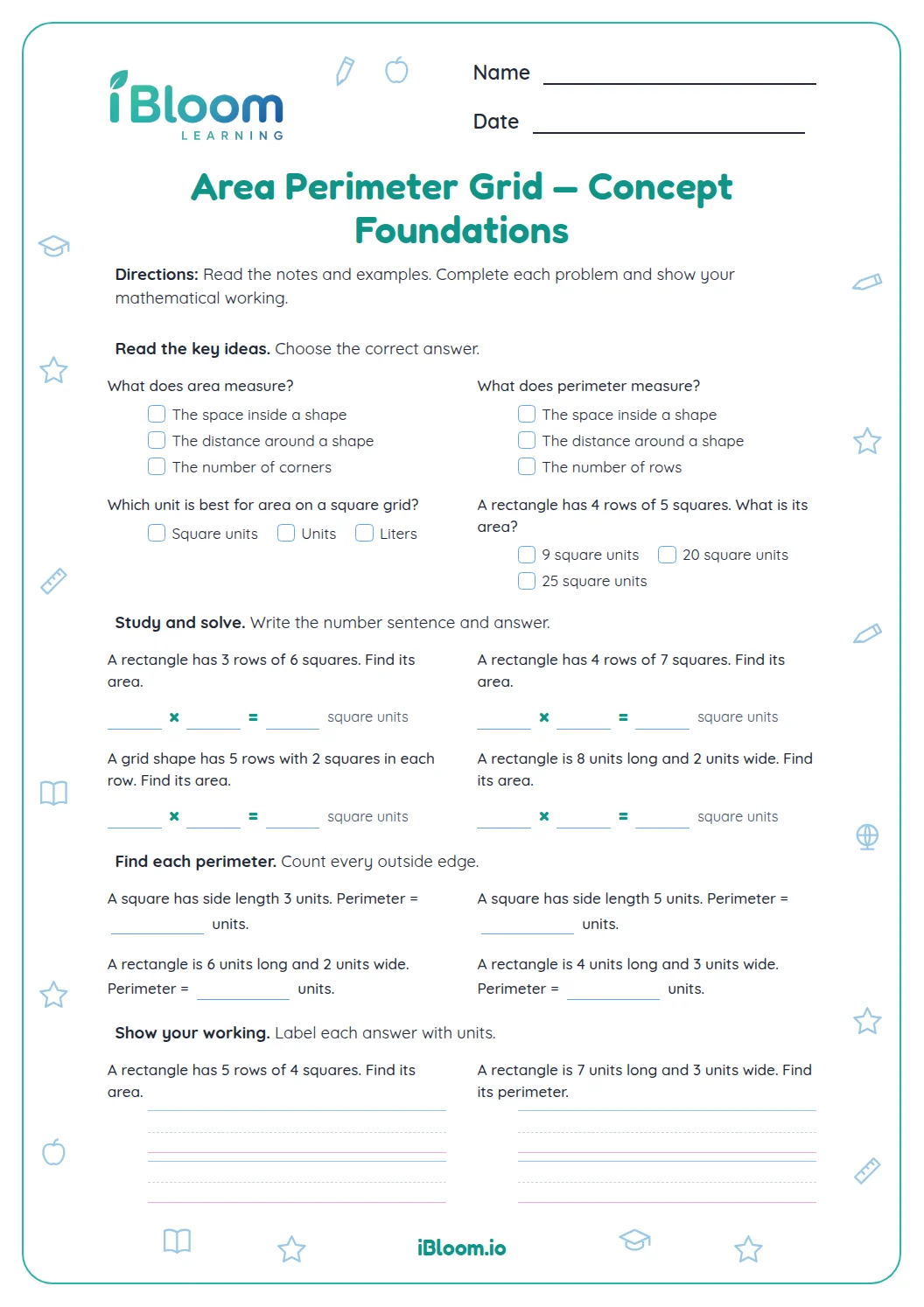
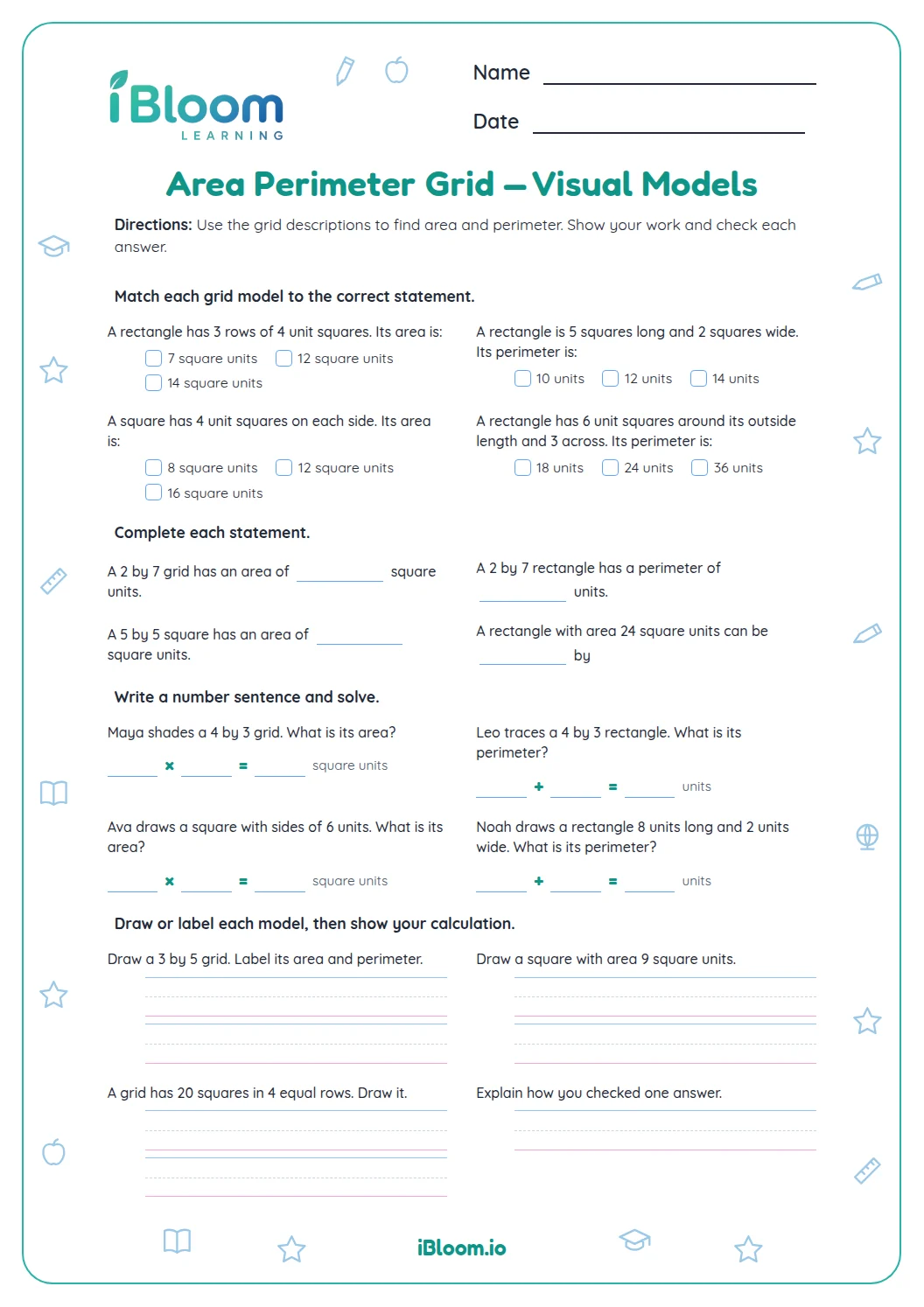
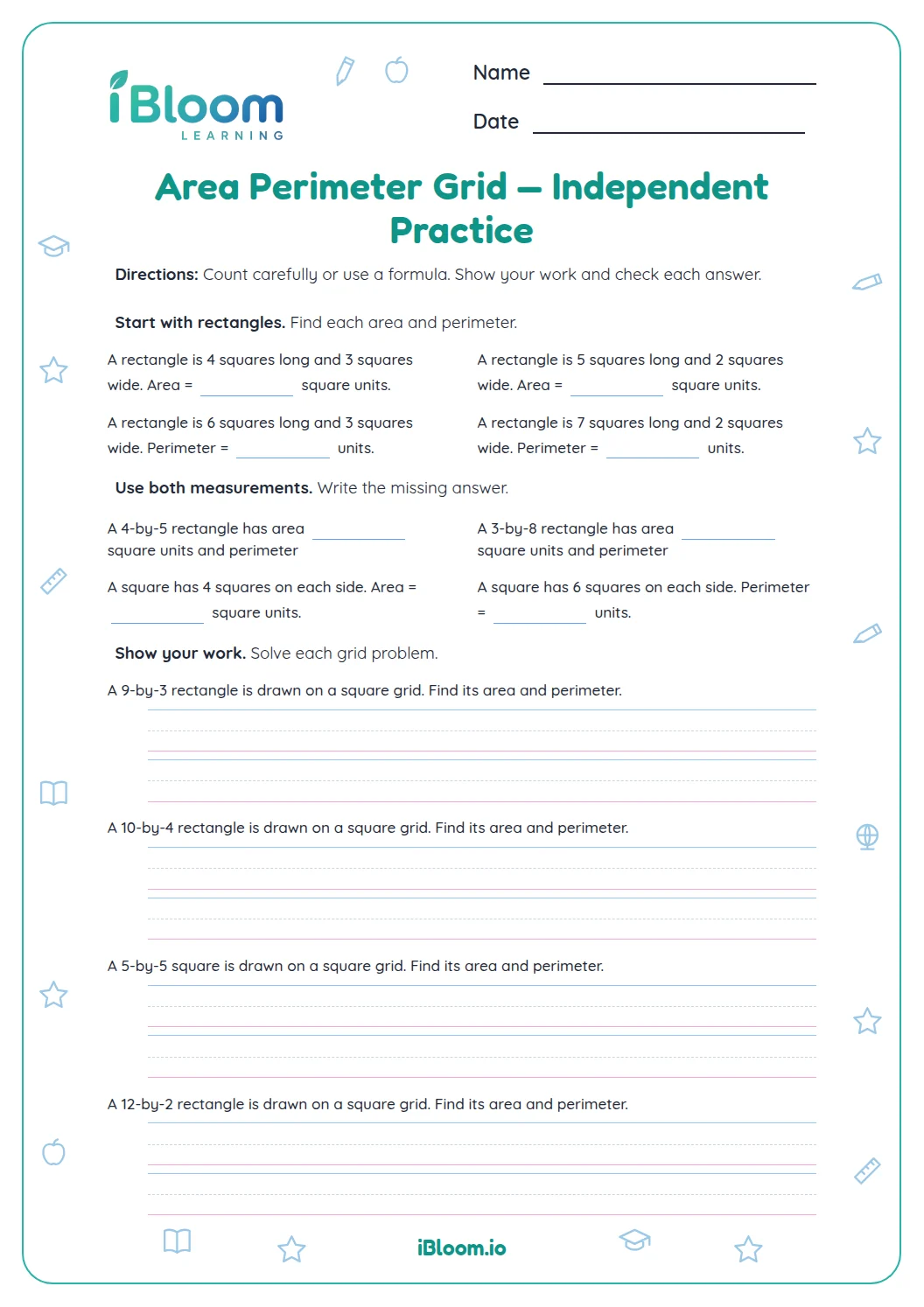
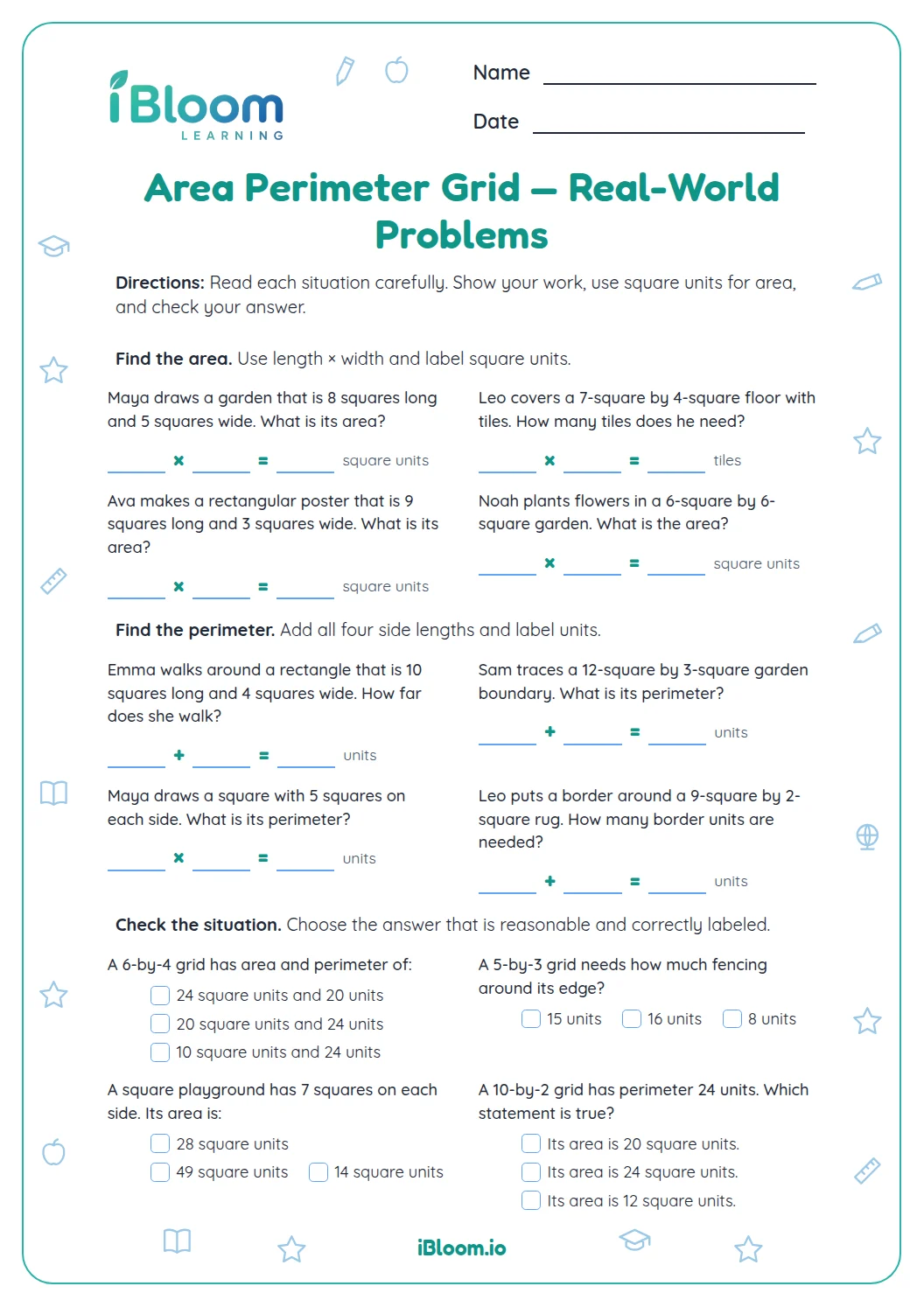
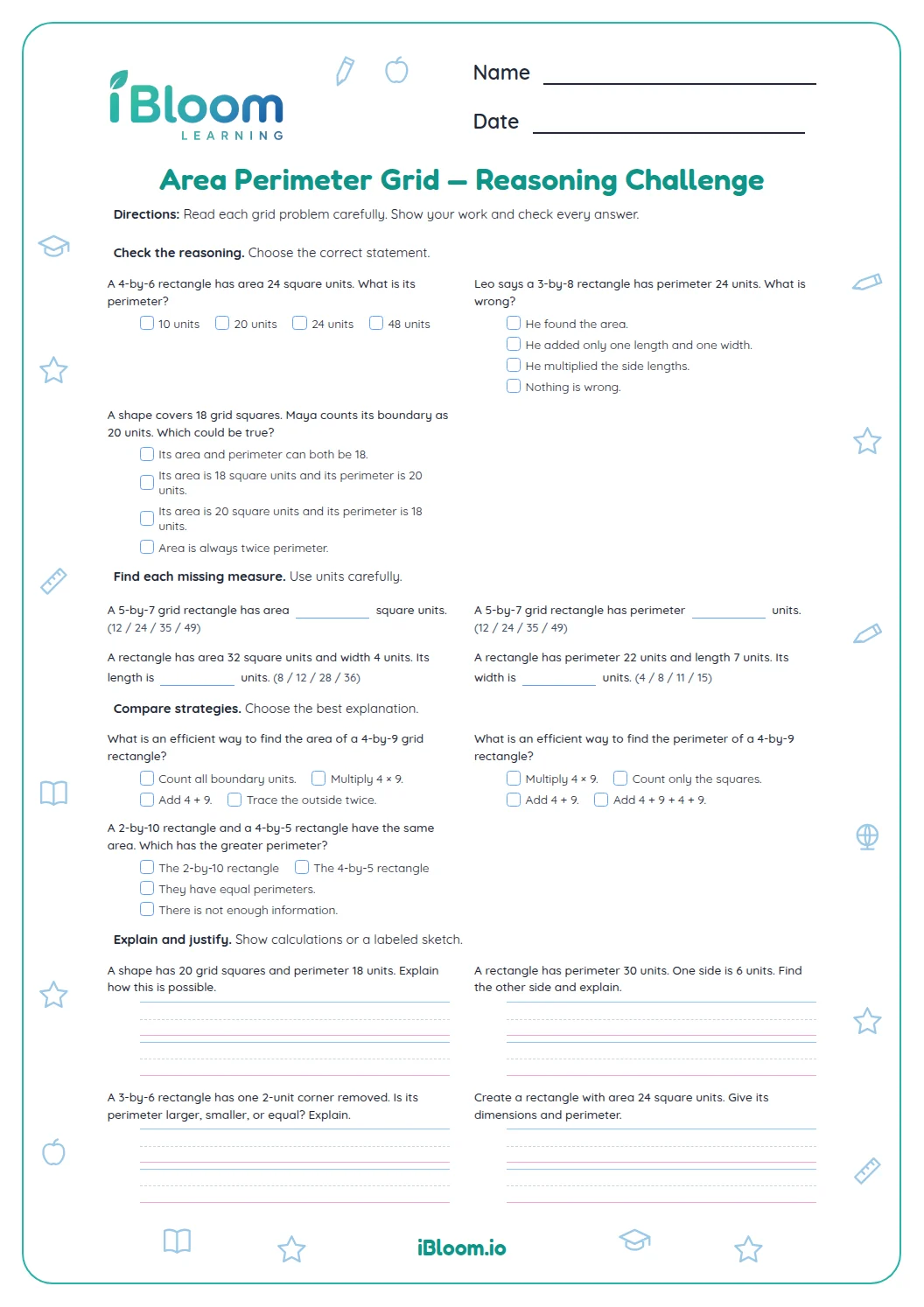
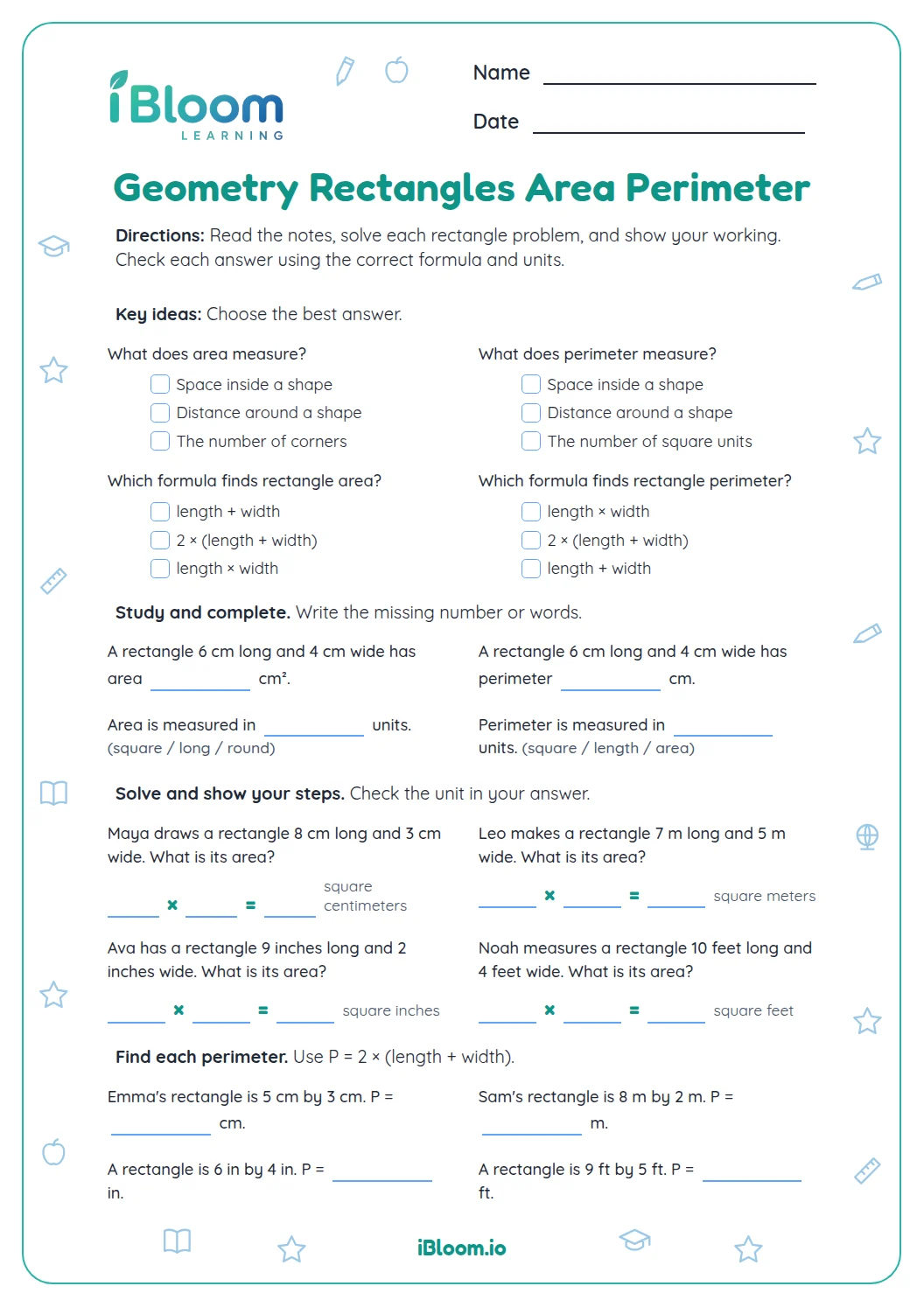
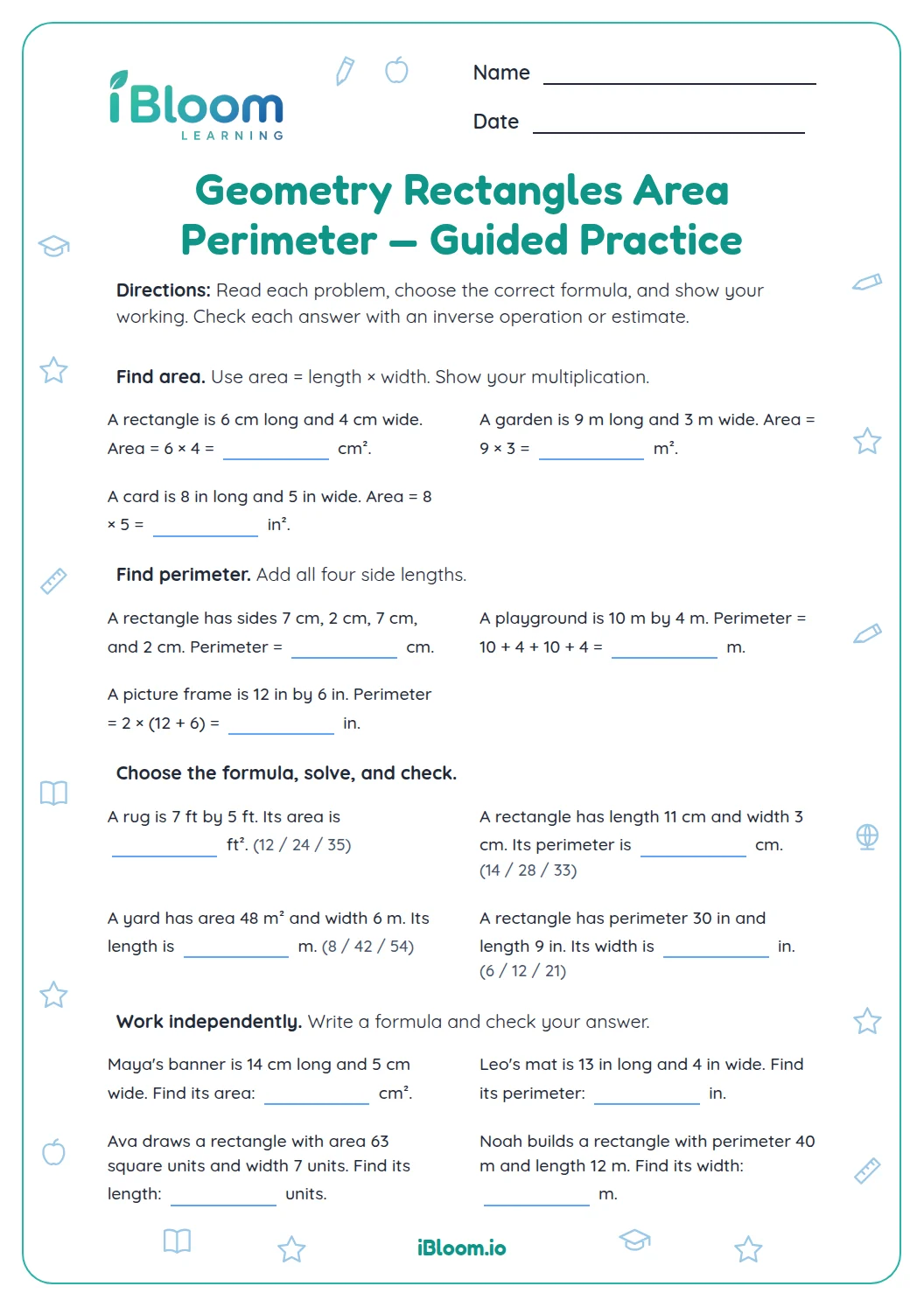
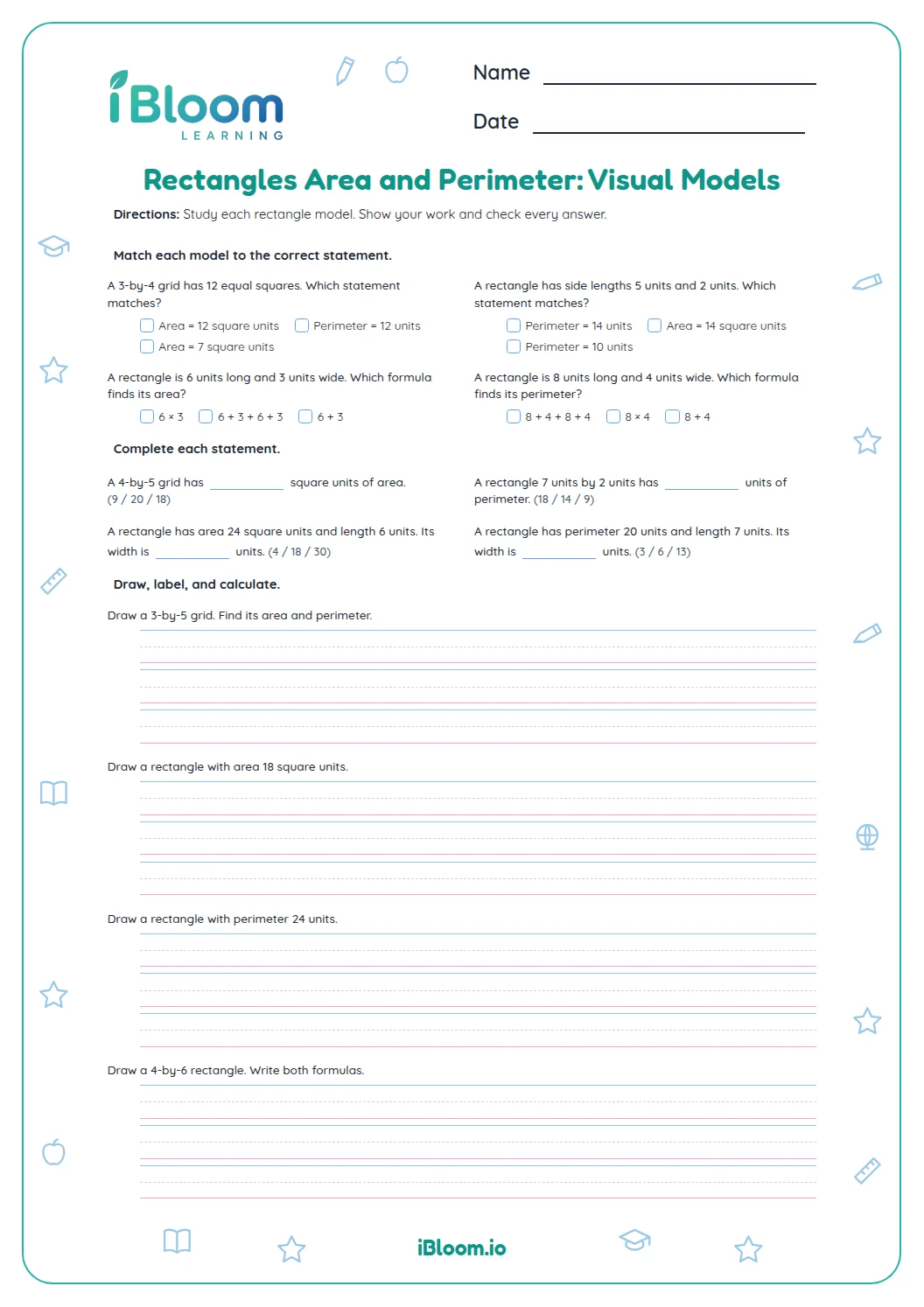
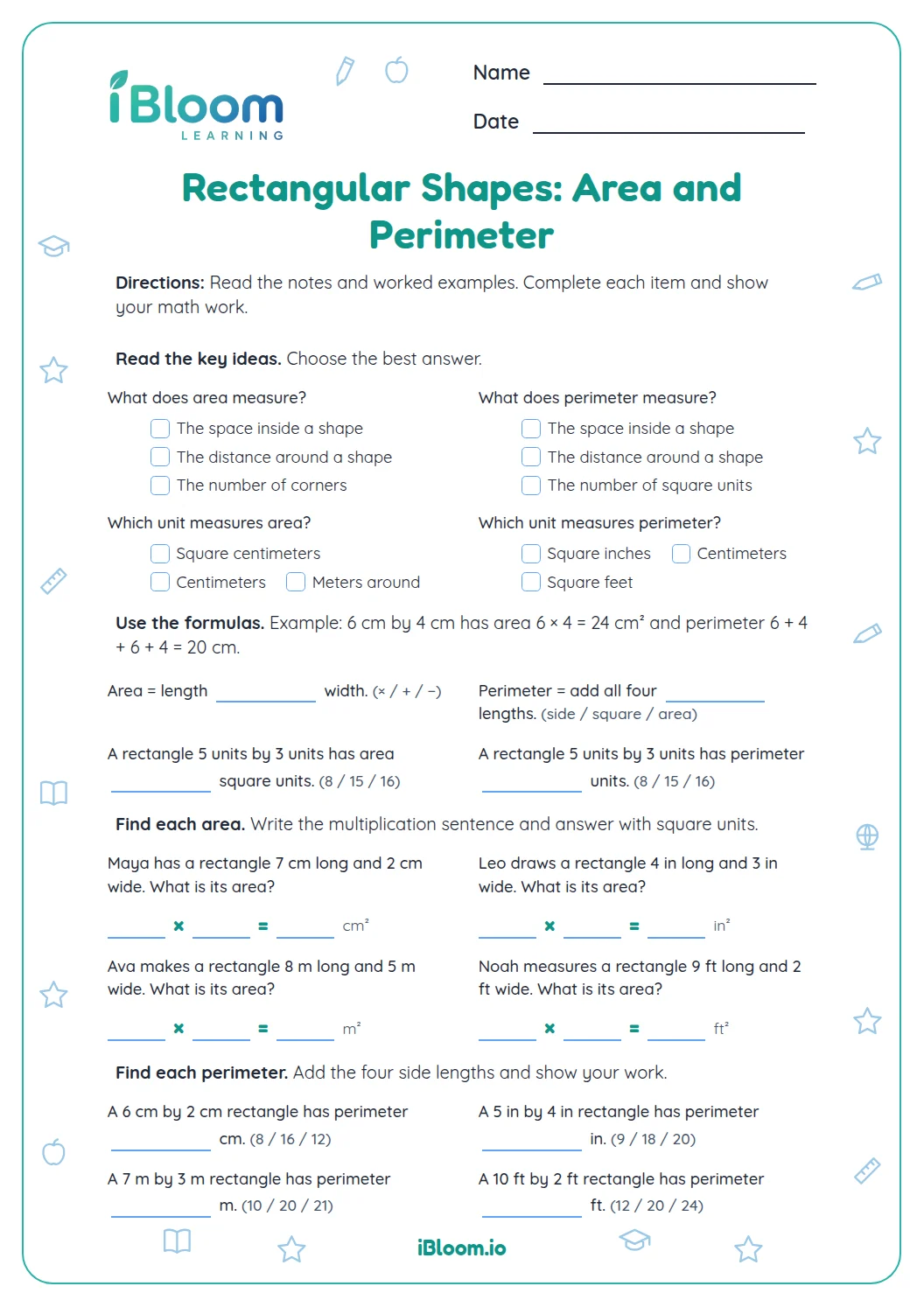
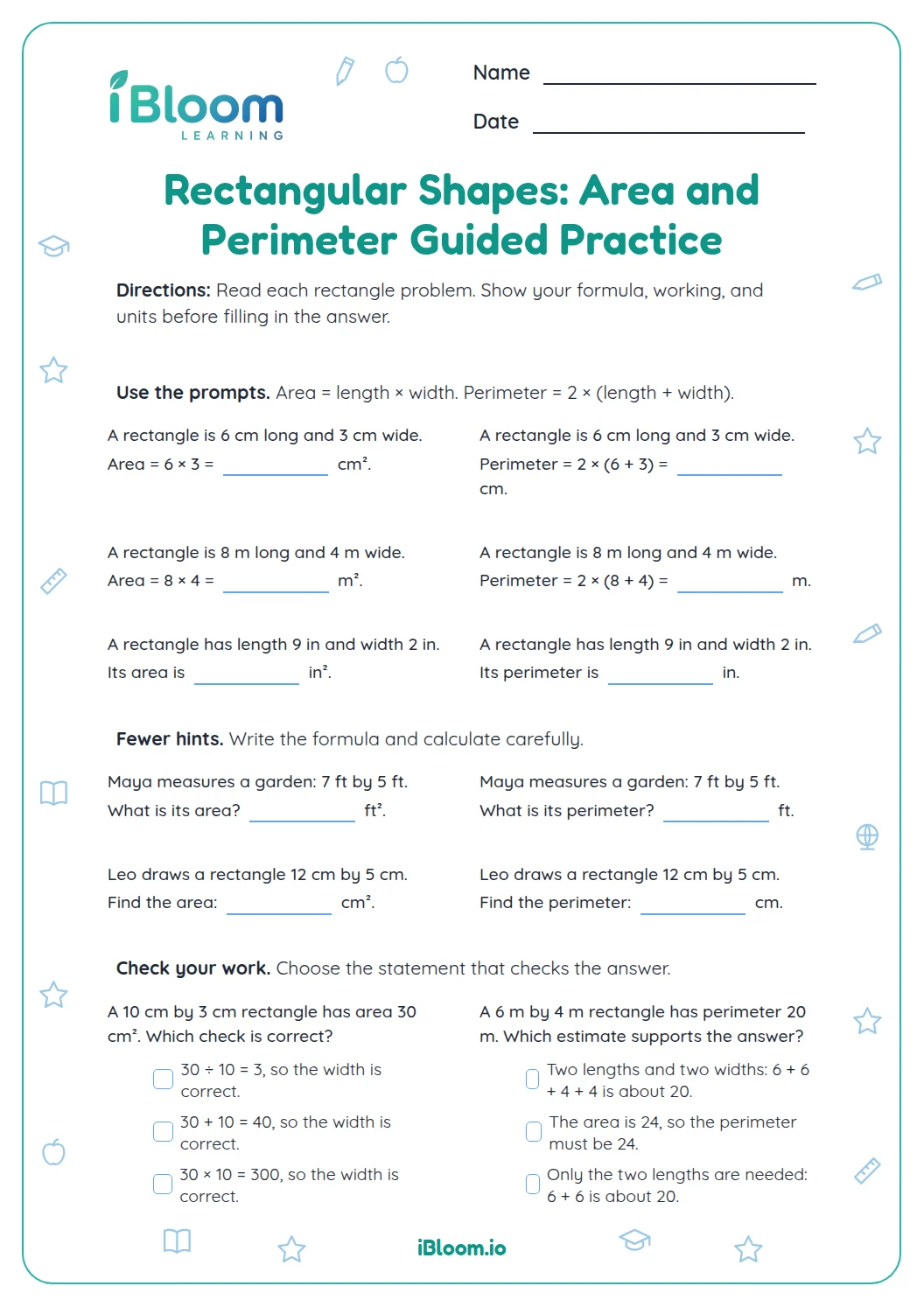
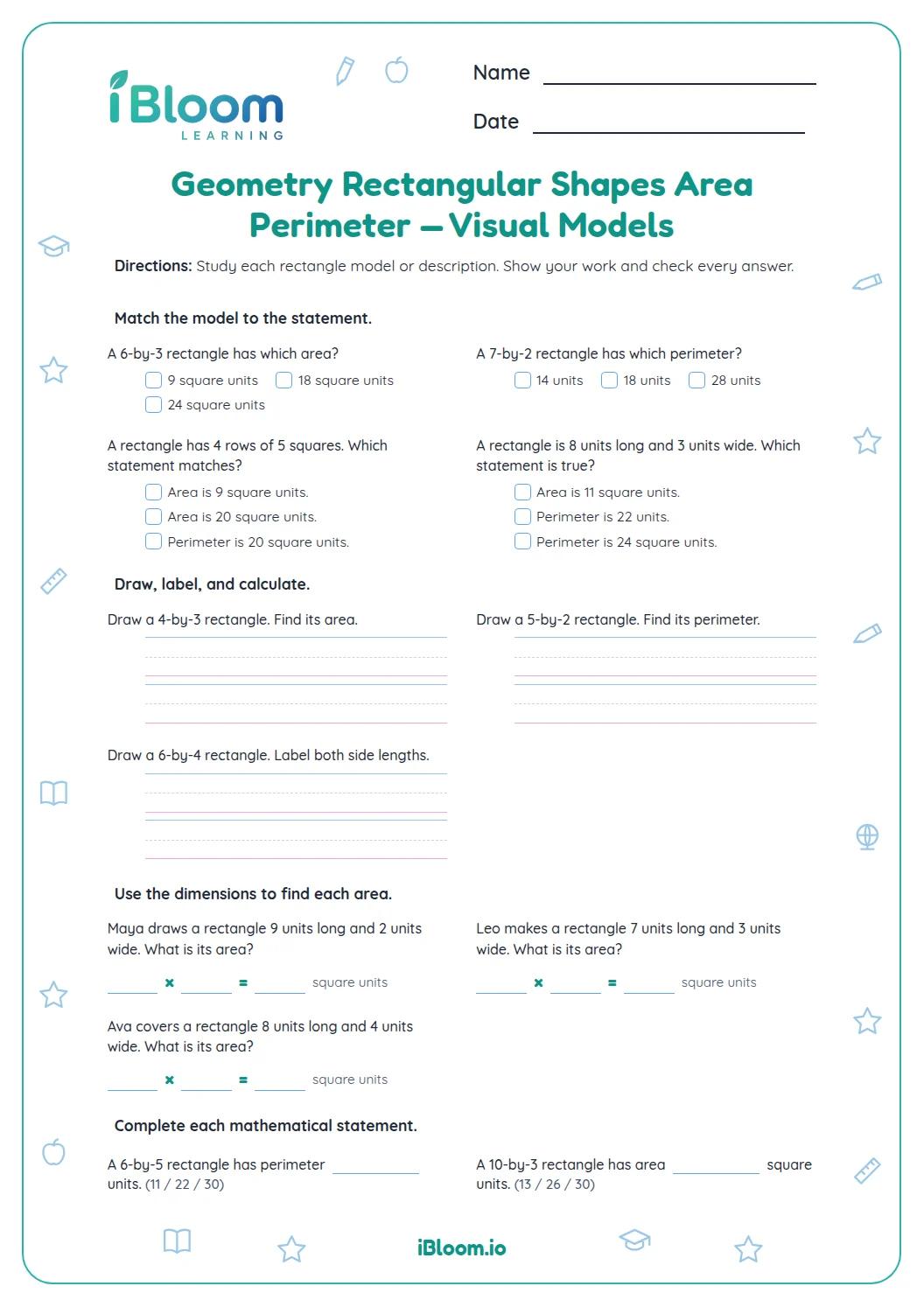
This free Grade 4 worksheet uses unit-square grids to connect rectangle dimensions with area and perimeter. Children count rows and columns, calculate square units inside a rectangle, measure the boundary in units, and use a known area to find a missing side. Four parts move from choosing a method to solving problems independently. The practice aligns with Common Core 4.MD.A.3 and includes a separate answer key.
Aligned to 4.MD.A.3
How does a grid show area?
Each small square is one square unit. Count the rows and columns or multiply them to find how many unit squares cover the rectangle. The 4-by-3 model has 12 squares, so its area is 12 square units.
Perimeter measures the outside edge. Add the four side lengths and label the result in units.
- 1Area: 4 × 3 = 12 square units.
- 2Perimeter: 4 + 3 + 4 + 3 = 14 units.
- 3The same grid helps you see the inside and trace the boundary.
How do the parts build confidence?
Part A asks children to choose a calculation or unit. Part B uses shaded unit-square rectangles to practice area and perimeter. Part C checks whether a missing side fits the stated area. Part D mixes the skills with fewer hints.
Before checking an answer, ask whether it measures the inside or the boundary and whether its unit matches.
- 1A rectangle has area 24 square units and length 6 units.
- 224 ÷ 6 = 4, so the width is 4 units.
- 3Check: 6 × 4 = 24 square units.
How to work through this sheet
- 1Look at the grid and identify its number of rows and columns.
- 2For area, multiply the side lengths or count the unit squares inside.
- 3For perimeter, add the four side lengths and use units.
- 4Use division to find a missing side when the area and other side are known.
- 5Check that each answer names the right measurement and unit.
Mistakes to discuss
The mistake
Adding side lengths to find area.
The fix
Multiply the side lengths or count the unit squares inside.
The mistake
Writing units instead of square units for area.
The fix
Area counts squares; perimeter measures the boundary length.
The mistake
Calling 4 the area of a 6-by-4 rectangle.
The fix
The area is 24 square units; 4 units is one side length.
Common Core alignment
Use rectangle area and perimeter formulas, including finding a missing width.
On this sheet: Children calculate area and perimeter from given side lengths and find width from area and length.
Show the official wordingHide the official wording
Apply the area and perimeter formulas for rectangles in real world and mathematical problems. For example, find the width of a rectangular room given the area of the flooring and the length, by viewing the area formula as a multiplication equation with an unknown factor.
What to practice next
Make more practice
Further reading
Questions parents and teachers ask
What does each small grid square represent?
Each cell represents one square unit. Count every cell inside the outlined rectangle or multiply its number of rows by its number of columns. A model with six columns and four rows covers 24 square units, so its area is 24 square units.
How is perimeter different from area?
Area describes the surface inside a shape and is measured in square units. Perimeter is the total distance around the outside and is measured in units. The same rectangle can have an area of 24 square units and a perimeter of 20 units.
How can a missing width be found?
Divide the area by the known length. For a rectangle with an area of 24 square units and a length of 6 units, calculate 24 ÷ 6 = 4 units. Multiply 6 by 4 afterward to check that the product matches the given area.
Does the printable include an answer key?
Yes. The printable has two worksheet pages followed by two answer-key pages. The key gives each area, perimeter, or missing-side answer and includes the calculation children can use to check their work. Review whether answers use units or square units as appropriate.