

About this worksheet
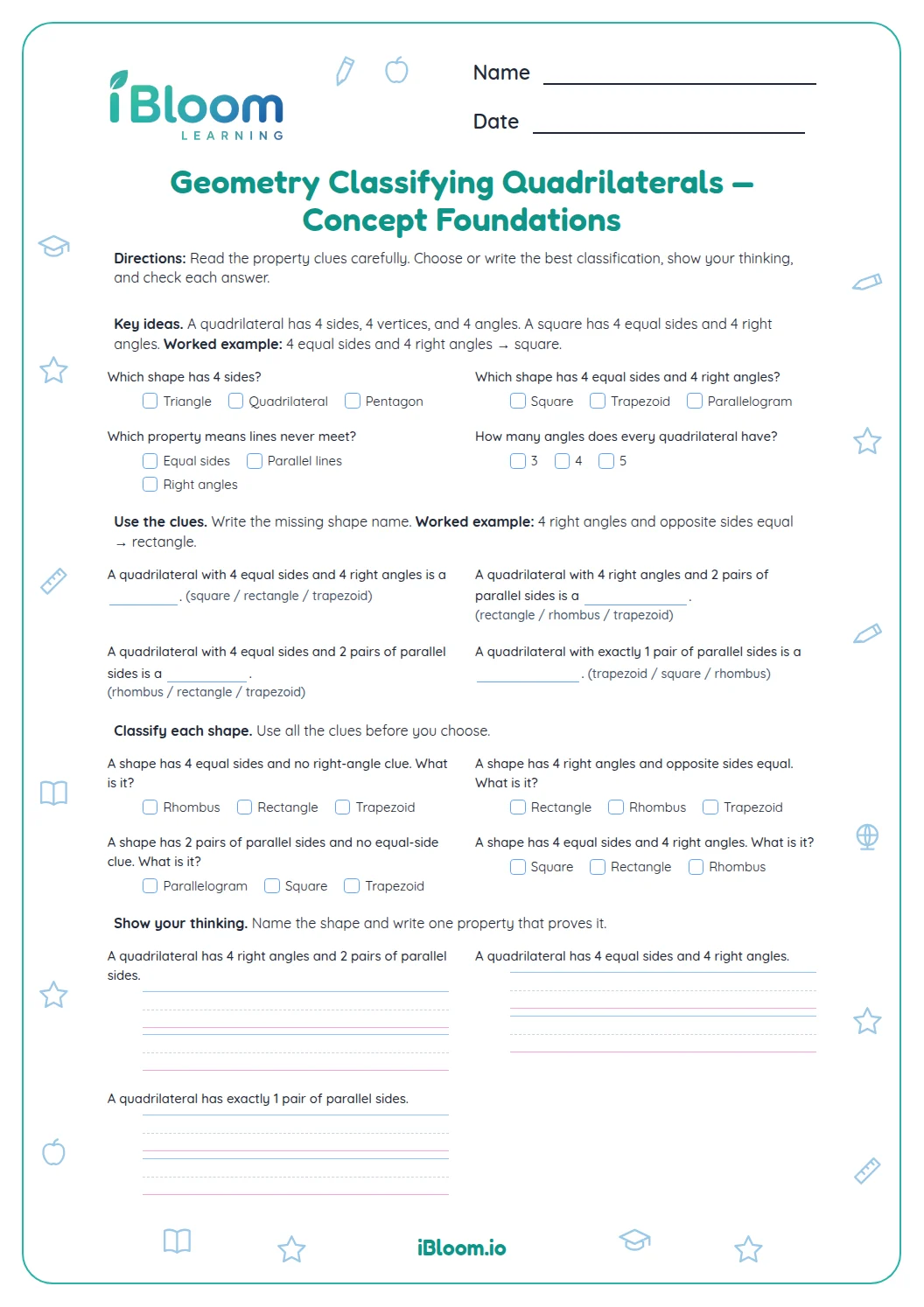
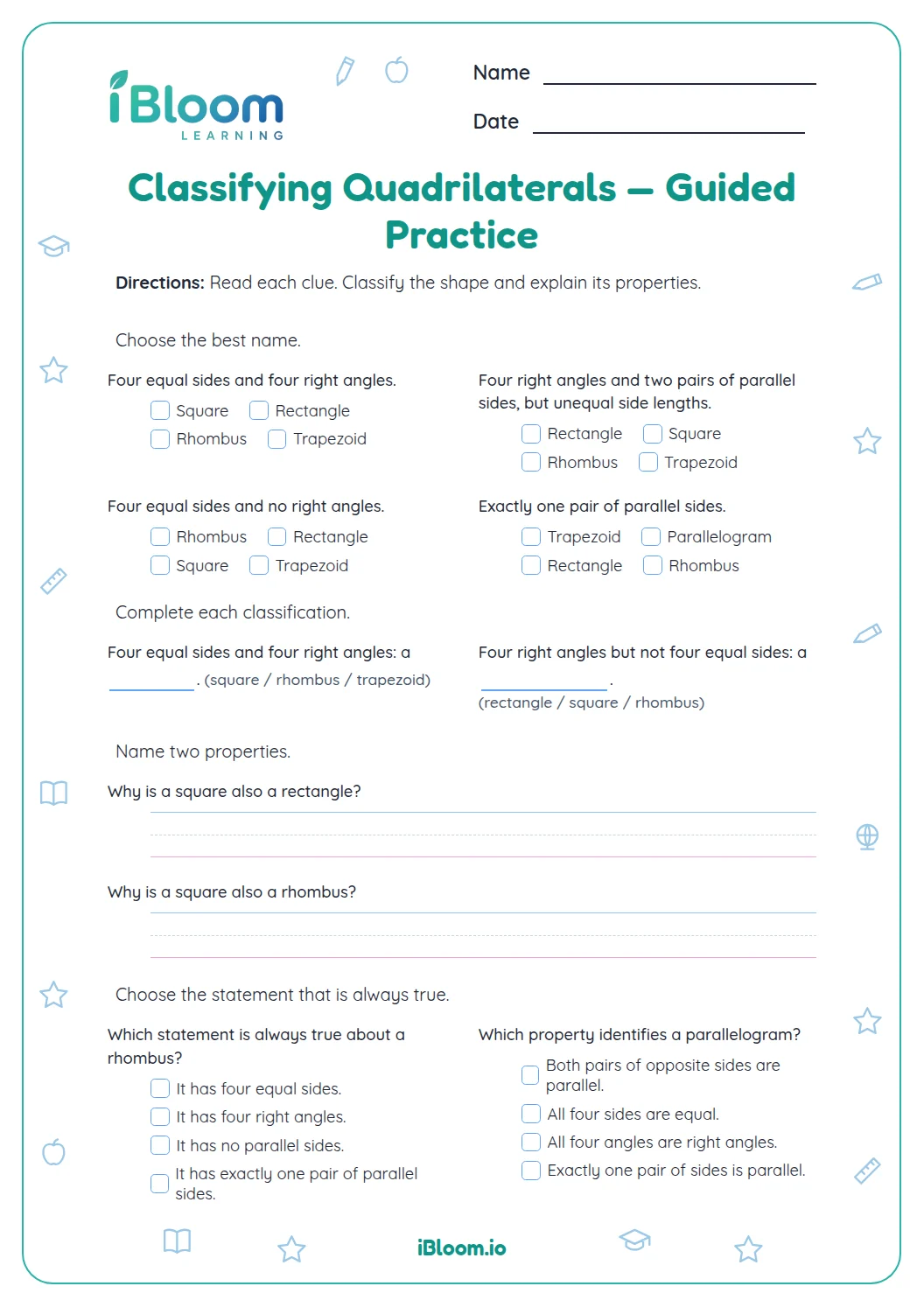
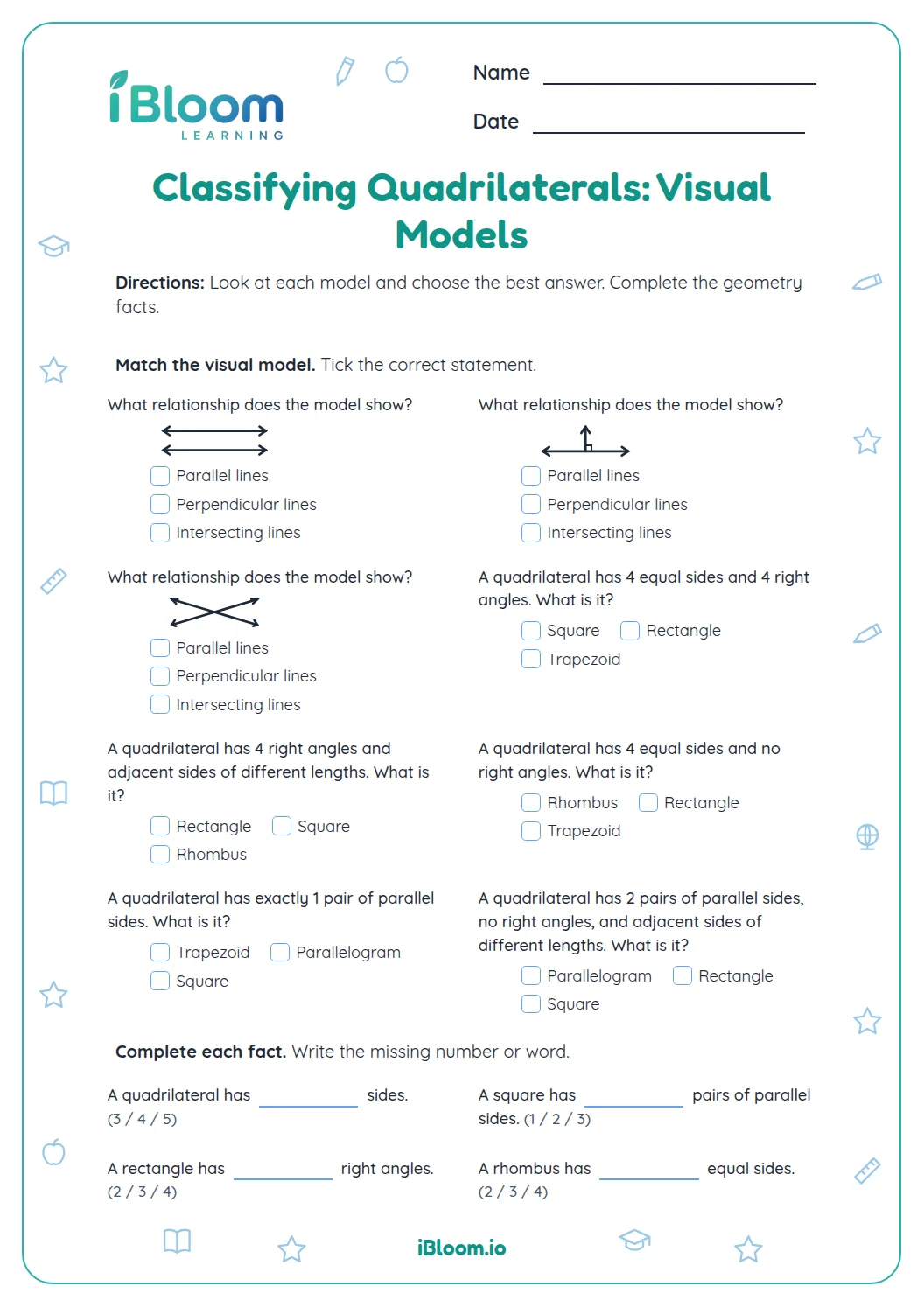
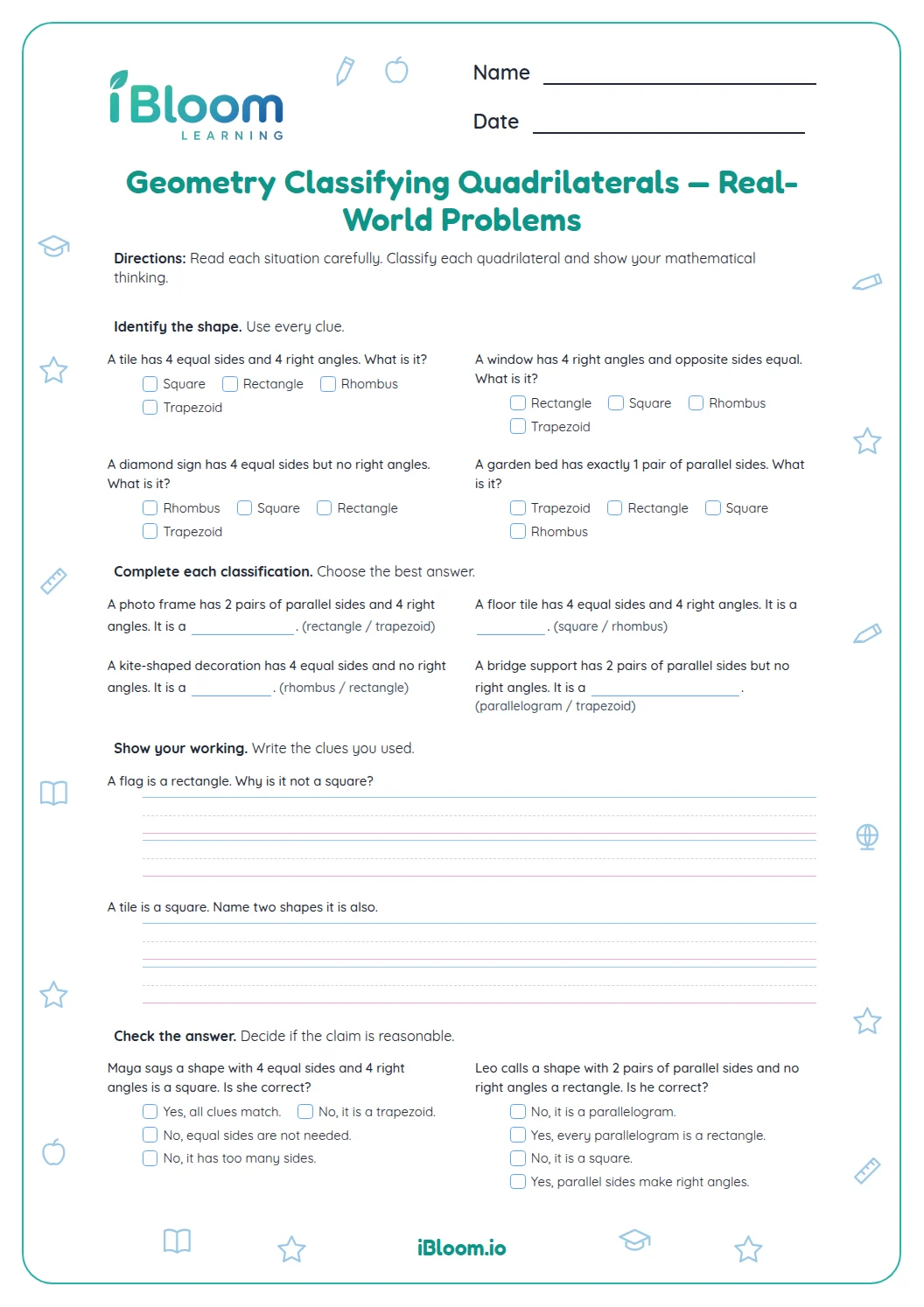
This free Grade 4 worksheet gives students independent practice classifying quadrilaterals. They identify familiar shapes from their properties, name labeled drawings, and reason about how squares, rectangles, and rhombuses are related. The practice uses parallel sides, equal sides, and right angles as clues. A separate answer key is included. The questions align with CCSS 4.G.A.2, which asks students to classify two-dimensional figures by line and angle properties.
Aligned to 4.G.A.2
Which properties help name a quadrilateral?
Start by checking the sides: are any pairs parallel, and are all four sides equal? Then check the corners for right angles. A property can narrow the choices quickly.
- 1Four right angles indicate a rectangle.
- 2The sides are described as opposite pairs equal, not all four equal.
- 3So the most specific name given is rectangle.
How do drawings and words work together?
Questions 7–10 show one labeled shape at a time. The remaining items describe a property or ask about a relationship. Moving between a drawing and a property statement helps students focus on what makes the shape belong to a group.
How are squares, rectangles, and rhombuses related?
A square has four right angles and four equal sides. It is a special rectangle and a special rhombus. A rectangle has four right angles; a rhombus has four equal sides. Not every rectangle or rhombus is a square.
How can students check a classification?
Name the property first, then check whether the shape satisfies it. For a trapezoid on this page, look for exactly one pair of parallel sides. For a square, check both the equal sides and the four right angles.
How can I use this worksheet?
- 1Review parallel and perpendicular lines with a quick sketch.
- 2For each drawing, count four sides before naming the shape.
- 3Mark parallel pairs with your finger or a pencil edge.
- 4Check for equal sides and right angles as a second clue.
- 5Answer the relationship questions using the shape definitions.
- 6Compare each response with the separate key.
Common mistakes and quick fixes
The mistake
Calling a turned square a diamond and changing its category.
The fix
Rotate the paper mentally and check its four equal sides and four right angles.
The mistake
Assuming every quadrilateral with parallel sides is a rectangle.
The fix
Check for right angles; two parallel pairs alone can describe a parallelogram or rhombus.
The mistake
Thinking every rhombus is a square.
The fix
Check the angles as well as the sides. A rhombus has four equal sides, but may not have right angles.
Curriculum alignment
This page classifies quadrilaterals by line and angle properties.
Classify figures using parallel or perpendicular lines and angle properties.
On this sheet: Questions identify quadrilaterals using parallel sides, right angles, and equal sides.
Show the official wordingHide the official wording
Classify two-dimensional figures based on the presence or absence of parallel or perpendicular lines, or the presence or absence of angles of a specified size. Recognize right triangles as a category, and identify right triangles.
What to practice next
Make more practice
Further reading
Questions parents and teachers ask
What makes a shape a quadrilateral?
A quadrilateral is a closed two-dimensional shape with four straight sides and four angles. This worksheet focuses on naming common quadrilaterals by their side and angle properties, including squares, rectangles, parallelograms, rhombuses, trapezoids, and kites. Students can point to each side while counting to four, then use the defining properties to name the shape confidently.
How is a trapezoid identified on this page?
The trapezoid questions use the definition in the worksheet: exactly one pair of parallel sides. Children can inspect the drawing or read the property sentence, then match that feature to the name trapezoid. The key idea is exactly one pair; students should check both pairs of opposite sides before choosing a name.
Is a square also a rectangle?
Yes. A square has four right angles, so it meets the rectangle’s angle property; it also has four equal sides. The final relationship questions ask children to recognize that a square can belong to a broader quadrilateral group.
Why are shapes drawn in different orientations?
A shape keeps its properties when it is turned. The drawings let children focus on parallel sides, equal sides, and right angles instead of relying only on a familiar “upright” position. Orientation does not change parallel sides, equal sides, or angle sizes, so the classification stays the same after a turn.
How should a child answer a shape drawing question?
For the labeled drawings, write the shape name shown by the drawing. The drawings are deliberately simple, while other questions state the defining property in words to practice switching between a visual and a description. Encourage the student to use the labeled letter when writing the shape name, then check the same features in the key.
Does this page include an answer key?
Yes. A separate answer key lists the name or choice for each of the 16 questions. For the drawn items, it names the labeled quadrilateral so an adult can check the classification. The key is on a separate page so it can be kept aside during practice and used for a quick review afterward.