
About this worksheet
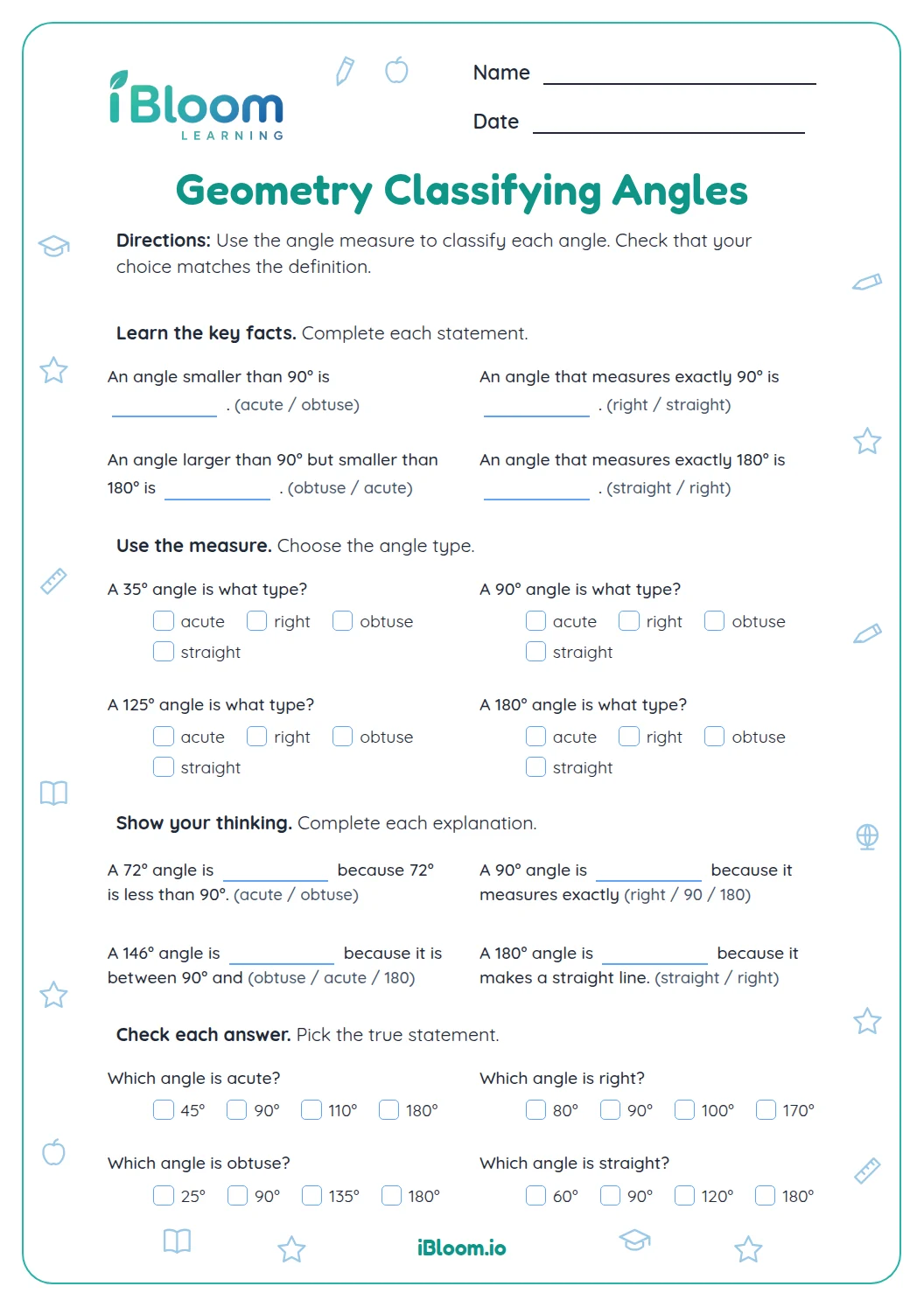
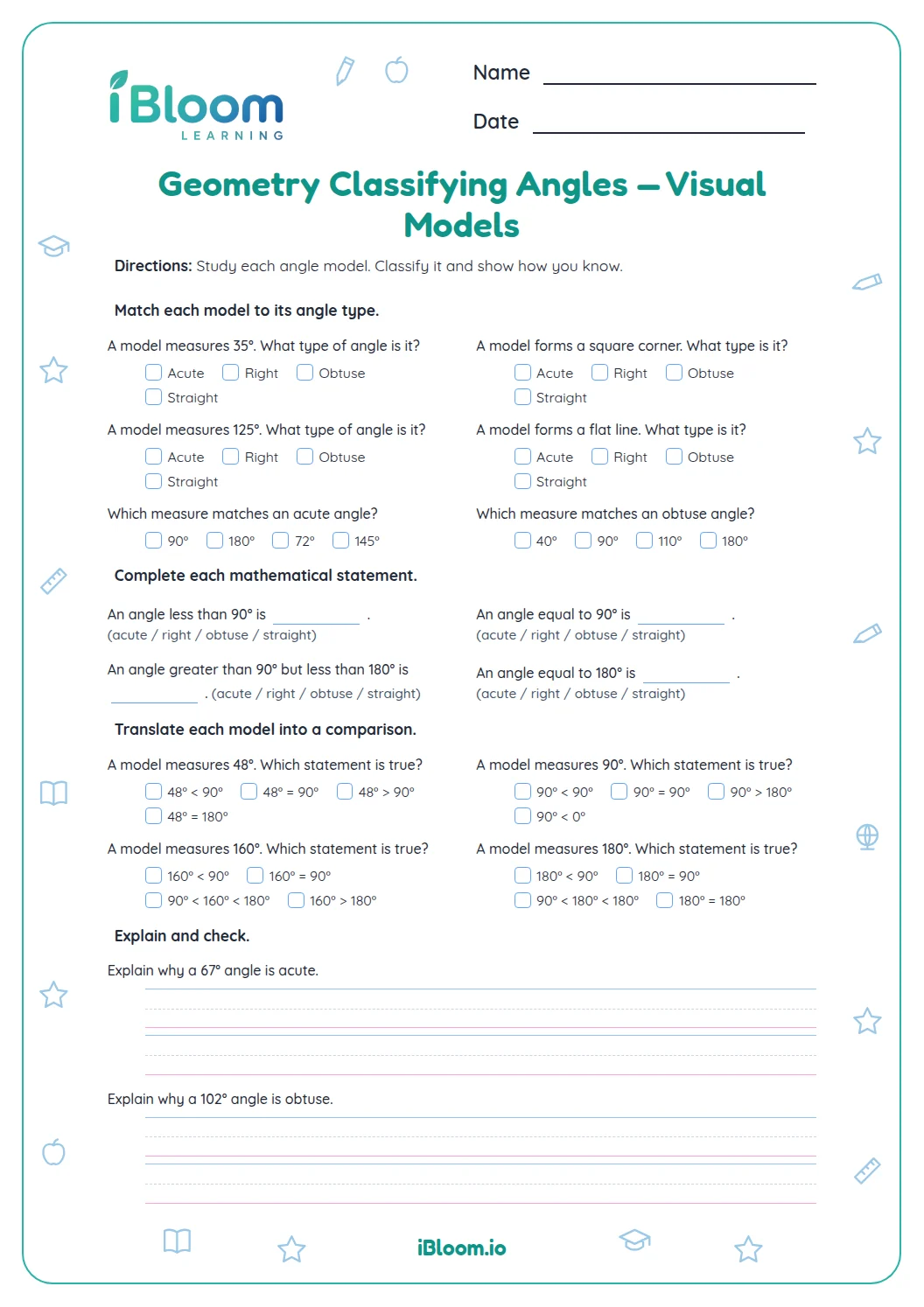
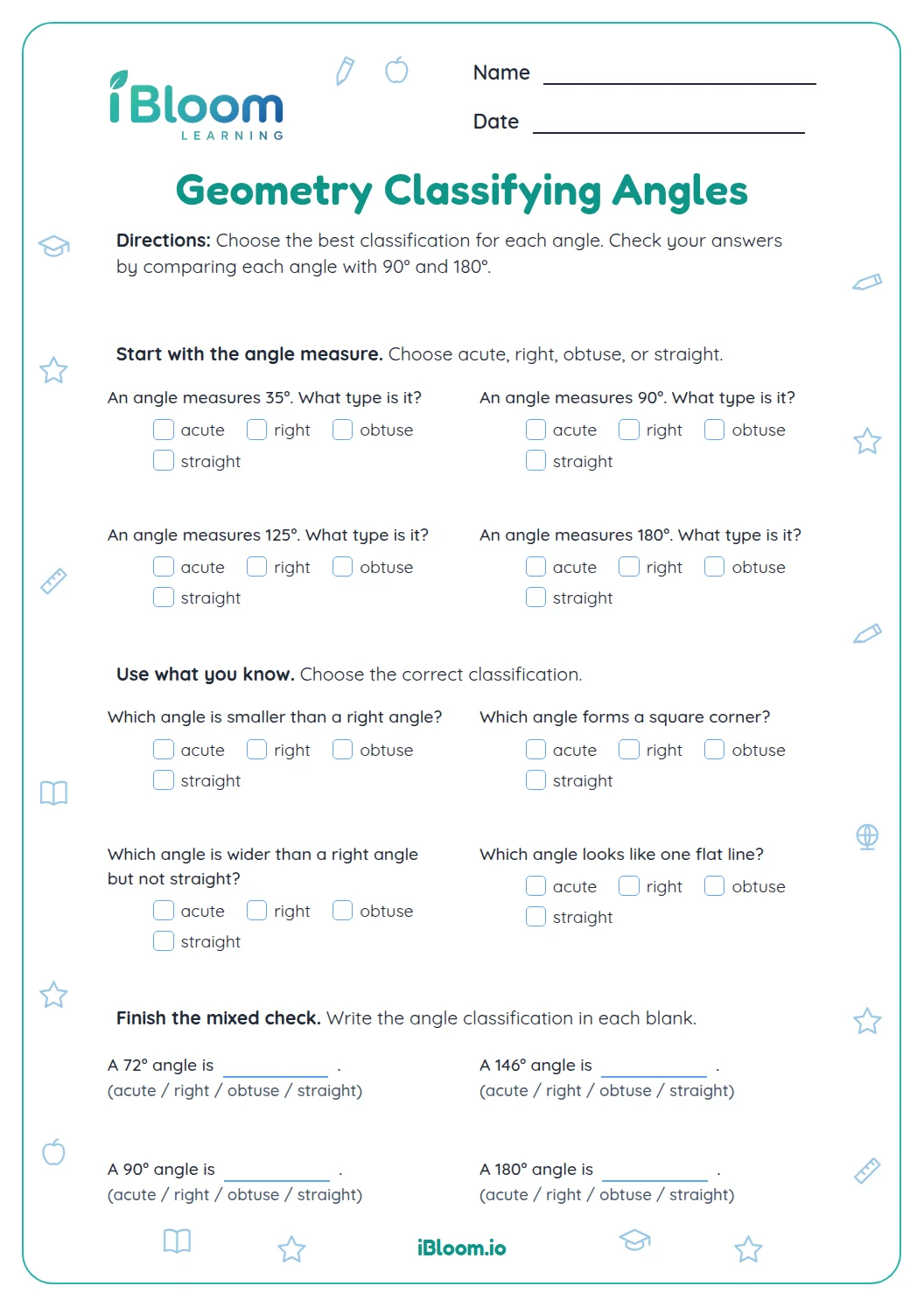
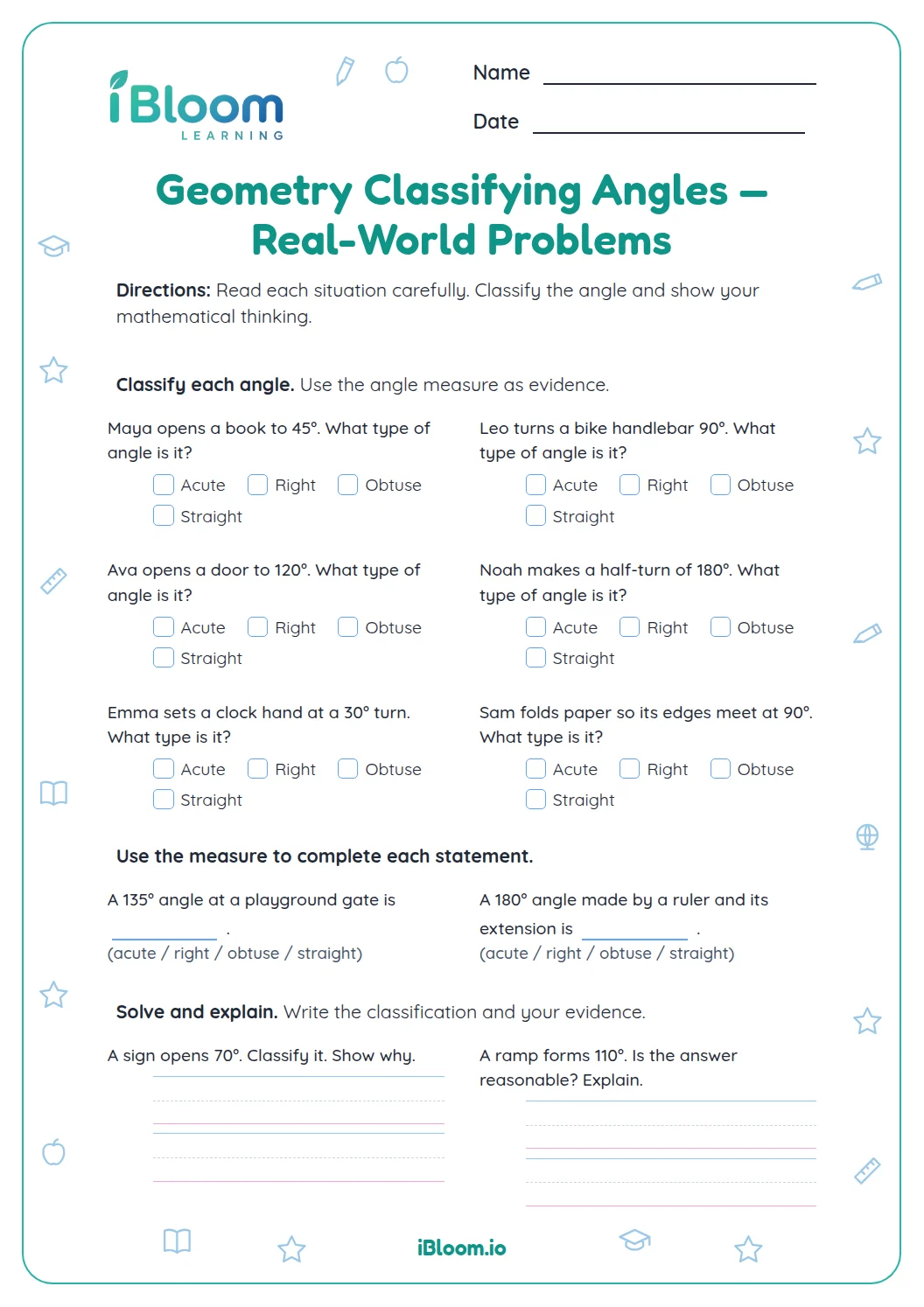
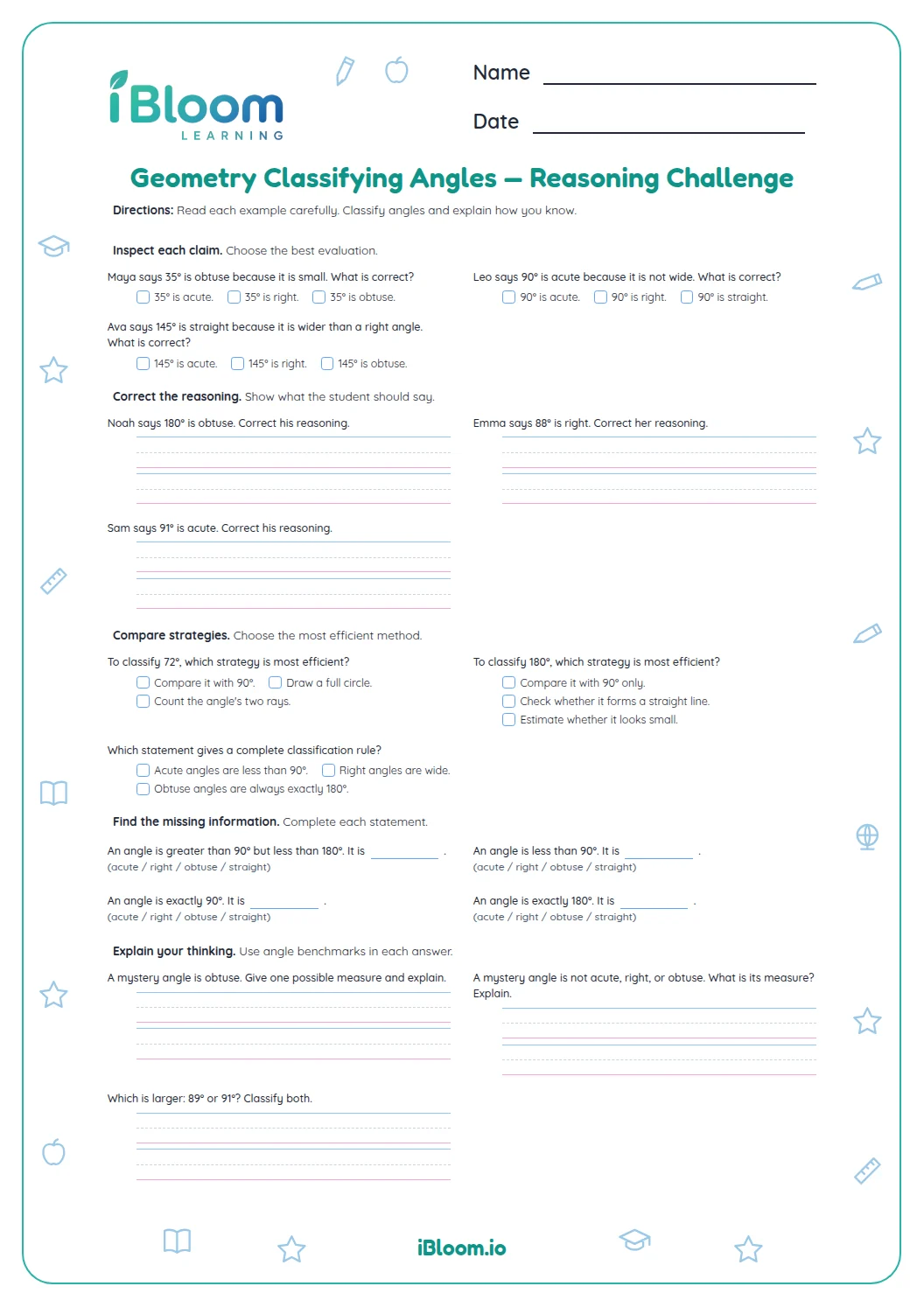
This Grade 4 worksheet gives children 16 angle measures with matching angle drawings to classify as acute, right, obtuse, or straight. The first part builds recognition across familiar examples; the second mixes the types, including openings close to a right angle. Children compare each opening with a square corner or a straight line. The practice aligns with CCSS 4.MD.C.5, and a separate answer key is included.
Aligned to 4.MD.C.5
What does an angle opening tell you?
An angle is made by two rays that meet at one endpoint. Its type depends on how wide the rays open.
Question 1 pairs 38° with its angle drawing. Because 38° is less than 90°, it is acute.
- 138° < 90°
- 2The drawn angle is acute.
How do you classify an angle near a right angle?
Check whether the opening is below or above 90°. An angle of 89° is acute; 90° is right; 101° is obtuse.
A straight angle is a half-turn, with its rays pointing in opposite directions.
How to use this worksheet
- 1Find the vertex where the two rays meet.
- 2Imagine a square corner and compare the angle opening with it.
- 3Choose acute if it is smaller than 90°.
- 4Choose right at 90°; choose obtuse above 90° but below 180°.
- 5Choose straight at 180° and check the answer key.
Common mistakes and quick fixes
The mistake
Calling every wide angle straight.
The fix
A straight angle is exactly a half-turn; an obtuse angle is less than a half-turn.
The mistake
Calling an 89° angle right.
The fix
A right angle measures exactly 90°, so 89° is acute.
The mistake
Using the length of the rays to judge size.
The fix
Compare the opening between the rays, not how long the rays are.
Common Core alignment
This worksheet practices the standard below through focused printable practice.
Recognize angles as shapes formed by two rays with a shared endpoint.
On this sheet: Students classify drawn angles by comparing their openings with a right angle and a straight angle.
Show the official wordingHide the official wording
Recognize angles as geometric shapes that are formed wherever two rays share a common endpoint, and understand concepts of angle measurement:
What to practice next
Make more practice
Further reading
Questions parents and teachers ask
What makes an angle acute?
An acute angle is smaller than a right angle, so it measures less than 90 degrees. For example, an angle measuring 38 degrees is acute because its opening is narrower than a square corner. The worksheet includes several acute examples to classify.
How can children tell a right angle from an obtuse angle?
A right angle measures exactly 90 degrees. An obtuse angle is larger than 90 degrees but smaller than 180 degrees. Comparing with a square corner helps distinguish the two, even when their openings look close. The degree measure settles the classification.
What is a straight angle?
A straight angle measures 180 degrees and looks like a straight line because its rays point in opposite directions. The worksheet includes straight angles alongside acute, right, and obtuse angles for comparison. A straight angle is a half-turn.
How many angle questions are included?
There are 16 fill-in-the-blank questions. Each gives the angle measure, and children write acute, right, obtuse, or straight. The answer key lists the classification for each item and makes it easy to review the boundary values. Children may also say the angle rule aloud as they compare each measure.