


About this worksheet
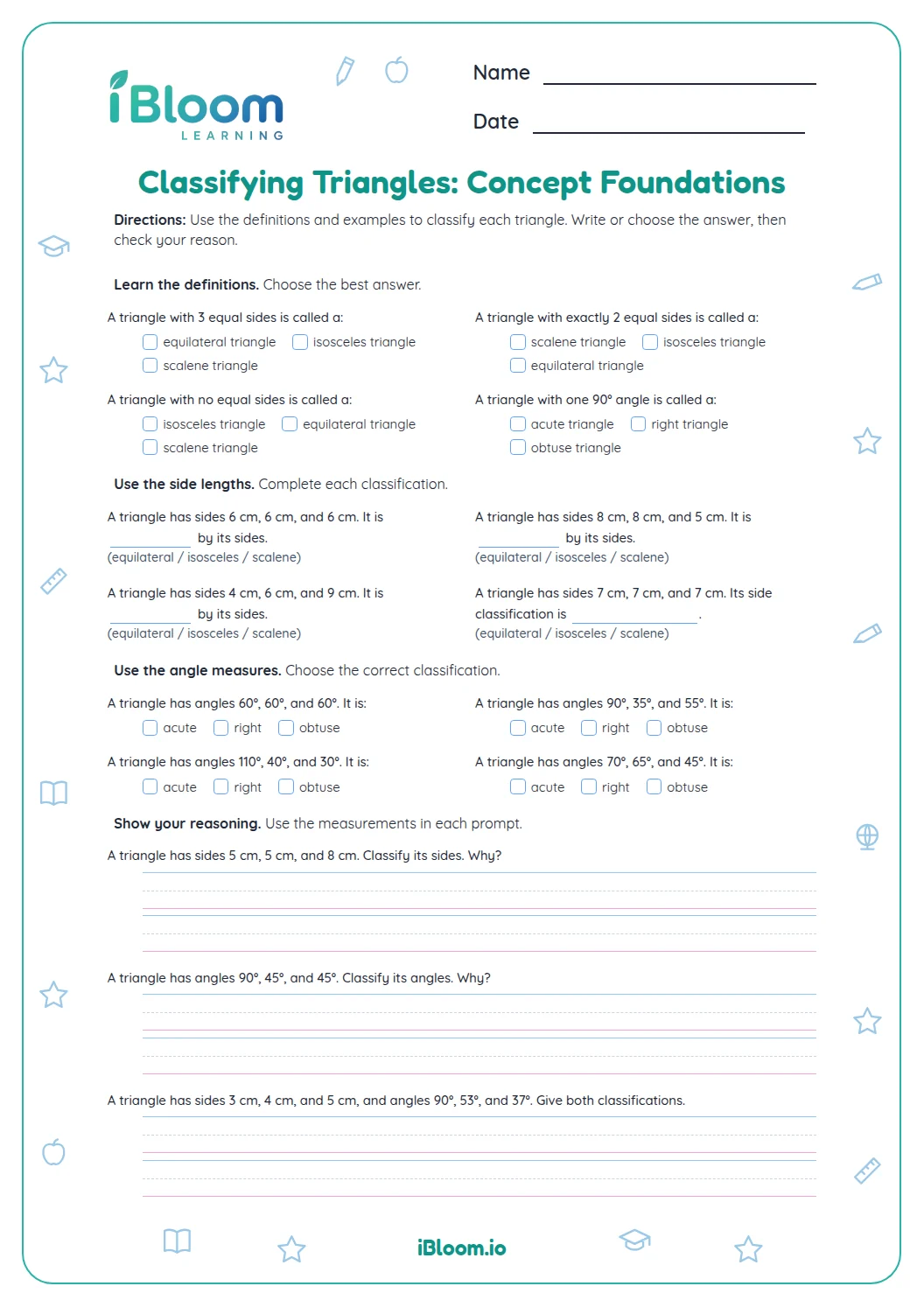
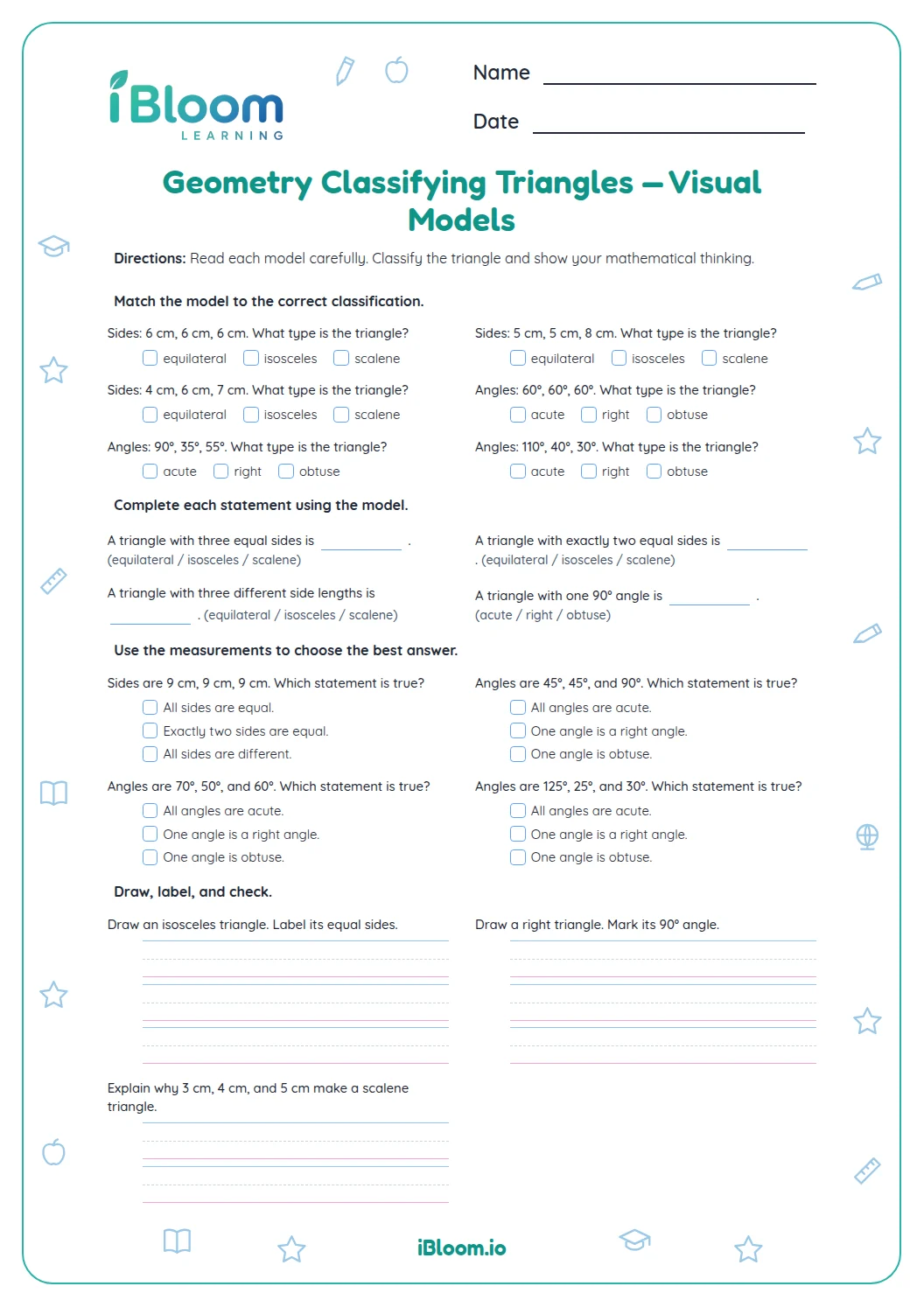
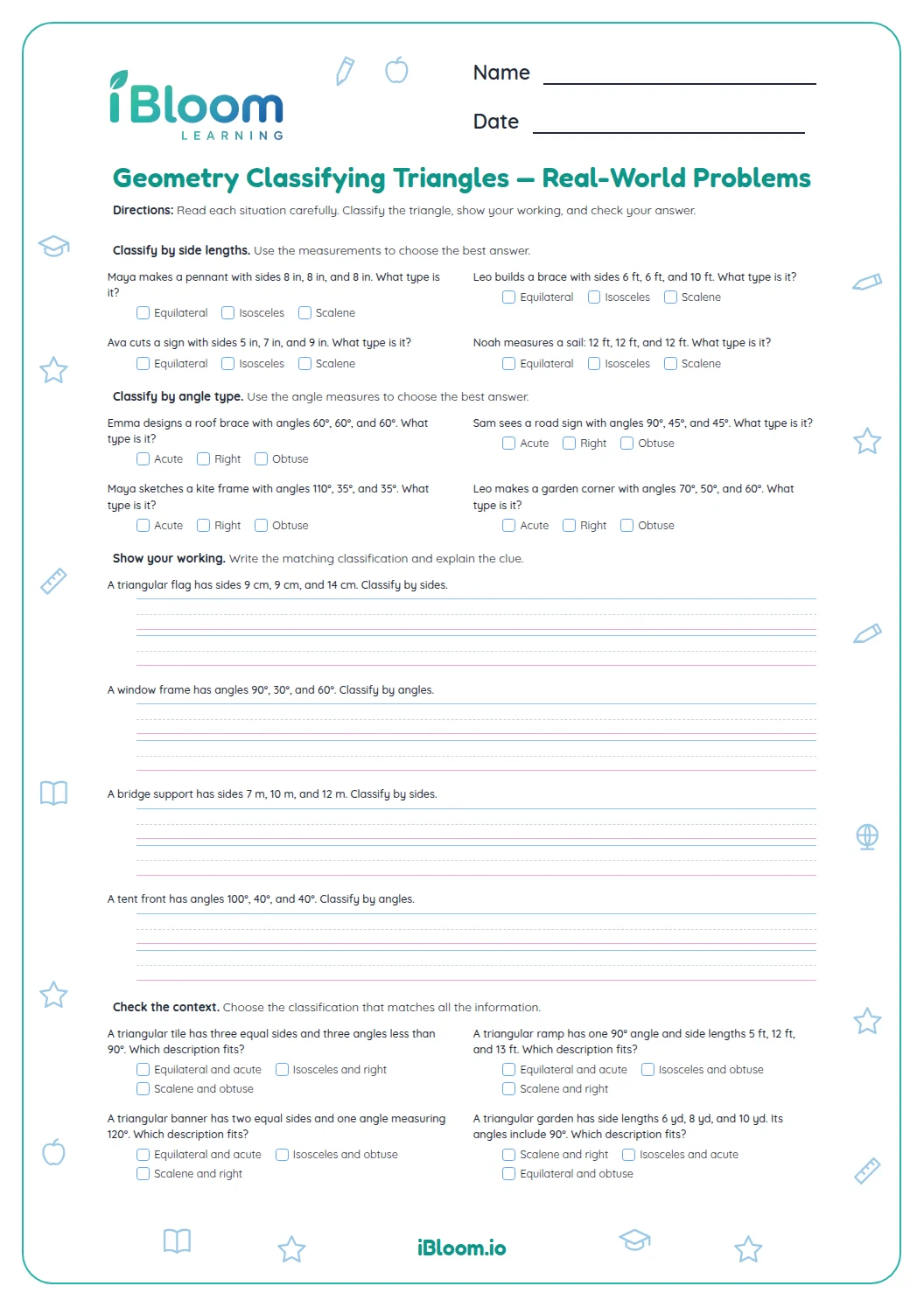
This Grade 4 guided practice worksheet has 14 concise questions about classifying triangles by side lengths and angle measures. Students distinguish equilateral, isosceles, and scalene sides, then classify acute, right, and obtuse angles. The key gives one clear classification per item, and the page practices CCSS 4.G.A.2.
Aligned to 4.G.A.2
How do side lengths classify a triangle?
Compare all three lengths. Three equal sides are equilateral; exactly two equal sides are isosceles; three different lengths are scalene.
- 1The side lengths are 6 cm, 6 cm, and 4 cm.
- 2Exactly two lengths match, so the triangle is isosceles.
How do angle measures classify a triangle?
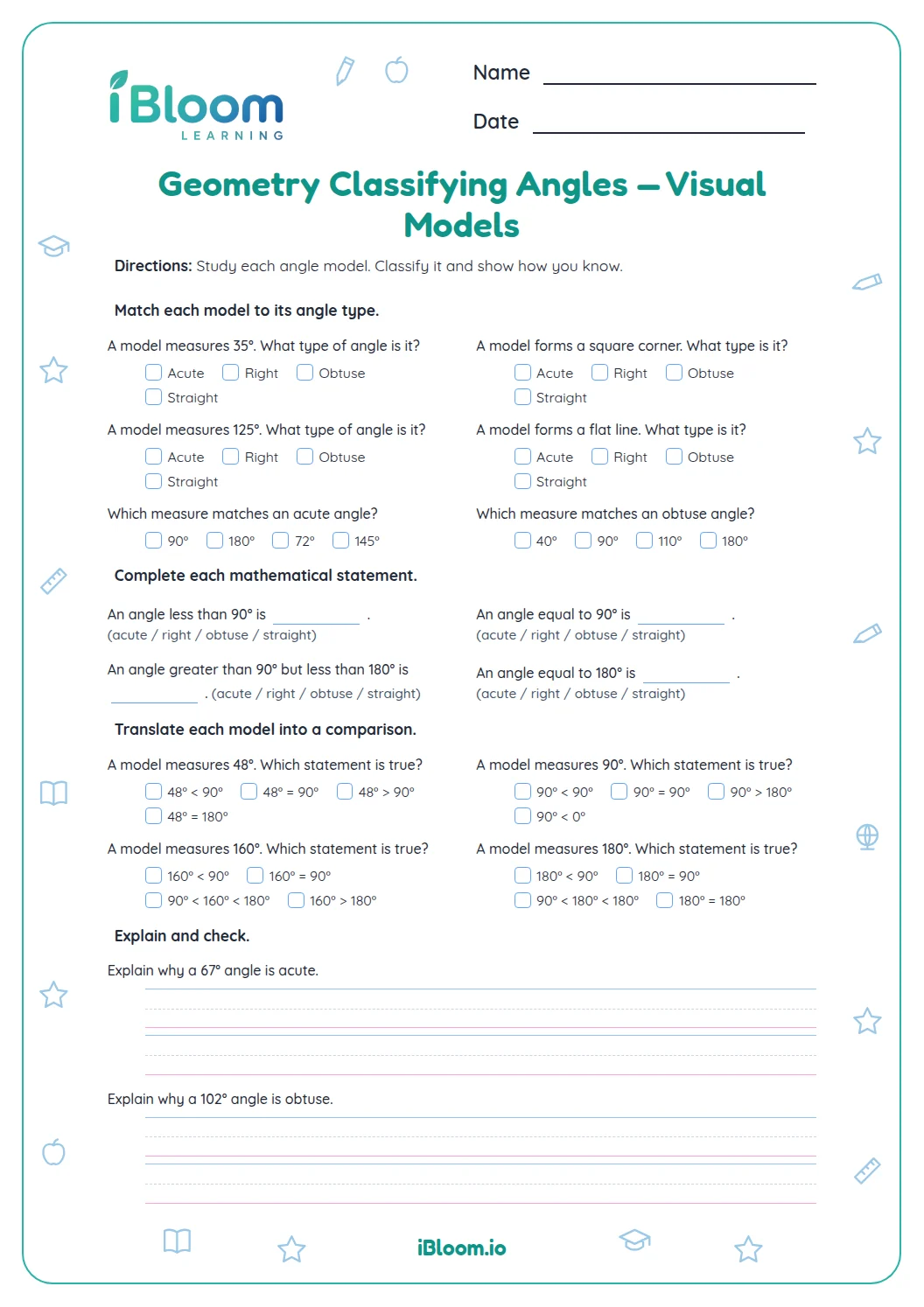
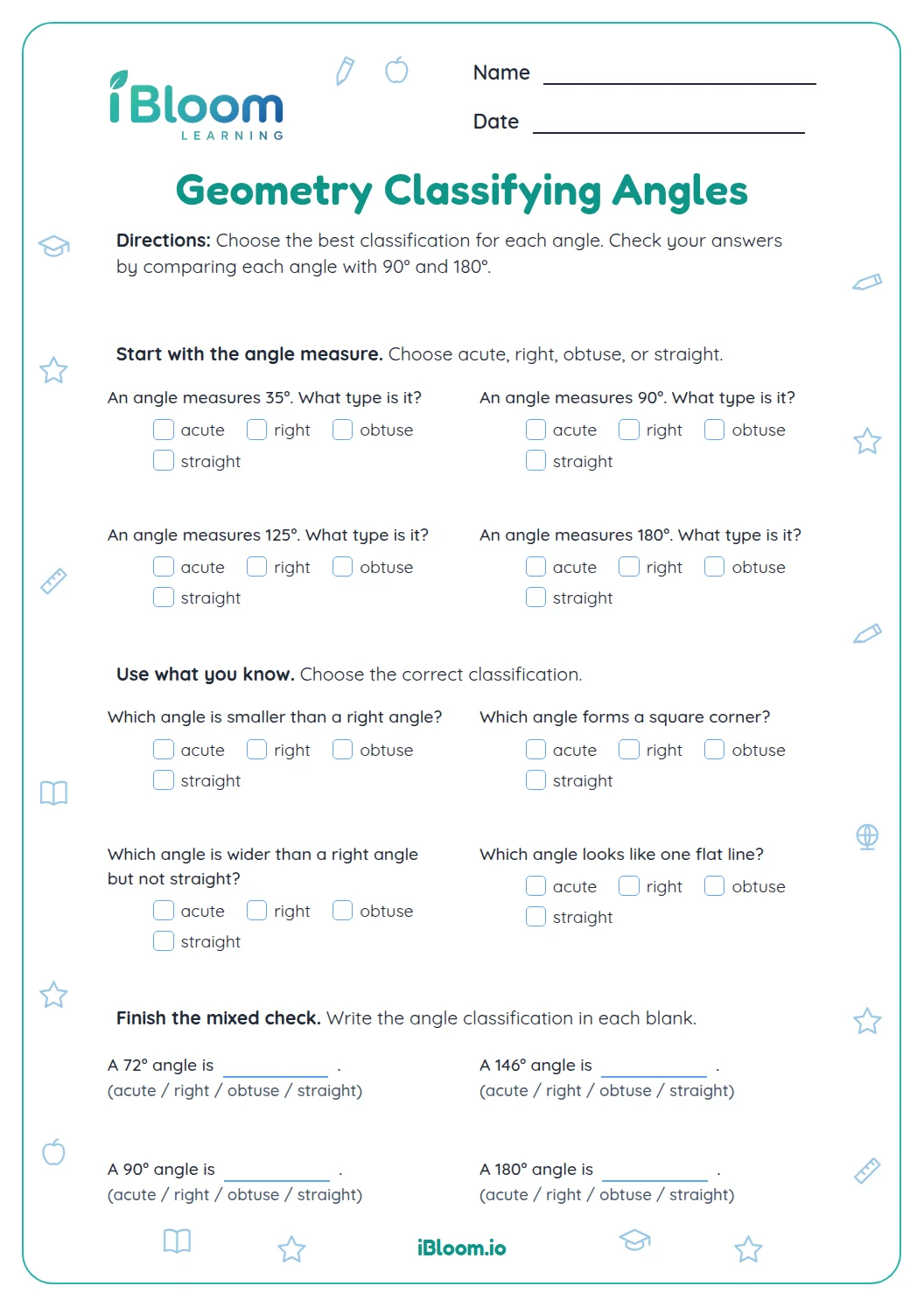
Check the largest angle. If it is below 90°, the triangle is acute; if it is 90°, it is right; if it is above 90°, it is obtuse.
Can one triangle have both kinds of labels?
Yes. Side and angle labels describe different features. Classify the sides and angles separately when both are requested.
How to classify a triangle
- 1Read whether the question asks about sides or angles.
- 2For sides, compare all three lengths.
- 3For angles, find the largest measure.
- 4Choose the matching classification.
- 5Check the key after answering all items.
Common mistakes and quick fixes
The mistake
Calling every triangle with two equal sides equilateral.
The fix
Check whether all three sides or only two sides match.
The mistake
Mixing up acute and obtuse.
The fix
Compare the angle with 90 degrees: smaller is acute, larger is obtuse.
The mistake
Assuming a triangle gets only one name.
The fix
Classify its side lengths and its angles as separate attributes.
Common Core alignment
Classify two-dimensional shapes by properties such as side and angle measures.
On this sheet:
Show the official wordingHide the official wording
Classify two-dimensional figures based on the presence or absence of parallel or perpendicular lines, or the presence or absence of angles of a specified size. Recognize right triangles as a category, and identify right triangles.
What to practice next
Make more practice
Further reading
Questions parents and teachers ask
What are the three side classifications?
Equilateral triangles have three equal sides, isosceles triangles have exactly two equal sides, and scalene triangles have three different side lengths. The worksheet states the lengths directly, so students can compare them carefully without estimating from a drawing.
How do I tell whether a triangle is acute, right, or obtuse?
Look at the largest angle. If every angle is less than 90°, the triangle is acute. An angle of exactly 90° makes it right; one angle greater than 90° makes it obtuse. Each angle question states measures that add to 180°.
Can a triangle be classified by both sides and angles?
Yes. Side labels describe the lengths, while angle labels describe the angle measures. A triangle can have one side classification and one angle classification at the same time. The worksheet groups side questions and angle questions so students can focus on one feature at a time.
Does this sheet use drawings?
The questions state side lengths or angle measures in words and numbers. This lets students focus on the classification rule without needing to infer measurements from a drawing. The answer key gives the classification for each of the 14 items.
How should a learner check a missed answer?
First identify whether the question asks about sides or angles. Compare all three lengths for a side classification, or find the largest angle for an angle classification. Then compare the result with the answer key and name the rule that supports it.