


About this worksheet
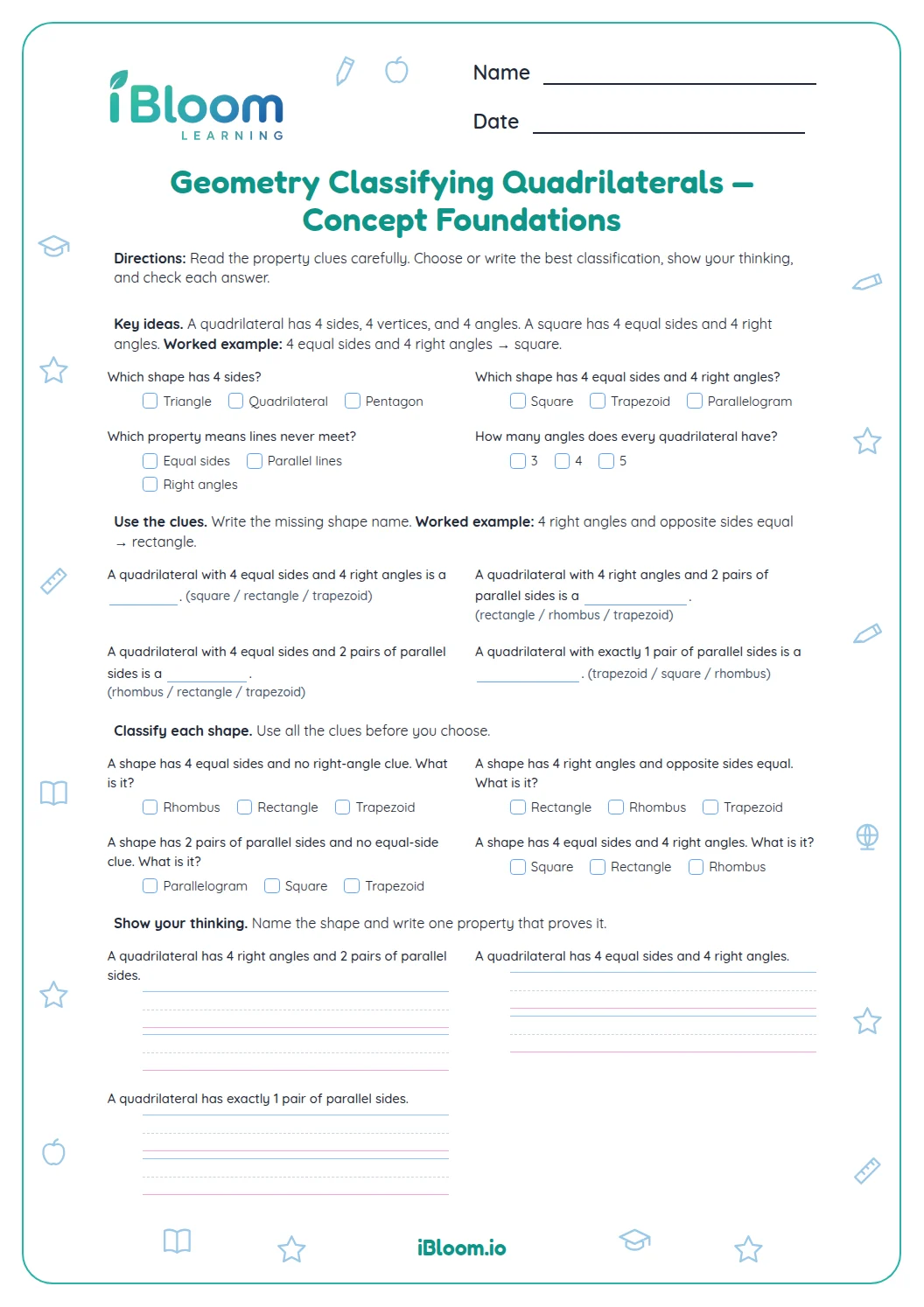
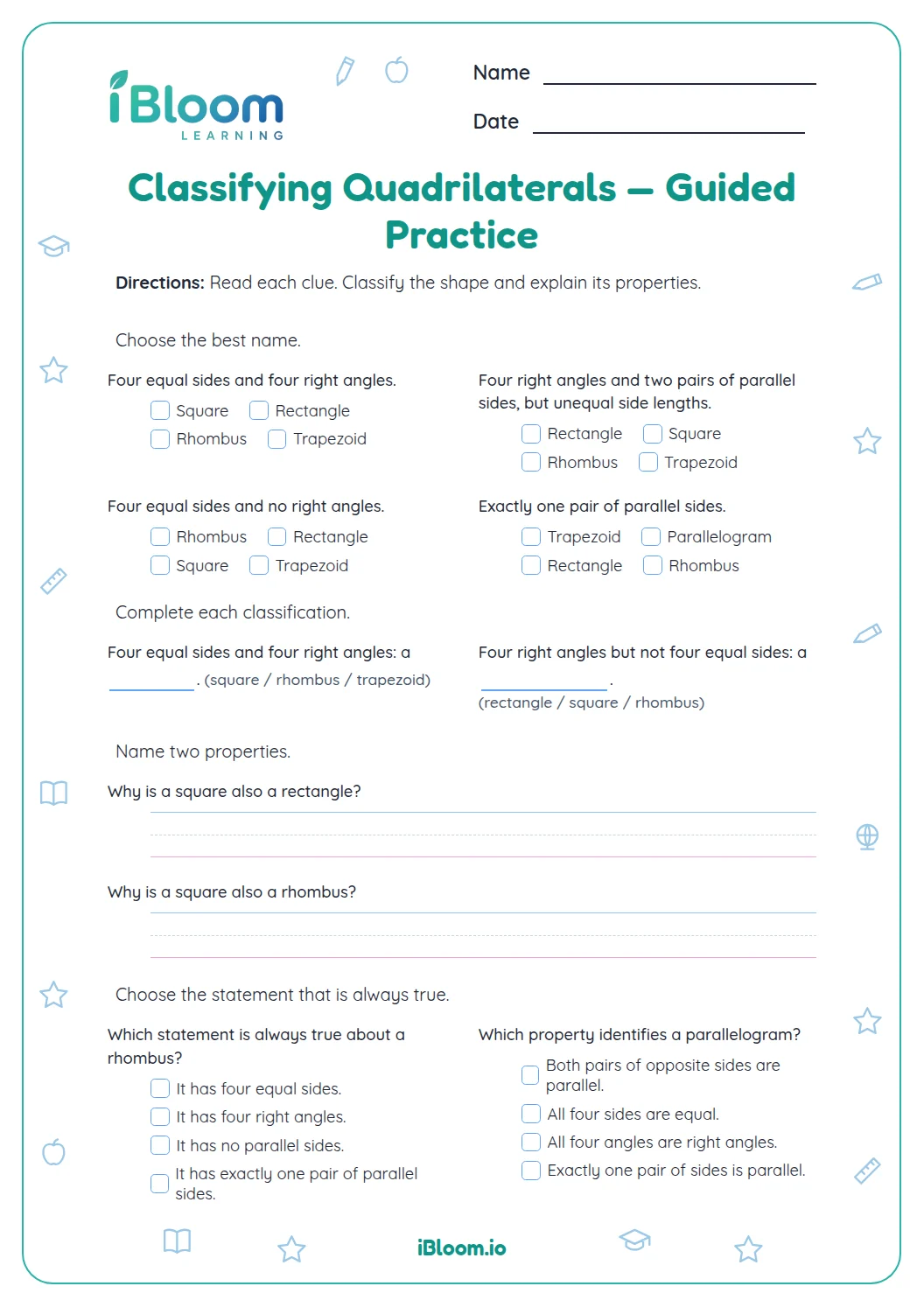
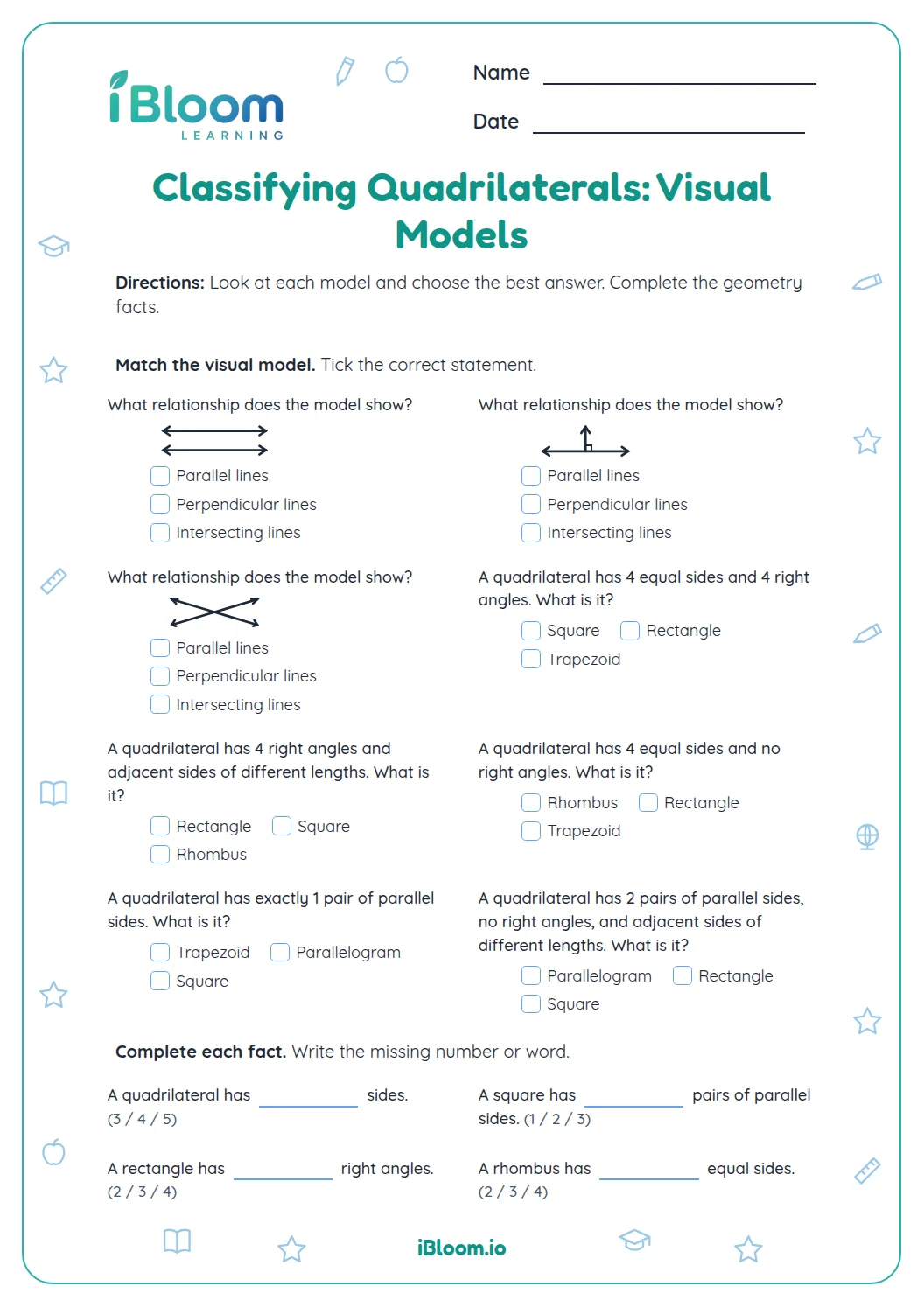
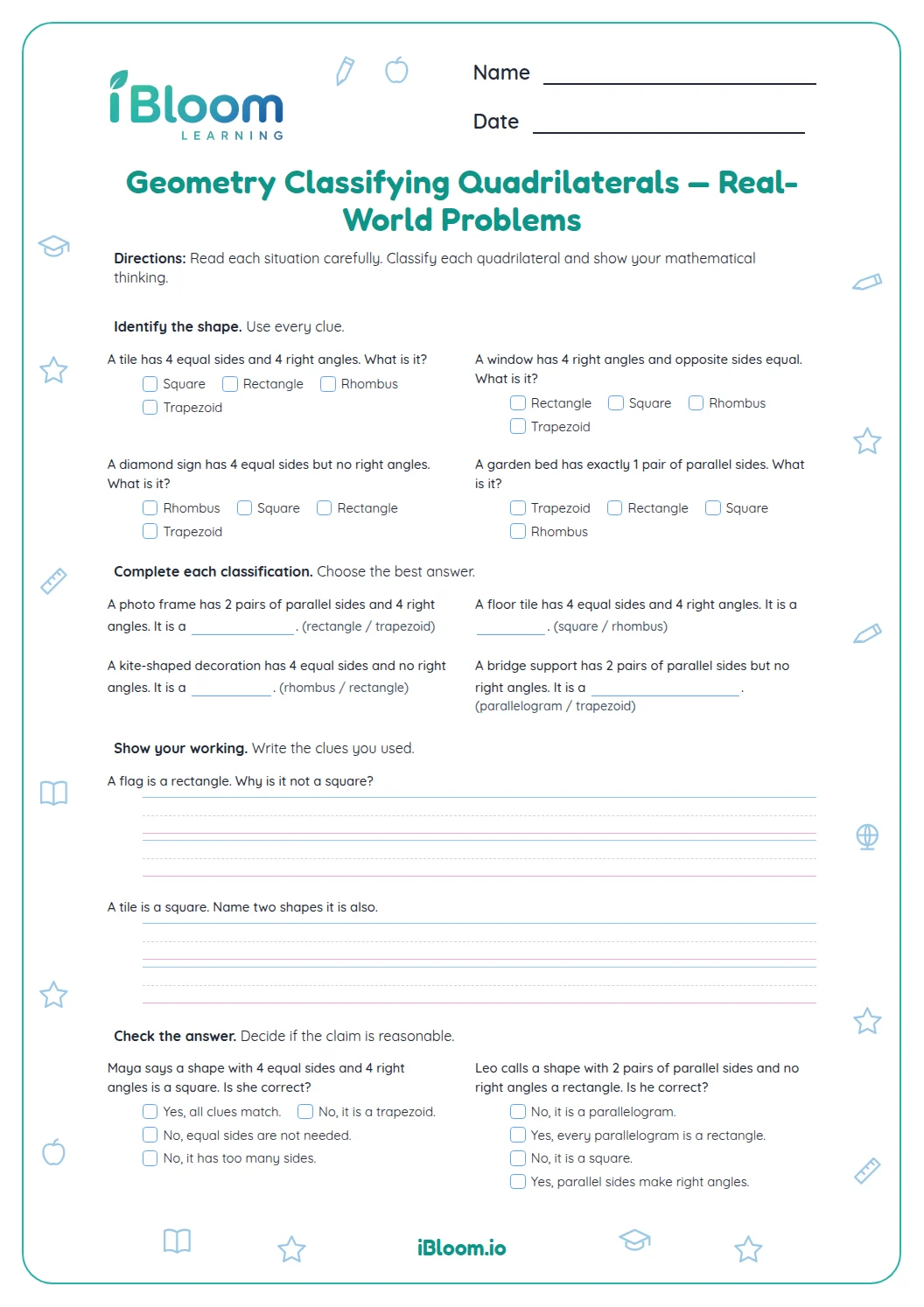
Grade 4 students classify quadrilaterals by side and angle properties through 14 questions, including brief written explanations. The answer key includes sample reasoning. Lettered shape drawings support identification and classification. The worksheet practices CCSS 4.G.A.2.
Aligned to 4.G.A.2
What does classify quadrilaterals by their properties mean?
Lettered shape models and property questions help Grade 4 students explain how quadrilaterals are related. Includes 14 questions and a separate key.
Work through the parts in order. Each section adds a new way to use the same skill.
- 1A square has four equal sides and four right angles.
- 2It is both a rectangle and a rhombus.
How is the practice organized?
There are 14 questions across three parts, followed by a separate answer key. The prompts move from recognizing the idea to using it in context.
- Part A: guided recognition and first examples
- Part B: apply the skill to new examples
- Part C: explain, solve, or write independently
How can an adult support the learner?
Read each direction aloud if needed, then ask the learner to explain one choice or step. Use the key to check the final response and revisit any item that needs another look.
How to use this worksheet
- 1Read the direction for the first part together.
- 2Model one item by thinking aloud.
- 3Let the learner complete the next items independently.
- 4Ask the learner to explain one answer.
- 5Check work with the separate answer key.
Common mistakes and quick fixes
The mistake
Rushing past an important clue in the prompt.
The fix
Underline the key word or detail before answering.
The mistake
Choosing an answer that does not fit the full question.
The fix
Reread the prompt and check that the response addresses it.
The mistake
Leaving a response unchecked.
The fix
Use the answer key and correct the work in a different color.
Common Core alignment
This worksheet practices the standard below.
Classify two-dimensional figures by parallel sides and angle properties.
On this sheet: Lettered shape models and property questions help Grade 4 students explain how quadrilaterals are related. Includes 14 questions and a separate key.
Show the official wordingHide the official wording
Classify two-dimensional figures based on the presence or absence of parallel or perpendicular lines, or the presence or absence of angles of a specified size. Recognize right triangles as a category, and identify right triangles.
What to practice next
Make more practice
Further reading
Questions parents and teachers ask
What skill does this page practice?
The worksheet asks students to classify quadrilaterals by their sides and angles. Lettered shape drawings show examples, and later items ask students to apply properties such as equal sides, right angles, and parallel sides. Classification depends on the properties stated or visible, not on how a shape is turned.
How many questions are included?
There are 14 questions in three parts: identify and compare drawn shapes, choose properties that always apply, and explain classifications in writing. The answer key includes sample explanations for open responses. Classification depends on the properties stated or visible, not on how a shape is turned.
Can an adult read the directions aloud?
Yes. Ask the learner to name the property in the prompt, then inspect the drawn shape for that property. For written items, a complete answer names the shape and states which side or angle fact supports the classification. Classification depends on the properties stated or visible, not on how a shape is turned.
How should mistakes be reviewed?
A square has four equal sides and four right angles. A rectangle must have four right angles, but its sides do not all need to be equal. Check both side and angle properties before naming a shape. Classification depends on the properties stated or visible, not on how a shape is turned.
Is the answer key included?
Yes. The key lists selected answers and sample reasoning for written items. Other explanations are acceptable when they correctly use the shape’s properties, such as four equal sides or two pairs of parallel sides. Classification depends on the properties stated or visible, not on how a shape is turned.