




About this worksheet
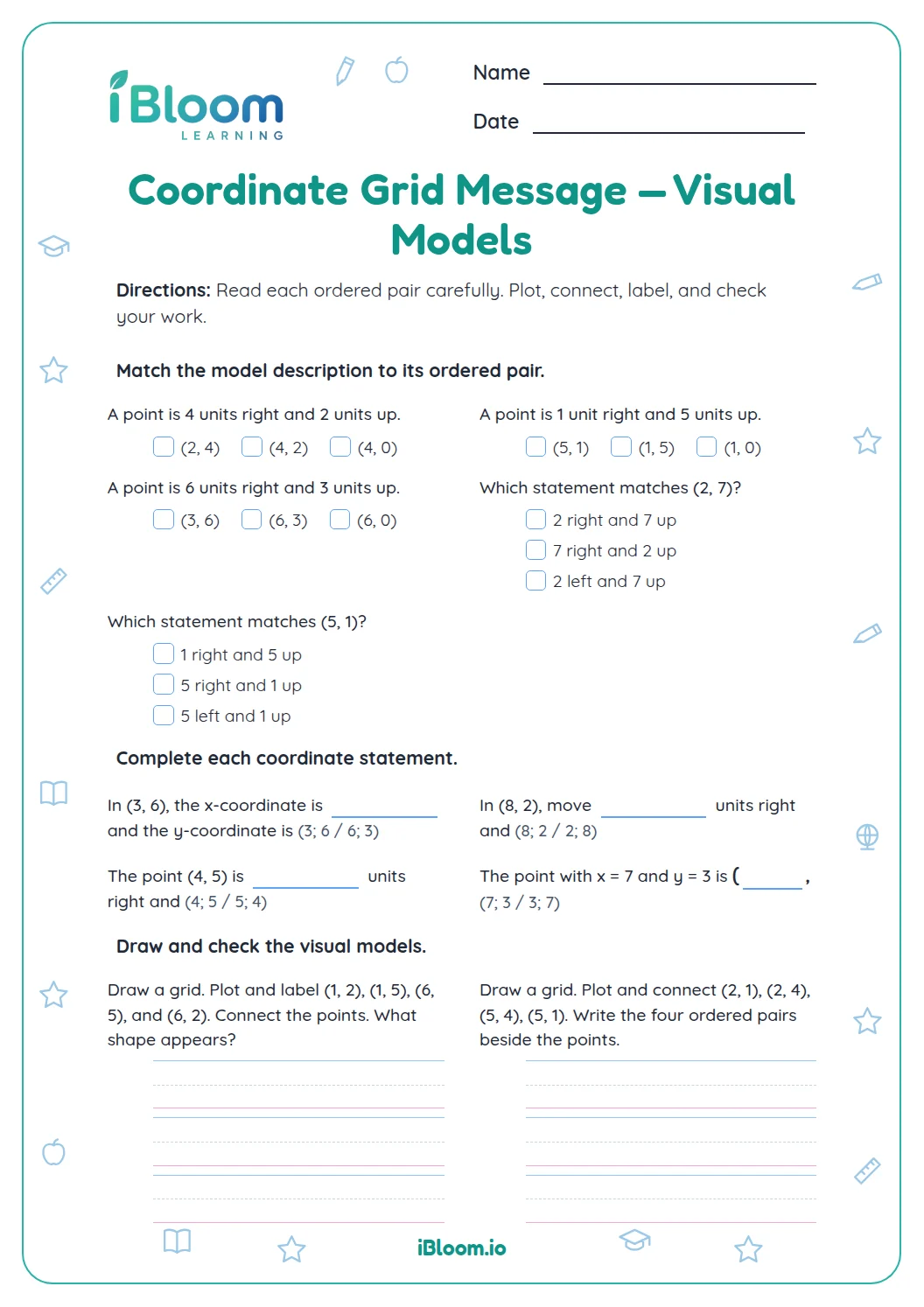
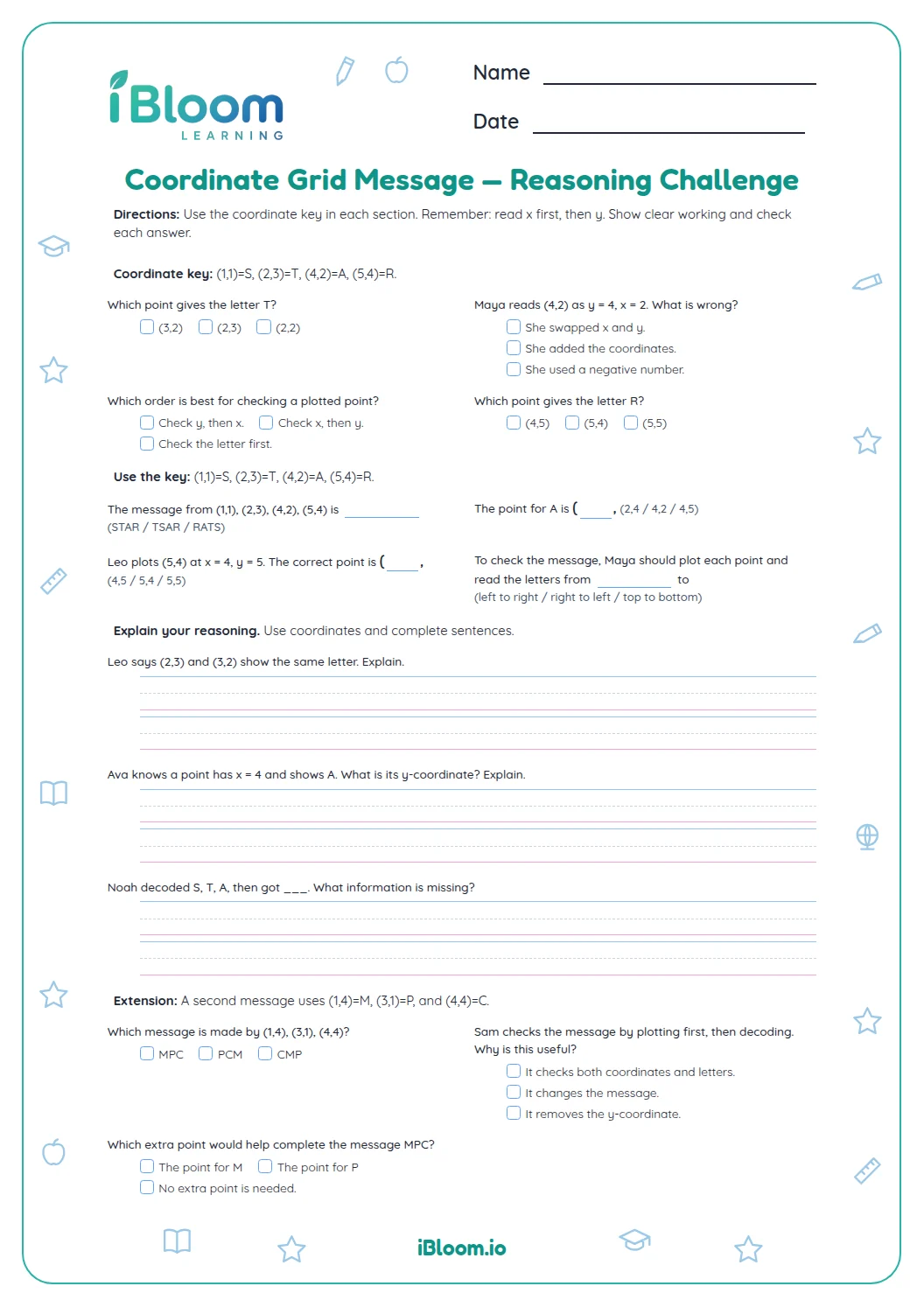
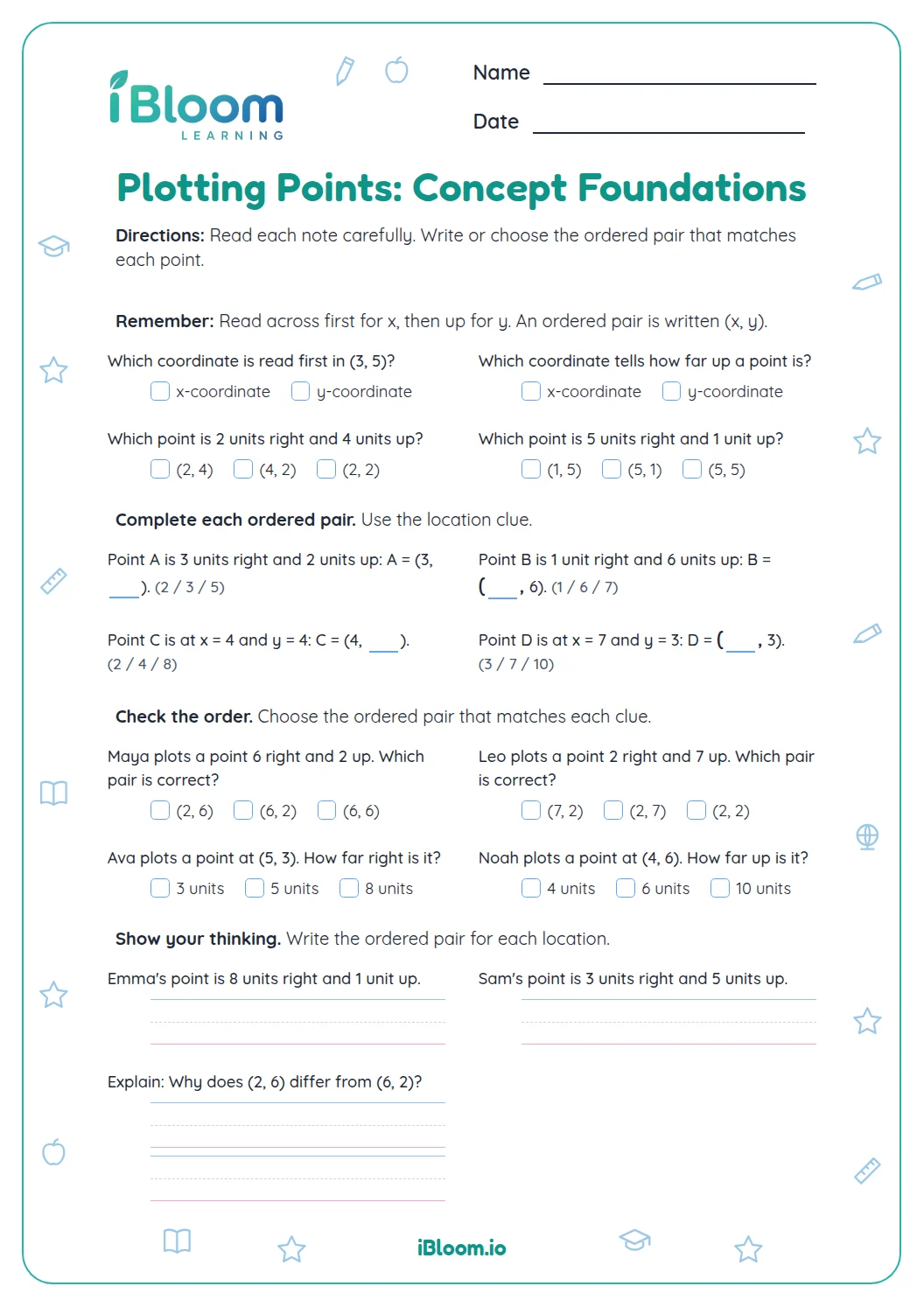
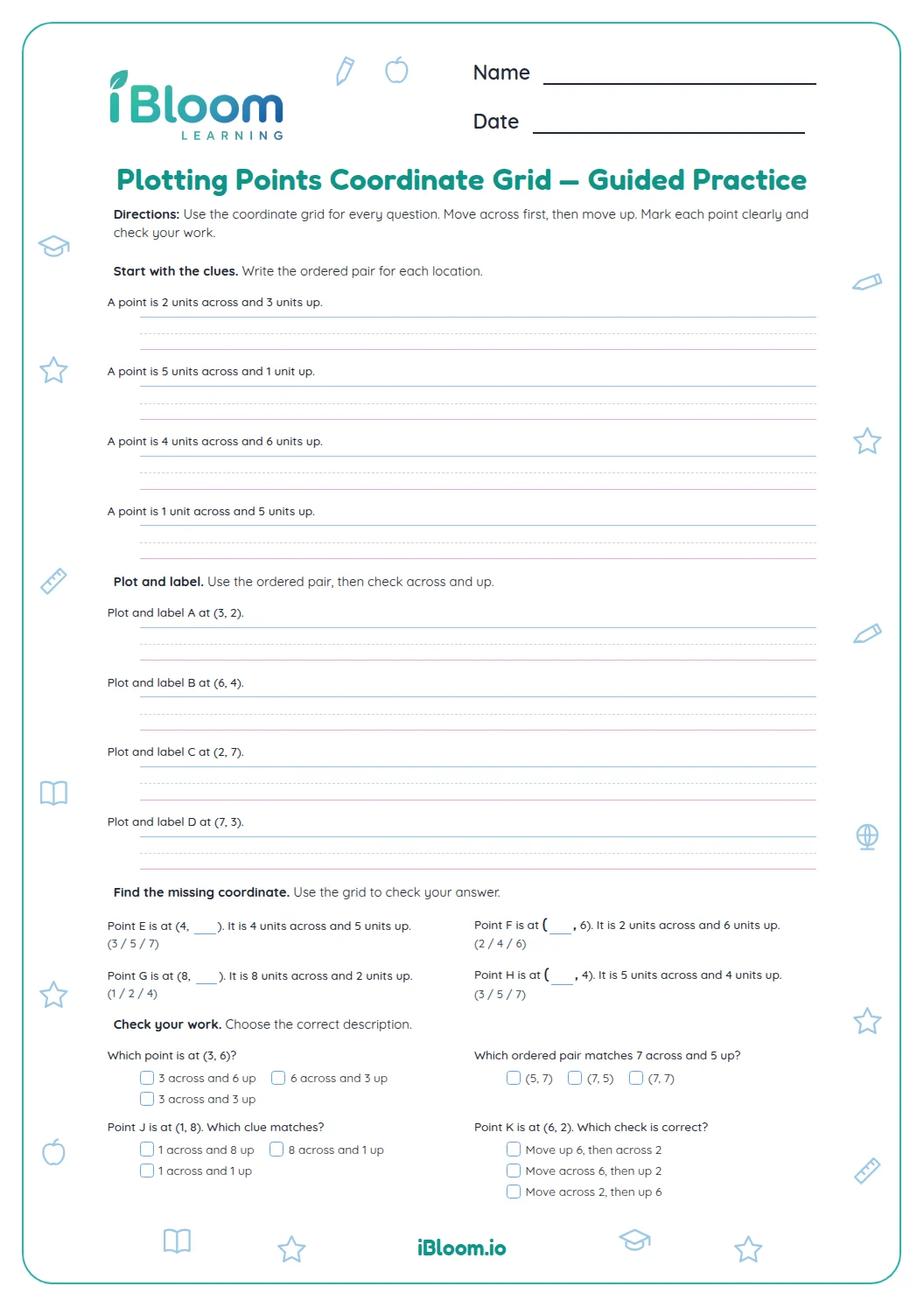
This printable coordinate-grid worksheet asks students to decode PLAY BALL from labeled points, then answer 13 short questions about ordered pairs, position, and movement. It practices the x-then-y convention and first-quadrant graphing described by CCSS 5.G.A.1 and 5.G.A.2. The separate key gives the message and each response.
Aligned to 5.G.A.1 and 5.G.A.2
How do the plotted letters make a message?
Read the point labels across the lower row, then across the upper row. The directions mark where the space goes.
- 1Lower row: P-L-A-Y.
- 2Upper row: B-A-L-L.
- 3The message is PLAY BALL.
Which coordinate tells across or up?
In an ordered pair (x, y), x gives the horizontal move and y gives the vertical move. Compare y-values to compare height, and x-values to compare left and right.
What changes when a point moves?
A right-or-left move changes x. An up-or-down move changes y. Keep the other coordinate the same.
How to work through the grid
- 1Read the x-coordinate first.
- 2Read the y-coordinate second.
- 3Compare x-values for left and right.
- 4Compare y-values for height.
- 5Change one coordinate for a one-direction move.
Common mistakes and quick fixes
The mistake
Switching the x- and y-coordinates.
The fix
Read the first number as across and the second as up.
The mistake
Comparing the wrong coordinate to decide which point is higher.
The fix
Compare y-coordinates for height; compare x-coordinates for left and right.
The mistake
Changing both numbers when a point moves in one direction.
The fix
Change only x for left or right, and only y for up or down.
Common Core alignment
Use perpendicular axes and ordered pairs to name points on a coordinate grid.
On this sheet:
Show the official wordingHide the official wording
Understand that a two-dimensional coordinate system is defined by a pair of perpendicular number lines, called axes, that intersect at the origin (the 0 point on each line). Understand that the point where the axes intersect is called the origin, and that the numbers on the coordinate grid are called coordinates.
Graph and interpret first-quadrant points in mathematical problems.
On this sheet:
Show the official wordingHide the official wording
Represent real world and mathematical problems by graphing points in the first quadrant of the coordinate plane, and interpret coordinate values of points in the context of the situation.
What to practice next
Make more practice
Further reading
Questions parents and teachers ask
What message does the worksheet reveal?
The labels read PLAY across the lower row and BALL across the upper row. Read the lower row from left to right, then the upper row, and leave a space between the words. The remaining questions practice reading and comparing coordinates and describing short moves.
How do you read an ordered pair?
Read the first number as x, the horizontal distance across from the origin. Read the second number as y, the vertical distance up. For (3, 5), move three units right and five units up. Keep that order when you name or compare points.
What is the answer key for?
The separate answer key gives the decoded message and all 13 coordinate answers. Students can complete the worksheet first, then use the key to check the point comparisons and moves. If an answer differs, trace from the origin across first and up second.
How can I help a child compare points?
Ask which coordinate answers the question. Compare x-values when deciding which point is farther right, and compare y-values when deciding which point is higher. Keeping one coordinate in view at a time makes the comparison easier to explain.
How long does this worksheet take?
Plan for about 20 minutes to decode the grid and complete the 13 short coordinate questions. Time depends on how quickly the learner reads the pairs and checks each move. The answer key is included for a quick review after the student finishes.