
About this worksheet
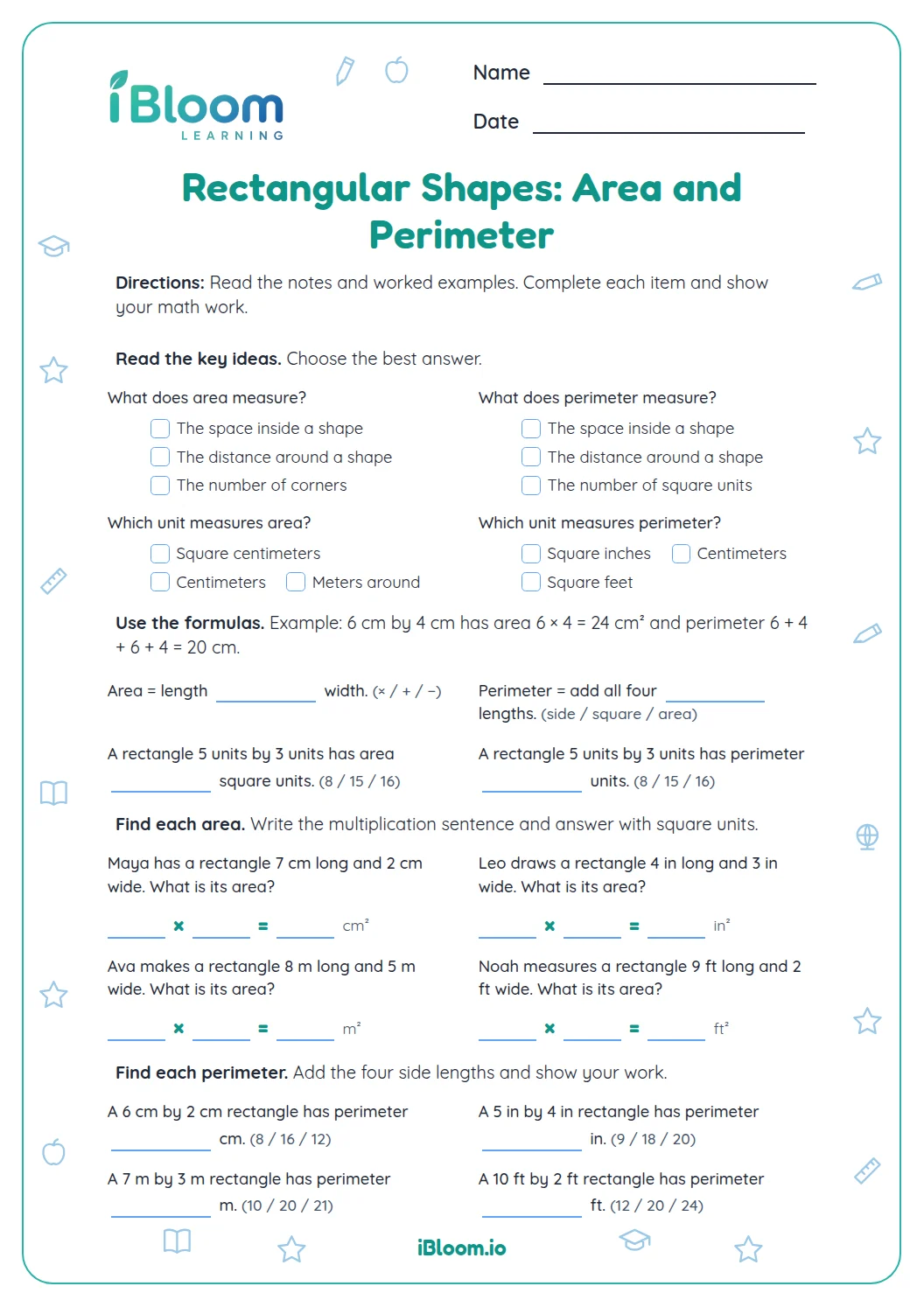
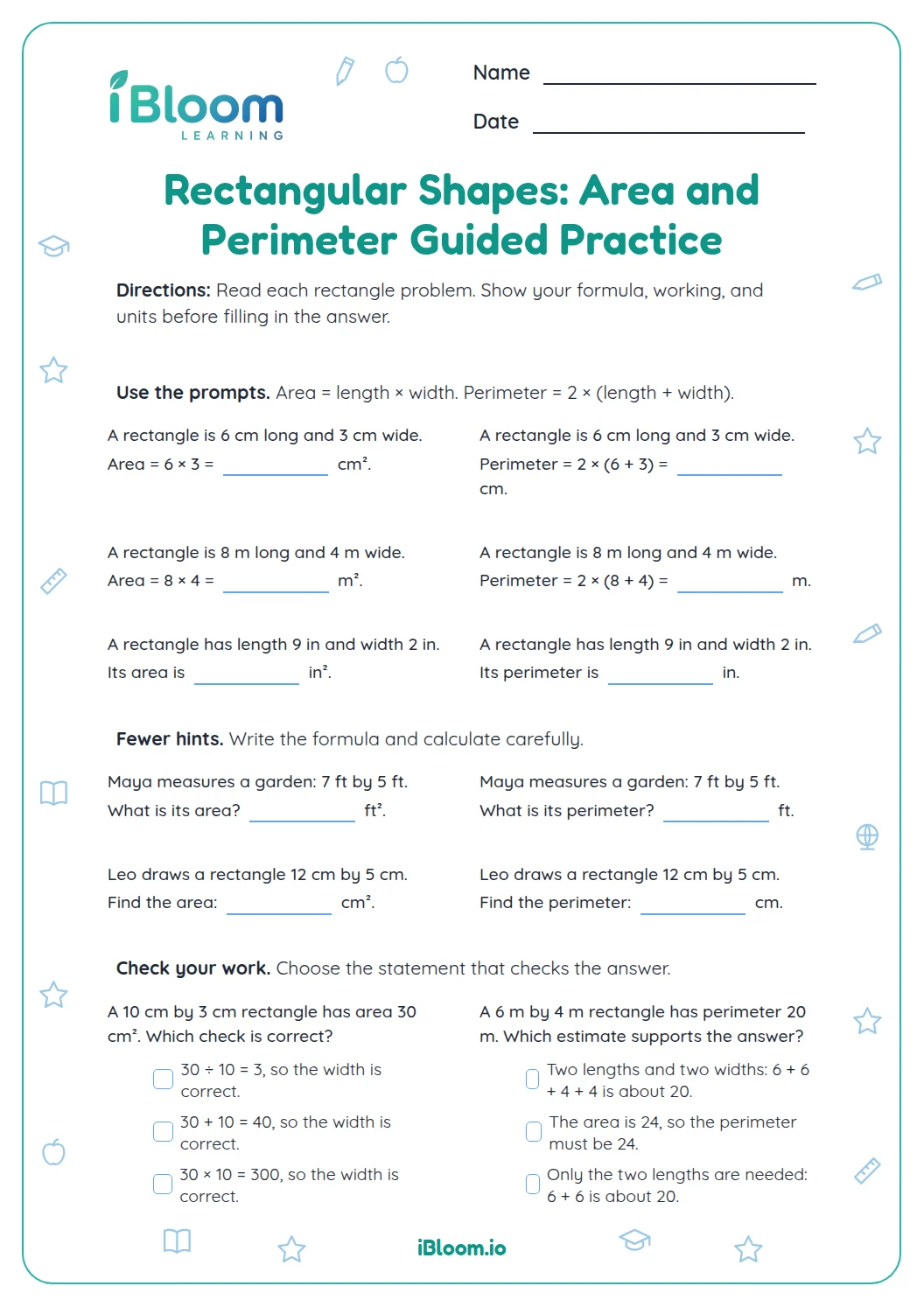
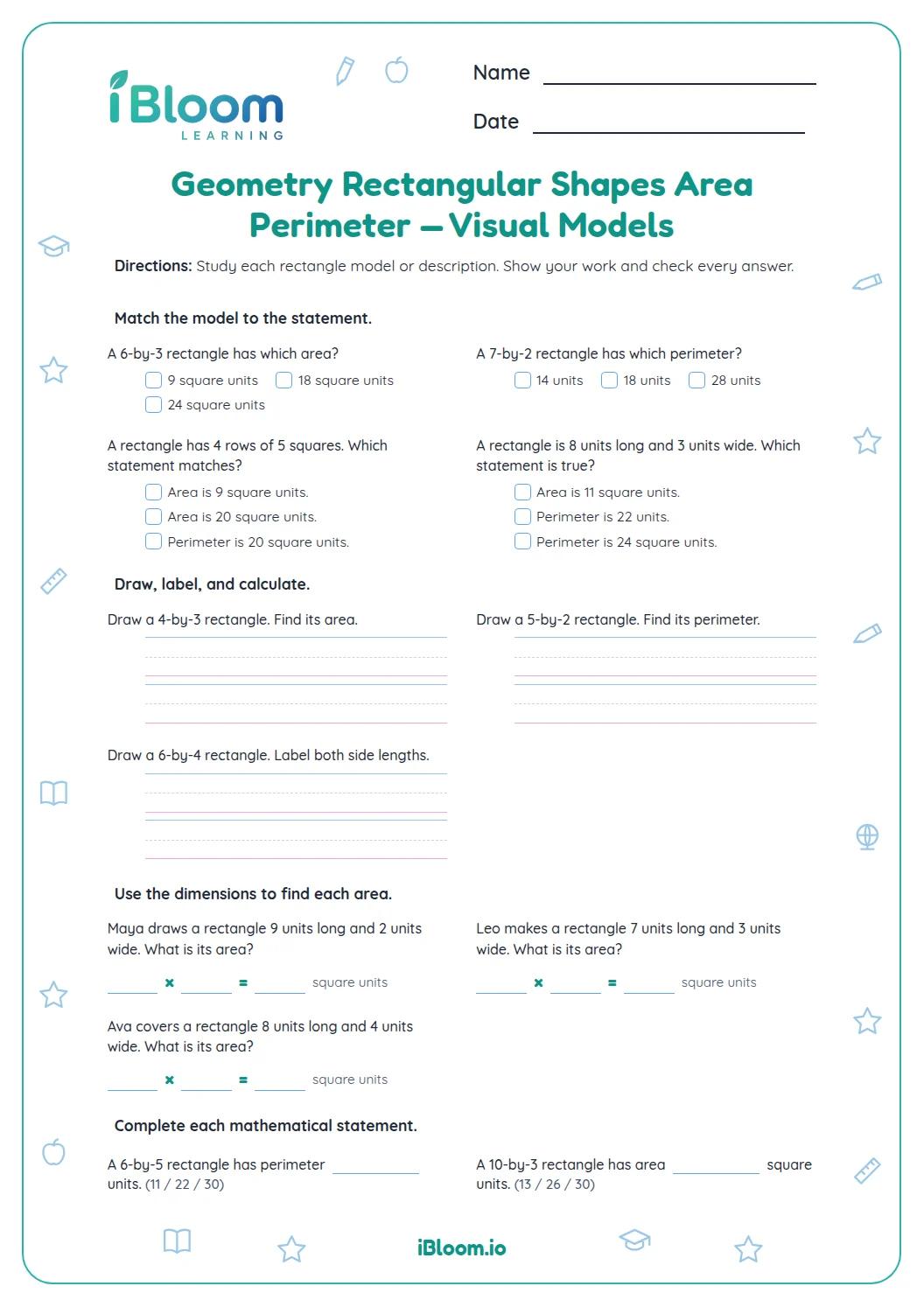
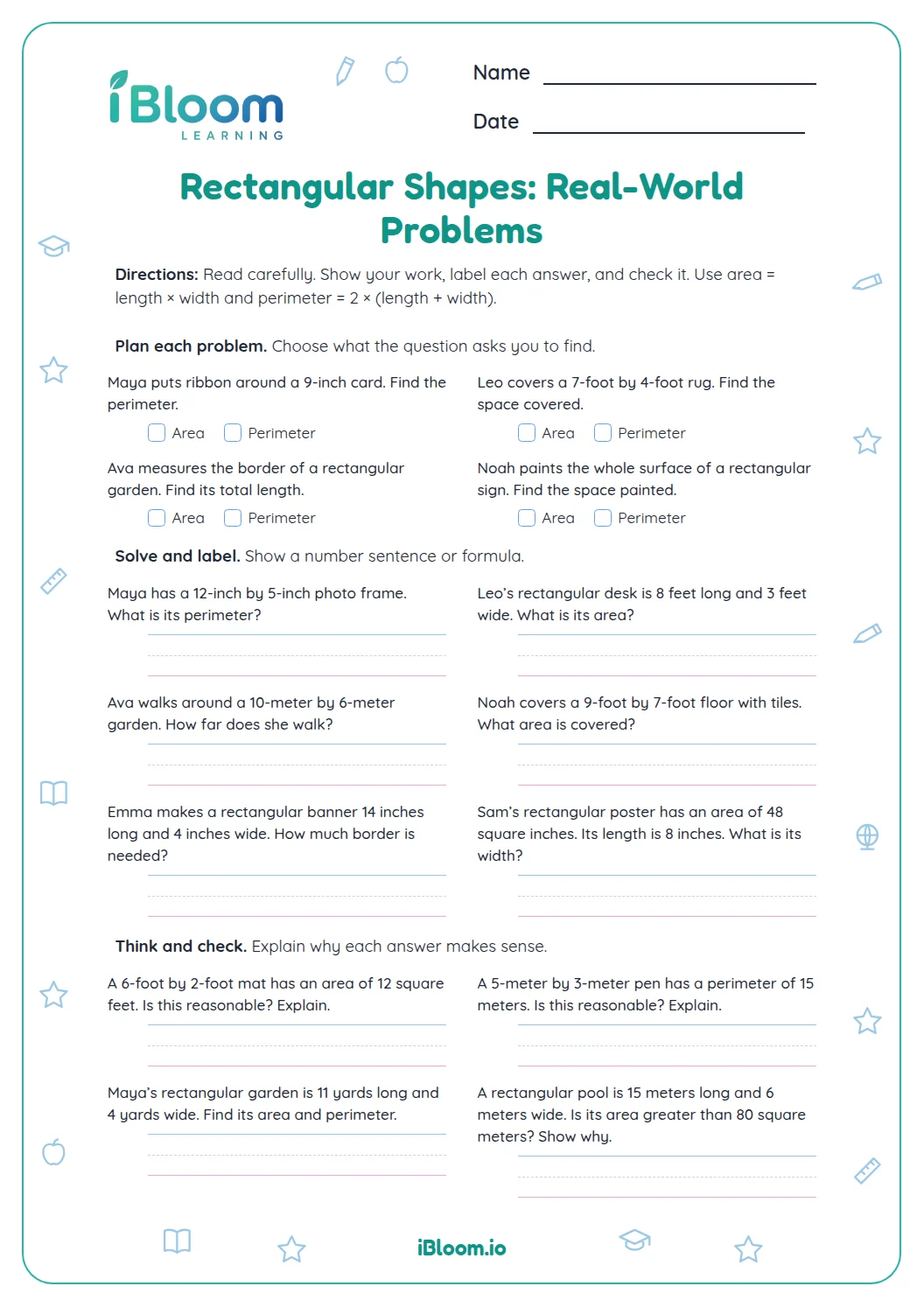
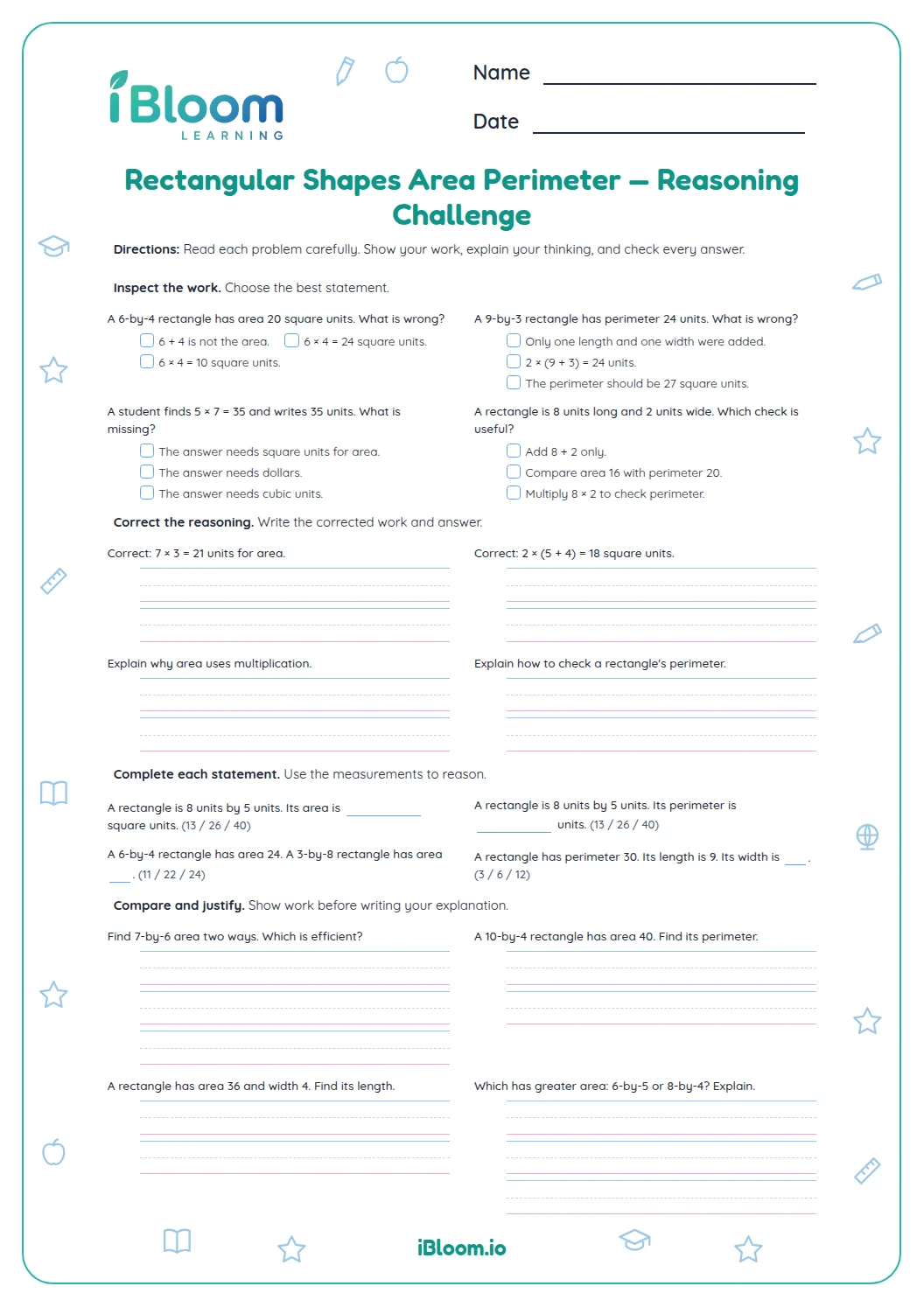
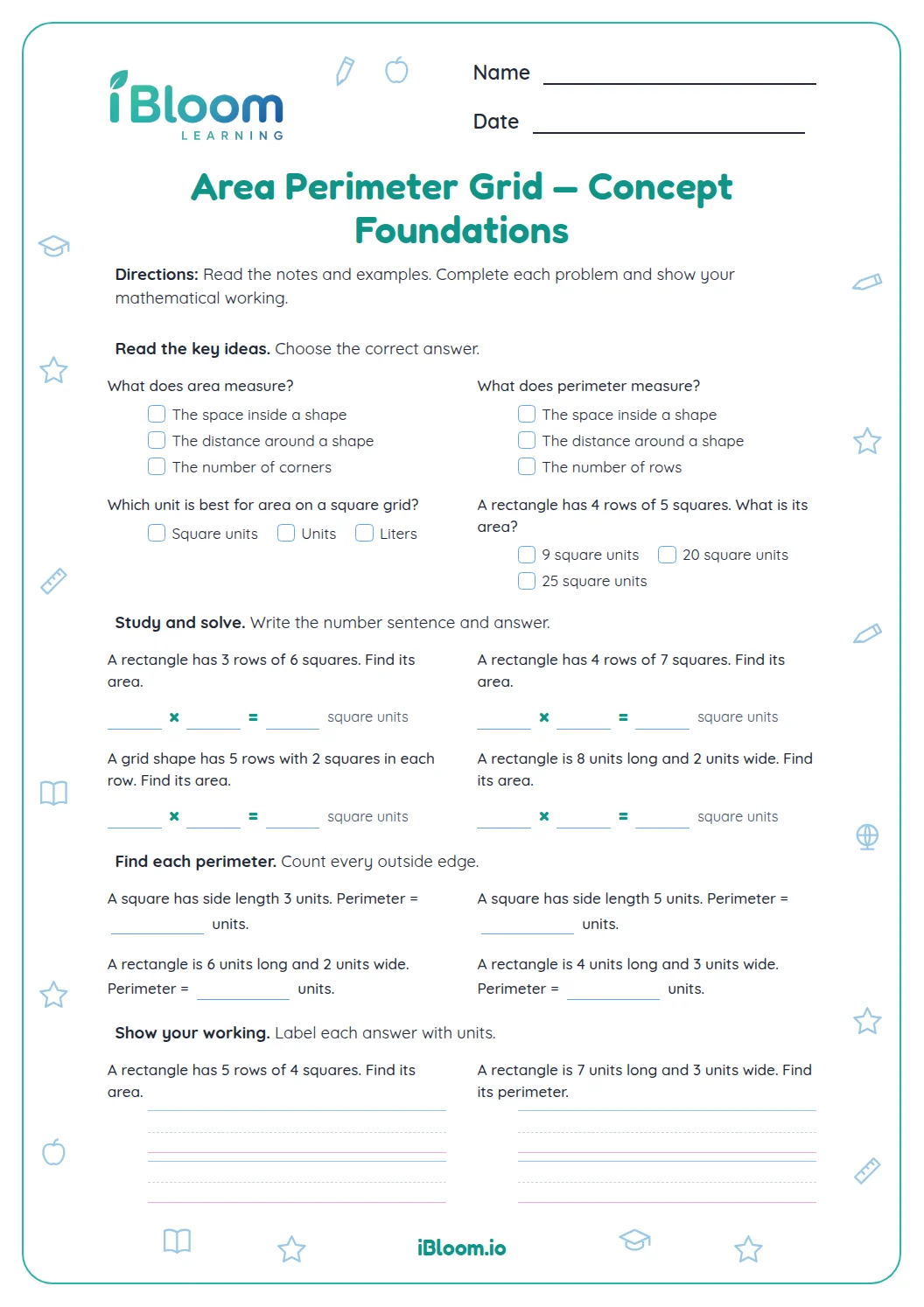
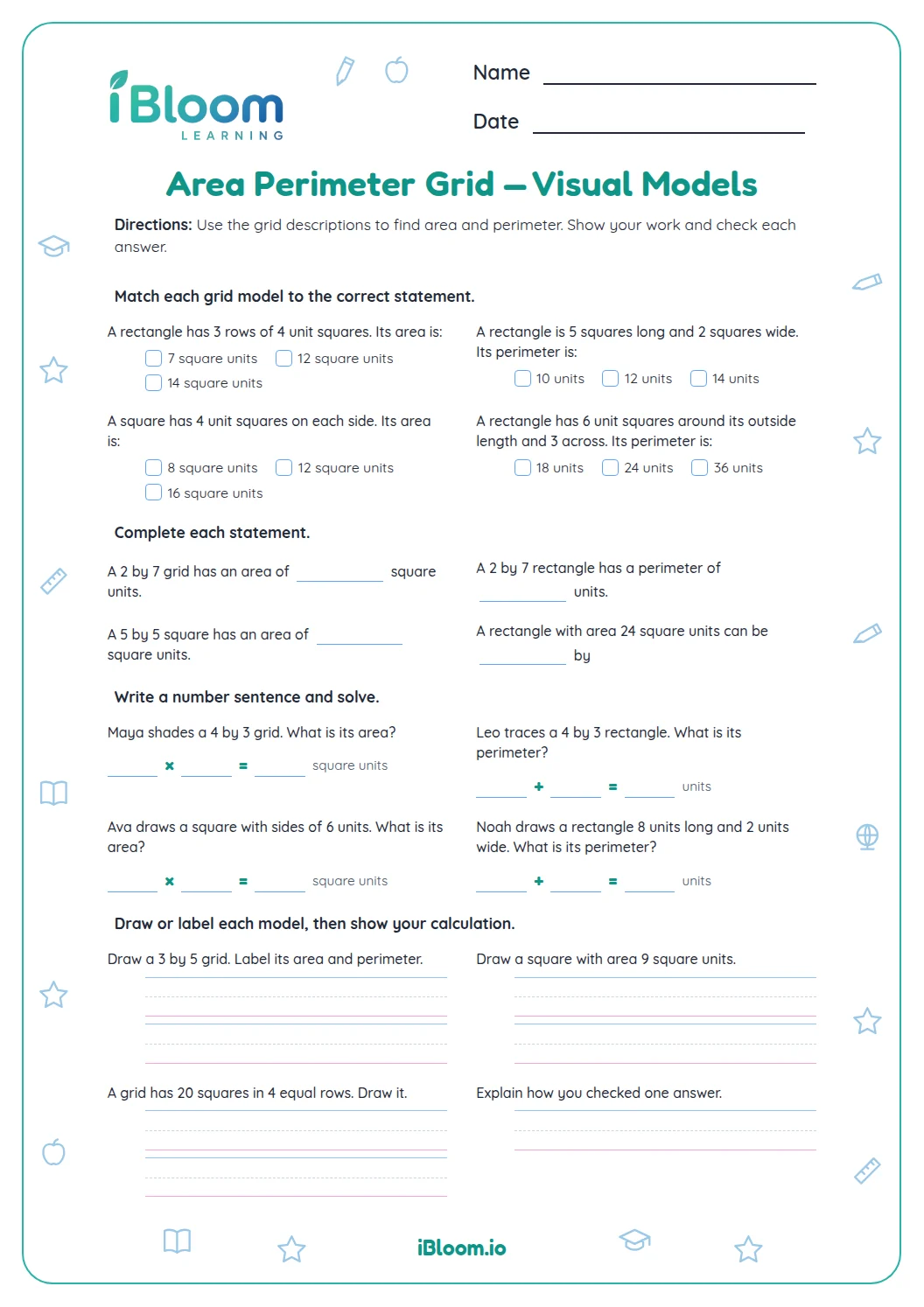
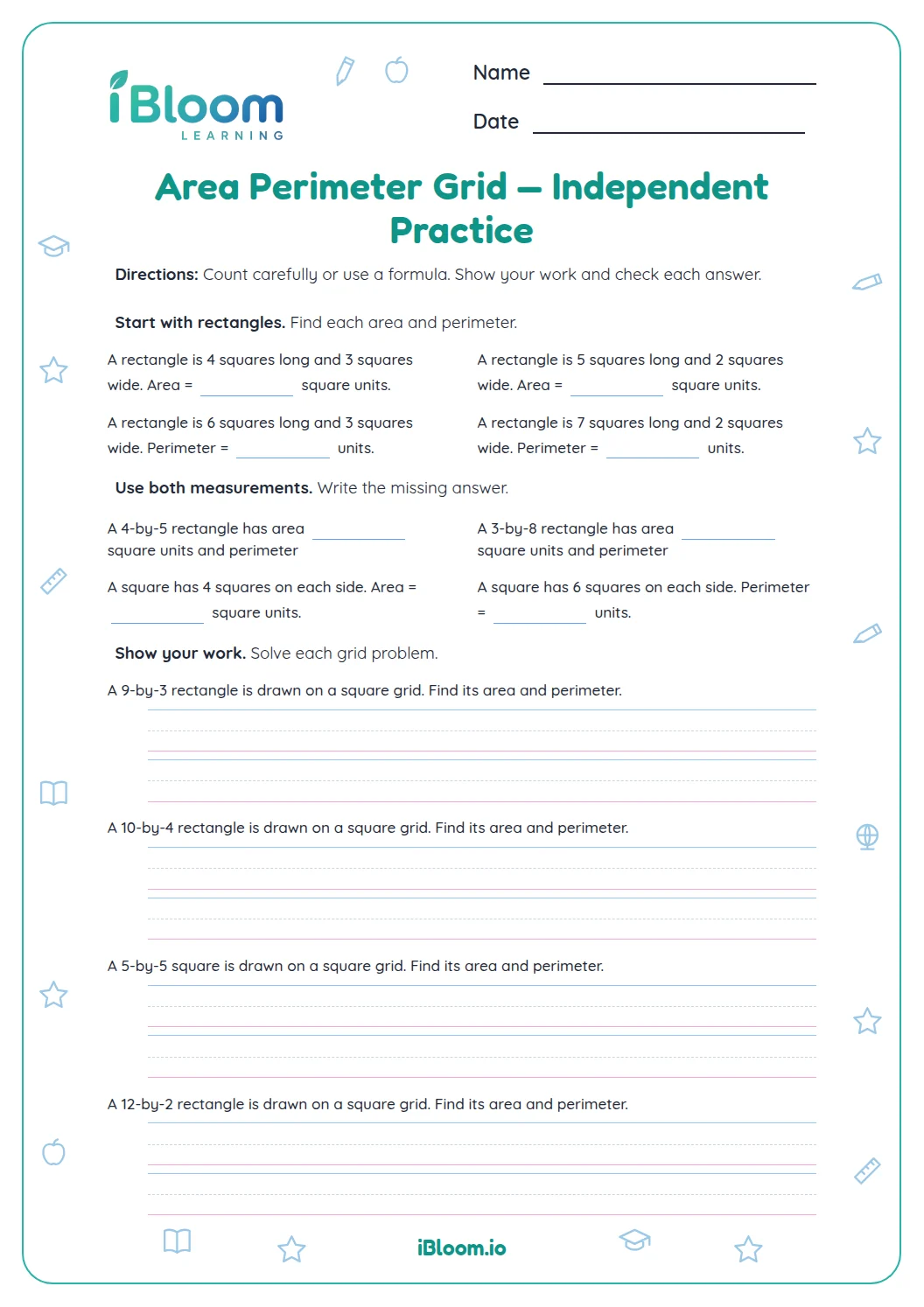
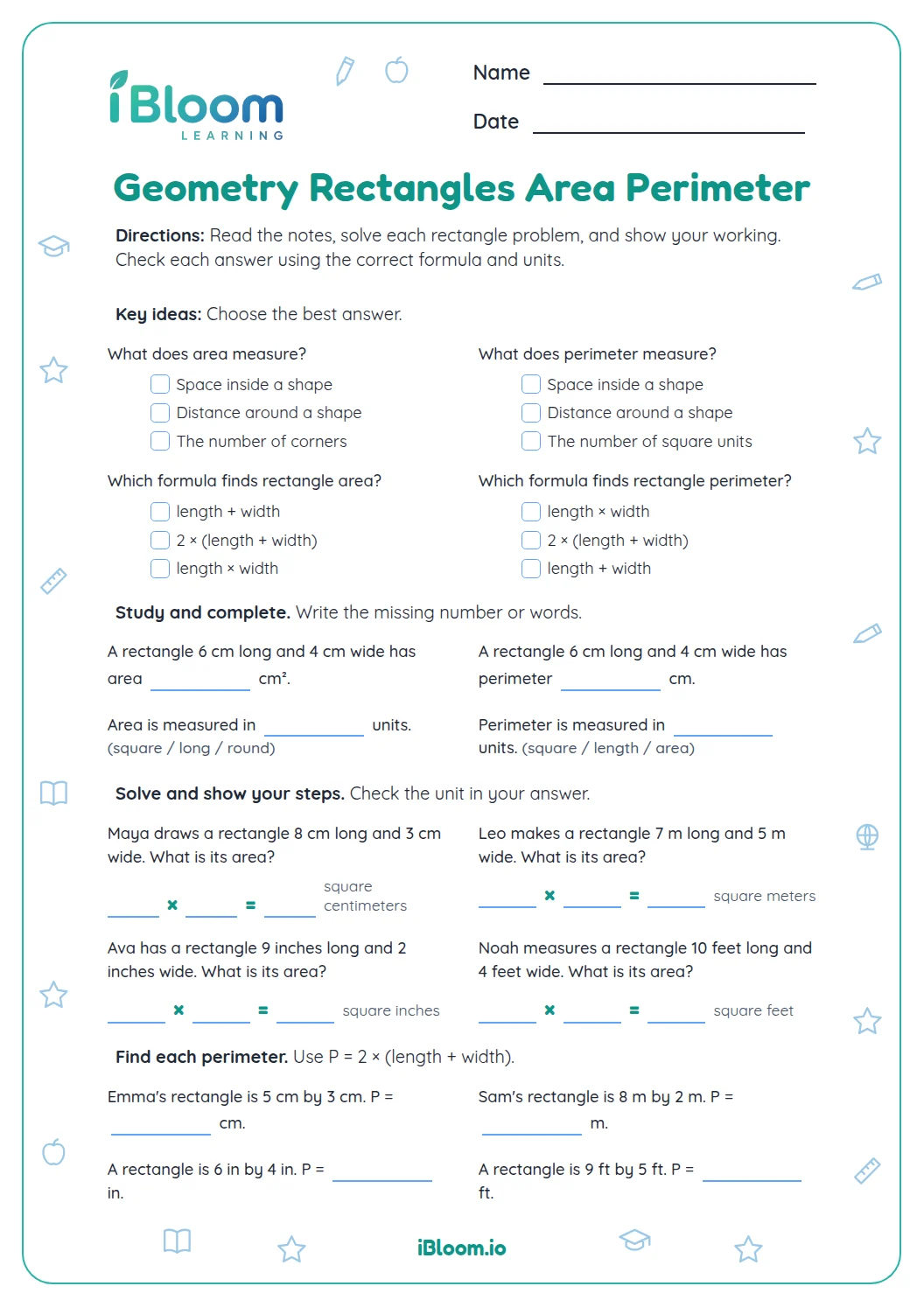
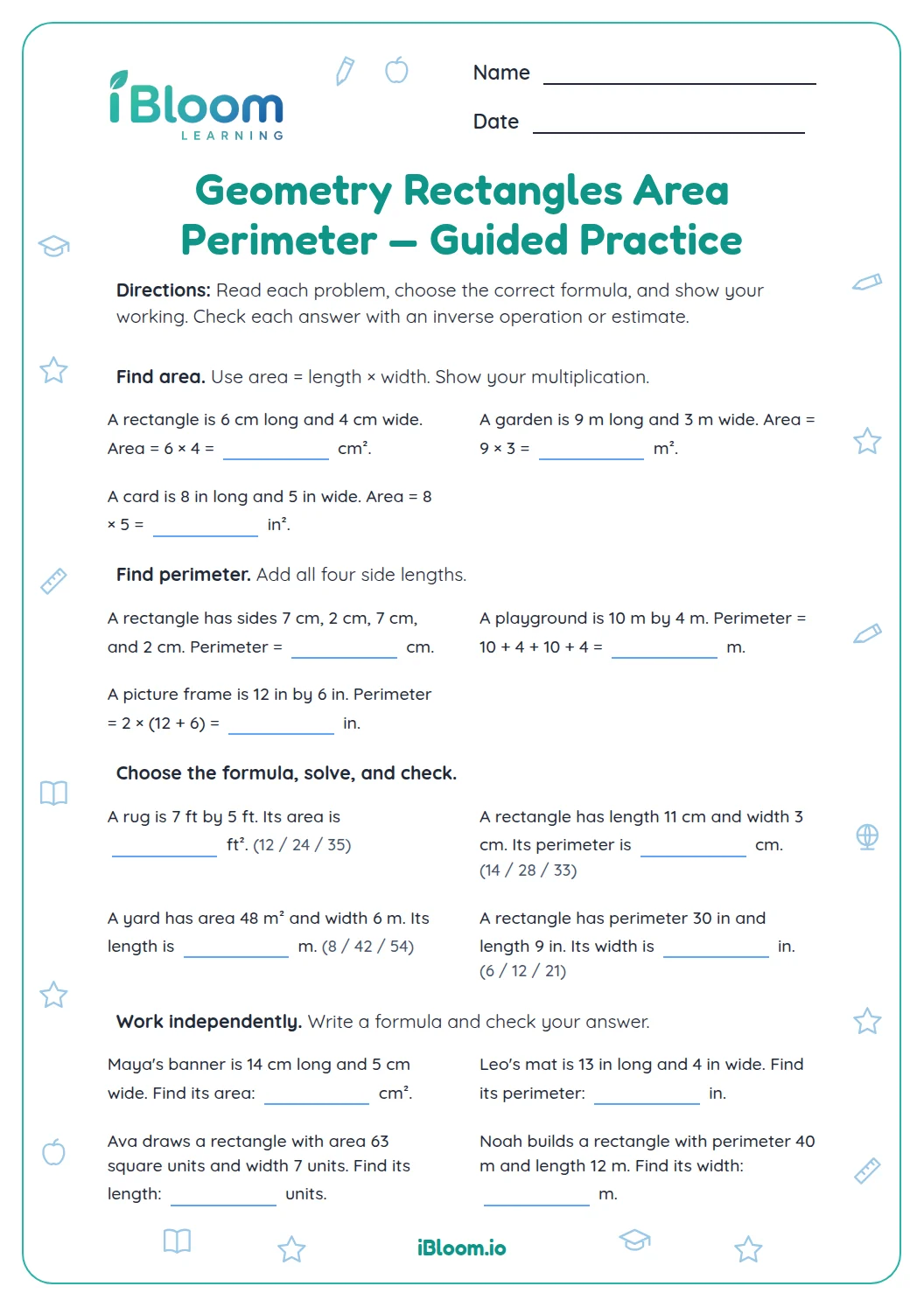
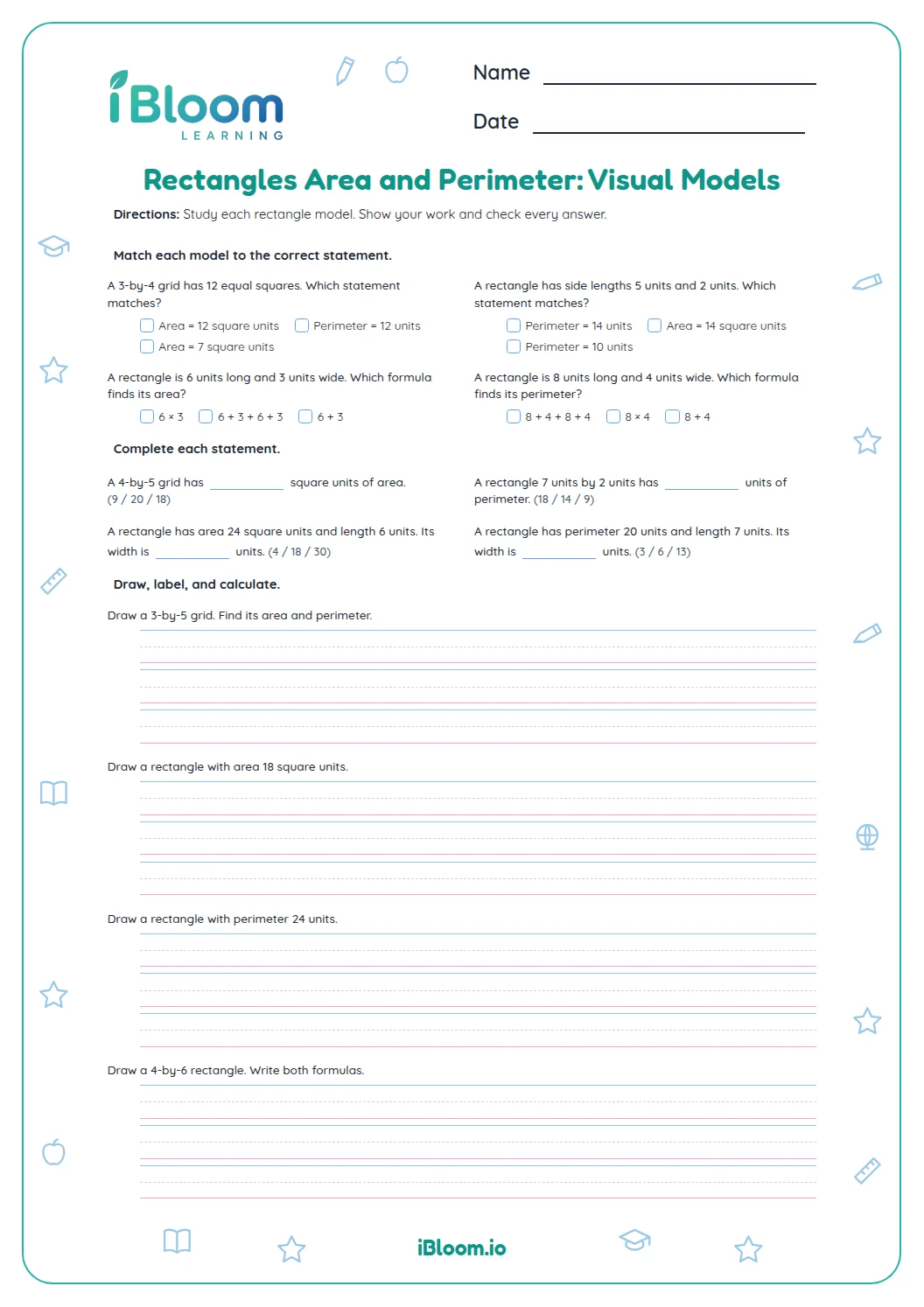
This free printable gives Grade 4 students 14 questions on rectangle area and perimeter. Students calculate with the formulas, find missing side lengths, solve measurement problems, and recall a formula across three parts. A separate answer key spans two pages. The page practices CCSS 4.MD.A.3.
Aligned to 4.MD.A.3
How do area and perimeter differ?
Area measures the square units inside a rectangle. Perimeter measures the distance around its four sides. For an 8 cm by 3 cm rectangle, area is 8 × 3 = 24 cm²; perimeter is 8 + 3 + 8 + 3 = 22 cm.
How can you find a missing side?
Use the known measurement and the formula. If area is 40 square inches and width is 5 inches, divide 40 by 5 to find a length of 8 inches.
Which units belong with each answer?
Perimeter uses length units such as cm or ft. Area uses square units such as cm² or square feet.
How to use this worksheet
- 1Read whether the question asks for space inside or distance around.
- 2Write the matching formula before calculating.
- 3Substitute the side lengths and calculate.
- 4Use square units for area and length units for perimeter.
- 5Check whether the answer is reasonable for the rectangle.
Common mistakes and quick fixes
The mistake
Using length × width for perimeter.
The fix
Use length × width for area, and add all four sides for perimeter.
The mistake
Leaving out one of the two lengths and widths when adding perimeter.
The fix
Leave out a side when finding perimeter; add both lengths and both widths.
The mistake
Writing cm instead of cm² for area.
The fix
Write square units, such as cm², for area; use cm for perimeter.
Common Core alignment
Apply rectangle area and perimeter formulas to solve measurement problems.
On this sheet: Students calculate rectangle area and perimeter and find a missing side from the area.
Show the official wordingHide the official wording
Apply the area and perimeter formulas for rectangles in real world and mathematical problems. For example, find the width of a rectangular room given the area of the flooring and the length, by viewing the area formula as a multiplication equation with an unknown factor .
What to practice next
Make more practice
Further reading
Questions parents and teachers ask
What is the difference between area and perimeter?
Area measures the square units inside a rectangle; perimeter measures the distance around it. This worksheet asks students to calculate both, find missing side lengths, and use the formulas in garden, rug, and other measurement problems. Check each result by substituting it into the formula.
How many questions are on this worksheet?
There are 14 questions across two worksheet pages. Students calculate area and perimeter, solve for missing sides, use the formulas in context, and recall a formula. A separate two-page answer key shows the expected answers. A quick calculation with the formula can verify the result.
Which units should students use for area?
Area is measured in square units, such as square centimeters or square feet. Perimeter uses length units, such as centimeters or feet. The worksheet names units in most questions; remind students to carry the correct unit into each answer. This page uses both area and perimeter formulas in practice.
How does the answer key handle the written problems?
The key gives a concise answer with units for each measurement problem. For example, the garden needs 30 m of fencing, while an 8 ft by 6 ft rug has a length of 6 ft when its area is 48 square feet.
What is a good way to check a missing side?
Substitute the side you found back into the relevant formula. For an area problem, multiply the two side lengths; for perimeter, add all four sides. Check that the result matches the given area or perimeter and that the units make sense.