


About this worksheet
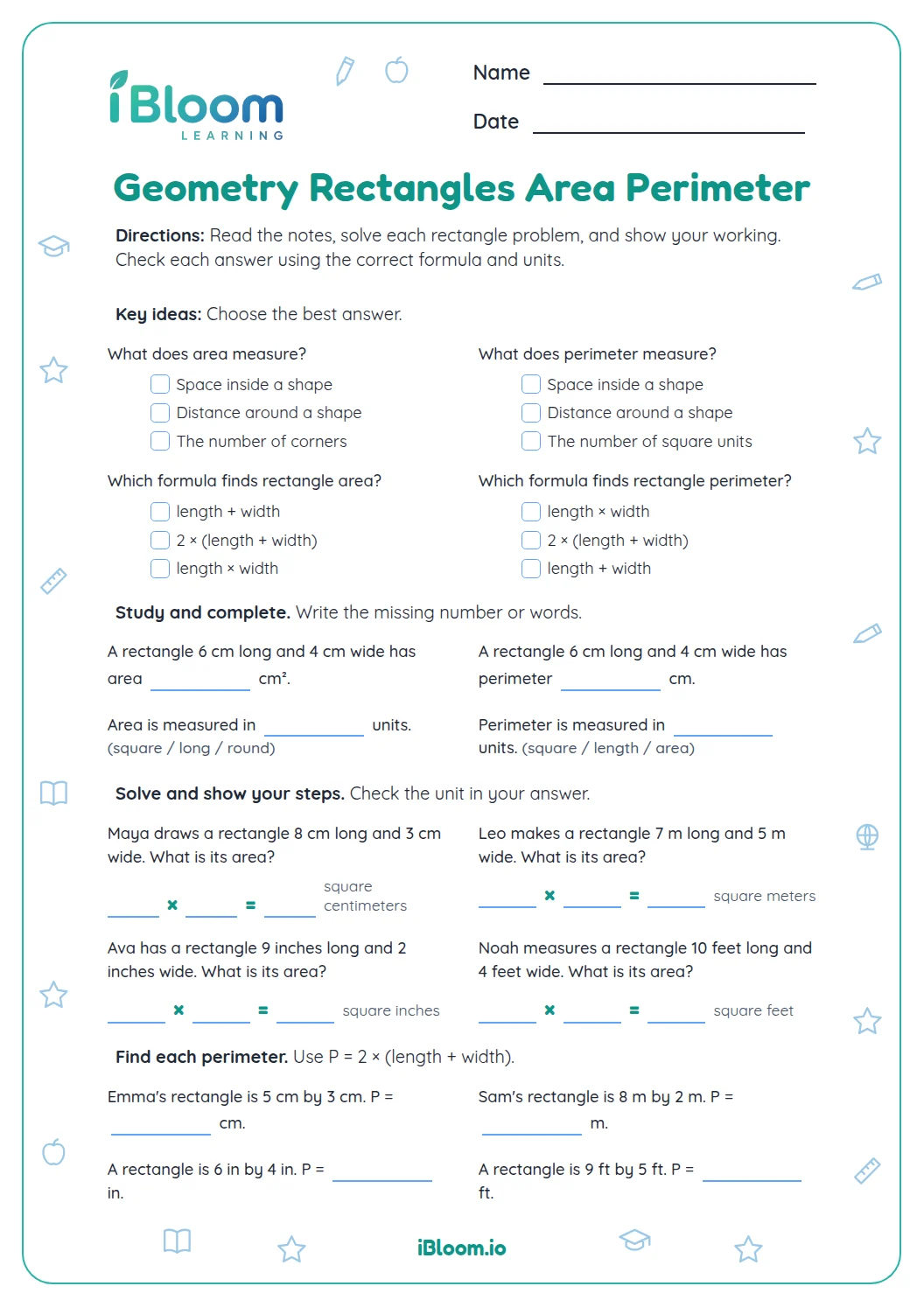
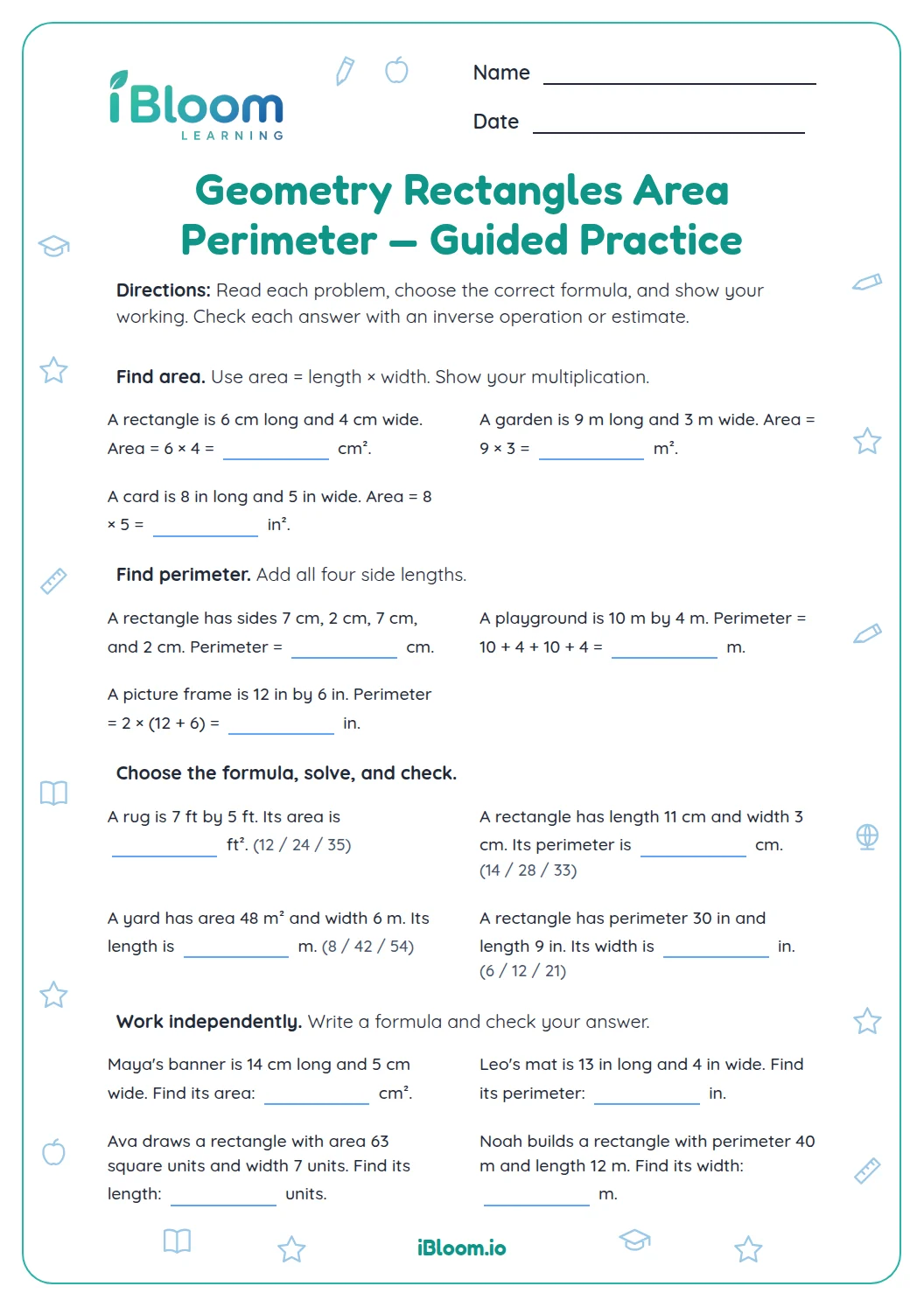
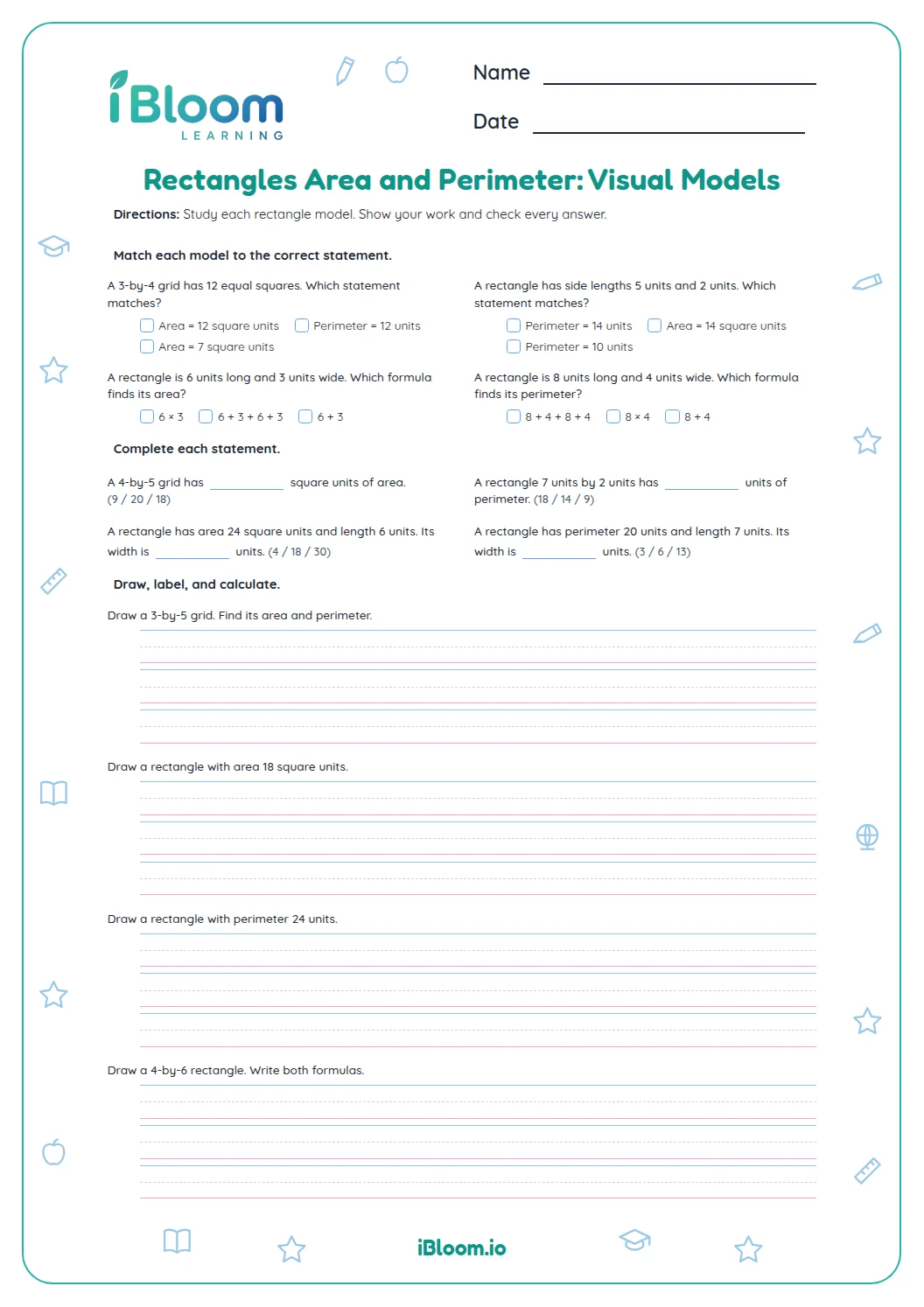
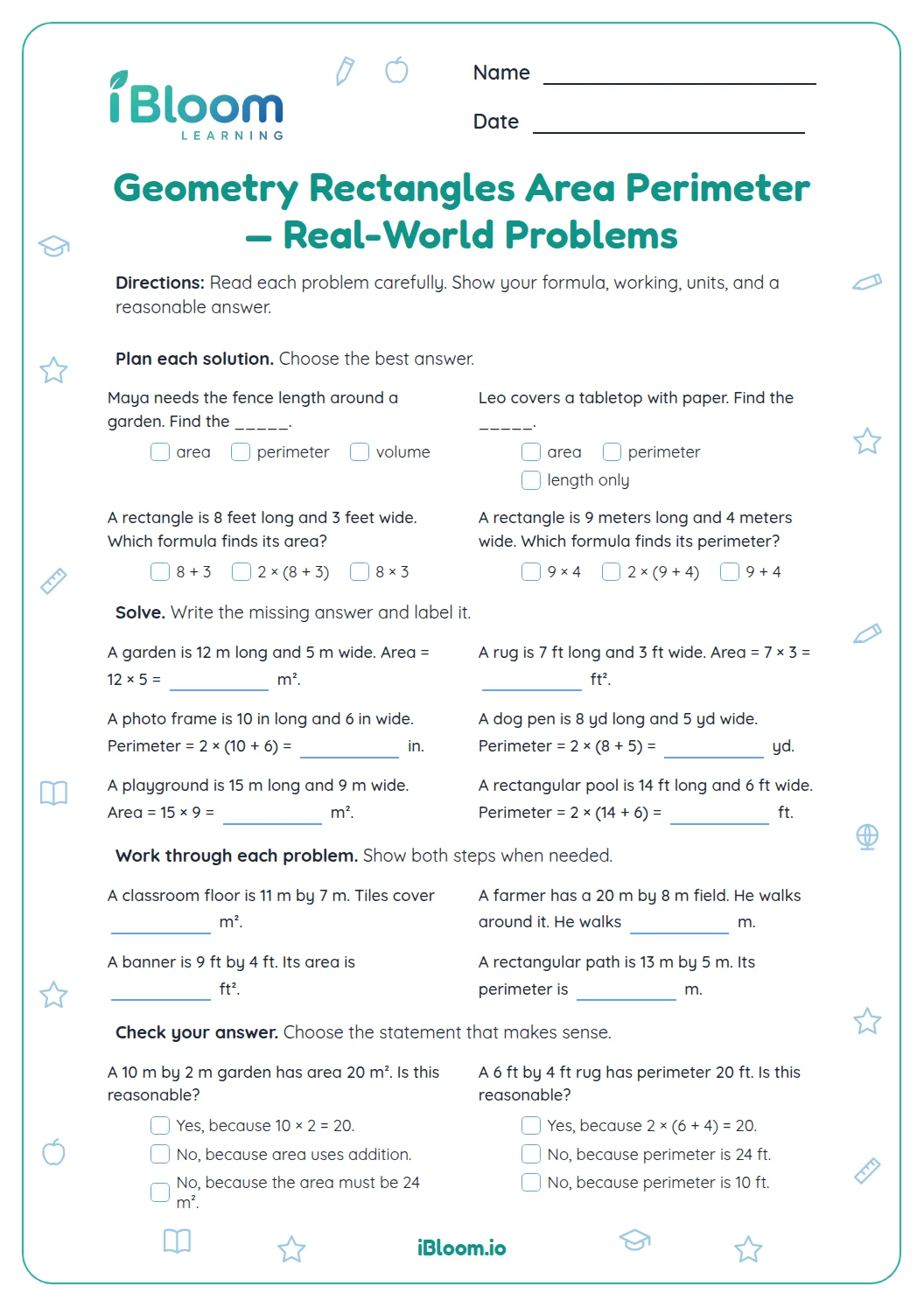
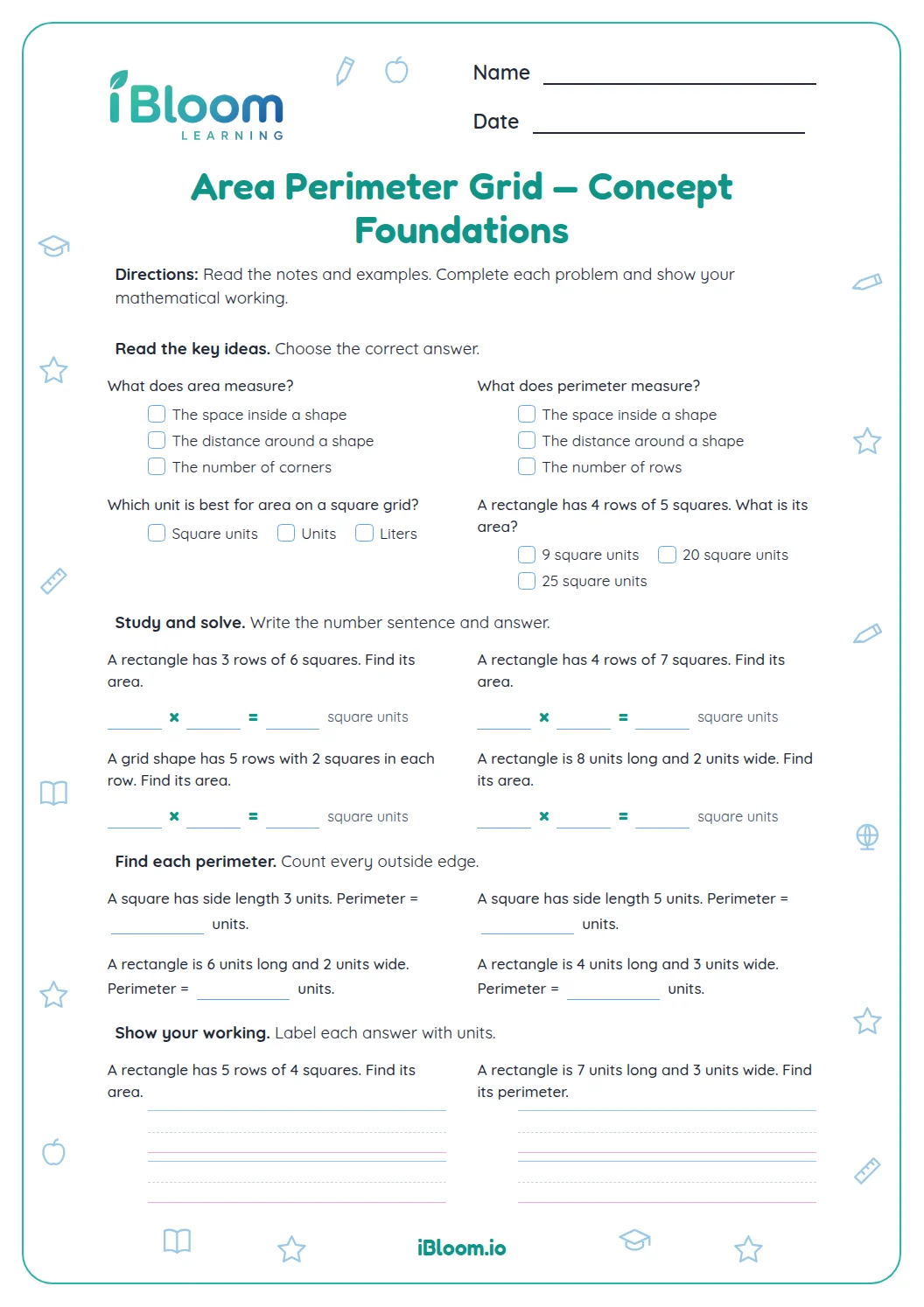
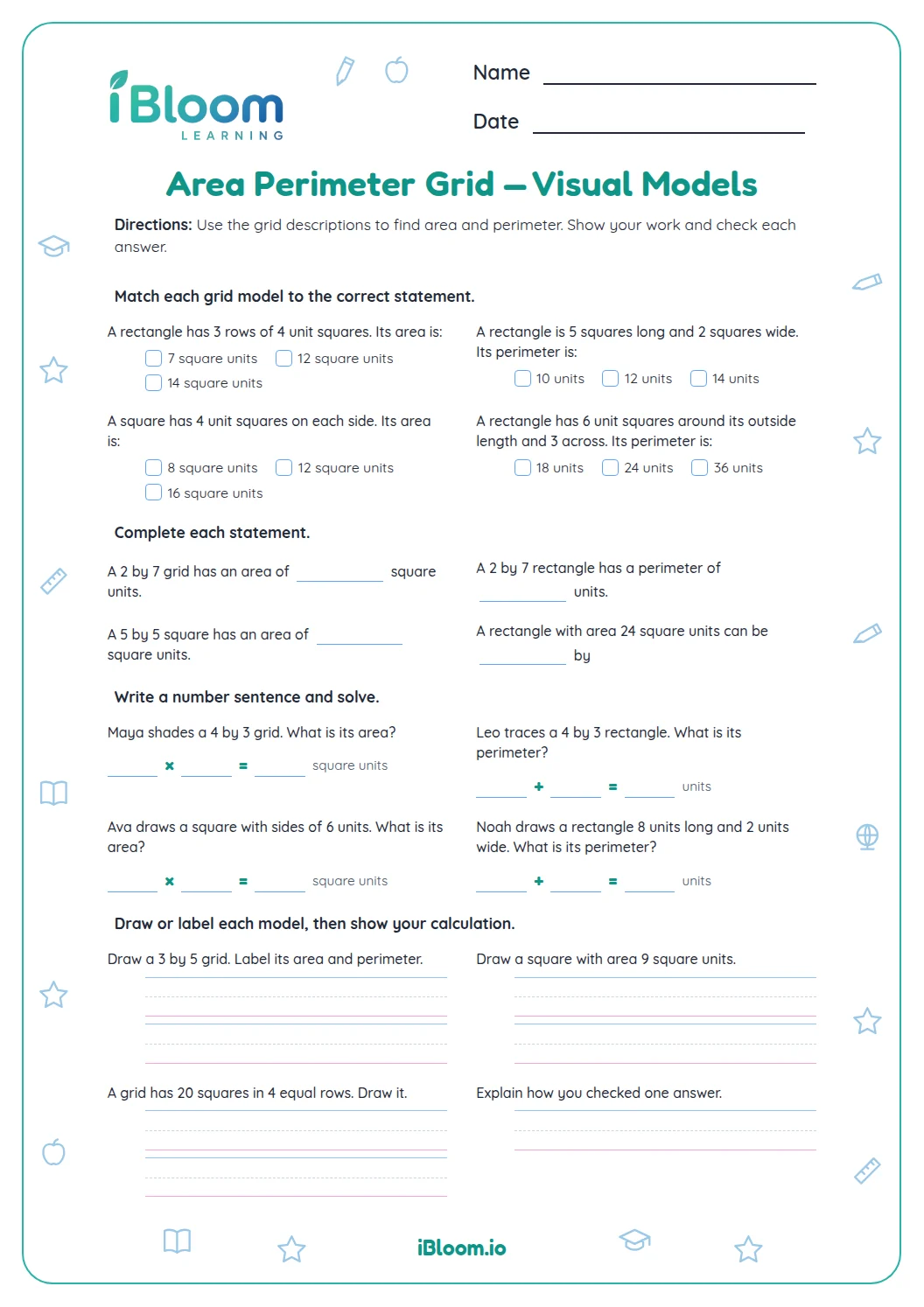
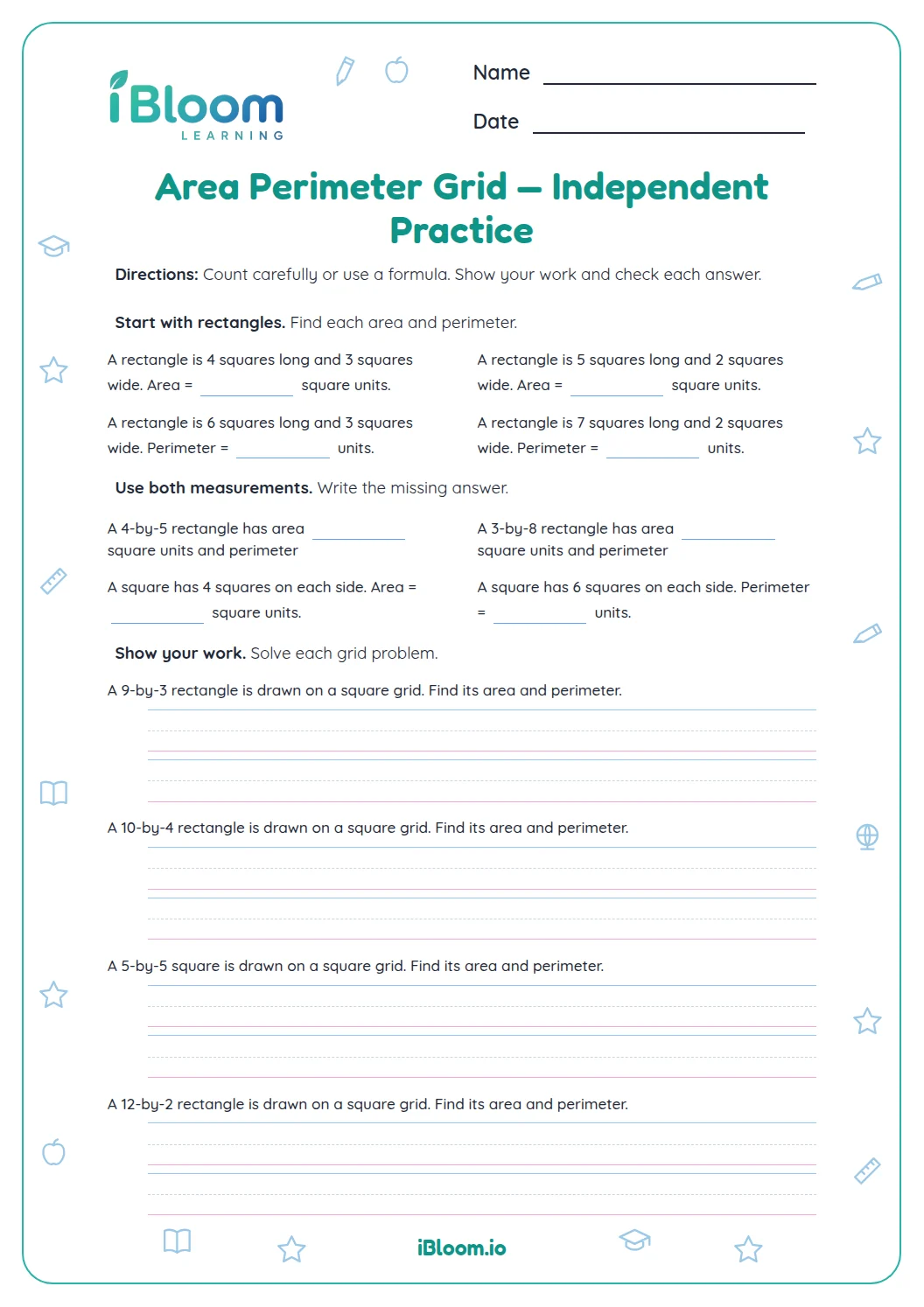
This free printable worksheet is for Grade 4 learners practicing applying rectangle area and perimeter formulas. It focuses on area, perimeter, and missing side lengths in mathematical and real-world problems. Across two parts, children work through 14 multiple-choice problems: rectangle area, perimeter, and missing sides. The prompts are specific to this skill, and a separate answer key supports quick checking. The page aligns with 4.MD.A.3.
Aligned to CCSS.Math.Content.4.MD.A.3
How do area and perimeter differ?
Part A has seven area questions, including a shaded rectangle grid, dimensions, and missing side lengths. Part B has seven perimeter questions, including a garden, a frame, and unknown sides.
- Part A: 7 area questions, including one grid model.
- Part B: 7 perimeter questions, including missing sides.
- A separate answer key lists all 14 answers.
How do you find a missing side?
For area, divide the known area by the known side length to find the missing factor. For perimeter, subtract the known pair of sides from the total; the two remaining opposite sides are equal.
- 1A 9 cm by 4 cm rectangle has area 9 × 4 = 36 square centimeters.
How do the formulas help in context?
A garden fence uses perimeter because it goes around the boundary. Floor covering uses area because it covers the inside. Naming what is being measured helps select the right formula before calculating.
How to use this worksheet
- 1Mark the rectangle’s length and width.
- 2For area, multiply length by width and label square units.
- 3For perimeter, add all four side lengths or use 2 × (length + width).
- 4If a side is missing, use the known area or perimeter to solve for it.
- 5Check whether the answer describes inside coverage or the outside boundary.
Common mistakes and quick fixes
The mistake
Using square units for perimeter.
The fix
Perimeter is a distance around the edge, so use linear units such as cm or m.
The mistake
Adding the side lengths to find area.
The fix
Area counts rows of square units; multiply the length by the width.
The mistake
Dividing the perimeter by two and calling it the length.
The fix
Half the perimeter is length plus width; subtract the known width to find the length.
Common Core alignment
This worksheet practices applying rectangle area and perimeter formulas through focused Grade 4 activities.
Use rectangle area and perimeter formulas to find unknown measures.
On this sheet: Use rectangle area and perimeter formulas to find unknown measures.
Show the official wordingHide the official wording
Apply the area and perimeter formulas for rectangles in real world and mathematical problems. For example, find the width of a rectangular room given the area of the flooring and the length, by viewing the area formula as a multiplication equation with an unknown factor.
What to practice next
Make more practice
Further reading
Questions parents and teachers ask
What is the difference between area and perimeter?
Area measures the inside of a rectangle in square units. Perimeter measures the distance around its boundary in ordinary units. A 6-by-4 rectangle has an area of 24 square units and a perimeter of 20 units. This gives a child one more clear way to use the page’s target skill.
How many problems are on this page?
There are 14 multiple-choice questions in two parts. The first seven focus on area, including one shaded grid and missing side lengths. The next seven focus on perimeter and missing sides. A separate two-page key lists each correct choice. Choices include common calculation errors as distractors.
When should my child use area?
Use area when covering or counting the inside of a rectangle, such as floor space or a mat. Multiply length by width, then name square units. If the question asks about fencing or a frame edge, that describes perimeter instead.
How can a missing rectangle side be found from area?
Area is the product of the two side lengths. If a rectangle has area 42 square inches and length 7 inches, divide 42 by 7 to find a width of 6 inches. Multiplication can check the result: 7 × 6 = 42.
How can a missing side be found from perimeter?
Opposite sides of a rectangle have equal lengths. For a perimeter of 30 cm and width 5 cm, the two widths use 10 cm, leaving 20 cm for the two equal lengths. Each length is 10 cm. This gives a child one more clear way to use the page’s target skill.
What comes next after rectangle formulas?
Children can apply these formulas to other rectangles, such as floors, gardens, and picture frames. The linked Grade 4 geometry pages offer practice with other shapes and models, while the area-perimeter grid page adds another way to visualize square units and boundaries.