
About this worksheet
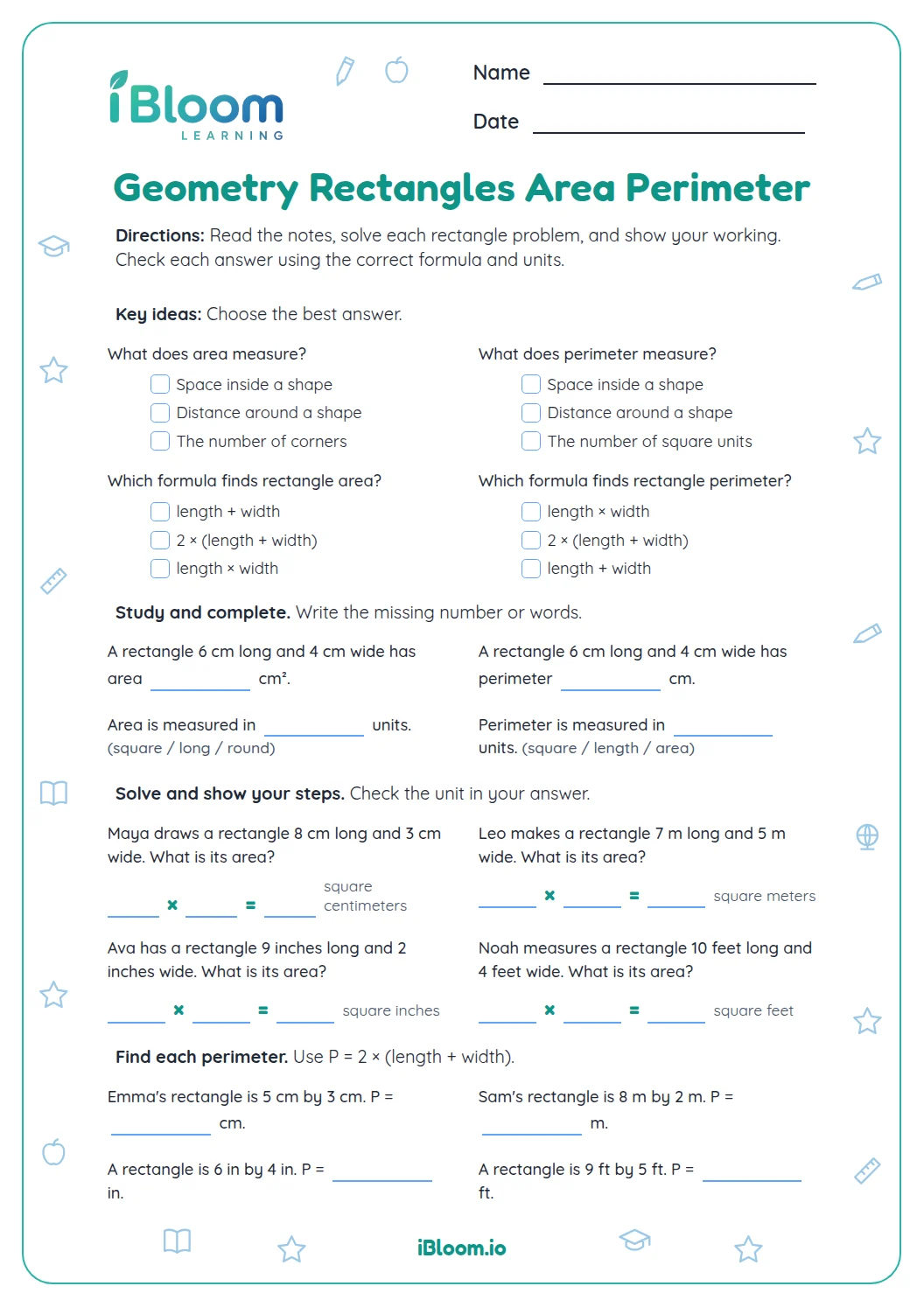
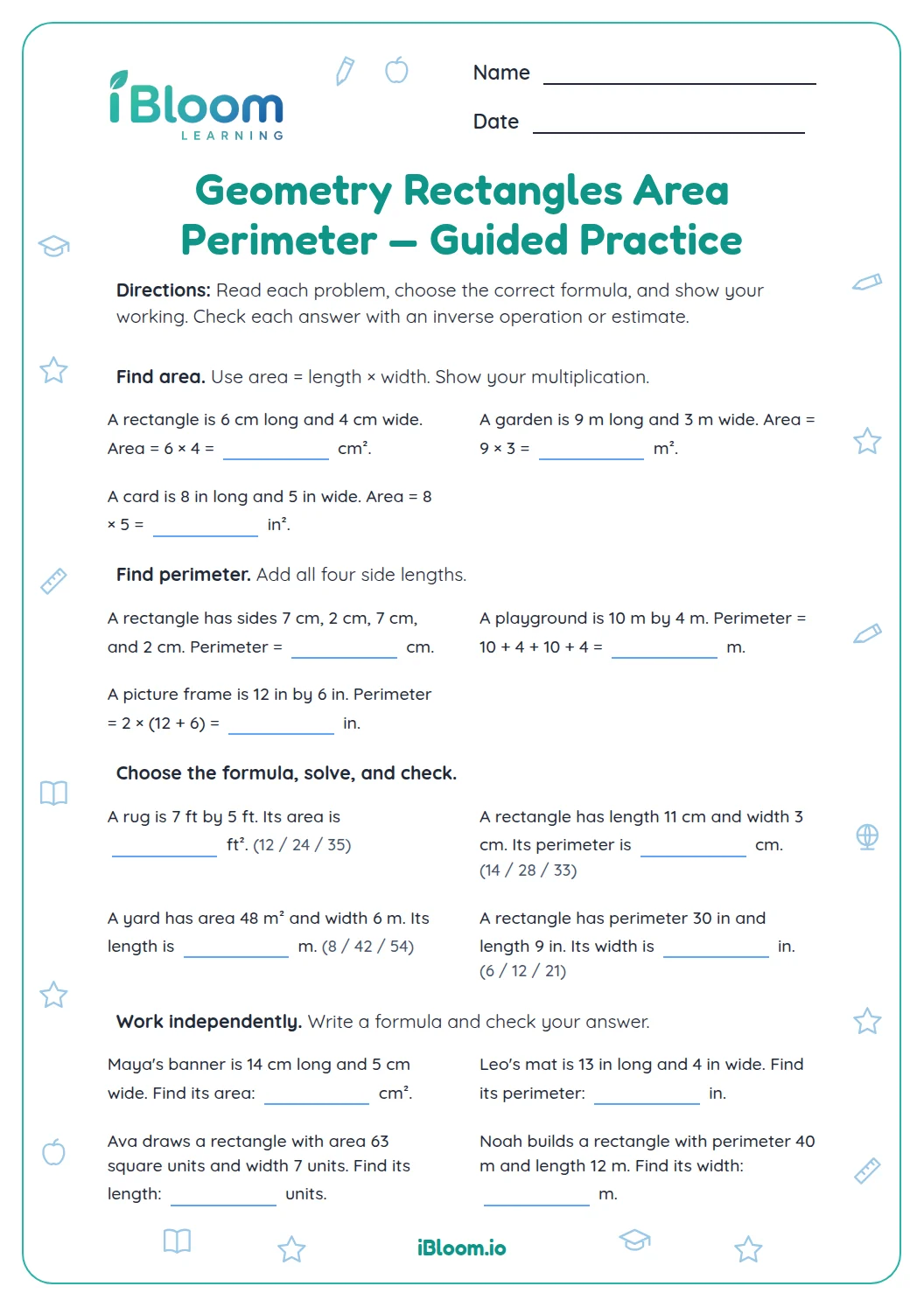
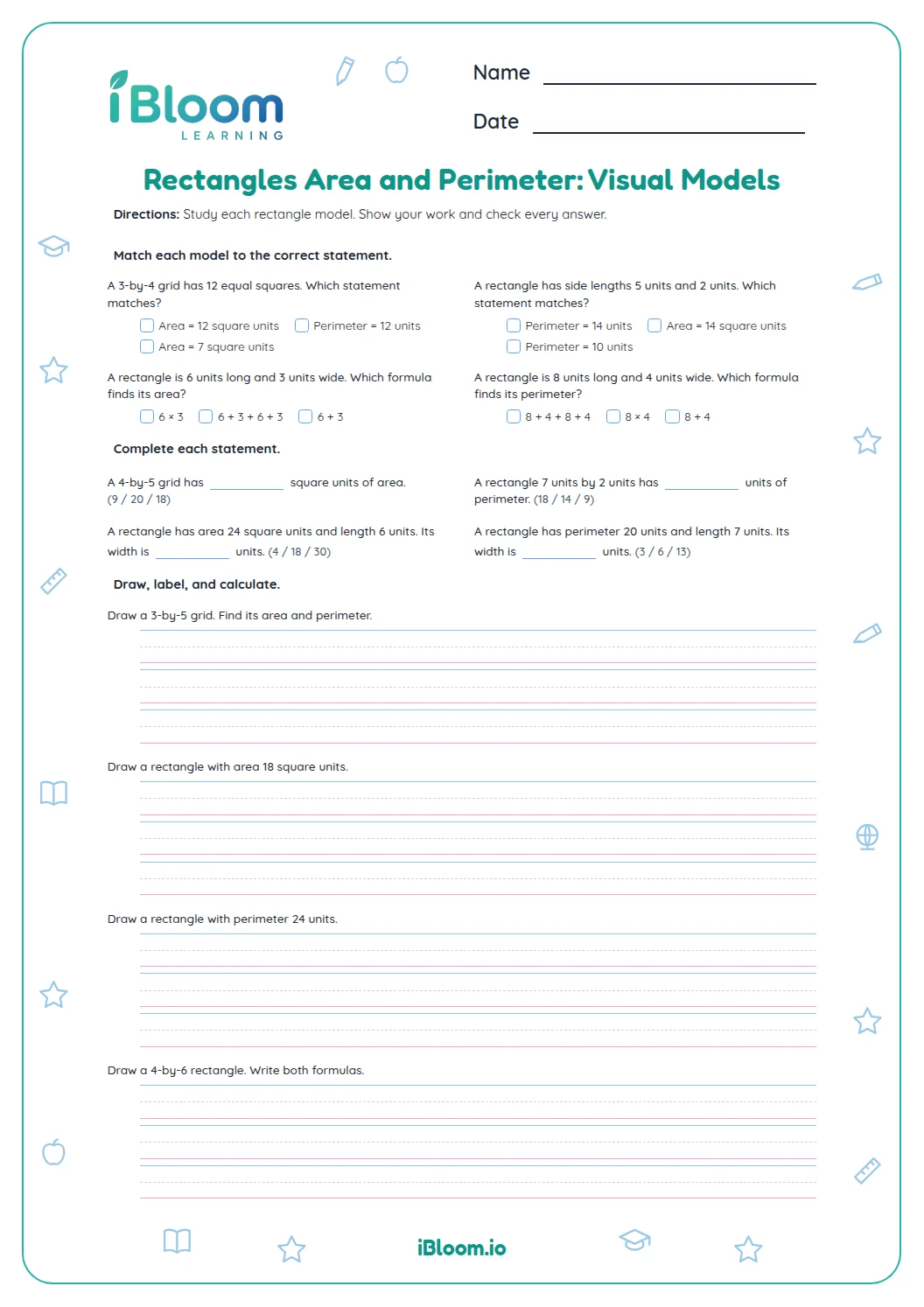
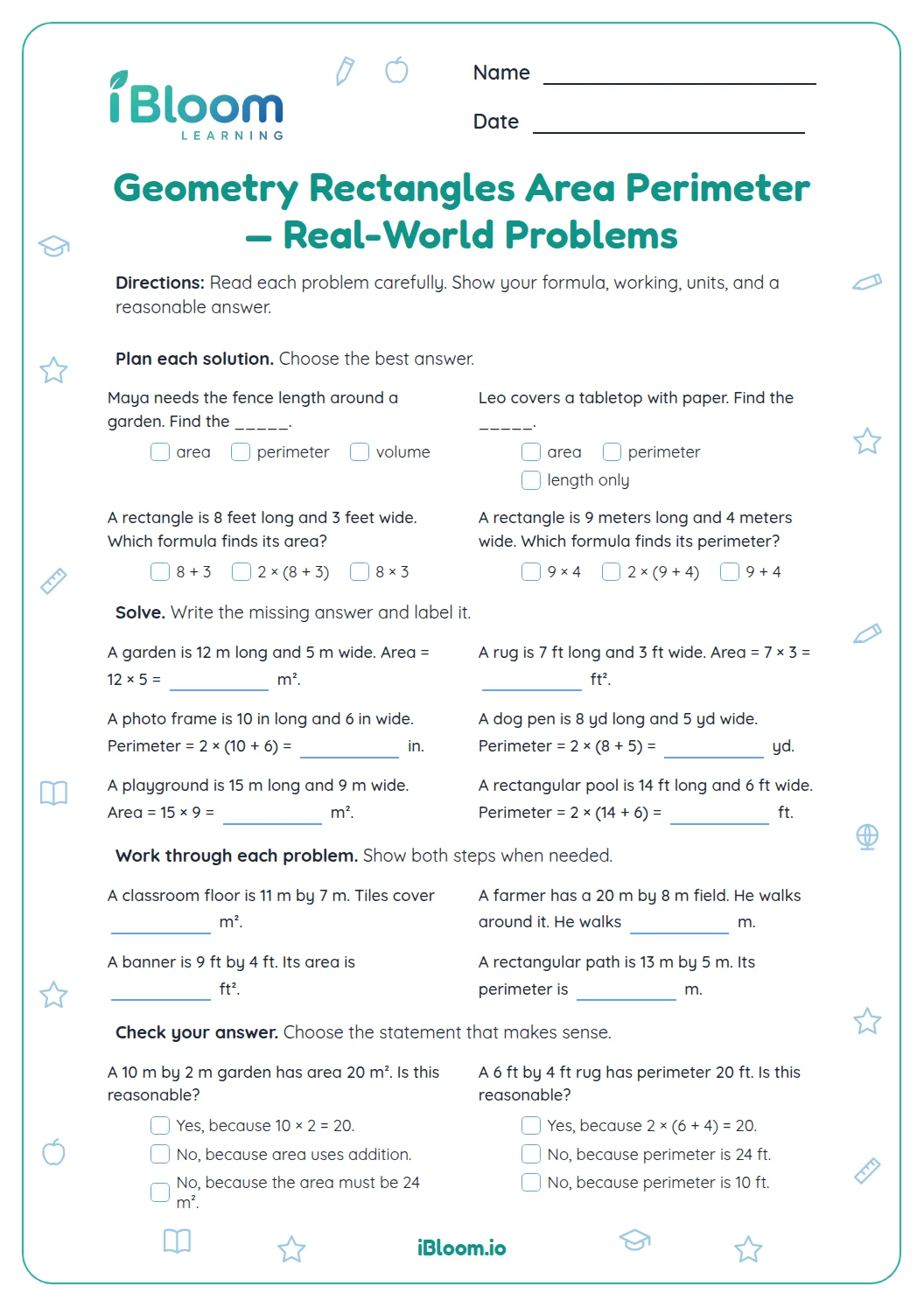
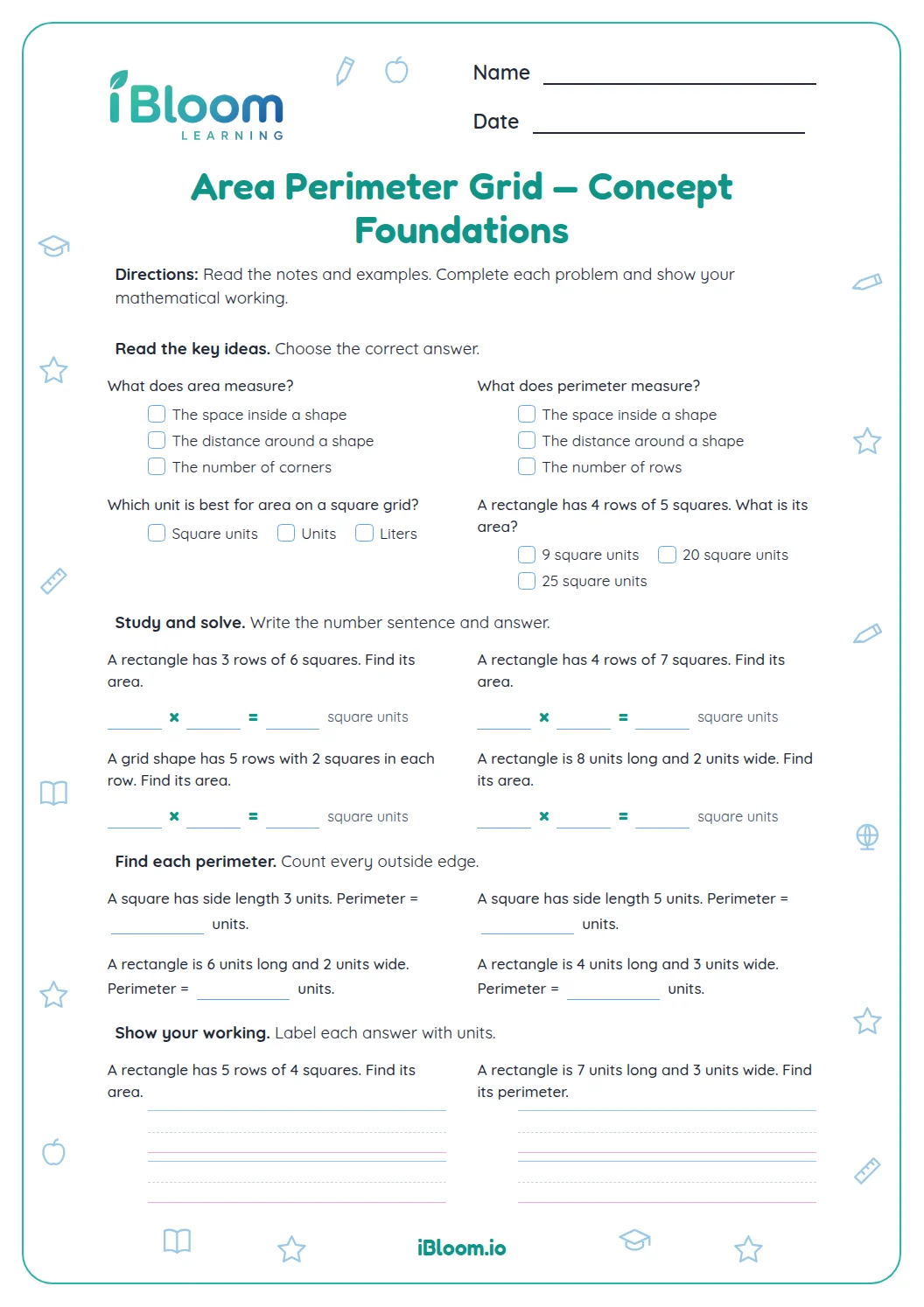
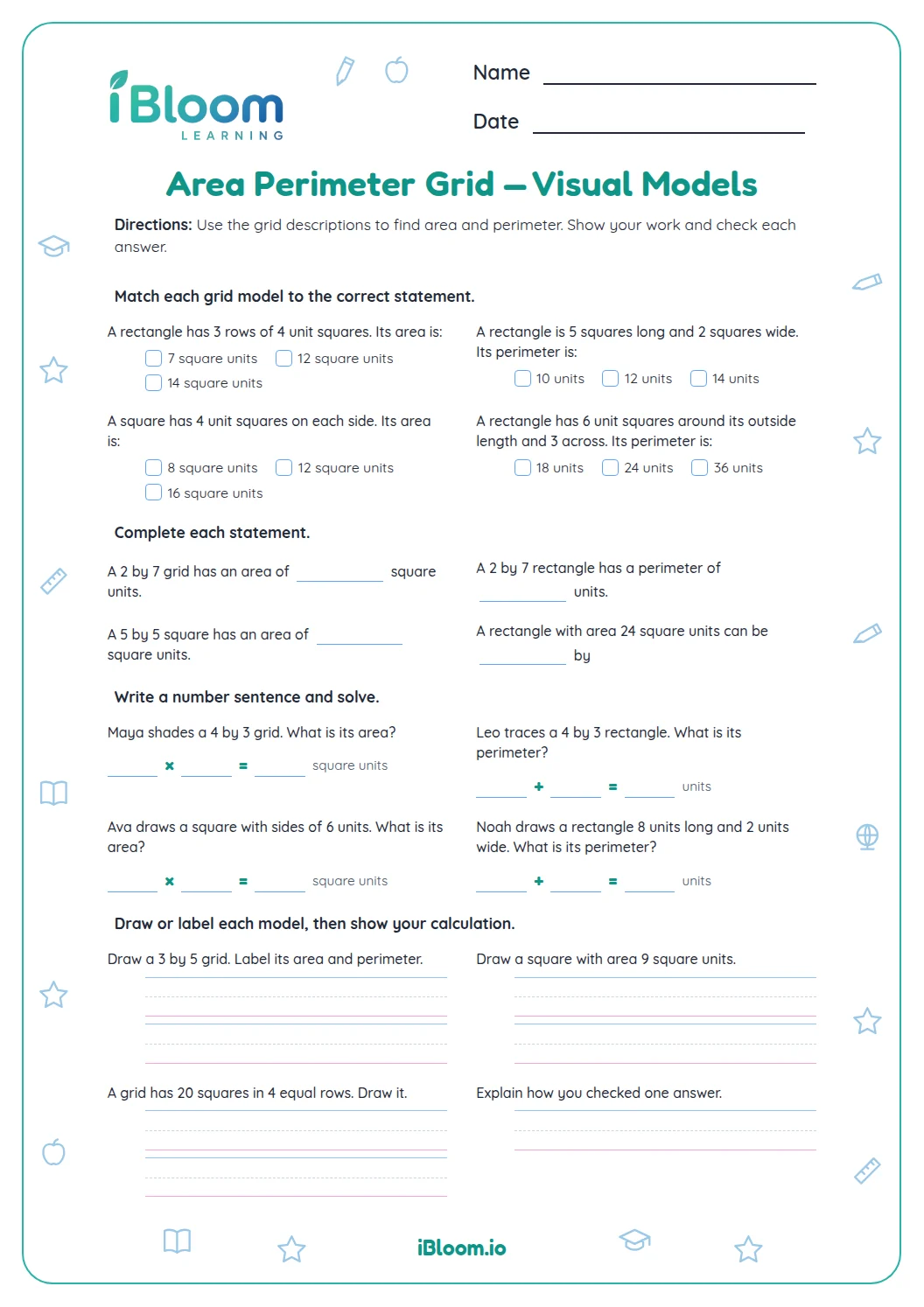
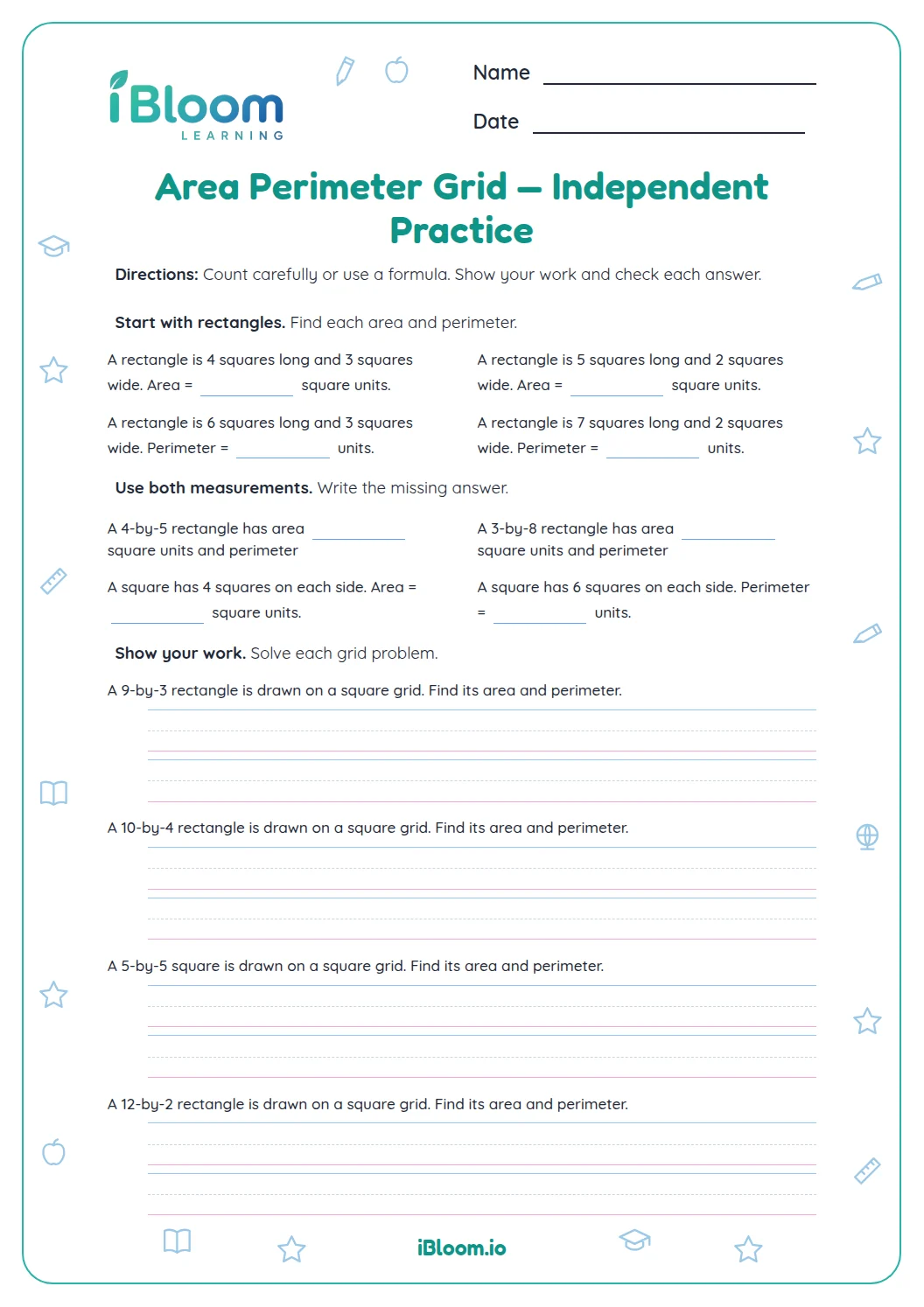
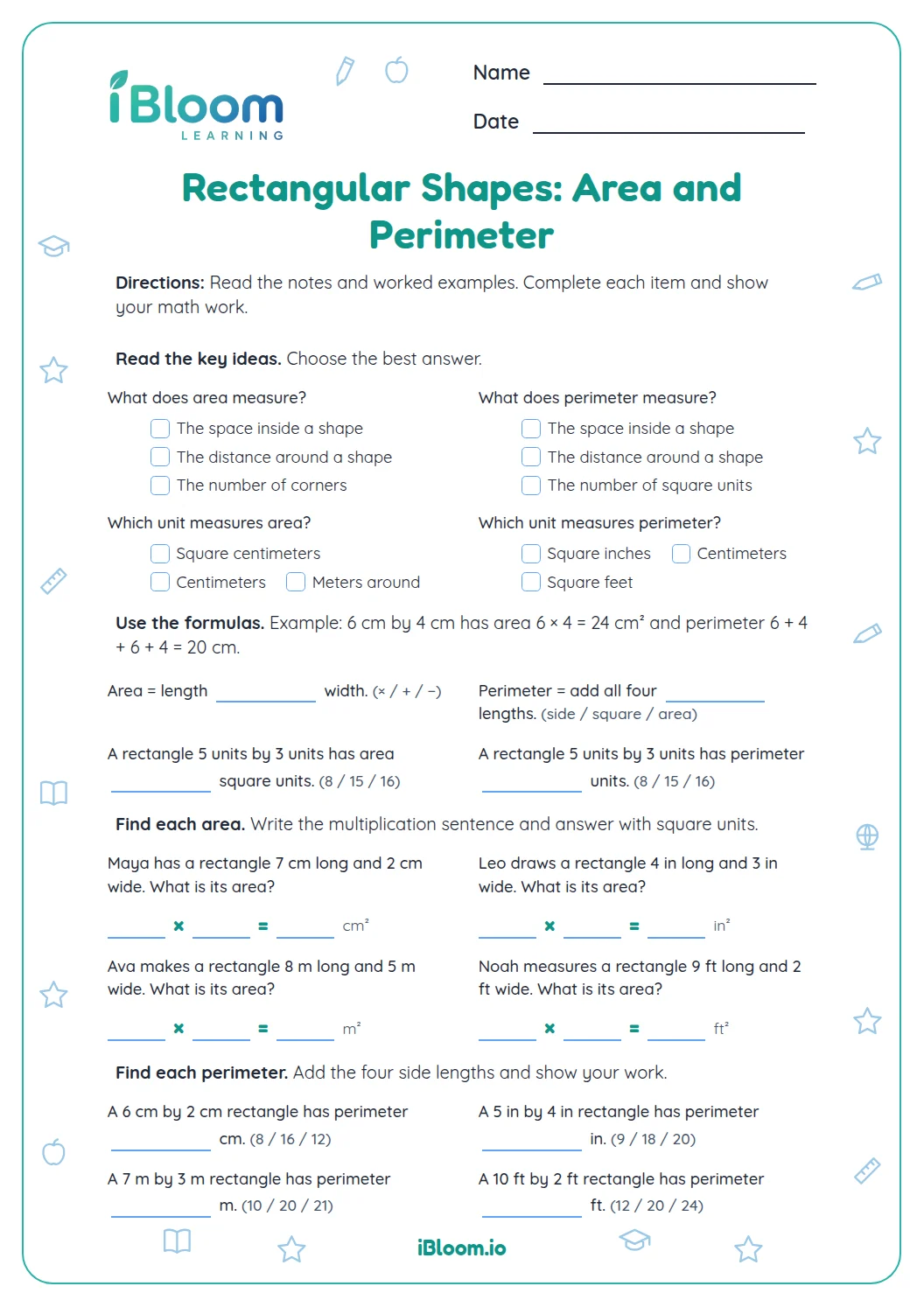
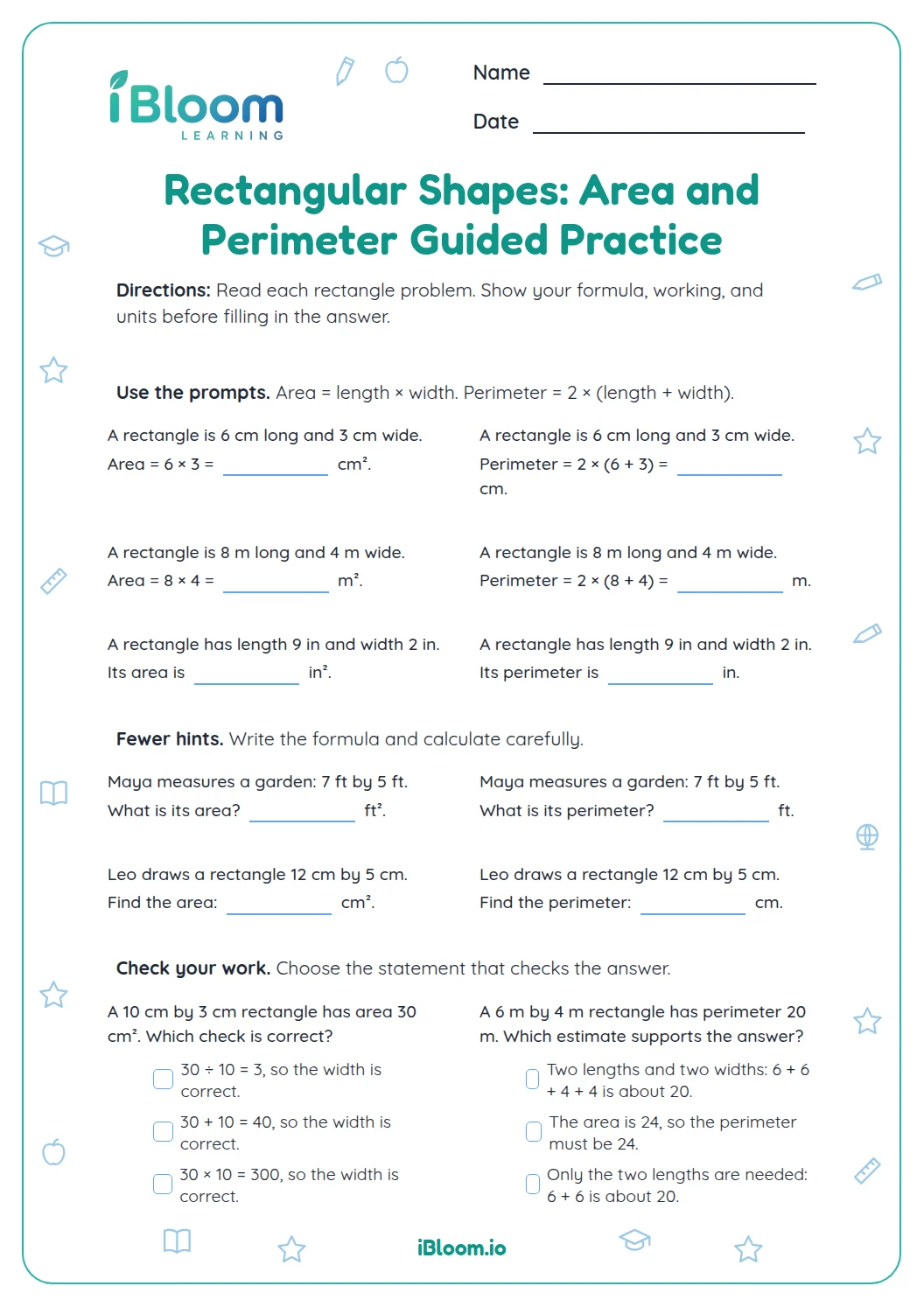
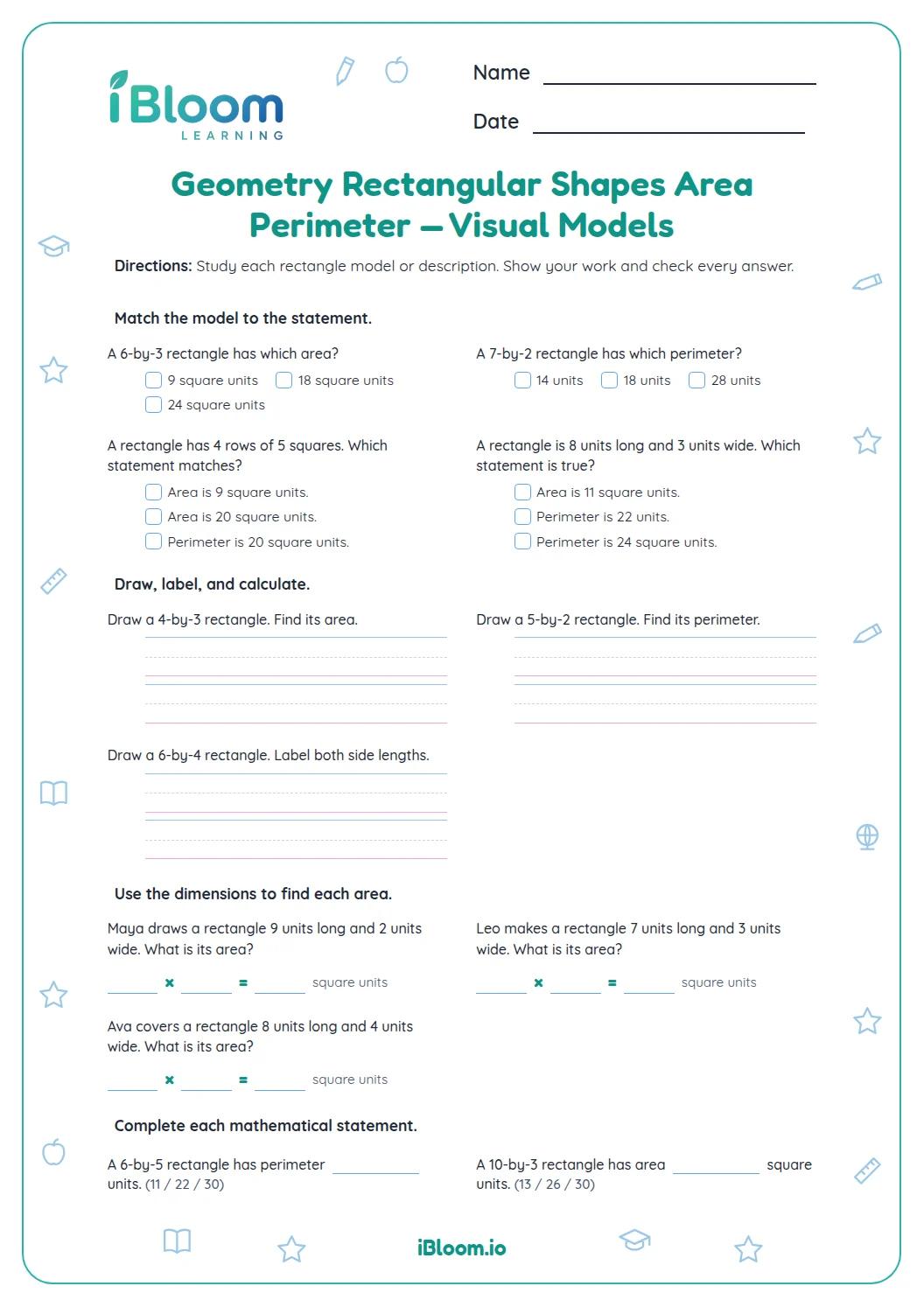
This Grade 4 printable asks students to calculate rectangle area and perimeter, recover missing side lengths, and compare dimensions. Fourteen questions move from direct calculations to short reasoning challenges, with a separate answer key.
Aligned to 4.MD.A.3
How do area and perimeter differ?
Area counts square units inside a rectangle: length × width. Perimeter measures the distance around it: add all four sides, or double the sum of length and width.
Question 1 uses 8 cm and 3 cm. Its area is 8 × 3 = 24 square centimeters; its perimeter is 8 + 3 + 8 + 3 = 22 centimeters. Keep square units for area and regular units for perimeter.
- 1Length 8 cm, width 3 cm
- 2Area = 8 × 3
- 3Area = 24 cm²
- 4Perimeter = 8 + 3 + 8 + 3 = 22 cm
How can missing side lengths be found?
Use the given area or perimeter to build an equation. If the area is 36 square units and one side is 4, divide 36 by 4 to find the other side. If the perimeter is 30 and the length is 9, the two widths share 12 units, so each width is 6.
How to use this worksheet
- 1Label each given side length.
- 2For area, multiply length by width.
- 3For perimeter, add all four sides.
- 4Use division or the perimeter equation to find a missing side.
- 5Check that area uses square units and perimeter uses regular units.
Common mistakes and quick fixes
The mistake
Using perimeter addition to find area.
The fix
For area, multiply length by width and label the result in square units.
The mistake
Giving perimeter in square units.
The fix
Perimeter measures distance around, so use regular units such as cm.
The mistake
Using only one pair of sides in perimeter.
The fix
Add length + width + length + width, or double length + width.
Common Core alignment
This worksheet practices 4.MD.A.3 through its rectangle area and perimeter reasoning questions.
Use rectangle formulas to find missing measures and compare designs.
On this sheet: The questions directly practice rectangle area and perimeter reasoning.
Show the official wordingHide the official wording
Apply the area and perimeter formulas for rectangles in real world and mathematical problems.
What to practice next
Make more practice
Further reading
Questions parents and teachers ask
What is the difference between area and perimeter?
Area describes the square units covering the inside of a rectangle, so multiply length by width. Perimeter measures the boundary, so add the four side lengths. The sheet includes both calculations and asks students to keep square units and regular units distinct.
How do you find a missing side from area?
If area and one side are known, divide the area by that side to find the other side. For example, a rectangle with area 36 square units and one side of 4 units has a second side of 9 units because 36 ÷ 4 = 9.
How do you find a missing side from perimeter?
For a rectangle, opposite sides have equal lengths. Add the known side and its opposite first, subtract that total from the perimeter, then split what remains equally between the two unknown sides. This works because both unknown sides have the same length.
Why does area use square units?
Compare the products of the side lengths to compare area. Compare the sums of all four sides to compare perimeter. A change in dimensions can keep area the same while changing perimeter, so calculate the measure asked for. Include the right units.
Does the answer key show reasoning?
The separate key gives a correct value or model response for each question. Students should include equations or a short explanation for the written reasoning items. This gives families a concrete way to review the skill together after the worksheet is finished.