

About this worksheet
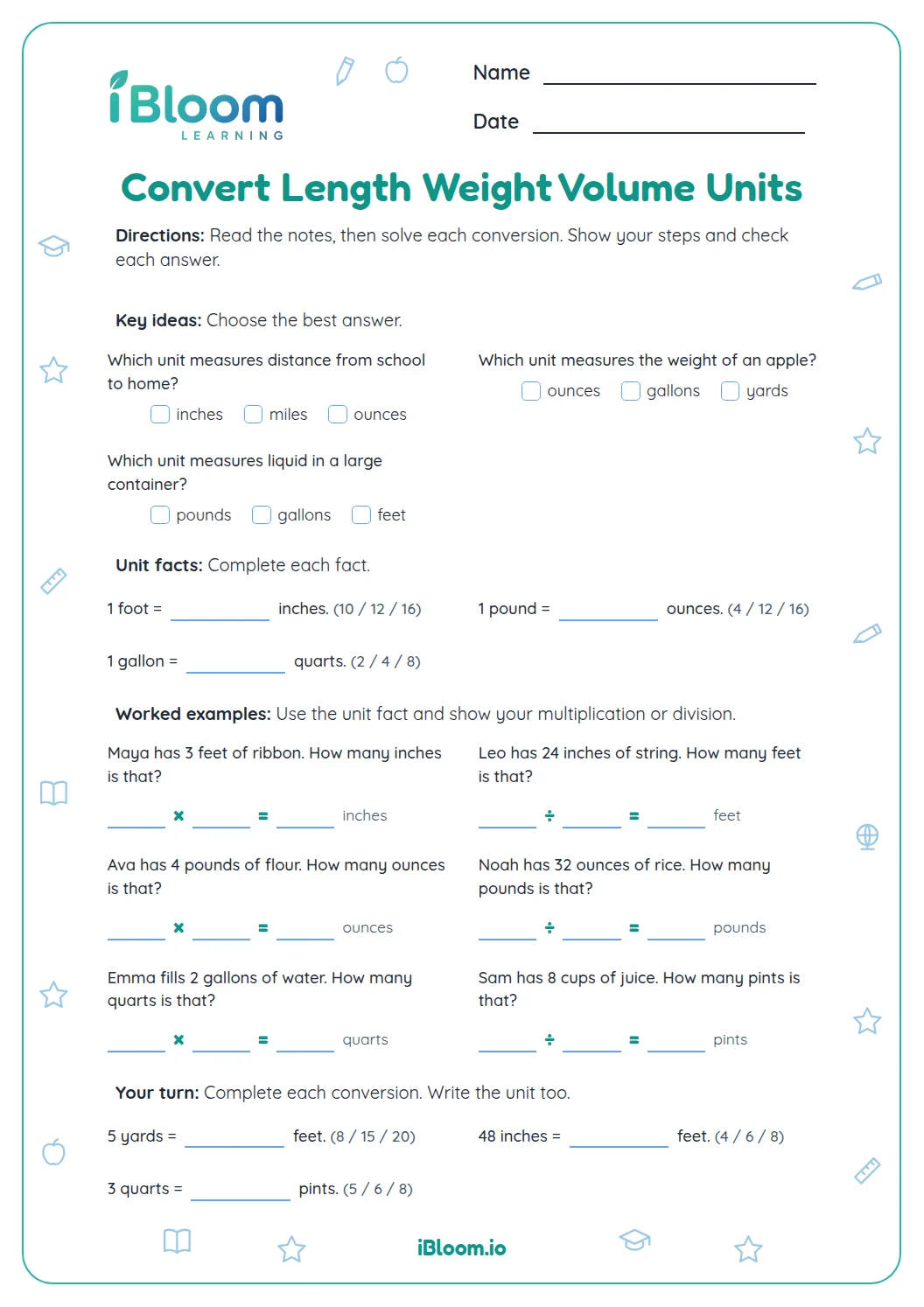
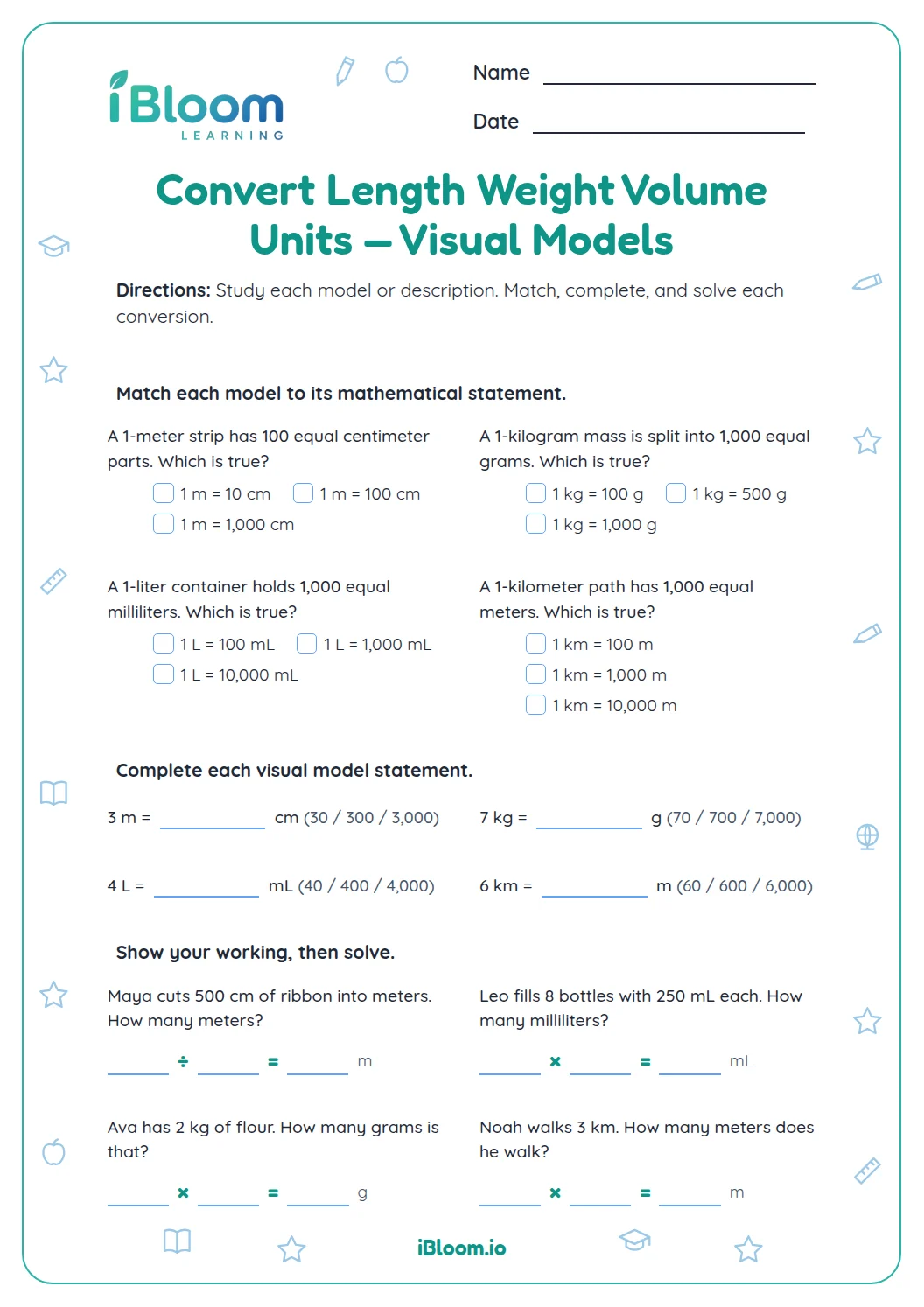
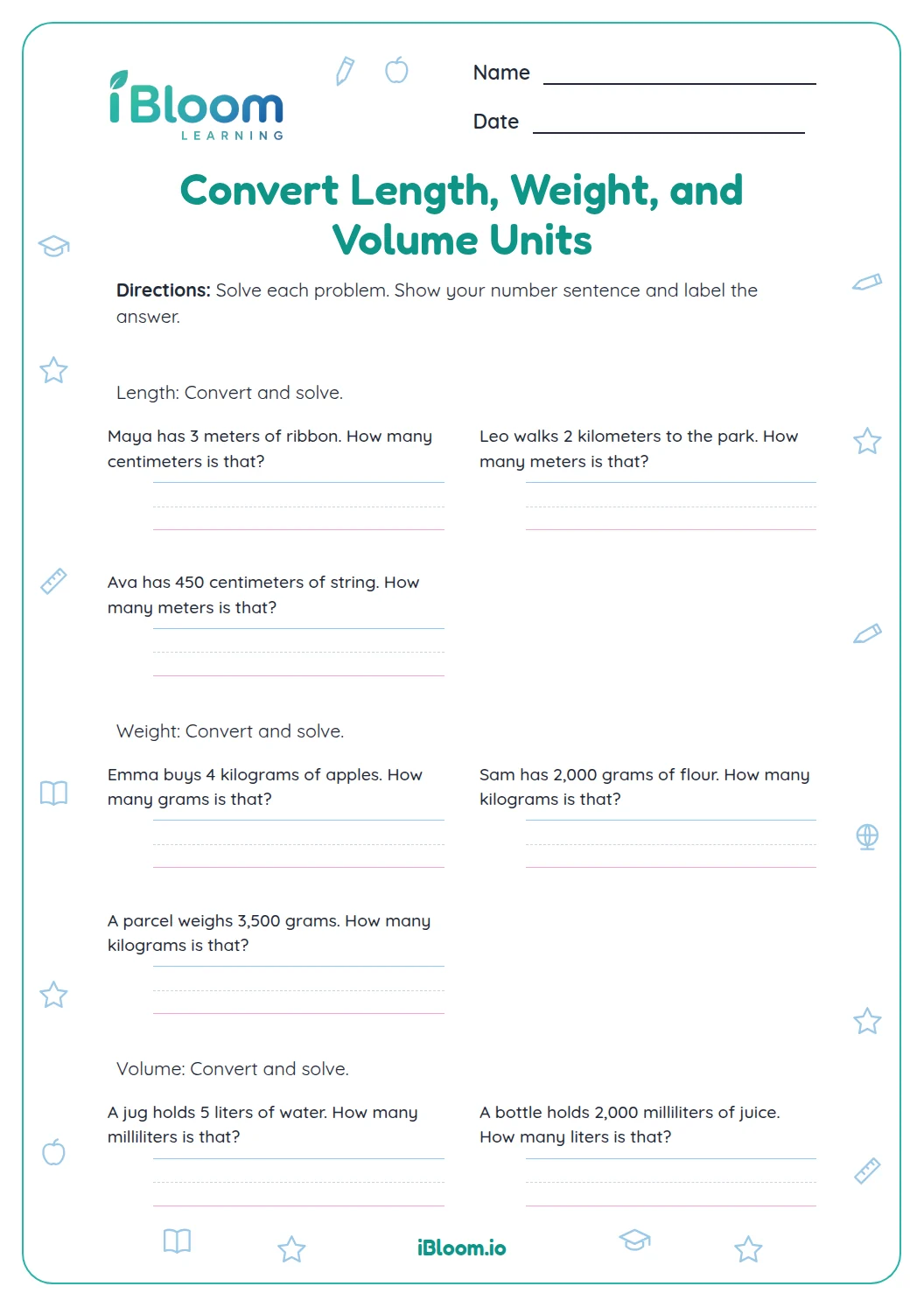
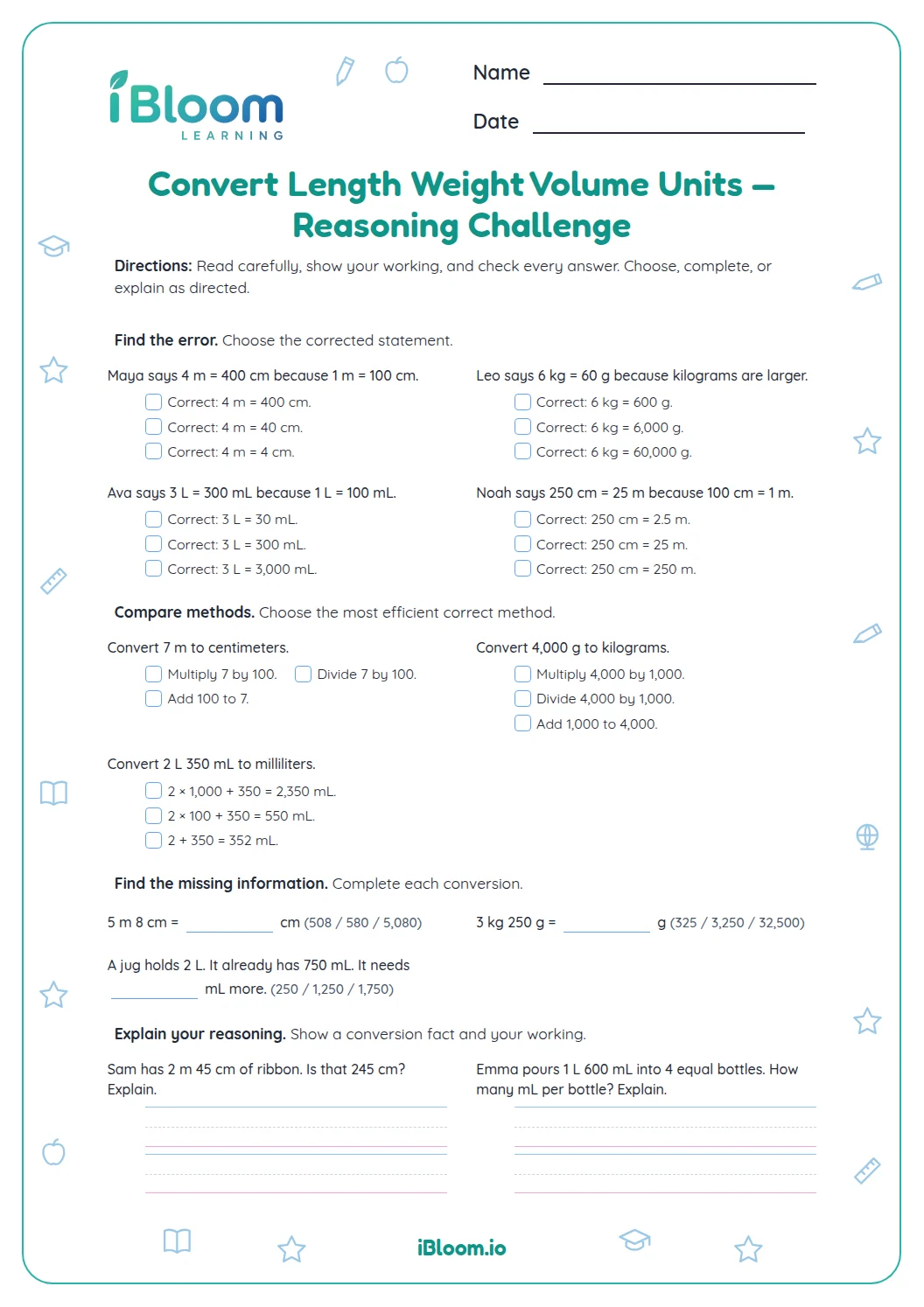
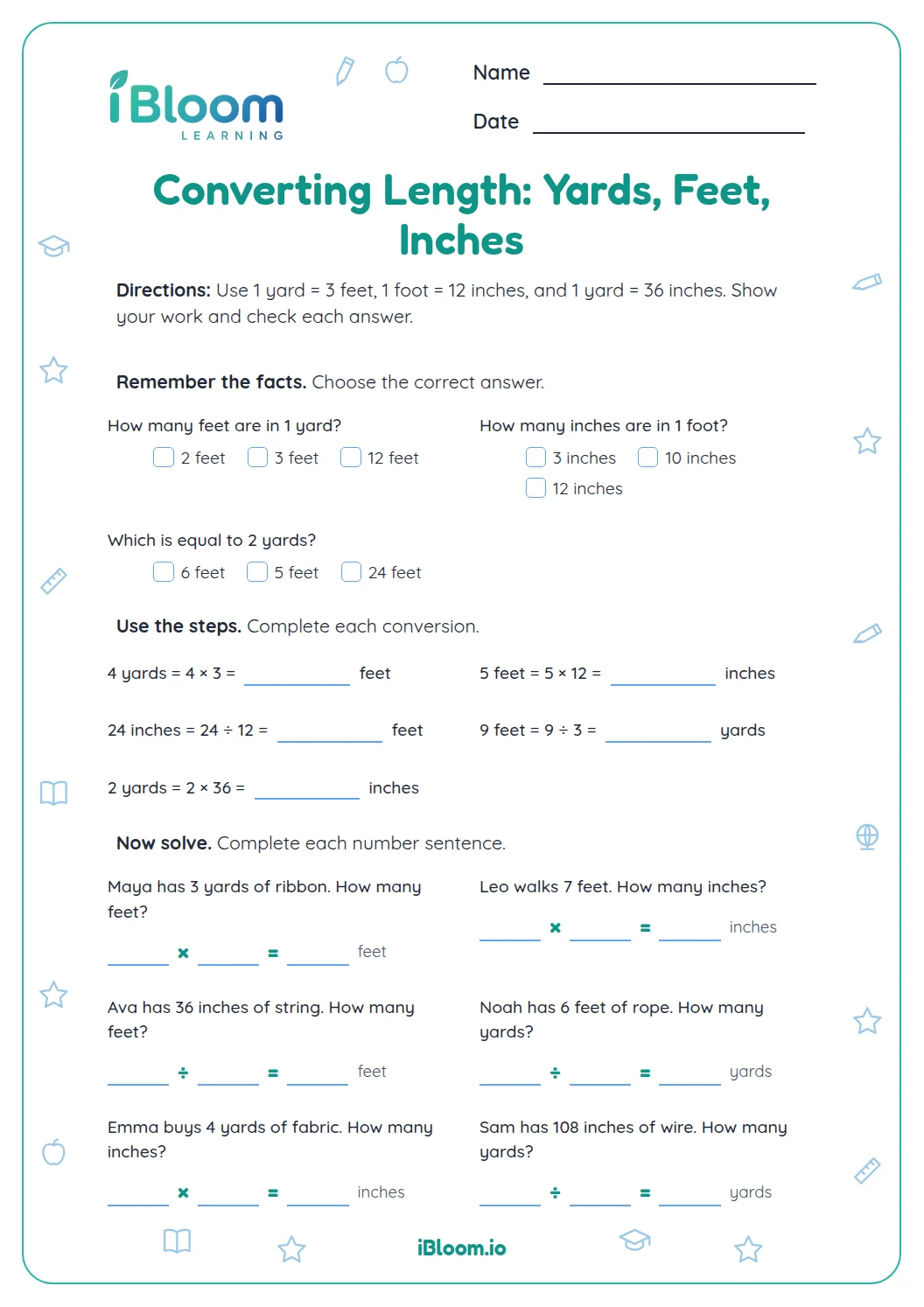
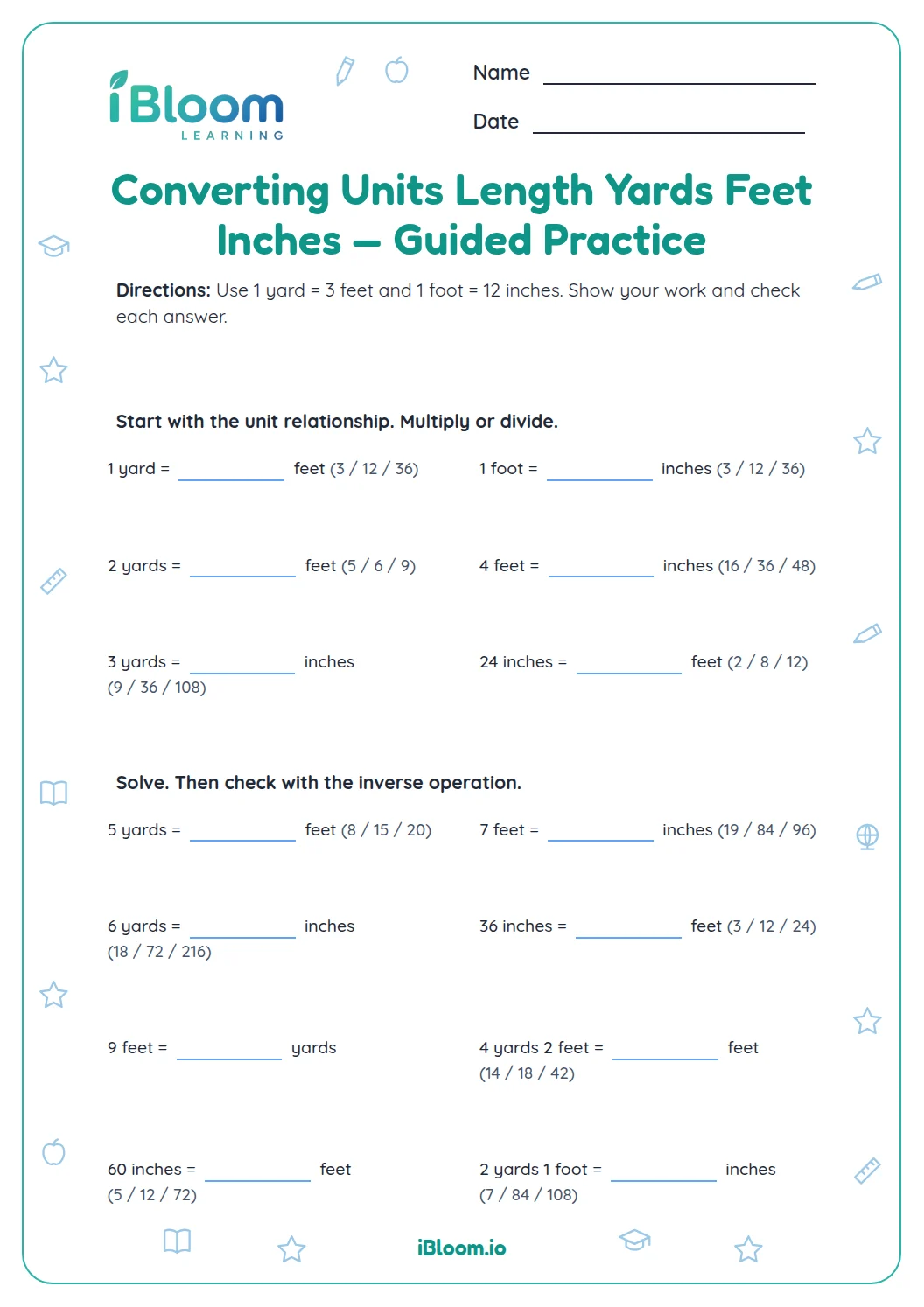
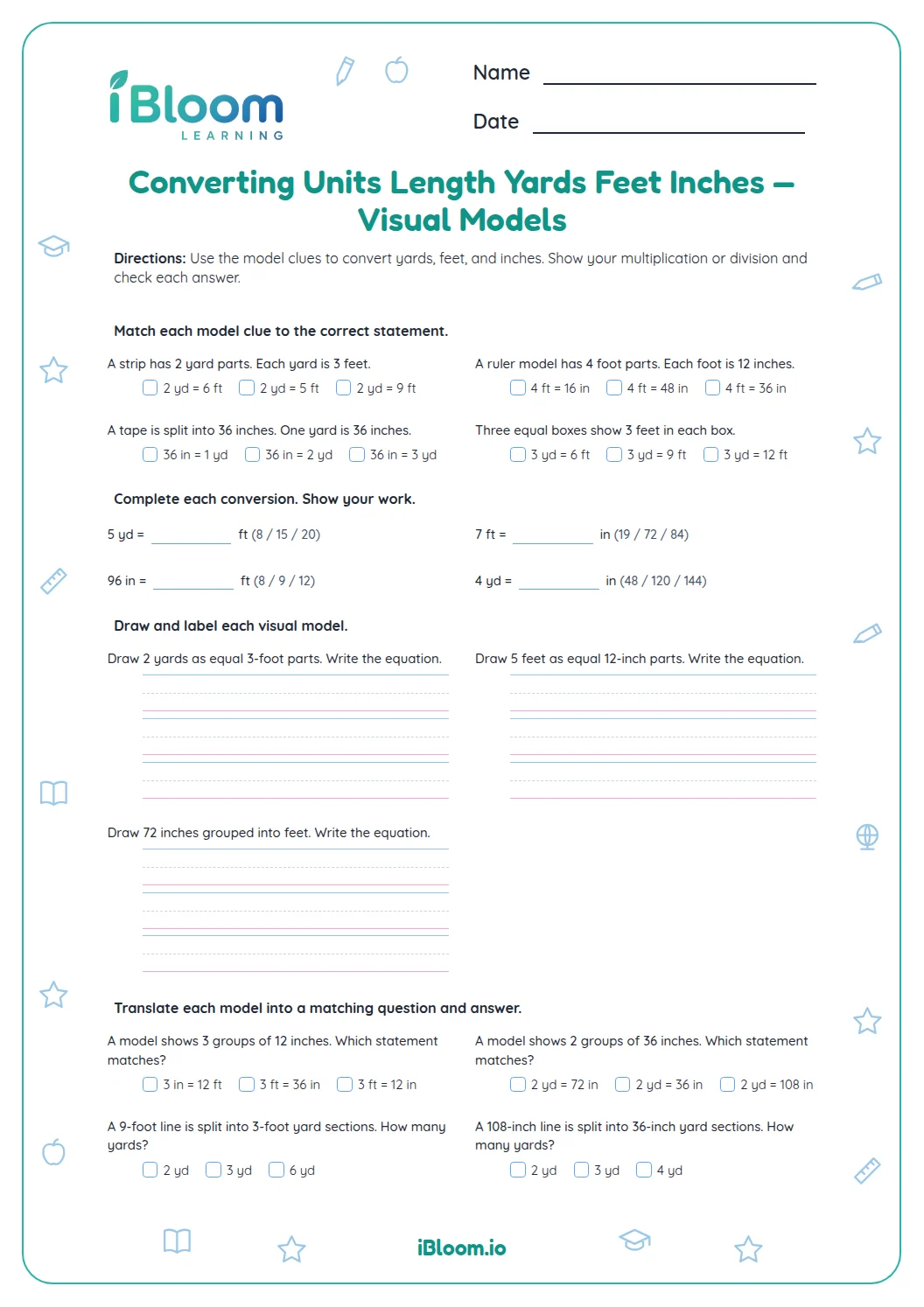
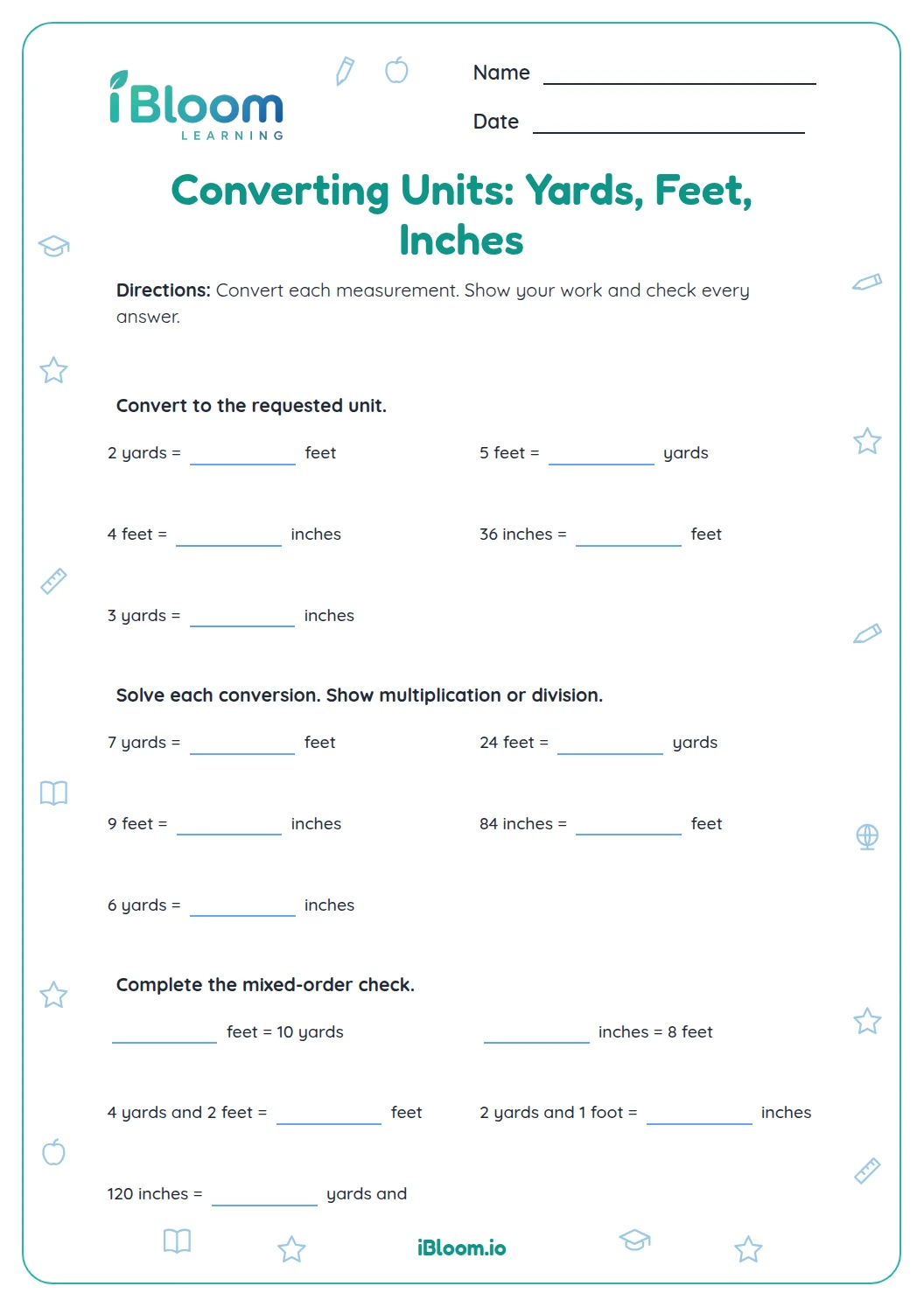
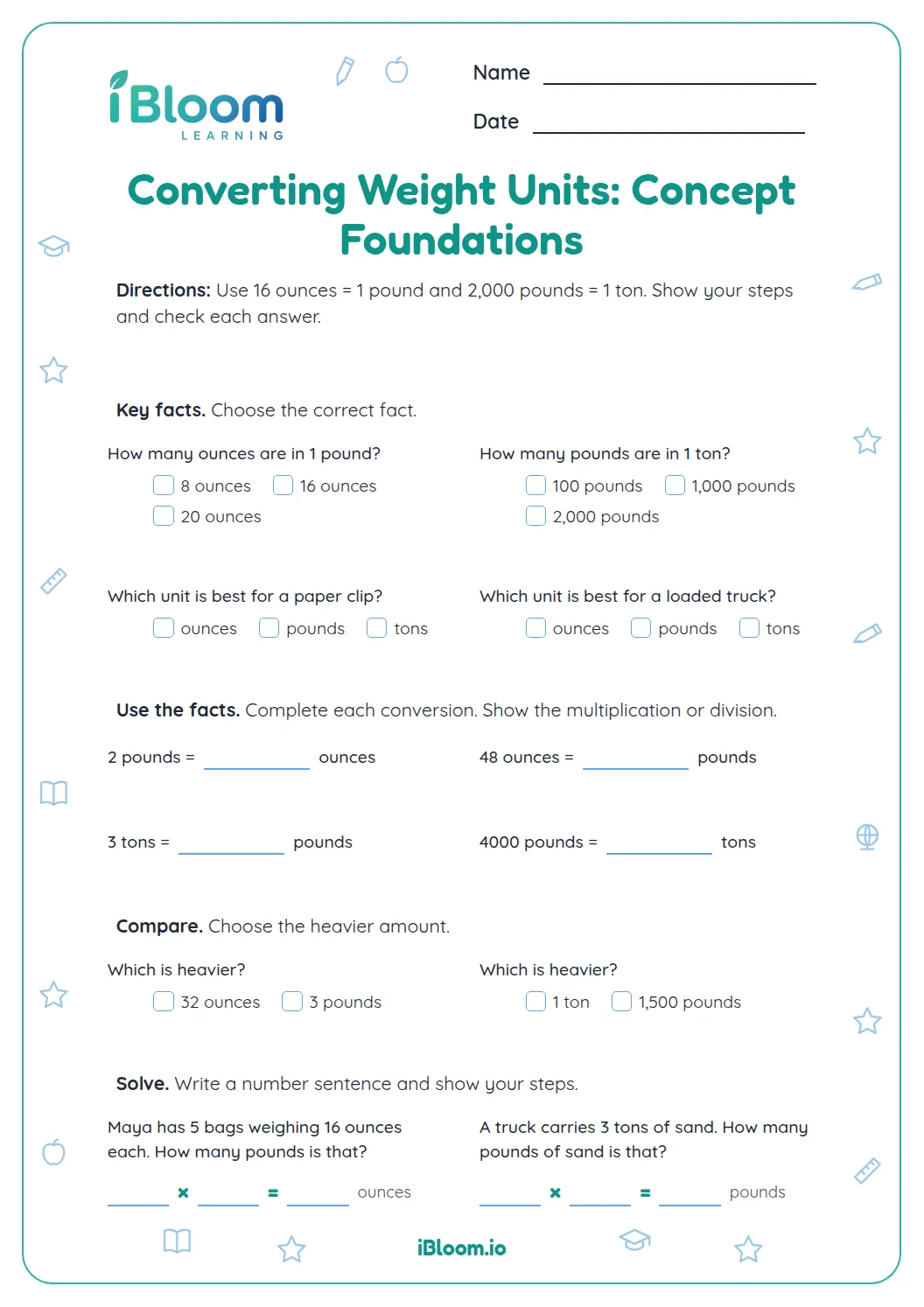
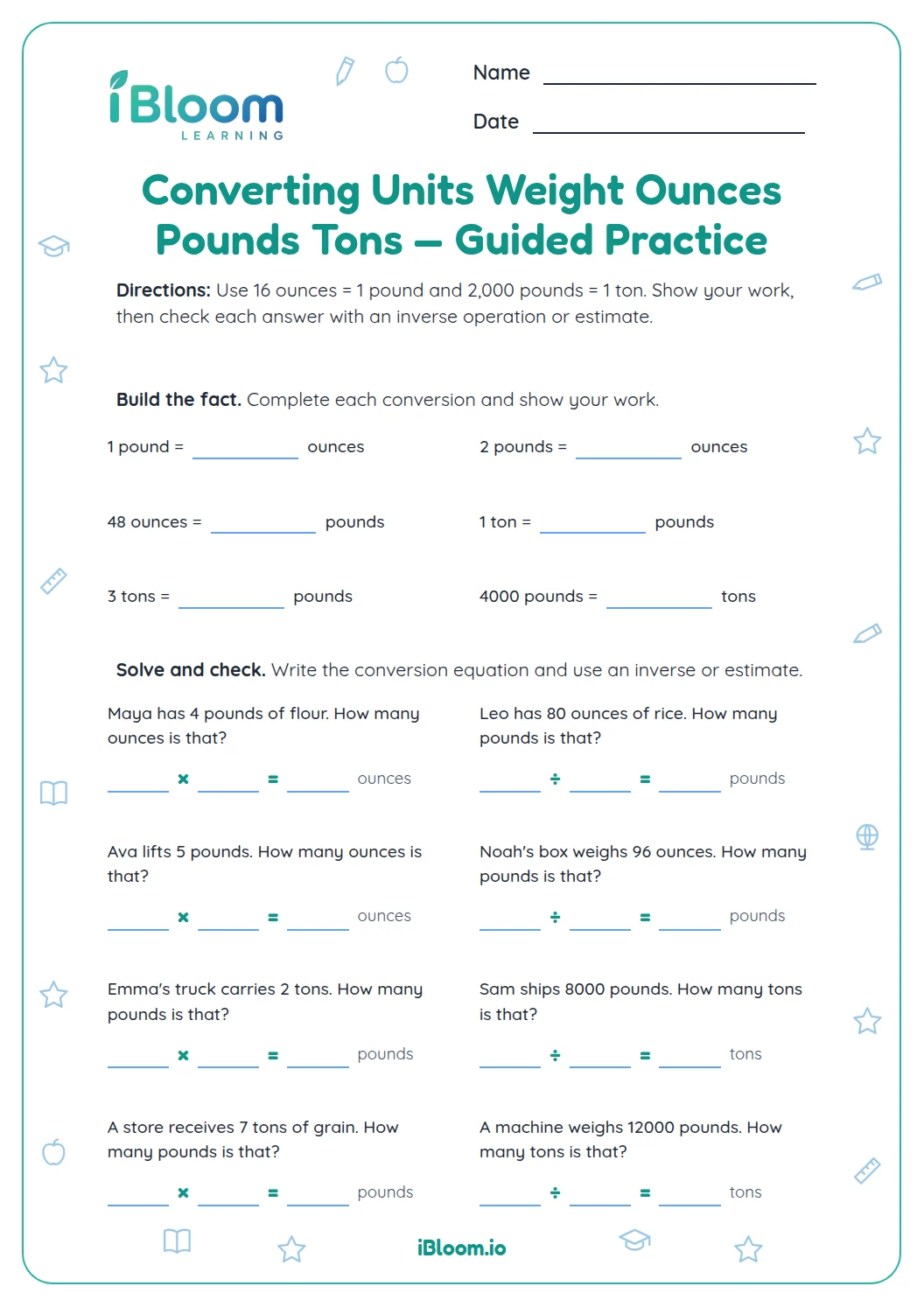
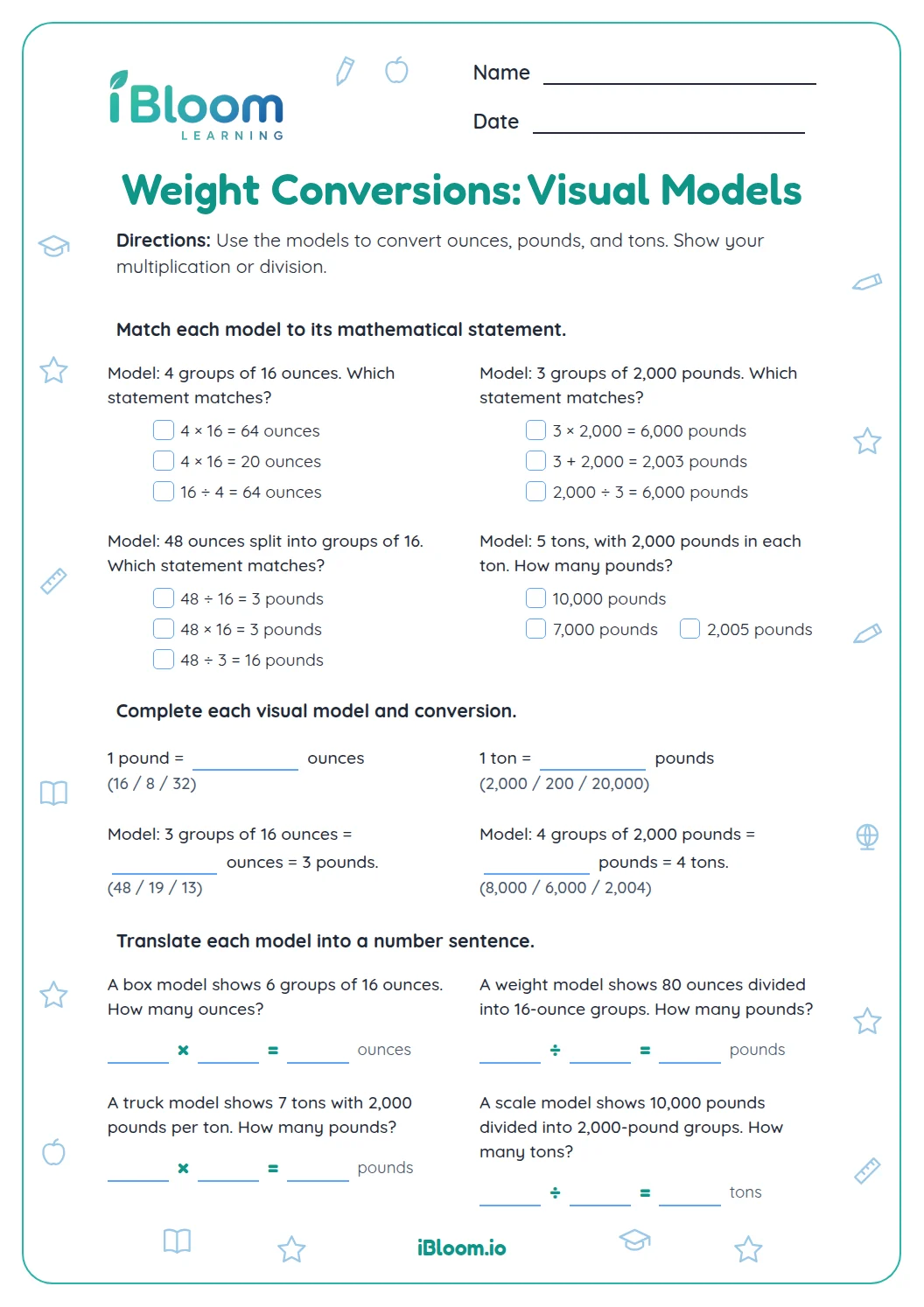
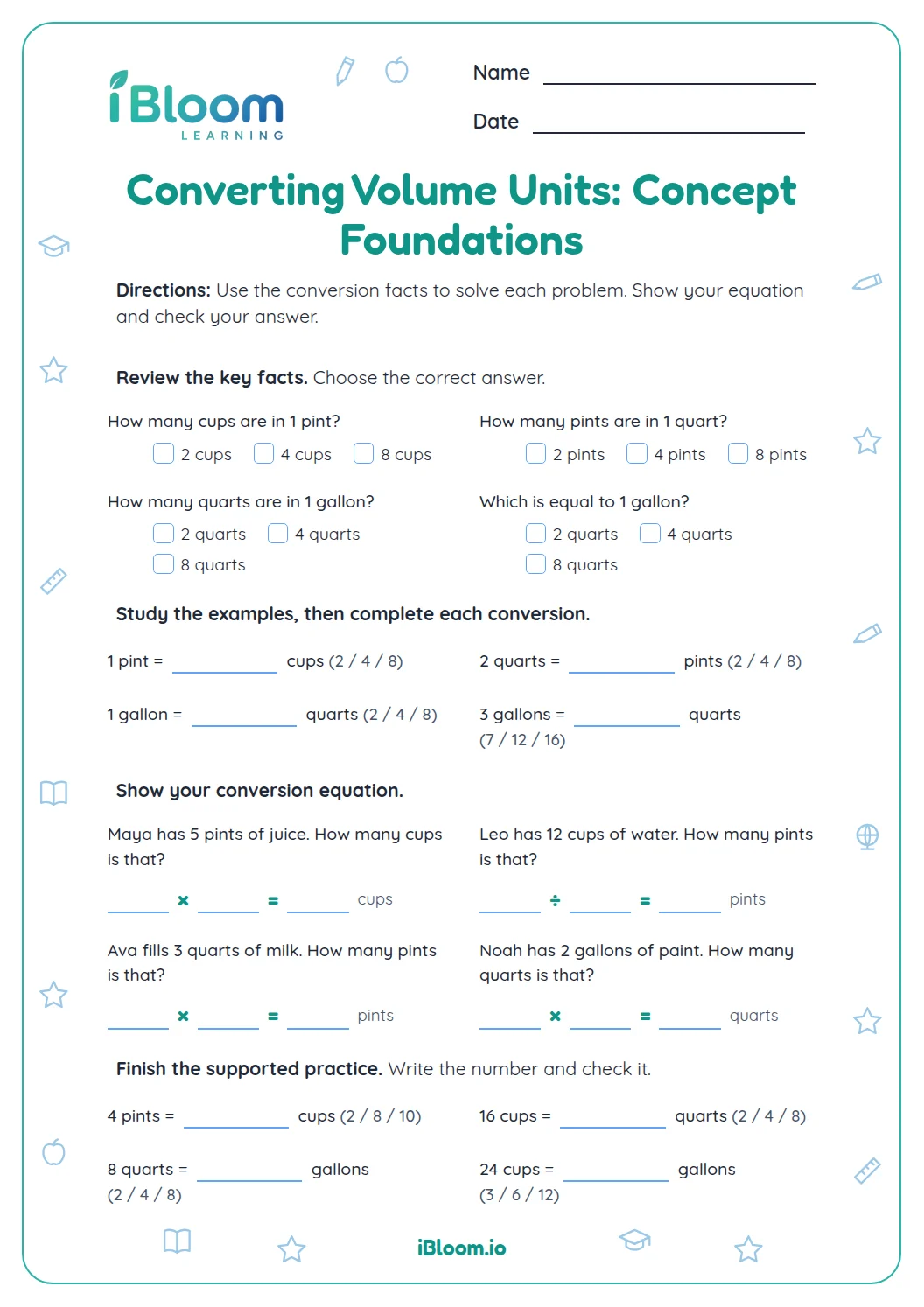
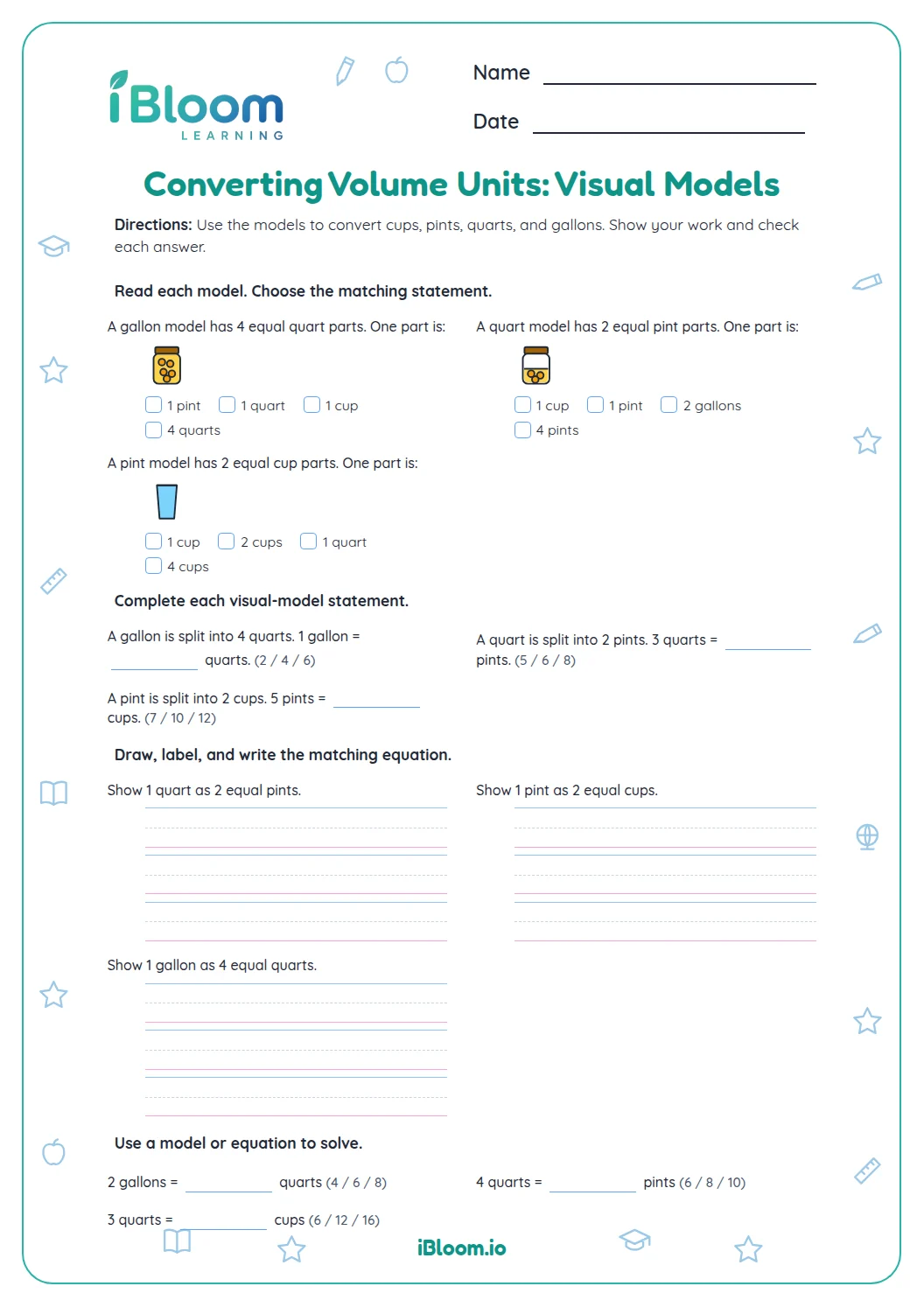
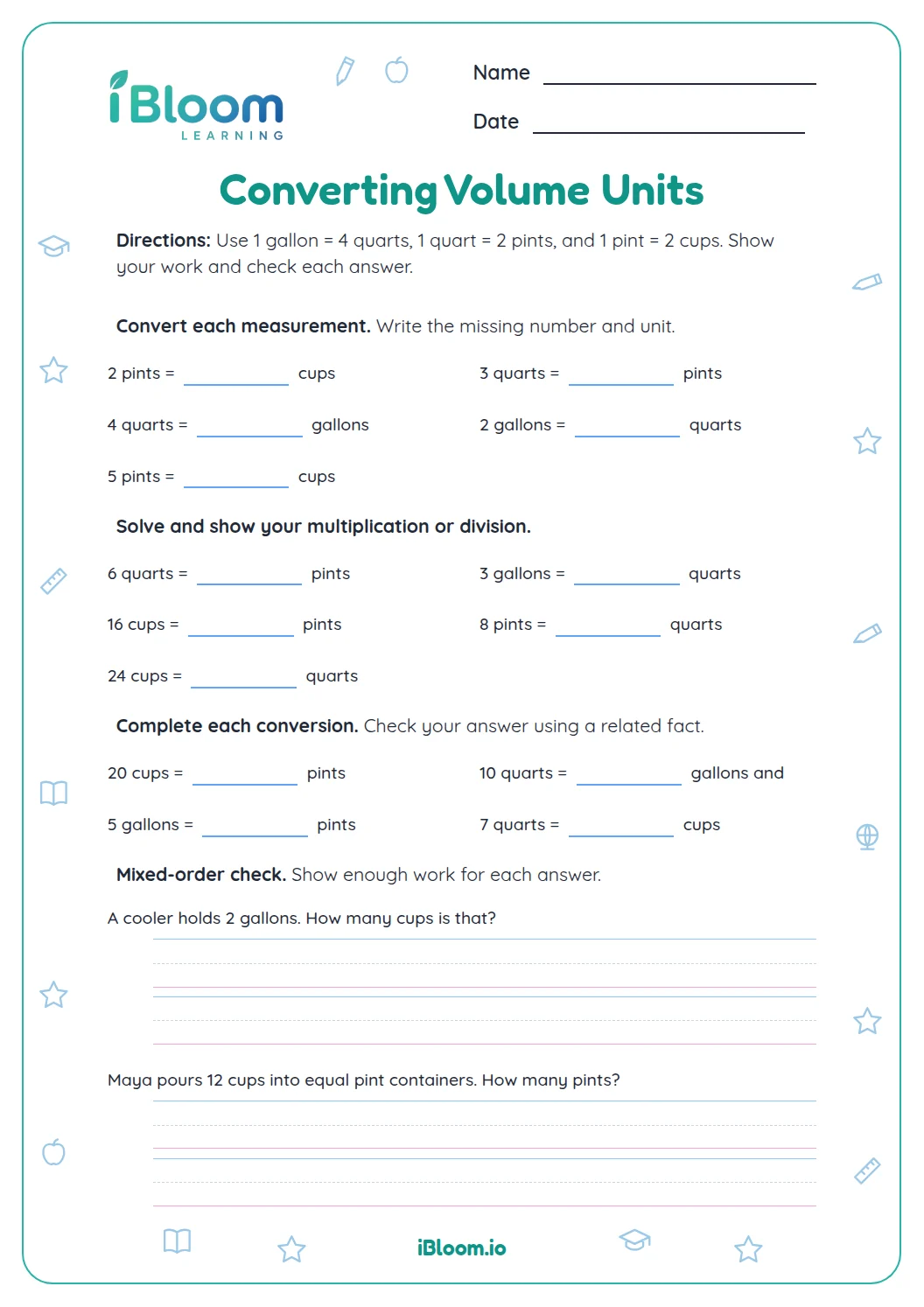
This Grade 4 measurement worksheet practices converting customary and metric length, weight, and capacity units. Students convert between feet and inches, yards and feet, pounds and ounces, cups and quarts, kilometers and meters, and liters or kilograms to smaller metric units. Later questions apply conversions in short stories and a table. The practice aligns with Common Core 4.MD.A.1. A separate answer key shows each equivalent value with its unit.
Aligned to 4.MD.A.1
How do you convert a larger unit to a smaller one?
Multiply by the number of smaller units in one larger unit. For example, 3 feet × 12 inches per foot = 36 inches.
- 11 foot = 12 inches
- 23 feet = 3 × 12 inches
- 33 feet = 36 inches
How do you convert to a larger unit?
Divide by the number of smaller units in one larger unit. To rename 48 inches in feet, calculate 48 ÷ 12 = 4 feet.
What should students do in the story problems?
Convert units first when needed, write the intermediate amount, and then answer the story question with the requested unit.
How to use this worksheet
- 1Circle the starting unit and underline the target unit.
- 2Recall how many smaller units equal one larger unit.
- 3Multiply when renaming into smaller units; divide when renaming into larger units.
- 4In a story, convert before adding, subtracting, or splitting amounts.
- 5Write the unit beside every final answer and check it against the question.
Common mistakes and quick fixes
The mistake
Multiplying when converting into a larger unit instead of dividing.
The fix
Pause and check the sentence or calculation against the clue: multiplying when converting into a larger unit instead of dividing.
The mistake
Using the right number relationship but attaching the starting unit to the answer.
The fix
Pause and check the sentence or calculation against the clue: using the right number relationship but attaching the starting unit to the answer.
The mistake
Skipping a needed conversion before solving a two-step story.
The fix
Pause and check the sentence or calculation against the clue: skipping a needed conversion before solving a two-step story.
Common Core alignment
Convert between related units in one measurement system.
On this sheet: The questions ask students to practice convert between related units in one measurement system..
Show the official wordingHide the official wording
Know relative sizes of measurement units within one system of units including km, m, cm; kg, g; lb, oz.; l, ml; hr, min, sec. Within a single system of measurement, express measurements in a larger unit in terms of a smaller unit. Record measurement equivalents in a two-column table. For example, know that 1 ft is 12 times as long as 1 in. Express the length of a 4 ft snake as 48 in. Generate a conversion table for feet and inches listing the number pairs (1, 12), (2, 24), (3, 36), ...
What to practice next
Make more practice
Further reading
Questions parents and teachers ask
Which conversions are included?
The worksheet includes customary length, weight, and volume conversions along with metric length, mass, and capacity. Each item stays within one measurement system. Writing the unit after the number makes it easier to check whether the conversion answers the question.
How should students approach a conversion?
Identify the starting and target units, then use the number of smaller units in one larger unit. For 3 feet, use 12 inches per foot: 3 × 12 = 36 inches. Writing the unit after the number makes it easier to check whether the conversion answers the question.
Why are some answers larger than the starting number?
When a measurement is renamed in smaller units, more units are needed. Three feet is 36 inches because each foot contains 12 inches. Writing the unit after the number makes it easier to check whether the conversion answers the question.
What is in the table question?
One row gives feet and inches, and students complete the missing inch value. The other rows provide reference pairs to help children use a consistent conversion relationship. Writing the unit after the number makes it easier to check whether the conversion answers the question.
Does the worksheet have an answer key?
Yes. The separate key lists all 16 equivalent measurements, including units, table completion, and the results of the multi-step stories. Writing the unit after the number makes it easier to check whether the conversion answers the question. Have students name the unit relationship before doing the arithmetic.