





About this worksheet
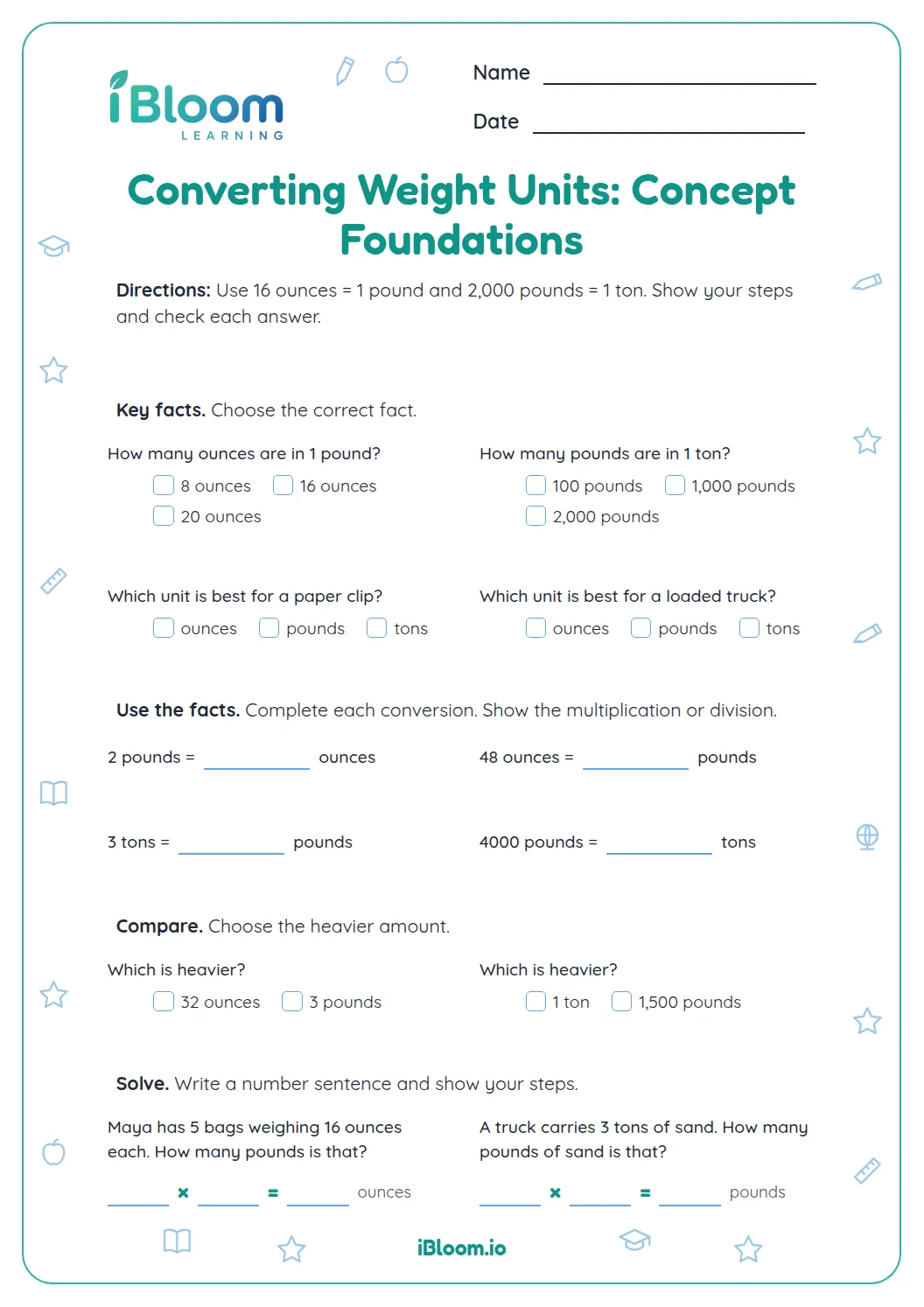
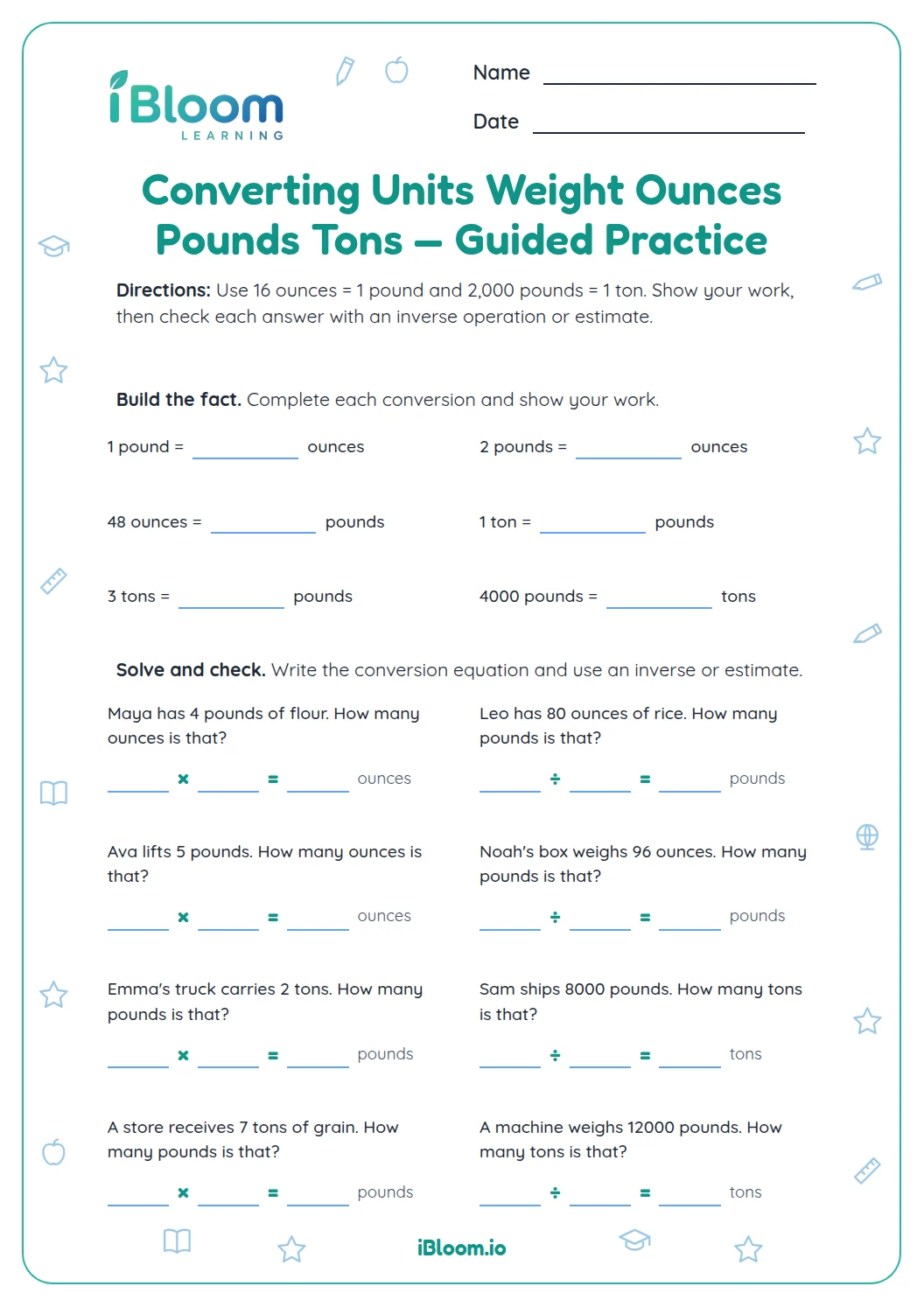
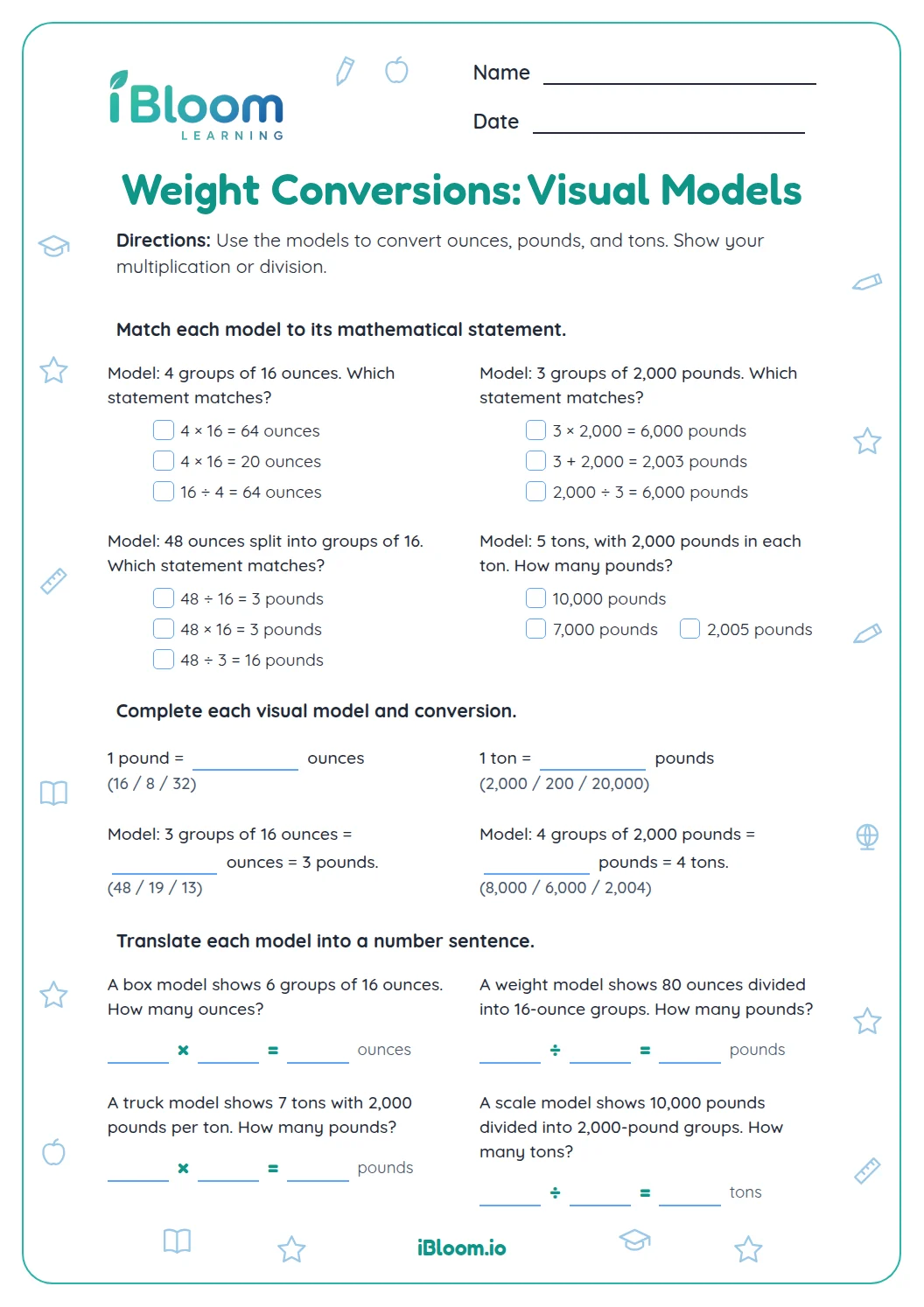
This Grade 4 worksheet builds fluency converting ounces, pounds, and tons. Children use 16 ounces per pound and 2,000 pounds per ton, then apply those relationships in short situations and compare weights after converting to a common unit. It includes 14 questions across three parts and a separate answer key. The practice aligns with CCSS 4.MD.A.1.
Aligned to 4.MD.A.1
Which facts connect ounces, pounds, and tons?
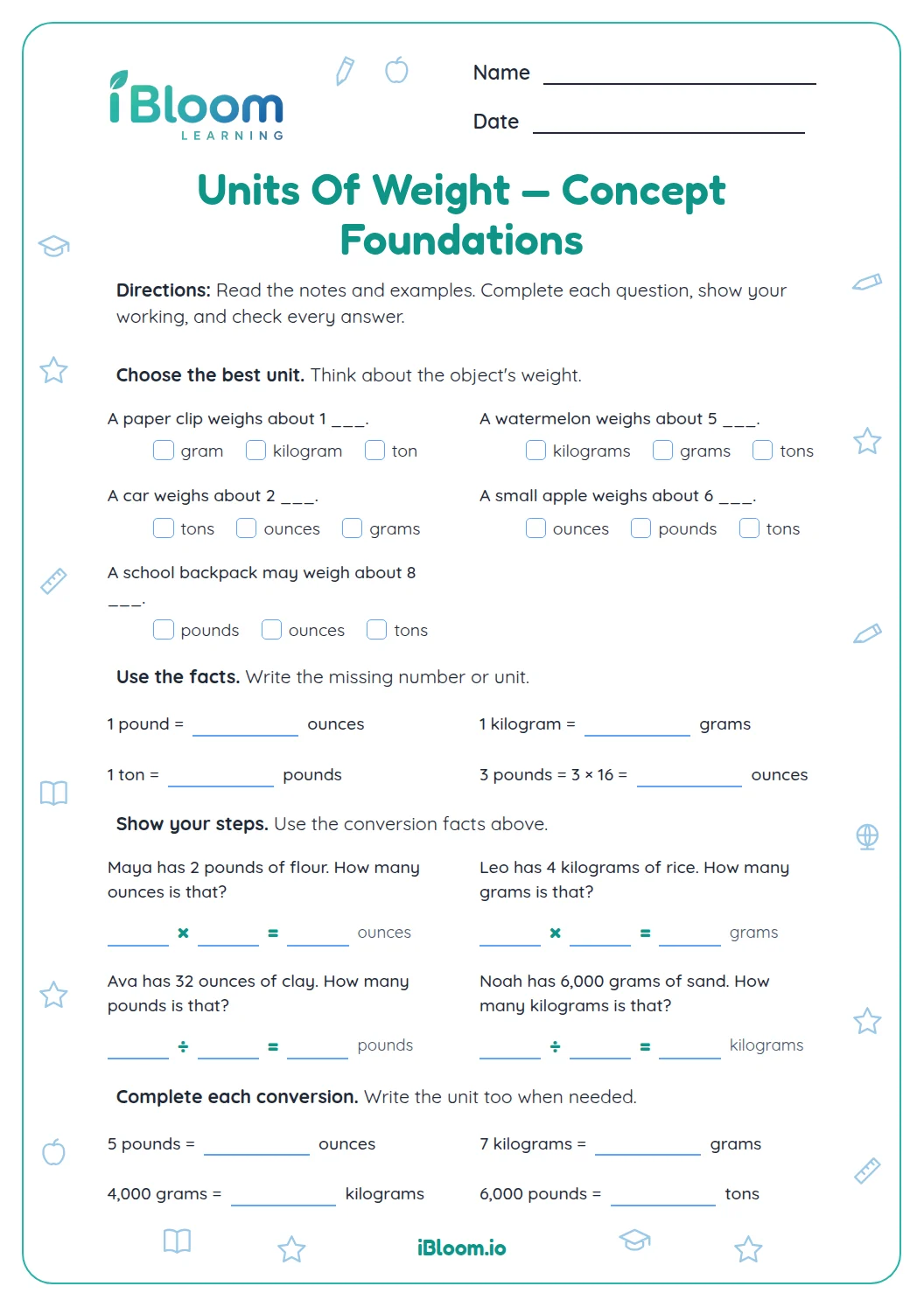
There are 16 ounces in 1 pound and 2,000 pounds in 1 ton. Moving to a smaller unit increases the number; moving to a larger unit decreases it.
For question 2, 56 ÷ 16 = 3.5, so 56 ounces is 3 1/2 pounds. Check by multiplying 3 1/2 × 16 = 56.
- 156 ounces = ___ pounds
- 256 ÷ 16 = 3 1/2
- 3Answer: 3 1/2 pounds
How can you compare two different weight units?
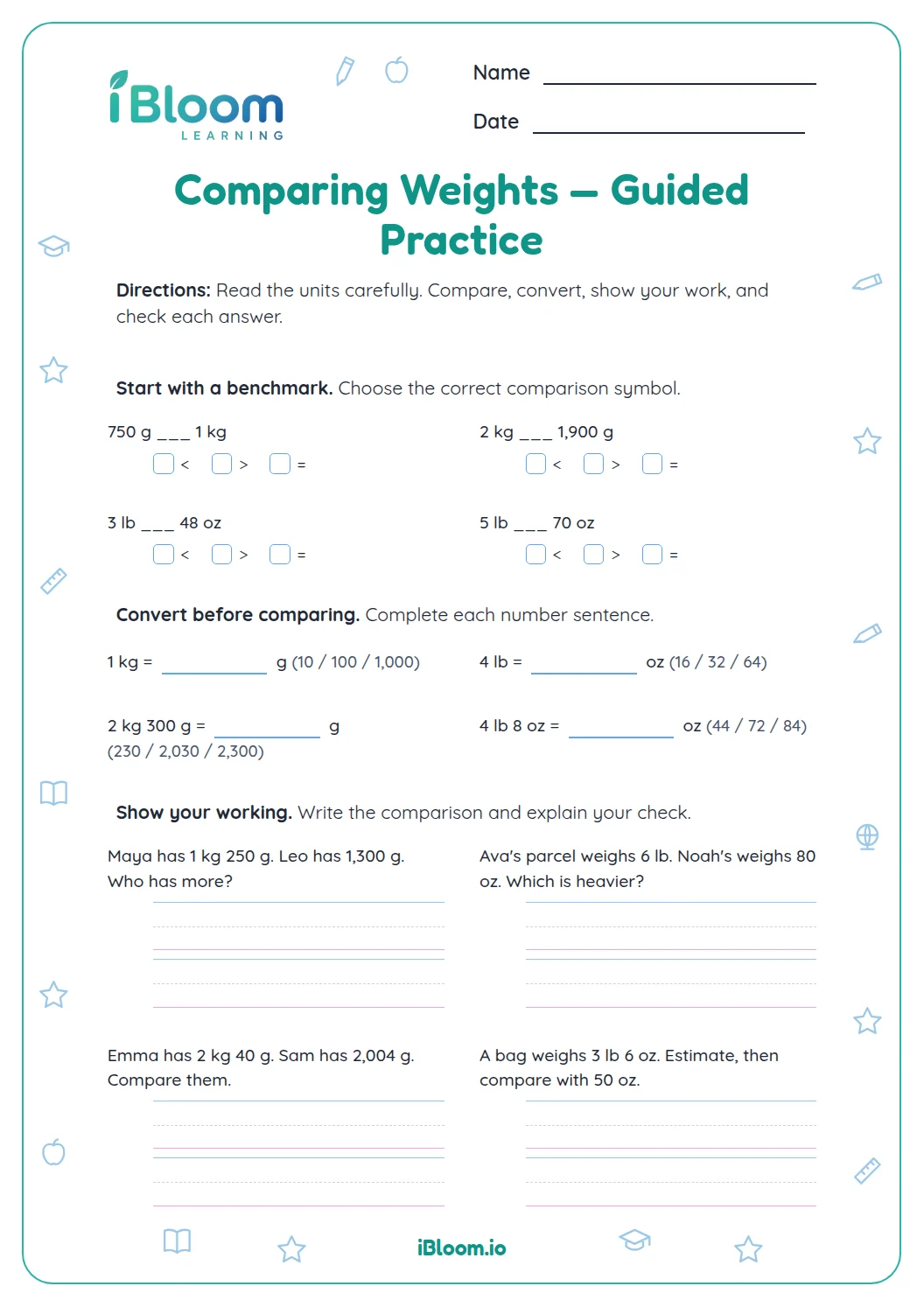
Rewrite one amount so both use the same unit. For example, 3 pounds equals 48 ounces, which is more than 40 ounces.
What will children practice on the pages?
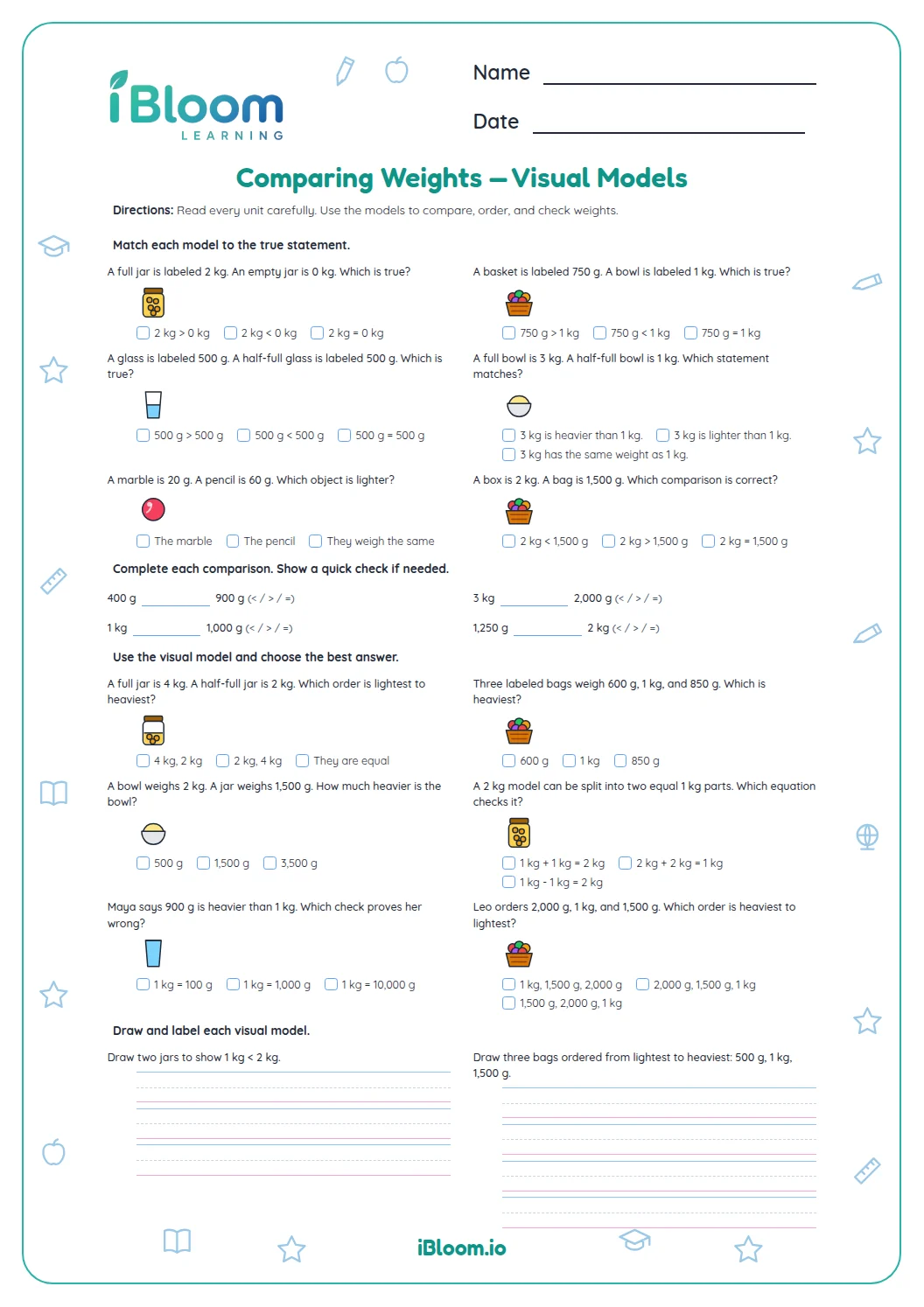
Part A converts between ounces, pounds, and tons. Part B applies conversions to everyday loads. Part C compares weights after rewriting units.
How to use this worksheet
- 1Write the two conversion facts where you can see them.
- 2In Part A, decide whether the answer needs a larger or smaller number.
- 3Multiply or divide by the correct conversion factor.
- 4In Part B, write an equation before giving the unit.
- 5For Part C, change both weights to ounces or pounds before comparing.
Common mistakes and quick fixes
The mistake
Multiplying when changing to a larger unit
The fix
Divide by the number of smaller units in each larger unit.
The mistake
Comparing 3 pounds directly with 40 ounces
The fix
Convert 3 pounds to 48 ounces first.
The mistake
Leaving off or mismatching the unit
The fix
Write ounces, pounds, or tons with every final amount.
Common Core alignment
This sheet practices measurement conversion within the customary system.
Convert measurements within one system and record equivalent units.
On this sheet: The problems convert customary weight units and compare equivalent amounts.
Show the official wordingHide the official wording
Know relative sizes of measurement units within one system of units including km, m, cm; kg, g; lb, oz.; l, ml; hr, min, sec. Within a single system of measurement, express measurements in a larger unit in terms of a smaller unit. Record measurement equivalents in a two-column table. For example, know that 1 ft is 12 times as long as 1 in. Express the length of a 4 ft snake as 48 in. Generate a conversion table for feet and inches listing the number pairs (1, 12), (2, 24), (3, 36), …
What to practice next
Make more practice
Further reading
Questions parents and teachers ask
What conversion facts are used?
The worksheet uses 16 ounces = 1 pound and 2,000 pounds = 1 ton. Keep these relationships beside you while solving. If converting to a smaller unit, multiply; if converting to a larger unit, divide. The answer key includes the unit with each conversion.
How many ounces are in a pound?
There are 16 ounces in 1 pound. To convert pounds to ounces, multiply by 16; for example, 6 pounds is 96 ounces. To convert ounces to pounds, divide by 16. Some answers can be fractional pounds, such as 56 ounces = 3 1/2 pounds.
How many pounds are in a ton?
This worksheet uses the US customary short ton: 1 ton equals 2,000 pounds. Multiply tons by 2,000 to find pounds, or divide pounds by 2,000 to find tons. It also combines the two facts to convert between tons and ounces.
How should children compare different units?
First rewrite one or both measurements so the units match. For instance, 3 pounds becomes 48 ounces, so it is heavier than 40 ounces. Comparing the numbers before converting can lead to the wrong choice because the unit sizes differ.
Does the sheet include an answer key?
Yes. A separate key gives the completed conversions and comparison answers. For the word problems, it shows a suitable conversion equation and the final unit, so an adult can check both the computation and the measurement label. Ask the learner to say how the answer connects to the question before checking the key.
How long should this practice take?
Plan for about 20 minutes, with extra time if the learner writes equations for every situation. The 14 questions progress from direct conversions to applied problems and comparisons. Children can pause between parts and check one conversion with multiplication or division.