





About this worksheet
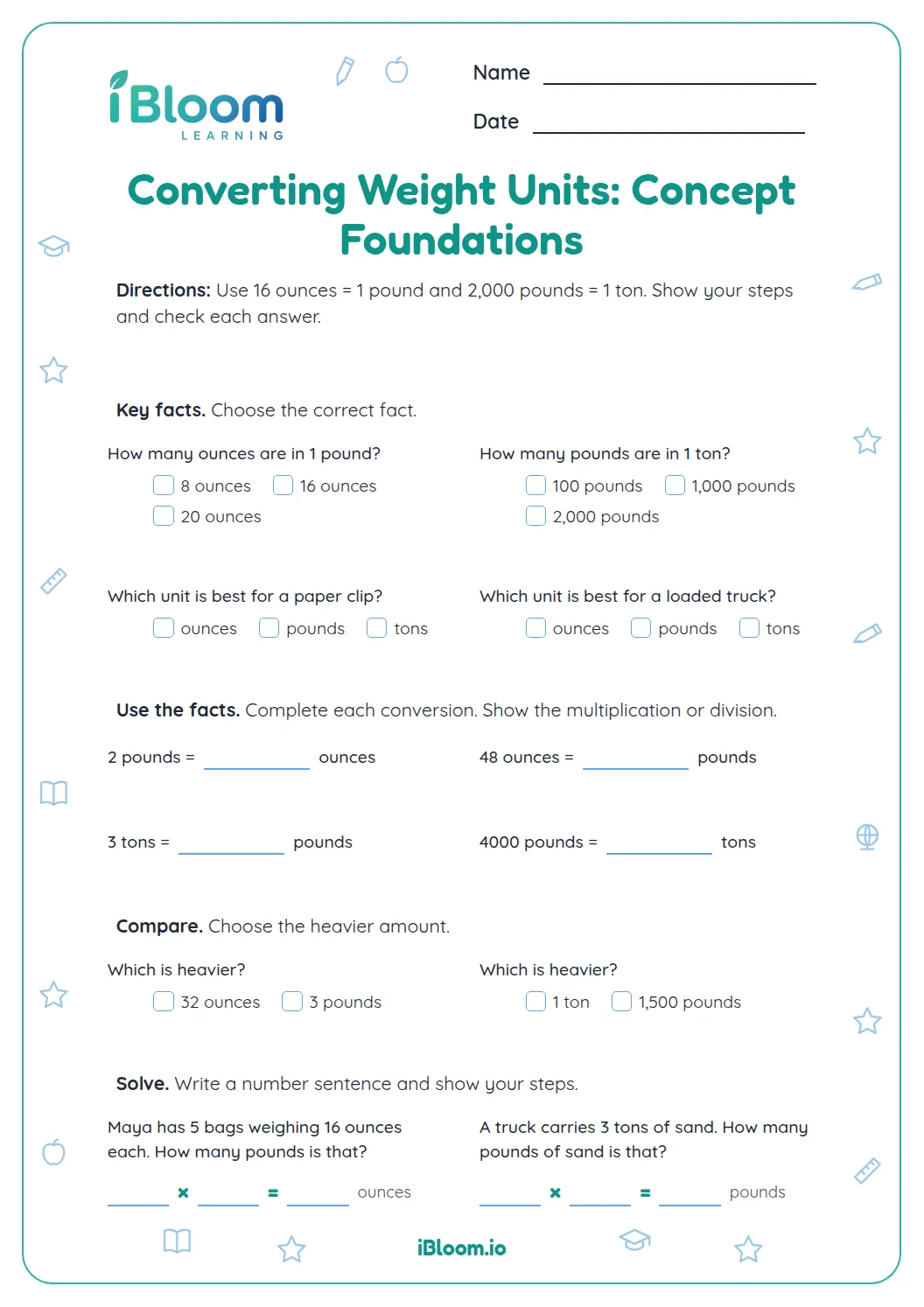
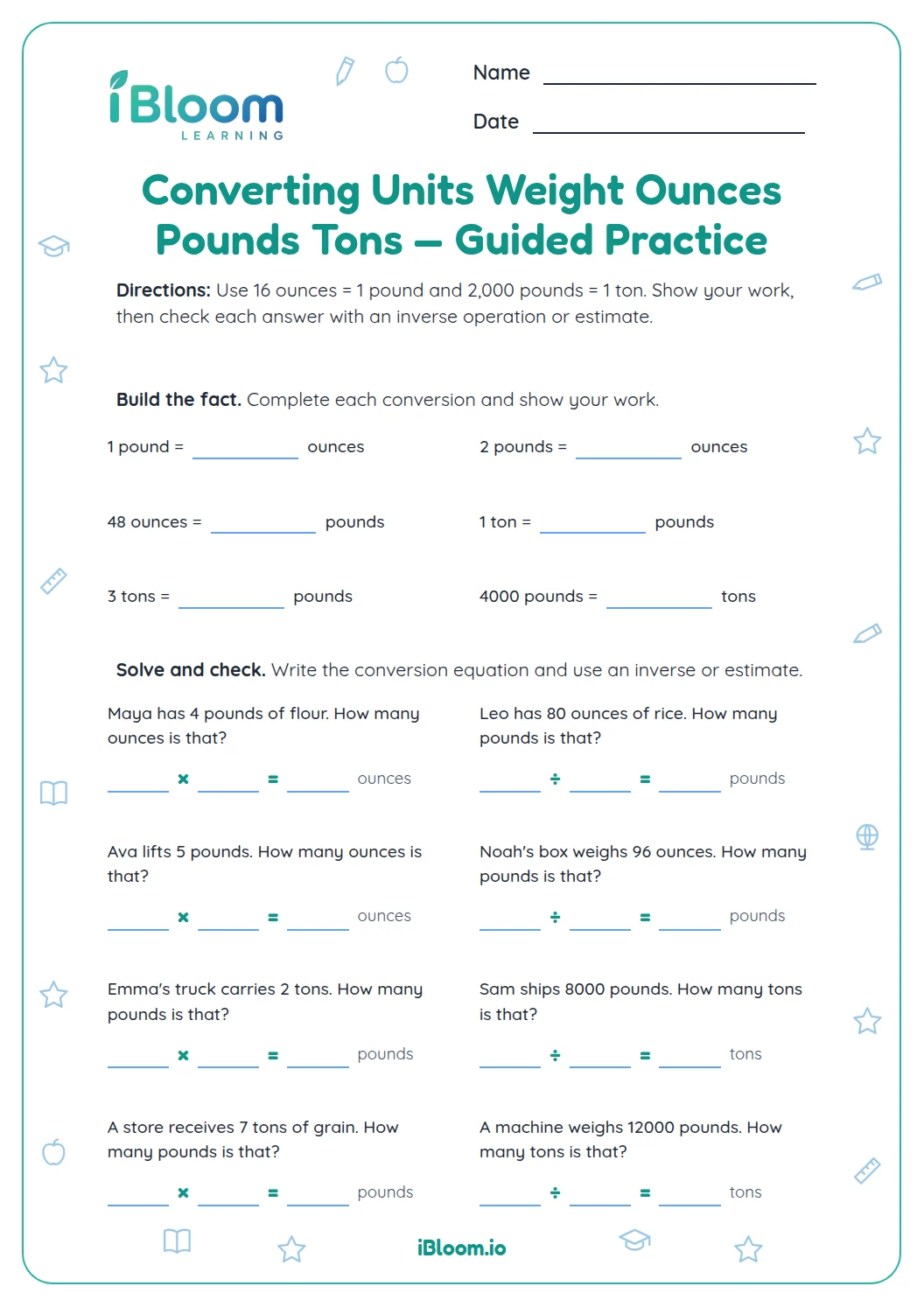
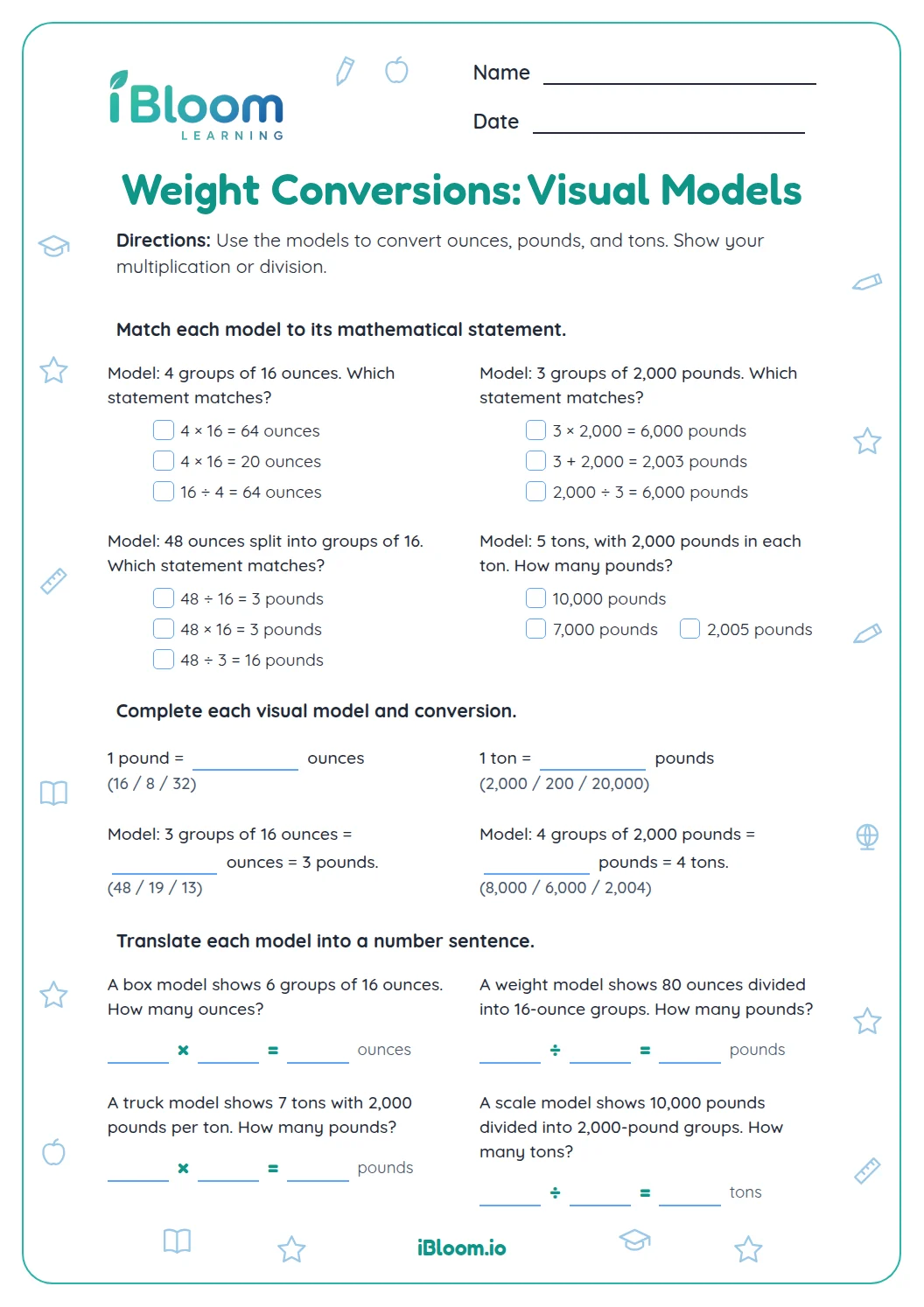
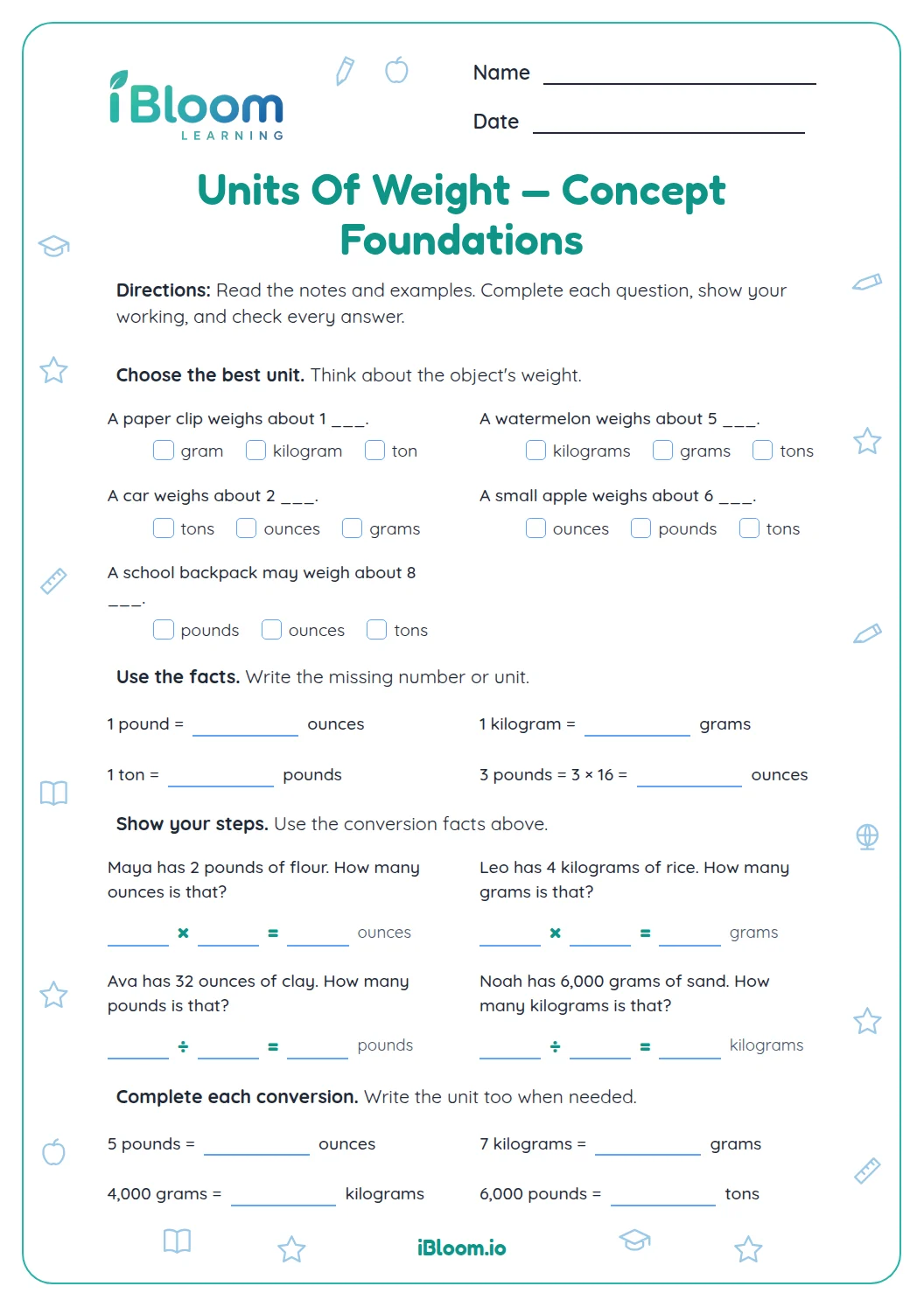
This free printable Grade 4 worksheet puts weight conversions into recipes, packages, pet food and deliveries. Students solve 14 problems using 1 pound = 16 ounces and 1 US ton = 2,000 pounds. Part A has eight direct conversion blanks, Part B has four comparisons, and Part C has two problems that require converting before adding or subtracting. The worksheet practices Common Core 4.MD.A.1 and 4.MD.A.2 through unit relationships and measurement word problems. Work spaces let students record their calculations, and a separate answer key gives each result in the requested unit.
Aligned to 4.MD.A.1 and 4.MD.A.2
Which conversion facts does this worksheet use?
The two facts are 1 pound = 16 ounces and 1 US ton = 2,000 pounds. Both are printed in the directions. Here, ounces measure weight. The labels oz and lb on the answer key mean ounces and pounds.
To change pounds to ounces, multiply by 16. To change ounces to pounds, divide by 16. The same relationship works between tons and pounds using 2,000 instead of 16.
How can students compare pounds with ounces?
Convert one amount so both weights use the same unit. A larger numeral by itself does not mean a heavier weight. In question 9, the 3-pound bag weighs 48 ounces, so it is heavier than the 40-ounce bag.
- 13 pounds = 3 × 16 ounces = 48 ounces
- 248 ounces > 40 ounces
- 3Choose: 3-pound bag
What changes in the final two problems?
Students must convert and then perform another operation. For question 13, 2 US tons is 4,000 pounds; subtracting 800 leaves 3,200 pounds. For question 14, 2 pounds is 32 ounces; adding 12 gives 44 ounces.
Ask students to label the intermediate conversion as well as the final answer. The written work makes it possible to distinguish a wrong conversion from a later addition or subtraction slip.
How to use this worksheet
- 1Read the two conversion facts in the directions.
- 2Underline the requested unit before completing each Part A blank.
- 3Multiply for smaller units and divide for larger units.
- 4For Part B, rewrite both weights in pounds or both in ounces.
- 5For Part C, record the conversion first and the addition or subtraction second.
- 6Check each answer against the key and read its unit aloud.
Mistakes to notice and fix
The mistake
Deciding 40 ounces is heavier than 3 pounds because 40 is greater than 3.
The fix
Rename 3 pounds as 48 ounces before comparing.
The mistake
Multiplying 48 by 16 when converting ounces to pounds.
The fix
One pound contains 16 ounces, so divide 48 into groups of 16.
The mistake
Subtracting 800 directly from 2 in the gravel problem.
The fix
Convert the 2 US tons to 4,000 pounds, then subtract 800 pounds.
Common Core alignment
Convert weights using the relative sizes of ounces, pounds and US tons.
On this sheet: Students use 16 ounces per pound and 2,000 pounds per US ton.
Show the official wordingHide the official wording
Know relative sizes of measurement units within one system of units including km, m, cm; kg, g; lb, oz.; l, ml; hr, min, sec. Within a single system of measurement, express measurements in a larger unit in terms of a smaller unit. Record measurement equivalents in a two-column table. For example, know that 1 ft is 12 times as long as 1 in. Express the length of a 4 ft snake as 48 in. Generate a conversion table for feet and inches listing the number pairs (1, 12), (2, 24), (3, 36), …
Solve weight problems by converting units before adding or subtracting.
On this sheet: The final problems combine weights in different units to find a remainder or total.
Show the official wordingHide the official wording
Use the four operations to solve word problems involving distances, intervals of time, liquid volumes, masses of objects, and money, including problems involving simple fractions or decimals, and problems that require expressing measurements given in a larger unit in terms of a smaller unit. Represent measurement quantities using diagrams such as number line diagrams that feature a measurement scale.
What to practice next
Make more practice
Further reading
Questions parents and teachers ask
How many ounces are in one pound?
One pound equals 16 ounces. The recipe problem uses this fact to change 3 pounds of flour into 48 ounces. Children write 48 in the blank before ounces. Reversing the calculation, 48 ÷ 16 = 3, checks that the conversion returns to the starting number of pounds.
Which kind of ton is used on this worksheet?
Every ton on this worksheet is a US ton, equal to 2,000 pounds. The directions state that relationship, and the word problems label tons as US tons. For example, 4 US tons of sand becomes 8,000 pounds by multiplying 4 by 2,000 before writing the final unit.
Should students multiply or divide when converting weight?
Multiply when expressing a weight in smaller units, and divide when expressing it in larger units. Pounds to ounces uses multiplication by 16; ounces to pounds uses division by 16. Ask the student whether the number of units should grow or shrink, then check with the printed conversion facts.
How does the key handle the two-step problems?
The key gives the final weight and its unit for each problem. Check the student’s written calculations too: the gravel problem should show 4,000 − 800 = 3,200 pounds, and the oats problem should show 32 + 12 = 44 ounces after the conversions. Equivalent correct working is acceptable.
What should I review after a wrong comparison?
Review the units before reviewing the arithmetic. In the apples problem, the numbers 3 and 40 cannot be compared as weights until both amounts use the same unit. Have the student rename 3 pounds as 48 ounces, then compare 48 with 40 and explain which bag is heavier.