


About this worksheet
This Grade 4 worksheet introduces Fahrenheit temperature readings and changes. Children read a number line, compare warmer and colder values, and solve short rise-and-drop problems. The examples use degree units and familiar temperature language, with a separate answer key for checking. The measurement word problems practice CCSS 4.MD.A.2 by adding and subtracting quantities in a measurement context.
Aligned to 4.MD.A.2
How do I read a Fahrenheit scale?
On a number line, a value farther to the right is warmer. Compare the numbers and keep the Fahrenheit unit attached to each reading.
- 1On a scale labeled by fives, a point one tick left of 0 is −5°F.
How do I find how many degrees the temperature changed?
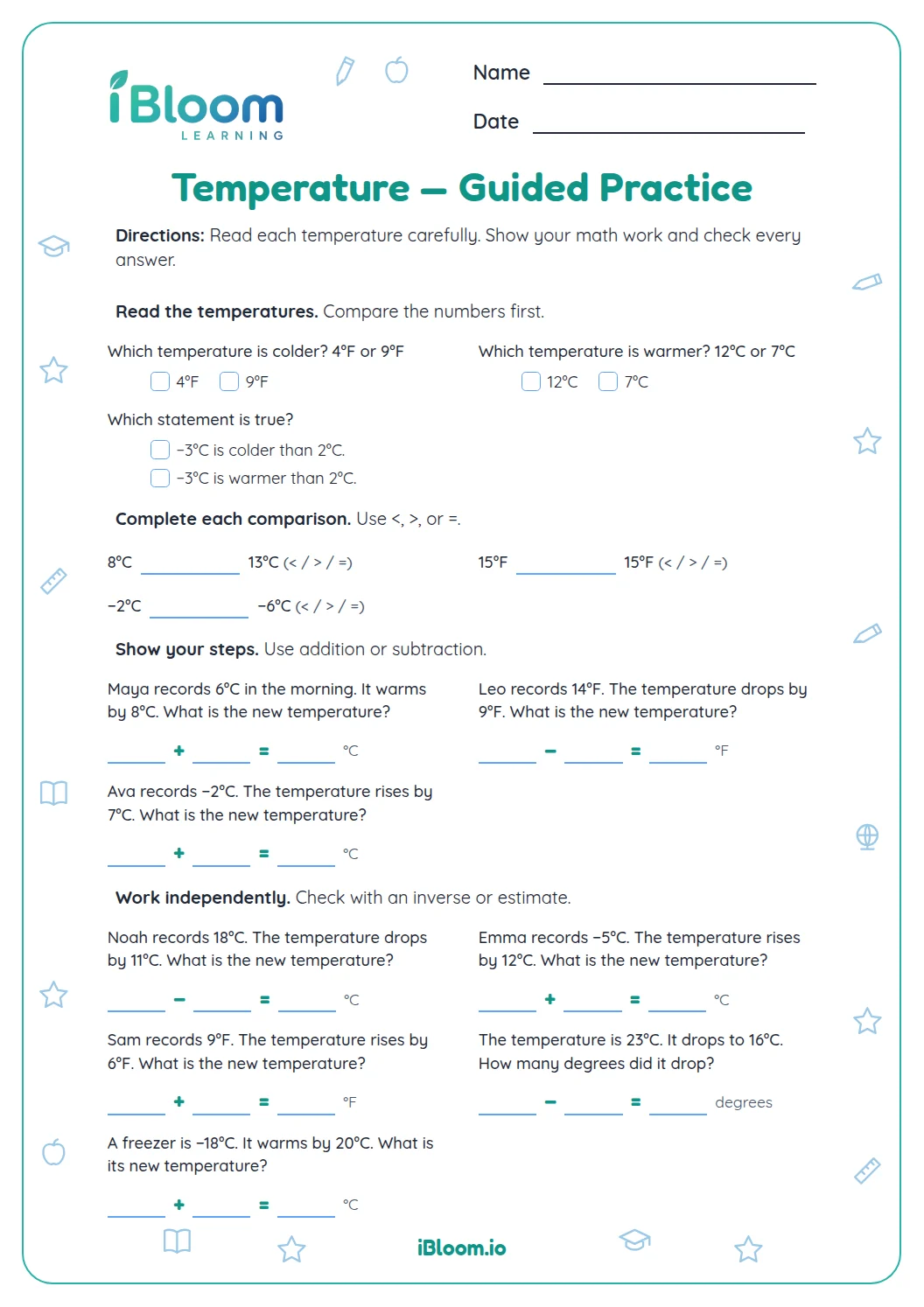
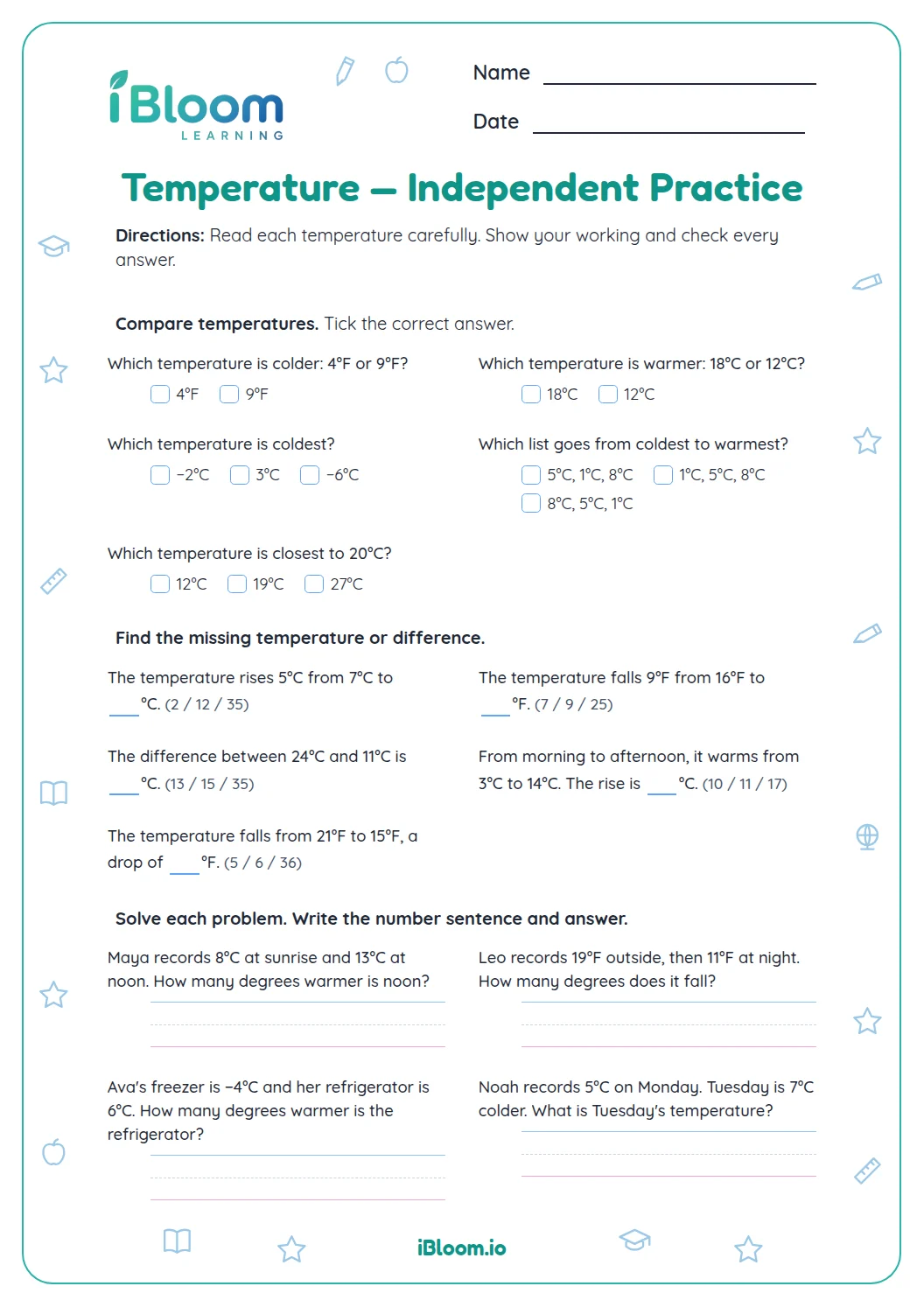
A rise adds degrees to the starting temperature; a drop subtracts them. For example, 18°F − 11° = 7°F. Check that the answer moves in the direction the clue describes.
- 118°F − 11° = 7°F
What does a temperature below zero mean?
A negative Fahrenheit value is colder than zero. On a number line, it appears to the left of zero. Comparing negative and positive values is easier when each is placed in order on the same scale.
How to use this worksheet
- 1Read the scale labels before finding the point.
- 2Check which side of zero the point is on.
- 3For a change, find the distance between the two temperatures.
- 4Use rise or fall from the story to choose the right direction.
- 5Check each result and unit with the answer key.
Common mistakes and quick fixes
The mistake
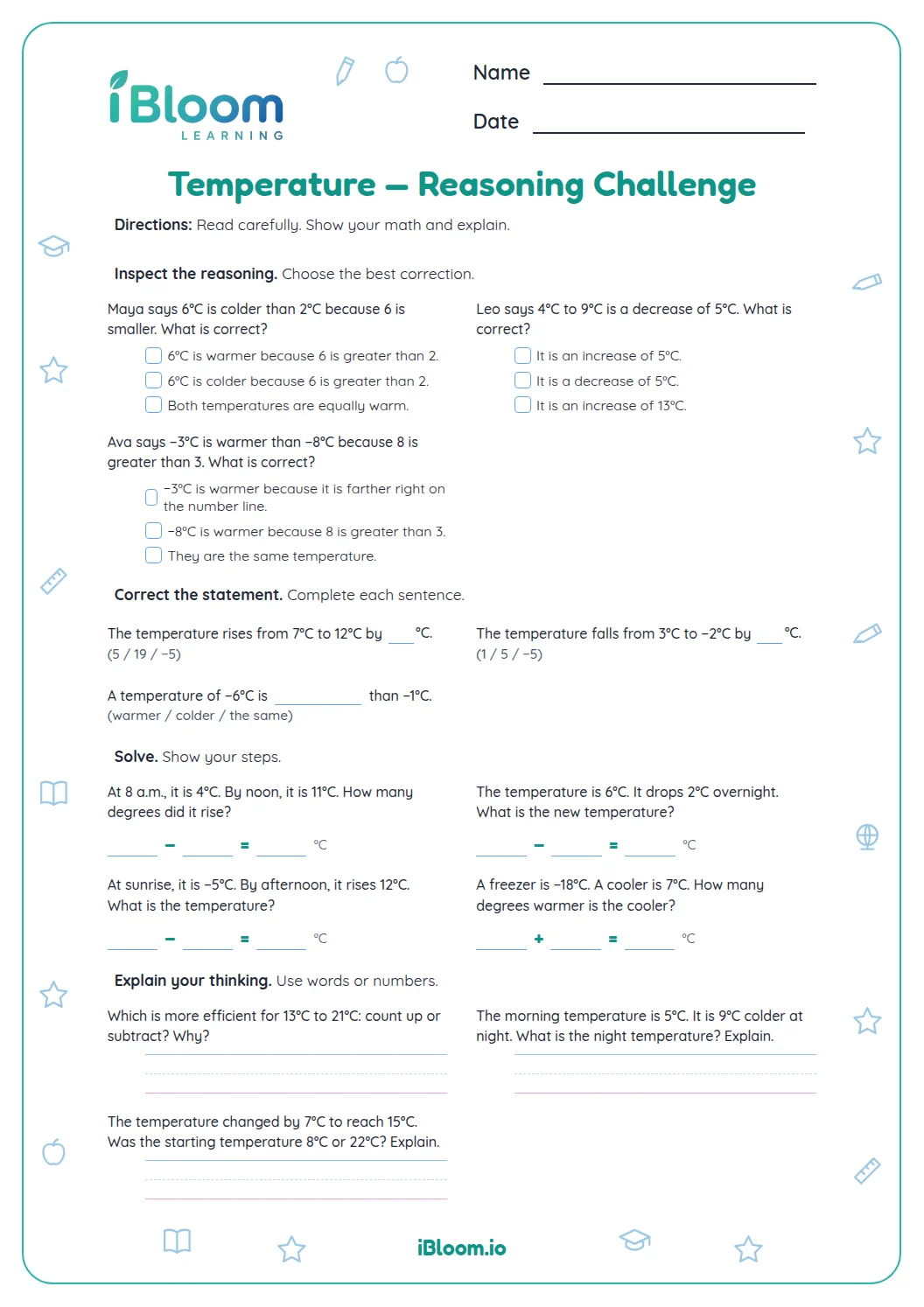
Thinking −8°F is warmer than −2°F because 8 is bigger than 2.
The fix
On a number line, −8 is farther left, so it is colder than −2.
The mistake
Reporting only the direction of change.
The fix
The question asks for degrees changed, so give the size of the difference.
The mistake
Adding when the story says the temperature fell.
The fix
A fall means move left on the number line; subtract the stated amount.
Common Core alignment
This worksheet practices the listed Common Core skill through the questions and models on the page.
Solve measurement problems using the four operations.
On this sheet: Students solve temperature measurement problems by comparing values and finding changes.
Show the official wordingHide the official wording
Use the four operations to solve word problems involving distances, intervals of time, liquid volumes, masses of objects, and money, including problems involving simple fractions or decimals, and problems that require expressing measurements given in a larger unit in terms of a smaller unit. Represent measurement quantities using diagrams such as number line diagrams that feature a measurement scale.
What to practice next
Make more practice
Further reading
Questions parents and teachers ask
How do I compare two temperatures?
The greater Fahrenheit number is warmer. For example, 12°F is warmer than 4°F, and 4°F is closer to freezing than 12°F. On the number line, values farther right are greater. Keep the degree unit with each reading as you compare.
How do I calculate a temperature rise?
Add the rise to the starting temperature. If a morning reading is 8°F and the temperature rises 5°, calculate 8 + 5 = 13°F. Include the Fahrenheit unit in the ending reading, then check that the answer is warmer than the start.
How do I calculate a temperature drop?
Subtract the number of degrees that the temperature drops. From 18°F, an 11-degree drop gives 18 − 11 = 7°F. The result should be lower than the starting temperature. Keep °F with the final reading and check the subtraction.
How does the number line help?
The number line shows the order of the temperatures and marks equal steps. Read the labeled ticks to locate a value, then compare positions or count the distance between two readings. The worksheet includes one marked example and several written temperature clues.
What does the answer key include?
The answer key gives the marked number-line reading, warmer and colder comparisons, and the results of the temperature changes. For each change, it shows the ending reading or number of degrees between the two readings, with Fahrenheit units where needed.