


About this worksheet
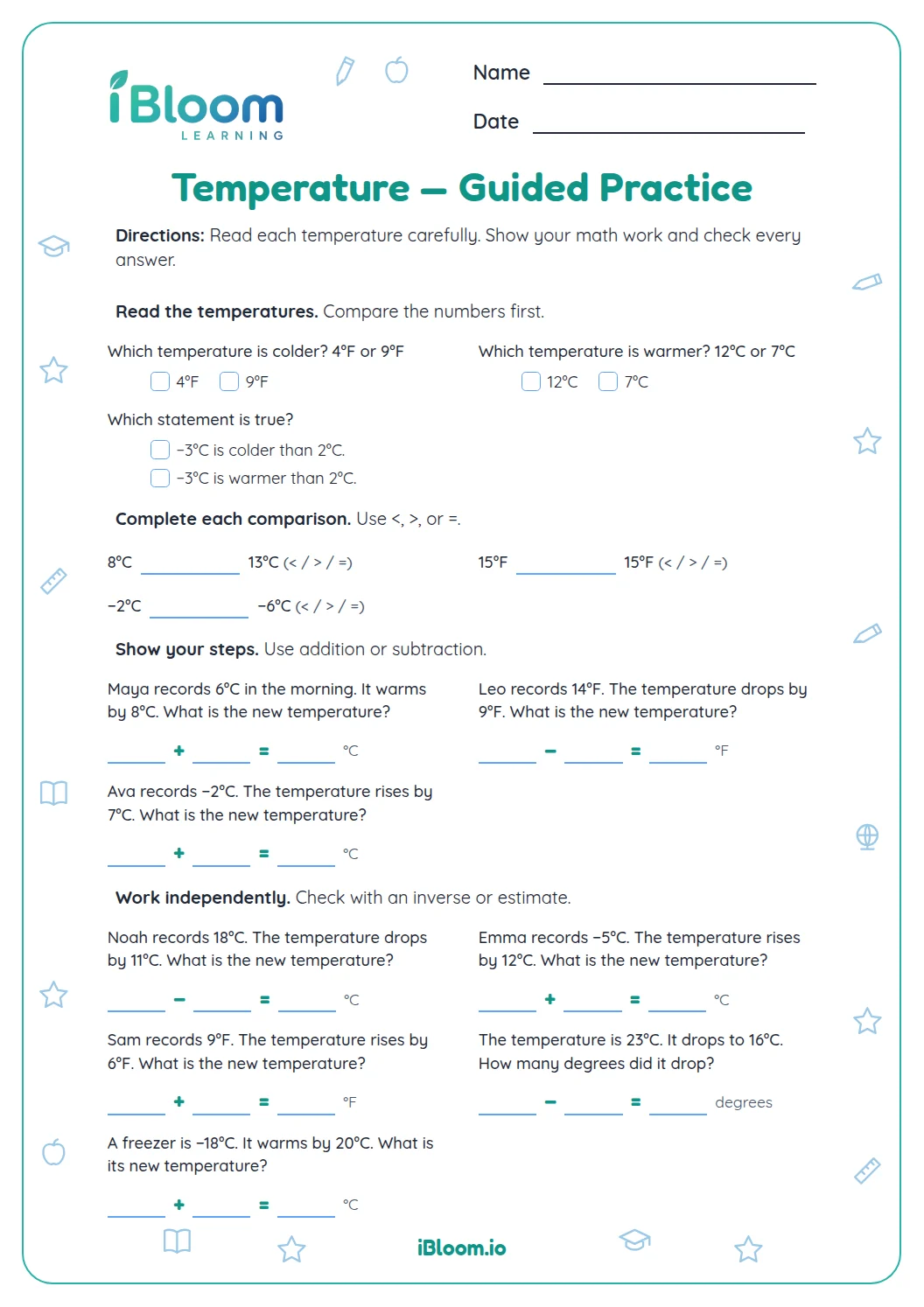
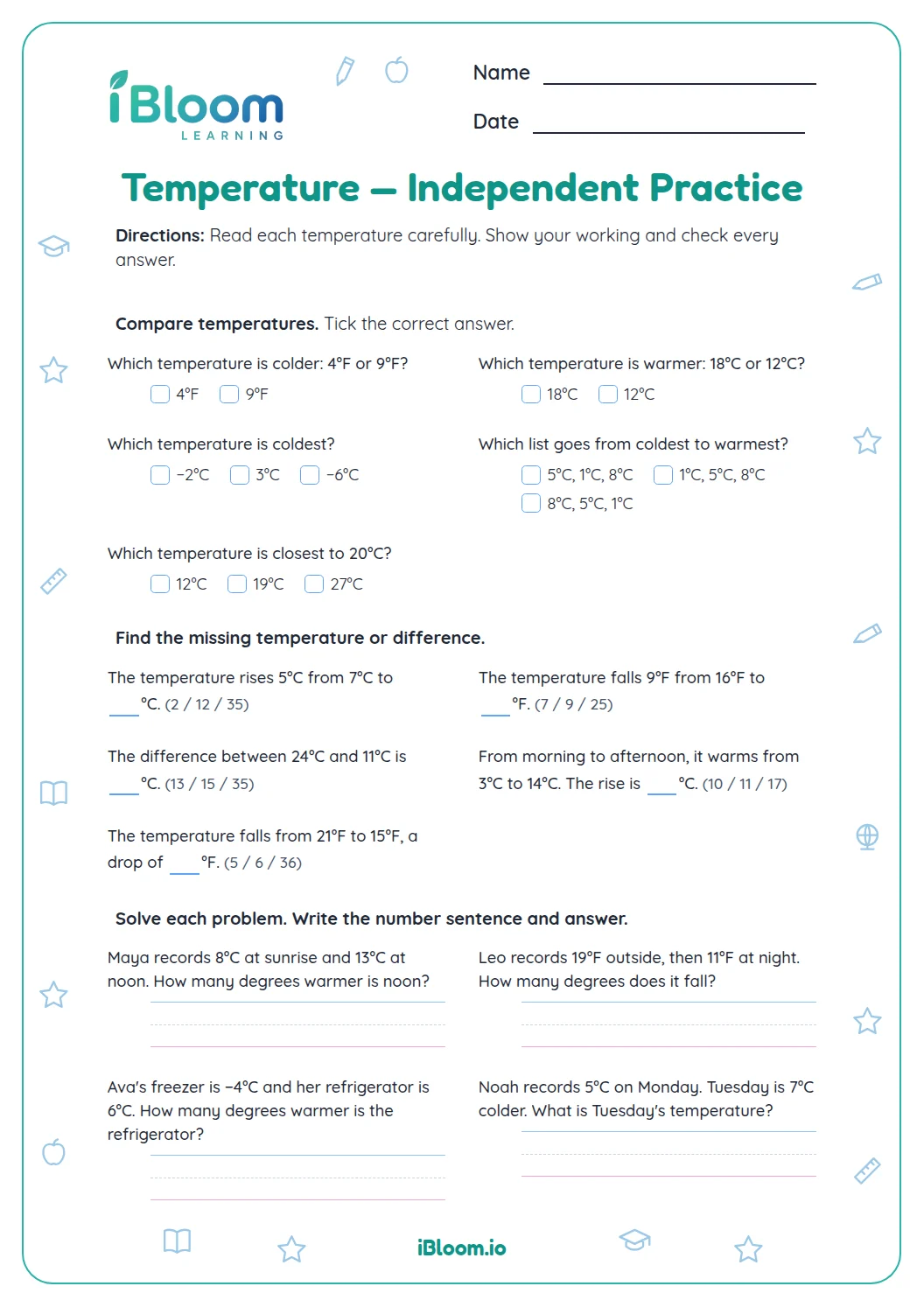
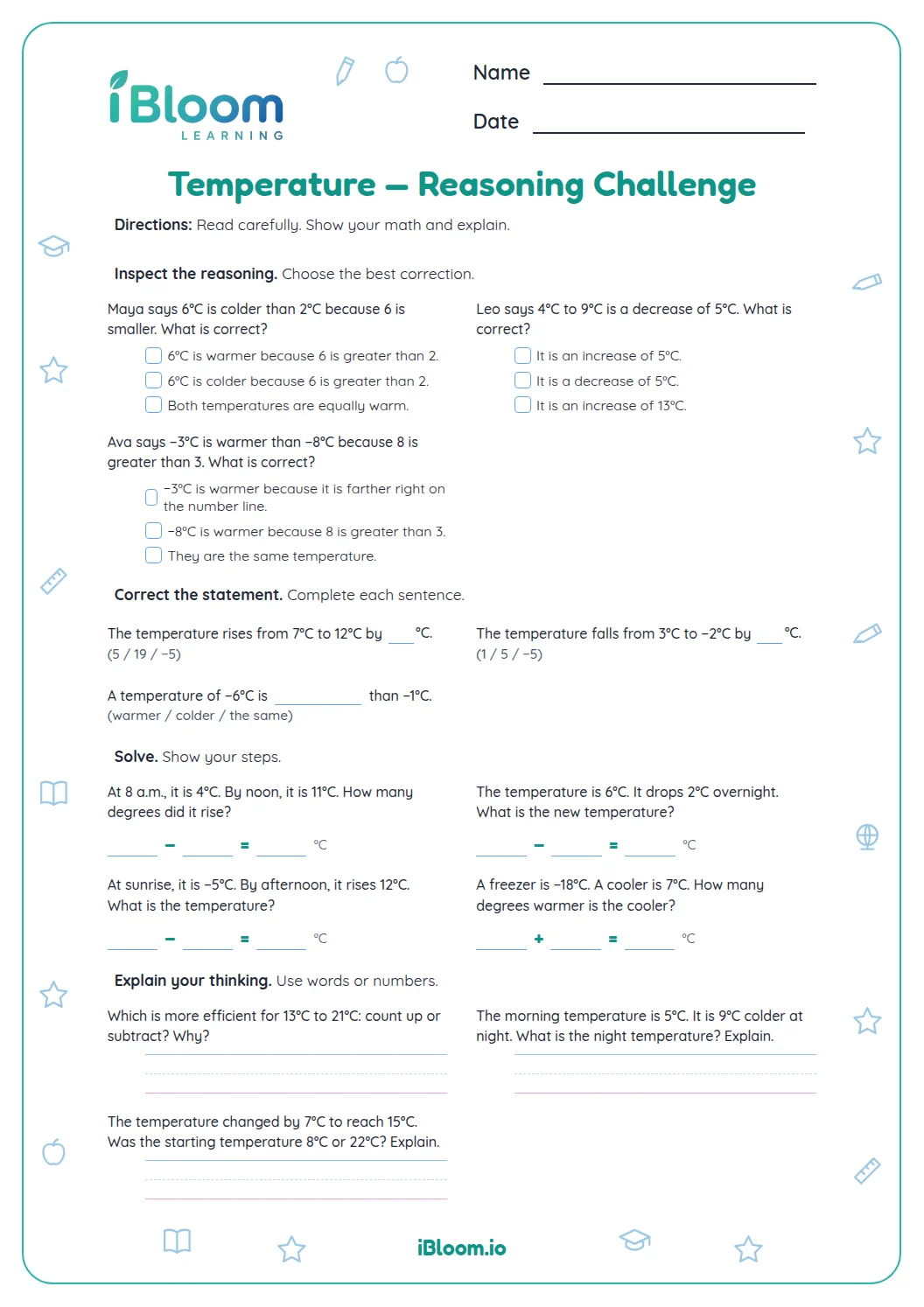
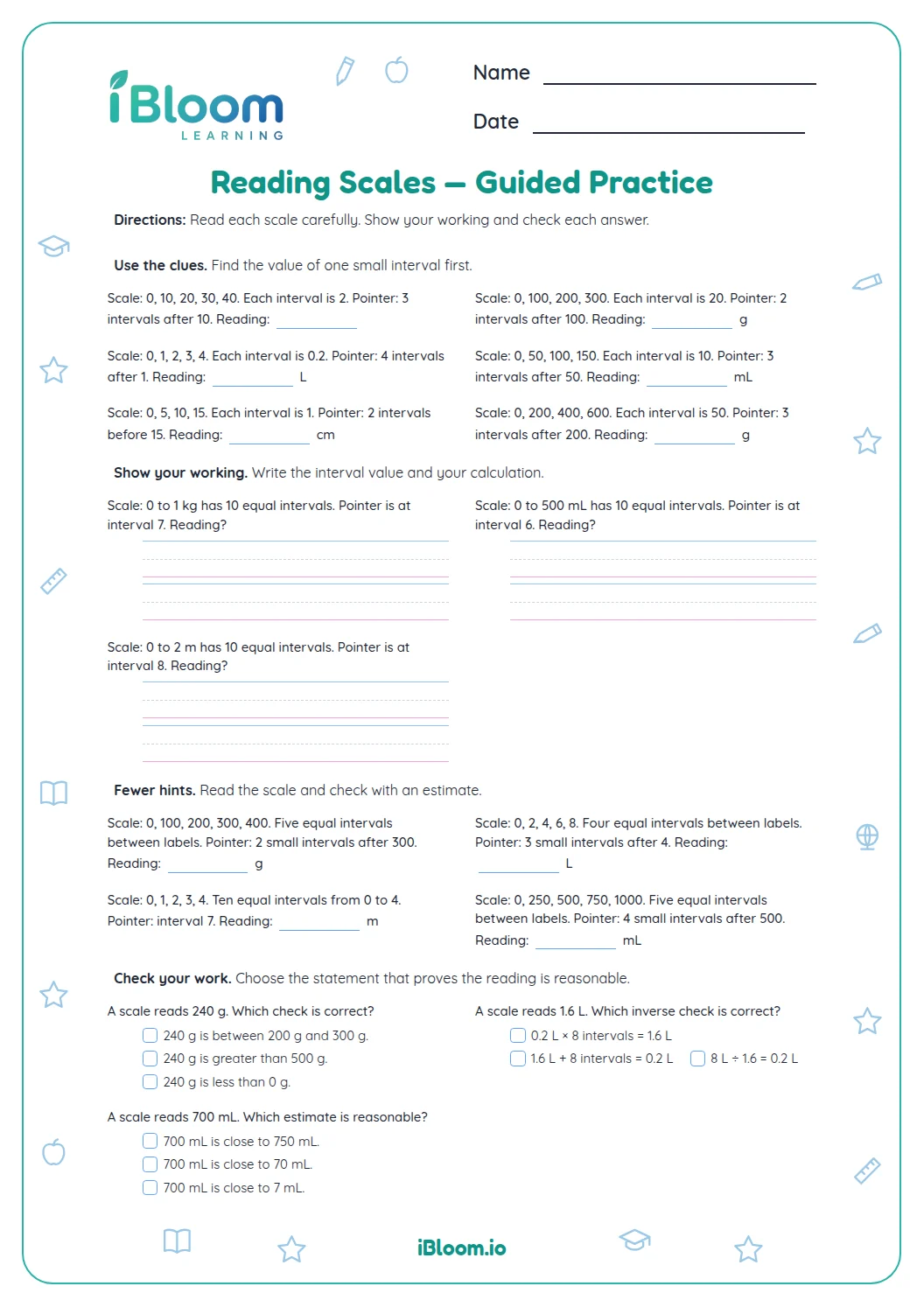
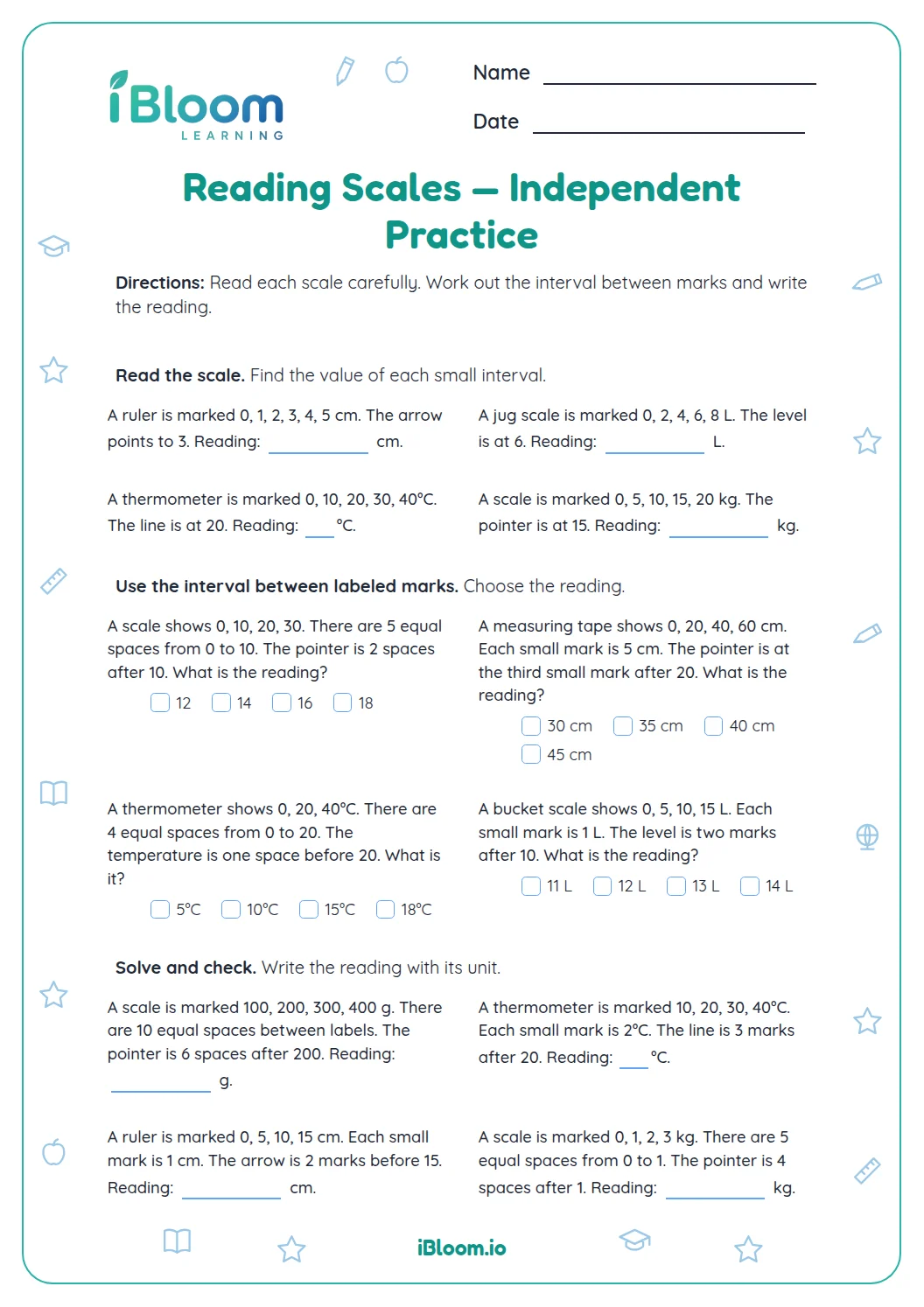
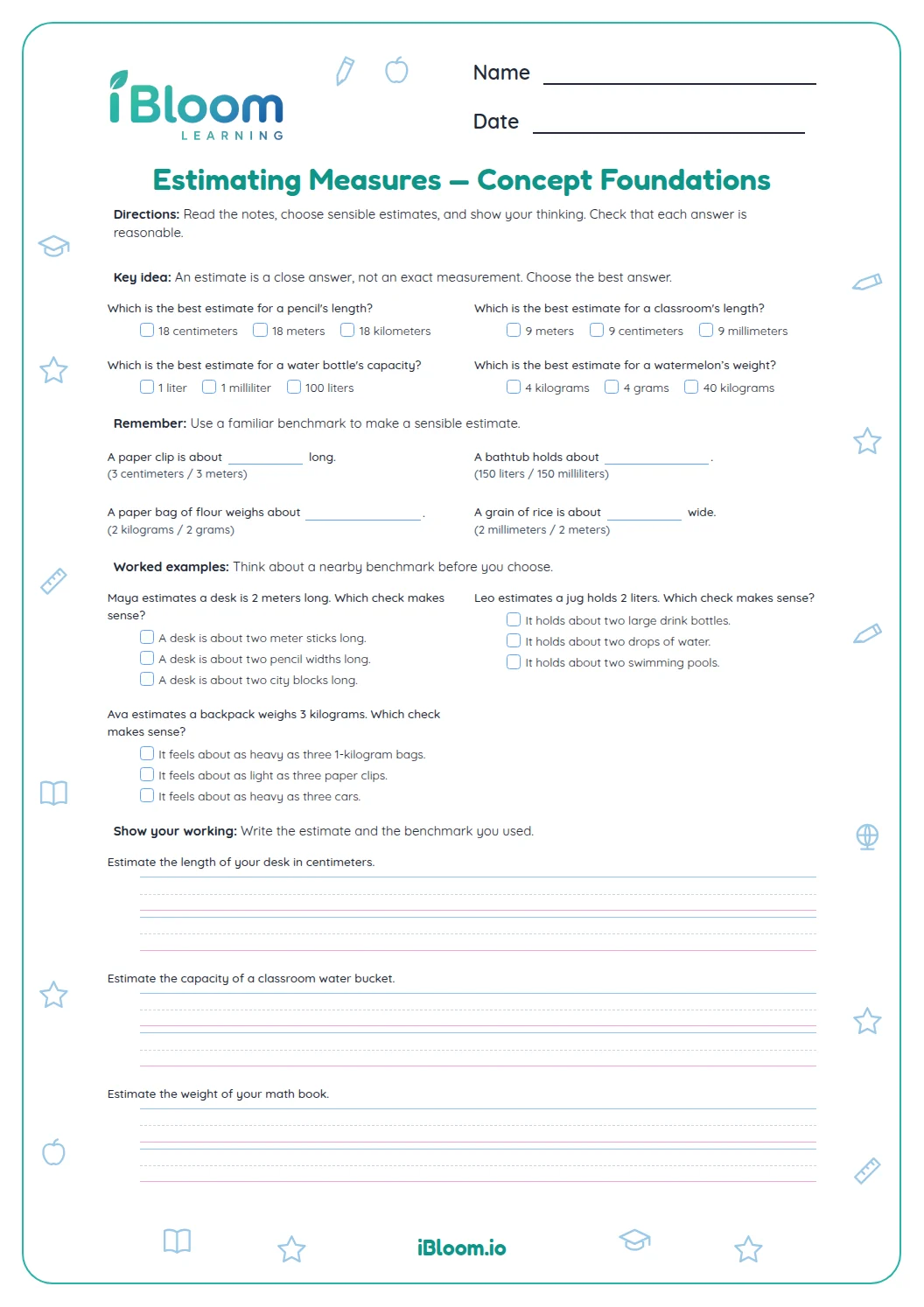
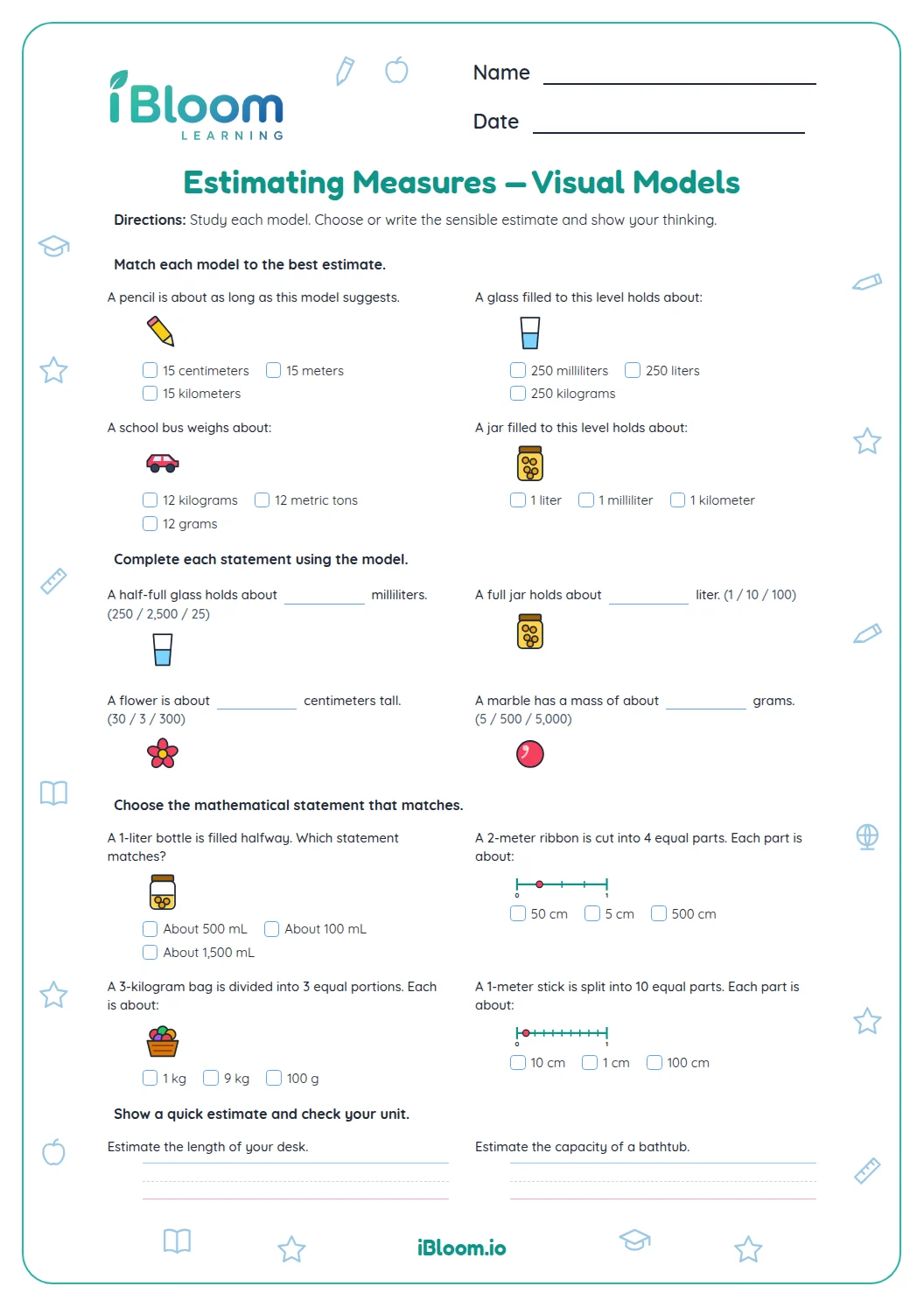
This Grade 4 measurement worksheet practices temperature changes in everyday situations. Learners write a number sentence, solve an increase or decrease in degrees Fahrenheit, label the result, and check it. Most problems use one change; Part B includes two-step changes. The 16 questions fill four worksheet pages, with a separate answer key. The measurement word problems connect with CCSS 4.MD.A.2.
Aligned to 4.MD.A.2
How do you decide whether to add or subtract?
Compare the starting and ending temperatures or read the change word. “Warmer” and “rose” mean add; “fell,” “cooled,” and “decreased” mean subtract. If both readings are given, find the distance between them.
How much did the temperature rise from 18°F to 31°F?
Subtract the starting reading from the ending reading: 31 − 18 = 13. The rise was 13°F. Label the difference in degrees Fahrenheit.
- 118°F to 31°F
- 231 − 18 = 13
- 3Answer: 13°F
What kinds of temperature changes are included?
Part A practices one-step increases, decreases, and differences between readings. Part B includes two changes in sequence, so learners must keep track of the temperature after the first step before finding the final reading.
How to use this worksheet
- 1Mark the starting temperature and each change.
- 2Decide whether each change is a rise or a fall.
- 3Write an addition or subtraction number sentence.
- 4Solve and label the answer in °F.
- 5Check whether the result matches the story.
Common mistakes and quick fixes
The mistake
Adding for a temperature drop
The fix
Words like fell and cooled signal subtraction.
The mistake
Giving the change when asked for the final reading
The fix
For a final temperature, apply the change to the starting reading.
The mistake
Forgetting the first step in a two-step problem
The fix
Write the intermediate temperature before applying the next change.
Common Core alignment
The questions use operations to solve real-world measurement situations.
Solve real-world measurement problems using temperature changes.
On this sheet: Add and subtract measured temperature changes in real-world situations.
Show the official wordingHide the official wording
Use the four operations to solve word problems involving distances, intervals of time, liquid volumes, masses of objects, and money, including problems involving simple fractions or decimals, and problems that require expressing measurements given in a larger unit in terms of a smaller unit. Represent measurement quantities using diagrams such as number line diagrams that feature a measurement scale.
What to practice next
Make more practice
Further reading
Questions parents and teachers ask
How do I know whether to add or subtract temperatures?
Add when the temperature rises or warms by a stated amount. Subtract when it falls or cools. If the problem gives a starting and ending reading and asks for the change, find the difference between the two readings in the story.
Does the worksheet use Fahrenheit or Celsius?
Every problem uses degrees Fahrenheit, shown as °F. Learners work with increases, decreases, and differences between readings. The sheet focuses on writing and solving number sentences for temperature changes in each situation and labeling the result in degrees Fahrenheit throughout.
What is an example of finding a temperature increase?
If the temperature rises from 18°F to 31°F, subtract the starting reading from the ending reading: 31 − 18 = 13. The temperature rose 13°F. Question 1 uses this kind of change and the answer key shows the result so learners can check their work.
What makes the two-step questions different?
Two-step questions describe more than one change. Find the temperature after the first rise or fall, then use that new reading as the starting point for the next change. Writing both steps helps prevent using the original temperature twice in the same story.
How many problems and pages are included?
There are 16 word problems on four worksheet pages and a separate four-page answer key. Fourteen questions use a single change or difference; two ask learners to apply changes in sequence. Allow about 25 minutes for solving and checking the set.