






About this worksheet
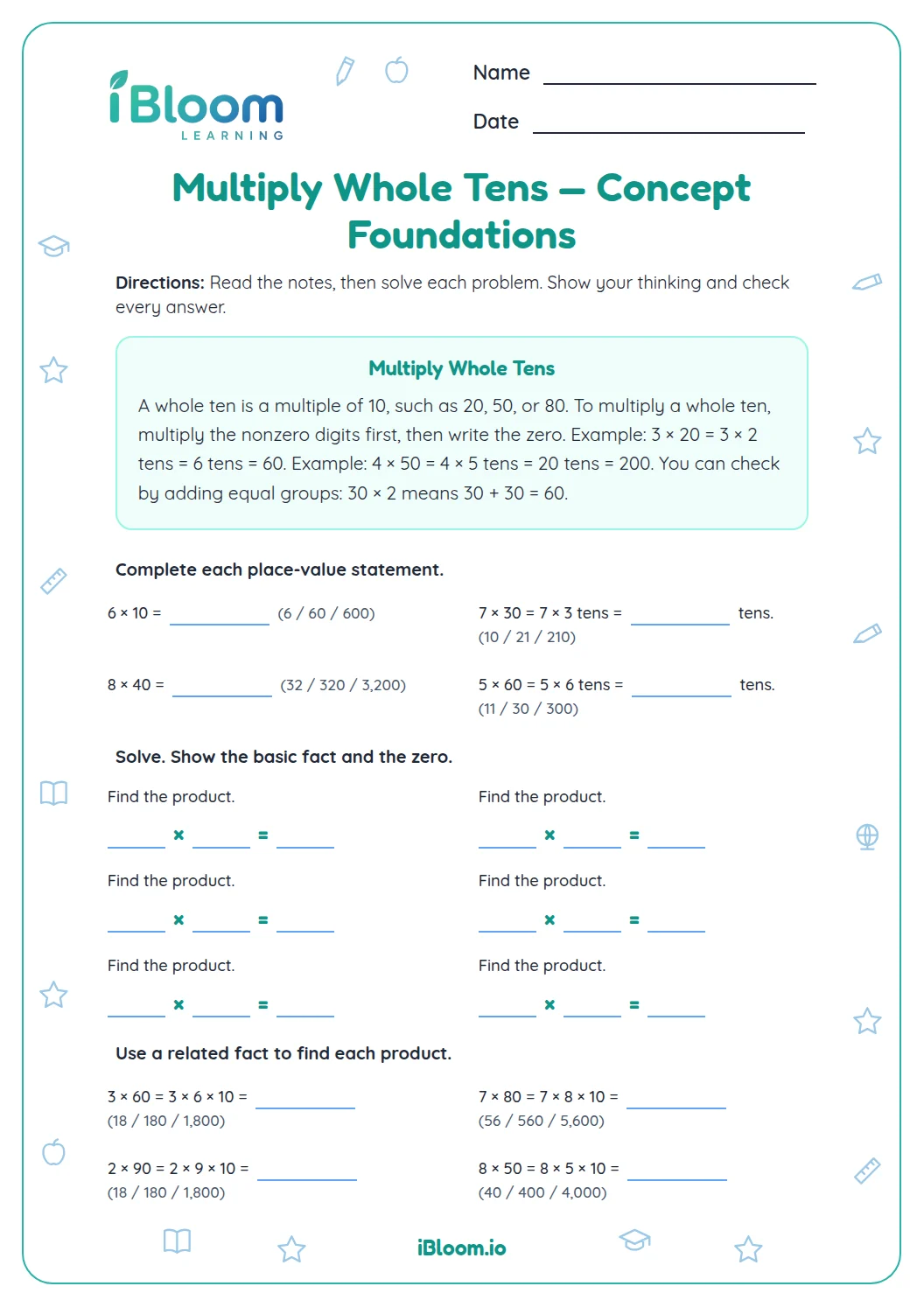
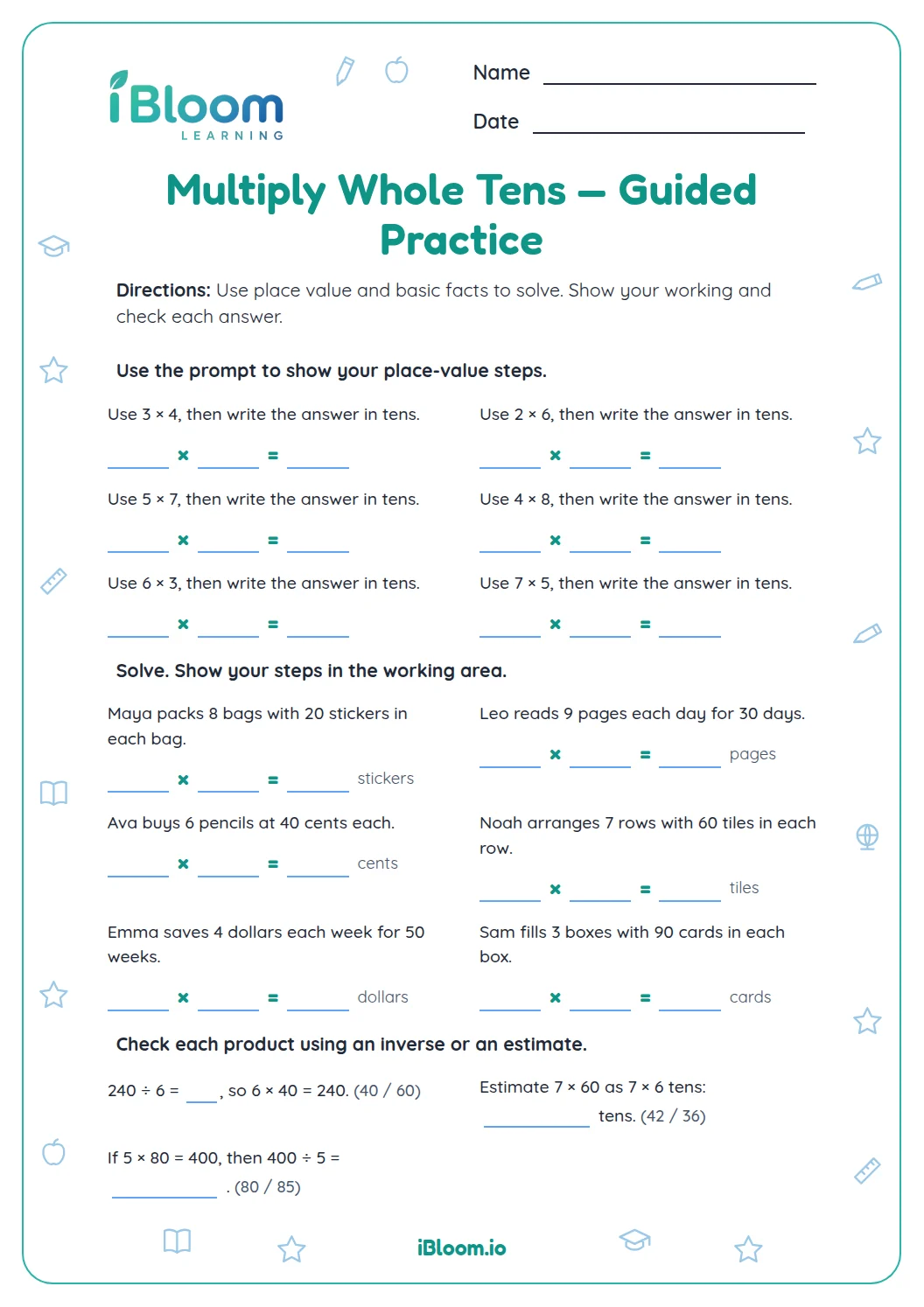
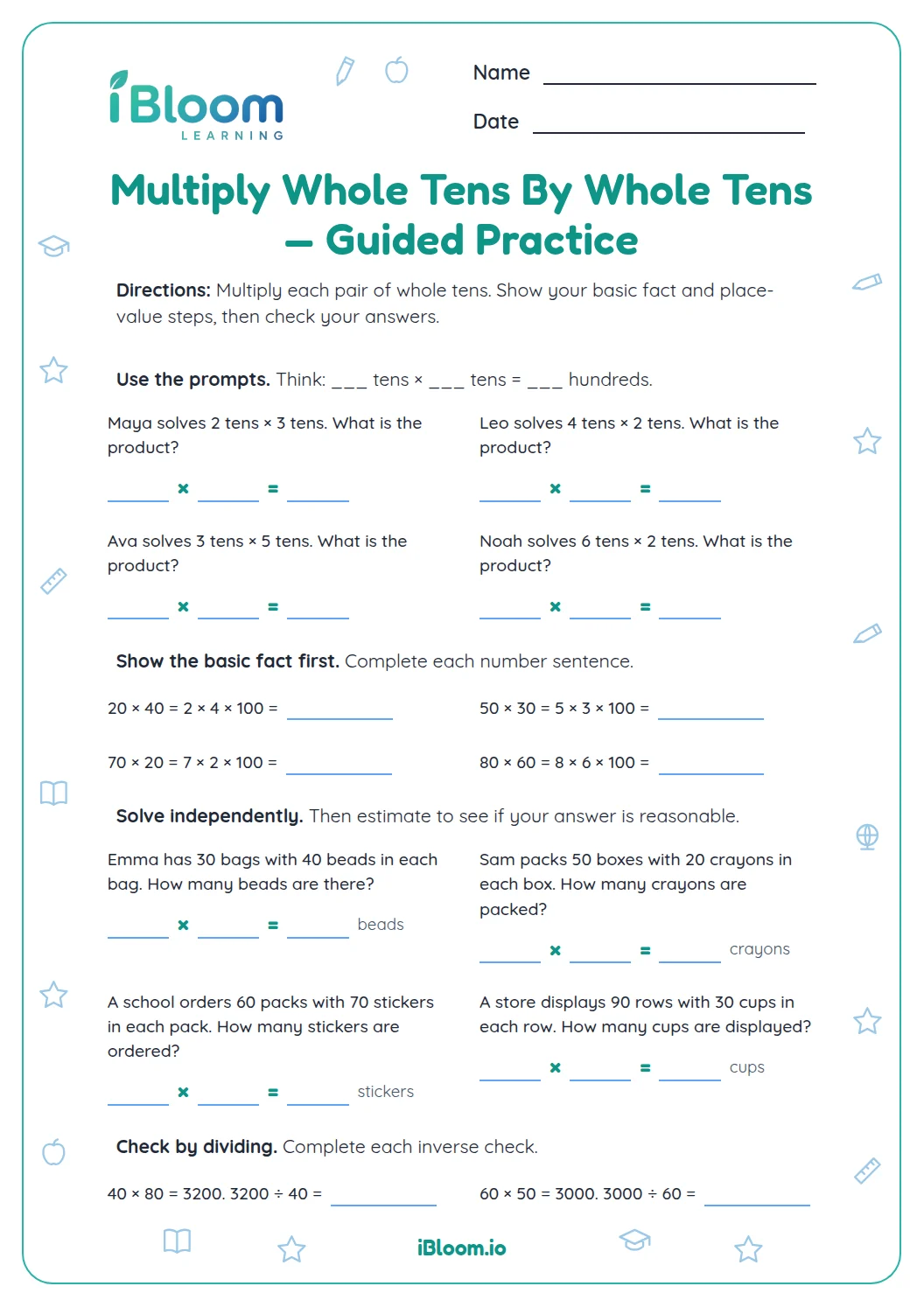
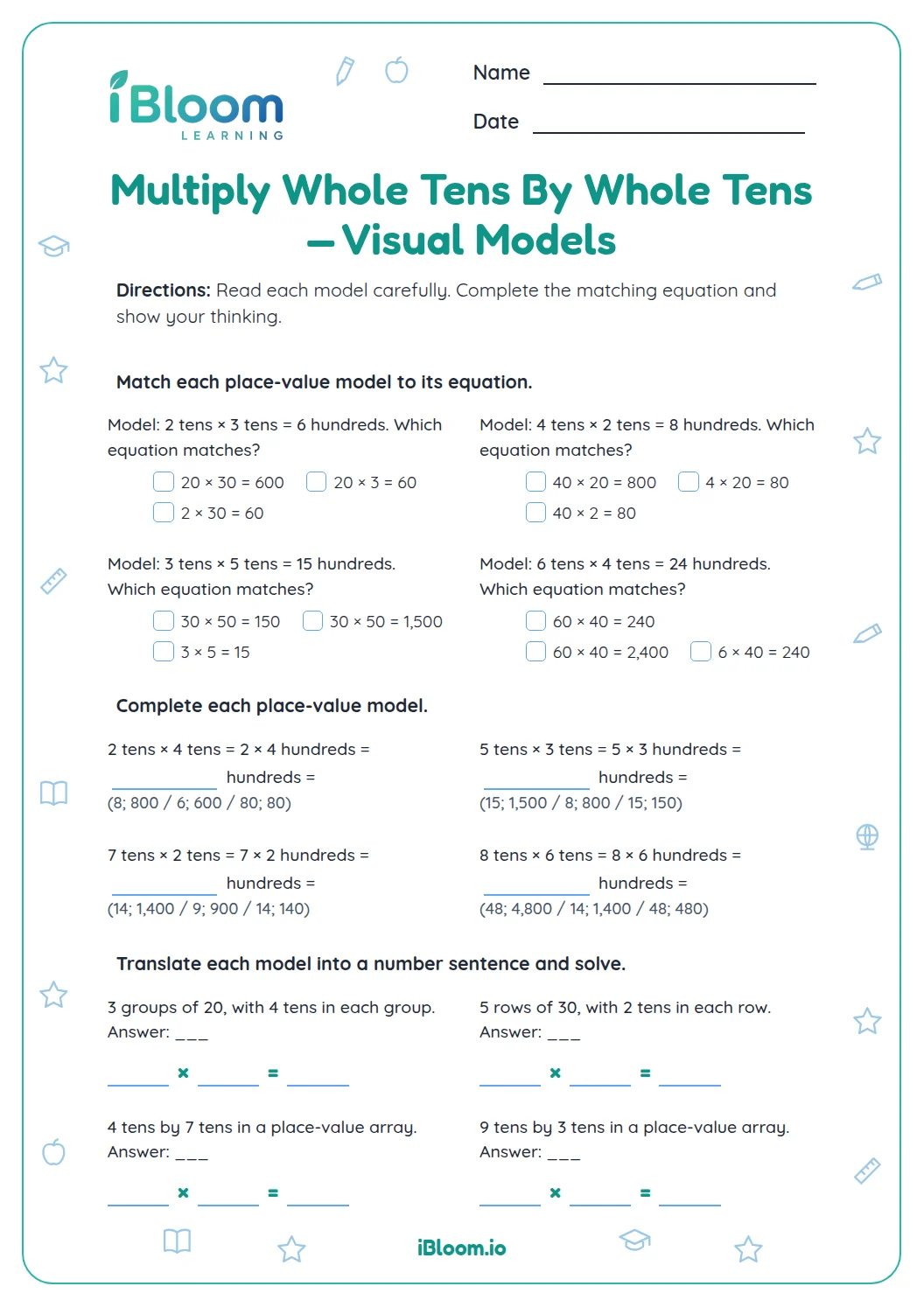
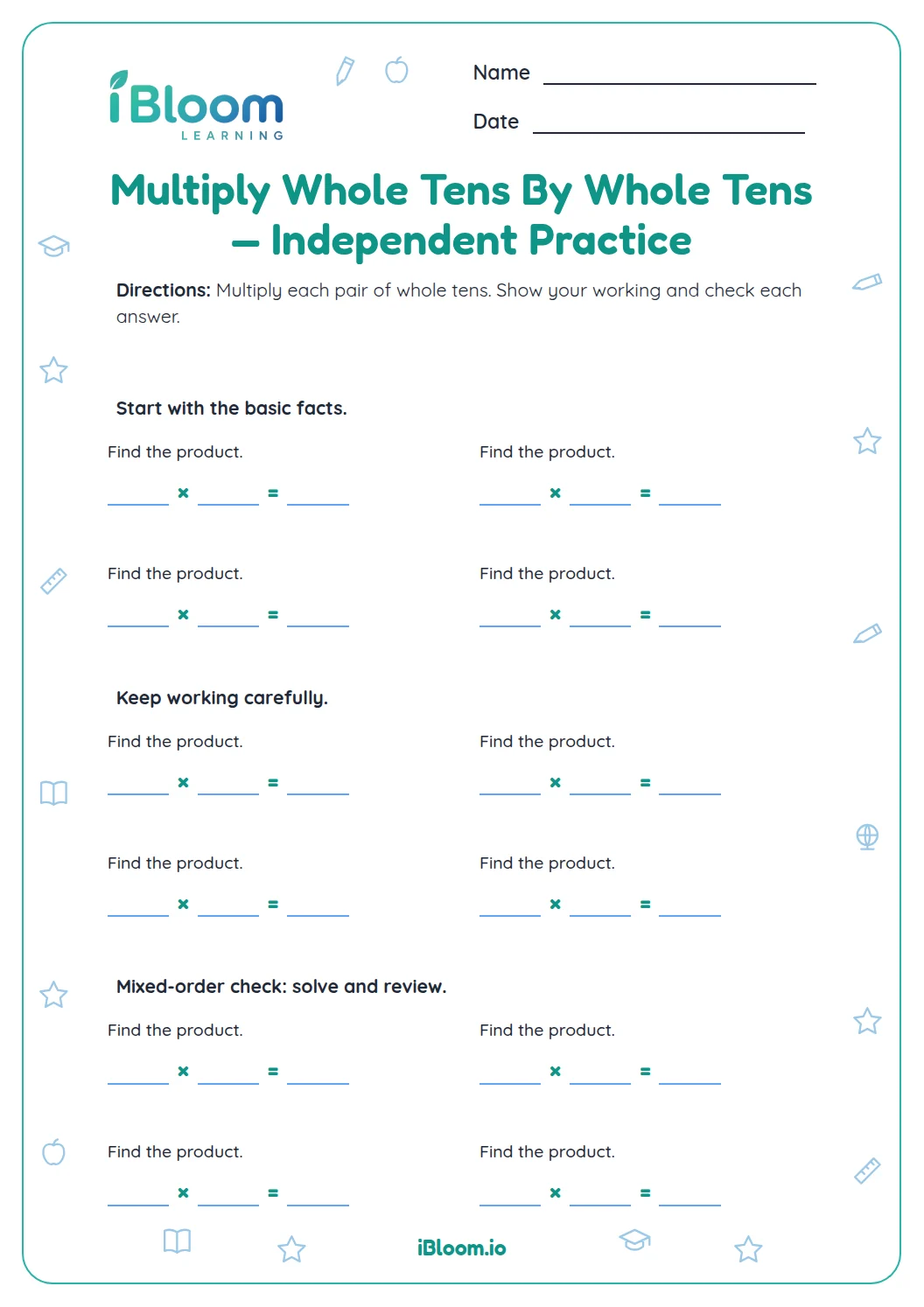
This Grade 4 mental-multiplication worksheet helps learners connect basic multiplication facts to products with whole tens. Sixteen questions begin with array models, then move to breaking factors apart and estimating larger products. The page practices multiplication reasoning and place-value patterns associated with CCSS 4.NBT.B.5. A separate answer key lists every product for quick checking.
Aligned to 4.NBT.B.5
How does place value help multiply by tens?
A whole number of tens can be written as a basic fact times 10. For example, 3 × 4 tens means 3 × 40, or 3 × 4 × 10 = 120. First multiply the nonzero digits, then account for the ten.
Question 1 shows 3 rows of 4 dots, with each row standing for 4 tens. There are 12 groups of ten, which makes 120.
- 13 × 4 tens
- 23 × 4 = 12
- 312 groups of ten = 120
- 4Product: 120
How can a factor be broken apart?
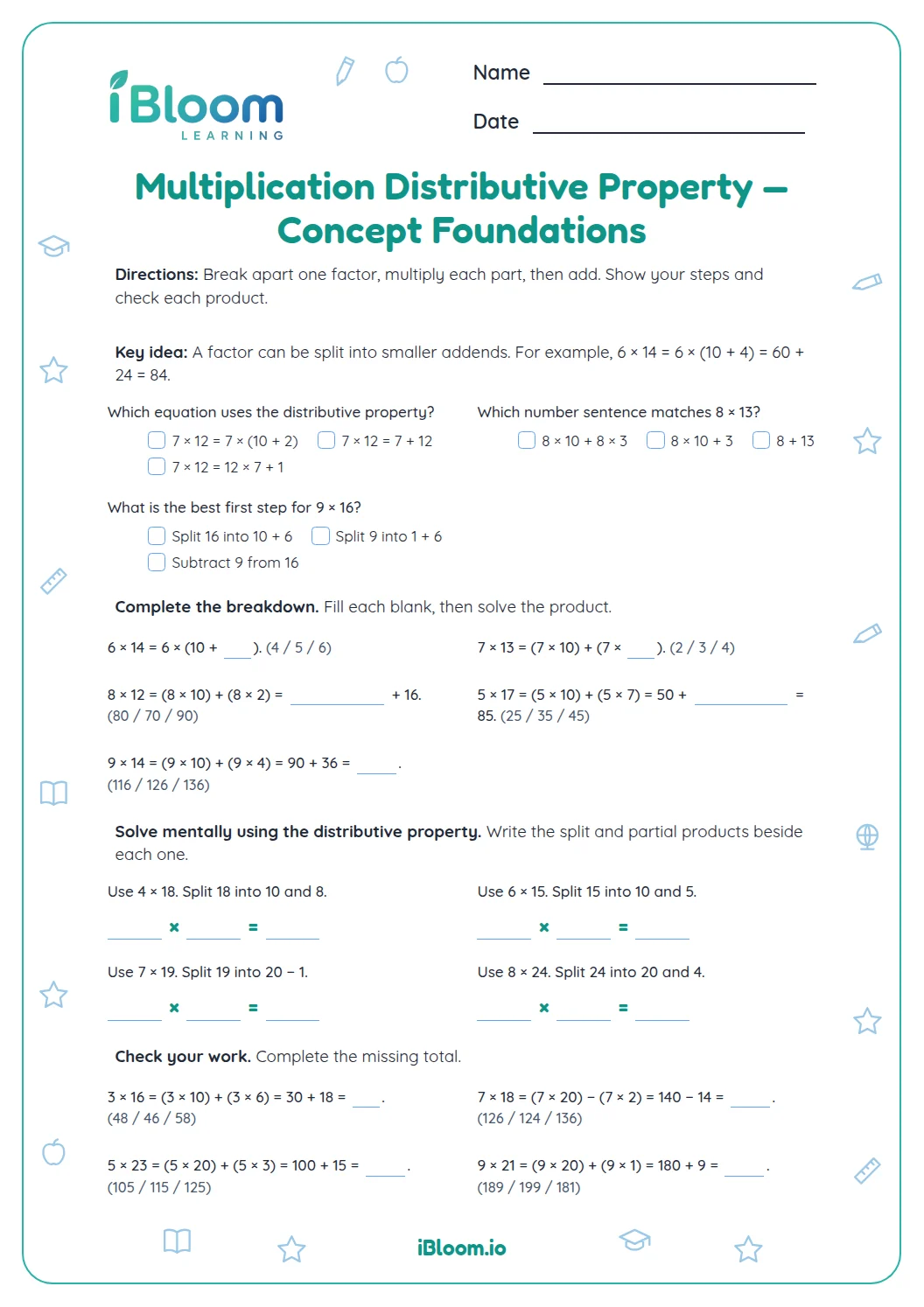
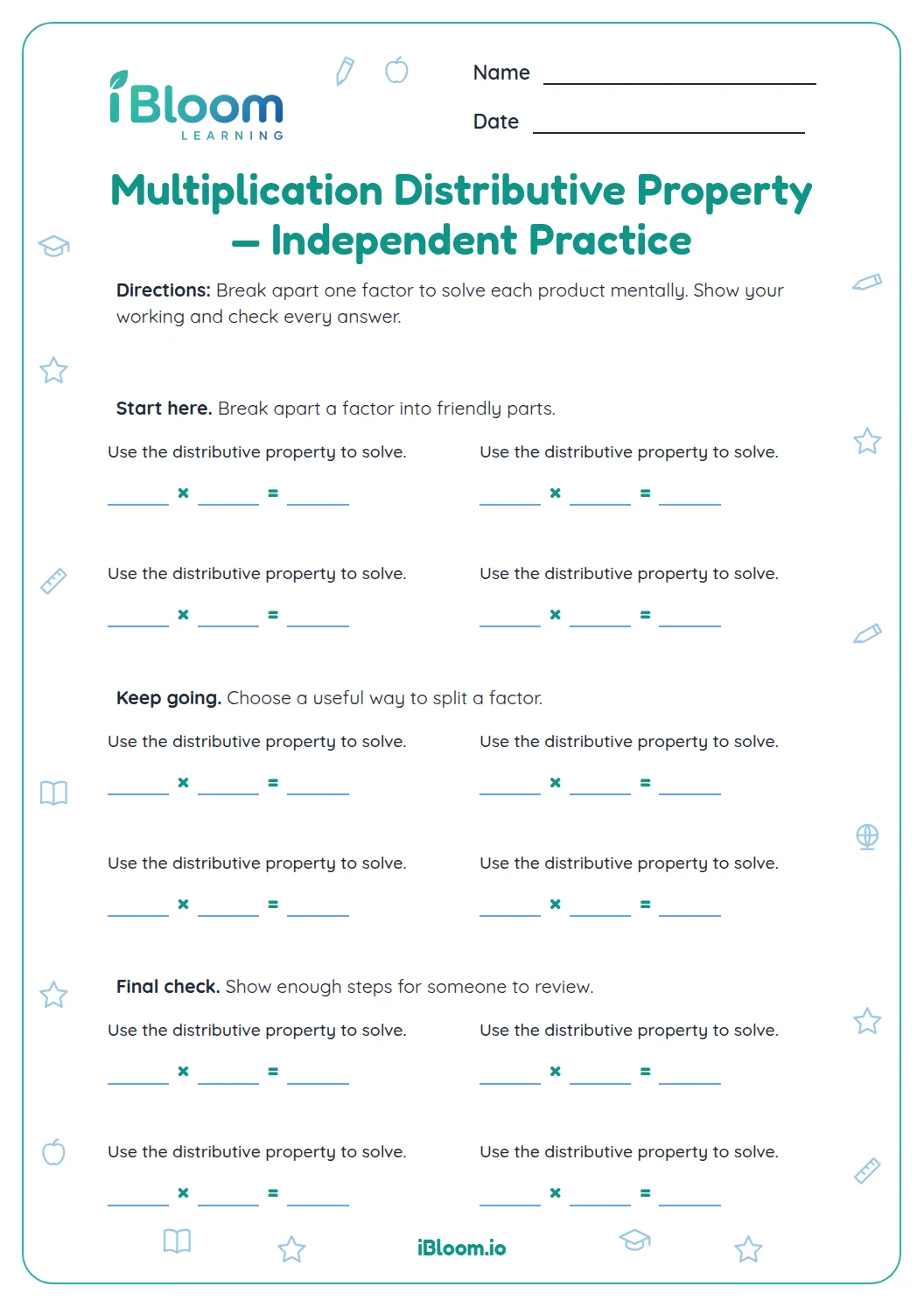
For 14 × 6 tens, split 14 into 10 and 4. Then find 10 × 6 tens and 4 × 6 tens, and add the partial products. This keeps the place value visible while using known facts.
How can an estimate check the product?
Round or use a nearby basic fact to judge the size. For 23 × 4 tens, 20 × 40 is 800, so an answer close to 920 is reasonable. A product of 92 would be too small by a factor of ten.
How to use this worksheet
- 1For a factor written in tens, identify its value.
- 2Use the array to connect rows and columns to a basic fact.
- 3Multiply the basic fact first.
- 4Account for the factor of ten in the product.
- 5Estimate to check that the answer has the right size.
Common mistakes and quick fixes
The mistake
Writing only the basic fact product
The fix
Rename the factor in tens and include its place value.
The mistake
Adding a zero without checking the basic fact
The fix
Multiply the nonzero digits first, then scale by ten.
The mistake
Breaking apart a factor but forgetting a partial product
The fix
Write each part’s product and add them together.
Common Core alignment
This worksheet uses place-value reasoning to connect multiplication facts with larger whole-number products.
Use place value and properties to multiply whole numbers.
On this sheet: The array and break-apart questions illustrate multiplication with place-value reasoning.
Show the official wordingHide the official wording
Multiply a whole number of up to four digits by a one-digit whole number, and multiply two two-digit numbers, using strategies based on place value and the properties of operations. Illustrate and explain the calculation by using equations, rectangular arrays, and/or area models.
What to practice next
Make more practice
Further reading
Questions parents and teachers ask
What does “4 tens” mean in a multiplication question?
Four tens means 40. So 3 × 4 tens is the same as 3 × 40. Multiply 3 by 4 to get 12 groups of ten, then write the value as 120. The drawing in the first part shows this grouping idea.
Why are arrays used in the first questions?
An array shows equal groups in rows and columns. Here, each row represents a number of tens, so learners can connect the familiar multiplication fact to a larger product. They then apply the same place-value reasoning to problems without a drawing.
How do you solve 14 × 6 tens?
First recognize that 6 tens is 60. You can split 14 into 10 and 4: 10 × 60 = 600 and 4 × 60 = 240. Add the partial products to get 840. An estimate such as 10 × 60 also helps check that the final product is reasonable.
How many questions are on the sheet?
There are 16 multiplication questions in three parts. The first six include array models, the middle five emphasize breaking a factor apart, and the final five ask learners to solve larger products and check their size. The answer key lists all products.
What is a quick way to check for a place-value error?
Estimate the product before or after calculating. For 23 × 4 tens, 20 × 40 is 800, so 920 is a plausible answer. If the result is 92, the basic fact may be right but the factor of ten was omitted.