






About this worksheet
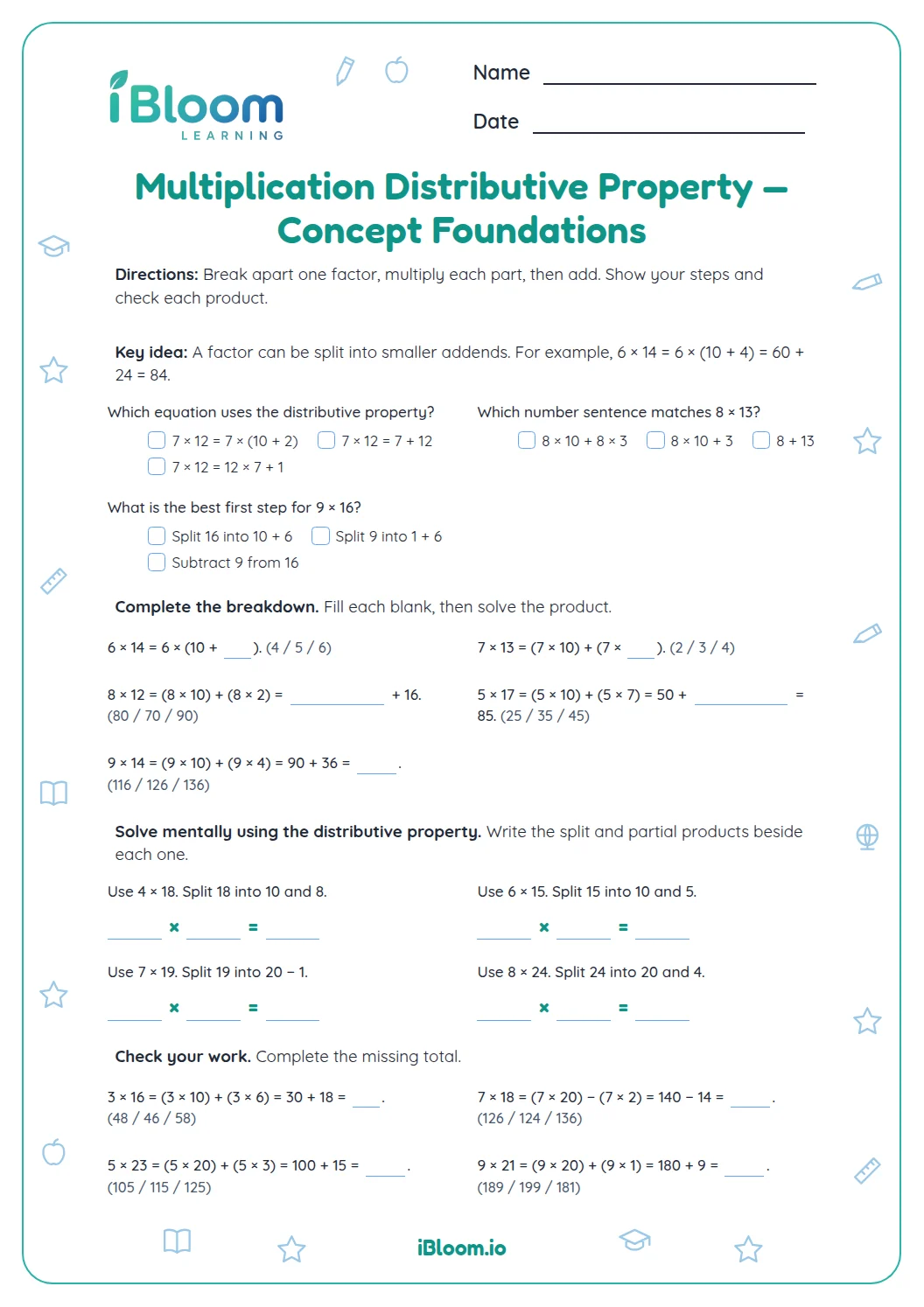
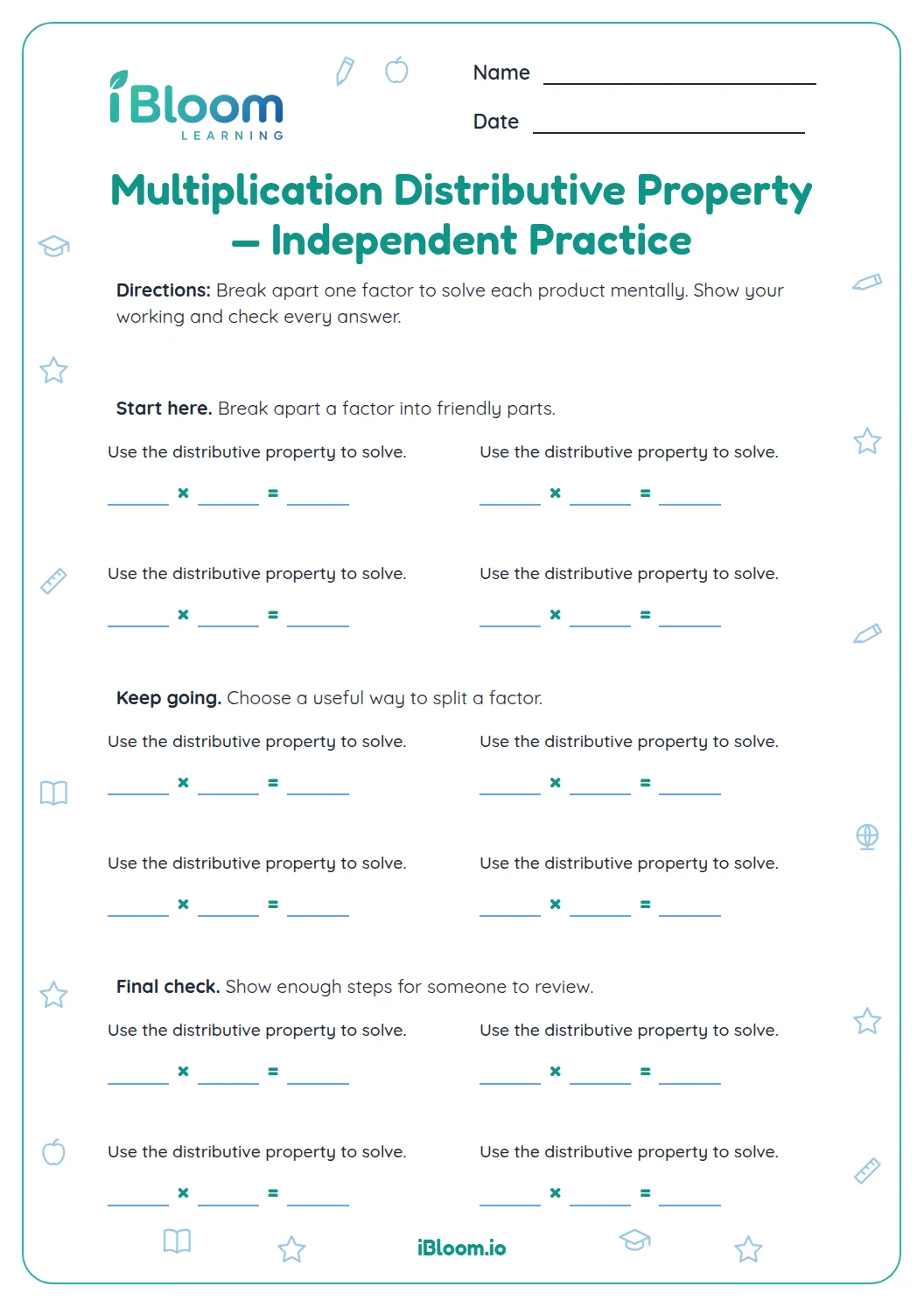
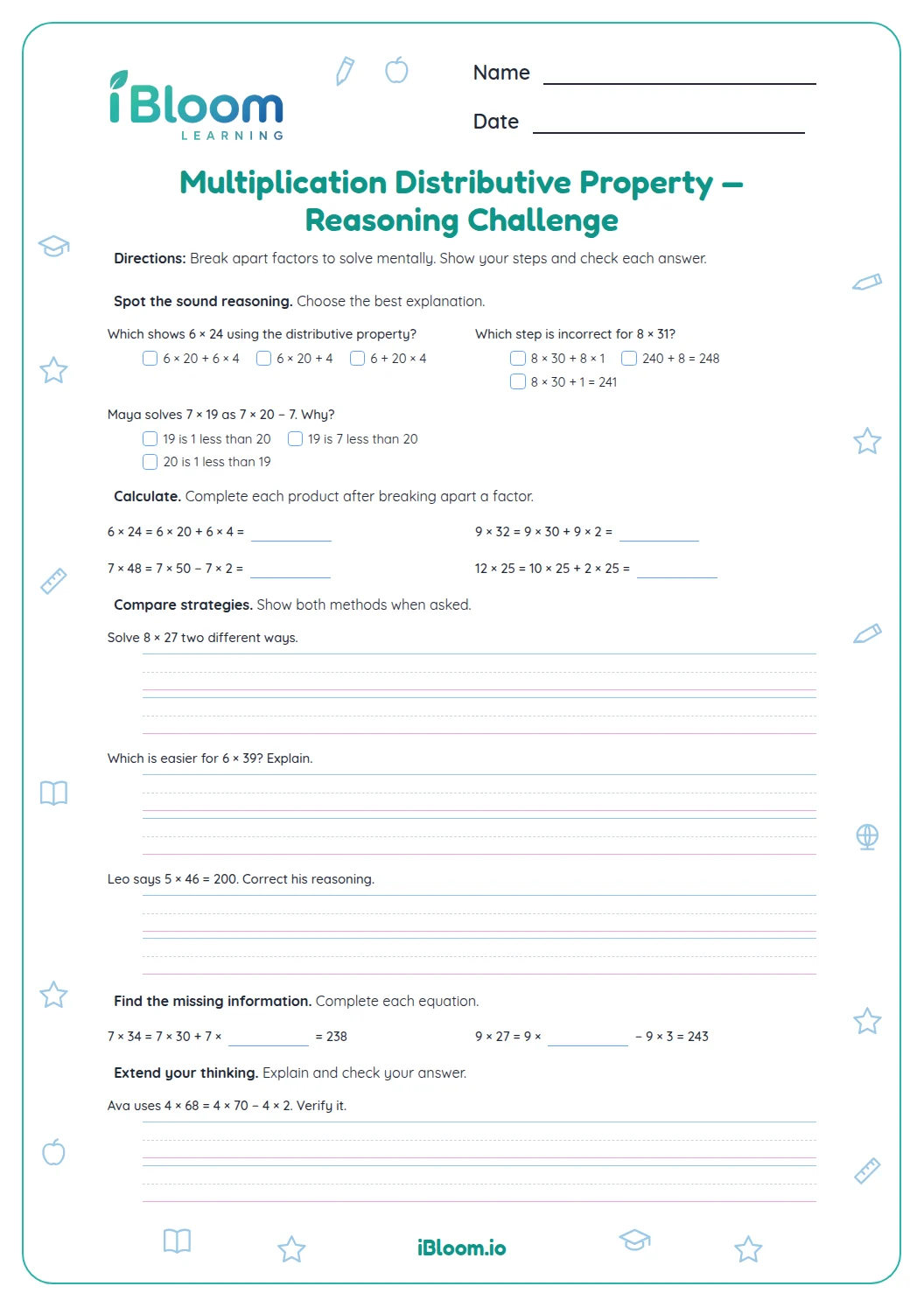
This Grade 4 worksheet builds mental multiplication with the distributive property. Students split a two-digit factor into tens and ones, multiply each part, and add the partial products. The second part varies the factor pair so students choose a useful split and show their work. An answer key lists each product.
Aligned to 4.NBT.B.5
How does this worksheet use the distributive property?
This Grade 4 worksheet builds mental multiplication with the distributive property. Students split a two-digit factor into tens and ones, multiply each part, and add the partial products. The second part varies the factor pair so students choose a useful split and show their work. An answer key lists each product.
- 17 × (20 + 3) = (7 × 20) + (7 × 3) = 140 + 21 = 161
How many products are included?
There are 16 multiplication problems in two parts. Part A emphasizes splitting the factor into tens and ones; Part B gives a new set for students to solve using a helpful split.
Should students show the partial products?
Yes. The open work area lets students record both smaller products and their sum before entering the final answer. This makes the distributive step visible and gives families a way to check the method as well as the product.
How to use this worksheet
- 1Read the directions and look at one example.
- 2Complete each part in order, showing work where there is room.
- 3Read answers aloud or check each written result.
- 4Use the key to review and correct any missed items.
Common mistakes and quick fixes
The mistake
Skipping a key detail in the prompt.
The fix
Read the full question before responding.
The mistake
Writing an answer without checking it.
The fix
Use the worked example and key to review.
The mistake
Moving on after an error.
The fix
Correct the response and explain what changed.
This worksheet practices the listed Common Core skill.
Use place-value and operation properties to multiply two two-digit numbers.
On this sheet: Students use place-value splits and partial products to multiply two-digit factors.
Show the official wordingHide the official wording
Multiply a whole number of up to four digits by a one-digit whole number, and multiply two two-digit numbers, using strategies based on place value and the properties of operations.
What to practice next
Make more practice
Further reading
Questions parents and teachers ask
How does this worksheet use the distributive property?
Each question applies the distributive property by splitting a two-digit factor into tens and ones. For example, 7 × (20 + 3) becomes (7 × 20) + (7 × 3), or 140 + 21 = 161. Part A shows the split; Part B asks students to choose a useful split.
How many products are included?
There are 16 multiplication problems in two parts. Part A emphasizes splitting the factor into tens and ones; Part B gives a new set for students to solve using a helpful split. The expressions show the tens-and-ones split directly.
Should students show the partial products?
Yes. Recording both partial products and their sum makes the distributive step visible. For 7 × 23, students can write 7 × 20 = 140 and 7 × 3 = 21, then add 140 + 21 to get 161. The key lists the final products.
What is a useful way to check a product?
Estimate by rounding the two-digit factor to the nearest ten, then compare the estimate with the exact product. Students can also multiply the final product by the one-digit factor when the factor pair makes that check easy. Compare the estimate with the exact product afterward.
How long does this worksheet take?
Plan for about 15 minutes, including time to record partial products. The sheet has two worksheet pages with 16 problems, followed by two answer-key pages. Students can check each final product and revisit the split if the total is incorrect.