



About this worksheet
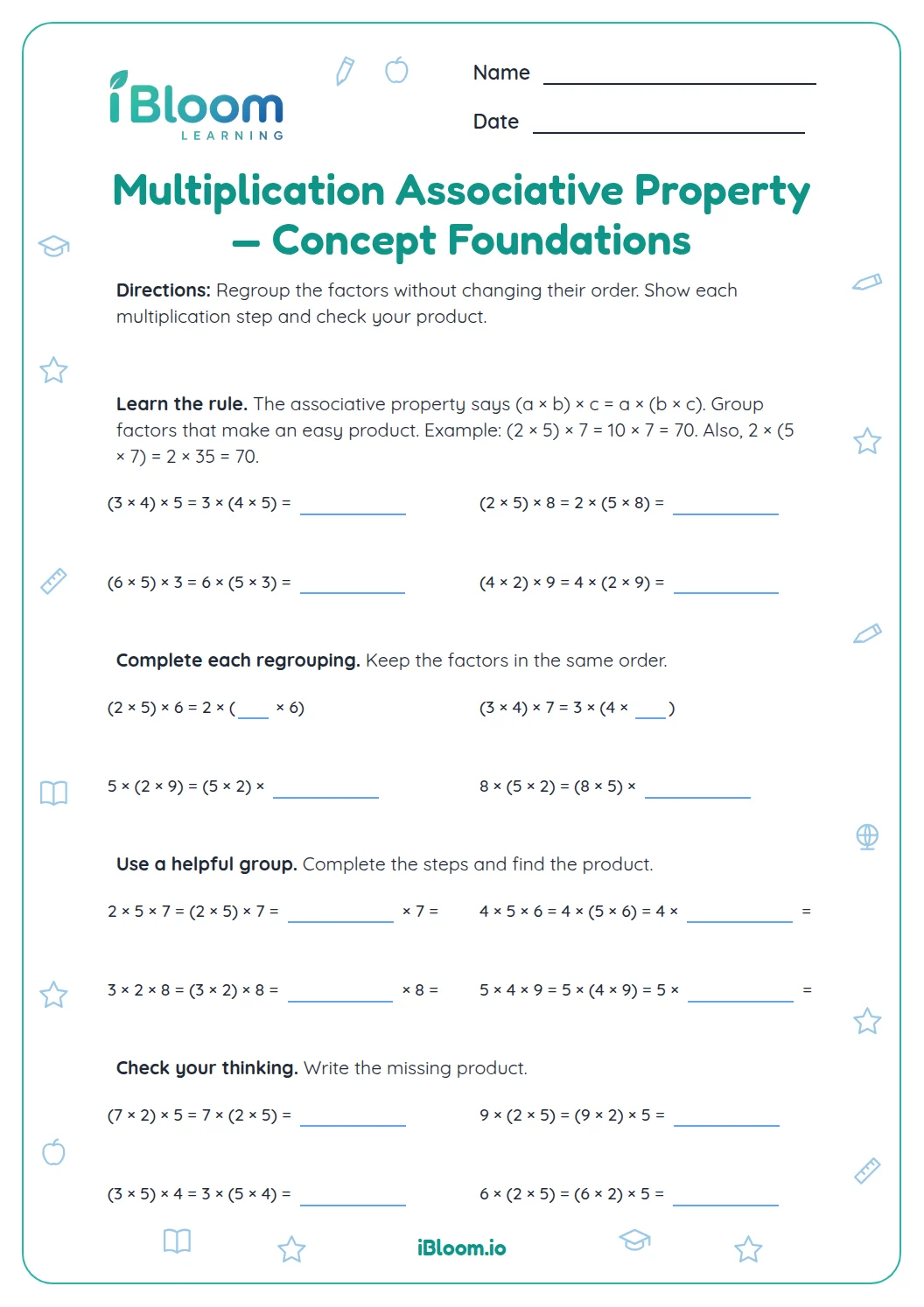
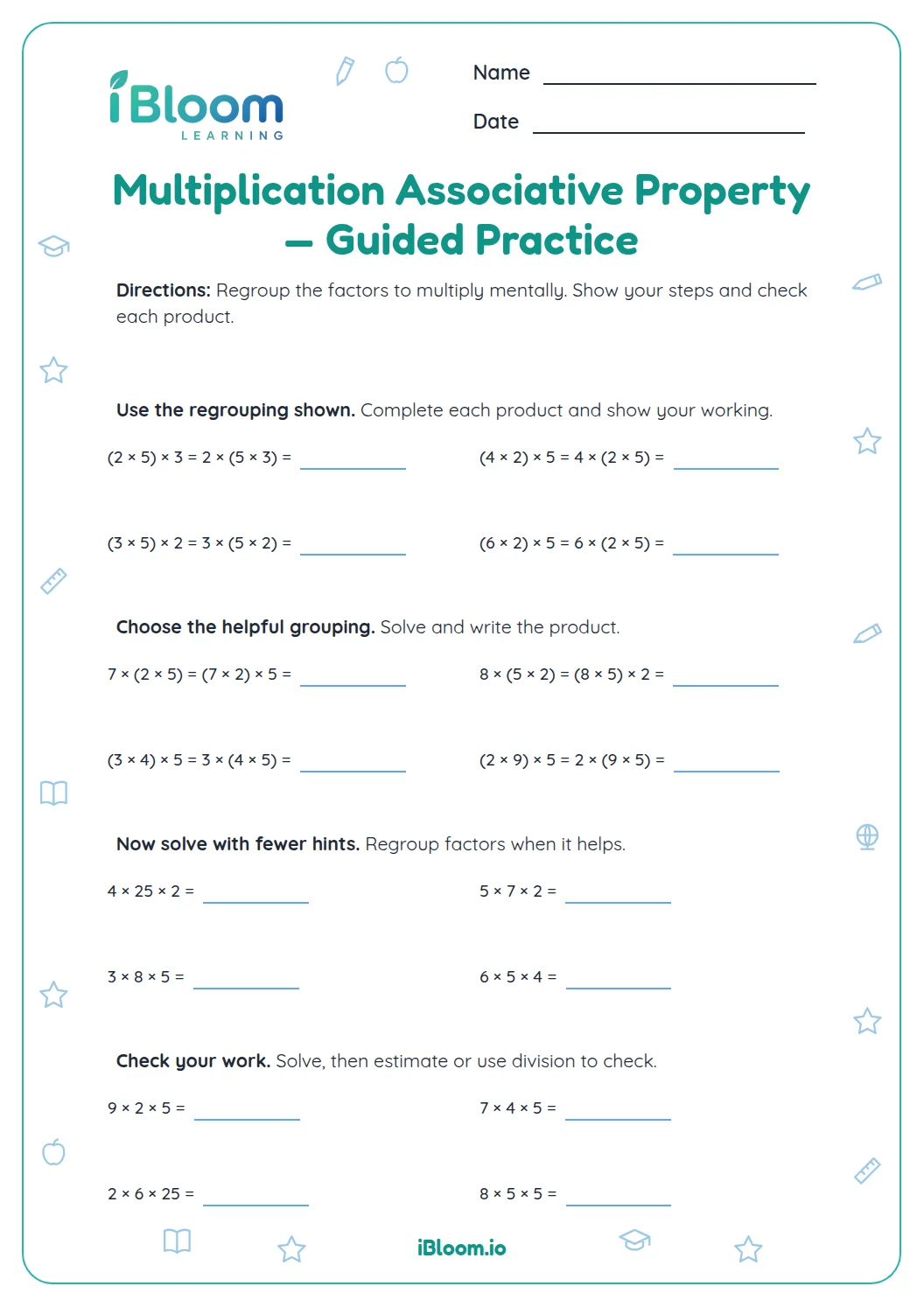
This Grade 4 worksheet gives students 16 chances to use the associative property of multiplication. Early questions ask students to recognize equivalent groupings; later items require finding products and modeling situations with multiplication. Problems use familiar factors such as 2, 5, and 25 so students can group factors strategically. The work connects to CCSS 4.OA.A.1, which asks students to interpret and represent multiplication equations. A separate answer key lists each result.
Aligned to 3.OA.B.5
What does regrouping factors change?
The associative property changes how factors are grouped while keeping the factors and product the same. It does not change addition into multiplication.
How can a grouping make a product easier?
Look for factor pairs such as 2 × 5, 4 × 25, or 5 × 12. Find that product first, then multiply by the remaining factor.
- 1Question 4: (3 × 4) × 25
- 2Regroup: 3 × (4 × 25)
- 3Find 3 × 100 = 300.
How does the property help with a story problem?
Write a multiplication expression that represents all groups. Regroup only after the factors match the situation, then calculate the product.
How to use this worksheet
- 1Read the factors before changing their grouping.
- 2Look for a pair that makes 10, 100, or another easy product.
- 3Keep every original factor in the expression.
- 4For a story, identify the number of groups and items in each group.
- 5Check the final product with a second grouping.
Common mistakes and quick fixes
The mistake
Dropping a factor while regrouping.
The fix
Rewrite all factors first, then add parentheses around the pair you want to multiply.
The mistake
Adding two factors instead of multiplying them.
The fix
Use multiplication signs between the factors in the original situation.
The mistake
Assuming any rearrangement is the associative property.
The fix
Keep the factor order fixed here and change only the parentheses.
Common Core alignment
This worksheet practices regrouping factors to use the associative property of multiplication.
Use the associative property to regroup factors and find products.
On this sheet: Students regroup three factors to make products easier, then apply that strategy in multiplication contexts.
Show the official wordingHide the official wording
Apply properties of operations as strategies to multiply and divide.
What to practice next
Make more practice
Further reading
Questions parents and teachers ask
What is the associative property of multiplication?
It says that changing the grouping of factors does not change their product. For example, (2 × 5) × 8 and 2 × (5 × 8) use the same factors and give the same answer, even though the parentheses move.
How many problems are included?
There are 16 items: three recognition questions, seven product or factor questions, and six word problems. They move from identifying a grouping to applying the property in multiplication situations. Each item has a single product or equation to complete, followed by a check.
Does the worksheet ask students to show work?
The story problems provide working space for a multiplication equation and a result. The earlier products can be solved mentally, with scratch work as needed to check a strategic grouping and confirm the total. The work space lets students record the factors and grouping before calculating.
What factors appear in the practice?
The questions use factors including 2, 3, 4, 5, 6, 7, 8, 9, 12, 14, 18, 22, and 25. Several combinations let students make useful products such as 10, 50, or 100. These friendly factors are chosen to make mental regrouping possible.
Is the answer key included?
Yes. A separate answer key shows the expected product or total for every question. For story problems, students may write an equivalent multiplication equation before giving the total and checking it. The key also helps families review how the factors were regrouped.