



About this worksheet
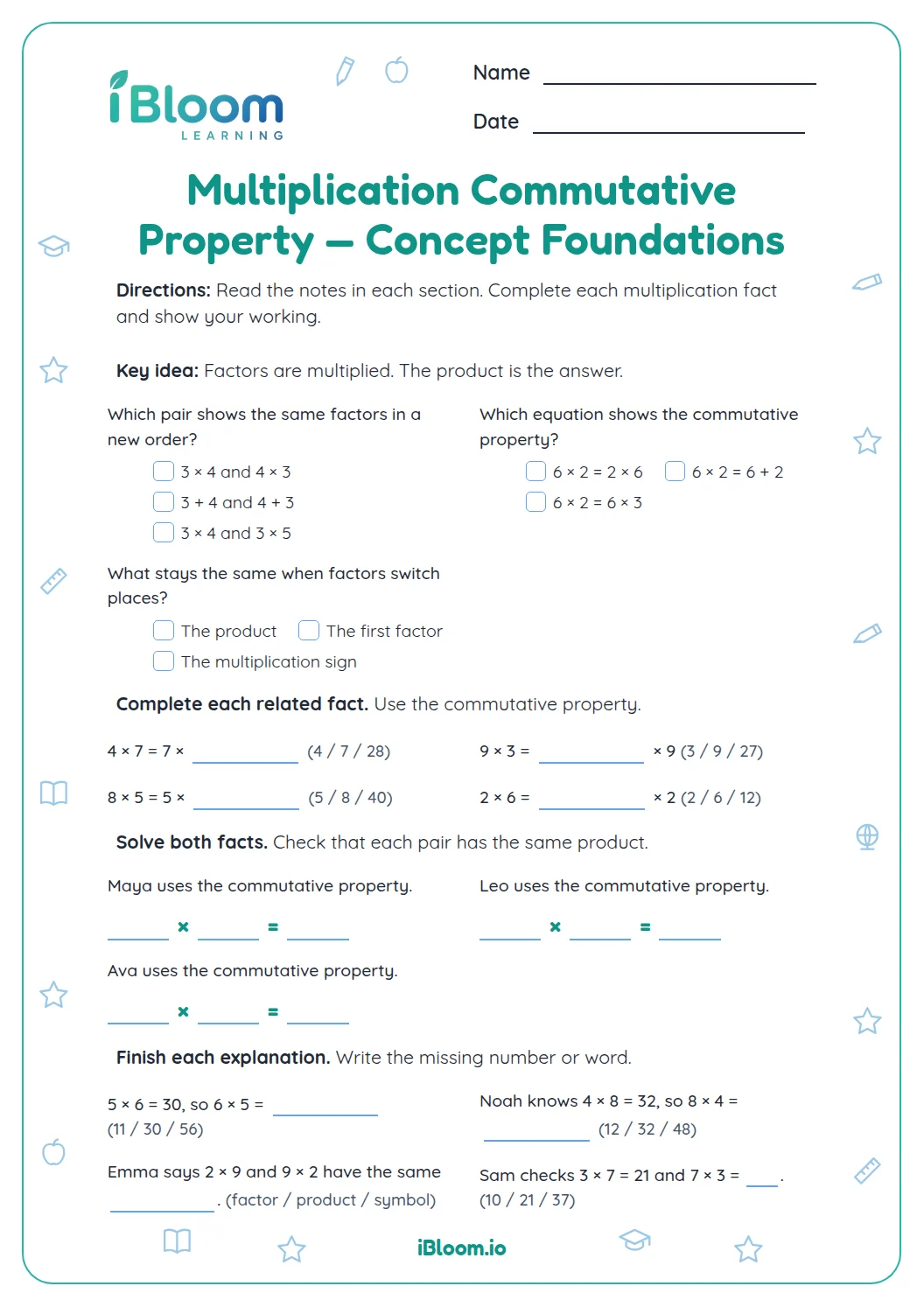
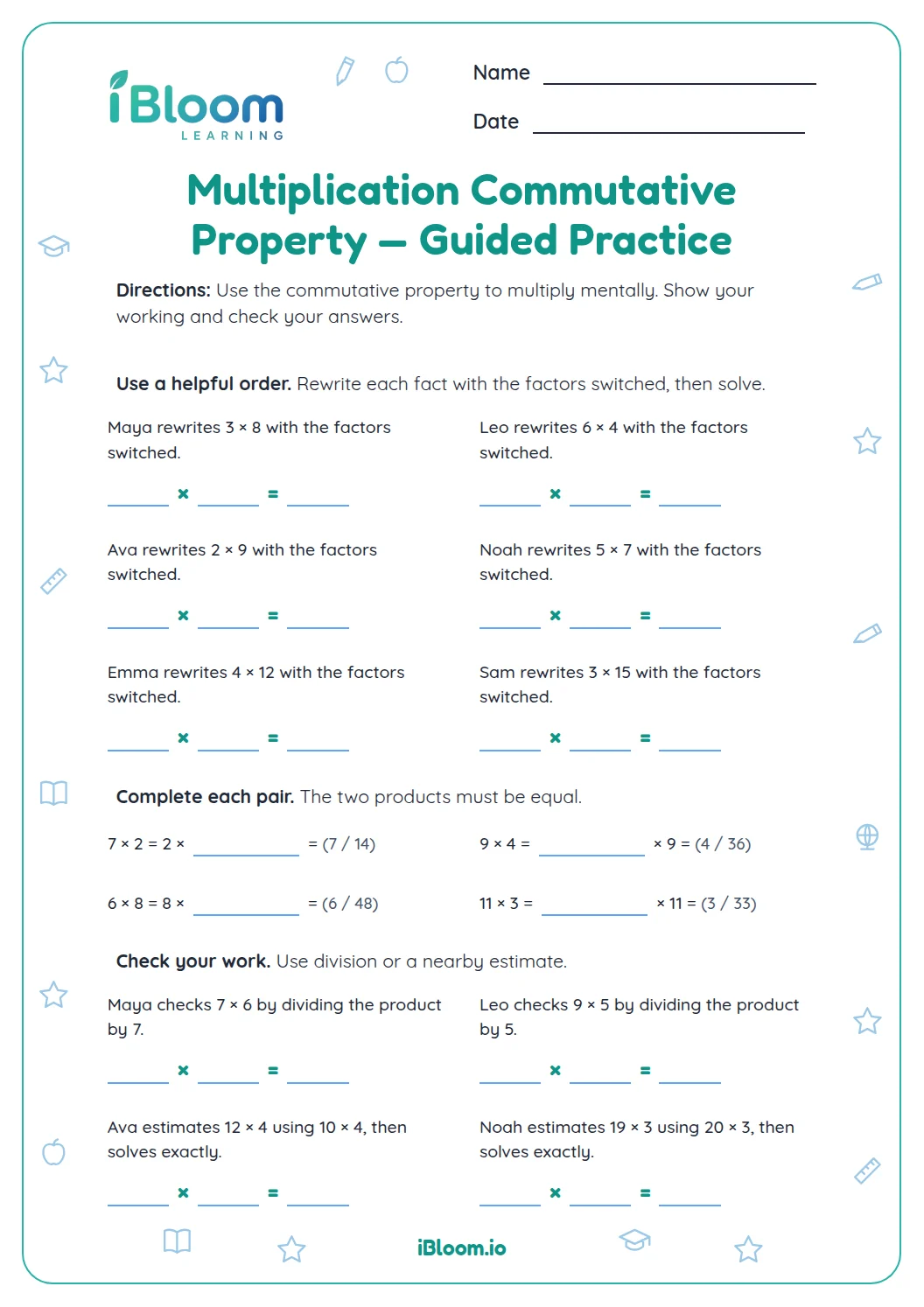
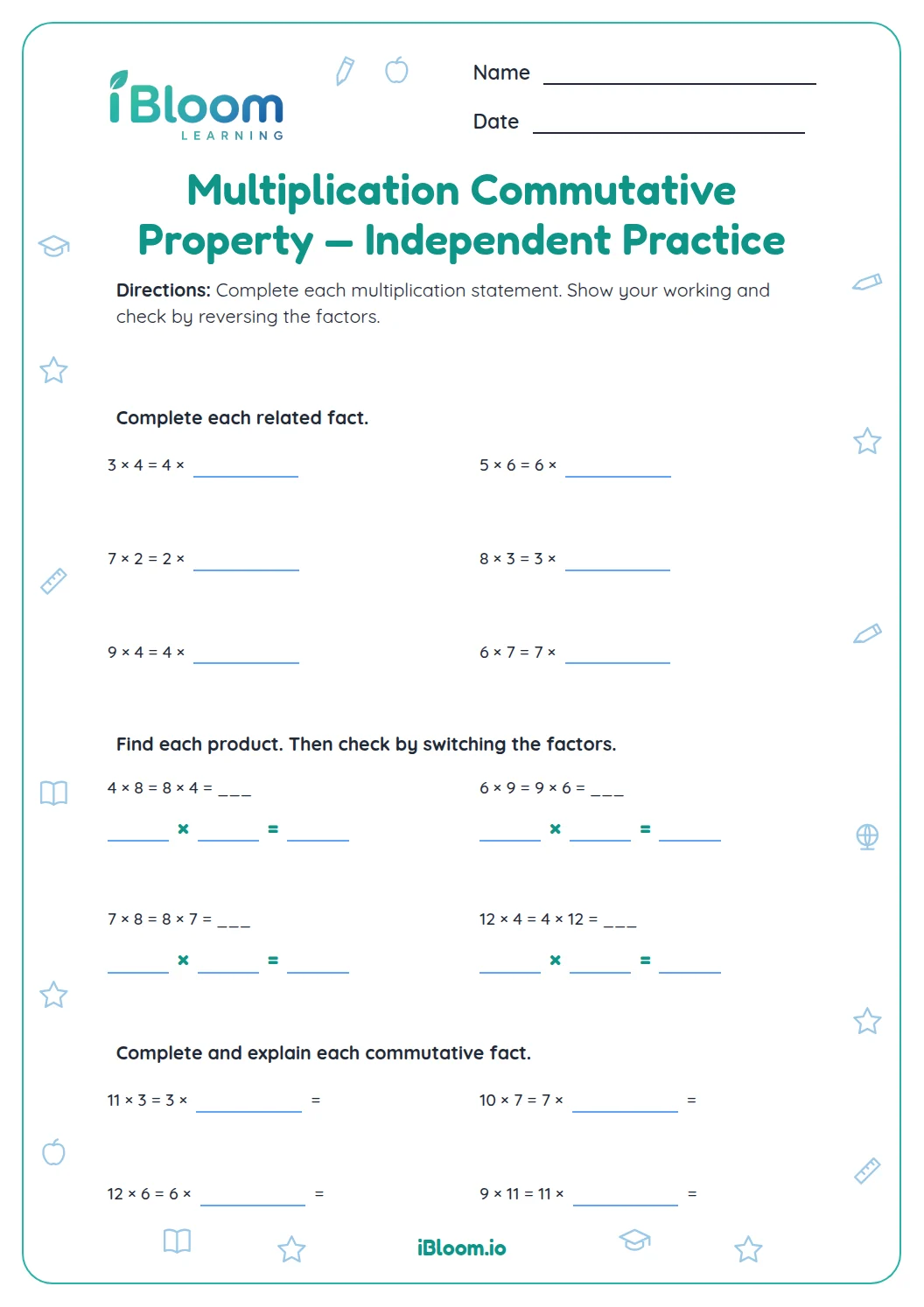
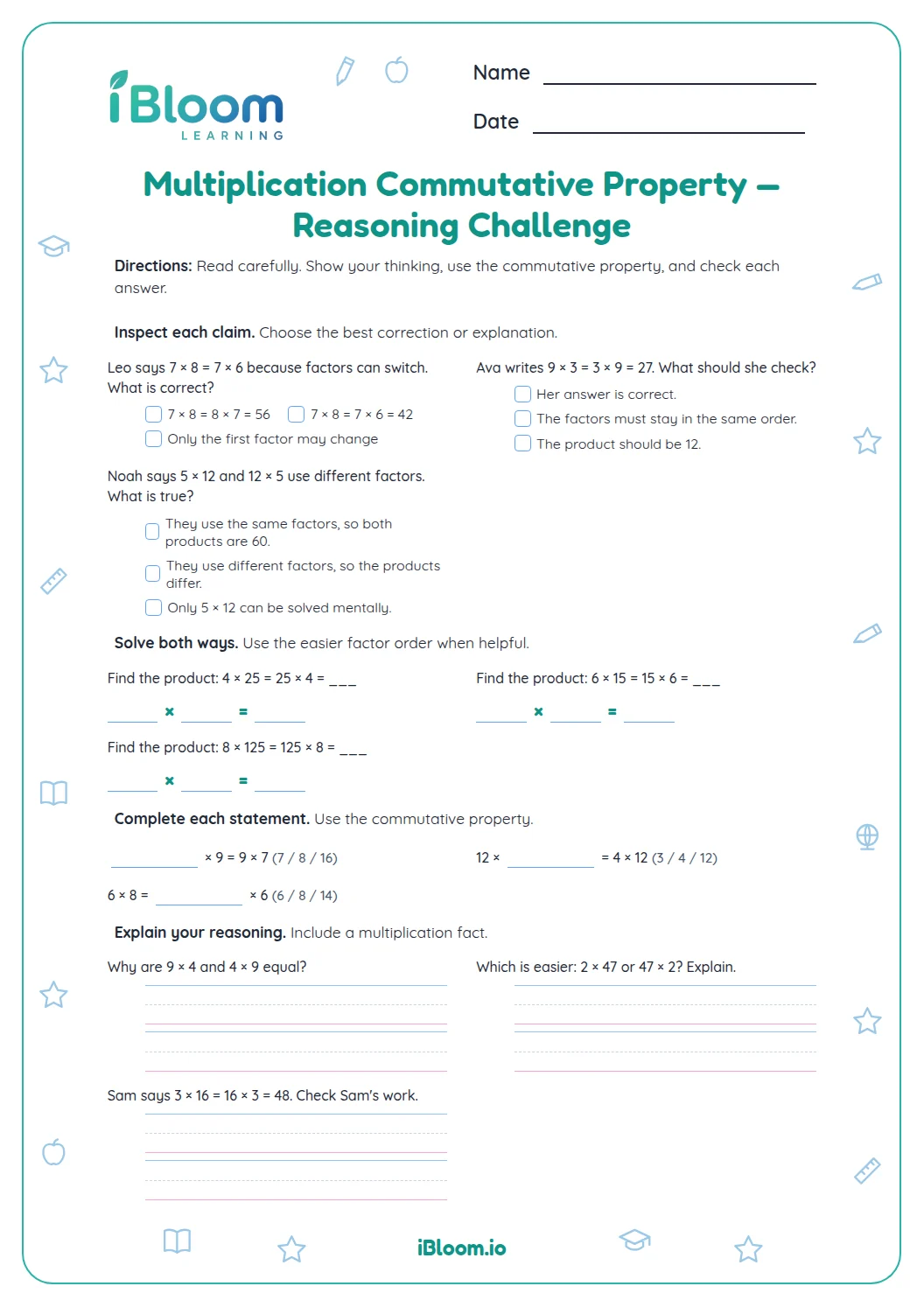
This Grade 4 printable practices the commutative property of multiplication with two dot arrays and twelve short equations. Children find products and write reversed-factor equations, such as 3 × 8 = 24 and 8 × 3 = 24. The 14 questions support CCSS 3.OA.B.5 and include a separate answer key.
Aligned to 3.OA.B.5
What does an array show about multiplication?
An array displays equal groups in rows and columns. The row count and column count give the two factor orders, and turning the array does not change the total.
Question 1 has 2 rows of 3 dots. The reversed fact is 3 × 2 = 6, with the same product as 2 × 3 = 6.
- 12 rows of 3 dots make 6.
- 22 × 3 = 6
- 3Reverse the factors: 3 × 2 = 6
How can turning factors help with a product?
If one order is easier to recall, reverse the factors and use the same total. For instance, 3 rows of 12 and 12 rows of 3 describe equal products. The array helps children see why the order changes but the total does not.
What will children do in each question?
Eight items show arrays; six describe equal groups. Each asks children to identify the reversed multiplication fact with the same product.
- Part A: read five array models
- Part B: read three more arrays and one described group
- Part C: write both factor orders for five described groups
How to use this worksheet
- 1Count the horizontal rows in the array.
- 2Count how many dots are in each row.
- 3Multiply to find the total number of dots.
- 4For a turn-the-factors question, reverse rows and columns.
- 5Check that both equations have the same product.
- 6Use the key to review any missed array.
Common mistakes and quick fixes
The mistake
Reversing the factors but changing the product.
The fix
Point to the same dots and count them by columns.
The mistake
Multiplying the row count by itself.
The fix
Use the number of dots in one row as the second factor.
The mistake
Counting one row twice or skipping a row.
The fix
Touch each row once and use repeated addition to check.
Common Core alignment
The models connect multiplication facts to a property of operations.
Use the commutative property to multiply each array’s row and column counts.
On this sheet: Use the commutative property to multiply each array’s row and column counts.
Show the official wordingHide the official wording
Apply properties of operations as strategies to multiply and divide.
What to practice next
Make more practice
Further reading
Questions parents and teachers ask
What is the commutative property of multiplication?
It means factors can switch order without changing the product. For example, 2 × 7 and 7 × 2 both equal 14. The arrays on this sheet show the same collection of dots counted by rows or by columns. The separate answer key gives a clear way to check the result after the child has finished.
How should a child read the arrays?
Count the number of horizontal rows and the number of dots in each row. Multiply those counts for the total. Then, when asked, reverse the factors and confirm that the product stays the same. The separate answer key gives a clear way to check the result after the child has finished.
Why does every problem include a visual model?
Each question has a dot array so children can connect the factors to equal rows and columns. This makes the commutative property visible: rotating the way the array is described changes the factor order while keeping the same dots. The separate answer key gives a clear way to check the result after the child has finished.
How many multiplication models are on the pages?
There are 16 array questions, each with its own model. Eight ask for the product and eight ask children to write both factor orders. The answer key includes each total and the matching reversed equation. The separate answer key gives a clear way to check the result after the child has finished.
Are all the facts within 100?
The arrays use factors from 2 through 12. Products are at most 60, so children can focus on equal groups and factor order while practicing familiar multiplication facts. The separate answer key gives a clear way to check the result after the child has finished.
What should I ask if the two equations seem different?
Ask the child to point to each row and column in the array. The equation with rows first and the equation with columns first count the same dots, just grouped in a different direction. The separate answer key gives a clear way to check the result after the child has finished.