




About this worksheet
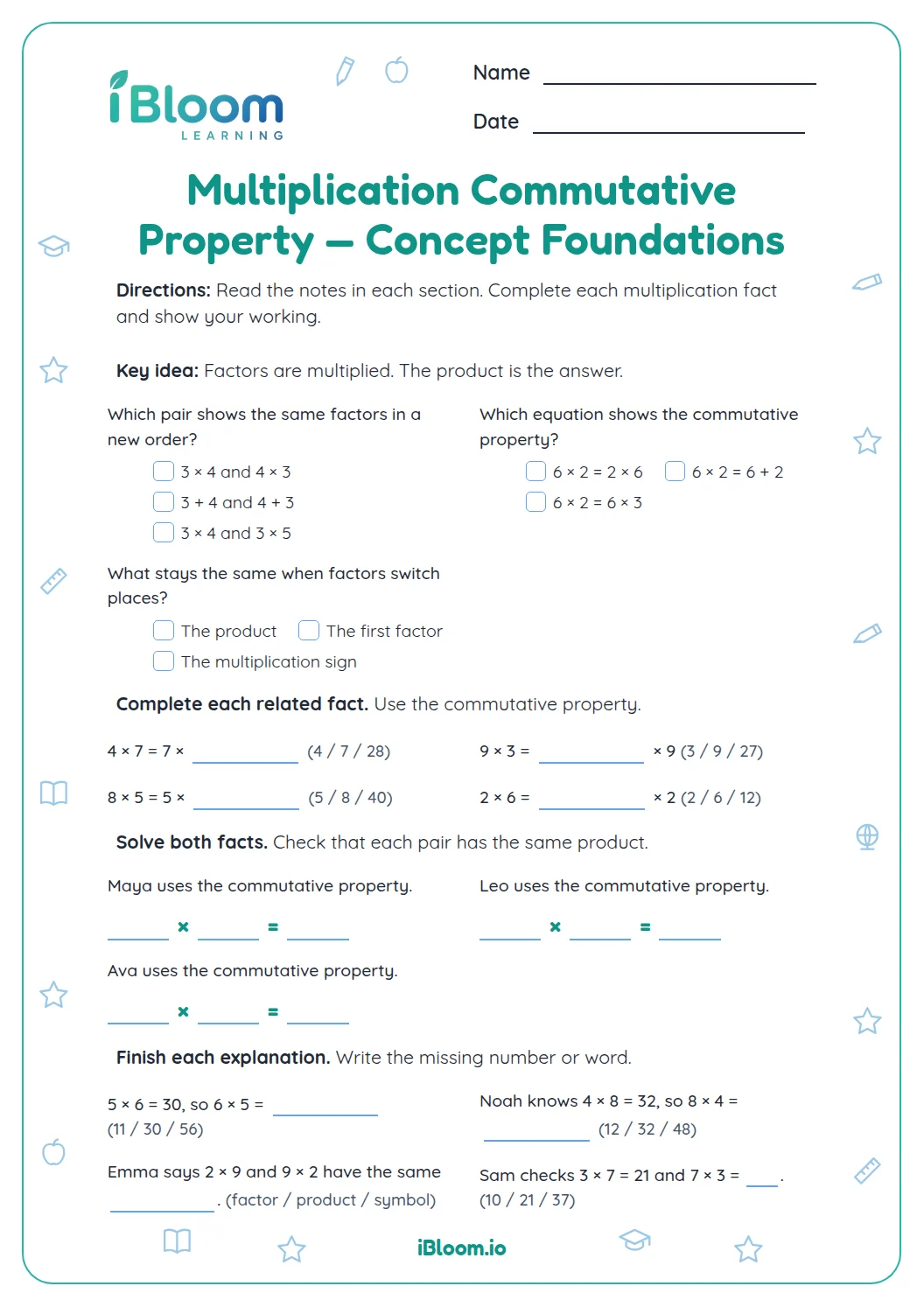
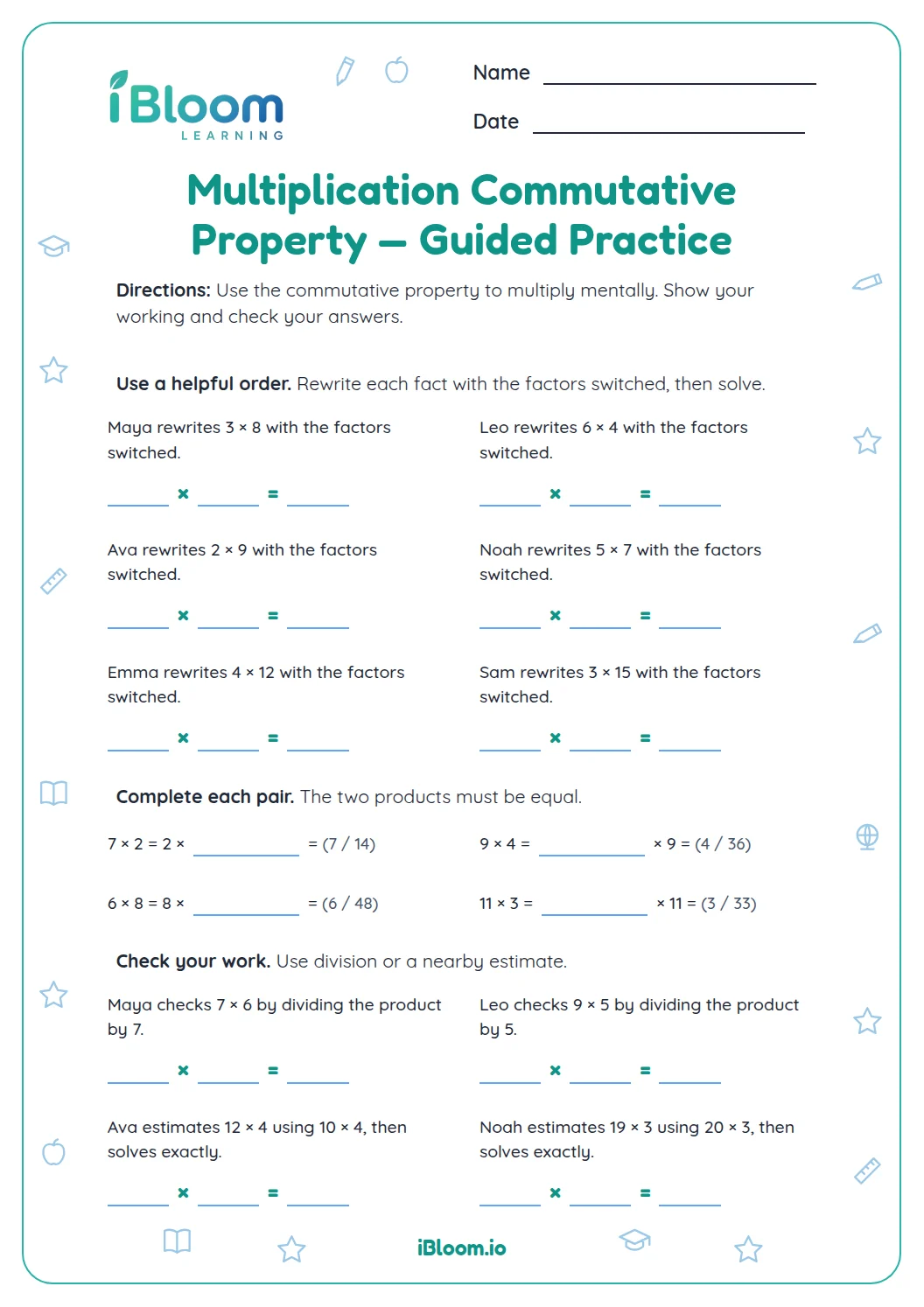
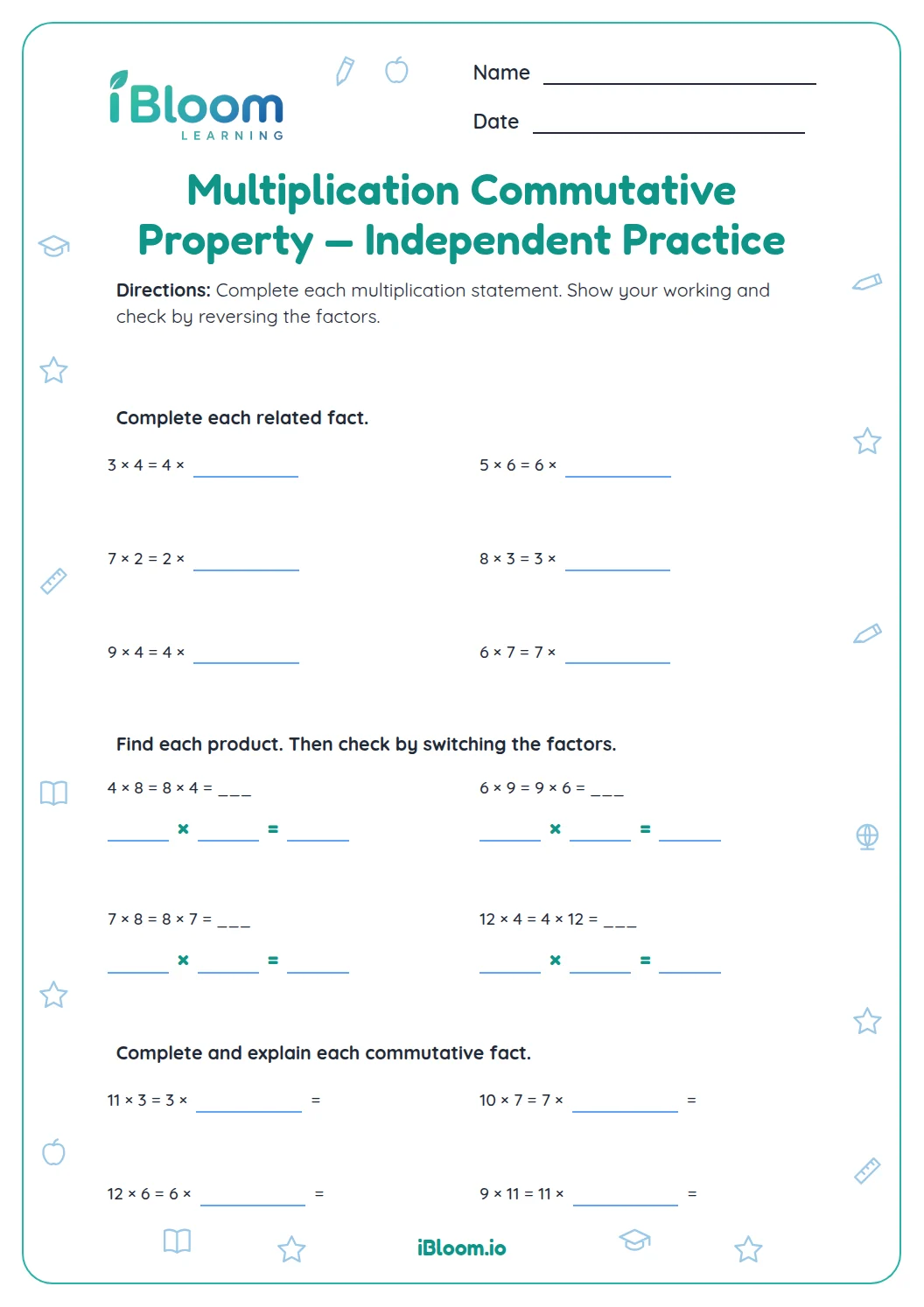
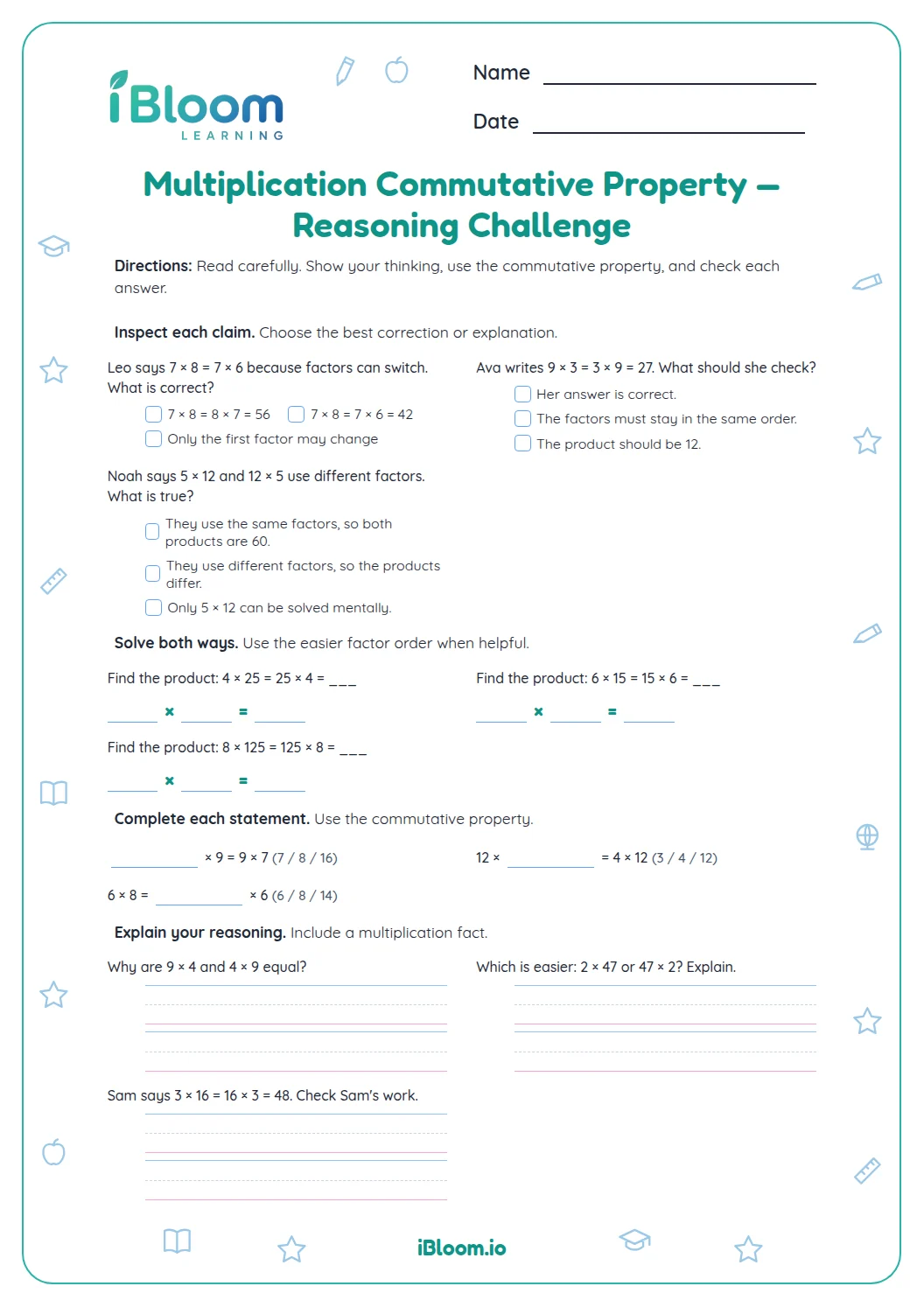
This Grade 4 worksheet connects the commutative property to equal-group stories. Learners choose equations, find totals in real-world problems, and check that switching factor order keeps the product. Familiar contexts include bags, rows, shelves, stickers, and seats. It practices CCSS 3.OA.B.5 and includes 14 questions with a separate answer key.
Aligned to 3.OA.B.5
How can learners match groups to an equation?
Part A asks learners to match equal groups to multiplication equations and recognize reversed factor orders. Each item gives a short context or asks about a related equation.
- The group count and amount in each group are factors.
- Switching their order keeps the product the same.
How does the property work in a story?
Multiply the two group quantities. Either factor can come first.
- 1Four bags hold 6 apples each.
- 24 × 6 = 24
- 36 × 4 = 24
- 4Both equations describe 24 apples.
How can factor order be checked?
Part C asks learners to name what stays the same when factors switch order. Part D asks them to write the reversed equation for a multiplication fact.
How to use this worksheet
- 1Underline the group count and the amount in each group.
- 2Write a multiplication equation for the story.
- 3Switch the factors if that order helps.
- 4Calculate and label the total with the item counted.
- 5Use the key to check the product and related equation.
Common slips and quick fixes
The mistake
Adding the two group numbers.
The fix
Equal groups call for multiplication; multiply the group count by the amount in each group.
The mistake
Changing a factor while reversing the order.
The fix
Keep both factors and switch only their positions.
The mistake
Changing the product when reversing factors.
The fix
Check both equations with the same multiplication fact; their product stays the same.
Common Core alignment
Use operation properties as strategies to multiply and divide.
On this sheet: The questions directly practice this skill.
Show the official wordingHide the official wording
Apply properties of operations as strategies to multiply and divide.
What to practice next
Make more practice
Further reading
Questions parents and teachers ask
What does the commutative property mean?
It means switching the order of factors does not change the product. For example, 4 × 6 and 6 × 4 both equal 24. The worksheet asks learners to recognize equations and stories that show this relationship. Learners can explain why counting the groups or objects gives the same total in either order.
How does the worksheet use real-world situations?
Short stories describe equal groups, such as bags of apples, rows of shells, or shelves of books. Learners choose the multiplication equation or total that fits each situation, then check the product in the answer key. This keeps the focus on using multiplication rather than adding the two quantities.
Does a learner have to reverse the factors?
No. Either order works when the same two factors represent the equal groups. Reversing can make a multiplication fact easier to calculate or check, but the learner should preserve both factors and the group meaning. The contexts stay the same whichever factor comes first.
What should be included in a word-problem answer?
Choose the multiplication equation and total that match the situation, including the item being counted. For example, four bags with six apples each make 24 apples. The answer choices and key include the appropriate units for each story. Units show what the total counts.
What does the final part ask learners to check?
The final two questions check that a product stays the same when factors switch order. Learners complete a statement and write a related equation for 7 × 6. Both checks keep the original factors and product. The key includes both model answers.