






About this worksheet
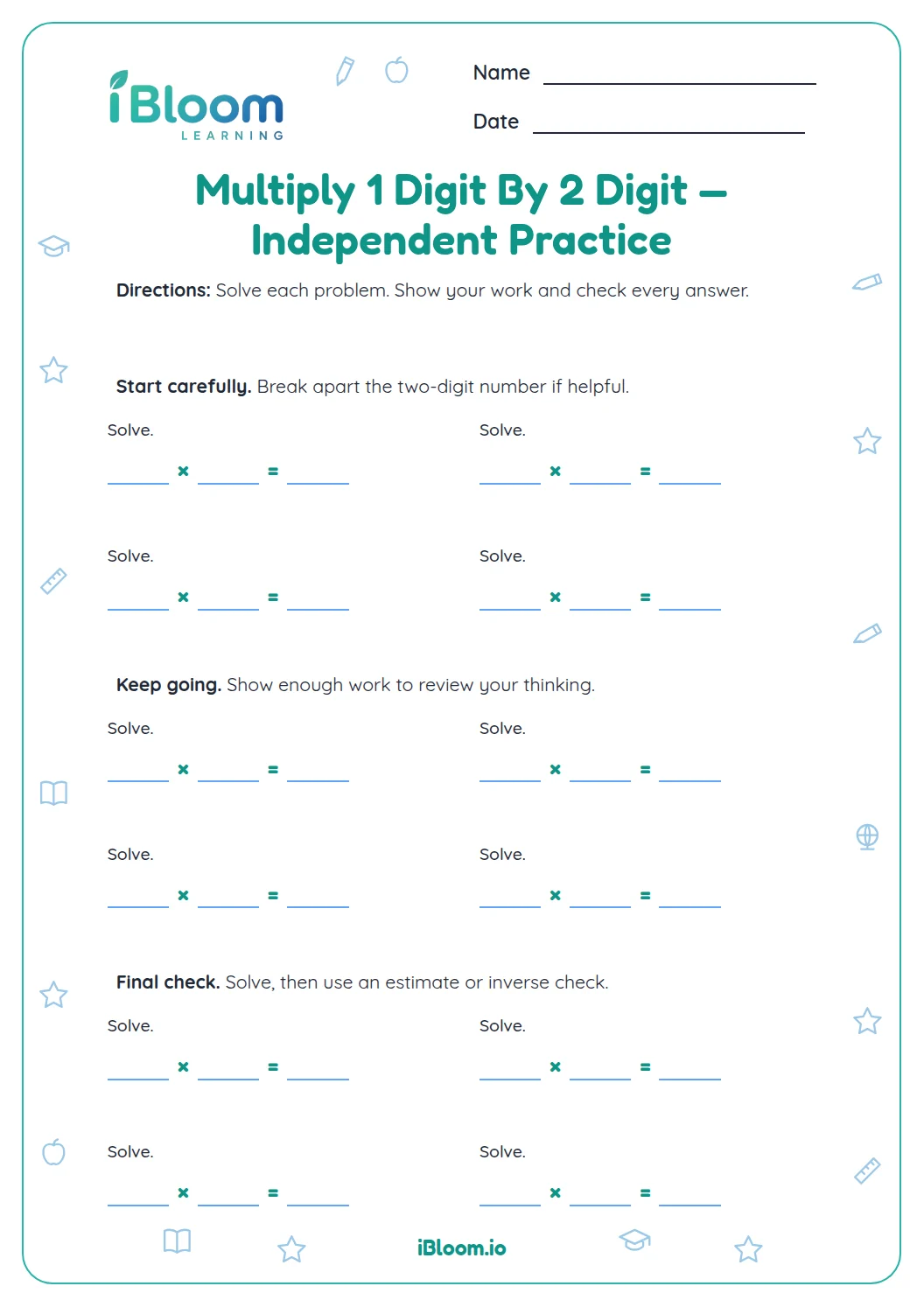
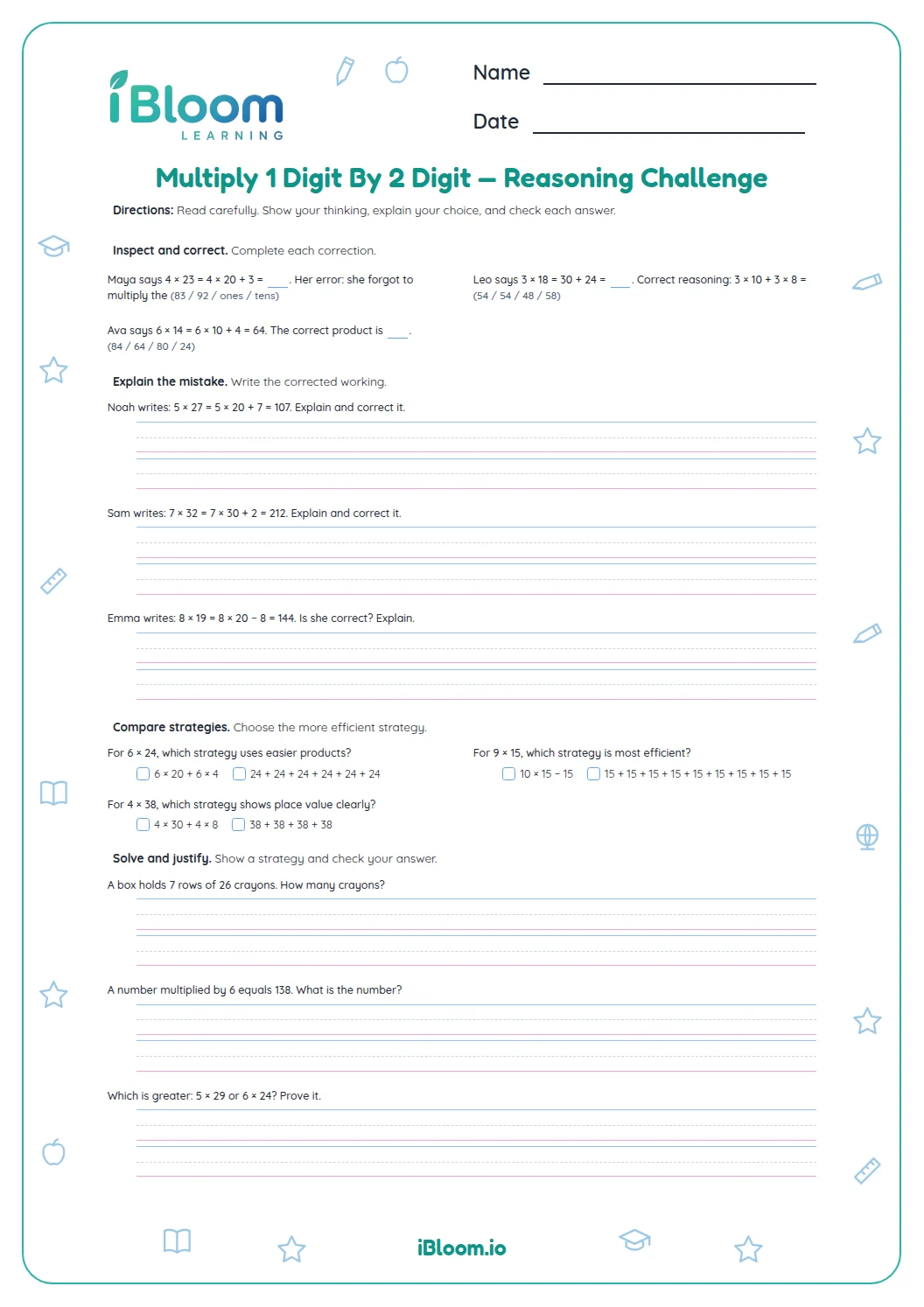
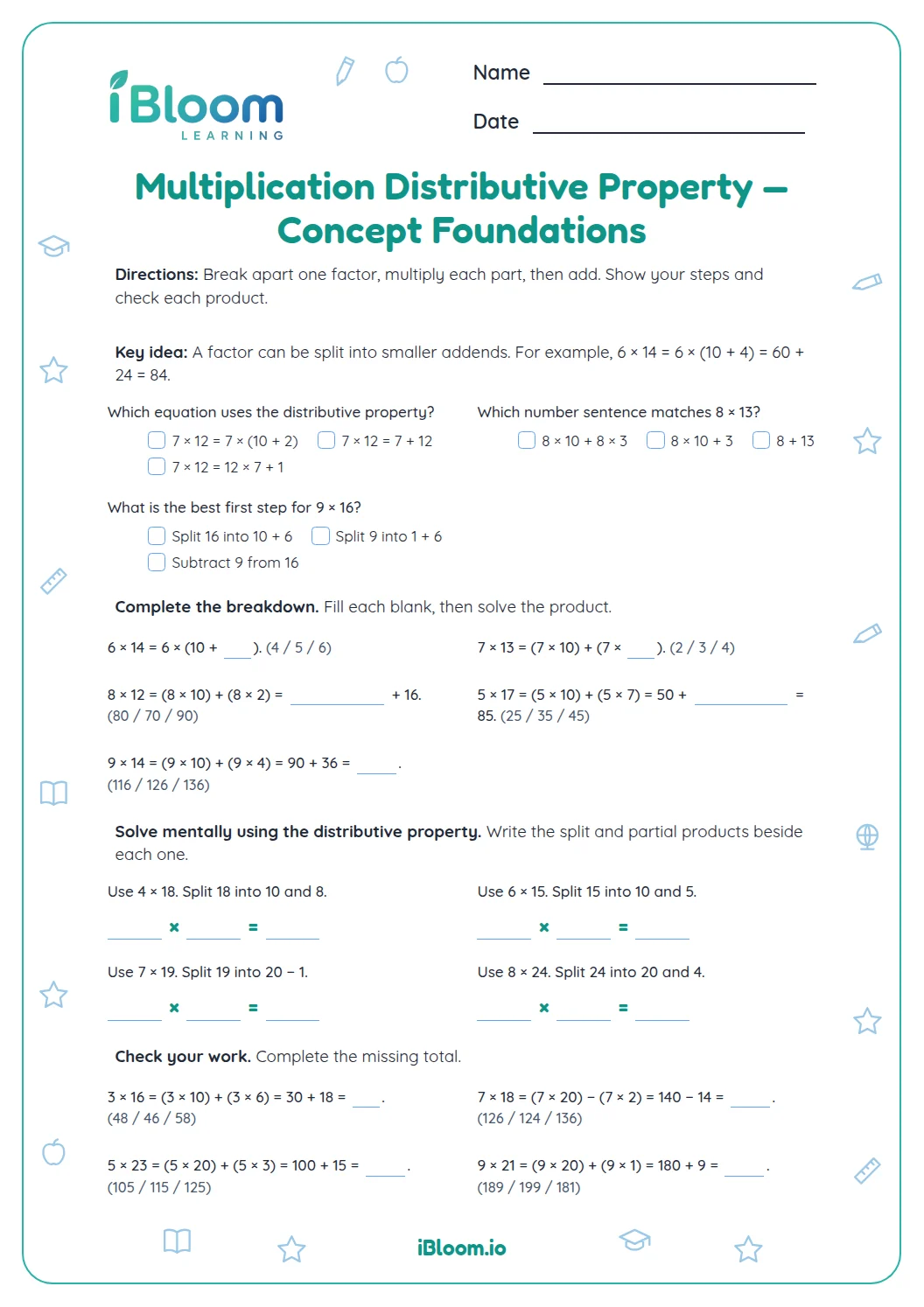
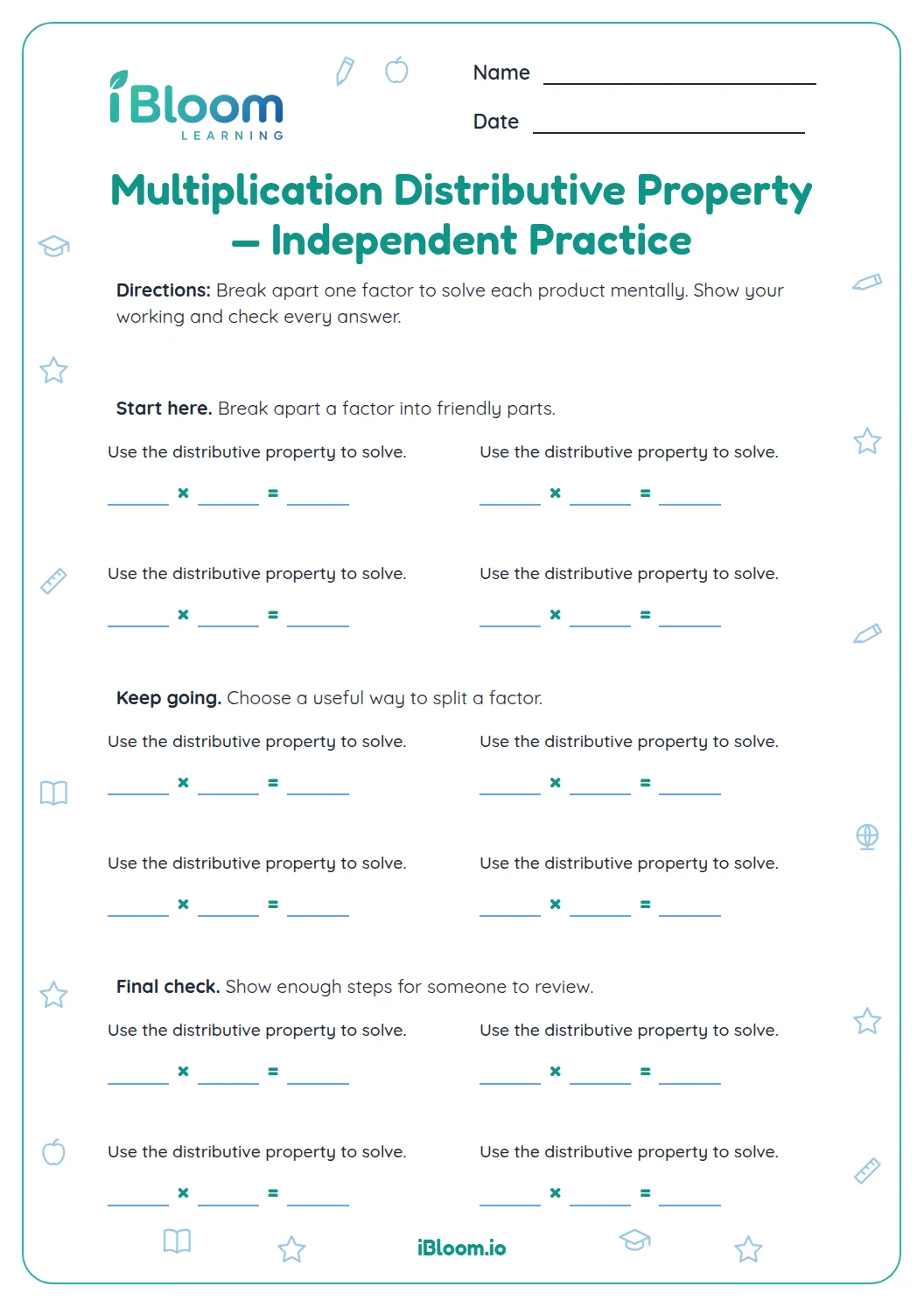
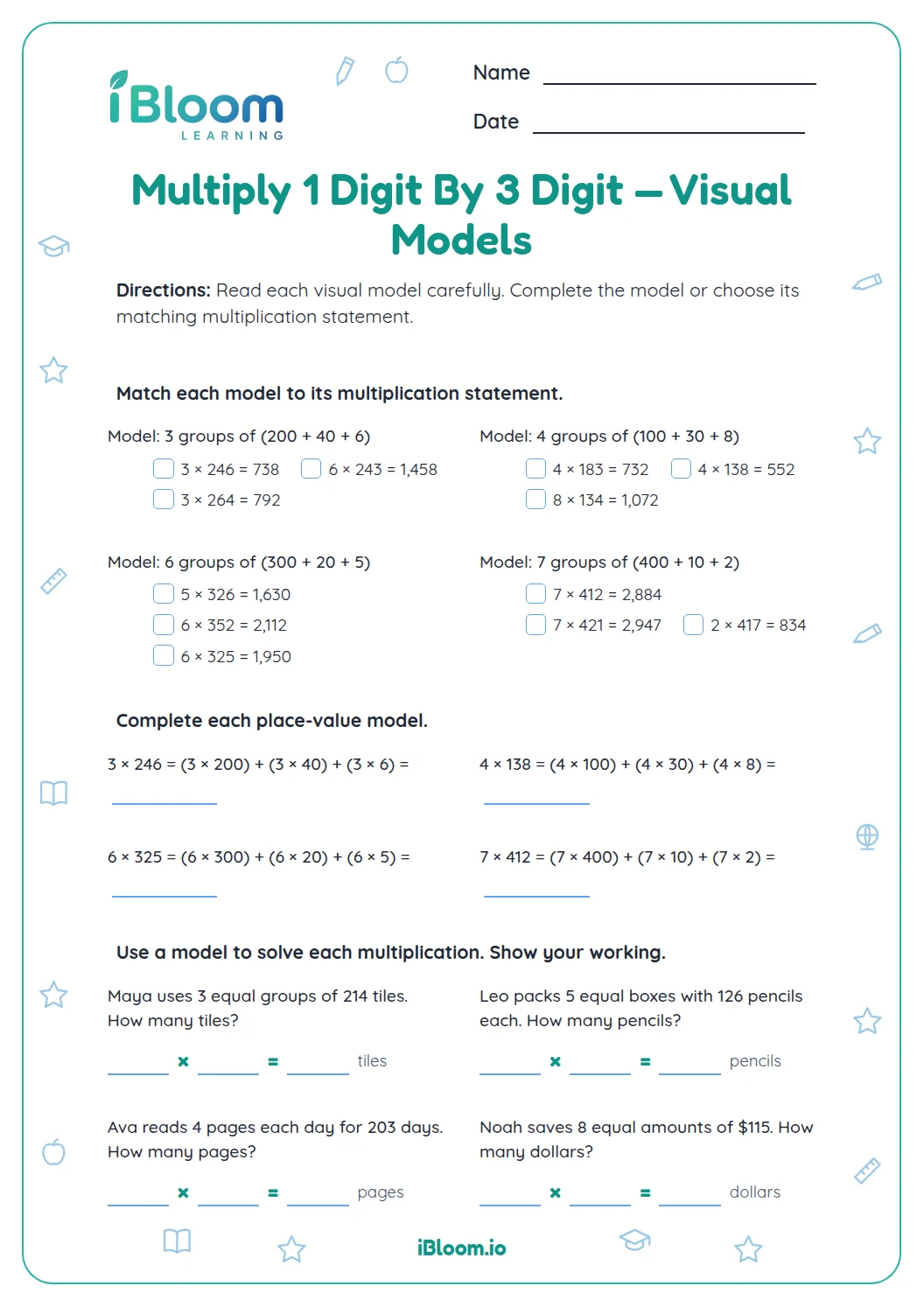
This Grade 4 printable builds mental strategies for multiplying a two-digit number by a one-digit factor. Children break a number such as 34 into 30 and 4, find each partial product, and combine them. The 16 questions progress from supported equations to short applications, with room to show the partial products. This practices CCSS 4.NBT.B.5, multiplying a whole number of up to four digits by a one-digit number using place-value strategies. The answer key includes products and sample decompositions.
Aligned to 4.NBT.B.5
How can you break apart a two-digit factor?
Write the two-digit number as tens plus ones. For 4 × 23, split 23 into 20 + 3. Then find 4 × 20 and 4 × 3.
How do partial products make the full product?
The partial products represent all the groups in the original multiplication. Add them to find the total. In the example, 80 + 12 = 92.
- 14 × 23
- 223 = 20 + 3
- 34 × 20 = 80; 4 × 3 = 12
- 480 + 12 = 92
Where will children use this strategy?
Part A breaks apart factors and finds products. Part B uses the same method with less prompting and short equal-group situations. The numbers are chosen for accurate mental work and clear partial products.
How to use this worksheet
- 1Rewrite the two-digit factor as tens plus ones.
- 2Multiply the one-digit factor by the tens amount.
- 3Multiply it by the ones amount.
- 4Add the partial products and check the size of the result.
- 5For a story, write the multiplication equation before decomposing.
Common mistakes and quick fixes
The mistake
Multiplying only the tens or only the ones.
The fix
Write both partial products before adding.
The mistake
Treating 30 as 3 in a partial product.
The fix
Keep the place value: 4 × 30 is 120, not 12.
The mistake
Adding the factor digits instead of the partial products.
The fix
Combine the two products, such as 80 + 12.
Common Core alignment
This sheet gives children direct practice with the stated grade-level skill.
Multiply by a one-digit number using place-value partial products.
On this sheet: Children decompose two-digit factors, calculate partial products, and combine them.
Show the official wordingHide the official wording
Multiply a whole number of up to four digits by a one-digit whole number, and multiply two two-digit numbers, using strategies based on place value and the properties of operations. Illustrate and explain the calculation by using equations, rectangular arrays, and/or area models.
What to practice next
Make more practice
Further reading
Questions parents and teachers ask
What mental multiplication strategy does this sheet teach?
It uses place value and the distributive property. Split a two-digit factor into tens and ones, multiply each part by the one-digit factor, and add the partial products to find the complete product. Reread each prompt and check the answer key when the work is complete.
What is the answer to the worked example?
For 4 × 23, split 23 into 20 and 3. The partial products are 4 × 20 = 80 and 4 × 3 = 12. Add them to get 92. Reread each prompt and check the answer key when the work is complete.
Should children write out their partial products?
Yes. The guided questions provide room to show the tens product and ones product before combining them. Writing the parts makes it easier to spot a missed place value or an addition error. Reread each prompt and check the answer key when the work is complete.
Are the problems suitable for mental math?
The two-digit factors and one-digit multipliers are selected so children can calculate each part and combine the results. Children may use scratch work or say the partial products aloud as they solve. Reread each prompt and check the answer key when the work is complete.
What should a child do when a story problem gives equal groups?
Identify the number of groups and the amount in each group, then write a multiplication equation. Use the same tens-and-ones decomposition to calculate the product and label it with the story’s unit. Reread each prompt and check the answer key when the work is complete.