






About this worksheet
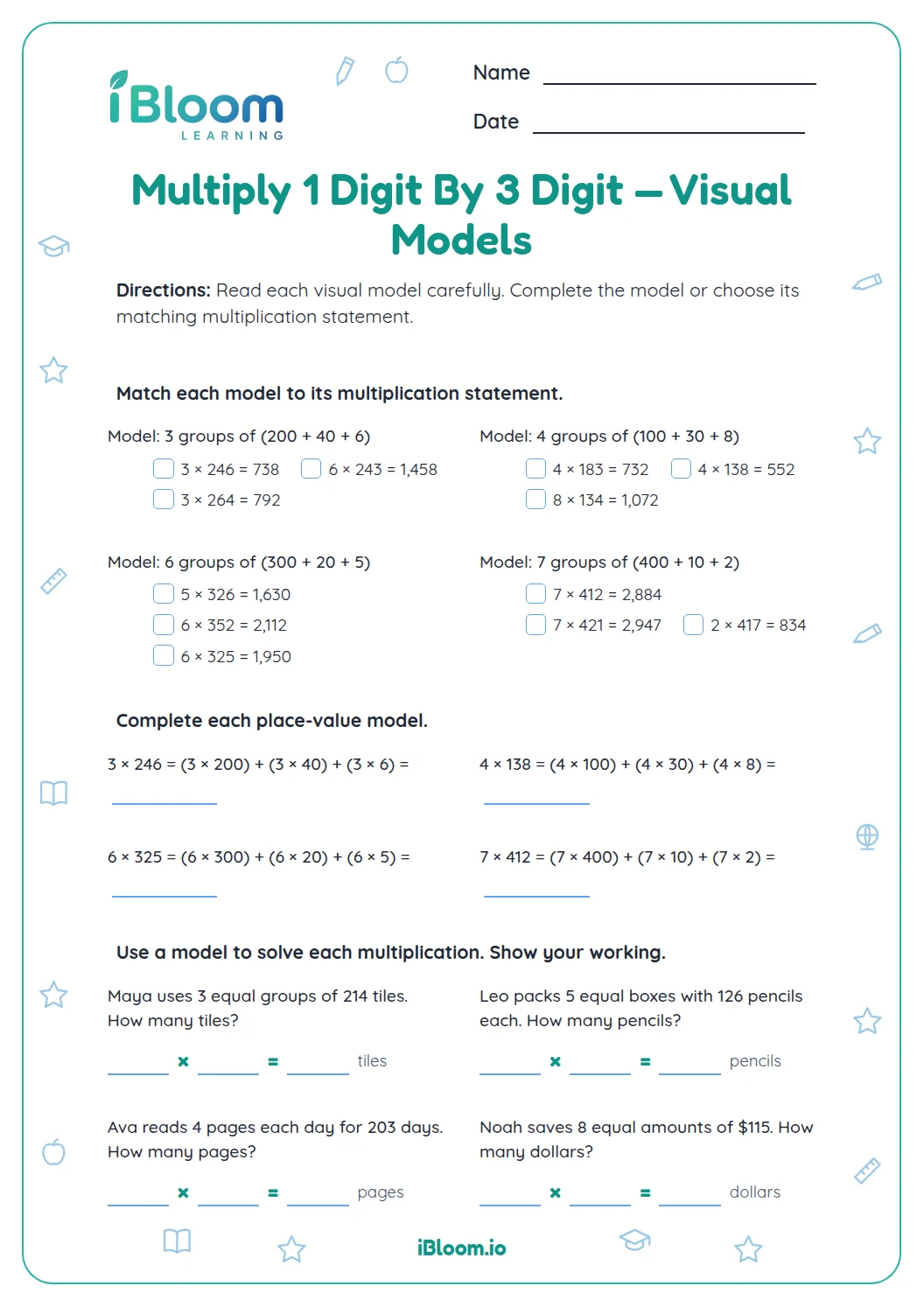
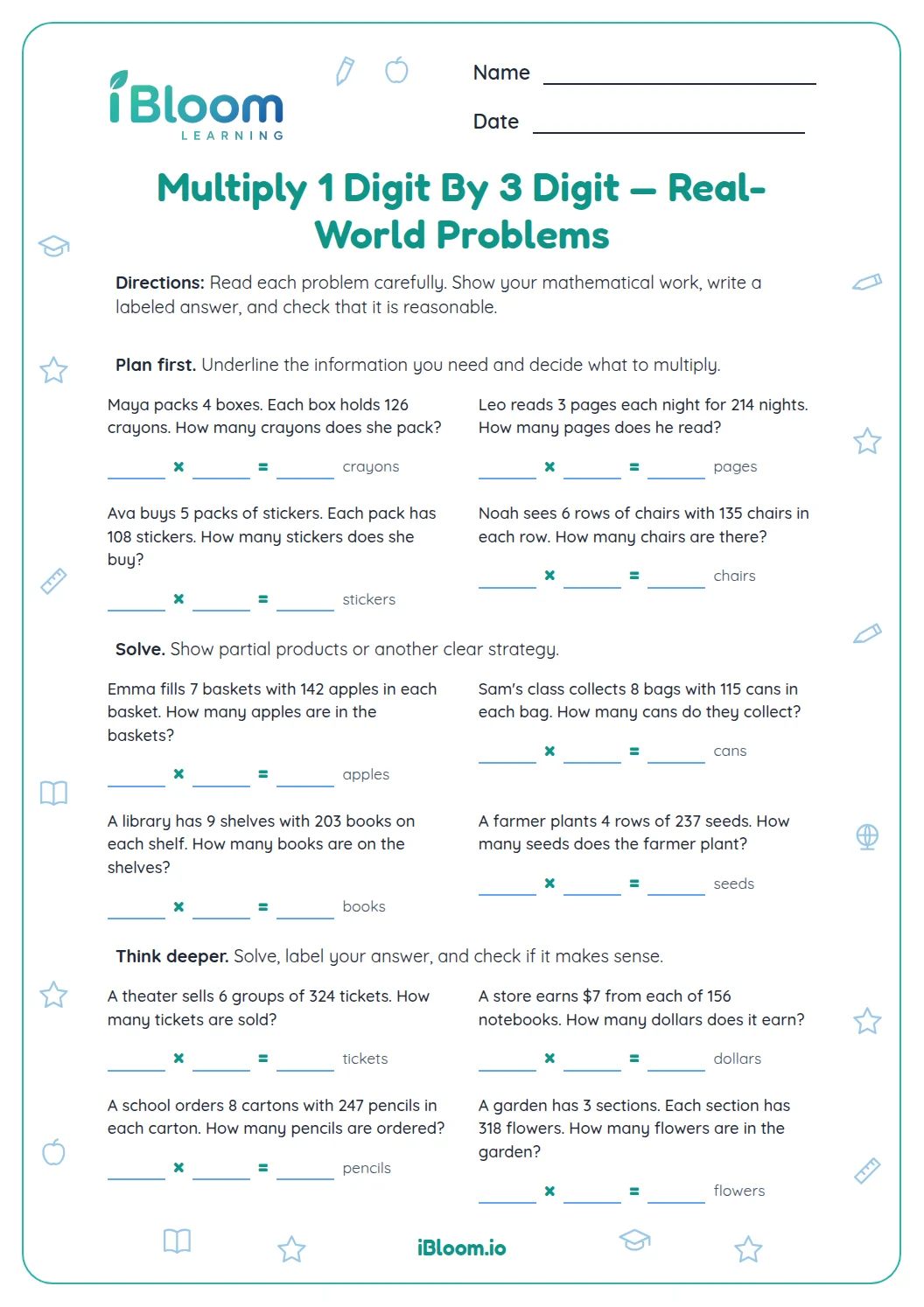
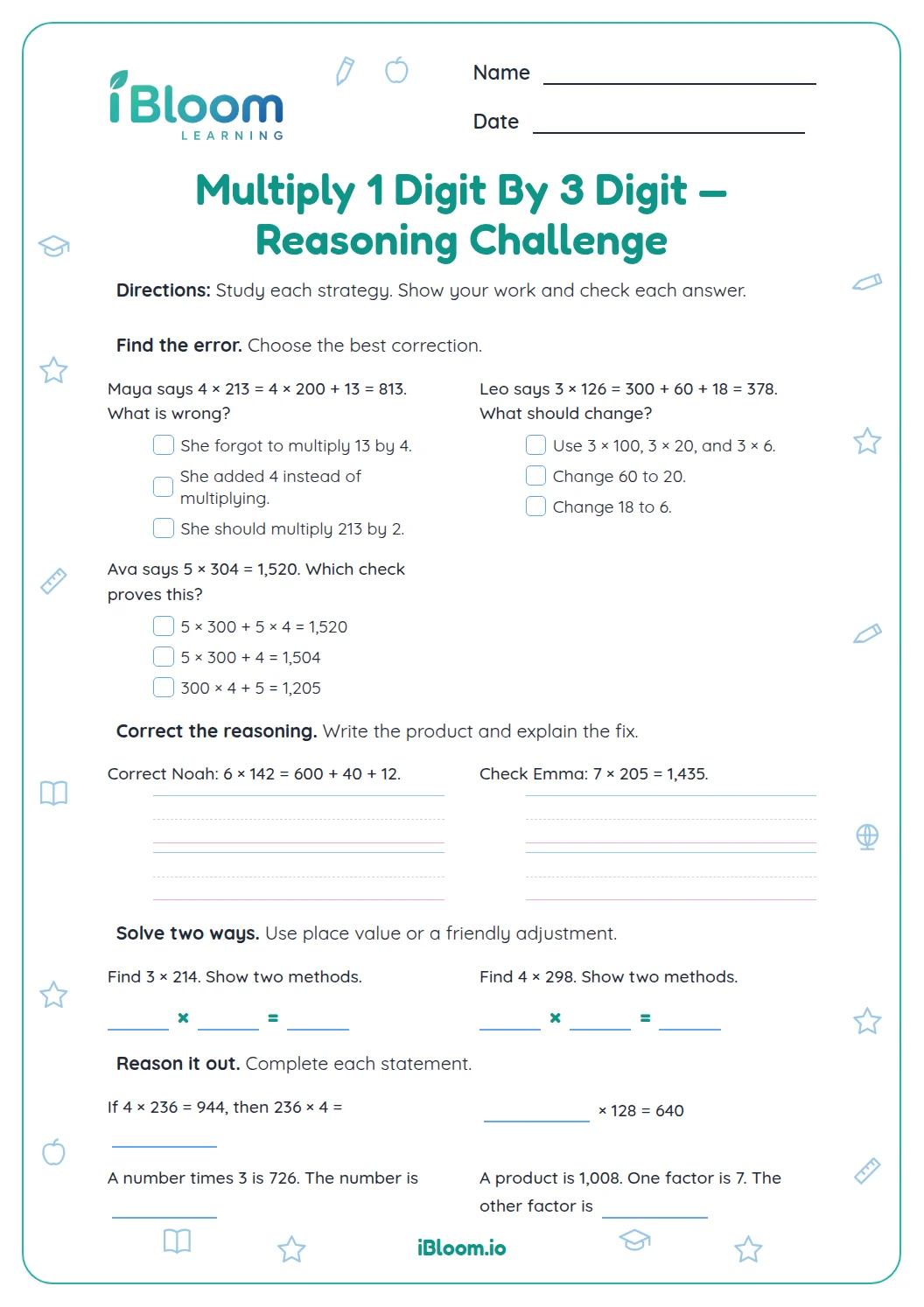
This Grade 4 worksheet builds one-digit by three-digit multiplication through place-value reasoning. Sixteen questions include products, partial-product explanations, an error check, and four equal-group situations. Learners multiply the hundreds, tens, and ones by the one-digit factor, then combine the results; a separate key gives answers.
Aligned to 4.NBT.B.5
How do partial products work?
For 3 × 246, split 246 into 200 + 40 + 6. Multiply each part by 3 to get 600, 120, and 18; then add them for 738.
How does multiplication model equal groups?
In a story with 3 boxes of 128 cards, 3 is the number of equal groups and 128 is the amount in each group. Find 3 × 128 to get 384 cards.
How to use this worksheet
- 1Read the one-digit factor and three-digit number.
- 2Break the three-digit number into hundreds, tens, and ones.
- 3Multiply each place-value part by the one-digit factor.
- 4Add the partial products carefully.
- 5For word problems, label the product with the requested item.
- 6Use the answer key to check each result.
Check each place
The mistake
Multiplying the tens digit without its place value.
The fix
For 4 tens, calculate 4 × 40, not 4 × 4.
The mistake
Leaving out a partial product.
The fix
Check the hundreds, tens, and ones parts.
The mistake
Adding partial products inaccurately.
The fix
Line up place values or add in steps.
Common Core alignment
This worksheet practices the following Common Core skill.
Multiply a three-digit number by a one-digit number using place value and partial products.
On this sheet: Multiply a three-digit number by a one-digit number using place value and partial products. is practiced in the worksheet.
Show the official wordingHide the official wording
Multiply a whole number of up to four digits by a one-digit whole number, and multiply two two-digit numbers, using strategies based on place value and the properties of operations. Illustrate and explain the calculation by using equations, rectangular arrays, and/or area models.
What to practice next
Make more practice
Further reading
Questions parents and teachers ask
How many problems are included?
There are 16 problems, including products, partial-product reasoning, an error check, and equal-group word problems. Ask the learner to point to the relevant sentence or number relationship before checking the key; that makes the reasoning visible and helps distinguish a supported answer from a guess.
What are partial products?
They are the products found by multiplying each place-value part separately. For 3 × 246, the partial products are 600, 120, and 18. Ask the learner to point to the relevant sentence or number relationship before checking the key; that makes the reasoning visible and helps distinguish a supported answer from a guess.
Does the sheet include word problems?
Yes. Several questions describe equal groups, such as boxes with the same number of cards. Multiply the group count by the amount in each group. Ask the learner to point to the relevant sentence or number relationship before checking the key; that makes the reasoning visible and helps distinguish a supported answer from a guess.
Is an answer key provided?
Yes. The separate key lists the products and gives the partial products for the question that asks learners to name them. Ask the learner to point to the relevant sentence or number relationship before checking the key; that makes the reasoning visible and helps distinguish a supported answer from a guess.
How can a learner check a product?
Multiply the hundreds, tens, and ones separately, then add those partial products. The total should match the product found with another strategy. Ask the learner to point to the relevant sentence or number relationship before checking the key; that makes the reasoning visible and helps distinguish a supported answer from a guess.