






About this worksheet
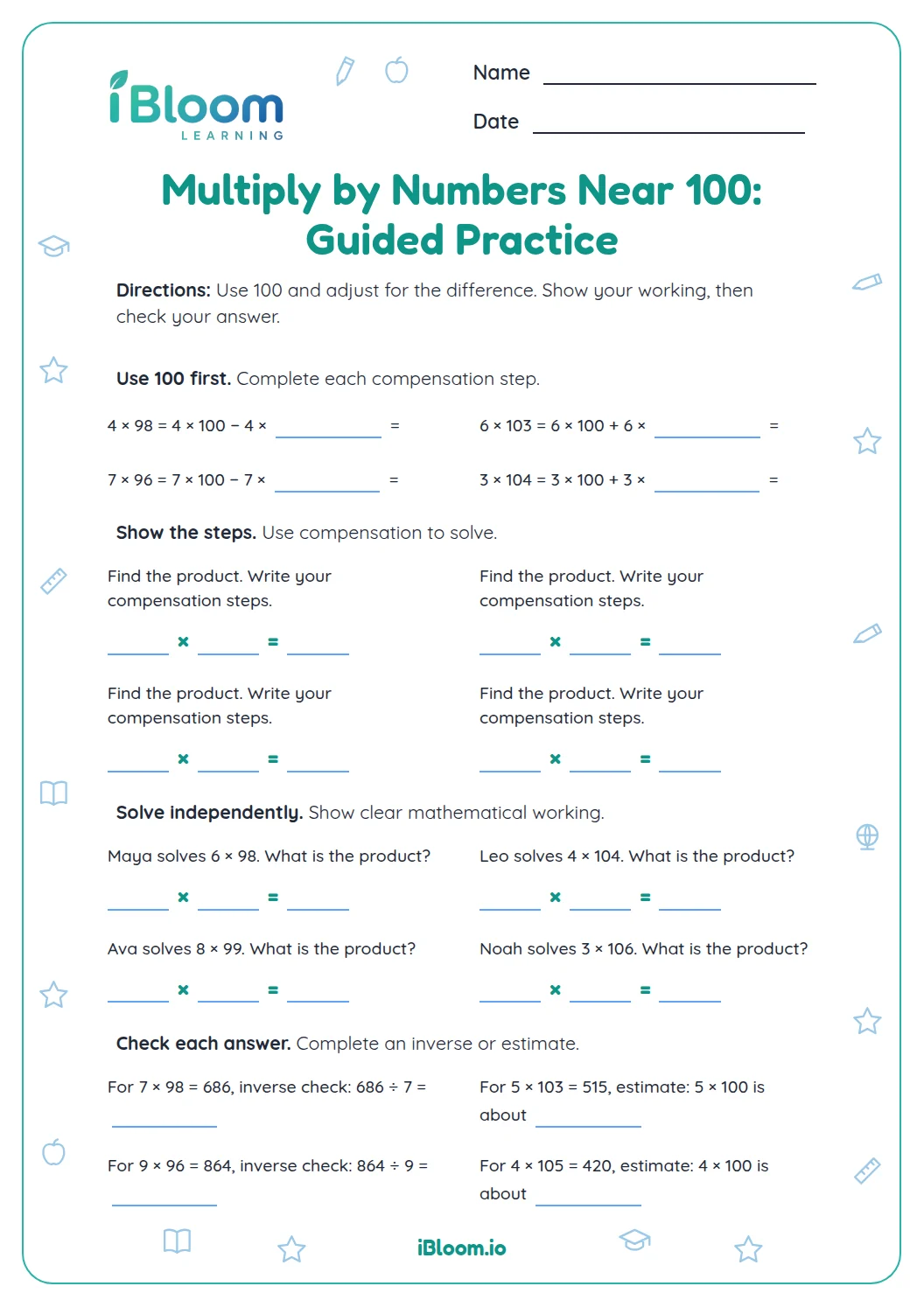
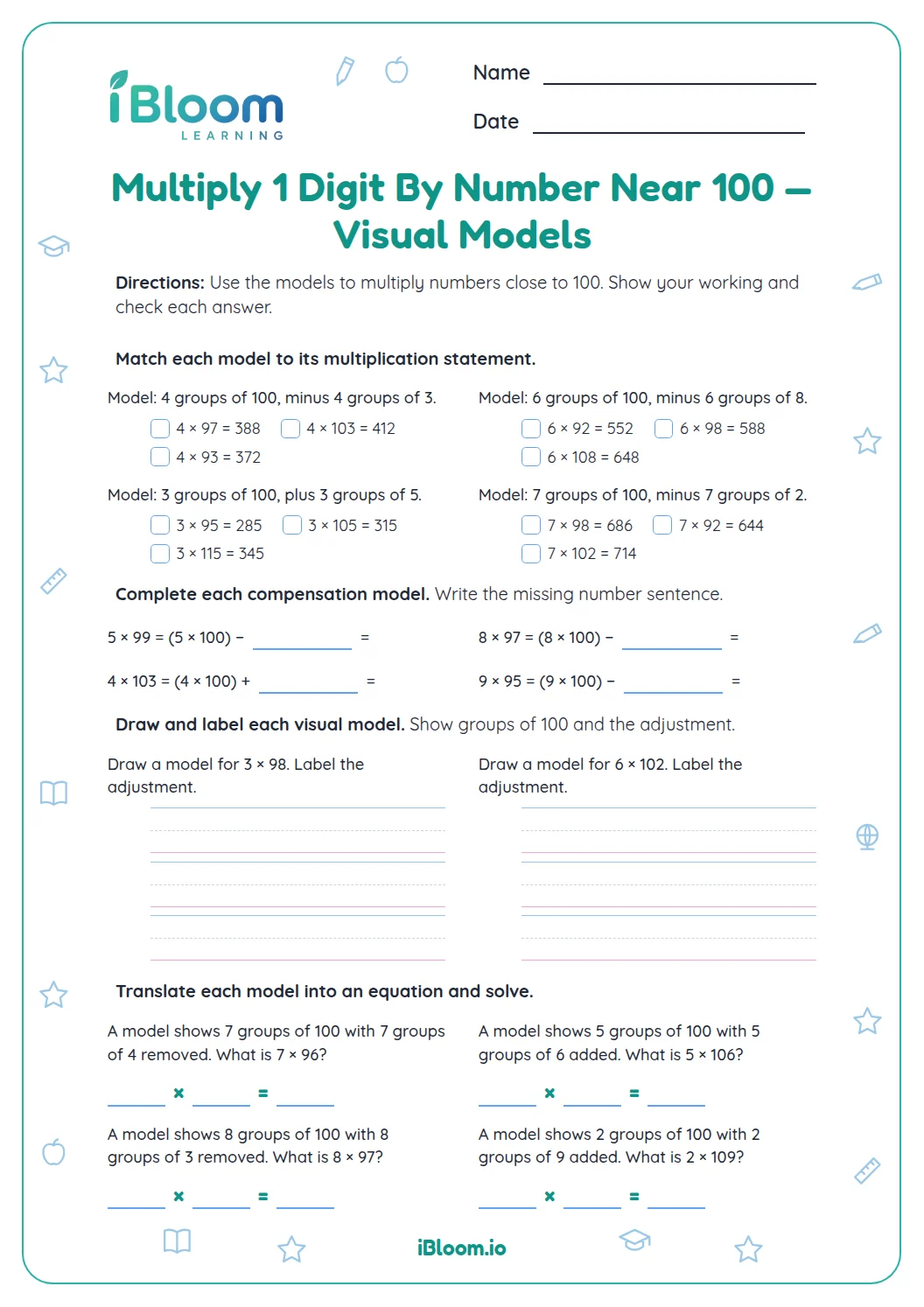
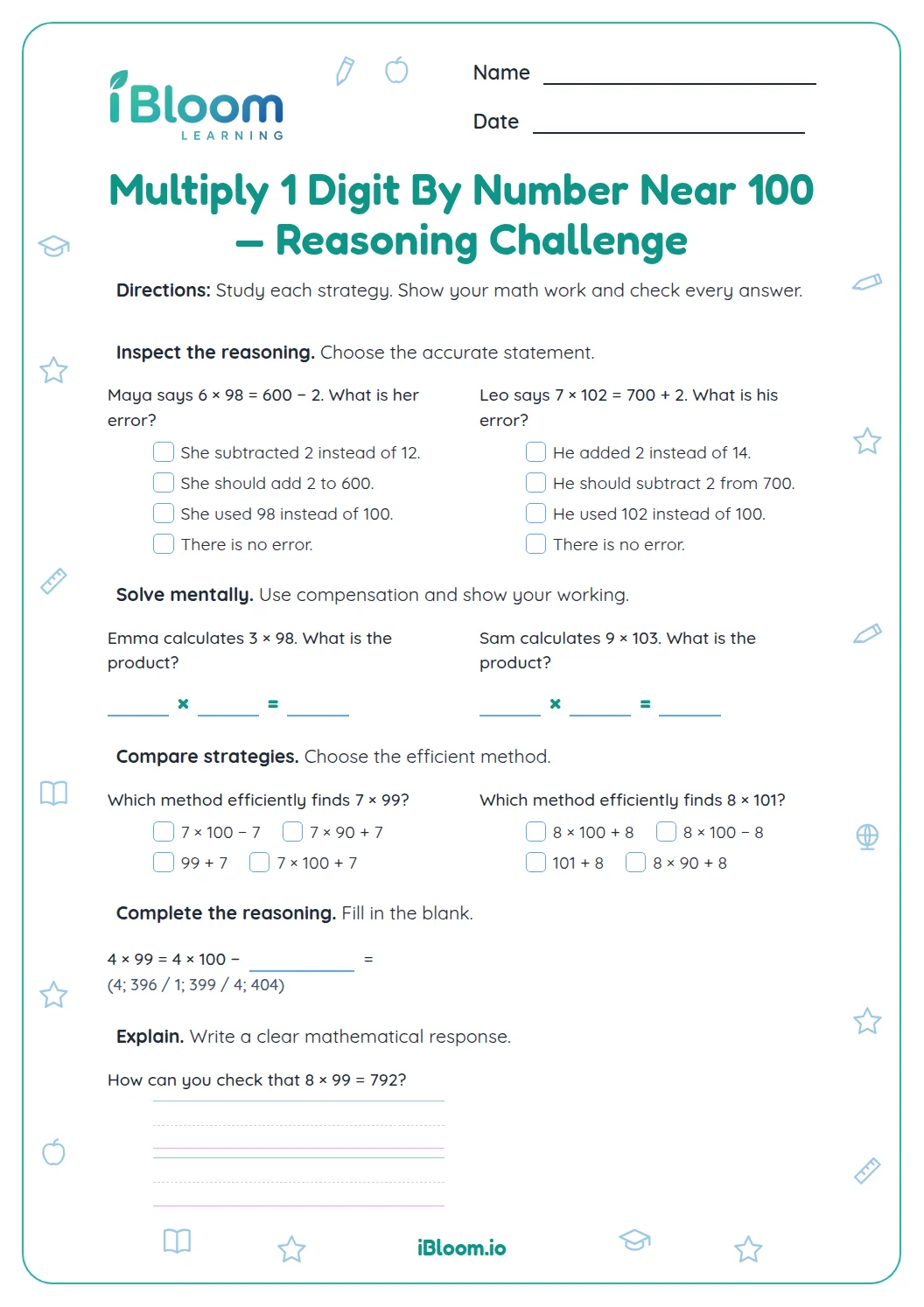
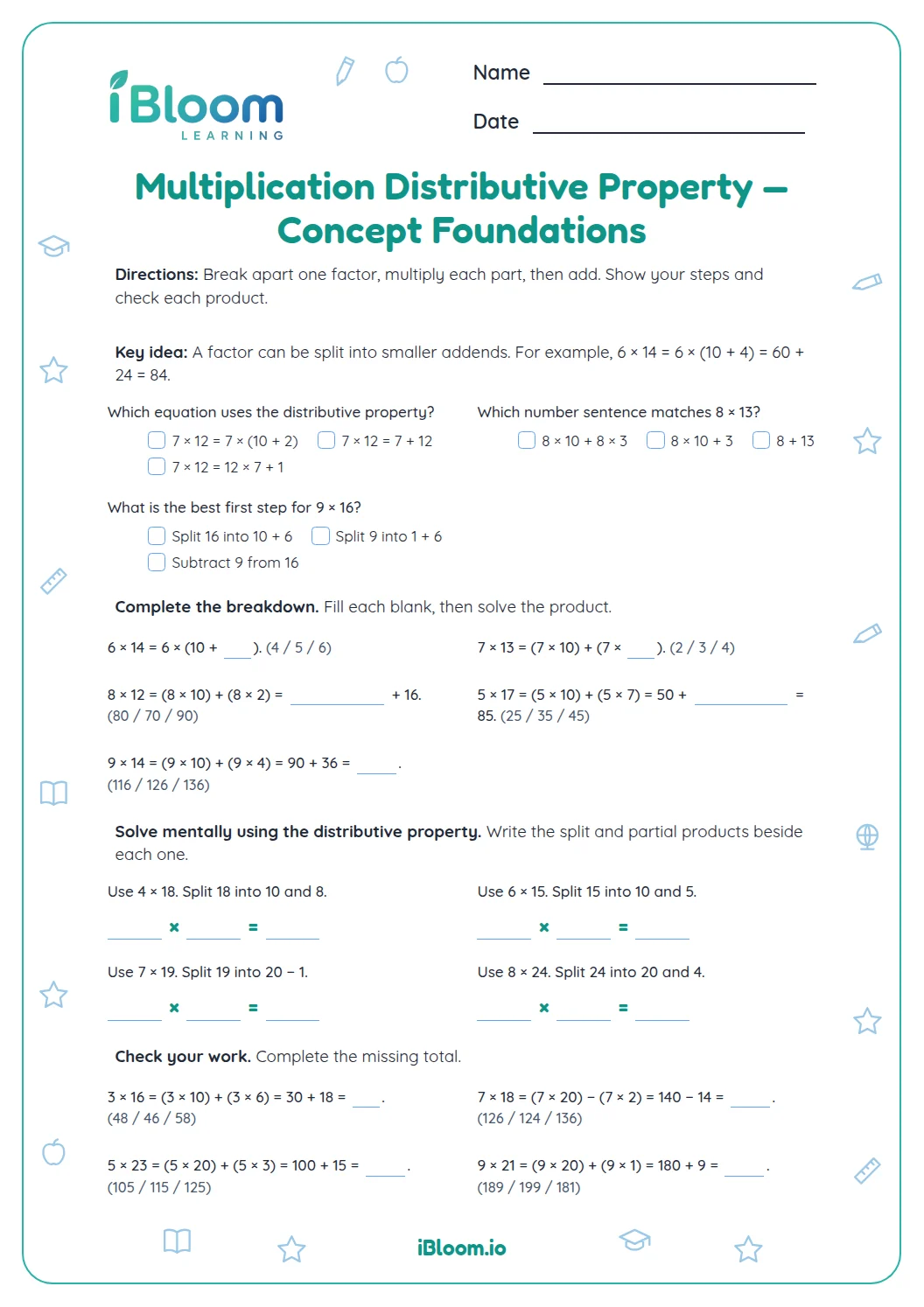
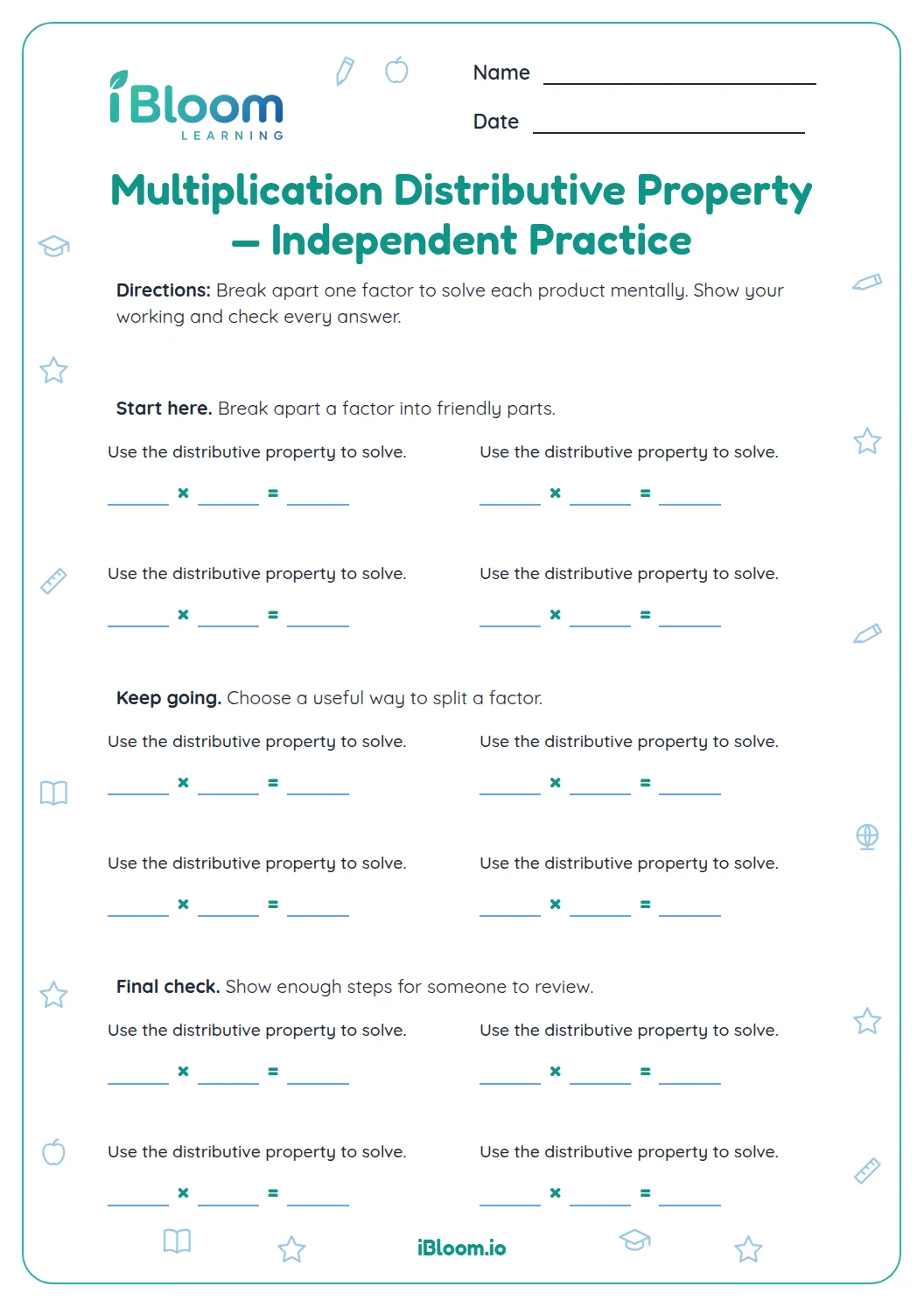
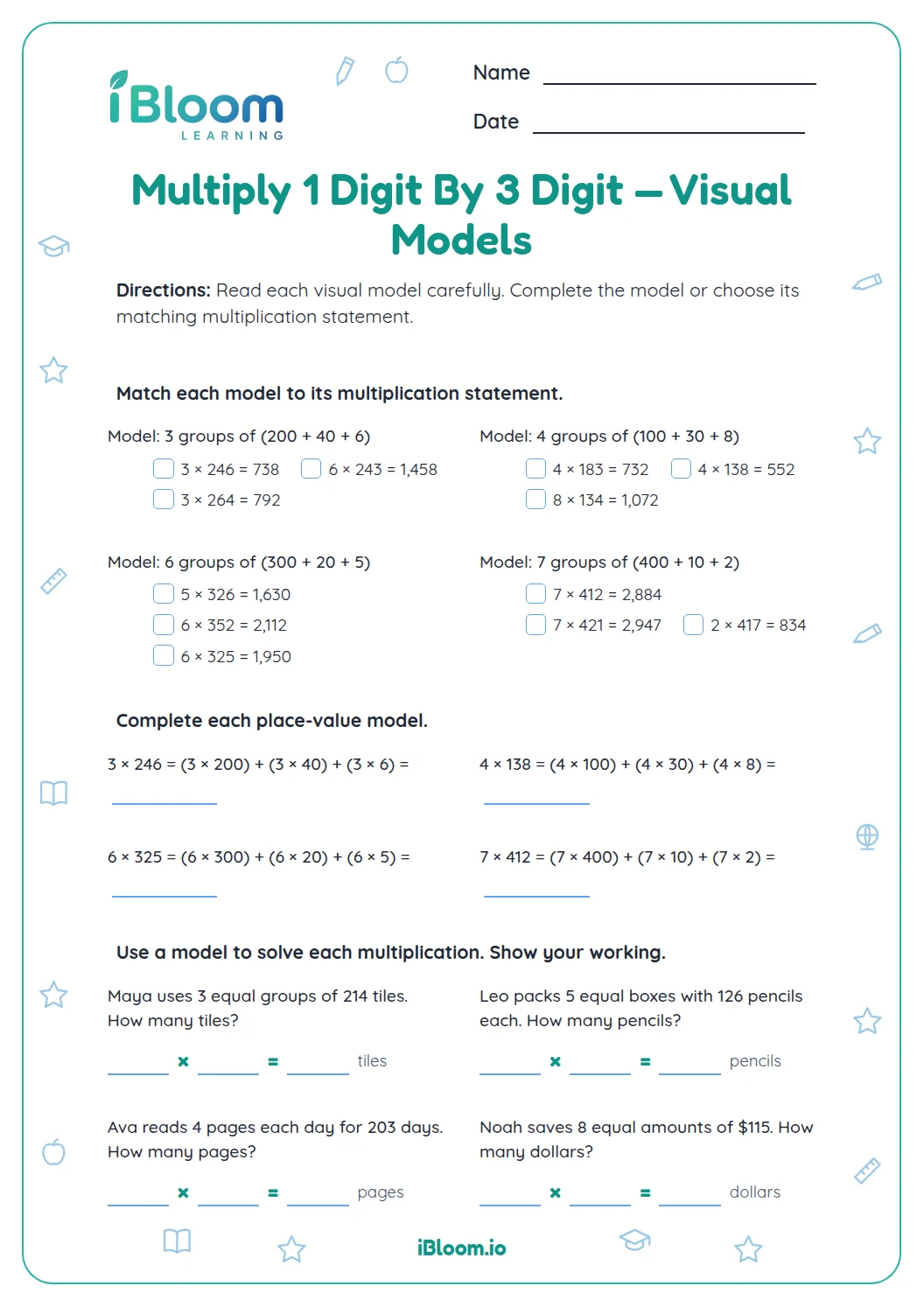
This free Grade 4 printable builds mental multiplication with one-digit factors and numbers close to 100. Part A shows how to rewrite a factor as 100 plus or minus a small amount. Part B asks students to find products, and Part C applies the same adjustment strategy to equal groups. The equations connect to place-value multiplication and the distributive property. A separate answer key is included.
Aligned to 4.NBT.B.5
Why use 100 as a friendly factor?
Multiplying a one-digit number by 100 is quick. A factor such as 98 is 2 less than 100, so subtract two groups of the one-digit factor from the easy product.
For 4 × 98, use 4 × (100 − 2) = 400 − 8 = 392.
When should you add or subtract the adjustment?
Subtract when the factor is below 100; add when it is above 100. For 7 × 101, the extra 1 contributes 7, so 700 + 7 = 707.
How can the strategy solve equal-group problems?
Treat the group size as the factor near 100. Five boxes with 99 cards each is 5 × (100 − 1), or 500 − 5 = 495 cards.
How to use this worksheet
- 1Notice whether the factor is below or above 100.
- 2Write it as 100 minus or plus the difference.
- 3Multiply the one-digit factor by 100.
- 4Multiply the same factor by the small difference.
- 5Subtract below 100 or add above 100.
- 6Estimate near the product with 100 to check.
Common mistakes and quick fixes
The mistake
Subtracting the difference even when a factor is above 100.
The fix
Compare the factor with 100 first; values above 100 require adding.
The mistake
Adjusting by the difference only once.
The fix
Multiply the difference by the one-digit factor before adjusting the 100 product.
The mistake
Using 100 × the digit without correcting for 98 or 99.
The fix
The friendly product is an estimate step; finish with the small adjustment.
Common Core alignment
Students use place value and the distributive property to explain multiplication.
Multiply by one digit using place-value strategies and equations.
On this sheet: Each near-100 product uses a one-digit factor and an equation that breaks the other factor around 100.
Show the official wordingHide the official wording
Multiply a whole number of up to four digits by a one-digit whole number, and multiply two two-digit numbers, using strategies based on place value and the properties of operations. Illustrate and explain the calculation by using equations, rectangular arrays, and/or area models.
What to practice next
Further reading
Questions parents and teachers ask
How does the near-100 strategy work?
Rewrite the factor as 100 plus or minus its distance from 100. For 4 × 98, calculate 4 × (100 − 2), or 400 − 8, to get 392. Part A shows the small product that must be added or subtracted for an accurate result.
Why do some answers require subtraction and others addition?
A factor below 100 is less than the friendly number, so subtract the matching adjustment. A factor above 100 is greater, so add it. For example, 7 × 101 is 700 + 7, while 7 × 99 is 700 − 7. The sign follows the factor’s distance from 100.
What does the worksheet ask students to do independently?
Part B has six products with factors from 97 to 103. Students can use a nearby multiple of 100, multiply the one-digit factor by the small difference, and adjust. Part C adds three equal-group situations and three more products, for 18 questions total.
Does the answer key show the multiplication strategy?
The separate key gives the answer to all 18 items. Students can compare a missed answer with the equation they wrote, then check whether they adjusted in the right direction and used the small difference for every group. This makes it easier to find a sign or multiplication slip.
Are the context problems about exact equal groups?
Yes. Each context gives a whole number of groups and the same number in every group. Five boxes with 99 cards each is 5 × 99, which can be calculated as 500 − 5 = 495 cards. The muffin and seat problems use the same equal-groups structure.