




About this worksheet
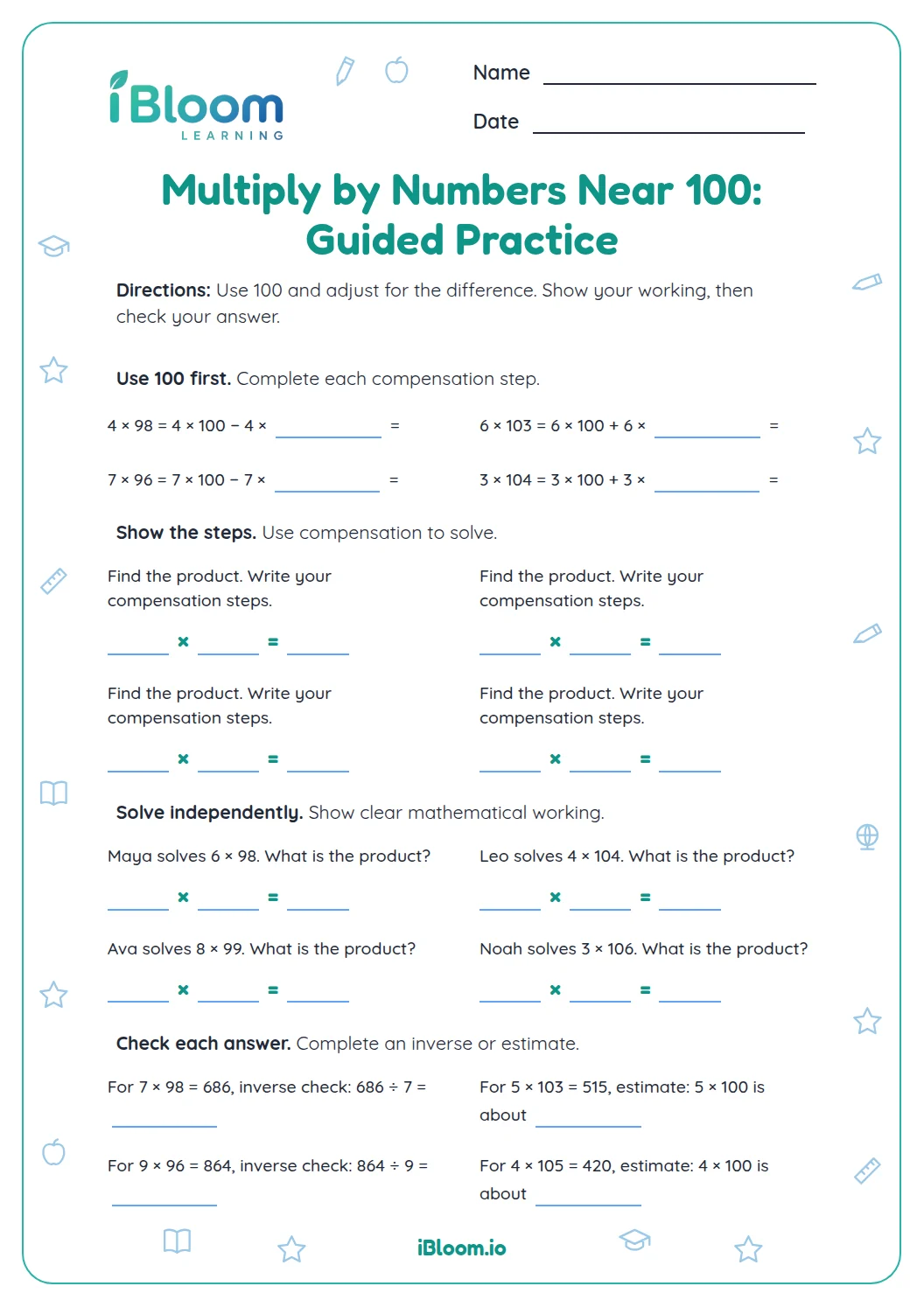
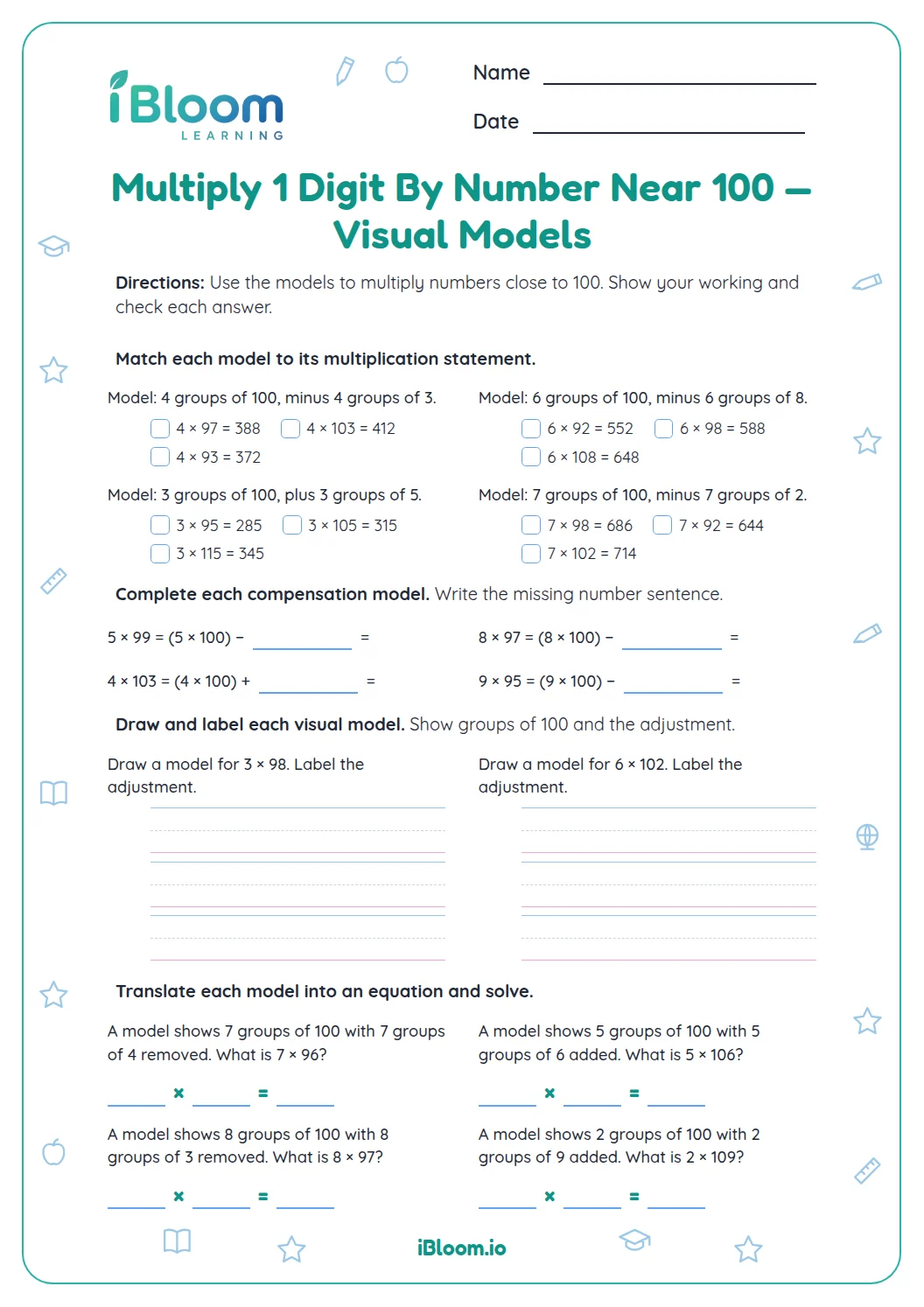
This Grade 4 worksheet gives students practice multiplying a one-digit number by a number close to 100 in familiar contexts. Each problem asks for a total such as rows of seats, boxes of pencils, or trays of seedlings. Students can use compensation: multiply by 100, then subtract the extra amount. The questions support CCSS 4.NBT.B.5 by practicing place-value strategies for multiplication, with answers written alongside the appropriate unit.
Aligned to 4.NBT.B.5
How does compensation help with 98 or 99?
Use 100 as the friendly number, then correct the extra amount. For 98, subtract 2 for every group; for 99, subtract 1 for every group.
- 14 × 98 = 4 × (100 − 2)
- 2400 − 8 = 392 pencils
How can the story help identify the factors?
For the final six problems, use compensation: multiply the one-digit factor by 100, then subtract the extra amount. For 6 × 97, calculate 6 × 100 − 6 × 3 = 582. Add the unit named in the story.
How can students check a near-100 product?
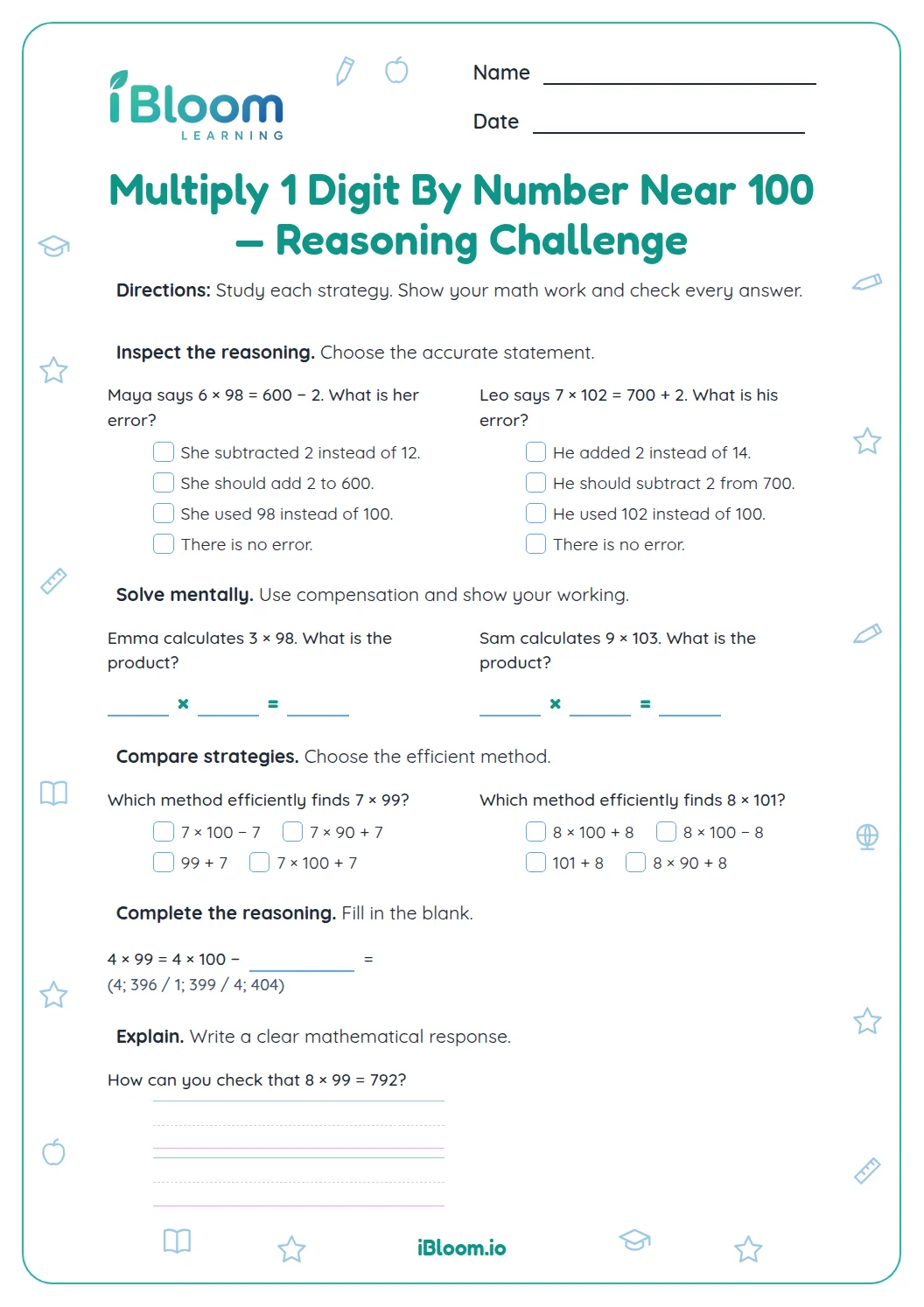
Estimate with 100 groups first. A product using 4 groups of 98 should be close to 400; 392 is reasonable, while 39 or 3,920 is not.
How to use this worksheet
- 1Circle the number of groups and the amount in each group.
- 2Write a multiplication expression for the story.
- 3Use 100 as the nearby number and calculate the adjustment.
- 4Subtract the adjustment from the product with 100.
- 5Write and check the answer with the correct unit.
Common mistakes and quick fixes
The mistake
Subtracting the near-100 difference only once.
The fix
Multiply the difference by the number of groups before subtracting.
The mistake
Adding the adjustment for a factor below 100.
The fix
Because 98 is 2 less than 100, subtract 2 per group.
The mistake
Leaving off the unit.
The fix
Use the object or measure named in the story after the total.
Common Core alignment
These Common Core standards describe the skills practiced on this worksheet.
Multiply a one-digit number by a multi-digit number using place value strategies.
On this sheet: Each context uses a one-digit factor and a factor from 96 to 99, suited to compensation from 100.
Show the official wordingHide the official wording
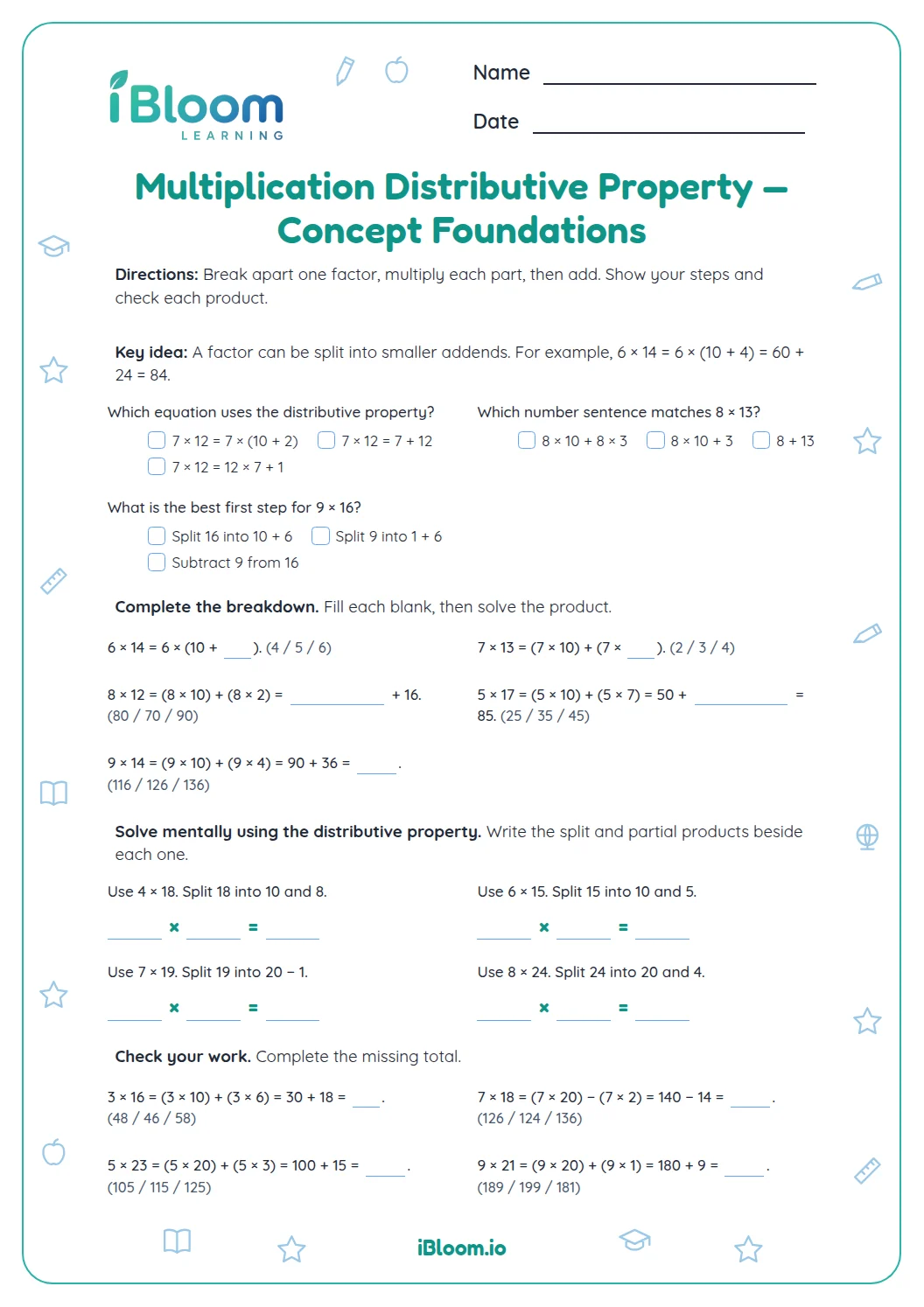
Multiply a whole number of up to four digits by a one-digit whole number, and multiply two two-digit numbers, using strategies based on place value and the properties of operations. Illustrate and explain the calculation by using equations, rectangular arrays, and/or area models.
What to practice next
Questions parents and teachers ask
How can I multiply by a number close to 100?
This page practices multiplying a one-digit number by a factor from 96 to 99 in a short story. The first eight questions ask students to choose a product; the final six ask them to calculate in a blank and label the total. The answer key lists each product with its unit.
Do students have to use compensation?
The worksheet instruction invites students to use a nearby hundred, and the worked example shows that strategy. A student may use another accurate place-value method. In every problem, the answer key shows the total with its unit so the product can be checked.
What factors appear in the problems?
Each story uses a one-digit number of groups and a group size from 96 to 99. The contexts include supplies, seats, food, and other countable items, so students can focus on multiplying a number near 100 and labeling the total.
How can a student check the product?
Estimate by replacing the near-100 factor with 100. Four groups of 98 should be close to 400, and 392 is reasonable. Students can also multiply the difference from 100 by the number of groups and check that the adjustment was subtracted.
How many problems ask students to show their work?
The final six questions ask students to calculate a product in a blank and label it with a unit. The first eight are multiple choice, so students can focus on finding the product and recognizing a reasonable total. For extra practice, ask a child to explain one chosen answer with a near-hundred equation.