

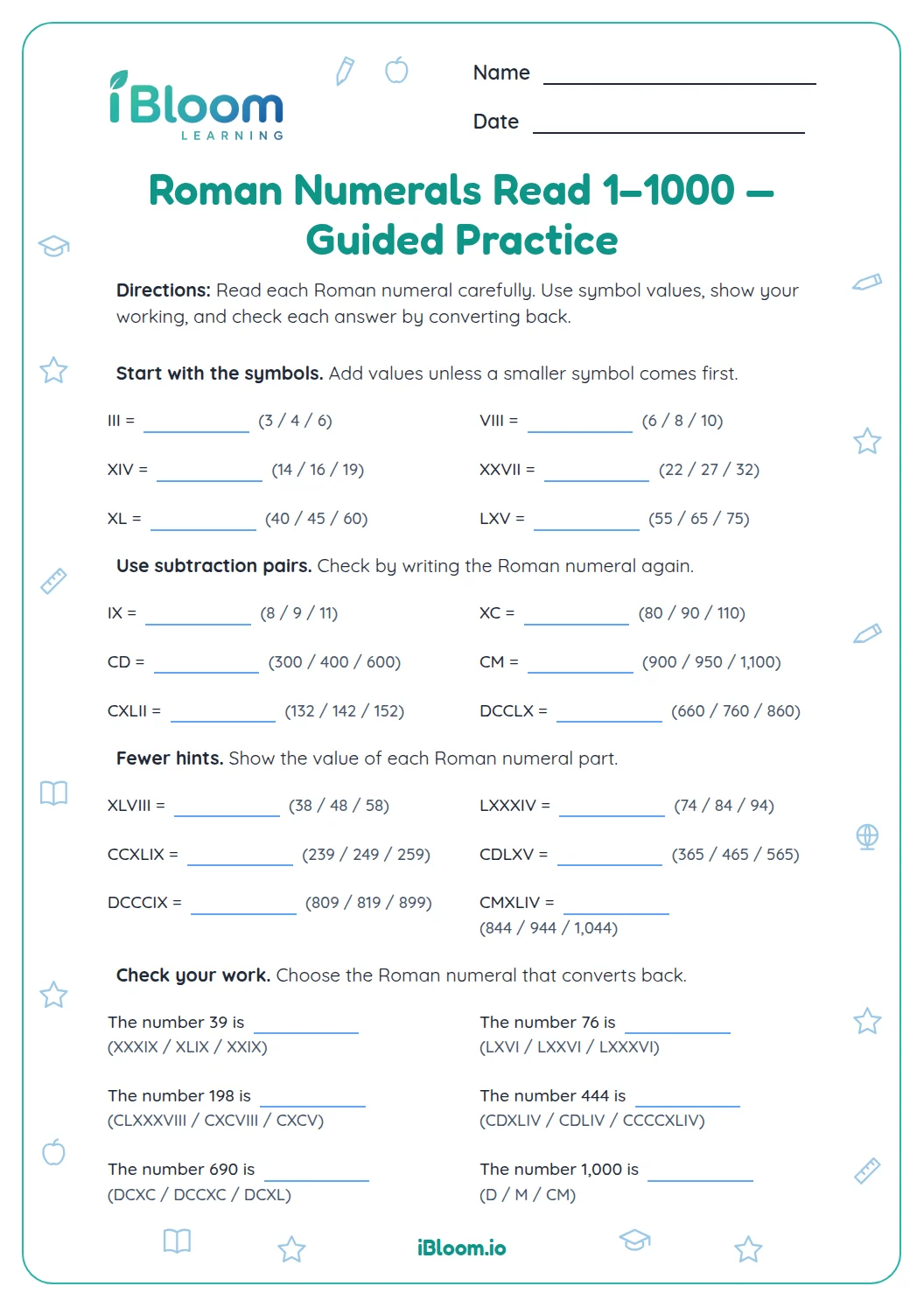
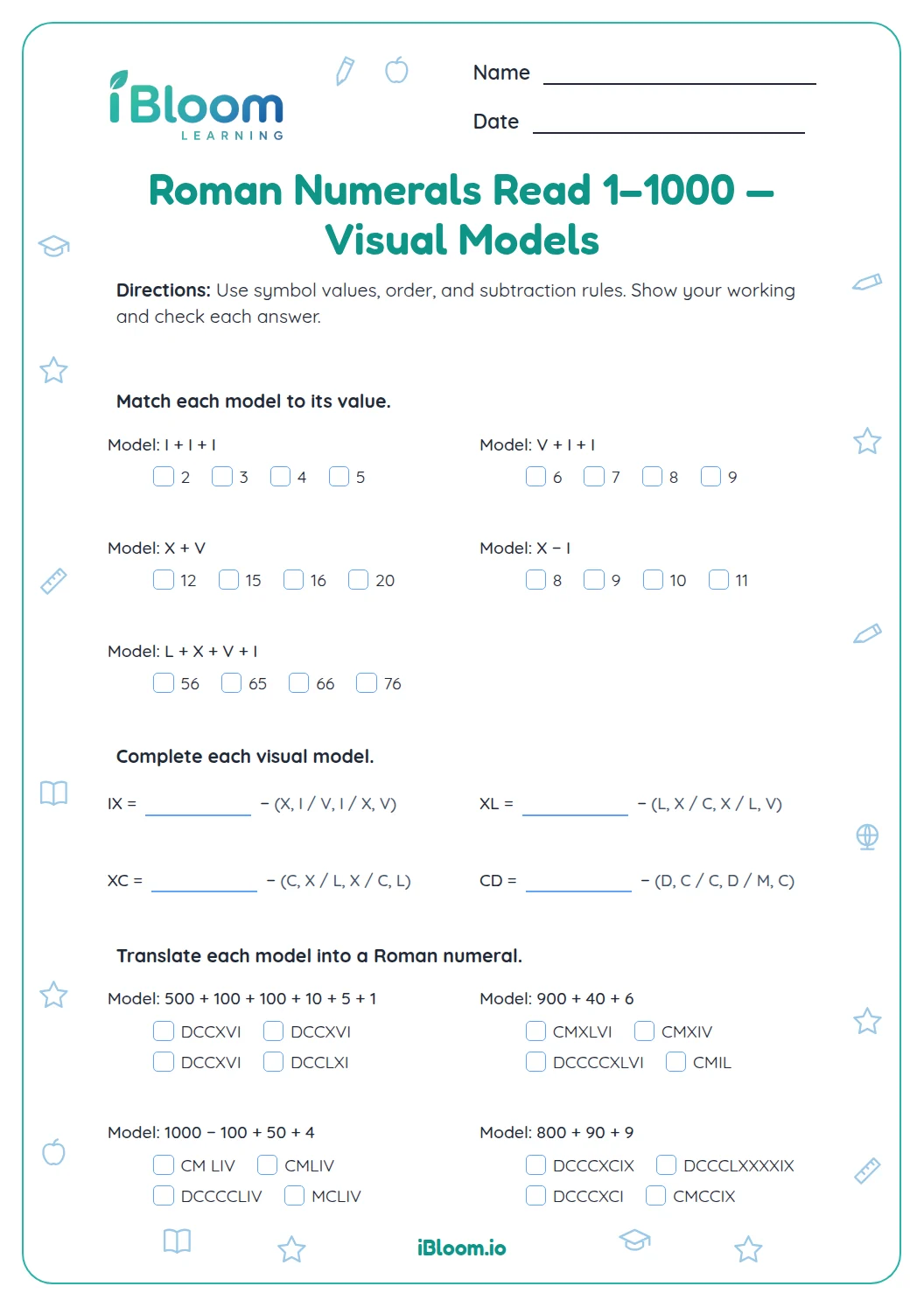

About this worksheet
This Grade 4 worksheet builds Roman numeral fluency in three steps: read numerals, write numerals for standard values, then add or subtract and express the result in Roman notation. The 18 questions move from familiar symbols to values through 156 and mixed operations. A separate answer key supports quick checking. The activities connect place-value understanding and the Grade 4 standard for reading and writing multi-digit whole numbers.
How do you read Roman numerals?
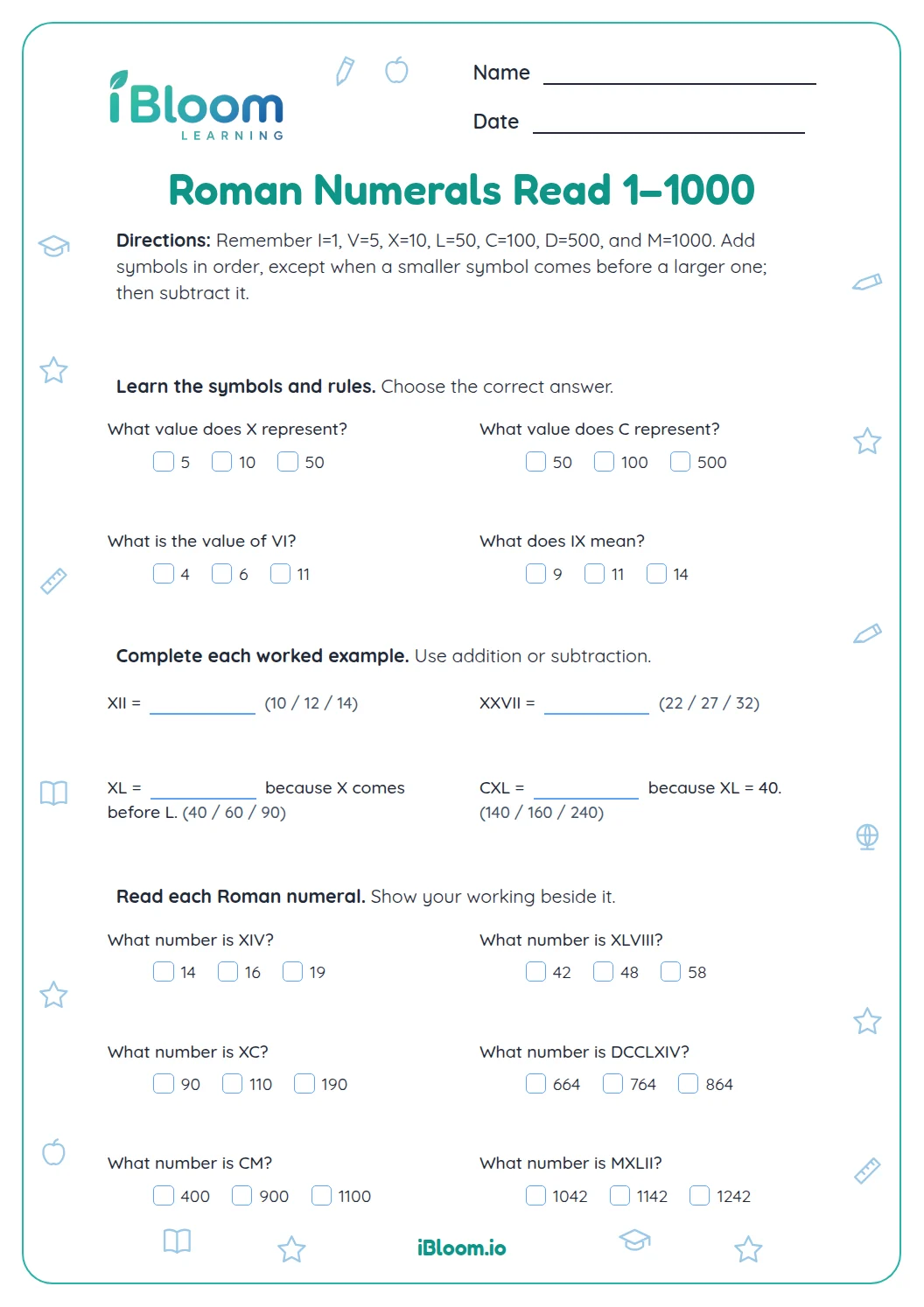
Read the symbols from left to right. When a smaller symbol comes before a larger one, subtract it; otherwise add it. Thus XIV is 10 + (5 − 1), or 14.
Part A asks students to interpret six numerals, including forms with subtractive pairs.
- 1XIV = 14: X is 10 and IV is 4.
How do you write a number in Roman numerals?
Break a number into hundreds, tens, and ones, then write each part with the conventional symbols. For example, 68 is 50 + 10 + 5 + 3, so it is LXVIII.
Part B converts values from 7 to 156, practicing subtractive forms such as XL and XC.
- 139 = XXXIX: 30 is XXX and 9 is IX.
How can you check a Roman numeral calculation?
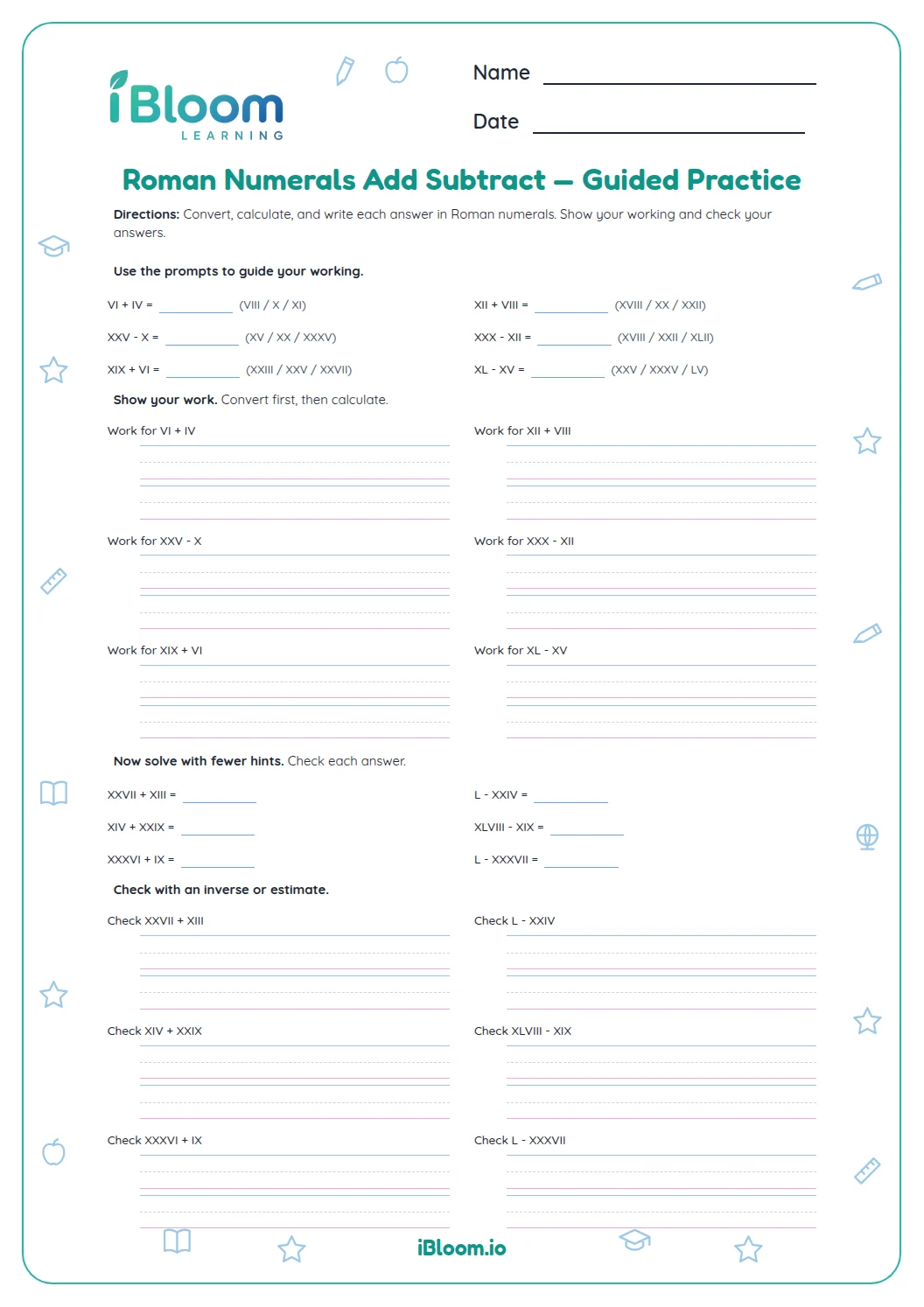
Translate both numerals to standard numbers and do the operation. Then write the result in standard Roman notation. Keep the calculation and the final notation as separate steps.
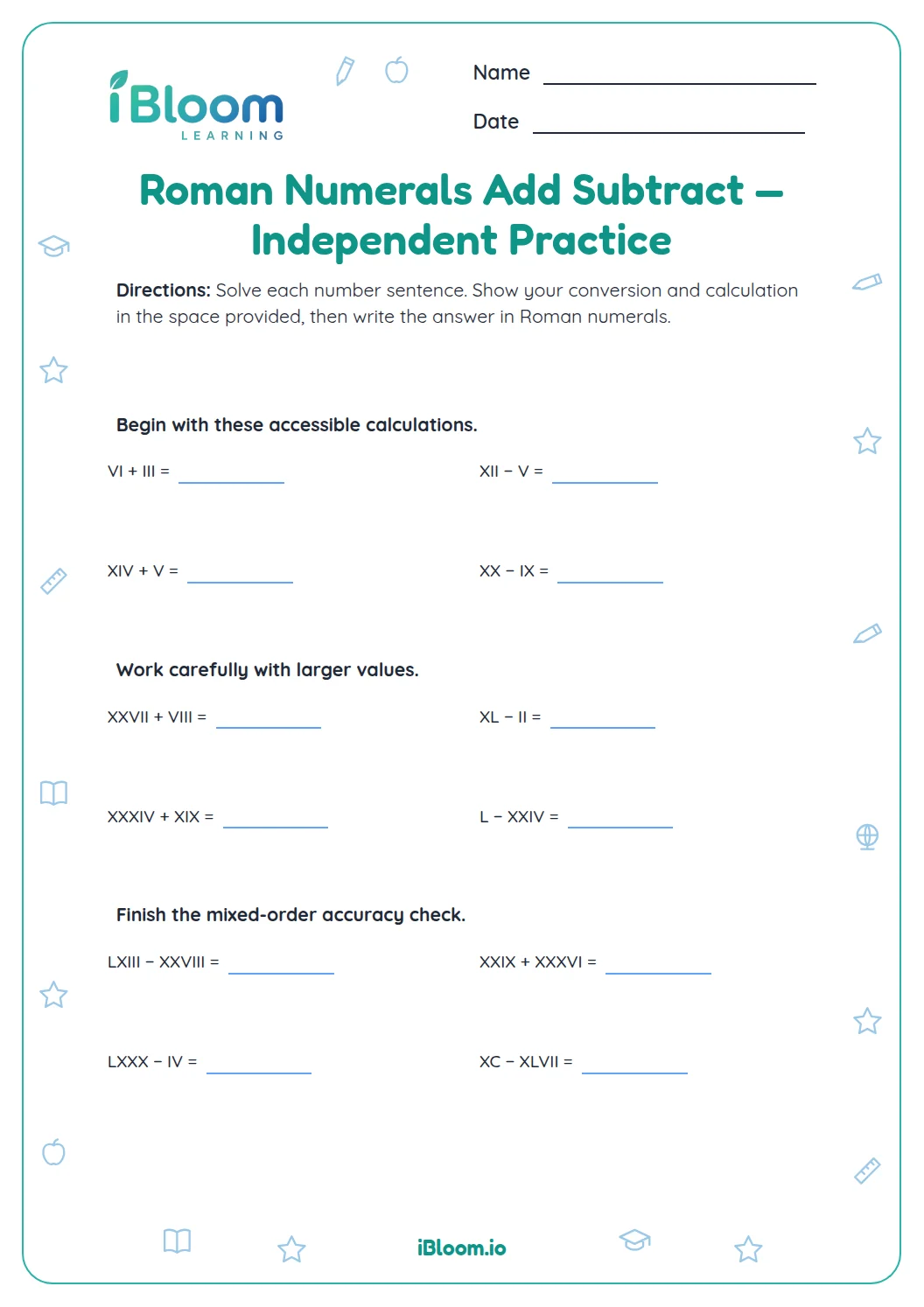
Part C mixes addition and subtraction and asks for Roman numeral answers.
- 1XXVII − VIII: 27 − 8 = 19, so the answer is XIX.
How to use this worksheet
- 1Read the one-line directions for each part before beginning.
- 2In Part A, say the symbol values aloud and combine them from left to right.
- 3In Part B, decompose each number into hundreds, tens and ones before writing symbols.
- 4For Part C, convert both sides to standard numbers, calculate, and convert the result back.
- 5Use the answer key to review any subtractive pair that was reversed.
Common mistakes and quick fixes
The mistake
Reading XIV as 16 by adding every symbol.
The fix
Notice that I comes before V, so IV means 4.
The mistake
Writing 9 as VIIII.
The fix
Use the standard subtractive form IX.
The mistake
Subtracting numeral symbols without converting first.
The fix
Find each numeral’s value, calculate, then rewrite the answer.
What to practice next
Make more practice
Questions parents and teachers ask
What does the Roman numeral IV mean?
IV means 4. The I comes before V, so it is subtracted from 5 instead of added. This same pattern appears in IX for 9, XL for 40 and XC for 90. On Part A, XIV combines X with IV to make 14.
How should a student solve the addition and subtraction items?
Convert each numeral to a standard number first. Do the arithmetic, then write that result using standard Roman numeral notation. For example, XXVII − VIII becomes 27 − 8, or 19, and 19 is written XIX. A final check is to translate the answer back into a standard number and compare.
Why use Roman numerals in a math worksheet?
Roman numerals provide practice reading a different number system and translating it into familiar whole numbers. The worksheet keeps the calculation manageable by making conversion the first step, then asks students to express each final answer in Roman numerals.
What does Part B practice?
Part B moves from standard numbers to Roman notation. The values include tens and hundreds as well as subtractive forms, so students must choose conventional forms such as XL for 40 and XC for 90 rather than repeat a symbol.
How can I check the answer key?
For a conversion item, translate the written answer back to a number. For an operation item, evaluate the Roman numerals as numbers, calculate, and check that the keyed numeral has the same value. Standard Roman notation makes the final form consistent.