


About this worksheet
This Grade 4 worksheet applies Roman numeral reading to familiar situations such as tickets, books, teams, and travel. Children translate the numerals, choose addition or subtraction from the story, calculate, and follow directions about whether to write the final answer as a number or Roman numeral. The 15 questions include one-step and two-step situations, with a separate answer key.
How do Roman numerals show a number?
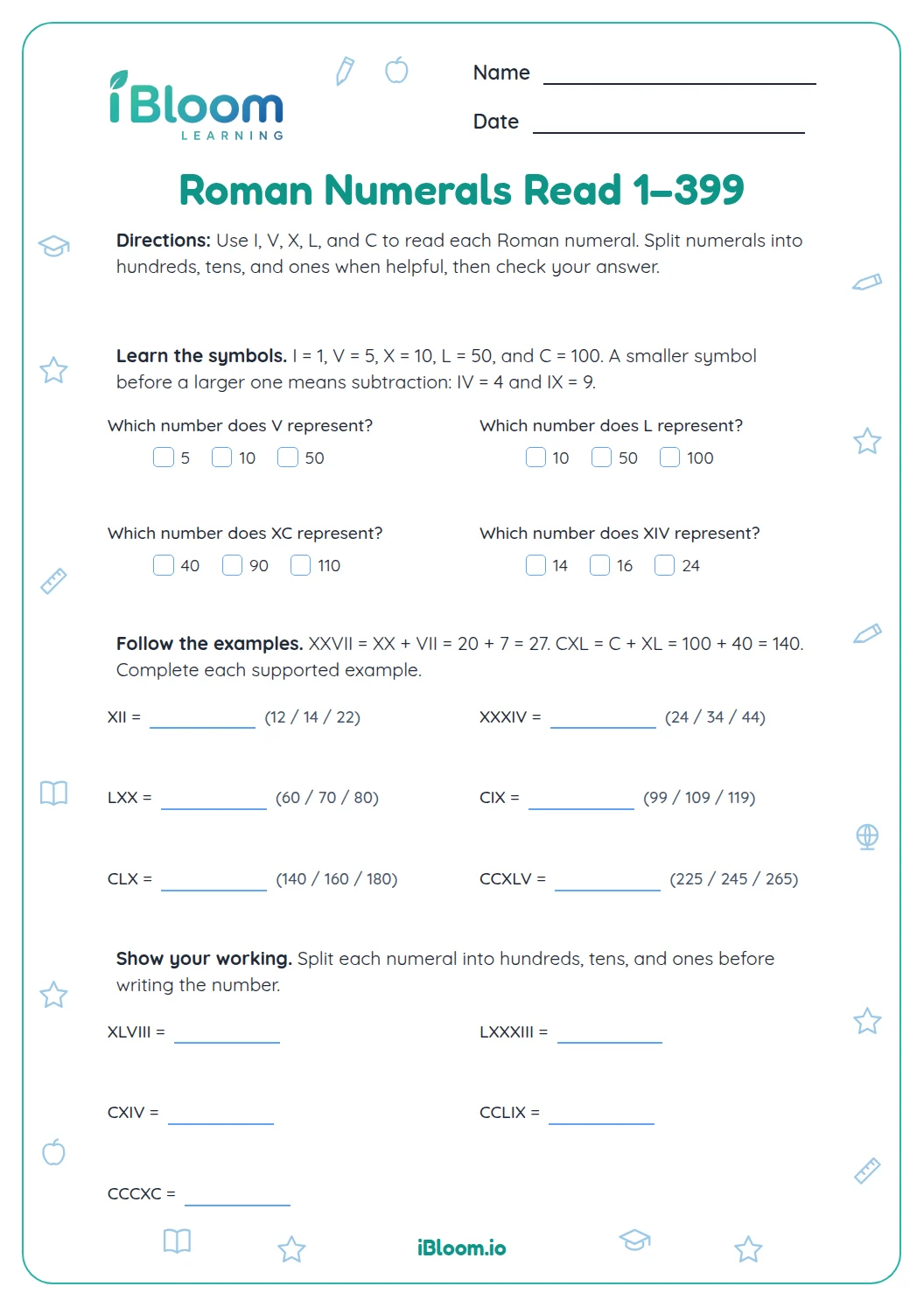
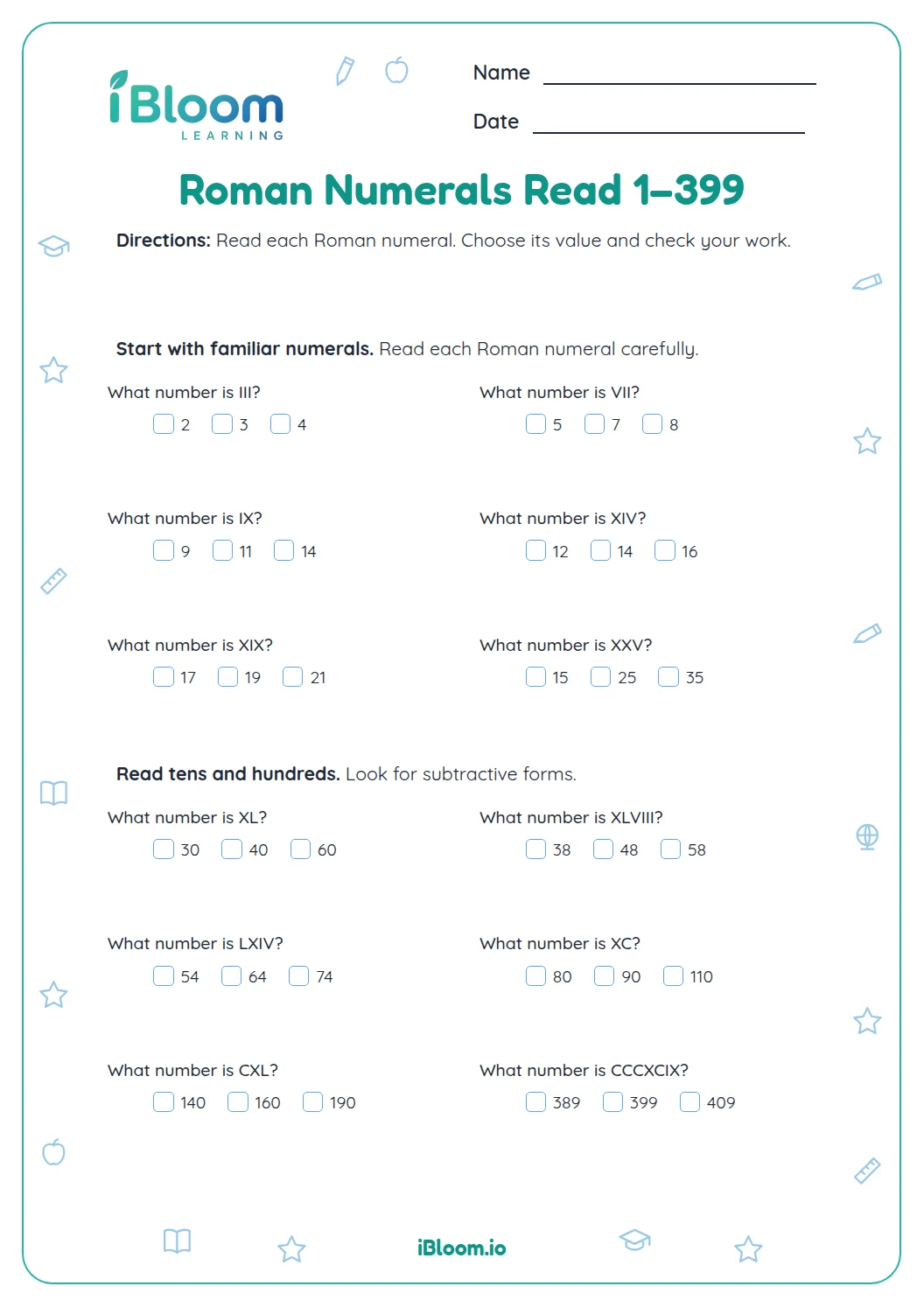
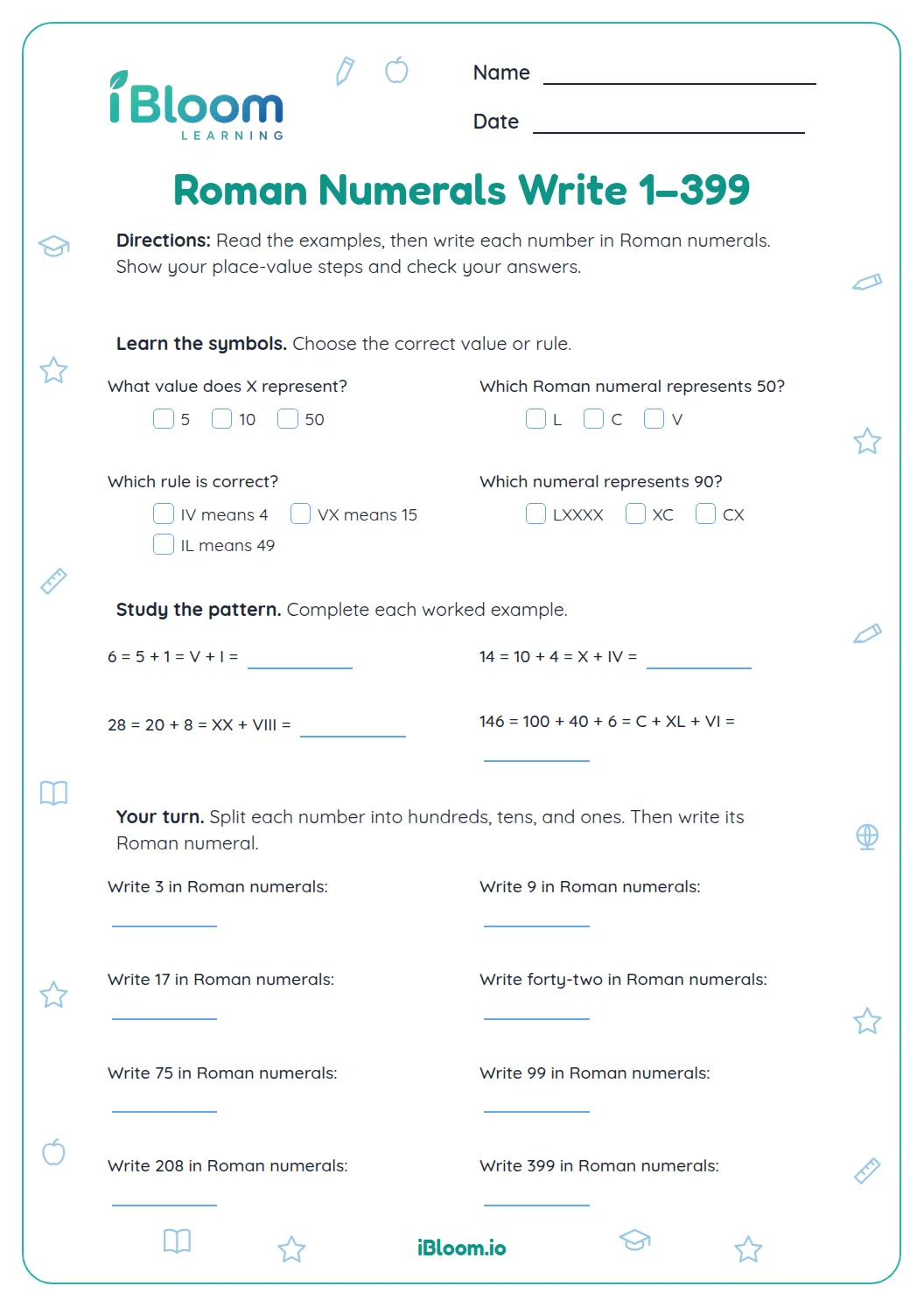
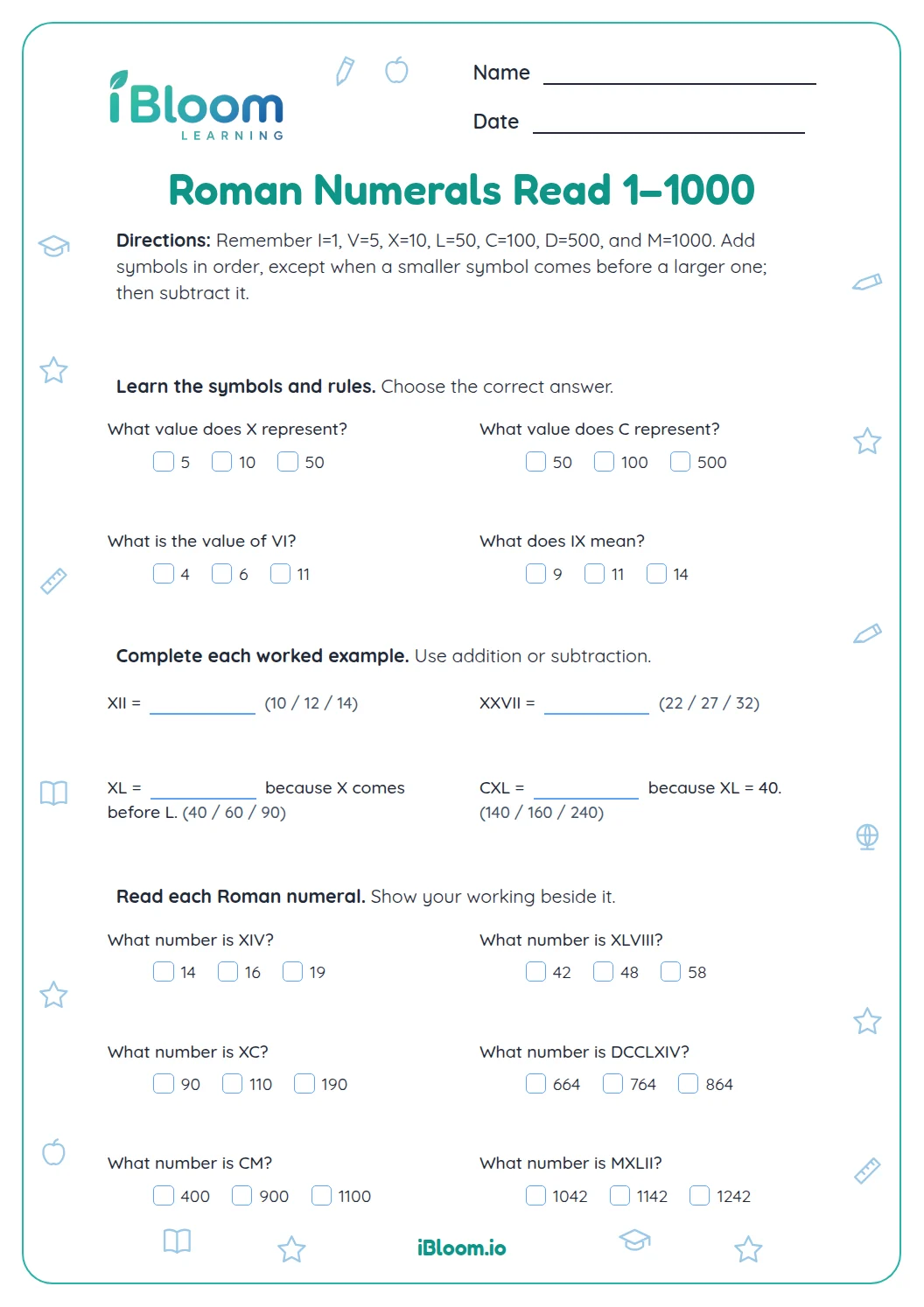
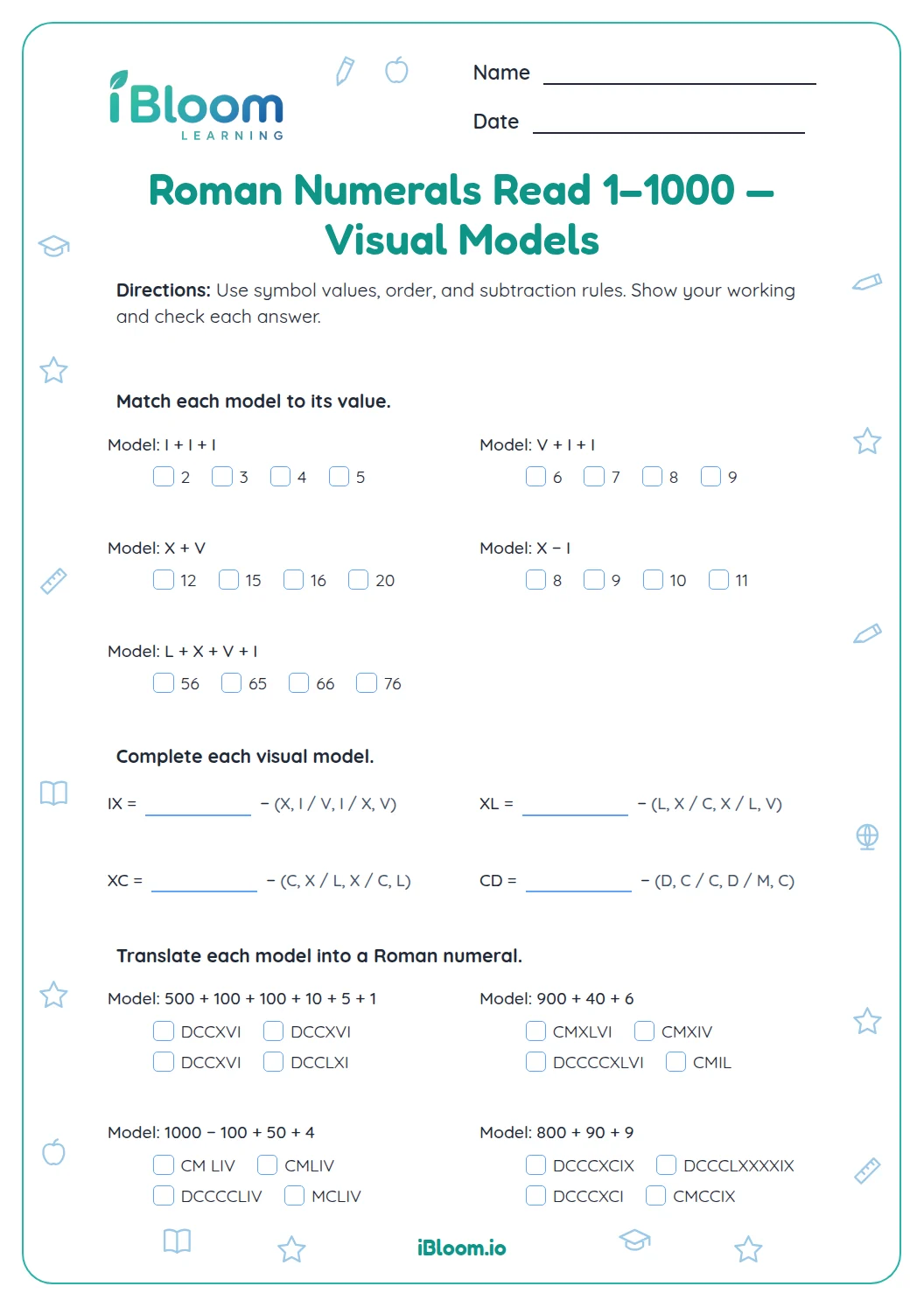
Symbols combine to show values. I is 1, V is 5, X is 10, L is 50, and C is 100. A smaller symbol before a larger one subtracts, as in IX = 9 and XL = 40.
How do you choose the operation in a story?
Look for what changes. “Then VII more” means add; “lends VI” or “has finished XIII” means subtract. Translate the numerals before doing the operation.
- 1XV = 15; VI = 6
- 215 − 6 = 9
- 3Answer: 9 paintings remain
When should the answer be a Roman numeral?
The prompt tells the answer format. Most items ask for a number; selected questions explicitly ask children to write the final result in Roman numerals.
How to use this worksheet
- 1Circle the Roman numerals in the story.
- 2Translate each numeral into a number.
- 3Underline words that show adding or subtracting.
- 4Calculate with the numbers.
- 5Check whether the prompt asks for a numeral or number.
- 6Review the answer key and retry missed conversions.
Common mistakes and quick fixes
The mistake
Subtracting whenever two numerals appear
The fix
Use the story action: “more” adds, while “left” or “remain” usually signals subtraction.
The mistake
Reading IX as XI
The fix
A smaller I before X means subtract one: IX is 9; XI is 11.
The mistake
Giving the right value in the wrong form
The fix
Reread the last sentence and write a Roman numeral only when requested.
What to practice next
Make more practice
Questions parents and teachers ask
How should a child solve a Roman numeral story?
Translate the Roman numerals into numbers first, then use the story to decide whether to add or subtract. Convert the result back to Roman numerals only when the prompt asks for that form. For example, translate XV and VI before finding how many paintings remain.
What is XII?
X is 10 and II is 2, so XII equals 12. The first question asks children to read XII as a ticket price. Group familiar symbols and add their values when no smaller-before-larger subtraction pair appears; then use the translated value as the story requires.
How many questions are on the worksheet?
There are 15 story problems. They practice addition and subtraction with Roman numerals, including several items that ask for the final answer in Roman numeral form. The separate answer key lists all 15 results and preserves the answer format requested in each prompt.
Which questions ask for Roman numeral answers?
Questions 9, 13, and 15 explicitly ask for a Roman numeral result. The other items ask for the answer as a number, so children should follow the requested format in each prompt. Checking the answer form is part of solving the story.
How can a child check a numeral before calculating?
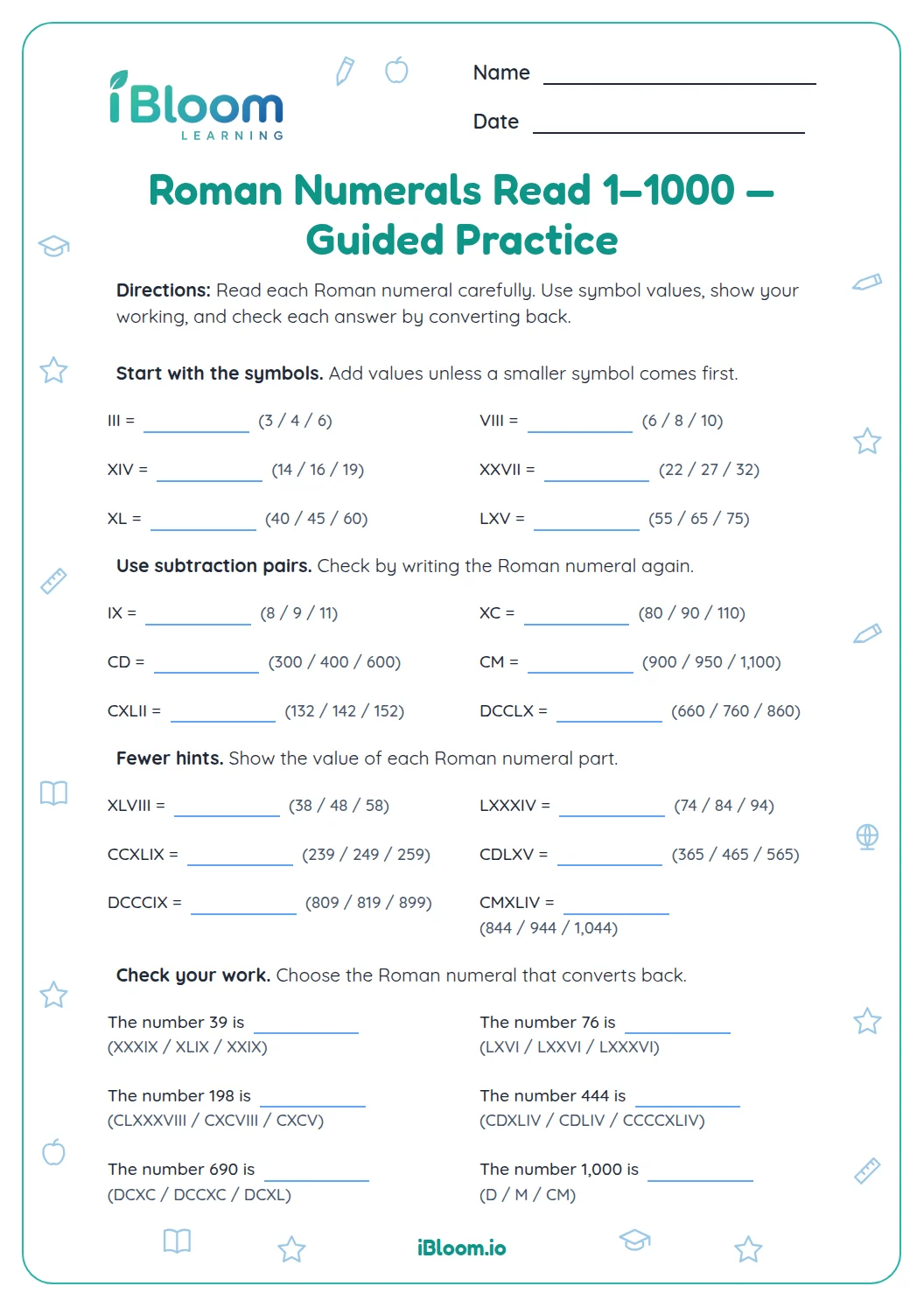
Break the numeral into familiar symbols and watch for a smaller symbol before a larger one. For example, IX means 9 and XL means 40. Translate the full numeral before choosing an operation so the calculation starts with the right values.
Is an answer key included?
Yes. The separate printable key gives answers to all 15 story problems, including the questions that request Roman numeral form. Children can compare both their calculation and the requested answer format with the key, then revisit the story if they need to check the operation.