

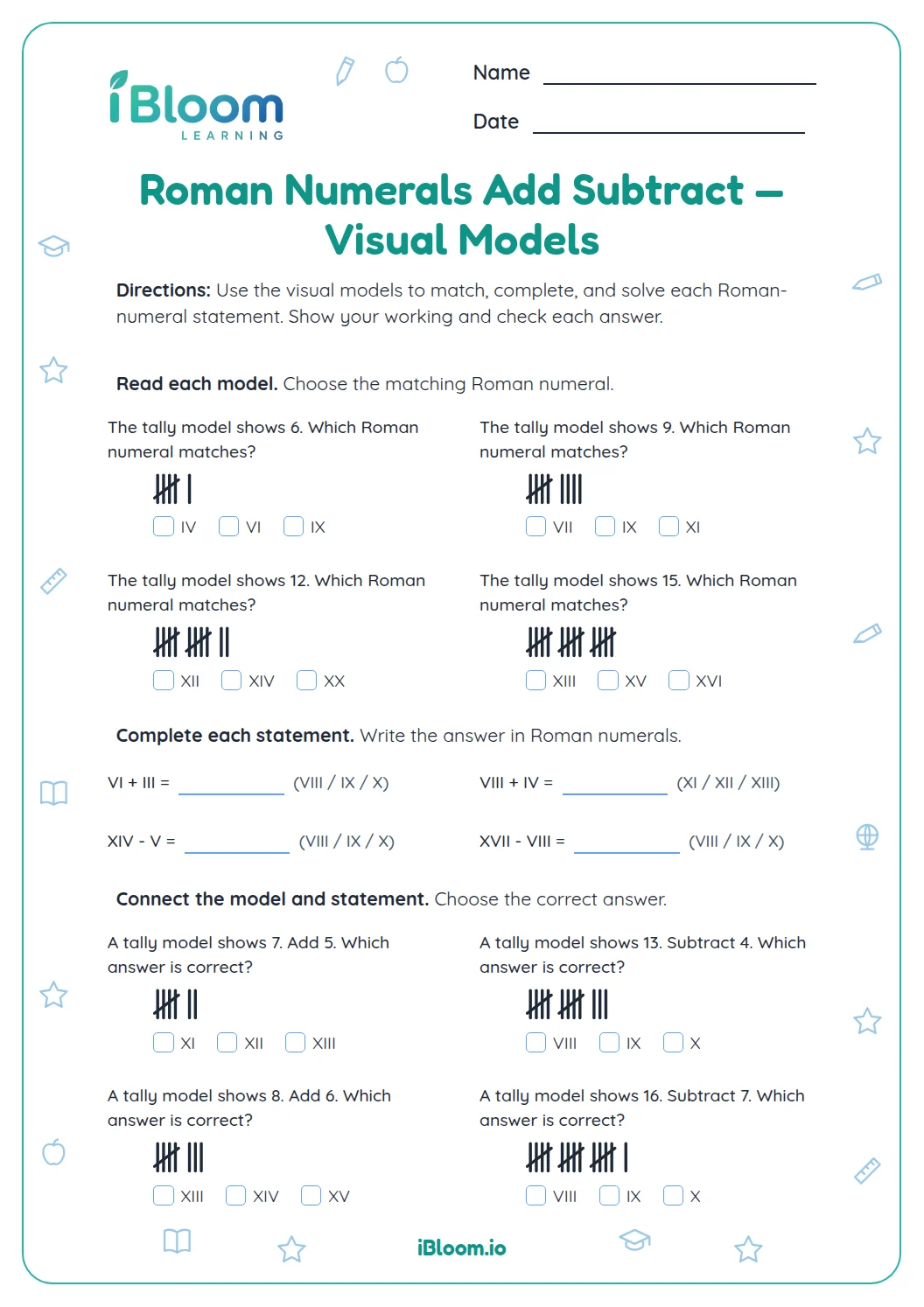
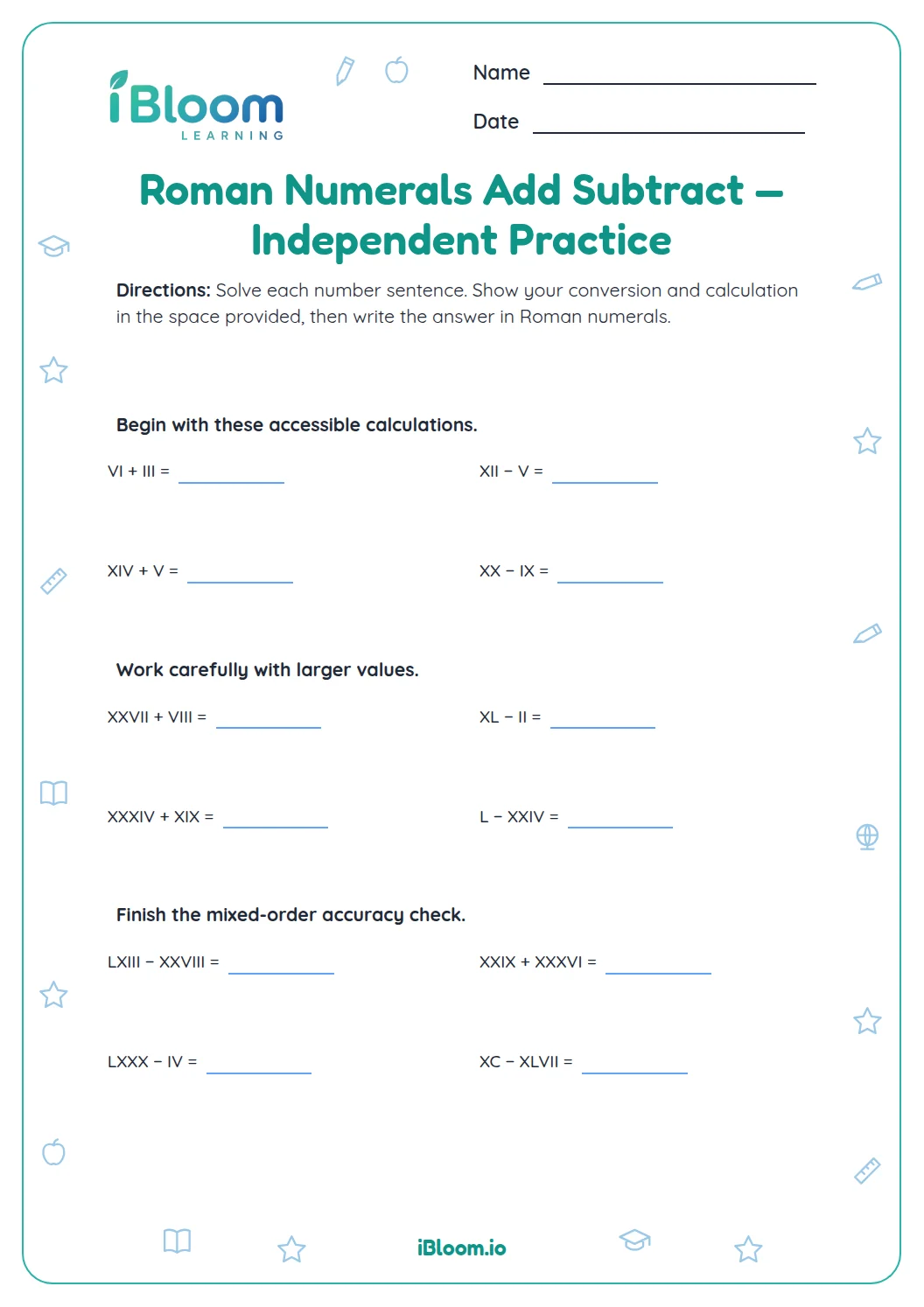
About this worksheet
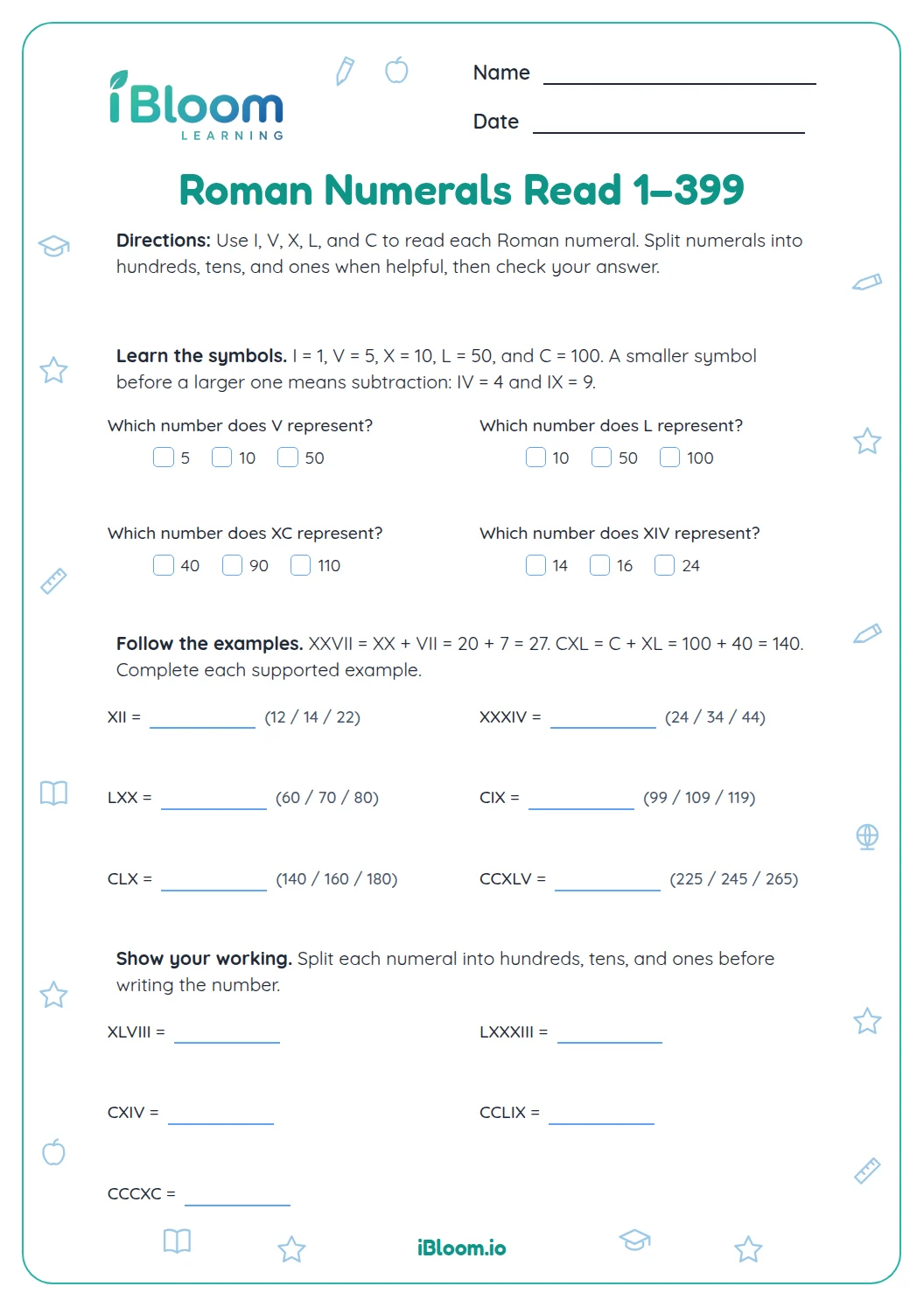
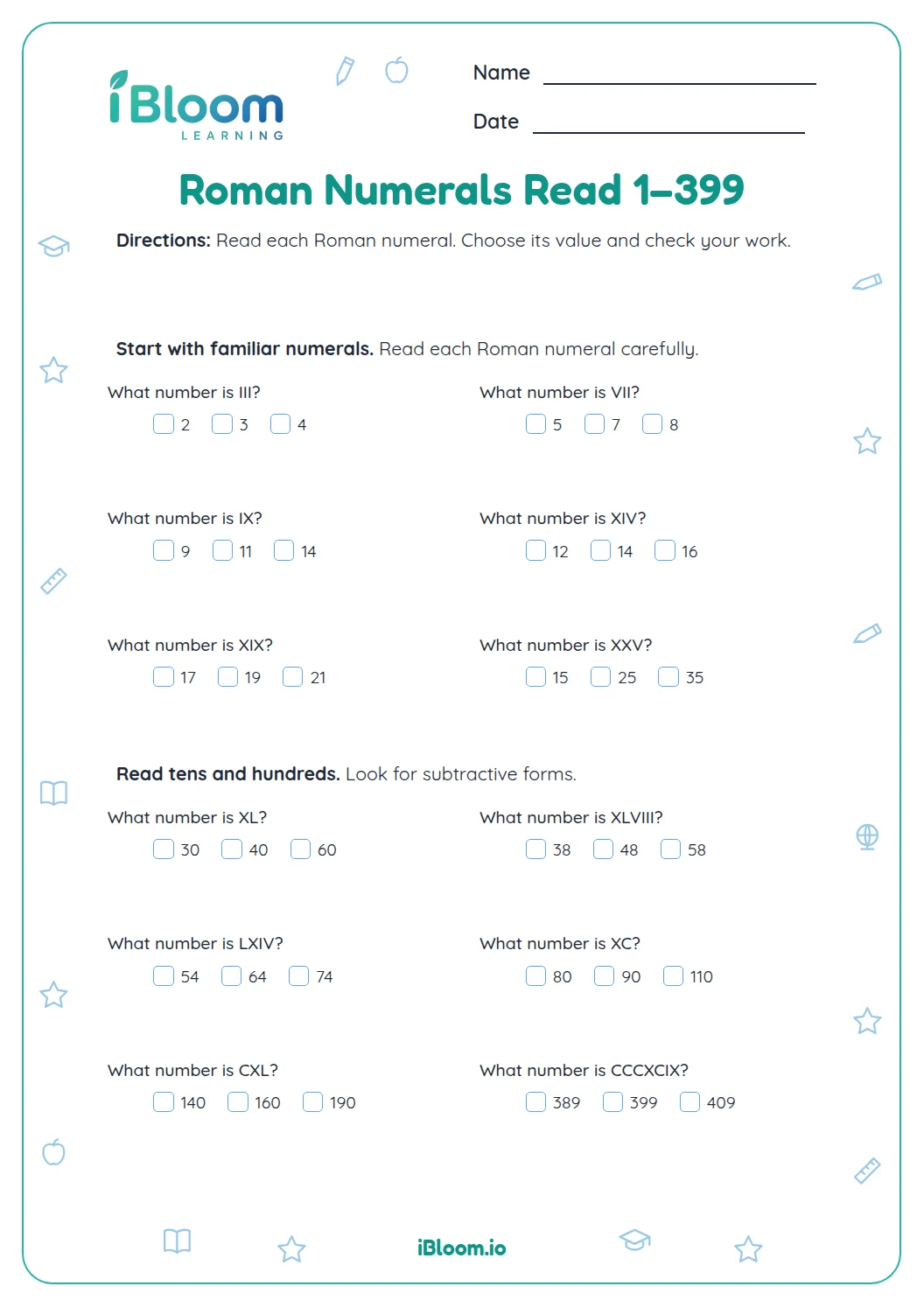
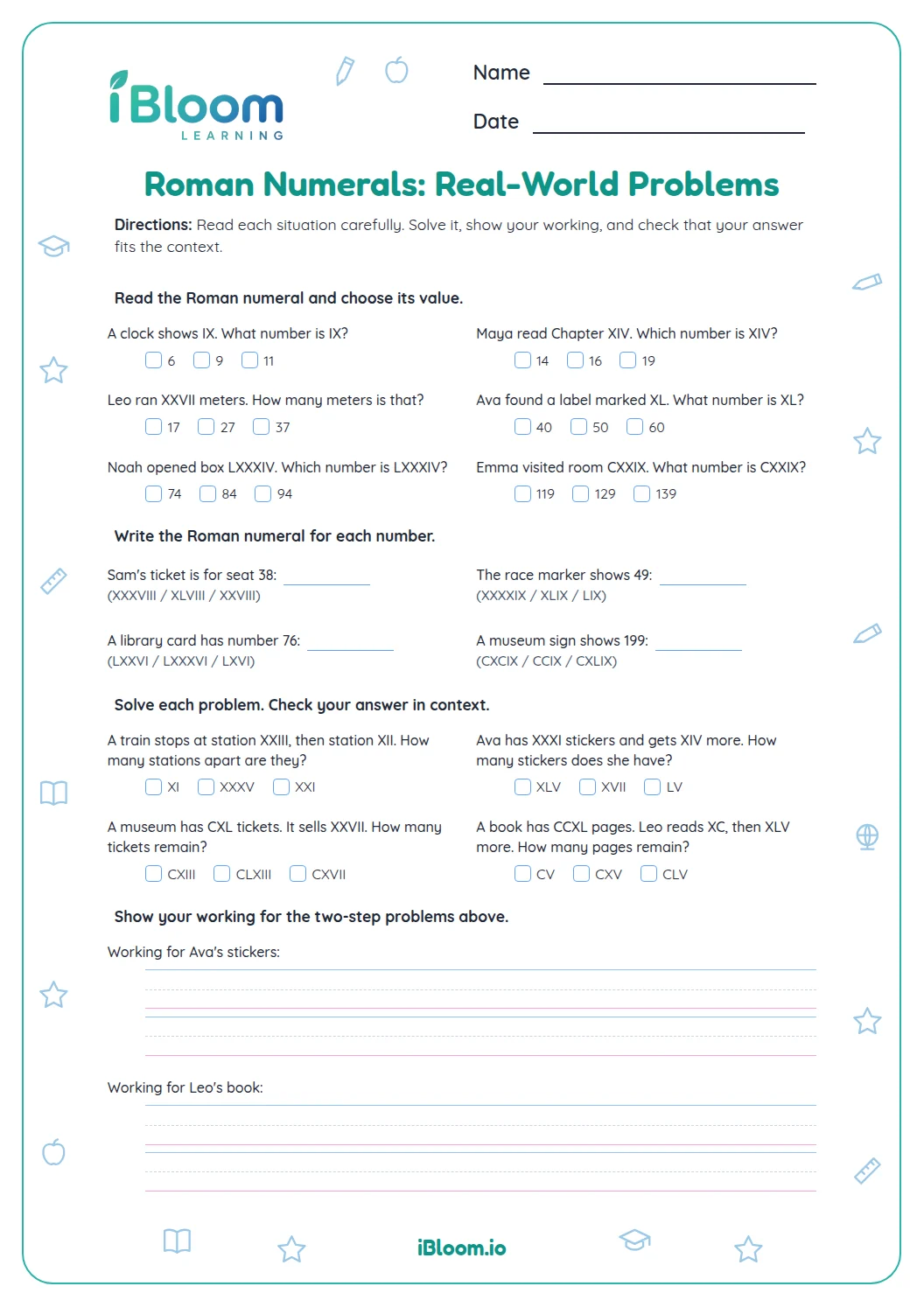
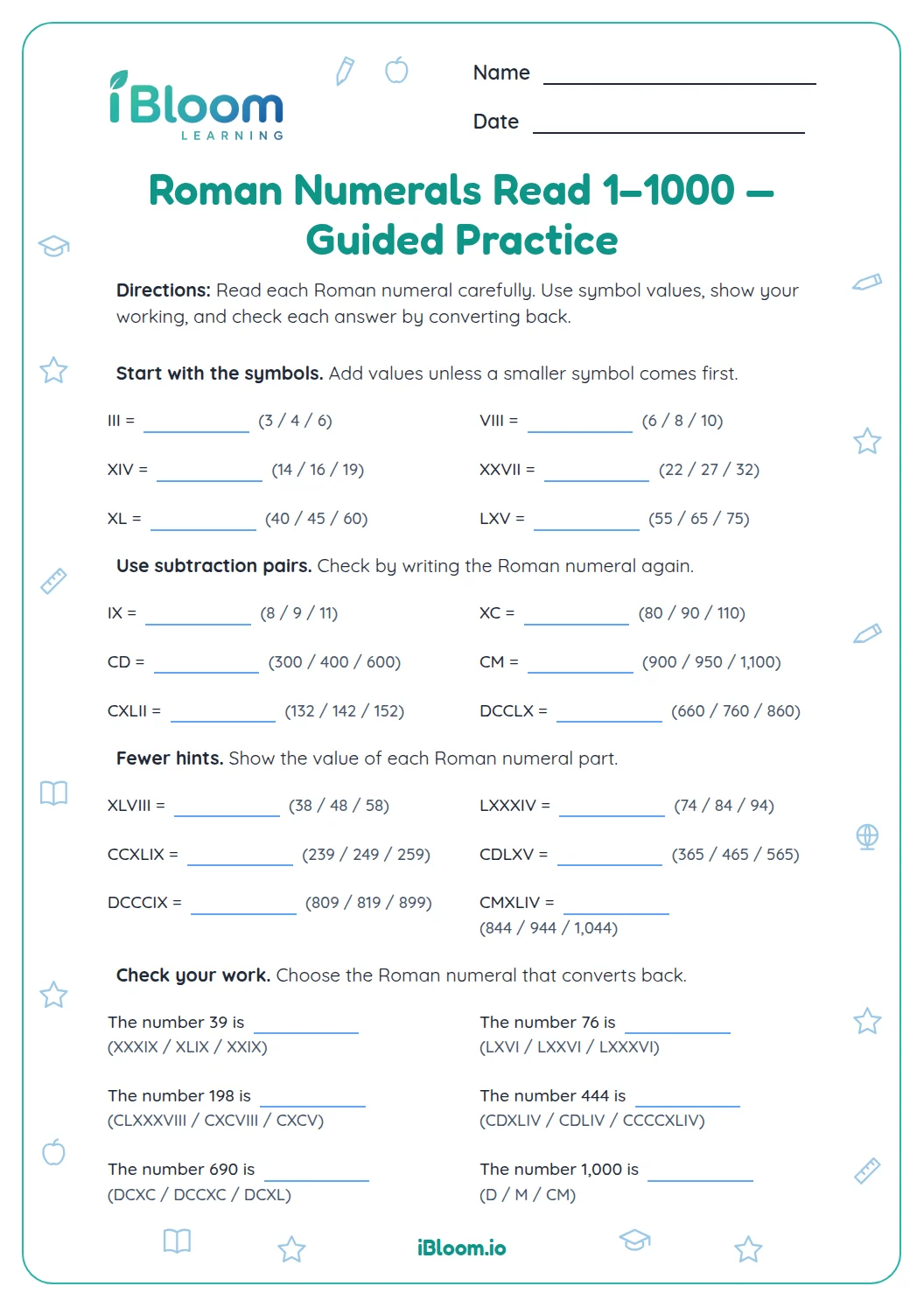
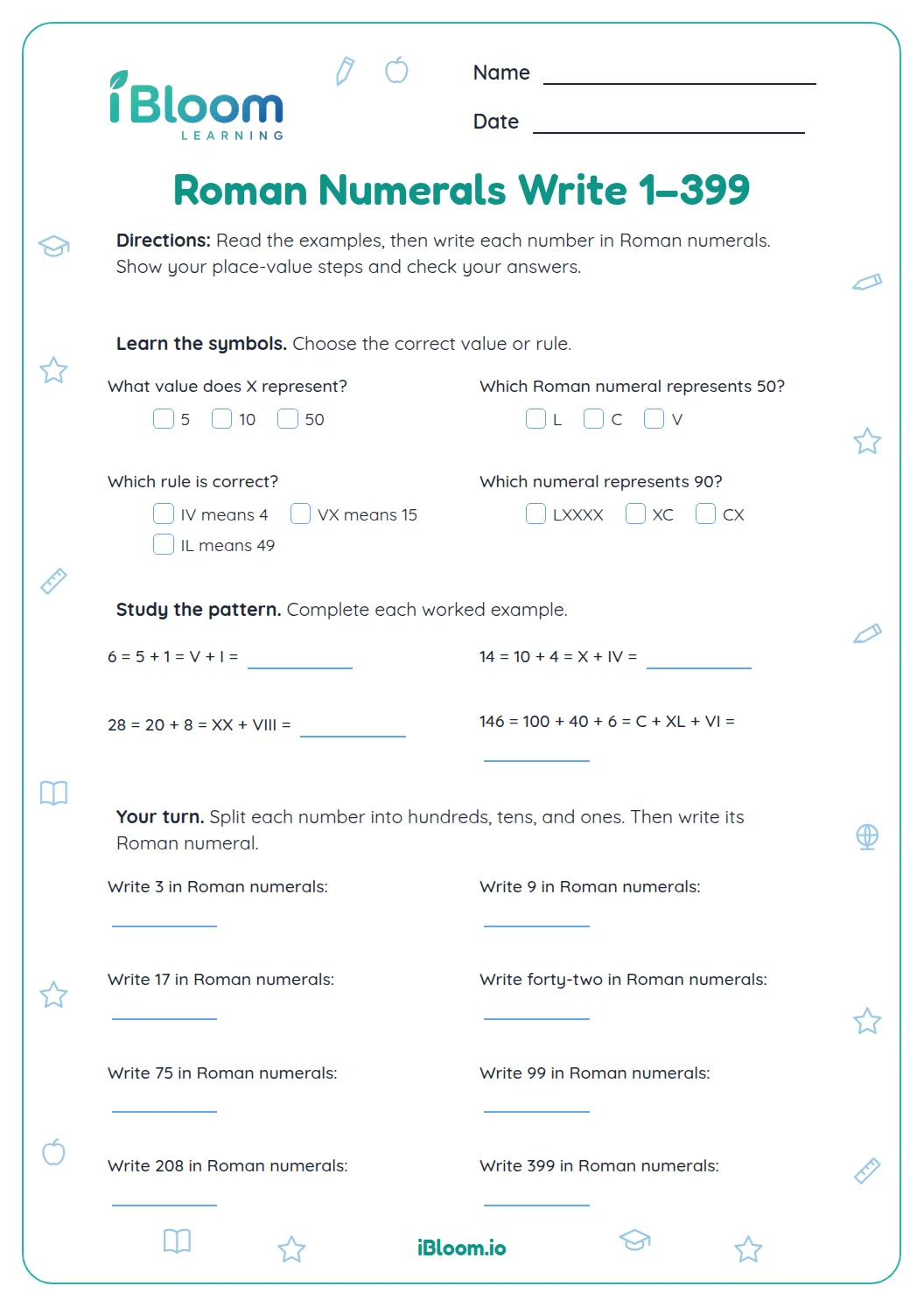
This Grade 4 worksheet gives students 16 guided questions using Roman numerals from 1 through 399. Students read numerals as numbers, build numerals from values across the range, and identify subtractive pairs such as XL and XC. The separate answer key shows the conversion for every item.
How do you read Roman numerals?
Group symbols by hundreds, tens, and ones, then check for a smaller symbol before a larger one. Question 5 uses CXLIX: C is 100, XL is 40, and IX is 9, totaling 149.
- 1CXLIX = C + XL + IX
- 2100 + 40 + 9
- 3CXLIX = 149
How do you build a Roman numeral?
Split the number into hundreds, tens, and ones, then combine the matching symbol groups. The questions include values from 14 to 399.
What happens in a subtractive pair?
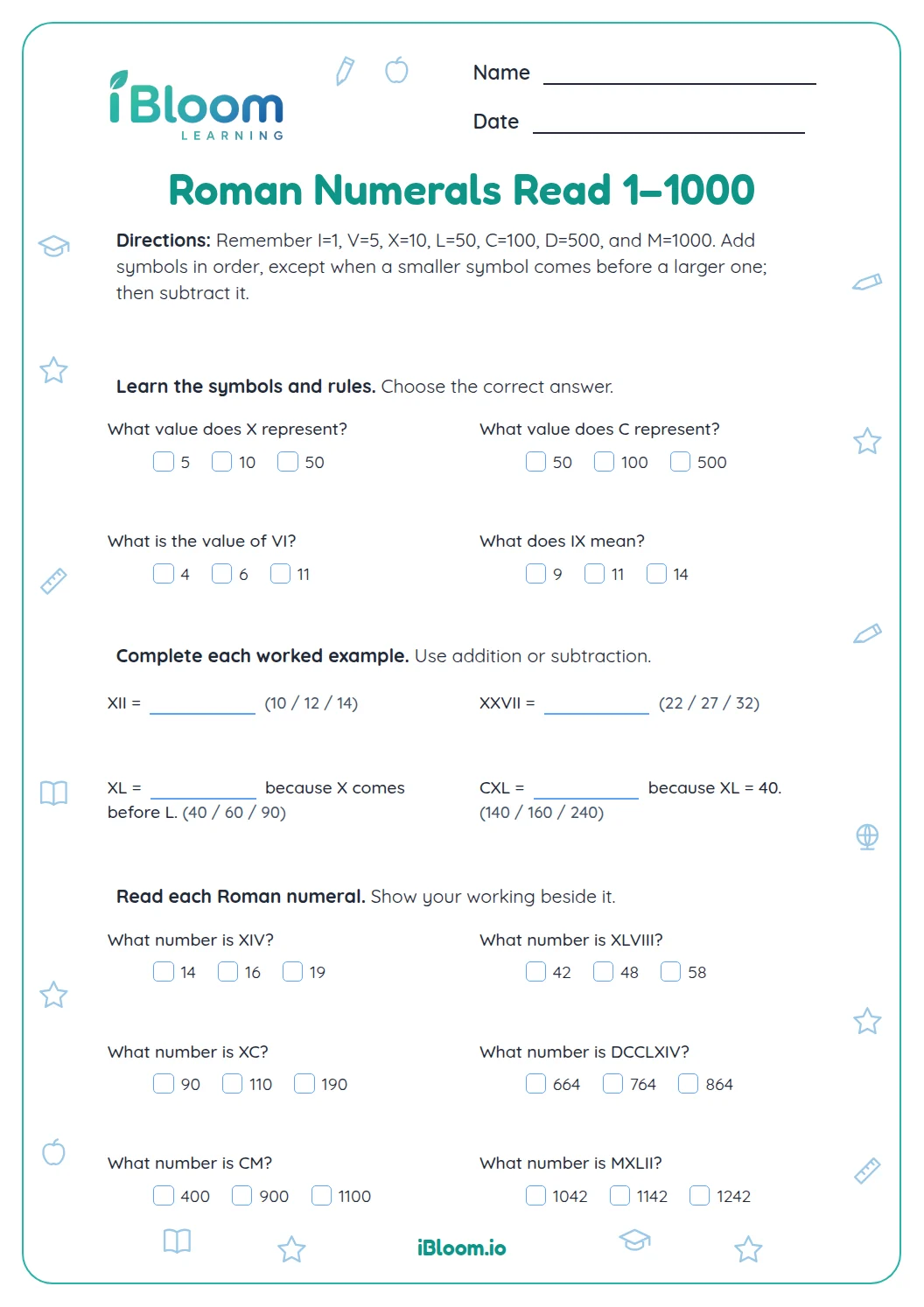
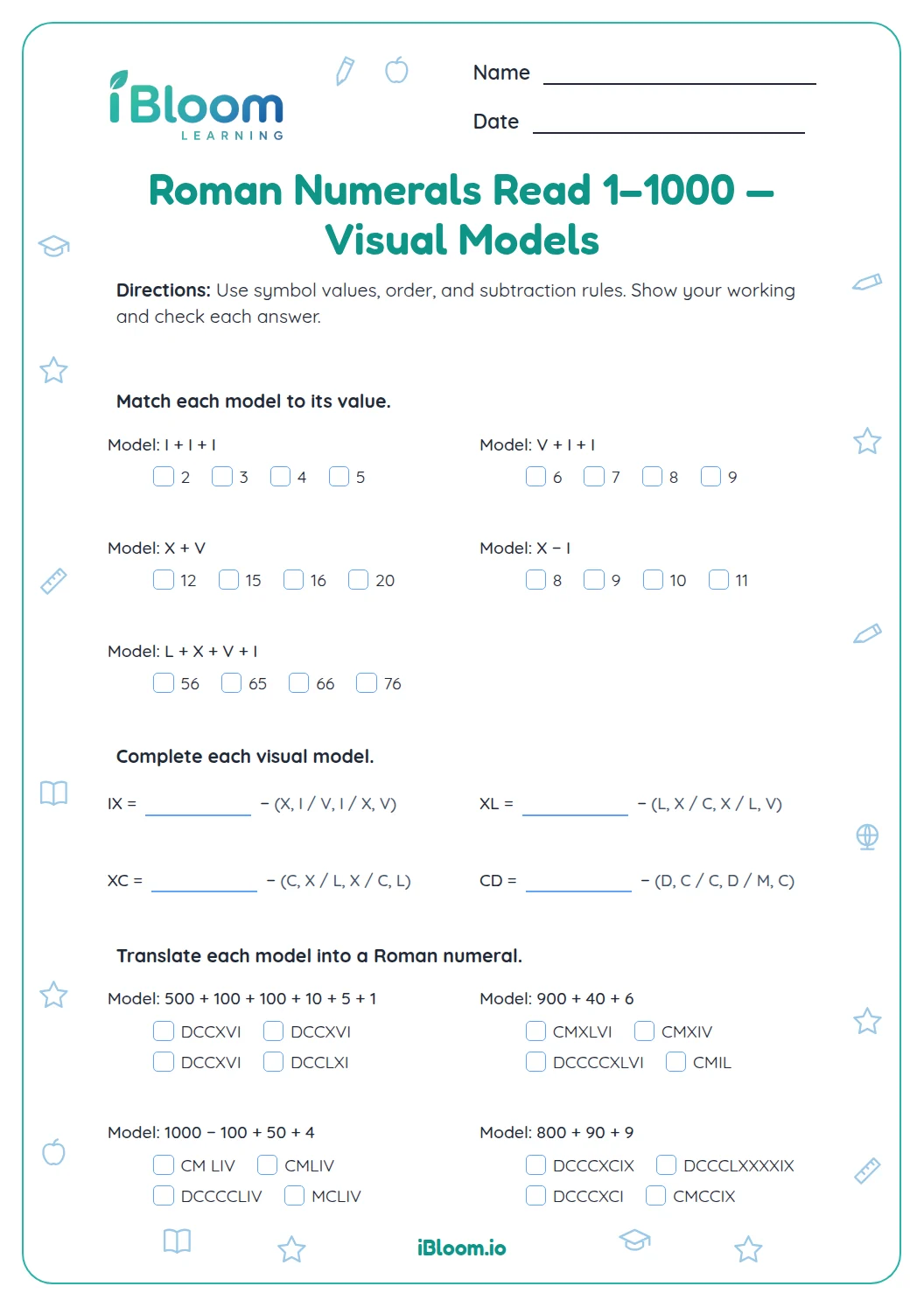
When a smaller symbol comes before a larger one in a standard pair, subtract its value. XL is 50 − 10 = 40, and XC is 100 − 10 = 90.
How to use this worksheet
- 1Read the section heading to see which direction to convert.
- 2Mark any subtractive pair before adding the other symbols.
- 3For a number, split it into hundreds, tens, and ones.
- 4Write the symbols in order and check the total.
- 5Use the answer key to review any pair that changed the value.
Common mistakes and quick fixes
The mistake
Reading IV as 6 because V is larger.
The fix
Subtract the I that comes before V: 5 − 1 = 4.
The mistake
Writing 40 as XXXX.
The fix
Use the subtractive pair XL for 40.
The mistake
Forgetting to regroup hundreds, tens, and ones.
The fix
Convert each place-value part separately, then join the symbols.
What to practice next
Questions parents and teachers ask
How do subtractive Roman numeral pairs work?
When a smaller symbol comes before a larger one in a standard pair, subtract the smaller value. IV is 5 − 1 = 4, XL is 50 − 10 = 40, and XC is 100 − 10 = 90. The questions include examples from the lower, middle, and upper portions of the stated range.
How do I read a longer Roman numeral?
Break it into hundreds, tens, and ones, while checking subtractive pairs. For example, CCLXXVI is CC (200), LXX (70), and VI (6), giving 276. The questions include examples from the lower, middle, and upper portions of the stated range.
How do I write 399 in Roman numerals?
Split 399 into 300 + 90 + 9. Write those parts as CCC, XC, and IX, then combine them: CCCXCIX. One worksheet item uses this upper-end value. The questions include examples from the lower, middle, and upper portions of the stated range.
What range does the worksheet cover?
The questions use values from 1 through 399, with small, middle, and large examples. They include reading numerals, writing numerals, and recognizing common subtractive pairs. The questions include examples from the lower, middle, and upper portions of the stated range.
How many questions and pages are included?
There are 16 questions in three parts: seven read conversions, seven write conversions, and two pair checks. The worksheet and separate answer key each fit two pages. The questions include examples from the lower, middle, and upper portions of the stated range.