

About this worksheet
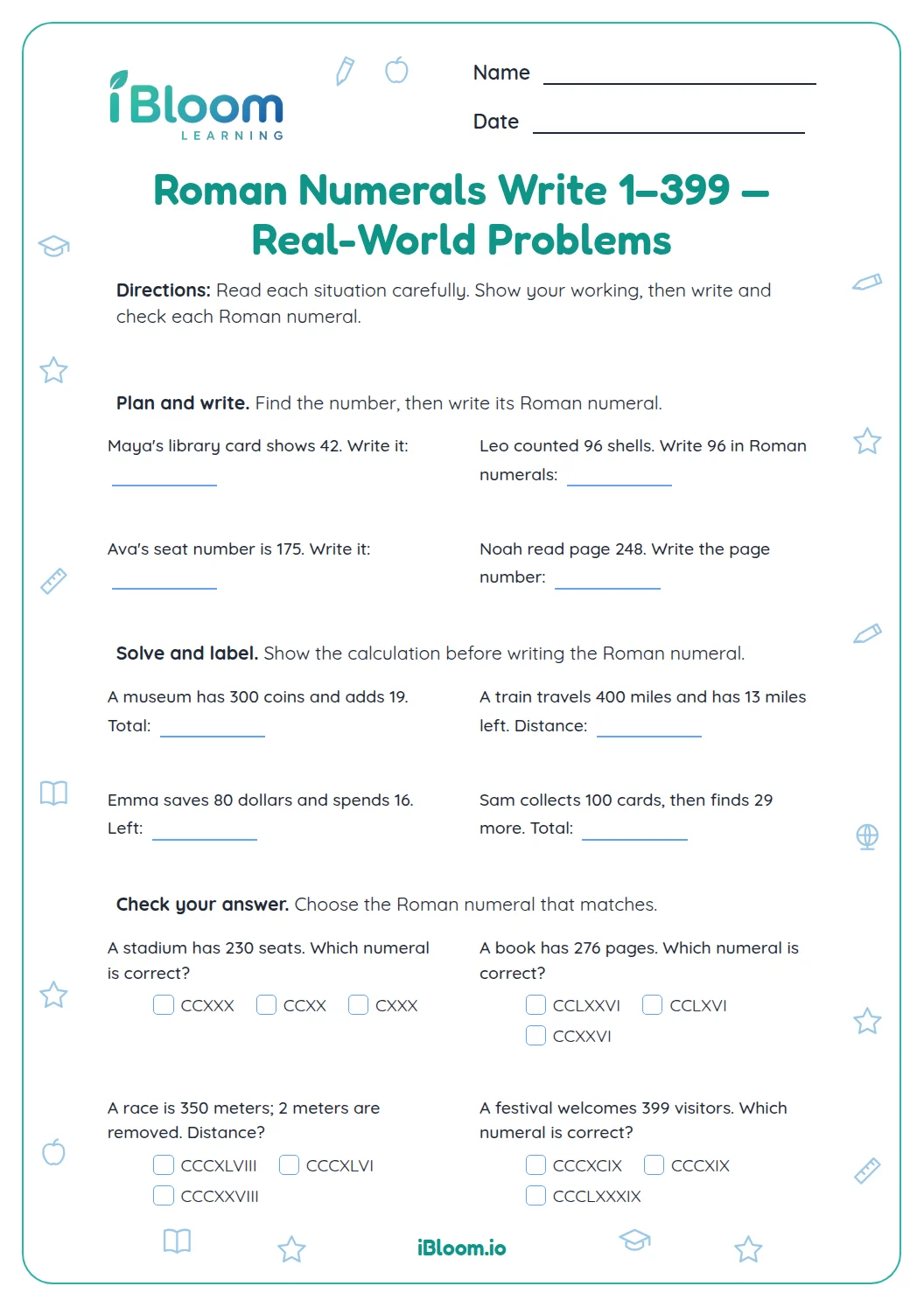
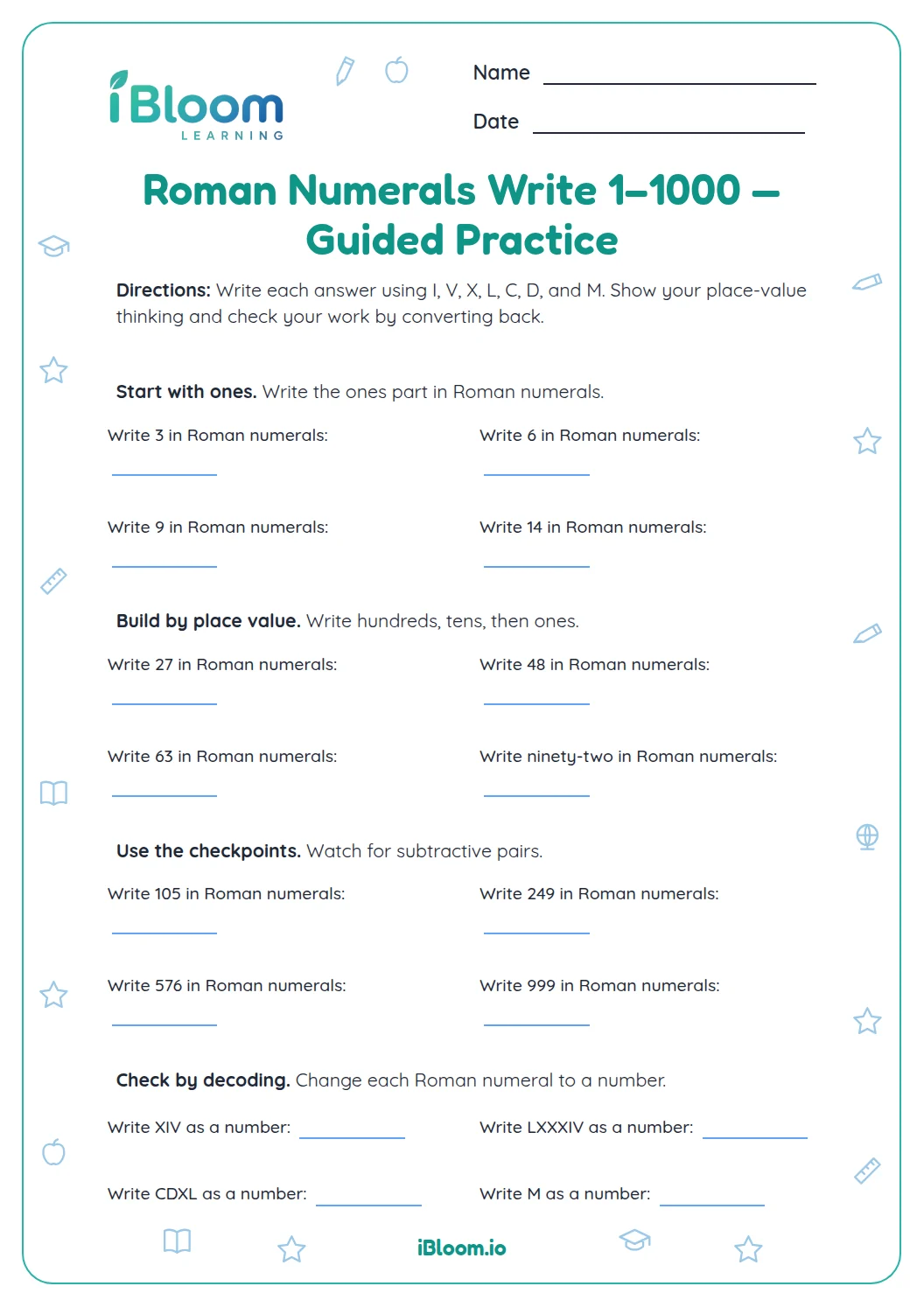
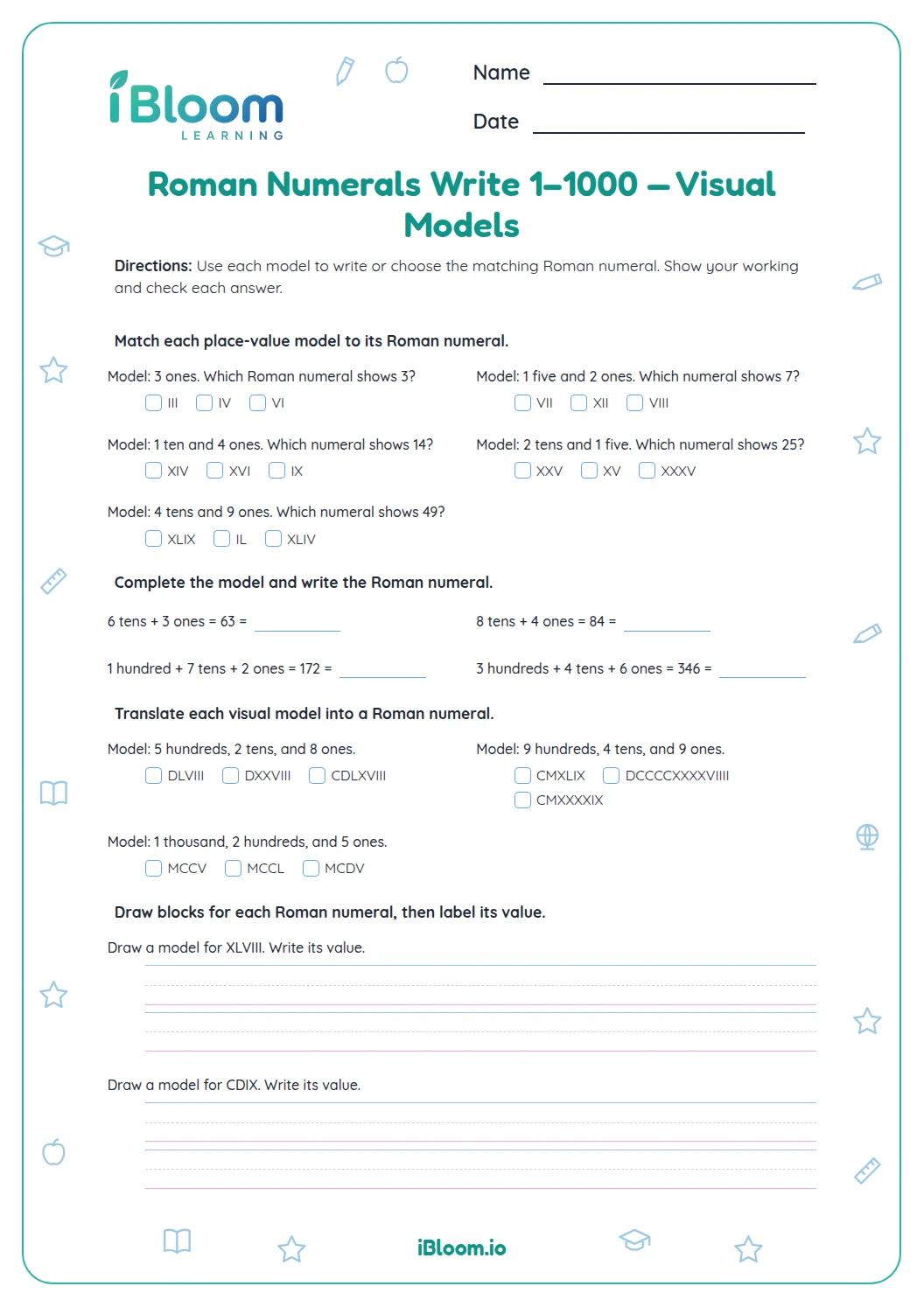
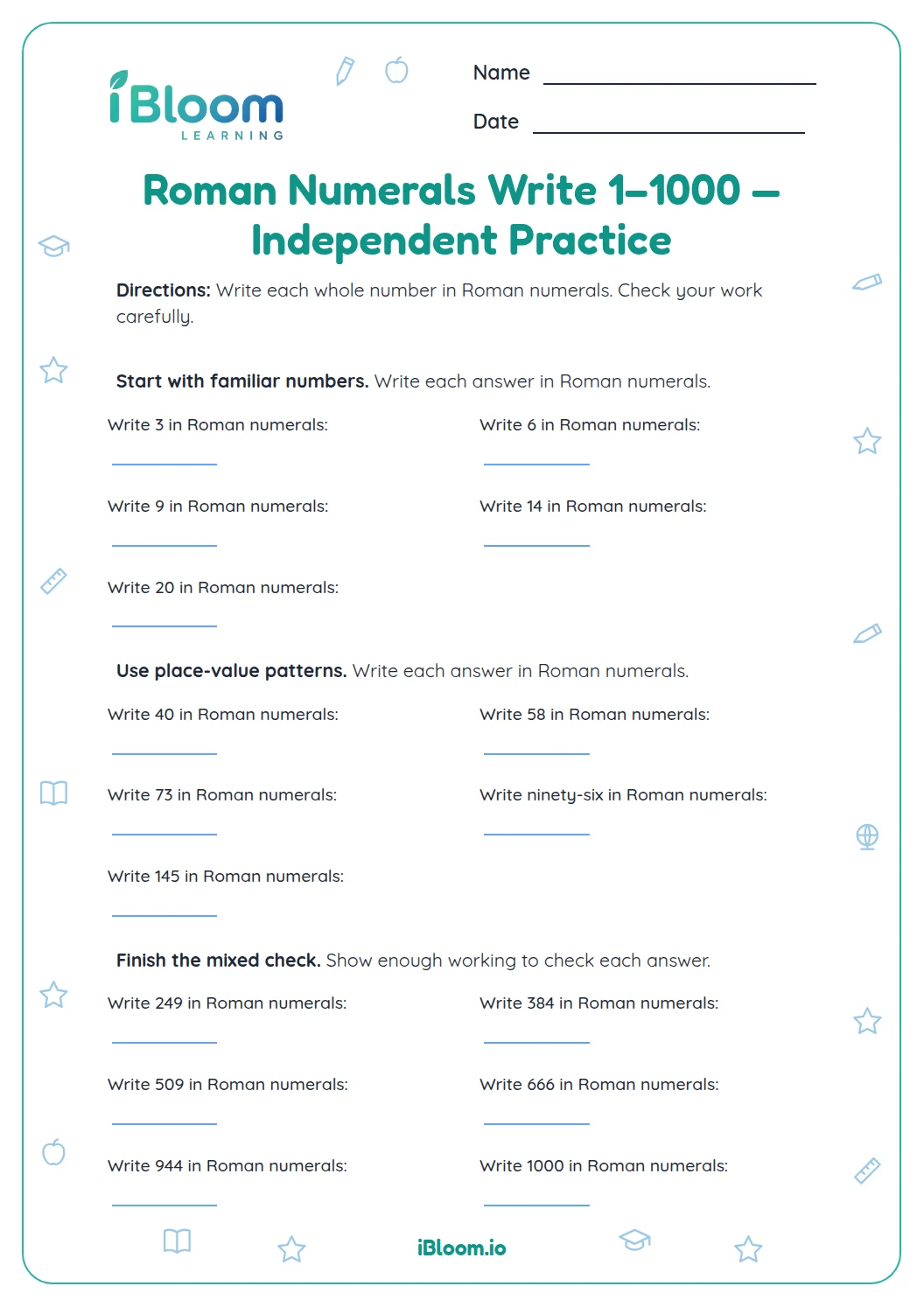
This Grade 4 worksheet practices writing Roman numerals throughout the full 1–399 range. Eight base-ten models show hundreds, tens, and ones; six more prompts ask students to convert directly. Values range from 1 and 4 through middle values to 246, 275, and 399. A separate answer key is included.
What do the blocks represent?
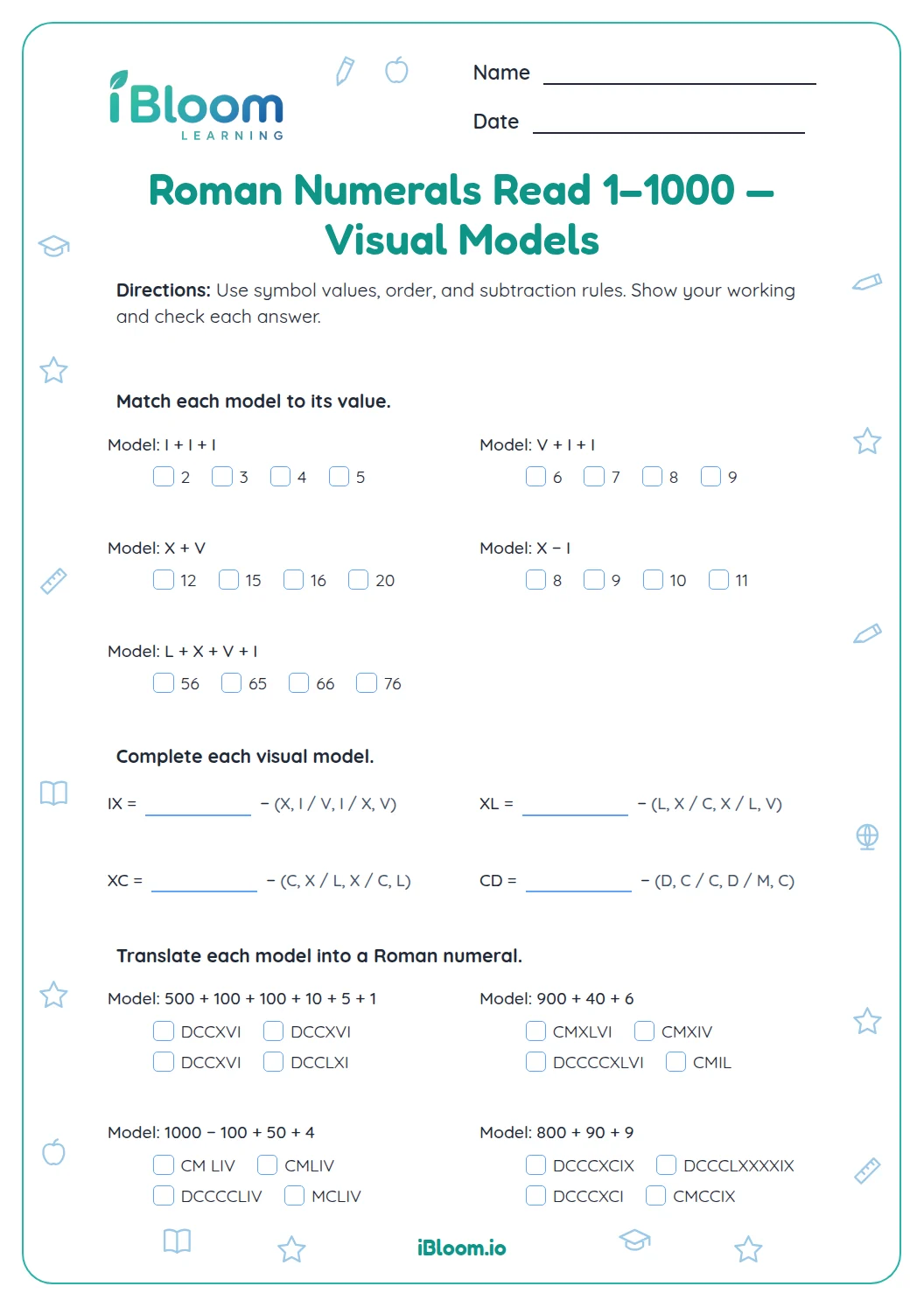
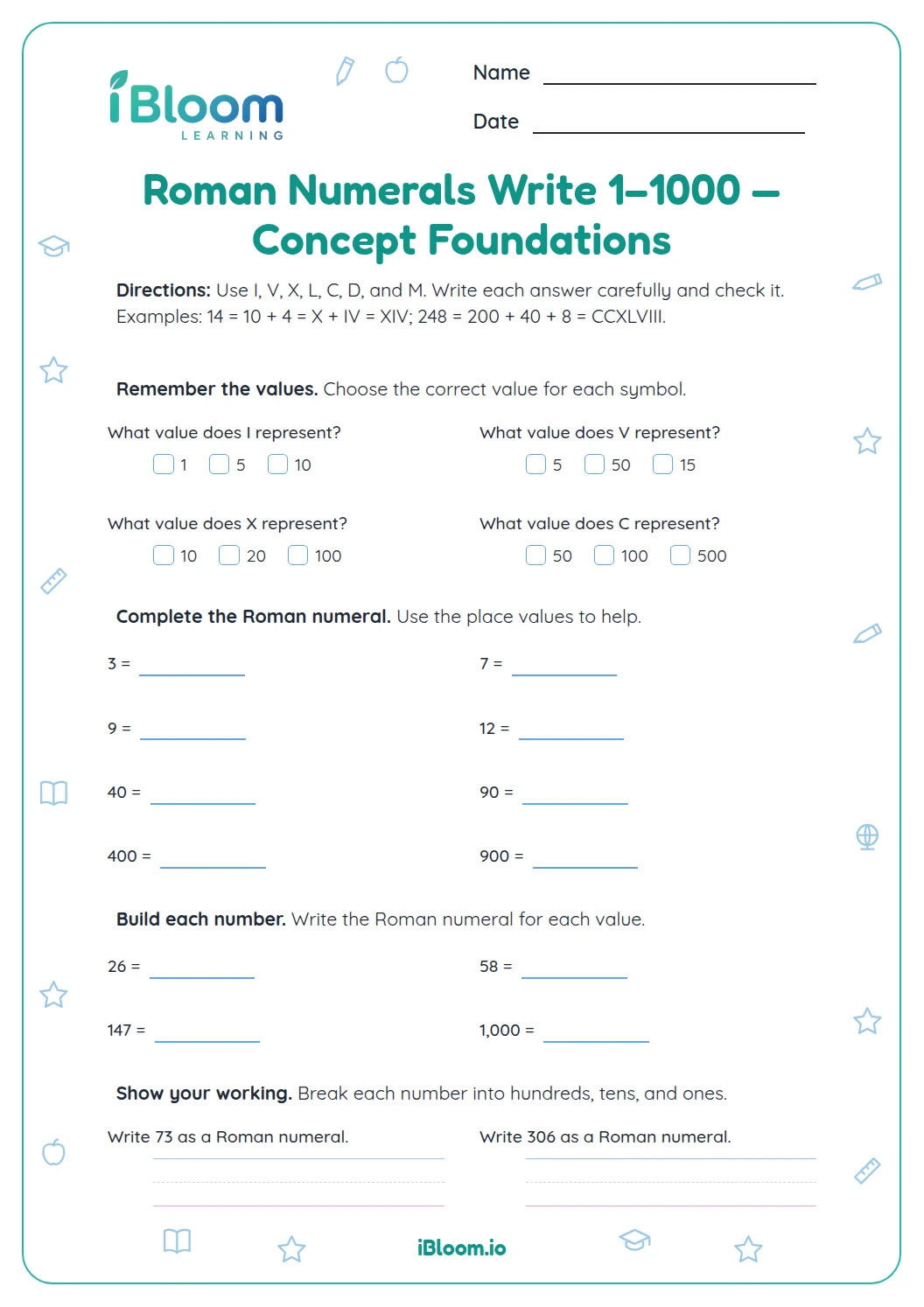
Read the blocks by place: hundreds, tens, then ones. Convert each group to Roman symbols and write the groups together. For 24, two tens are XX and four ones are IV, so 24 is XXIV.
- 124 = 20 + 4
- 220 = XX; 4 = IV
- 324 = XXIV
When does a smaller symbol come first?
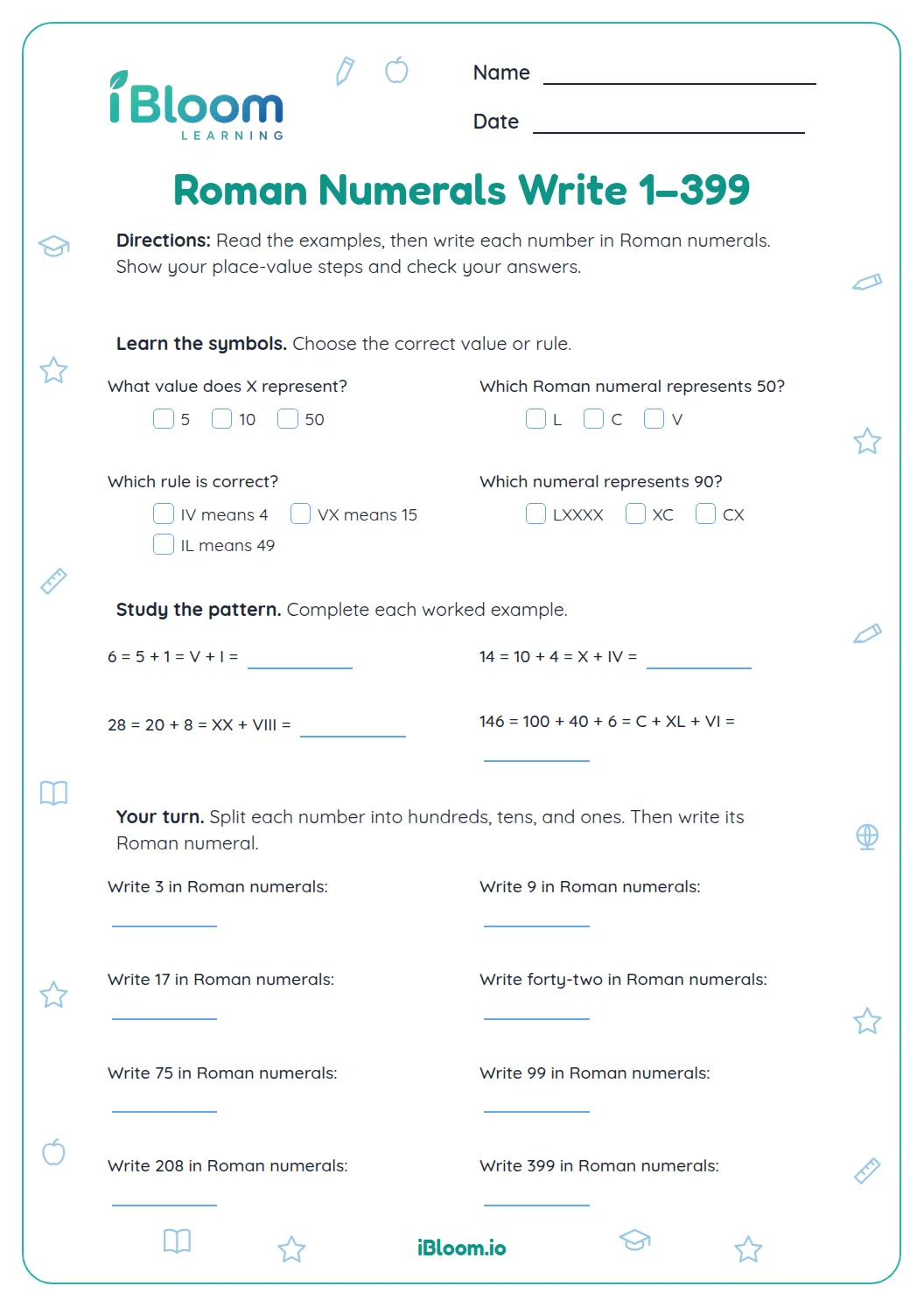
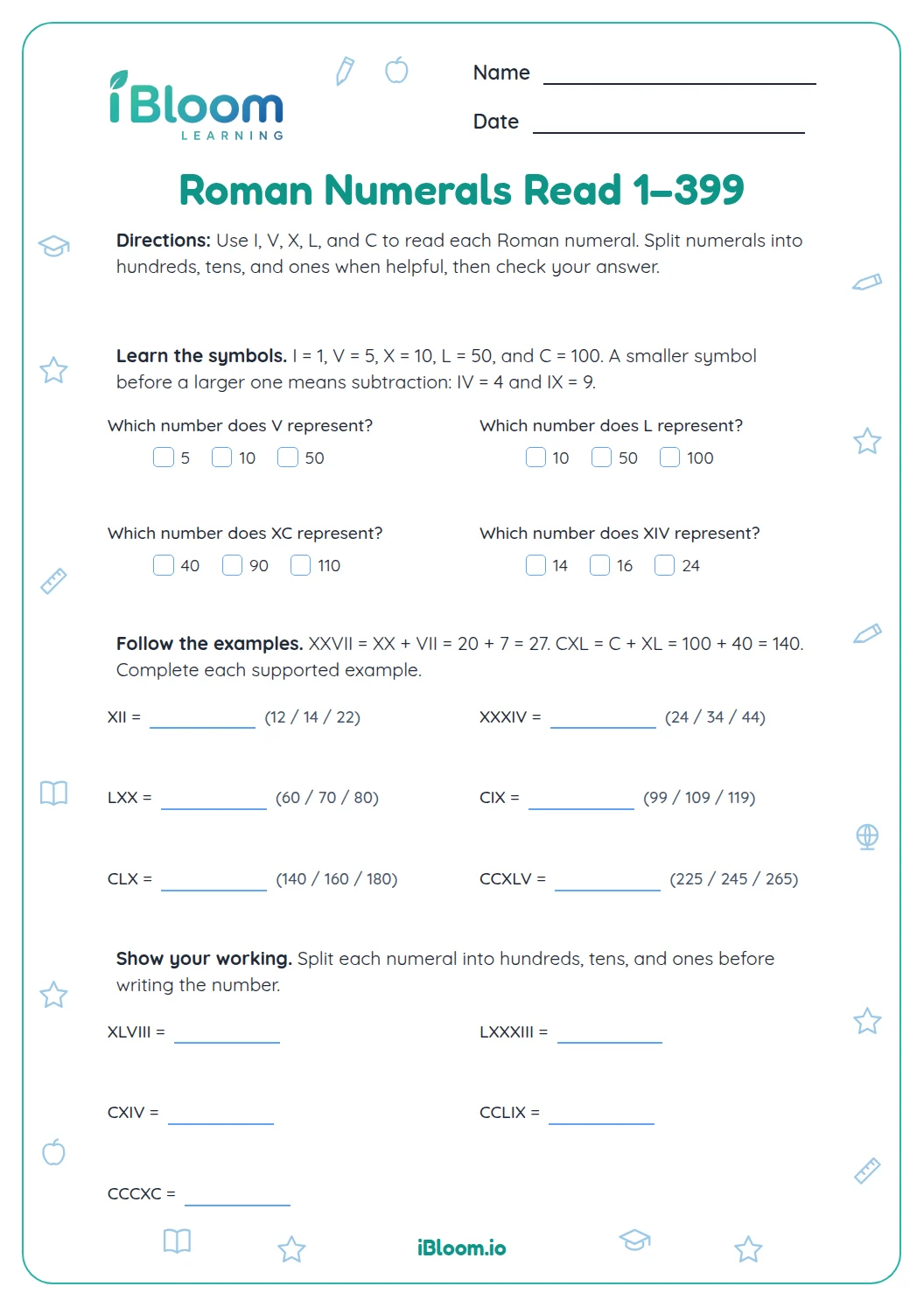
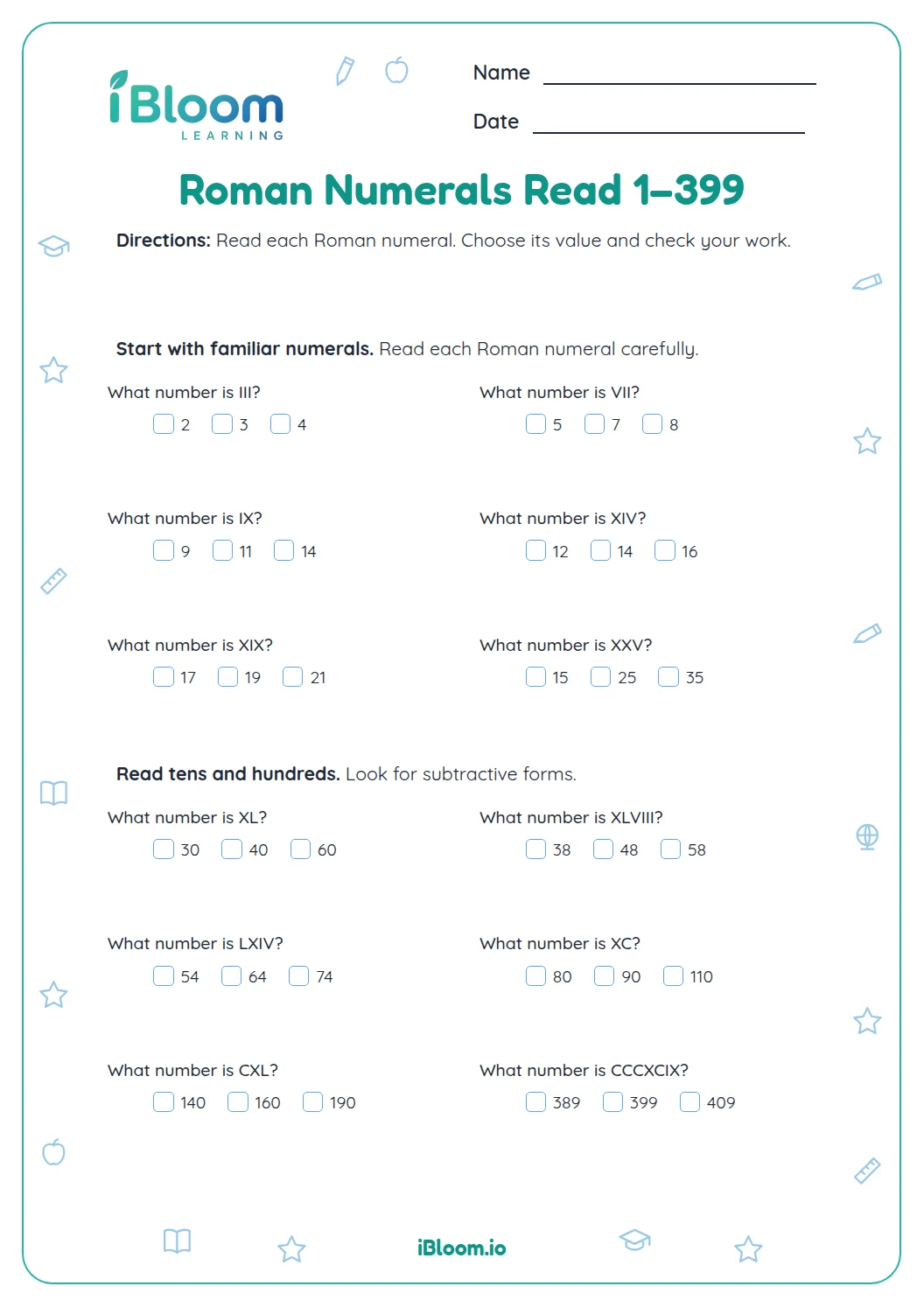
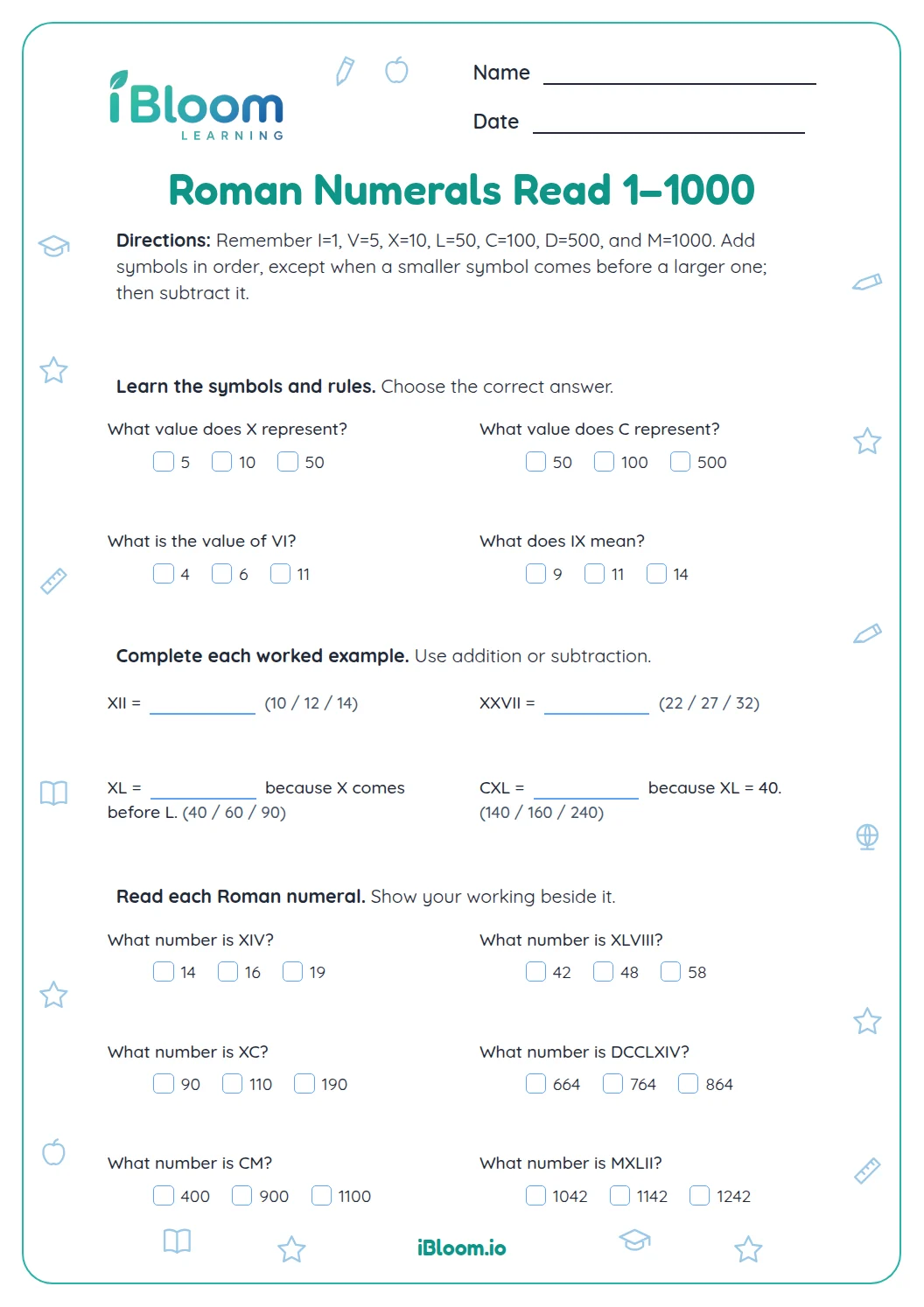
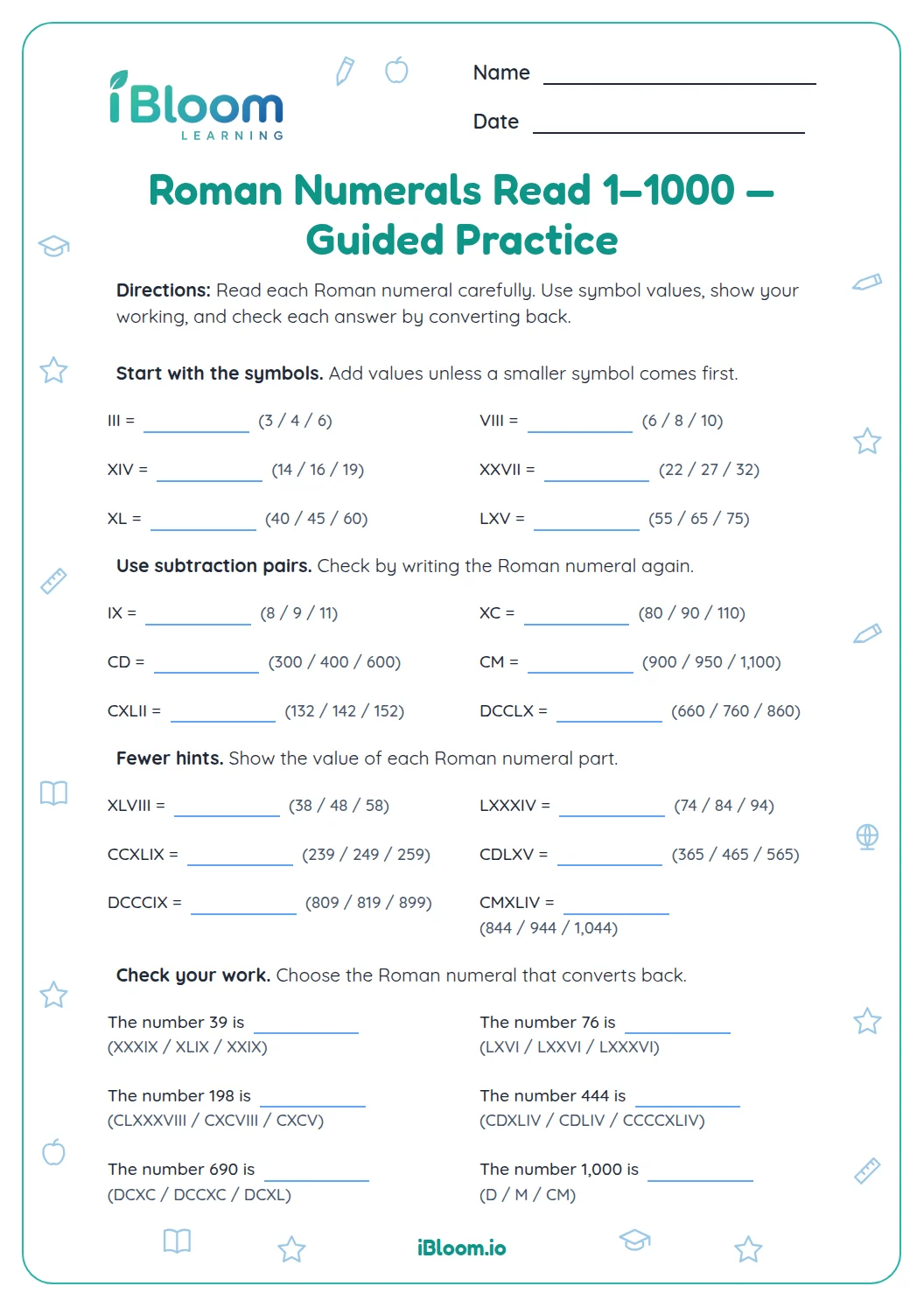
The subtractive forms represent 4 as IV, 9 as IX, 40 as XL, and 90 as XC. Use these forms inside each place-value group before joining the groups.
- 1149 = 100 + 40 + 9
- 2100 → C; 40 → XL; 9 → IX
- 3Join the groups: CXLIX
- 4Check: 100 + 40 + 9 = 149.
How does the practice get harder?
Questions 1, 3, 5, 7, 9, 11, 13, and 14 show base-ten blocks. The other six state the value directly; convert them by the same hundreds, tens, and ones steps.
How to use this worksheet
- 1Review I, V, X and L in Part A, then C and XC in Part B.
- 2Identify one cube, one ten rod and one hundred square in the drawings.
- 3For the first twelve questions, confirm each printed number with its blocks.
- 4Convert its hundreds, tens and ones separately, using the subtraction-pair reminder.
- 5Join the groups and check each answer by adding their values.
Mistakes to check together
The mistake
Writing IIII for 4.
The fix
Use the standard subtraction pair IV: one before five.
The mistake
Writing IL for 49.
The fix
Separate 49 into 40 and 9, then combine XL and IX as XLIX.
The mistake
Adding a placeholder to CIV for the zero tens in 104.
The fix
Write C for 100 and IV for 4, then join them directly.
What to practice next
Make more practice
Questions parents and teachers ask
Which numbers do children convert on this sheet?
The fourteen numbers are 1, 4, 9, 16, 24, 49, 58, 90, 104, 149, 246, 399, 146 and 275. They practice repeated symbols and the pairs IV, IX, XL and XC. The first twelve have block models; the last two ask children to use the same method without blocks.
Why use base-ten blocks for Roman numerals?
The blocks make the amount easier to split into manageable groups. For 246, children can see two hundreds, four tens and six ones. They write CC, XL and VI for those groups, then join them as CCXLVI. The written number remains beside the model for checking.
How should children write 399?
Write 399 as CCCXCIX. The three hundred squares give CCC, the nine ten rods give XC, and the nine single cubes give IX. Reading these groups back as 300, 90 and 9 checks the answer. Keep each subtraction pair together when joining the three groups.
What should children know before starting?
Children should be able to read three-digit numbers and identify hundreds, tens and ones. Review the Roman symbol values and subtraction pairs in the part directions before independent work. Try question 2 together so the child can explain why four is written IV.
Is there a key for checking the Roman numerals?
Yes, the separate answer key prints the Roman numeral for each of the fourteen questions. Check more than whether the letters look similar: ask the child to read each group back as a value. For CXLIX, the groups C, XL and IX must total 149.