

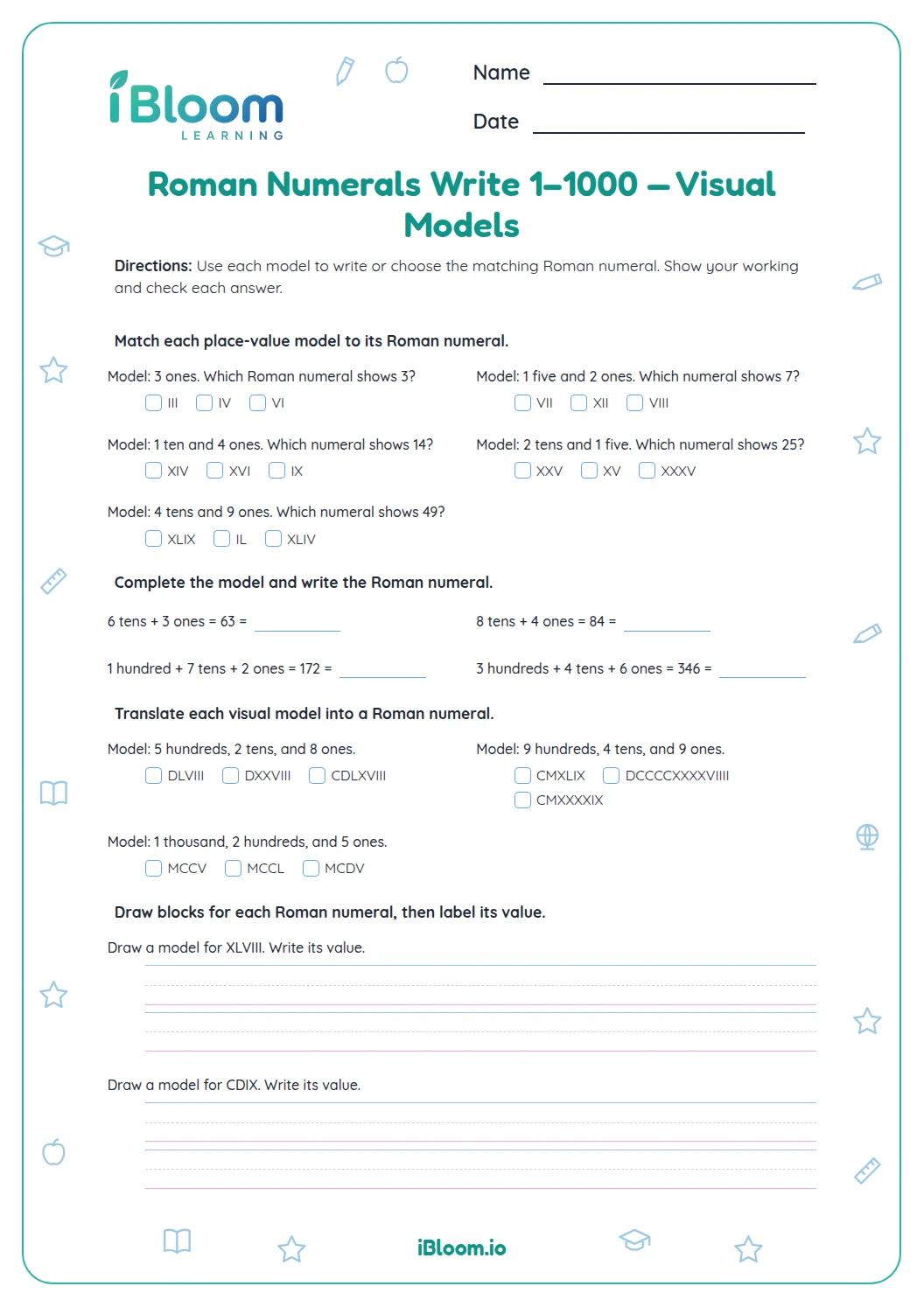
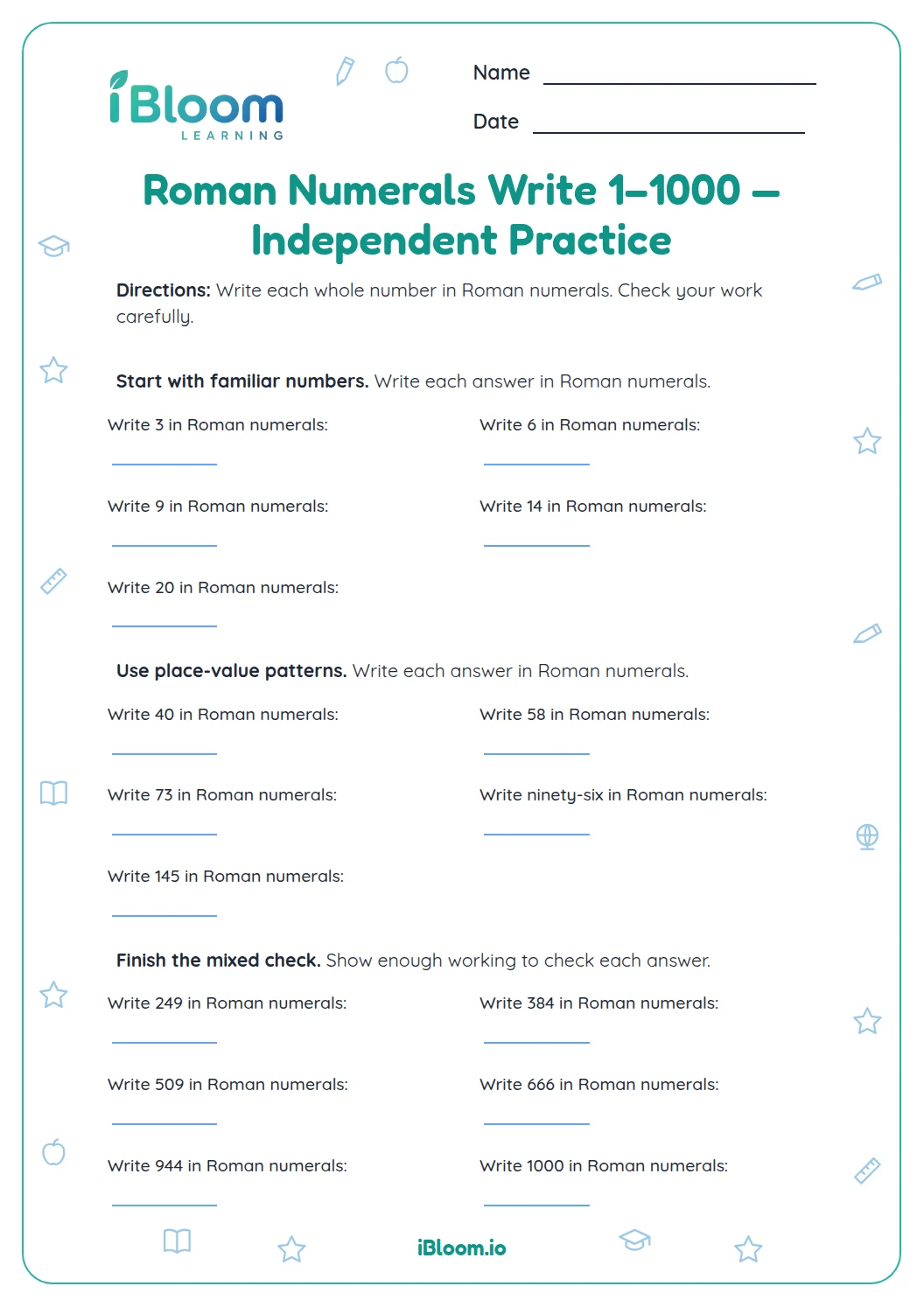
About this worksheet
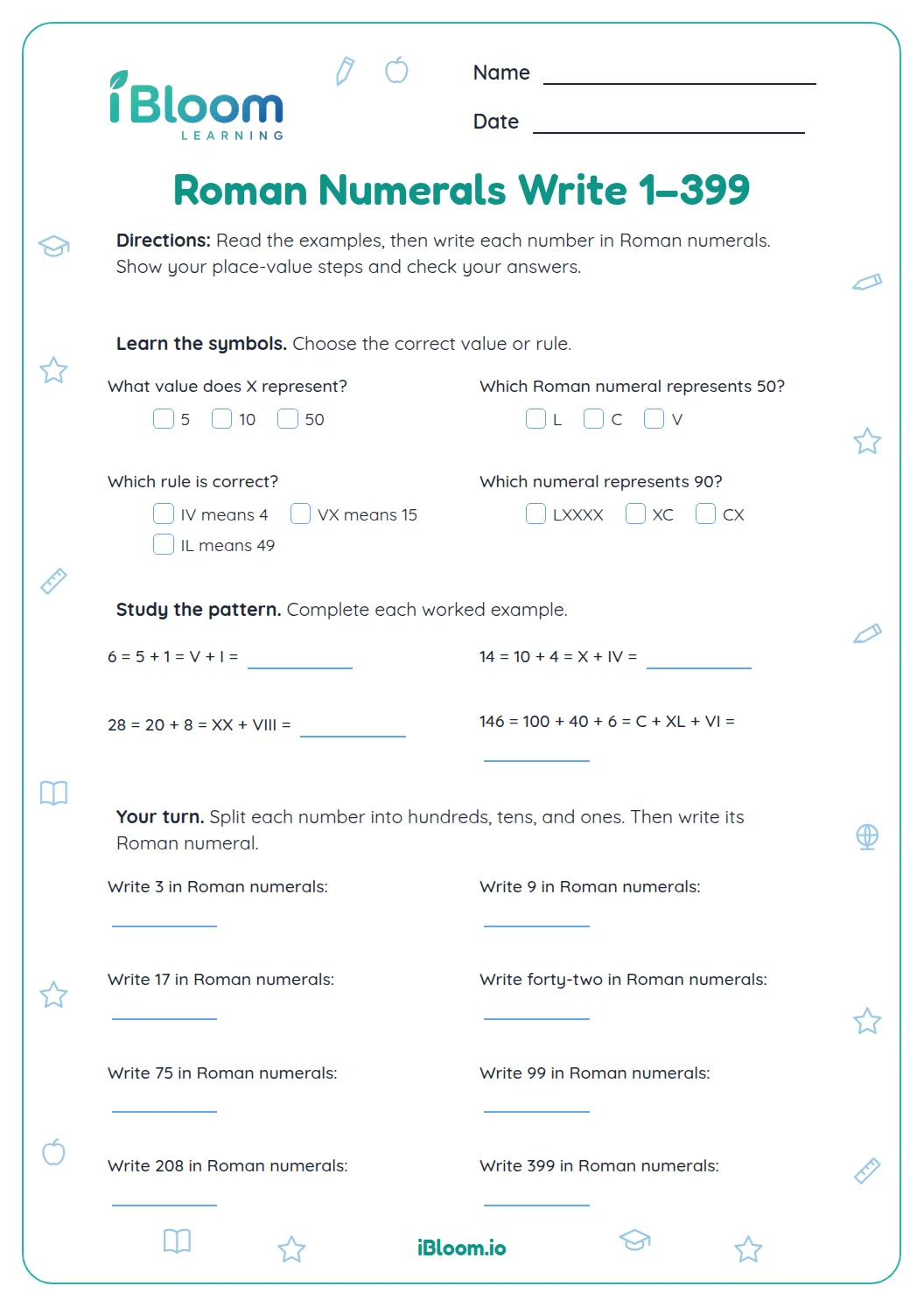
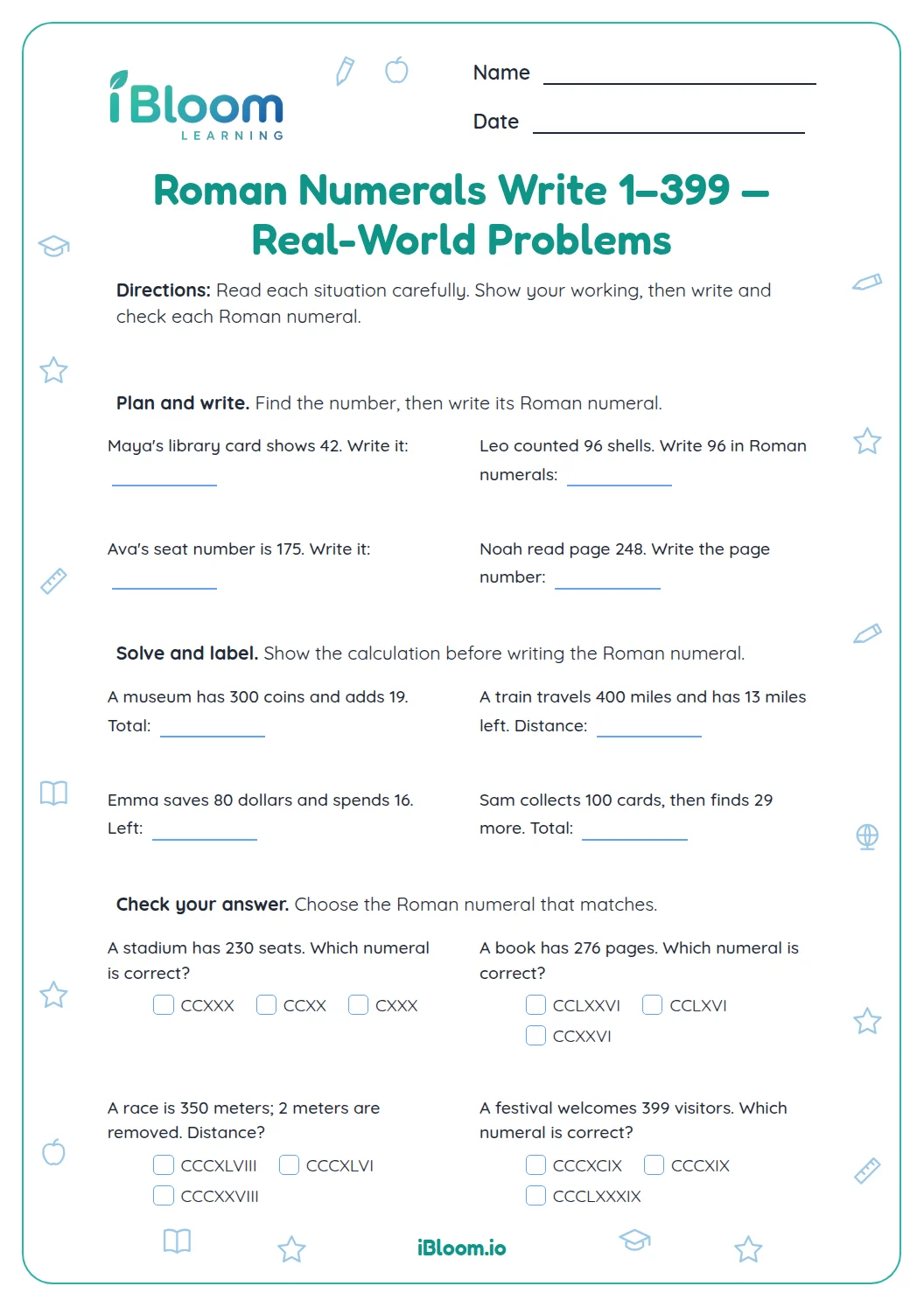
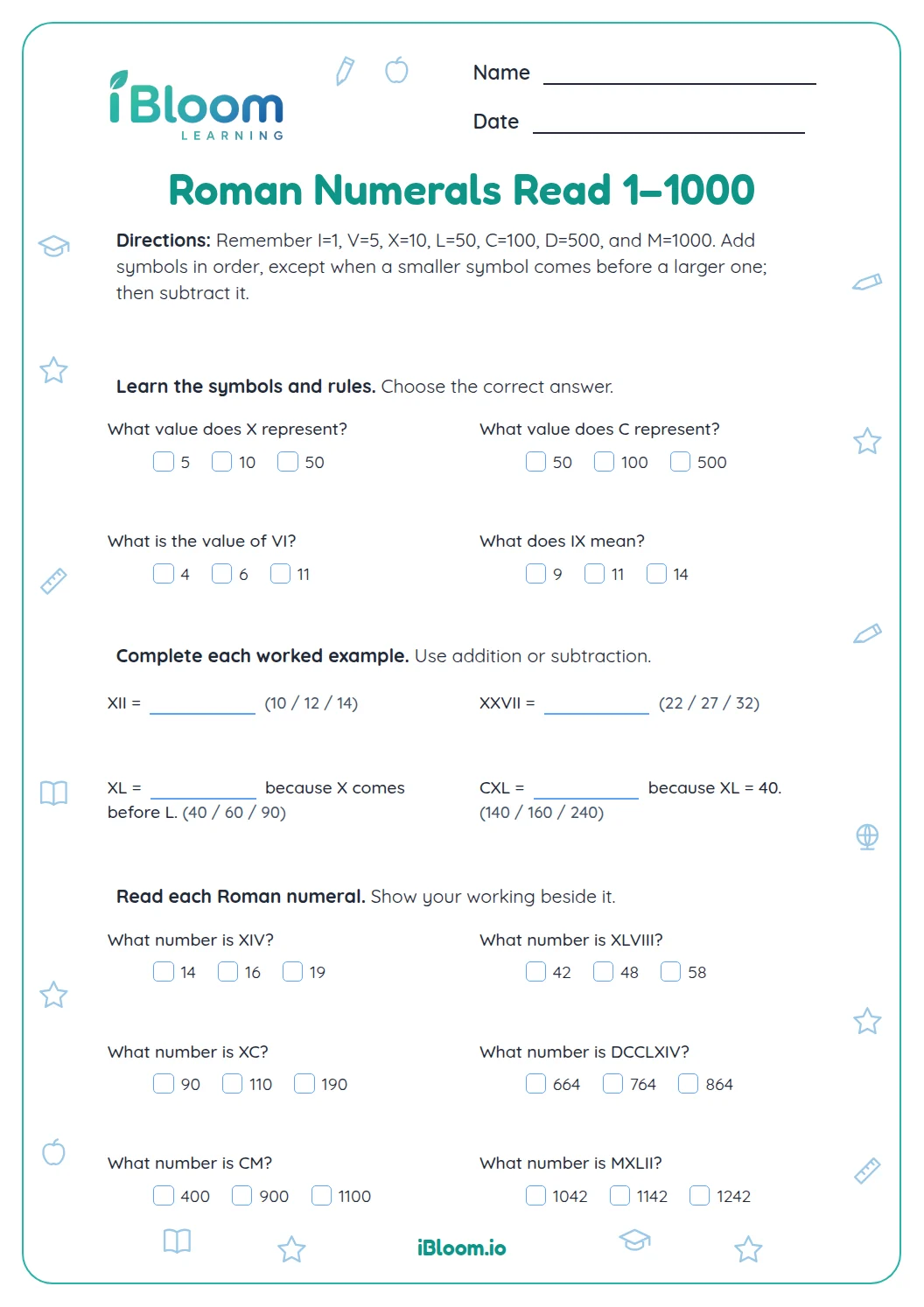
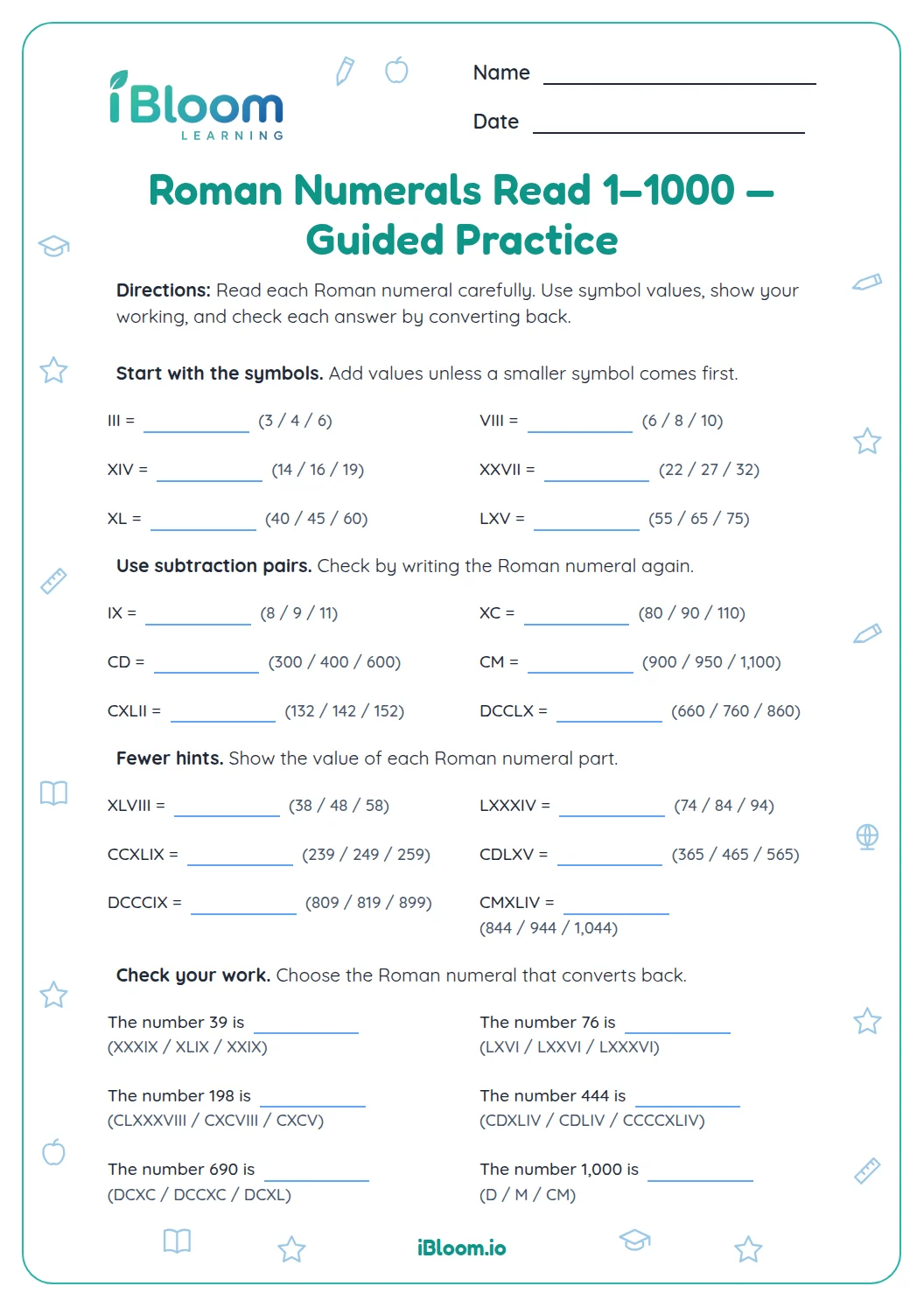
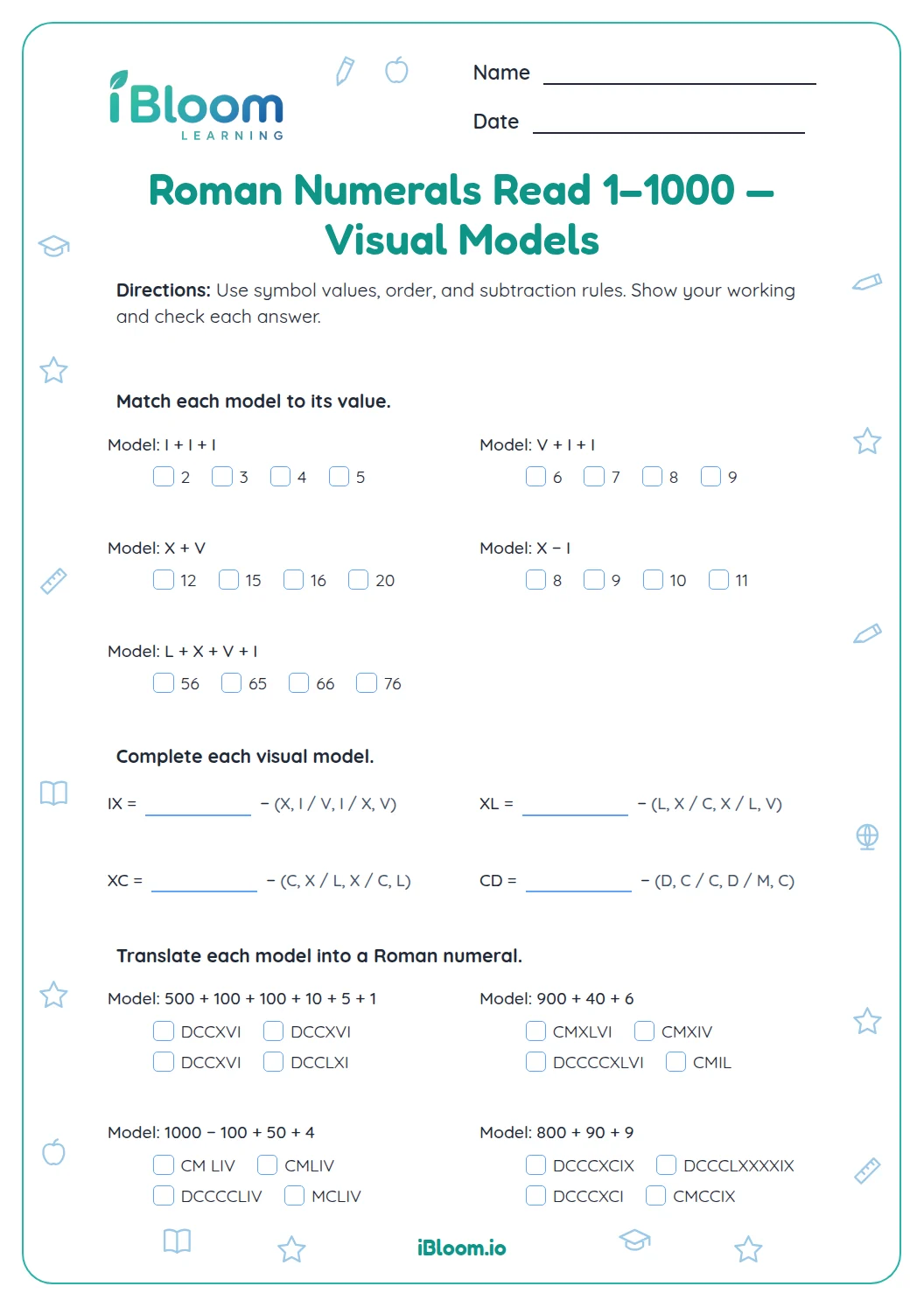
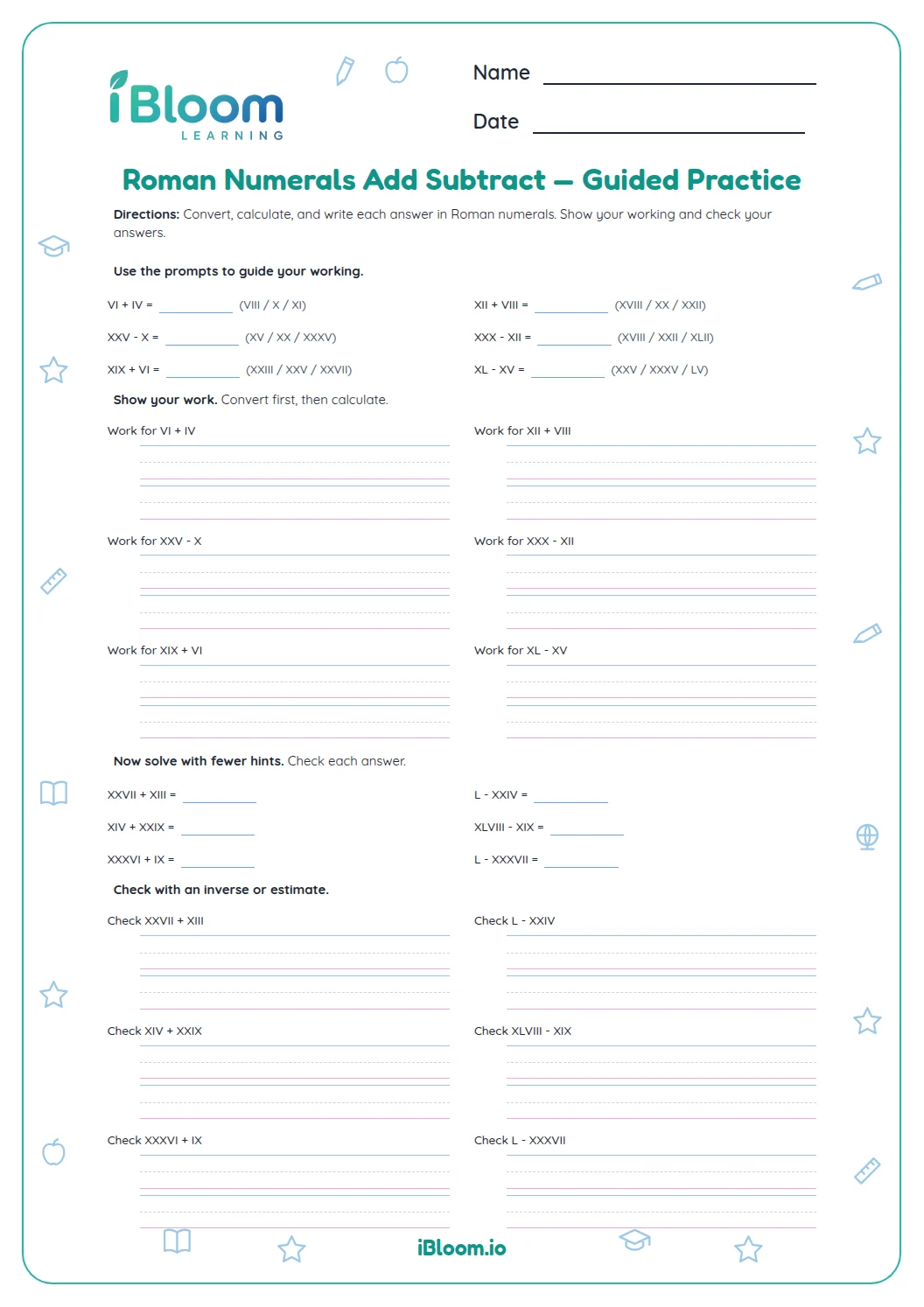
This Grade 4 worksheet gives students 20 opportunities to write Roman numerals from 1 through 399 and check how the symbols are combined. Direct conversion problems use a range of ones, tens, and hundreds, while final items ask students to correct a nonstandard form or evaluate a claim. The answer key provides standard Roman numeral forms and choices. Students can use familiar groups such as IV, XL, and XC to keep their writing concise.
How do you build a Roman numeral?
Split a number into its hundreds, tens, and ones. Write each part with the matching Roman symbols, then put the parts together from largest value to smallest. A zero in one place contributes no symbol.
- 1194 = 100 + 90 + 4
- 2100 is C; 90 is XC; 4 is IV
- 3Write the parts together: CXCIV
When does a smaller symbol come before a larger one?
The standard forms IV, IX, XL, XC, CD, and CM use subtraction for specific values. For example, XL represents 40 and XC represents 90. Use these compact forms rather than repeating a smaller symbol four times or placing a symbol before one that it cannot subtract from.
How can you check a written numeral?
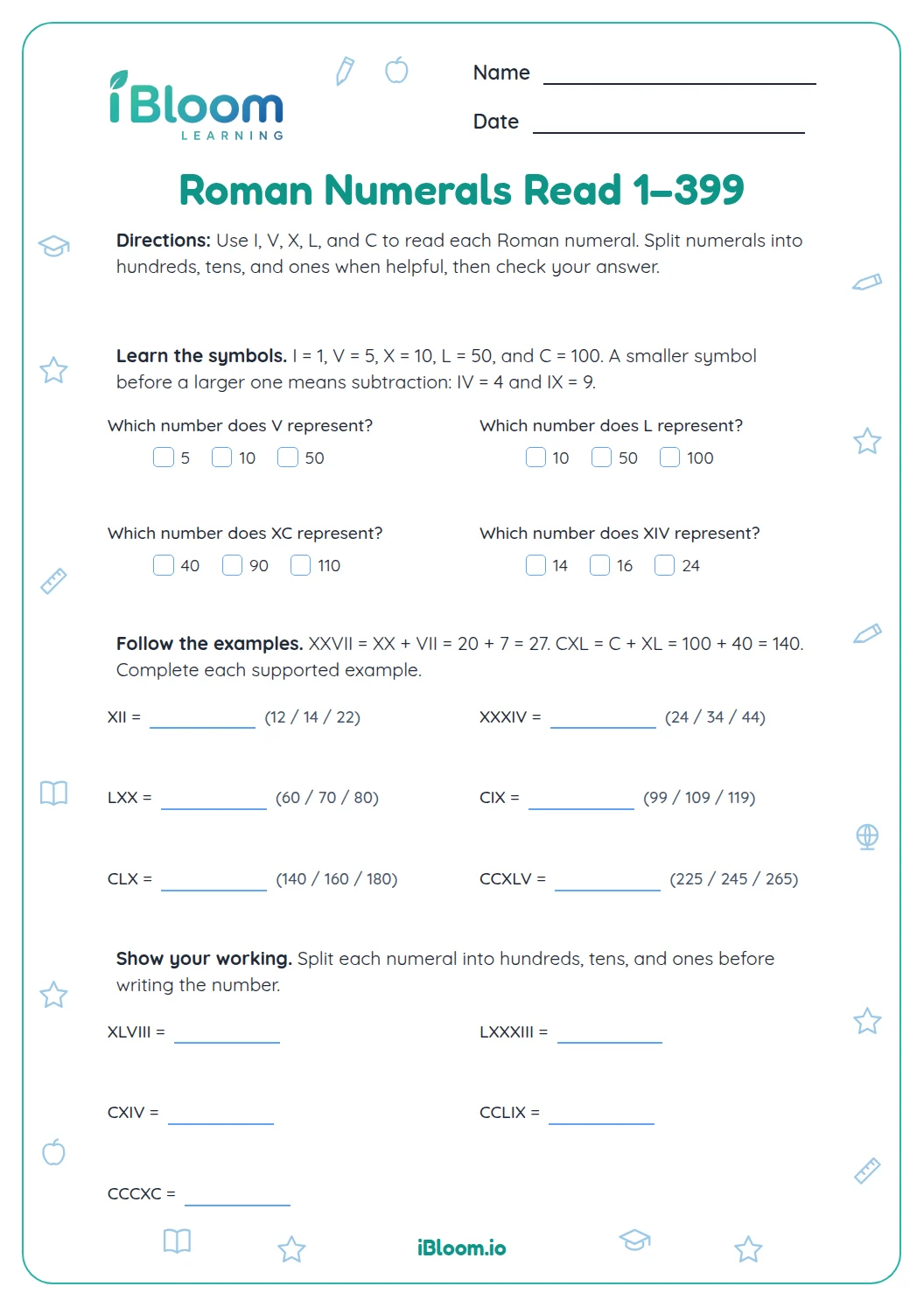
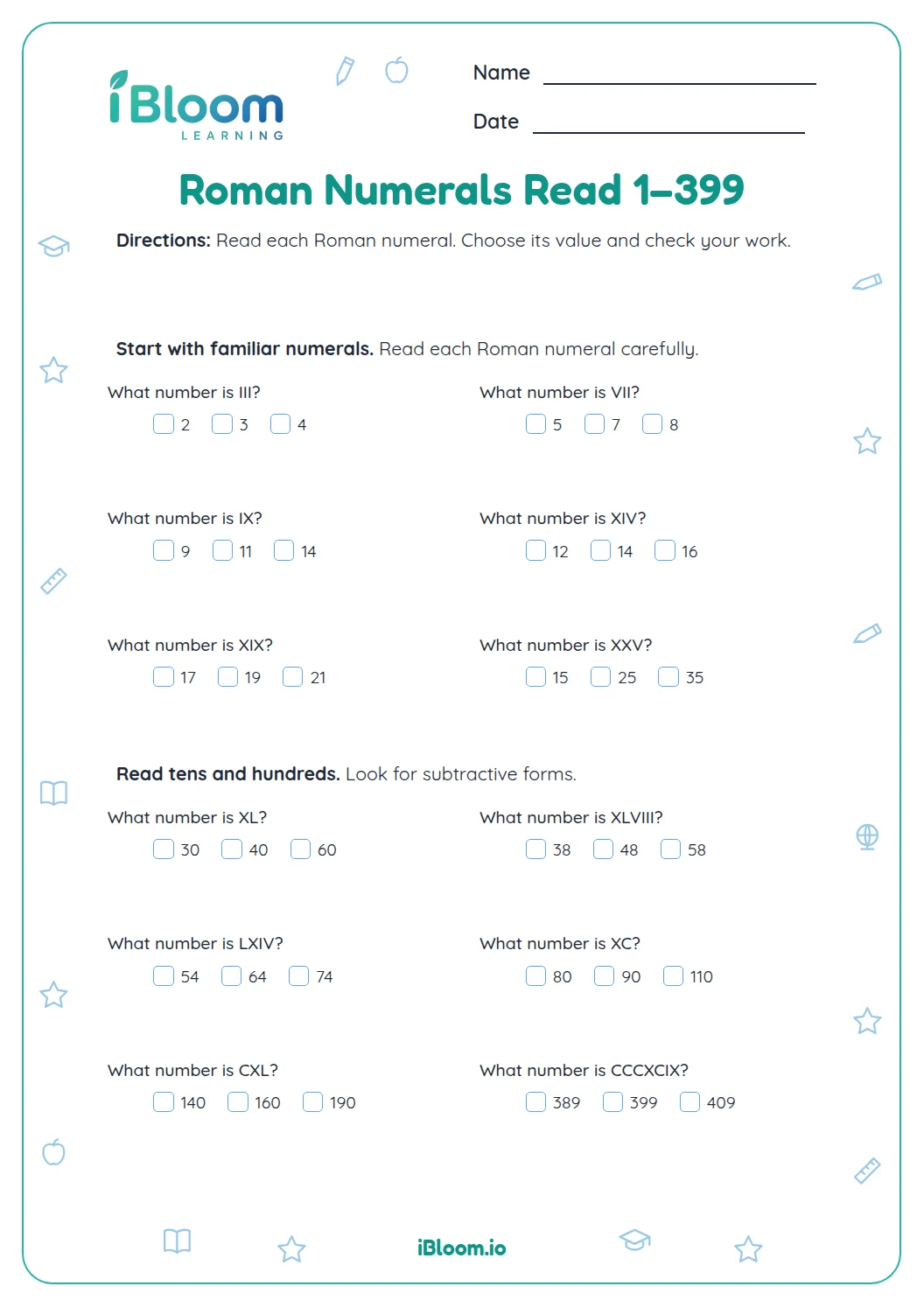
Read the symbols from left to right, applying a standard subtractive pair when it appears. Add their values and compare the total with the number in the prompt. The final items ask students to select standard forms and reason about the value represented by a symbol.
What does the challenge include?
Questions 1–12 convert values across the 1–399 range. Questions 13–16 ask students to write or complete a standard form. Questions 17–20 ask students to choose a numeral or judge a symbol-value statement.
- Part A: convert numbers using hundreds, tens, and ones
- Part B: write a standard form
- Part C: complete missing numerals
- Part D: choose or judge numeral forms
How to use this worksheet
- 1Separate the number into hundreds, tens, and ones.
- 2Write each part with Roman numeral symbols.
- 3Use standard subtractive pairs such as XL for 40 and XC for 90.
- 4Join the parts from largest place value to smallest.
- 5Add the numeral’s value to check your result.
Common mistakes and quick fixes
The mistake
Writing 49 as IL.
The fix
Use 40 + 9: XL + IX makes XLIX.
The mistake
Repeating a symbol four times instead of using the standard subtractive form.
The fix
Use IV, IX, XL, XC, CD, or CM where appropriate.
The mistake
Adding a symbol for a zero place.
The fix
Skip a place with value zero; it contributes no Roman numeral symbol.
What to practice next
Make more practice
Questions parents and teachers ask
What Roman numerals does this worksheet use?
The worksheet uses the standard symbols I, V, X, L, and C to write values through 399. It includes subtractive forms such as IV, XL, and XC, with a final section for selecting standard forms and reasoning about symbol values. The conversion items include the endpoints 1 and 399.
How do students write 194 as a Roman numeral?
Break 194 into 100, 90, and 4. Write those values as C, XC, and IV, then join them from largest to smallest: CXCIV. The worksheet’s worked example uses this conversion. Students can check by adding C, XC, and IV to confirm the original value.
Why is 49 not written as IL?
The standard subtractive form for 40 is XL, and the standard form for 9 is IX. Combining the two parts gives XLIX. One of the worksheet questions asks students to write 49 in standard form and check the value of its symbols.
What does a zero digit mean in a Roman numeral?
A zero in the tens or ones place contributes no symbol. For example, 305 is 300 plus 5, so it is CCCV. The numeral does not need a separate symbol to hold the empty tens place. This is why 305 is written CCCV rather than adding a mark for zero tens.
How can a student check an answer?
Read the numeral using its standard groups, add their values, and compare the total with the number in the prompt. For a numeral such as CXCIV, the groups are C, XC, and IV, whose values add to 194. This checks both the value and the order of the written parts.
How long does the Roman numeral worksheet take?
Plan about 25 to 35 minutes for 20 questions. The conversion items provide steady practice across different place values, and the final reasoning items may take longer because students need to judge standard forms and explain a symbol’s value.