
About this worksheet
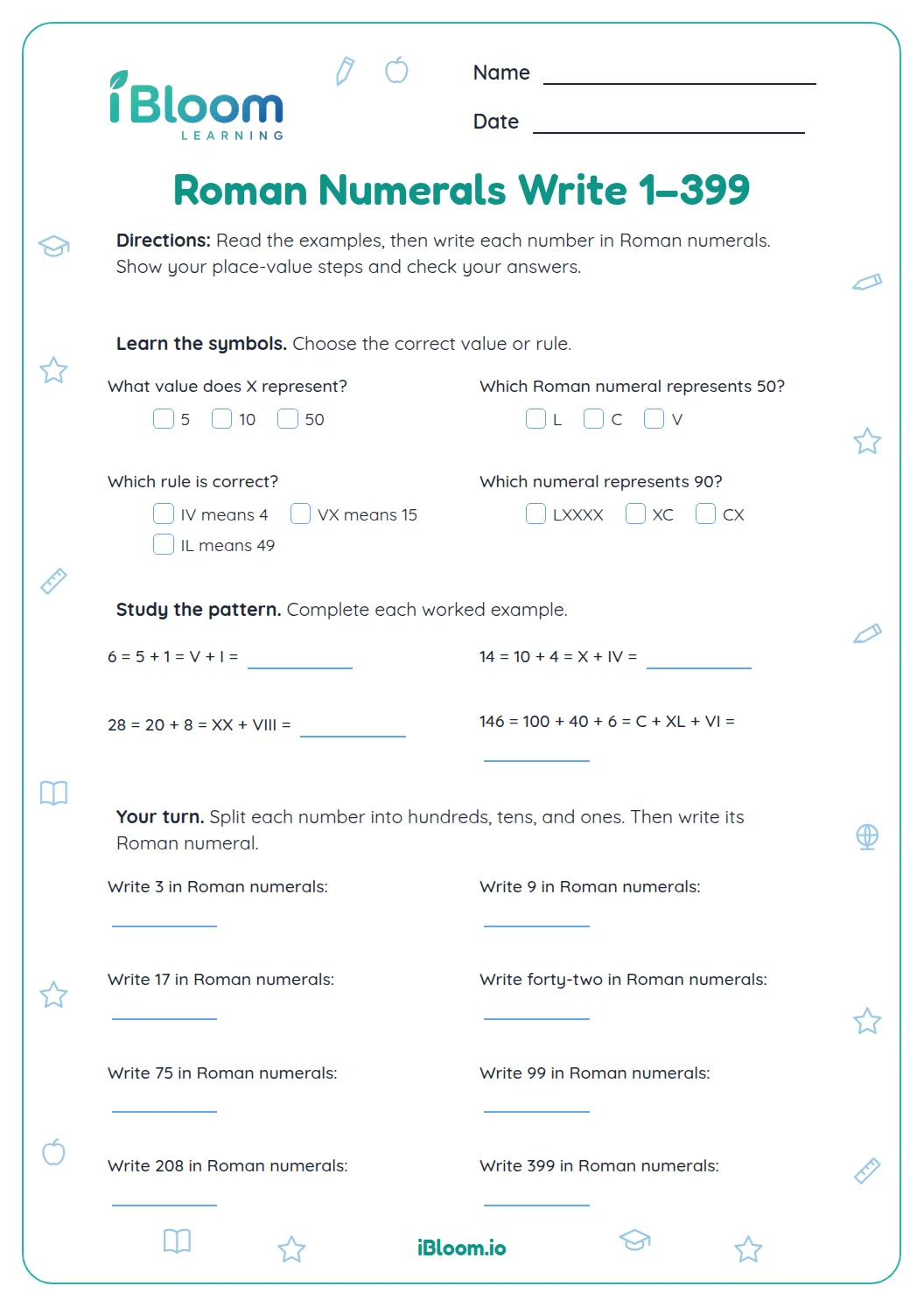
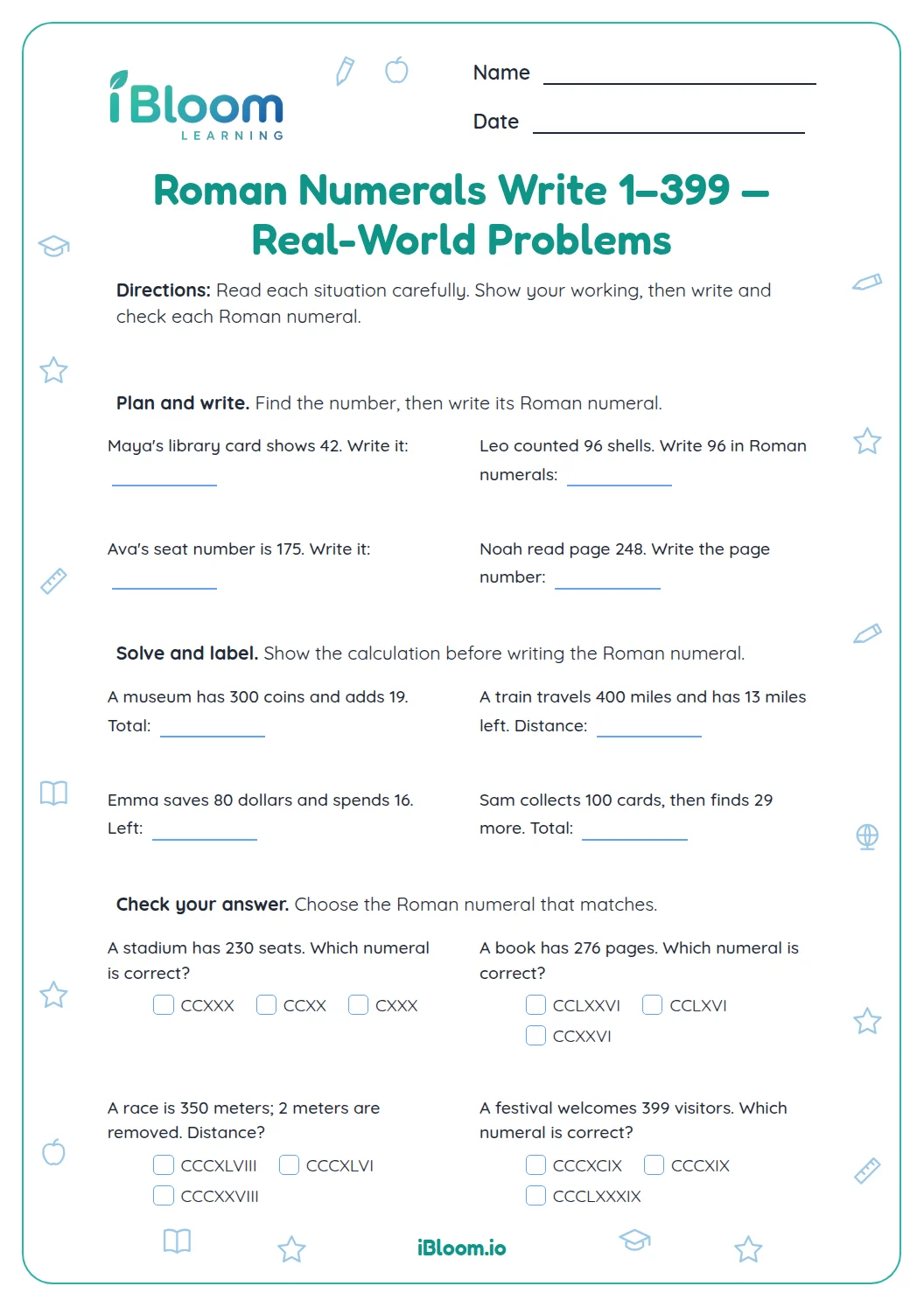
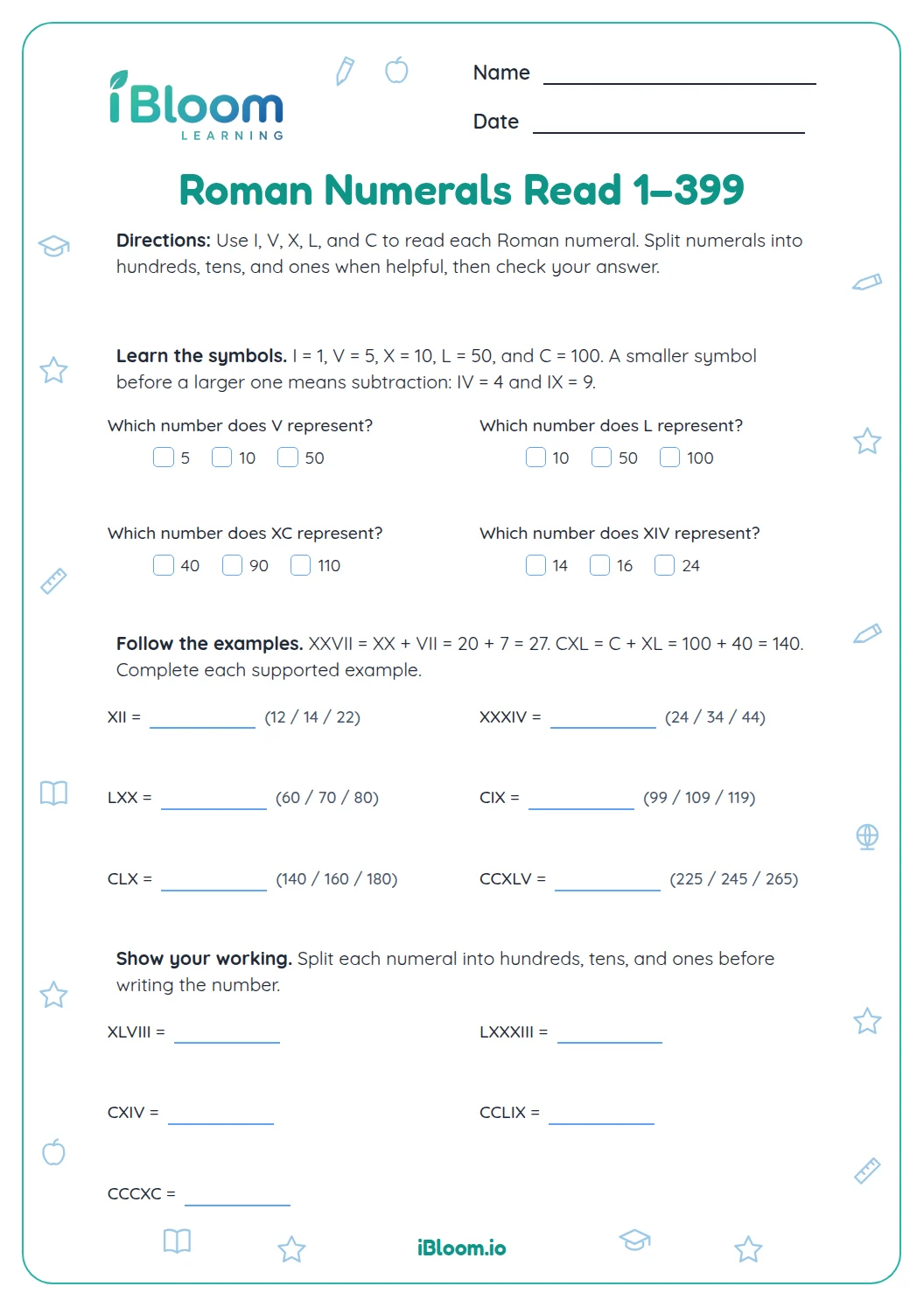
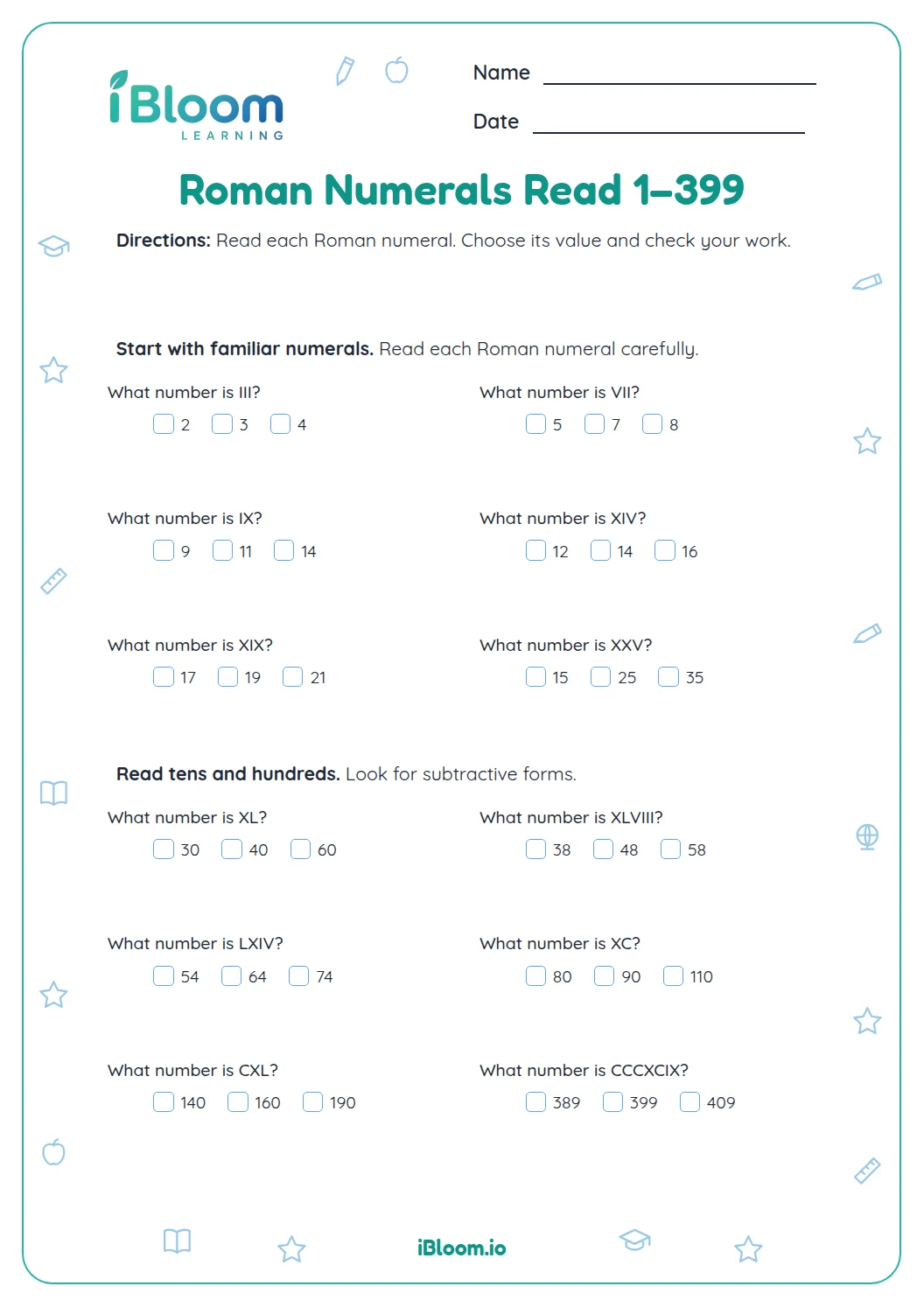
This Grade 4 printable gives students practice writing whole numbers from 1 through 399 in Roman numerals and reading numerals back into whole numbers. The questions move from familiar symbols to subtractive forms such as XL and XC, then combine hundreds, tens and ones. A separate answer key makes each conversion easy to check.
How do you build a Roman numeral?
Read the number by place value. The hundreds, tens and ones are written as groups, then placed side by side from greatest value to least.
For question 14, 208 is 200 + 8. Write 200 as CC and 8 as VIII, then join them: CCVIII.
- 1208 = 200 + 8
- 2200 = CC
- 38 = VIII
- 4208 = CCVIII
When do Roman numerals use subtraction?
A smaller symbol before a larger one means subtract: IV is 4, IX is 9, XL is 40 and XC is 90. The other symbols in a group are added.
In question 5, 58 is 50 + 8. L is 50 and VIII is 8, so the answer is LVIII.
What does this worksheet practice?
The 17 questions ask students to write numbers, read numerals and interpret one ticket value. The set includes 1 and 399 and samples values between them.
- Part A writes small and two-digit numbers.
- Part B reads Roman numerals and chooses their values.
- Part C writes larger numbers.
- Part D interprets a ticket value.
How to use this worksheet
- 1Review I, V, X, L and C and their values.
- 2For each number, split hundreds, tens and ones.
- 3Write each place-value group before combining them.
- 4For a numeral, scan left to right and subtract when a smaller symbol comes first.
- 5Check each response with the separate key.
Common mistakes and quick fixes
The mistake
Writing XXXX for 40.
The fix
Use the subtractive pair XL for 40.
The mistake
Reading IX as 11.
The fix
Because I comes before X, subtract 1 from 10: IX is 9.
The mistake
Leaving out a place-value group, as in writing CCVIII as CCII.
The fix
Convert each group separately and check the ones after the hundreds.
What to practice next
Make more practice
Questions parents and teachers ask
Which Roman numerals does this worksheet use?
The questions use I, V, X, L and C to write values through 399. Students combine these symbols in hundreds, tens and ones groups. The examples include subtractive pairs such as XL for 40 and XC for 90, along with values where symbols are added.
How do students convert a number to Roman numerals?
First split a number into place-value parts. For 275, write 200 as CC, 70 as LXX, and 5 as V; then combine the parts as CCLXXV. This place-value approach makes larger values easier to organize and helps students check that no group was skipped.
What does a smaller symbol before a larger one mean?
In standard Roman numerals, a smaller symbol before a larger symbol is subtracted. IX is 9 because 1 is taken from 10, and XL is 40 because 10 is taken from 50. Students use these patterns to read numerals such as XCIX and CCCXLIX.
Does the printable include an answer key?
Yes. The separate answer key shows the Roman numeral for every write-in question and the correct choice for each reading question. Students can compare one place-value group at a time, then check the complete numeral. This makes it useful for independent practice or quick review together.
Does the worksheet include the full range named in its title?
The practice includes the endpoints 1 and 399, along with examples from the hundreds, tens and ones. It samples values across the range rather than listing every whole number. Students use the same symbol and subtraction patterns throughout the practice.