

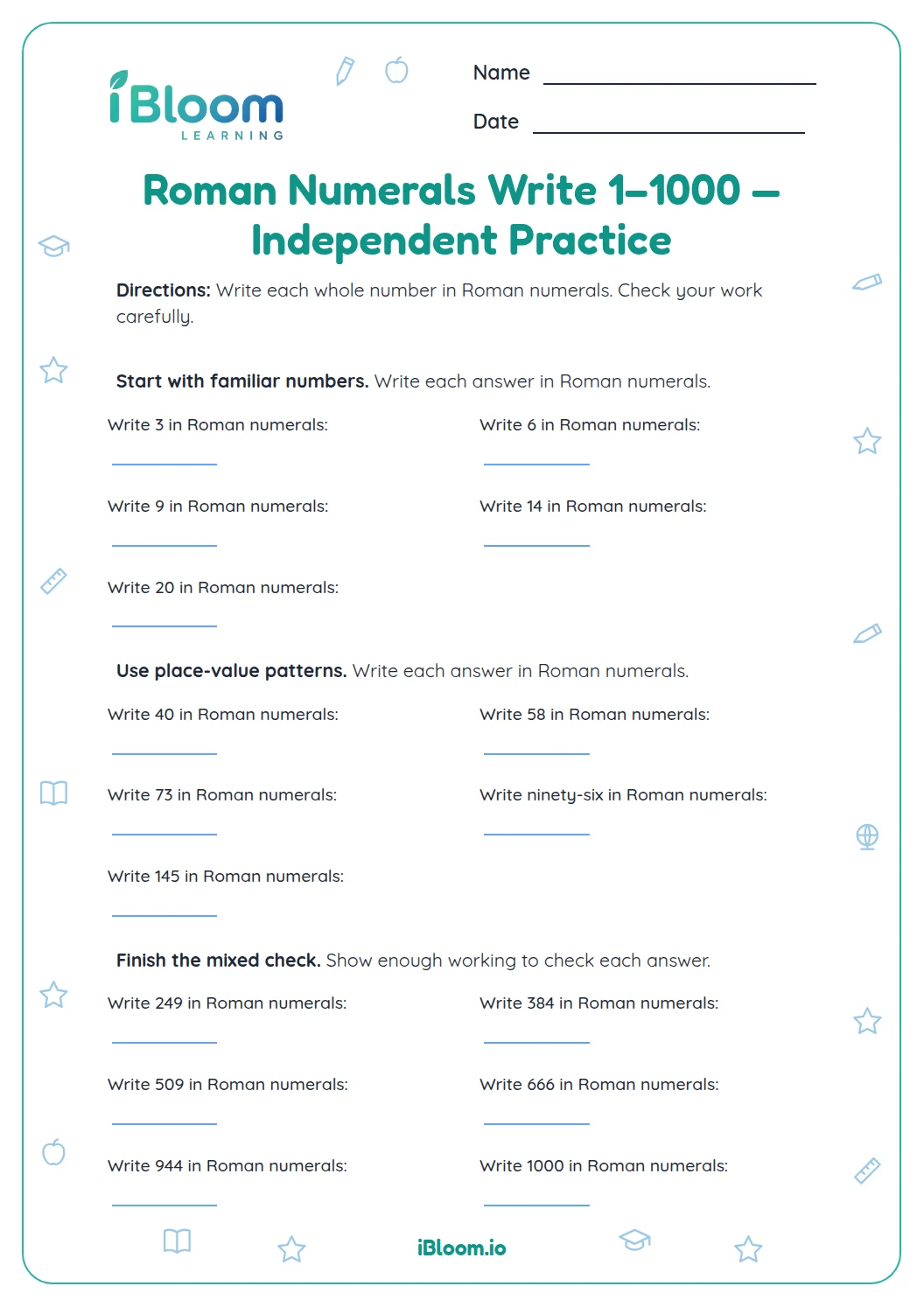
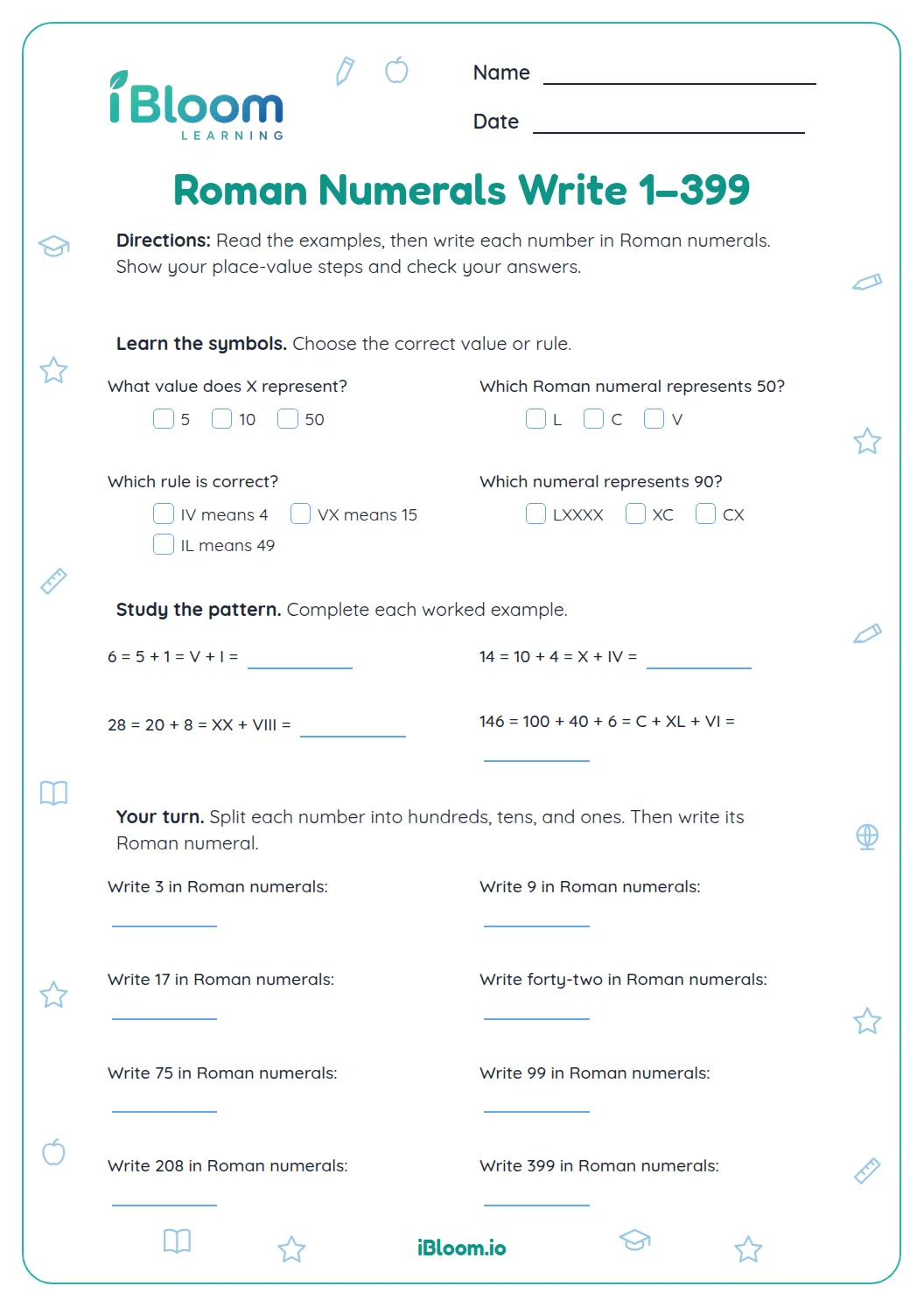
About this worksheet
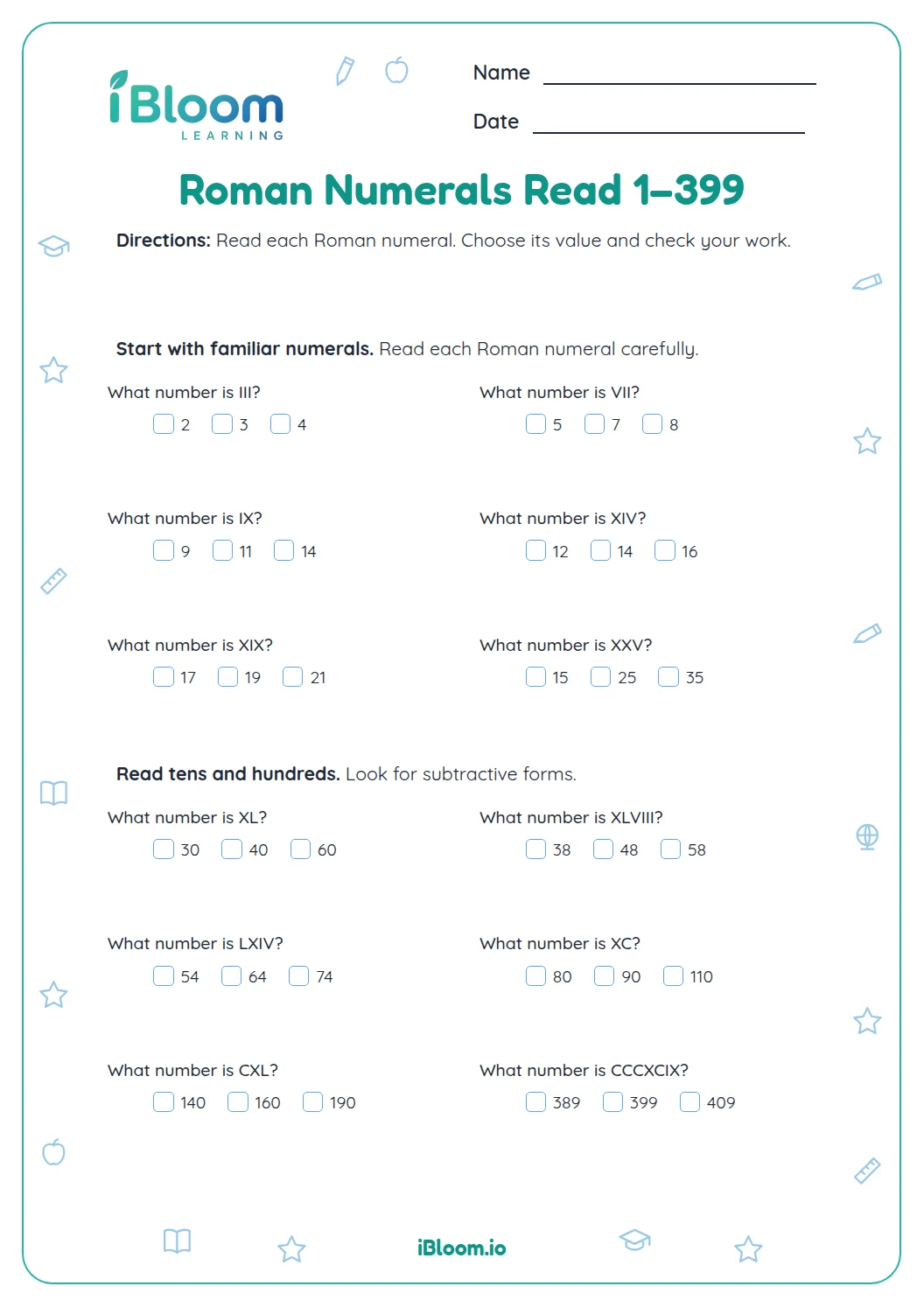
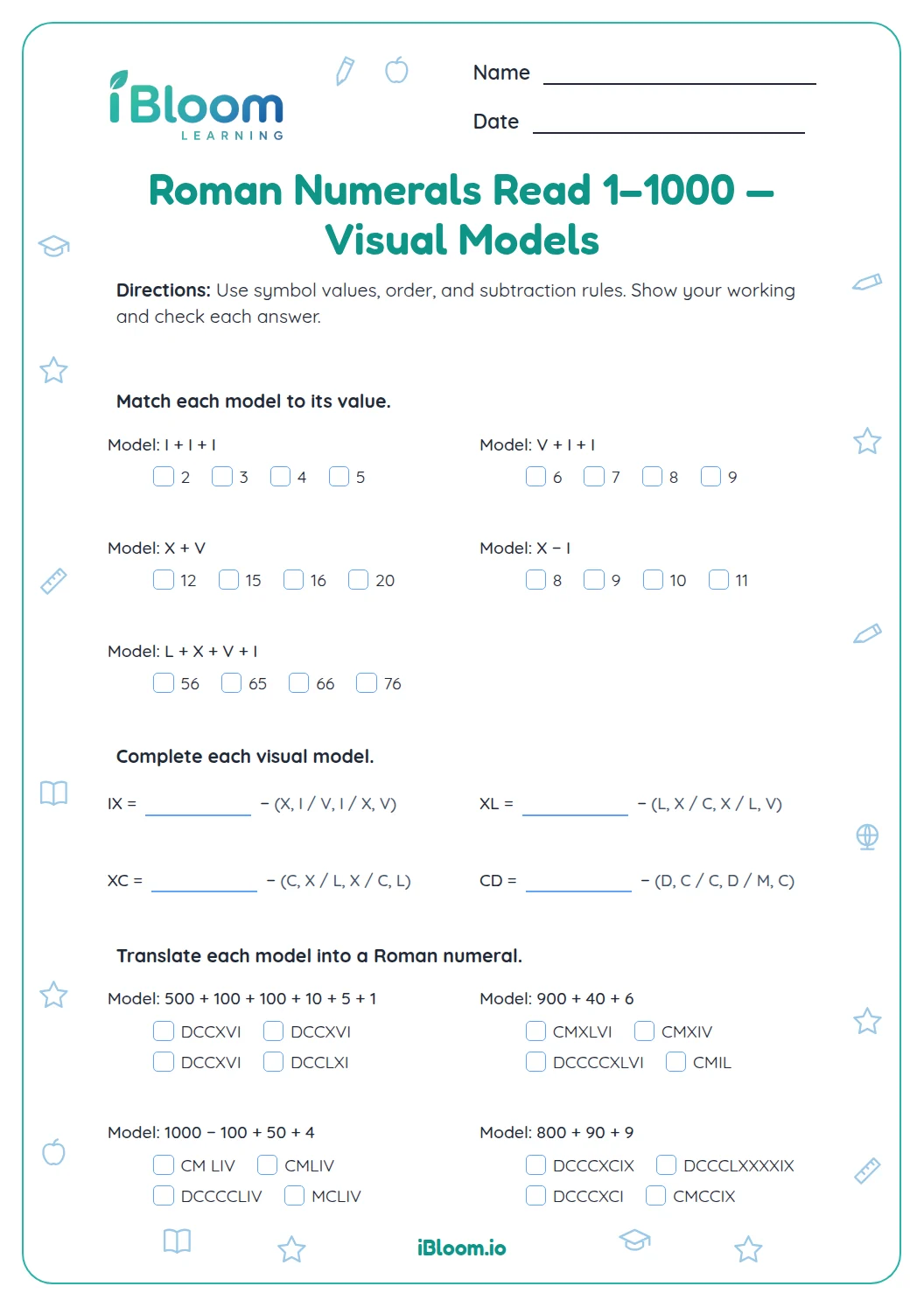
This Grade 4 worksheet gives 16 opportunities to read Roman numerals throughout the promised range of 1–399. Students identify values with additive forms such as LVIII, subtractive forms such as XL and XC, and larger combinations such as CCCXCIX. Small number-line models support the first values; later items ask students to interpret the symbols directly. The answer key lists each value so learners can check their reading and grouping.
Which symbol values should students know?
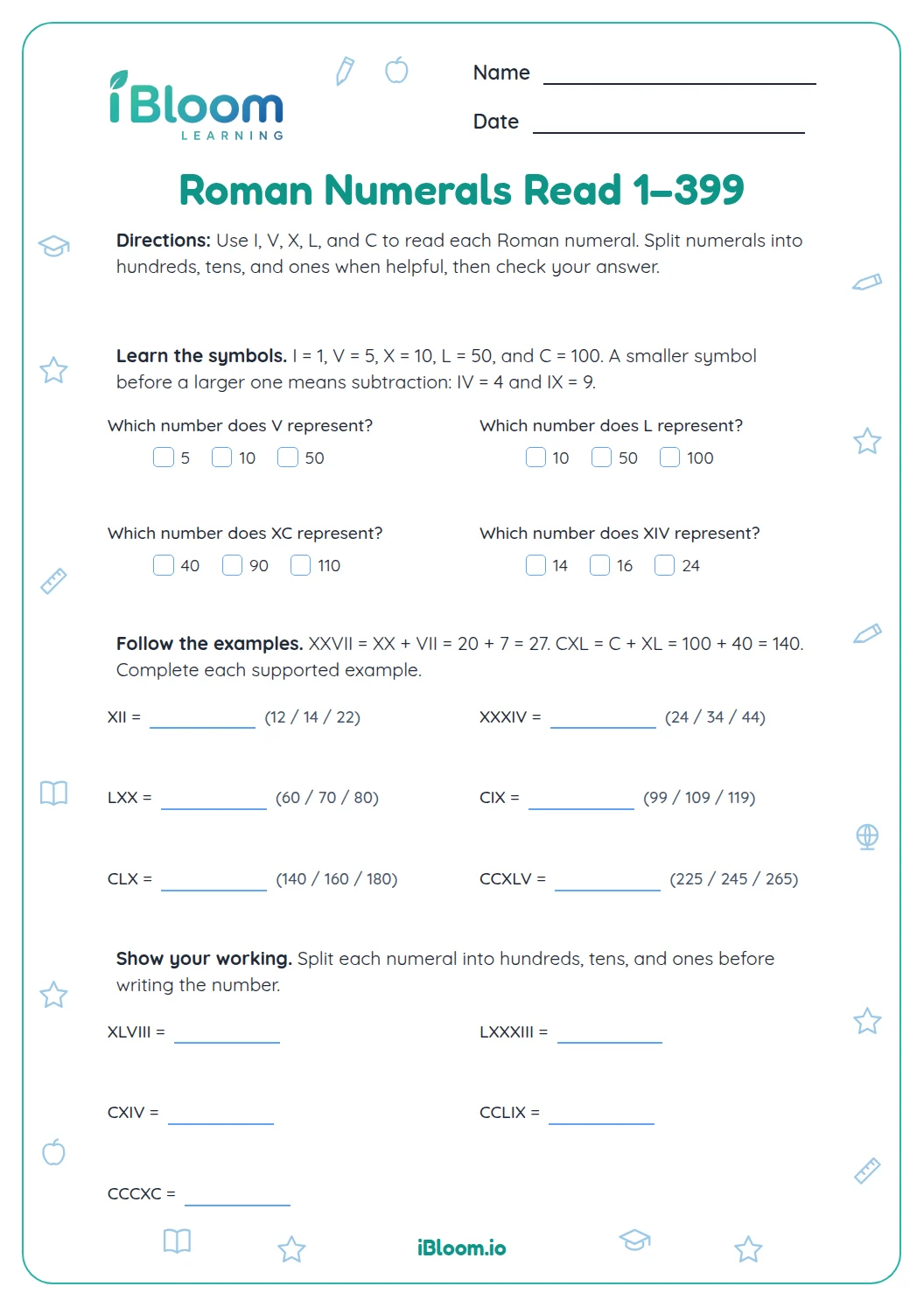
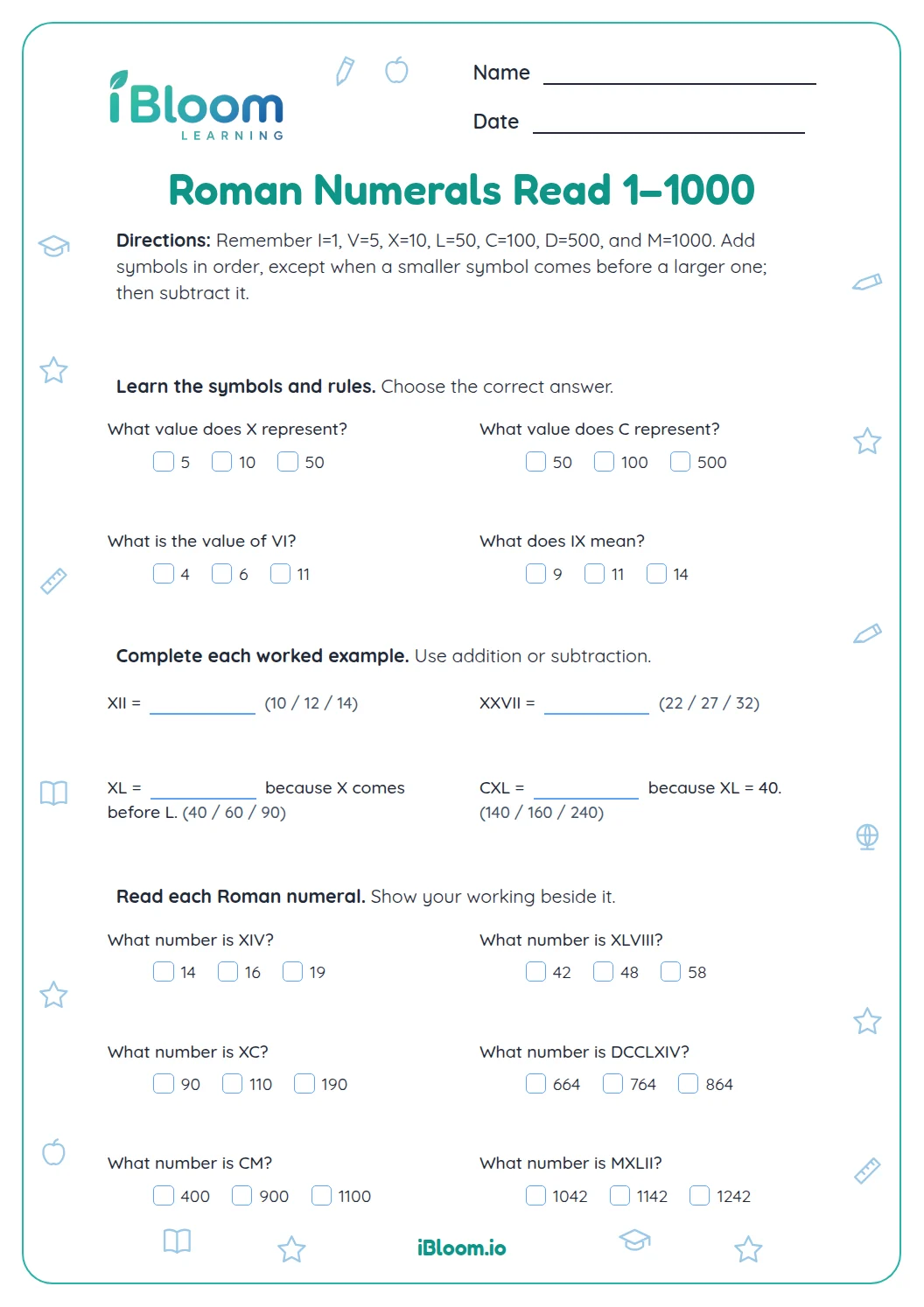
The page uses I, V, X, L and C. Read symbols from left to right: when a smaller value comes before a larger one in a subtractive pair such as IV or XC, subtract it; otherwise, add the values.
How does XL represent 40?
L represents 50 and X represents 10. Because X comes before L, subtract 10 from 50.
- 1XL = 50 − 10 = 40
How can students read numerals in the hundreds?
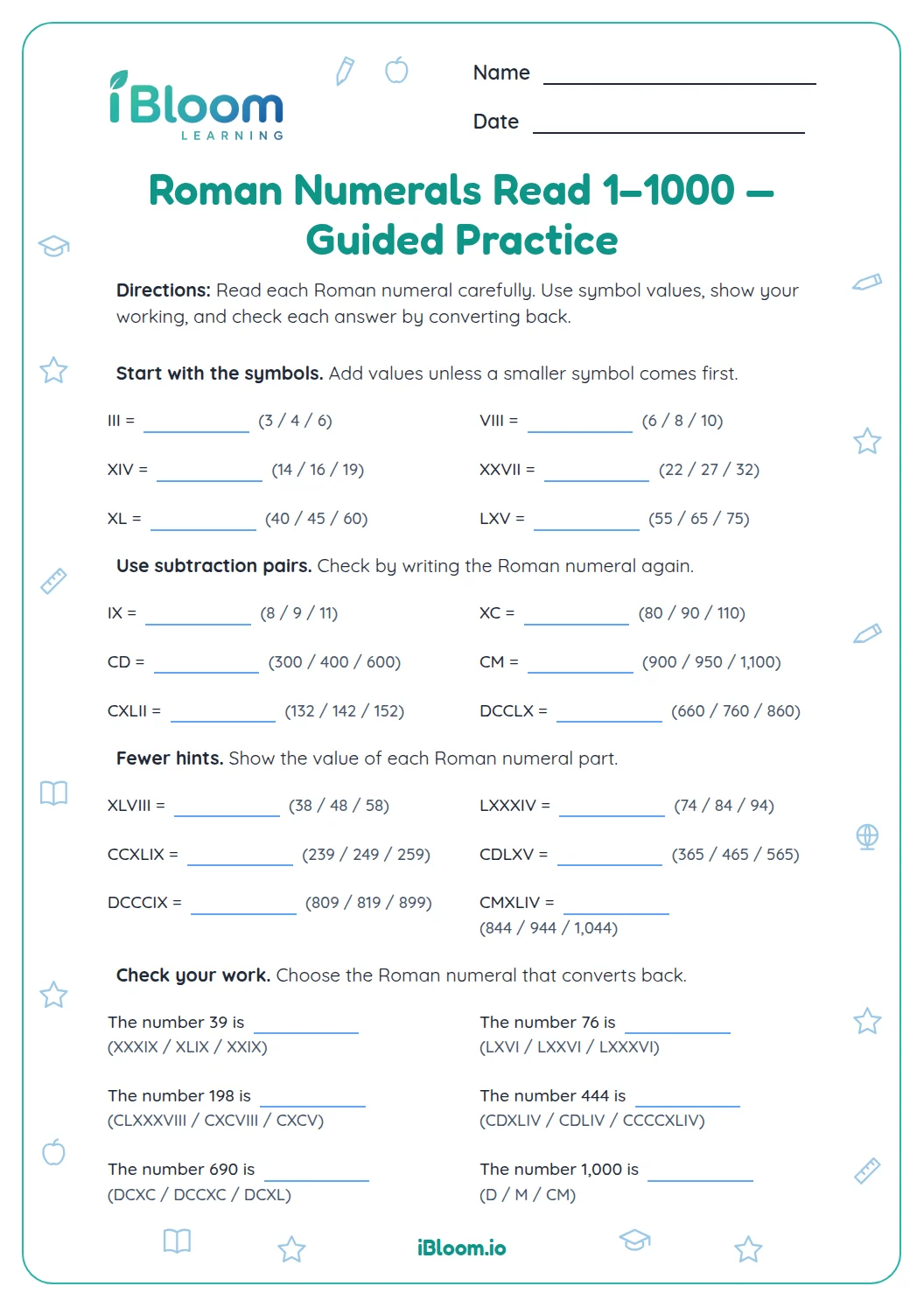
Separate a numeral into hundreds, tens and ones, then read each group. In CCCXCIX, CCC is 300, XC is 90 and IX is 9, for a total of 399.
How do number lines support the first questions?
Questions 2 and 8 pair Roman numerals with number lines as visual checks. Students can connect the symbol reading to a whole-number position, then use the same grouping idea on the larger numerals.
How to use this worksheet
- 1Recall the values I=1, V=5, X=10, L=50 and C=100.
- 2Read each numeral from left to right.
- 3Subtract when a smaller symbol comes before a larger symbol in a standard pair.
- 4Add the remaining values and group hundreds, tens and ones.
- 5Check the result against the answer key.
Common mistakes and quick fixes
The mistake
Reading IV as 6 by adding both symbols.
The fix
Because I comes before V, subtract 1 from 5 to get 4.
The mistake
Treating XL as 60.
The fix
X before L is subtractive: 50 − 10 = 40.
The mistake
Skipping a repeated C in a hundreds numeral.
The fix
Count each repeated C before reading the tens and ones groups.
What to practice next
Make more practice
Questions parents and teachers ask
Which Roman numeral symbols appear on this page?
The questions use I, V, X, L and C. These stand for 1, 5, 10, 50 and 100. Students combine them in additive groups and use subtractive pairs such as IV, IX, XL and XC to read values throughout the 1–399 range.
What does a smaller numeral before a larger one mean?
In a standard subtractive pair, take the smaller value away from the larger one. IV means 5 minus 1, or 4; XC means 100 minus 10, or 90. Read the pair together before adding it to the other groups.
How does CCCXCIX equal 399?
Break the numeral into groups: CCC is 300, XC is 90 and IX is 9. Add the groups to get 399. Grouping hundreds, tens and ones makes repeated symbols easier to track, especially in the longest numeral on this sheet.
How does the worksheet cover values across 1–399?
The 16 examples range from I, which is 1, through CCCXCIX, which is 399. They include single symbols, additive and subtractive pairs, tens and hundreds, plus numerals that combine several groups across this stated range. Learners see the start, end and intermediate values.
What are the number-line models for?
Questions 2 and 8 pair a numeral with a number-line model. These models connect Roman numerals to whole-number values; the other questions ask students to read the symbols and select the value without a number line, for more independent practice.