

About this worksheet
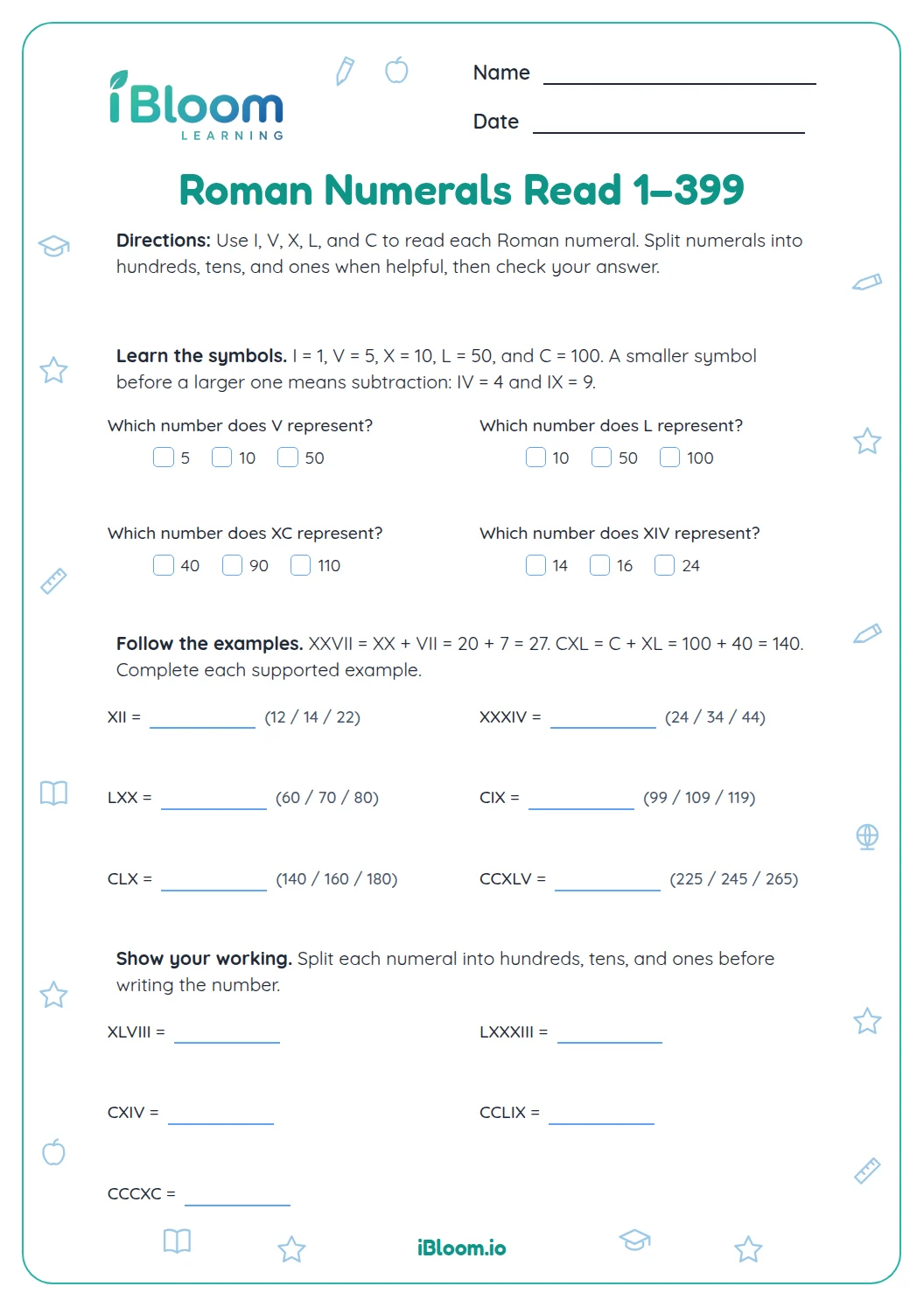
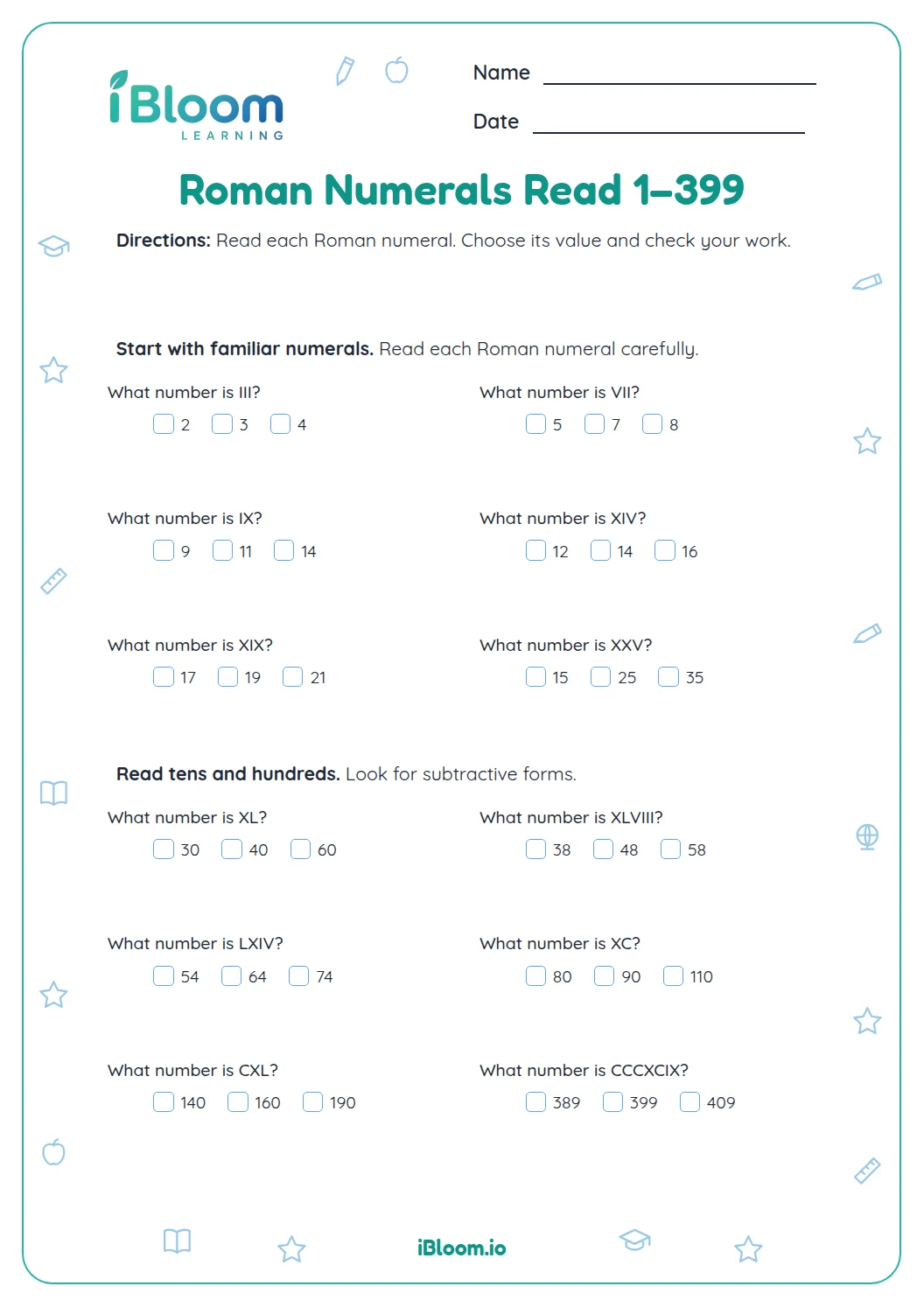
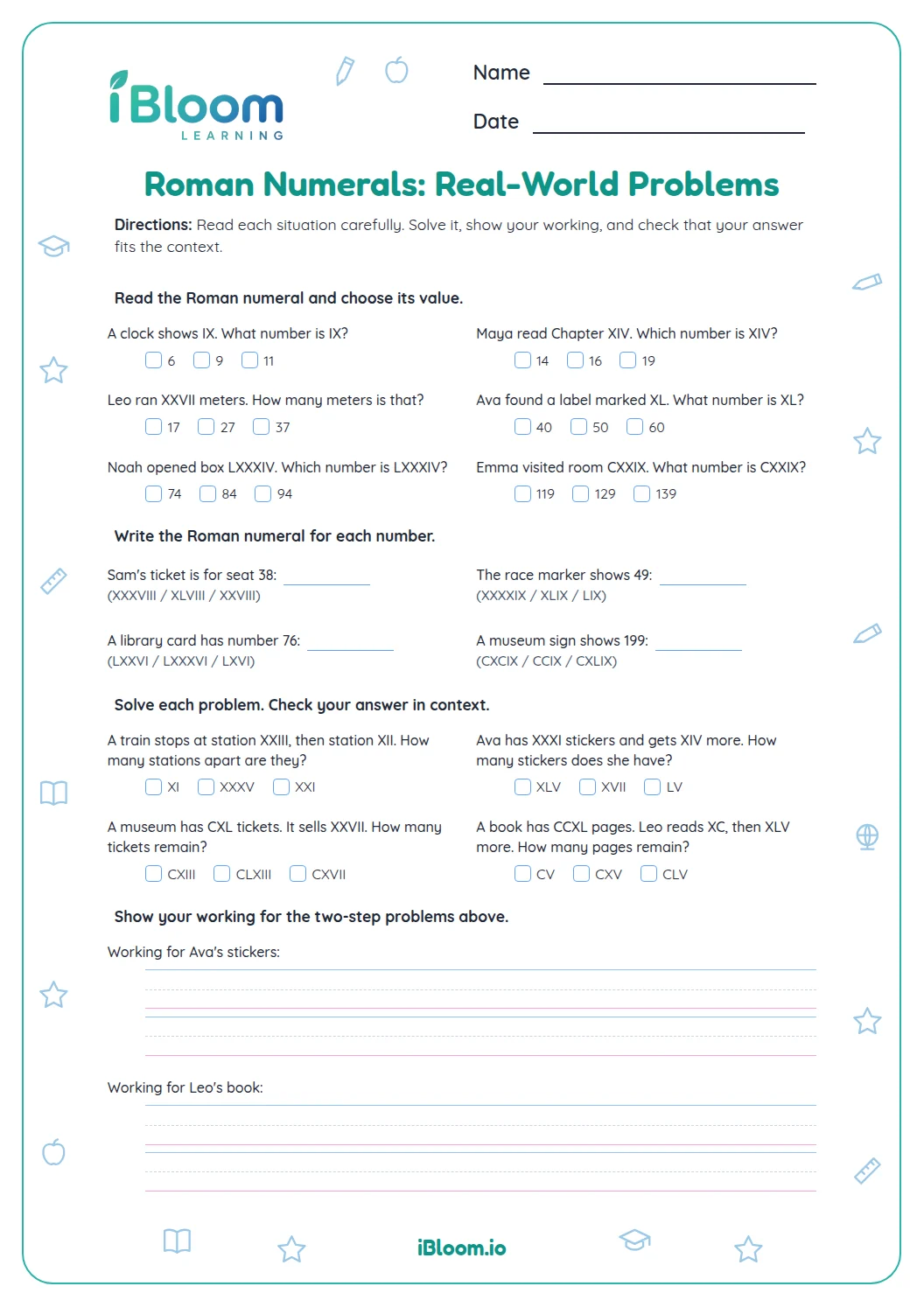
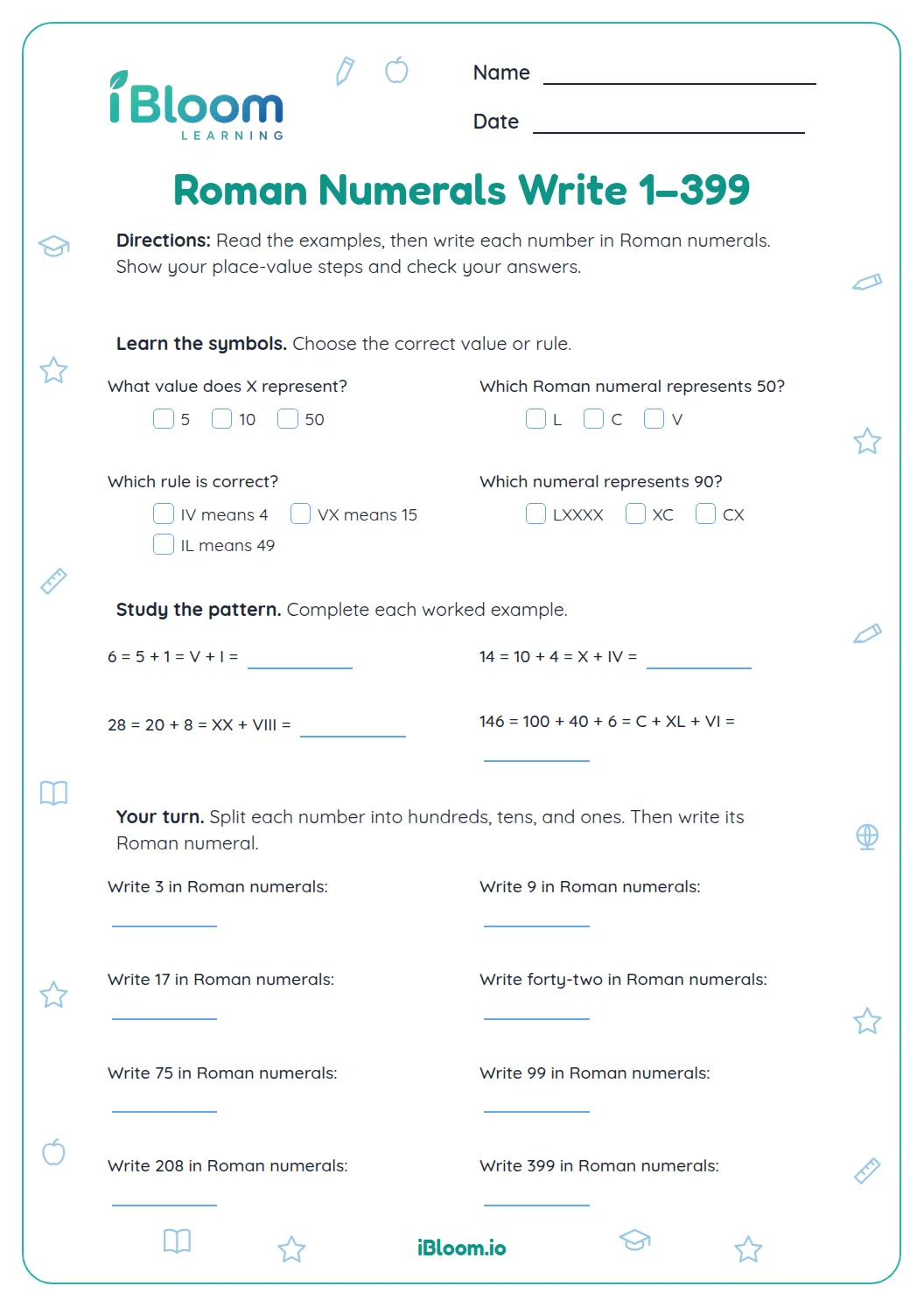
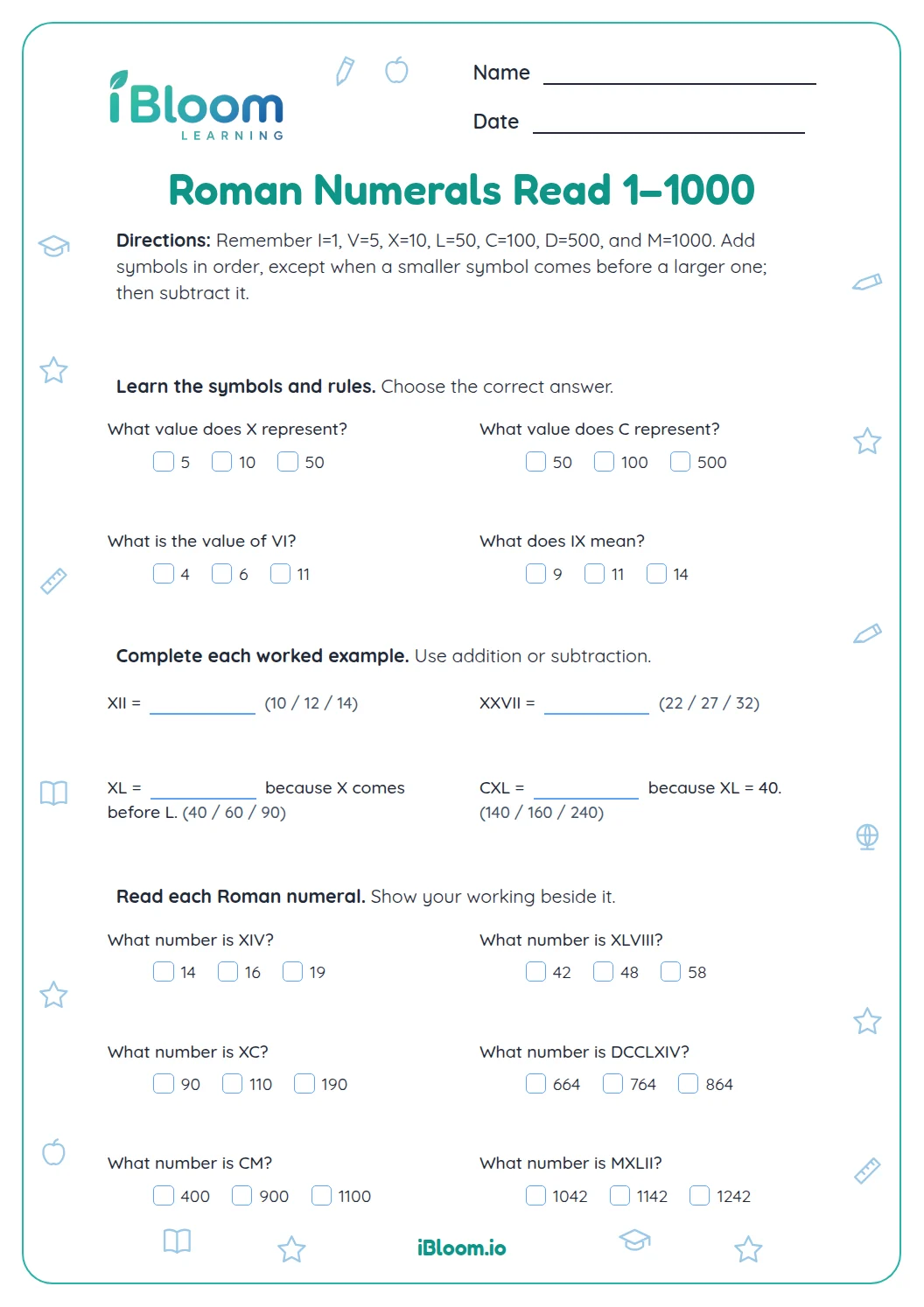
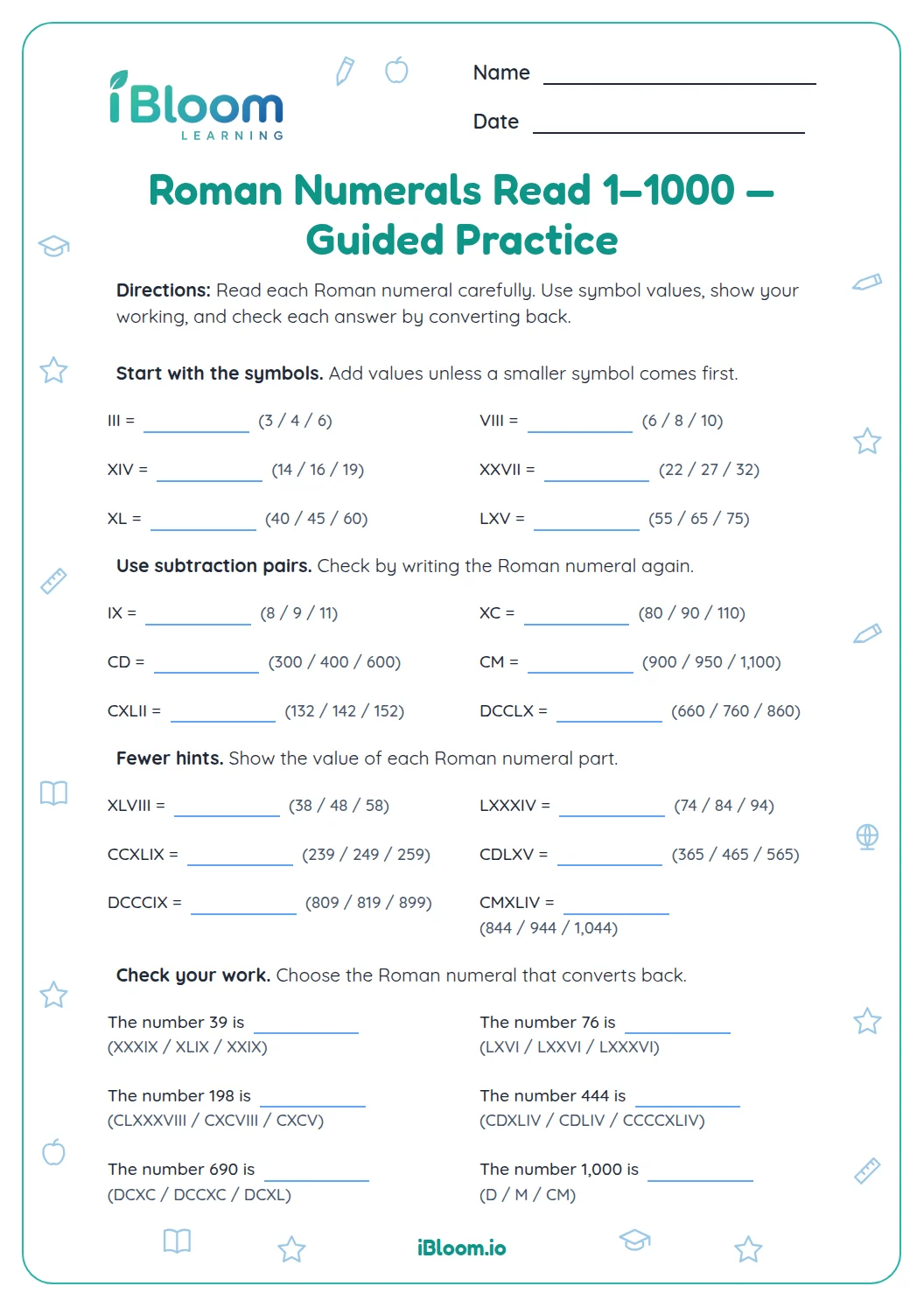
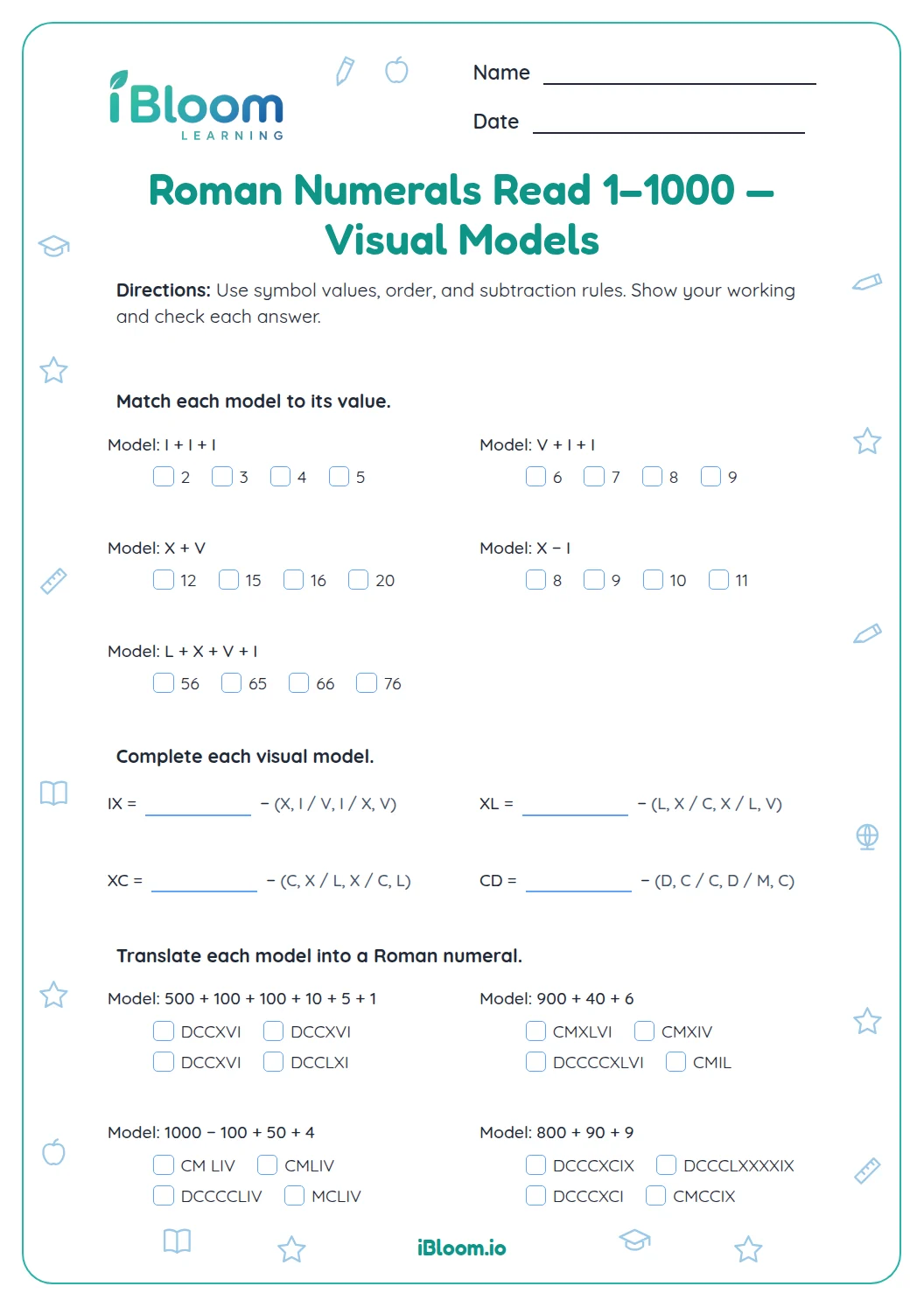
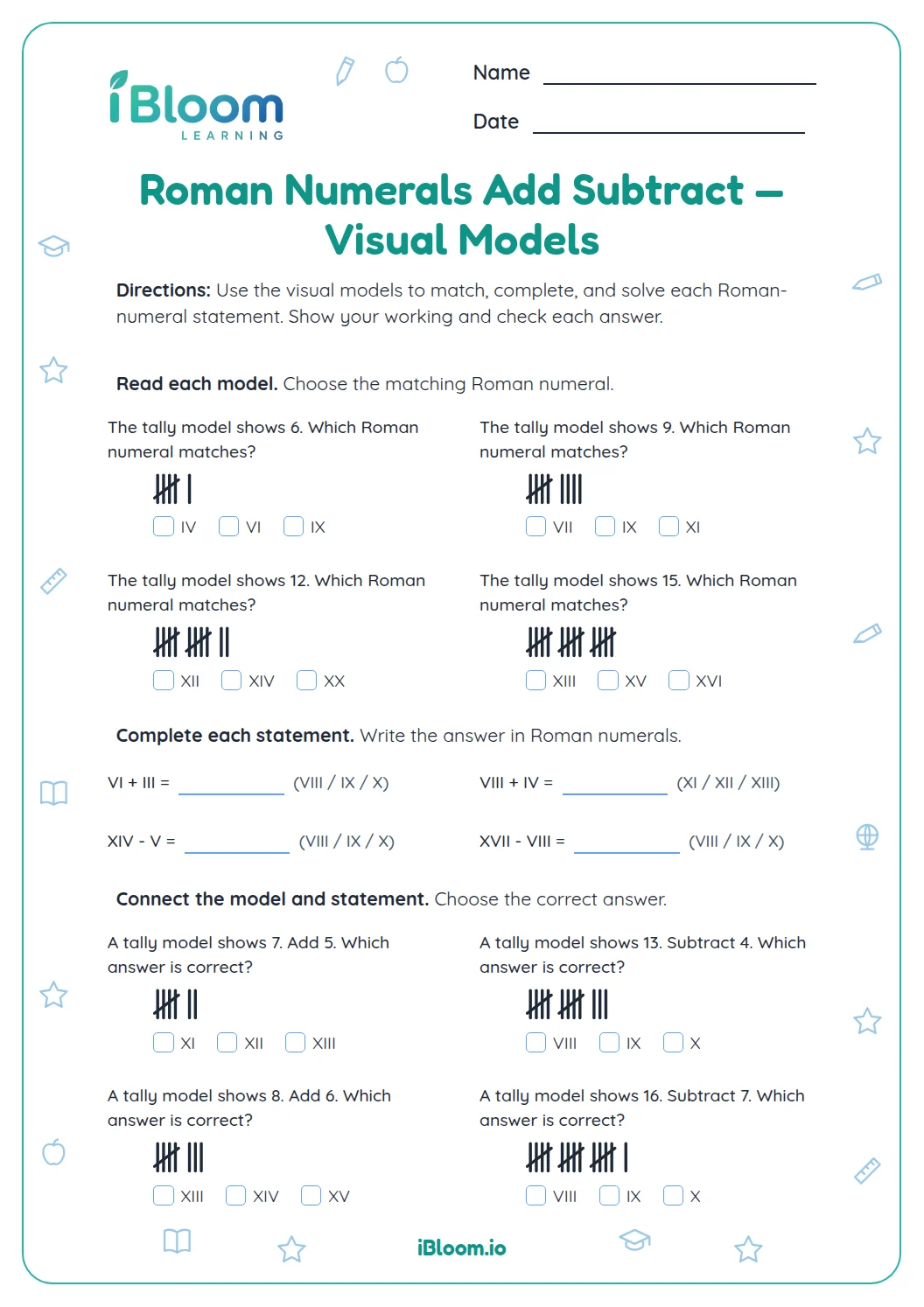
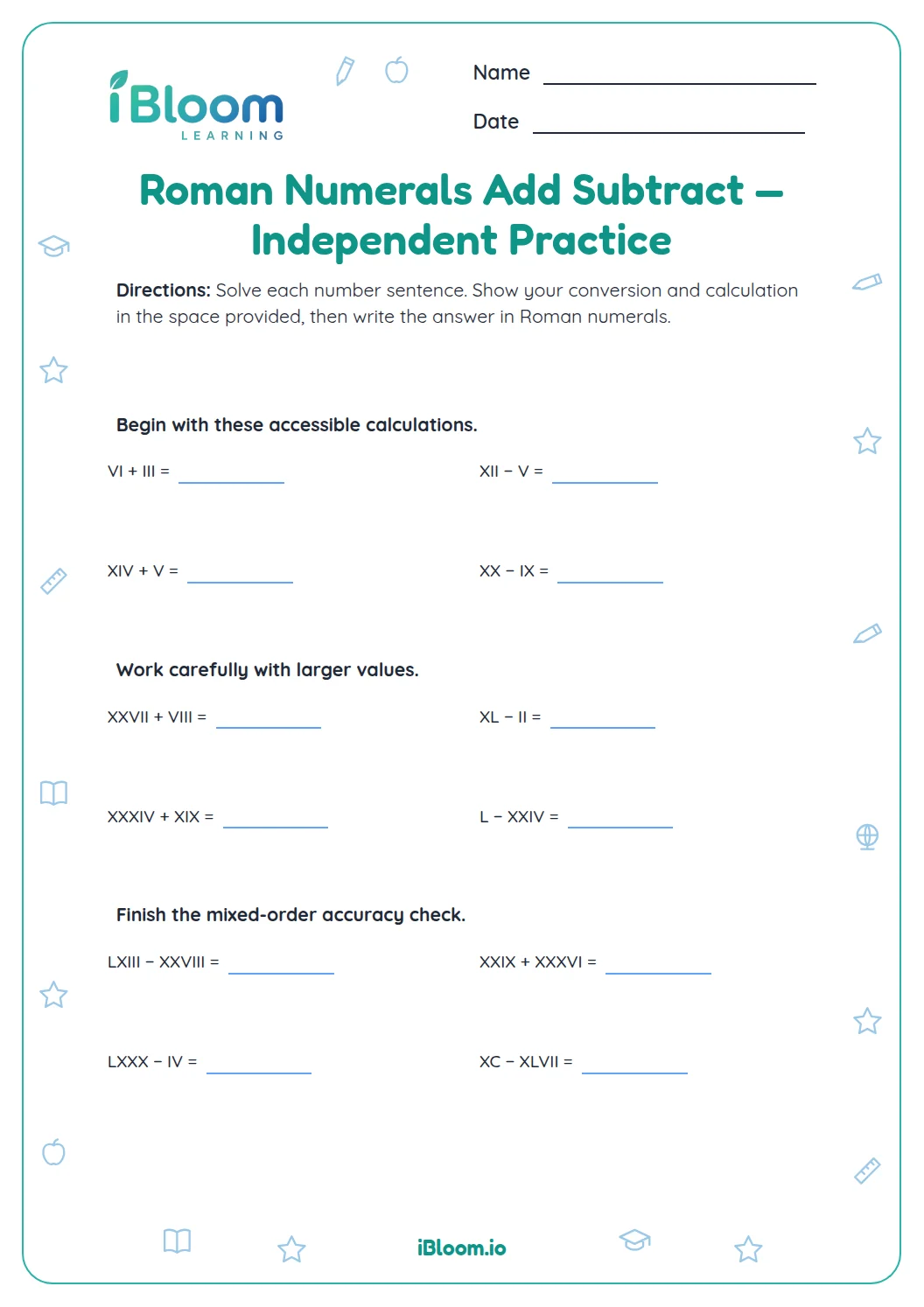
This free printable gives Grade 4 learners 14 reasoning questions on reading Roman numerals from 1 through 399. Children decode familiar symbols and subtraction pairs, check mistaken readings, and compare values. The worksheet includes examples such as IV, XL, XC, and CXLII, with a separate answer key. It builds careful grouping: hundreds, tens, and ones can be read as chunks and combined. The worksheet and its answer key each have two pages.
How do Roman numerals show a number?
Read the symbols in groups. When a smaller symbol comes before a larger one, subtract it; otherwise, add the values. In question 1, IV is 5 − 1, which equals 4. In XXVII, the values add: 10 + 10 + 5 + 1 + 1.
- 1IV
- 2I before V means subtract
- 35 − 1 = 4
- 4IV = 4
How do hundreds, tens, and ones combine through 399?
Separate a numeral into familiar groups, then combine their values. For CCCXCIX, read CCC as 300, XC as 90, and IX as 9. The total is 399, the upper end of the range on this worksheet.
What reasoning appears in the challenge?
The 14 items practice values from 4 through 399, including subtraction pairs, mixed hundreds and tens, and comparisons that require reading before ordering.
- Part A: decode eight Roman numerals, including 399
- Part B: check three readings
- Part C: compare numerals and identify values near 200 and 300
- Answer key on separate pages.
How to use this worksheet
- 1Recall I, V, X, L, and C before starting.
- 2Scan for subtraction pairs such as IV, IX, XL, and XC.
- 3Read the remaining symbols as groups and add their values.
- 4Compare or order the standard-number values, not symbol length.
- 5Use the key to check each group that was easy to miss.
Common mistakes and quick fixes
The mistake
Adding every symbol even in a subtraction pair
The fix
When a smaller symbol comes first, subtract it: IV is 5 − 1.
The mistake
Reading XL as 60
The fix
X before L means 50 − 10, so XL is 40.
The mistake
Comparing numerals by how many letters they have
The fix
Convert each numeral to a standard number before comparing.
What to practice next
Make more practice
Questions parents and teachers ask
What do the letters in Roman numerals mean?
The symbols used in this worksheet are I = 1, V = 5, X = 10, L = 50, and C = 100. When a smaller symbol comes before a larger one in a standard pair such as IV, subtract it; otherwise, add the values. The sheet combines these groups to read values through 399.
How do you read a subtraction pair such as XL?
In XL, X comes before L, so subtract 10 from 50 to get 40. The same pattern appears in XC: 100 − 10 = 90. Recognizing these pairs helps children read numerals efficiently without adding every symbol as though it were positive.
What is the answer to XXVII?
XXVII is 27. The two X symbols are 10 + 10, V is 5, and II is 2; together they total 27. Question 4 checks this kind of grouping, while later questions mix tens and ones with subtraction pairs. The value, rather than the numeral length, determines order.
Why is Ben’s reading of XLIV incorrect?
XLIV is 44, not 66. XL is 40 because X before L means 50 − 10. IV is 4 because I before V means 5 − 1. Add those groups: 40 + 4 = 44. Look for the smaller symbol placed before a larger one.
How many questions are on this worksheet?
There are 14 questions in three parts: eight numerals to decode, three multiple-choice reading checks, and three comparison or boundary checks. The printable and its separate answer key each have two pages. Numerals range from IV (4) through CCCXCIX (399).
What should children try after reading numerals to 399?
After reading Roman numerals through 399, try writing the numerals for standard numbers in the same range, then extend reading to larger values. Moving between standard numbers and Roman numeral groups checks whether children can both recognize and build the groups.