


About this worksheet
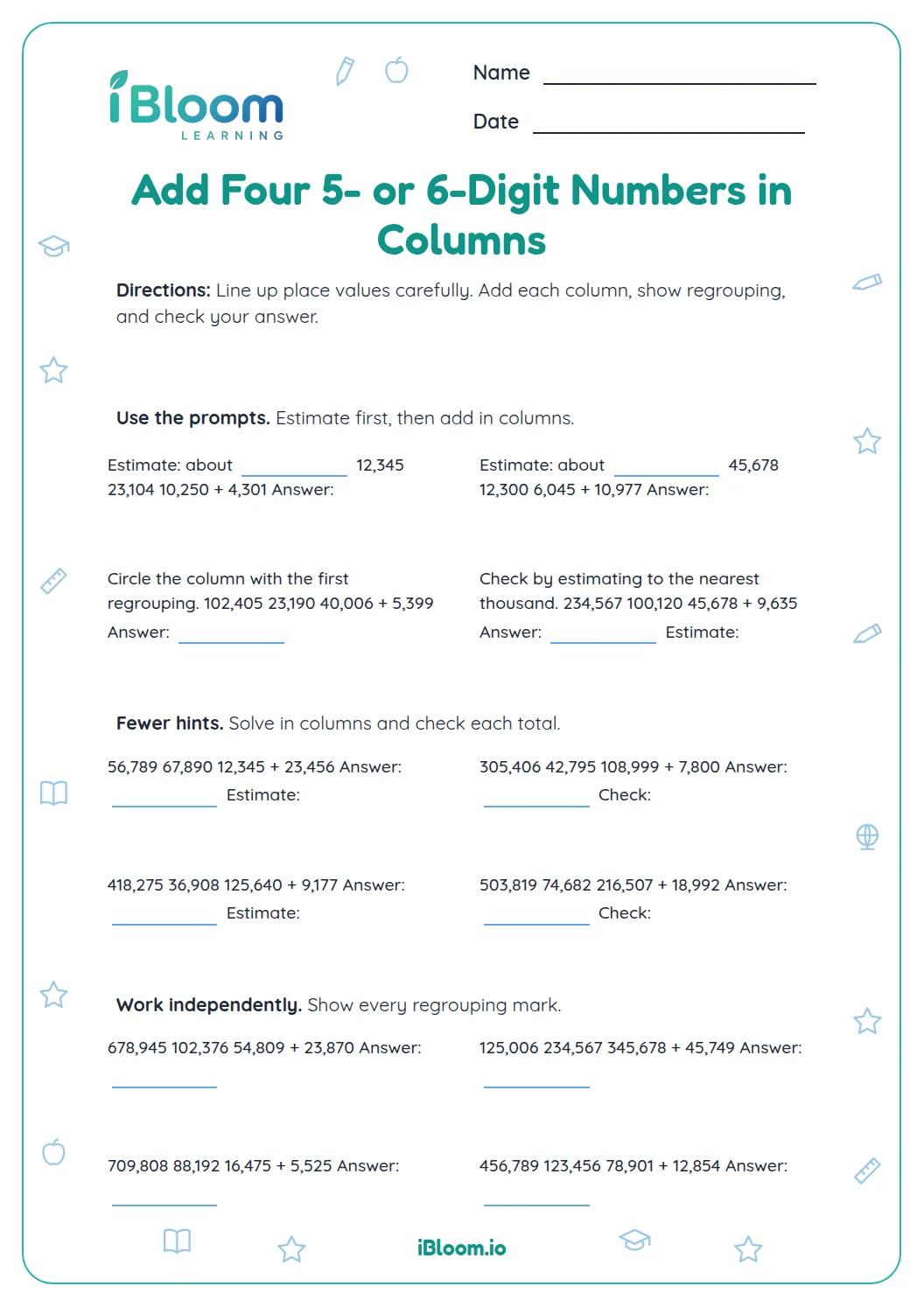
Each problem has four 5- or 6-digit addends. Work from ones through hundred-thousands, regrouping whenever a column reaches ten.
How do you add four numbers in columns?
Keep like place values in the same column. Add the four digits in the ones column first, write the ones digit, and carry the tens to the next column. Repeat through the largest place.
For example, if a column totals 23, write 3 in that column and carry 2 to the next one. Finally, estimate the sum to see whether the answer is a sensible size.
What is on the worksheet?
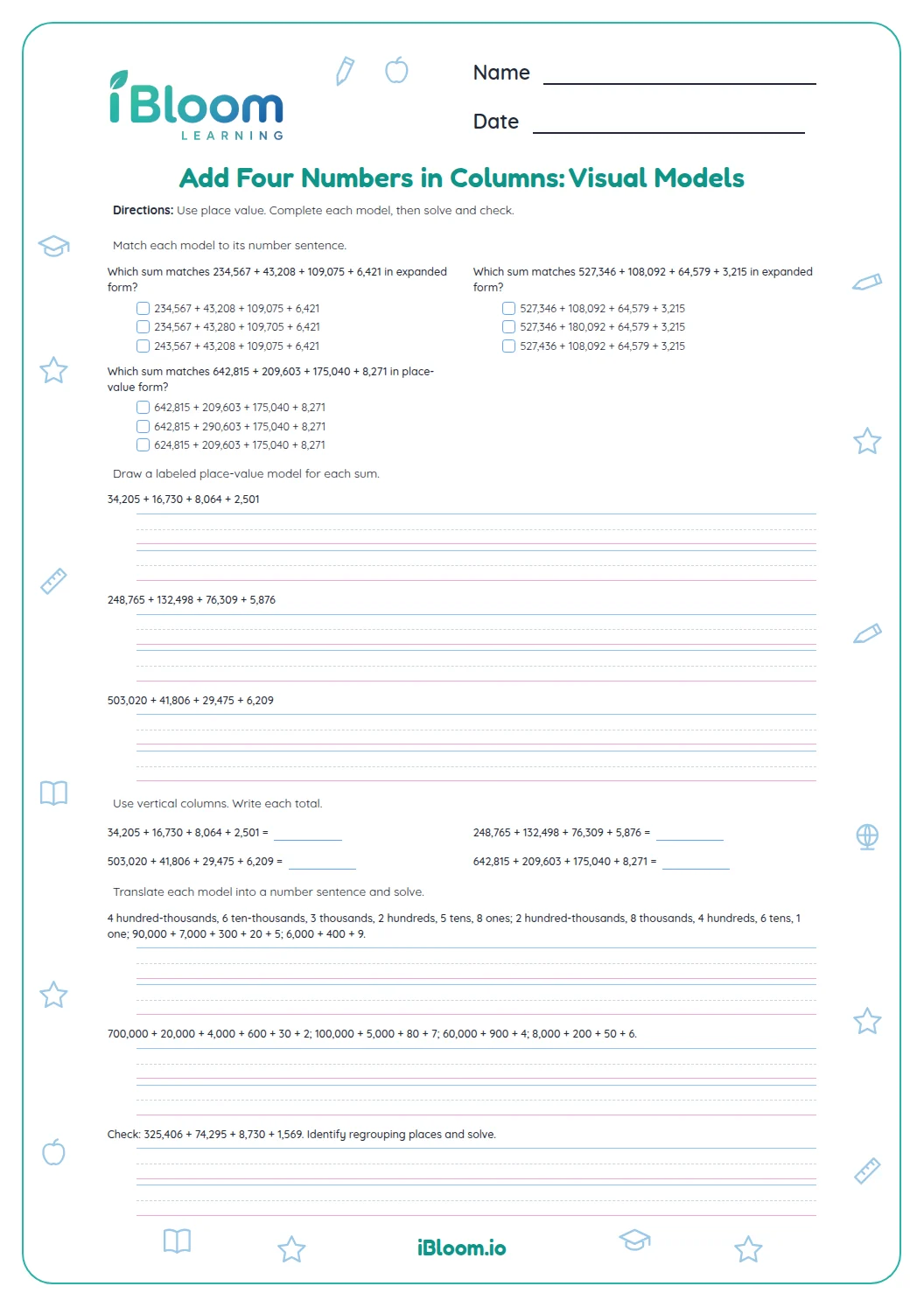
Part A starts with four addends, then Parts B and C practice regrouping across place values and checking totals. Each item is a four-number addition sentence, matching the worksheet title.
A steady column method
- 1Write each addend in a separate row and align ones under ones.
- 2Add the ones digits; record the ones and carry any tens.
- 3Add the next column and the carried amount.
- 4Continue through the leftmost place, then read the full sum.
- 5Estimate by rounding each addend to check the size of your total.
Check your thinking
The mistake
Forgetting to add a carried digit in the next column.
The fix
Mark the carry above the next column and include it in that column’s total.
What to practice next
Questions parents and teachers ask
How many questions are on this worksheet?
There are 16 addition problems, and every problem has exactly four addends. The five- and six-digit values give practice keeping ones, tens, hundreds, and larger place values aligned while adding. Before solving, count the four addends and note the largest place value shown.
How can learners check their answers?
Estimate a total first, then check the written sum with the answer key. If the total differs, add one place-value column at a time and verify each regrouped ten in the next column before changing the answer. Compare the estimate with the exact sum to catch a misplaced digit or regrouping error.
Can I use this worksheet at home?
Yes. Learners can set up each equation vertically on scratch paper, keeping matching place values in the same column. An adult can check the final total with the included answer key after all problems are complete. Ask the learner to explain which column required regrouping in one selected problem.
What skill does this page practice?
This worksheet practices adding four large whole numbers, including regrouping across place values. All 16 problems use five- or six-digit addends and ask for one total in the answer space. Writing addends vertically can make it easier to track each regrouped ten.