


About this worksheet
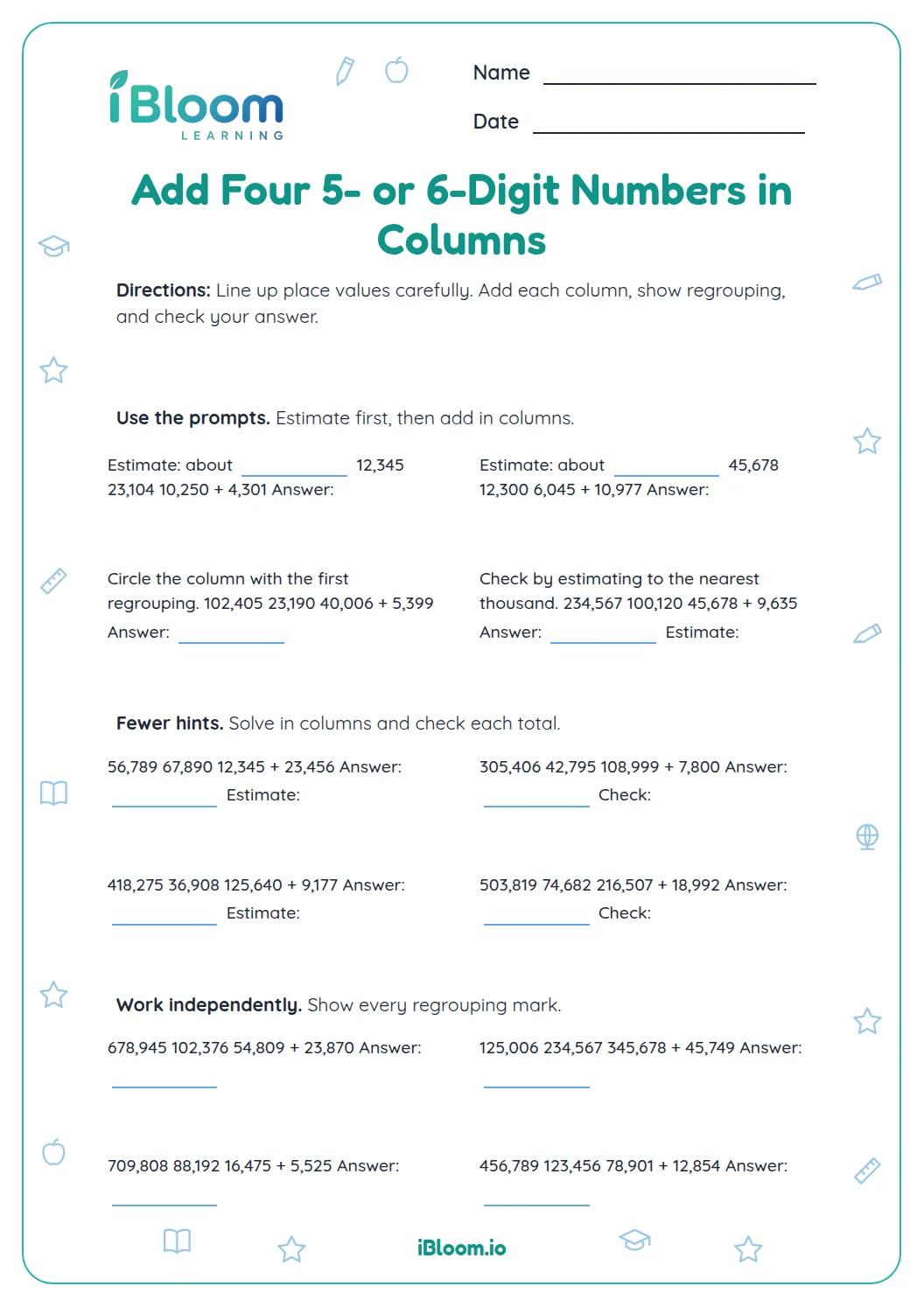
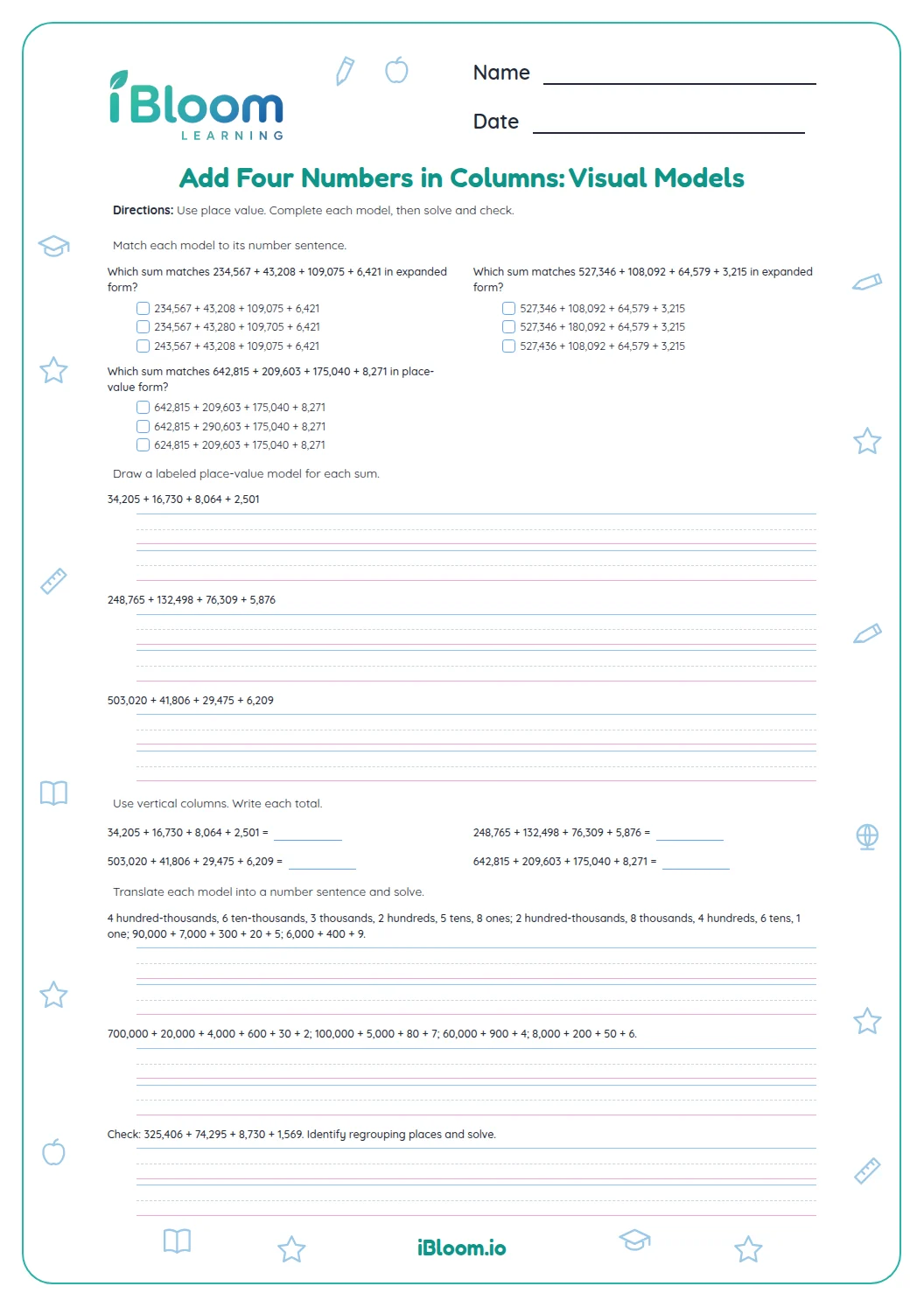
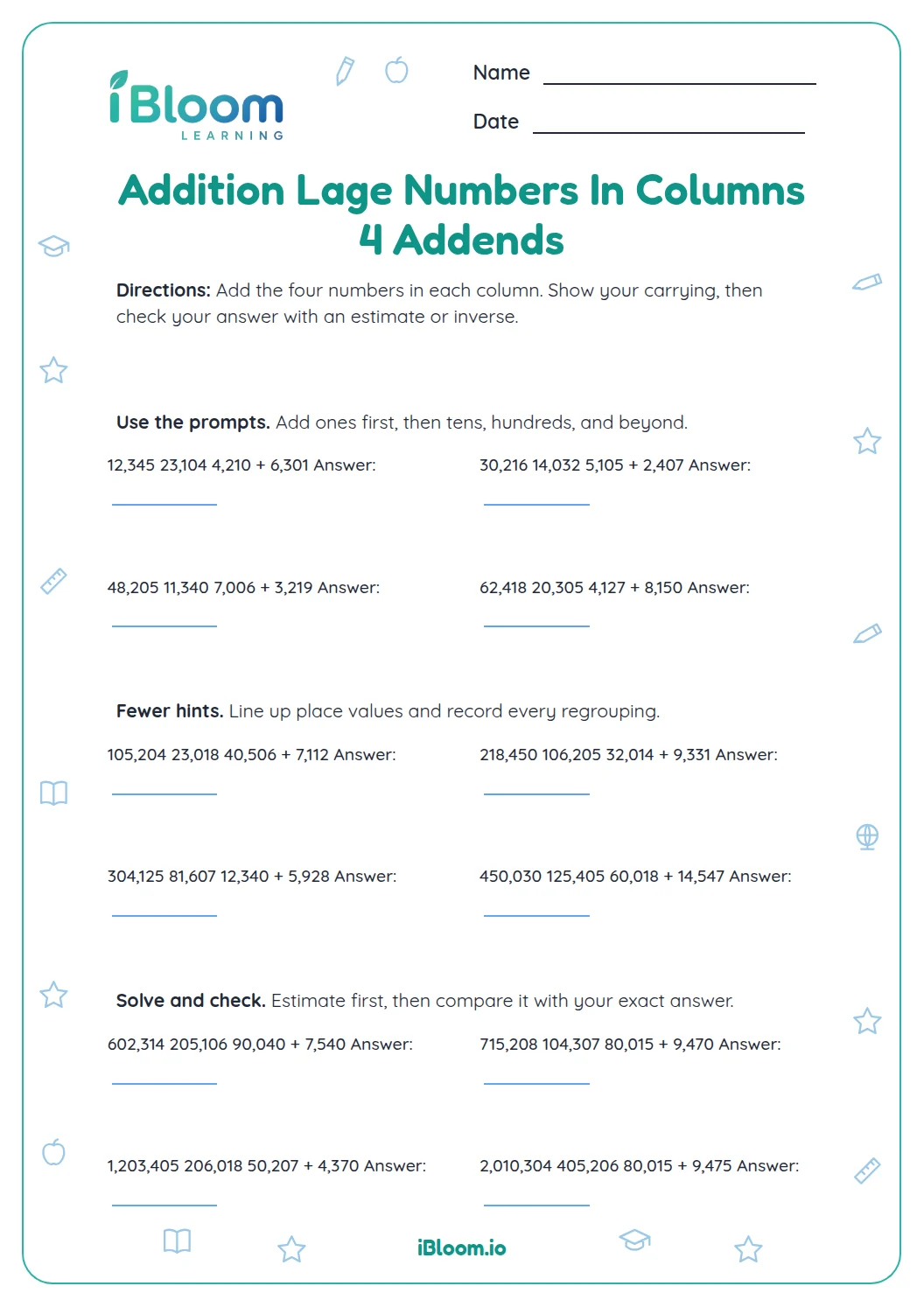
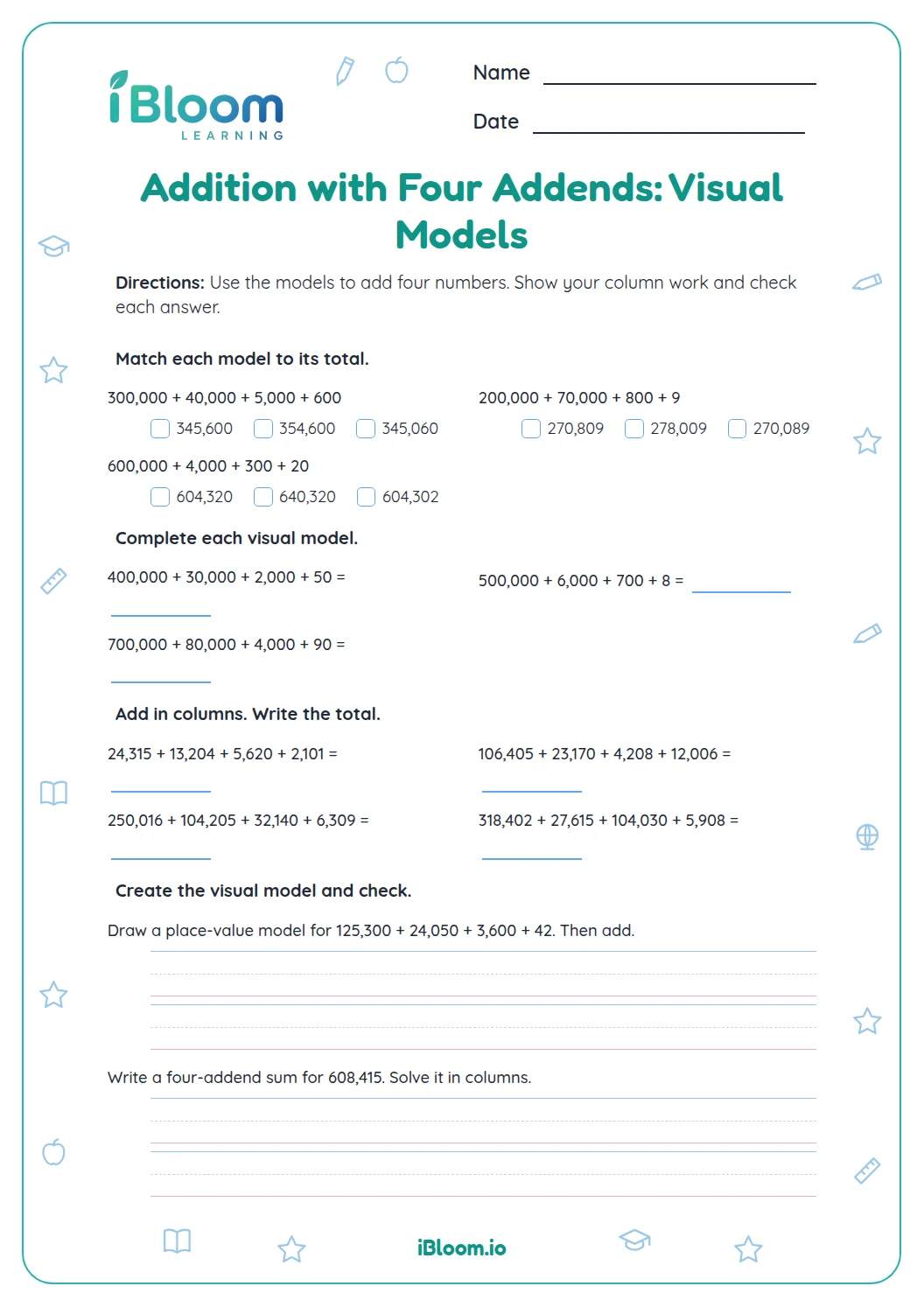
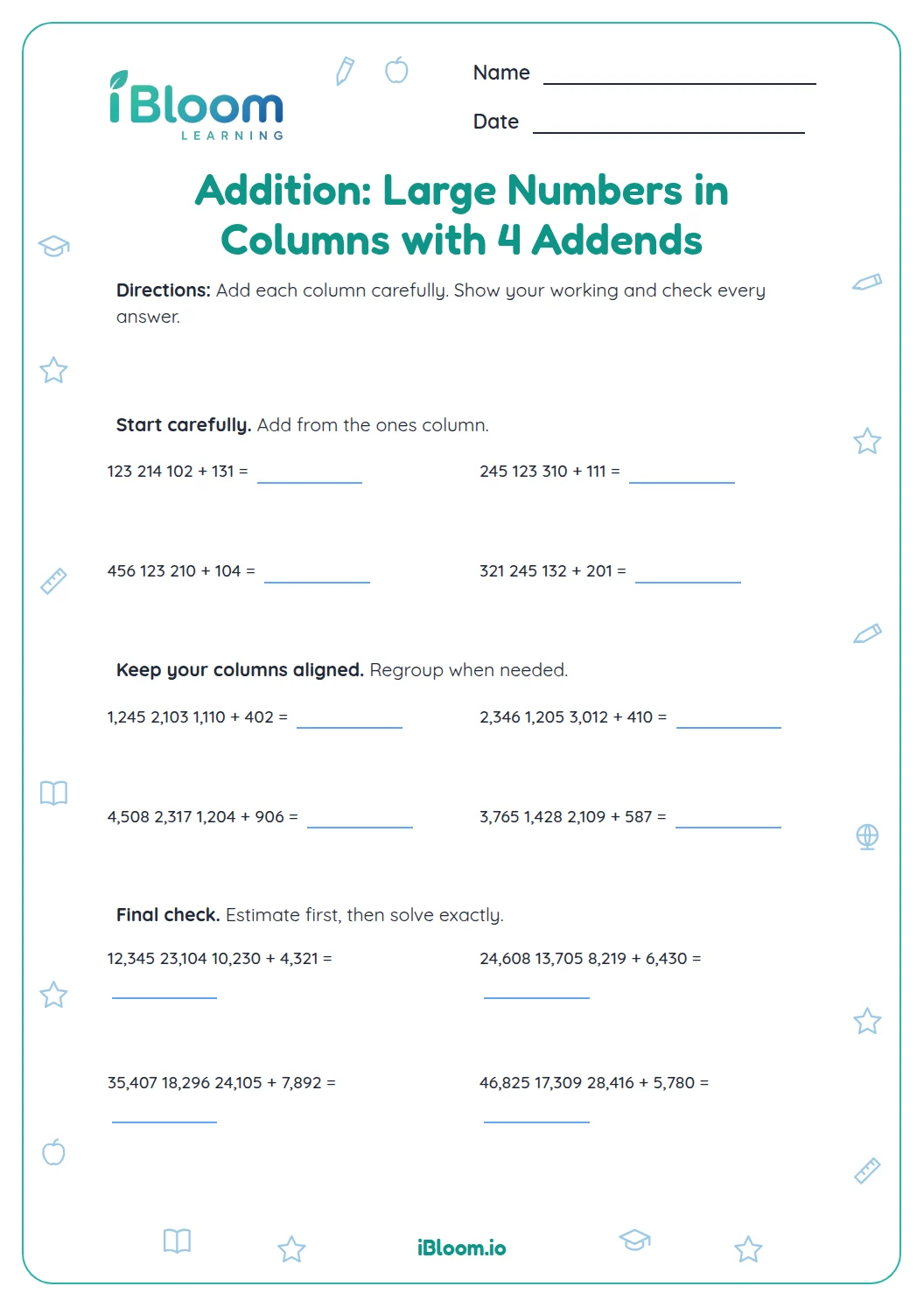
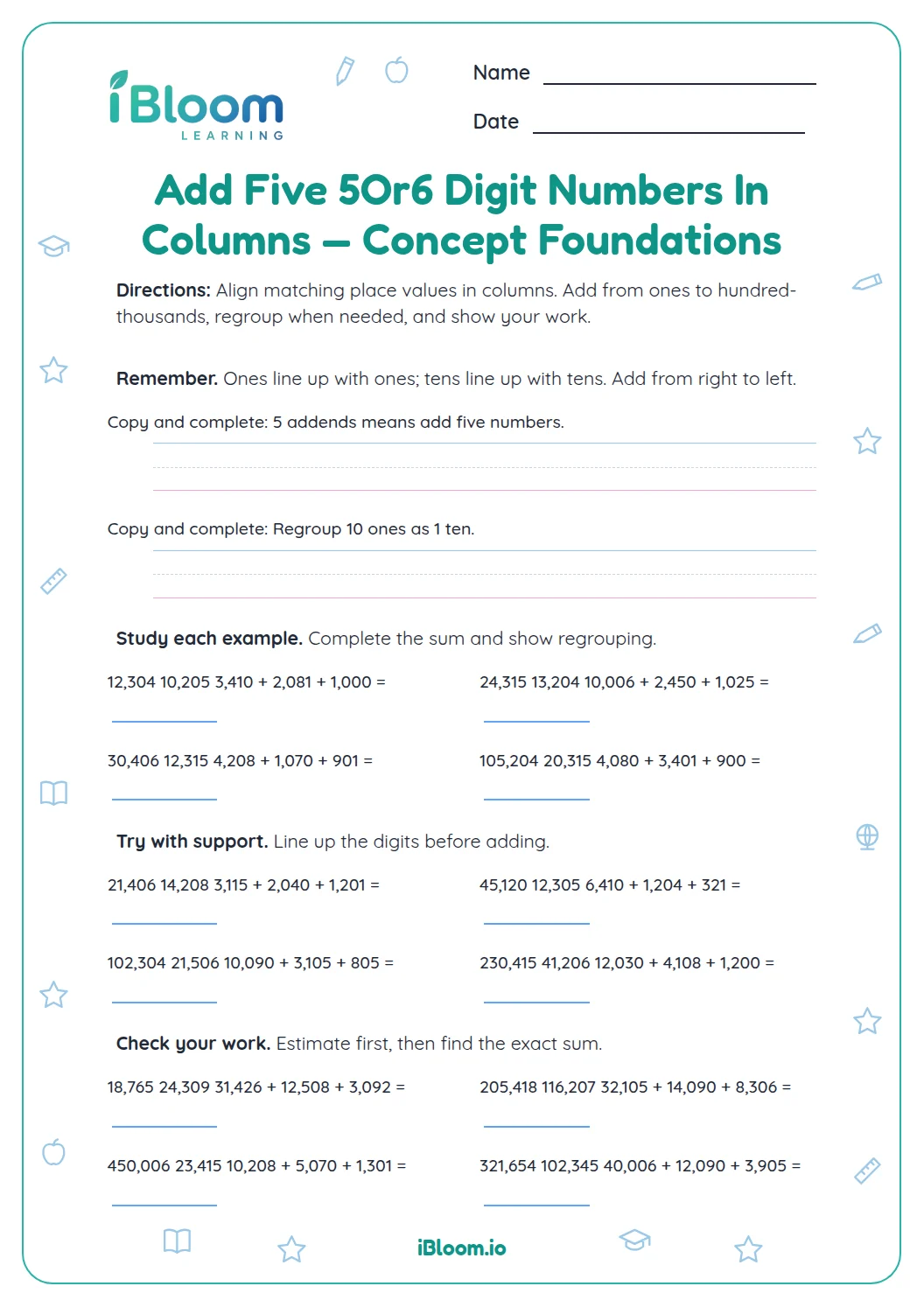
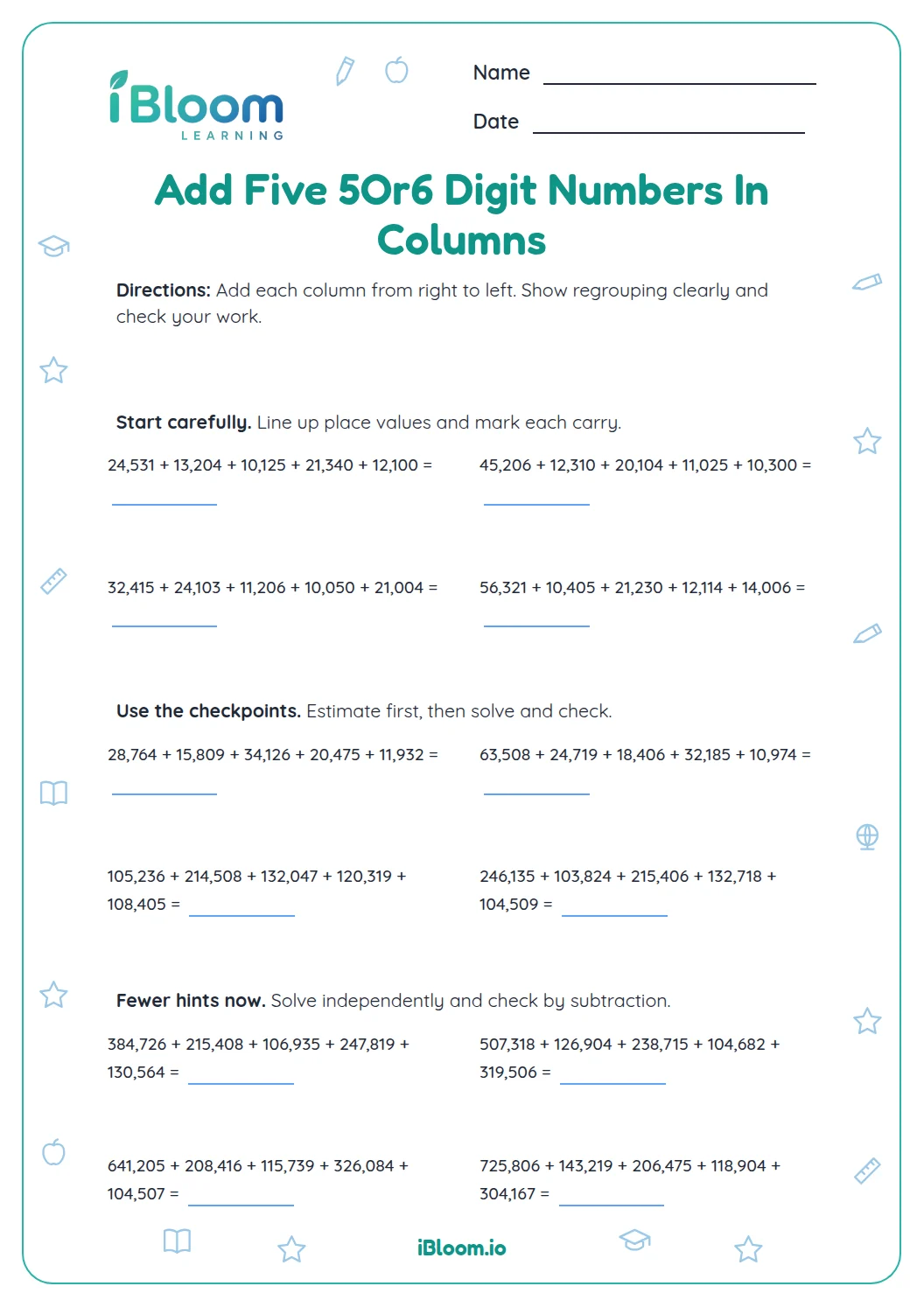
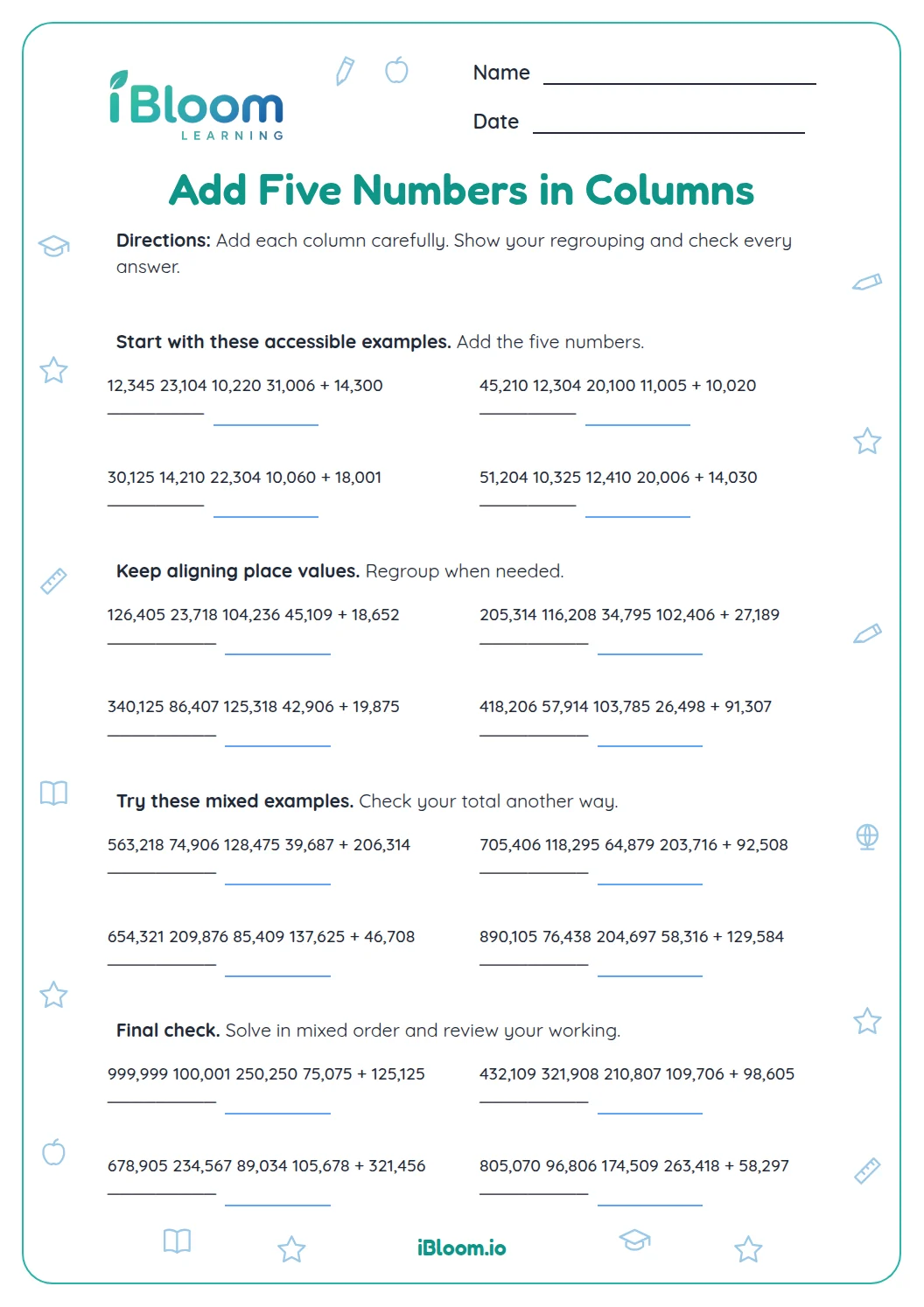
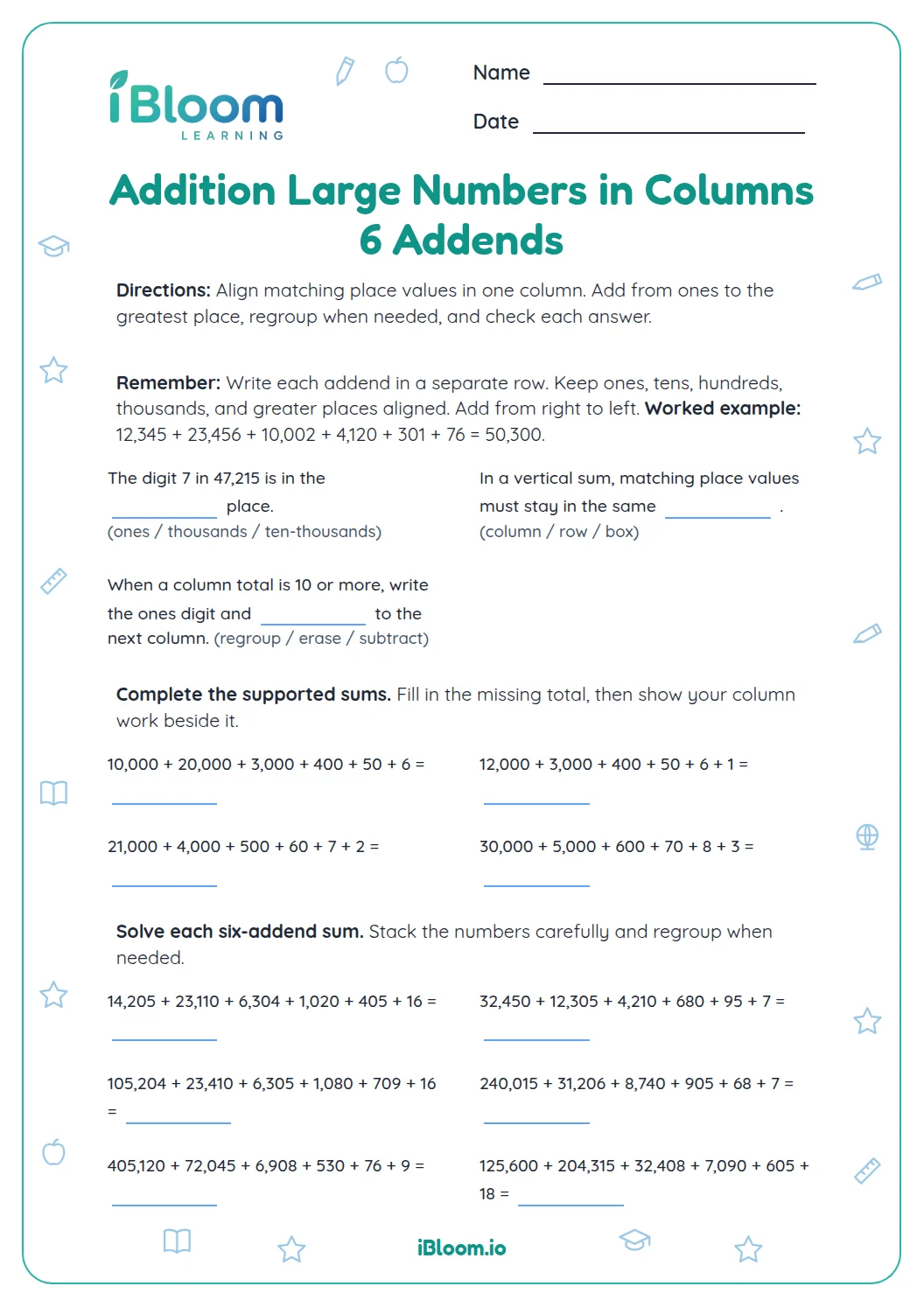
This free printable Grade 5 worksheet gives students 10 sums with four addends each. Part A uses five-digit numbers; Part B moves to six-digit numbers and mixed five- and six-digit lengths. Students arrange each set vertically in a work space, add from right to left, and record the total. The practice supports Common Core 4.NBT.B.4, adding multi-digit whole numbers with the standard algorithm. Early work includes a sum with no regrouping, while later sums require repeated regrouping and can produce totals in the millions. A separate answer key lists all 10 totals.
Aligned to 4.NBT.B.4
What is on the independent practice sheet?
Part A contains four sums of four five-digit numbers. Part B contains six more sums, including mixed five- and six-digit addends and totals greater than one million. Each problem supplies a horizontal list to copy into columns on the work space.
Students do the setup themselves. The ones digits share a column, and the shorter addends sit under the matching place values of longer addends. The answer box holds the final total; the space holds the calculation.
How do you regroup when there are four addends?
The carry can be greater than 1. In question 2, the ones digits total 28, so 8 stays in the ones place and 2 tens go to the tens column. Include that 2 when adding the tens digits.
Continue across all five columns. Record regrouped amounts above the next column so they are included once.
- 148,726 + 35,685 + 27,439 + 16,858
- 2Ones: 6 + 5 + 9 + 8 = 28; write 8, carry 2.
- 3Tens: 2 + 8 + 3 + 5 + 2 = 20; write 0, carry 2.
- 4Hundreds: 7 + 6 + 4 + 8 + 2 = 27; write 7, carry 2.
- 5Thousands: 8 + 5 + 7 + 6 + 2 = 28; write 8, carry 2.
- 6Ten-thousands: 4 + 3 + 2 + 1 + 2 = 12.
- 7Total: 128,708.
How can students check a large total?
Estimate before checking exact digits. Rounding the four addends in question 2 to the nearest ten thousand gives 50,000 + 40,000 + 30,000 + 20,000 = 140,000. A total near that size is plausible; 12,870 is not.
For an exact check, add in pairs: 48,726 + 35,685 = 84,411 and 27,439 + 16,858 = 44,297. Those pair totals add to 128,708. This changes the grouping and gives another way to catch a missed addend or carry.
How to use this worksheet
- 1Read the four addends and make a quick estimate of their total.
- 2Copy each sum vertically into its space, with ones under ones.
- 3Add the ones column and record any carry above the tens column.
- 4Work leftward, adding all four digits and the carry in each column.
- 5Write the total in the answer box and compare it with the estimate.
- 6Use the key to check, then recompute missed sums by adding two pairs.
Mistakes to watch for
The mistake
Aligning a five-digit number with the left edge of a six-digit number.
The fix
Start at the ones place on the right. A five-digit number leaves the hundred-thousands position empty.
The mistake
Carrying 1 automatically when a column totals 28 or 32.
The fix
Separate the total into tens and ones: 28 means write 8 and carry 2; 32 means write 2 and carry 3.
The mistake
Forgetting one of the four addends.
The fix
Count four number rows before adding and touch each digit once as you total a column.
Common Core alignment
Add four large whole numbers using aligned columns and regrouping.
On this sheet: Students independently arrange and add ten sets of four five- or six-digit numbers.
Show the official wordingHide the official wording
Fluently add and subtract multi-digit whole numbers using the standard algorithm.
What to practice next
Make more practice
Further reading
Questions parents and teachers ask
Are the numbers already arranged vertically?
Students arrange the numbers vertically themselves in the printed work spaces. Each question supplies four addends in a horizontal expression. Copying them into columns is part of the practice, especially when a five-digit number appears alongside six-digit numbers. Align the ones digits before starting any addition.
How many problems are included?
There are ten problems, each with exactly four addends. Part A has four sums using five-digit numbers. Part B has six sums using six-digit numbers or a mixture of five- and six-digit numbers. Every problem has a work space and a separate box for its final total.
Can the carry be greater than one?
Yes, adding four digits can produce a carry of two or three. In question 2, the ones digits add to 28, so students write 8 and carry 2. They then include those two tens in the next column. Writing the carry above that column helps prevent omissions.
What should my child do when the answer reaches a million?
Write the extra leading digit in a new place to the left. Four six-digit addends can have a seven-digit total, so a result above one million is reasonable. Keep the same right-to-left addition process, and include the final carry instead of squeezing it into an existing place.
Does the answer key include all the column work?
The answer key provides the final total for every problem. Use the child’s space to inspect alignment and regrouping when a total differs. For question 2, the worked example on this page explains every column. Adding pairs of addends also gives an exact check without repeating the same sequence.