

About this worksheet
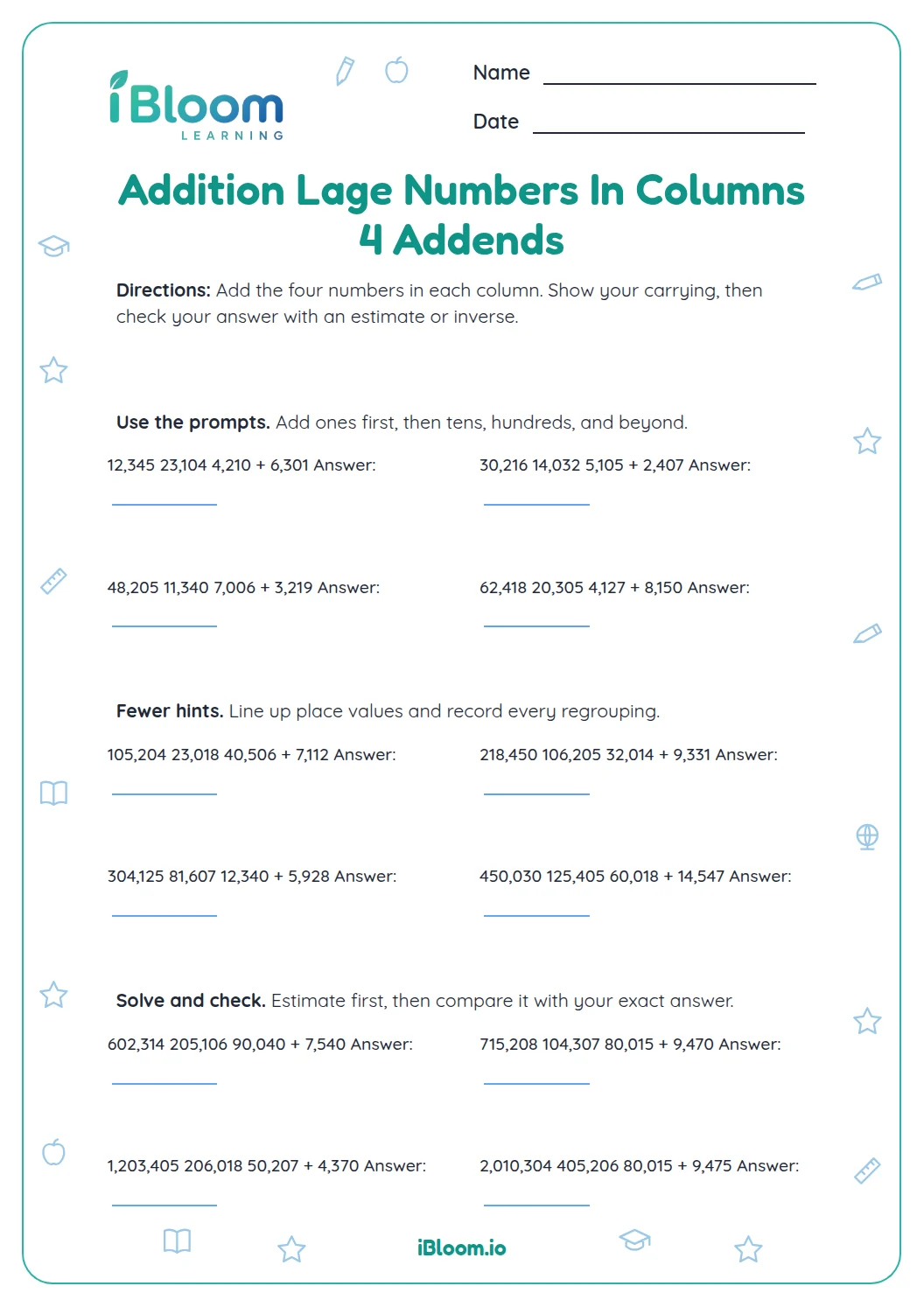
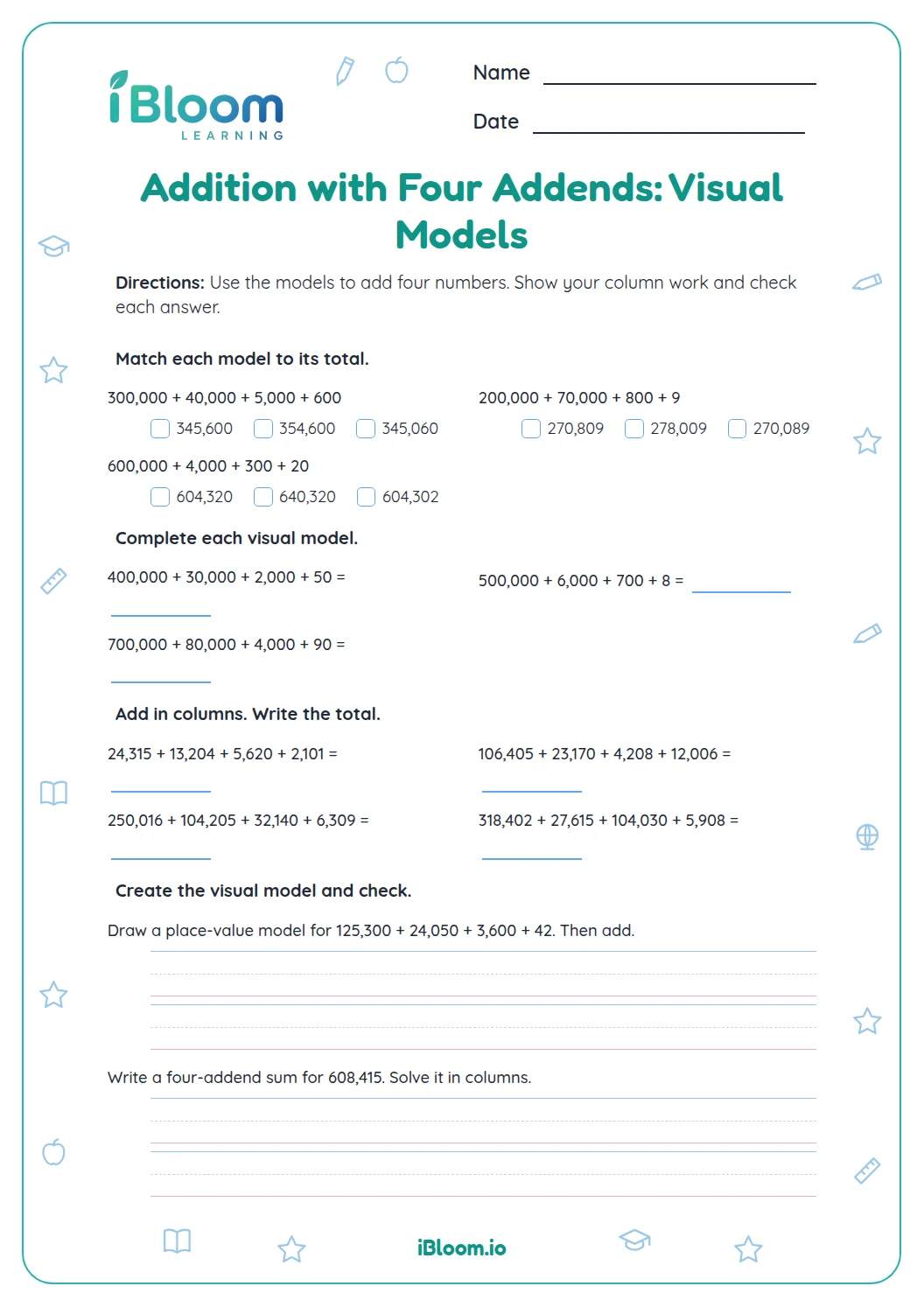
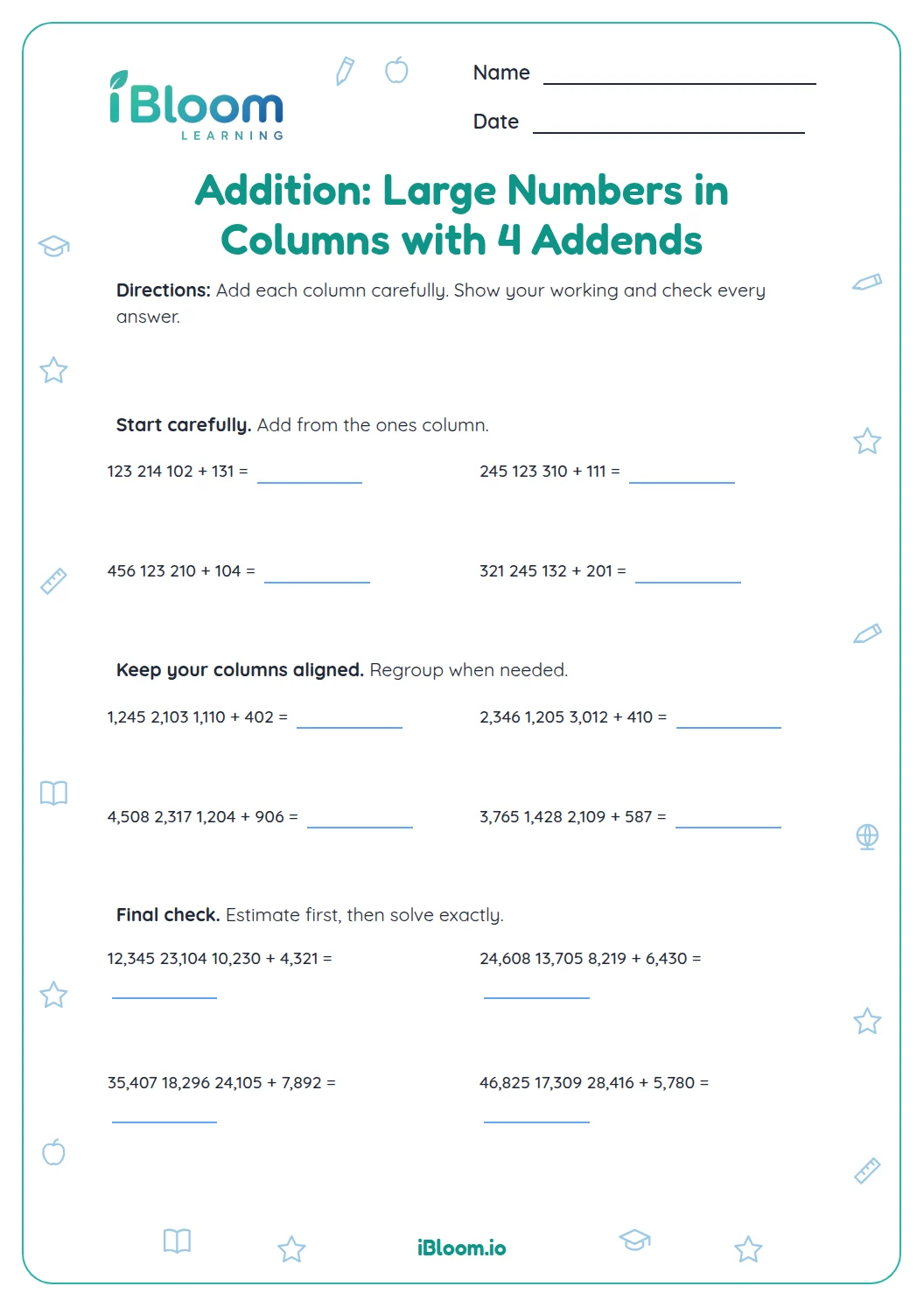
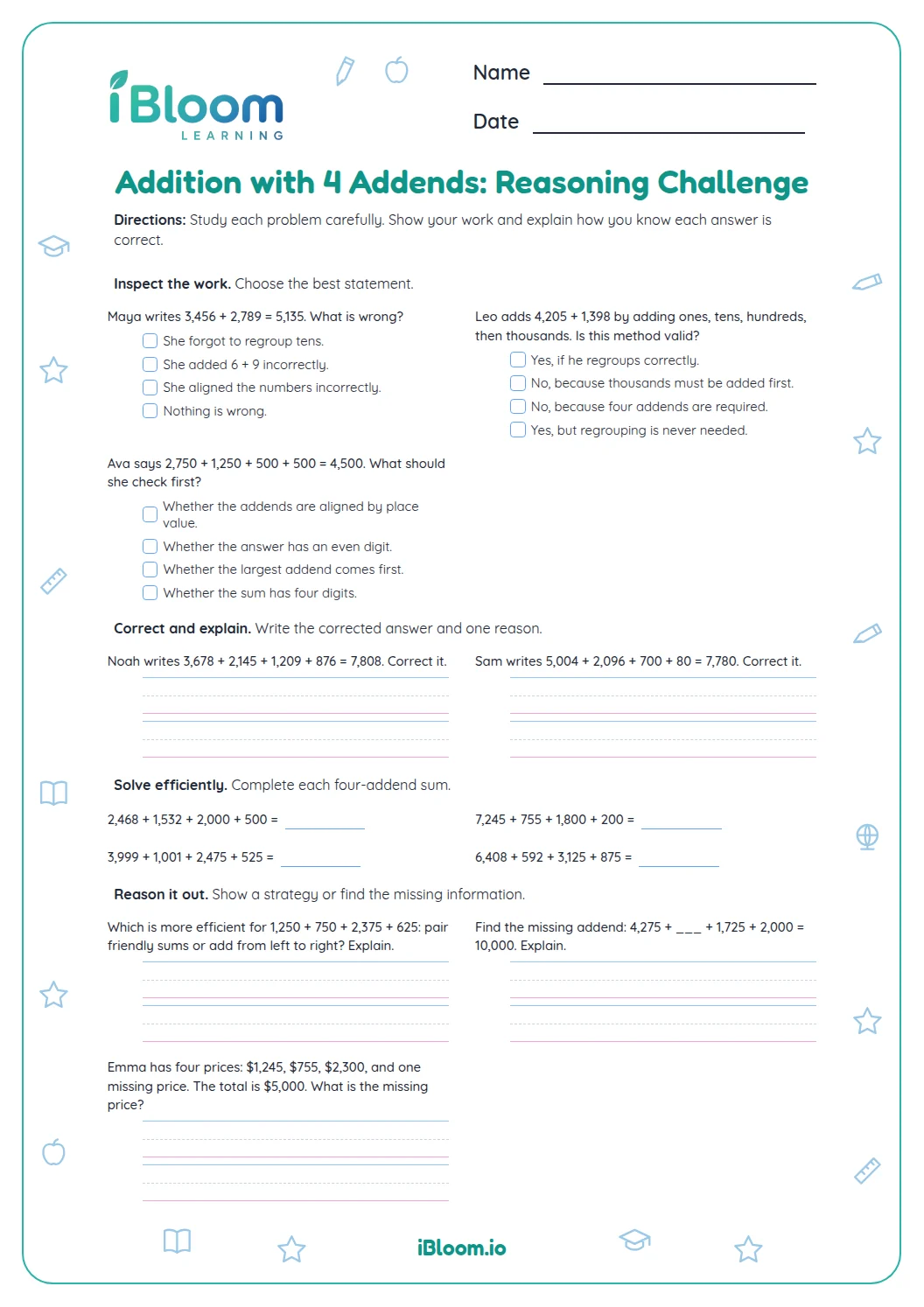
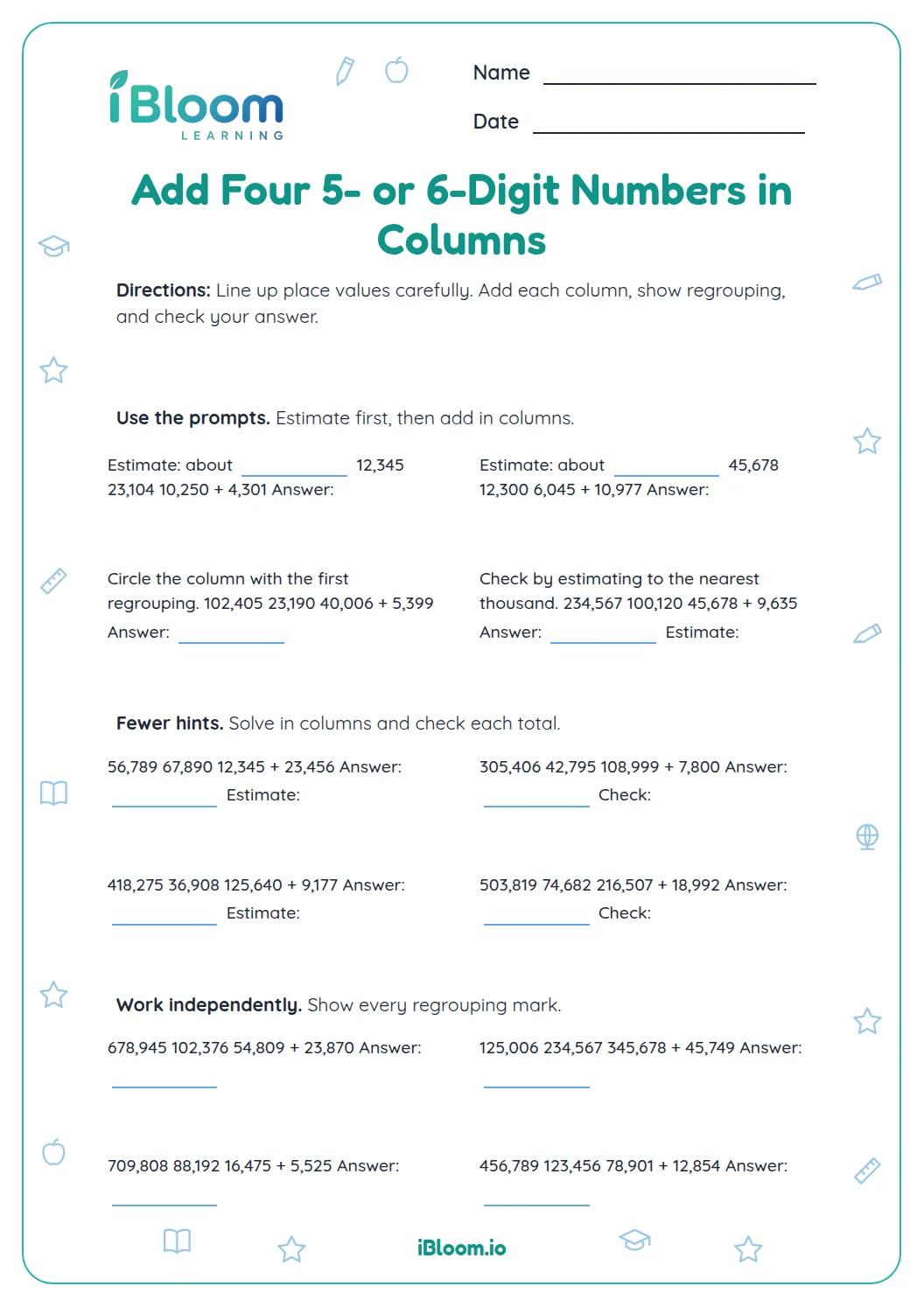
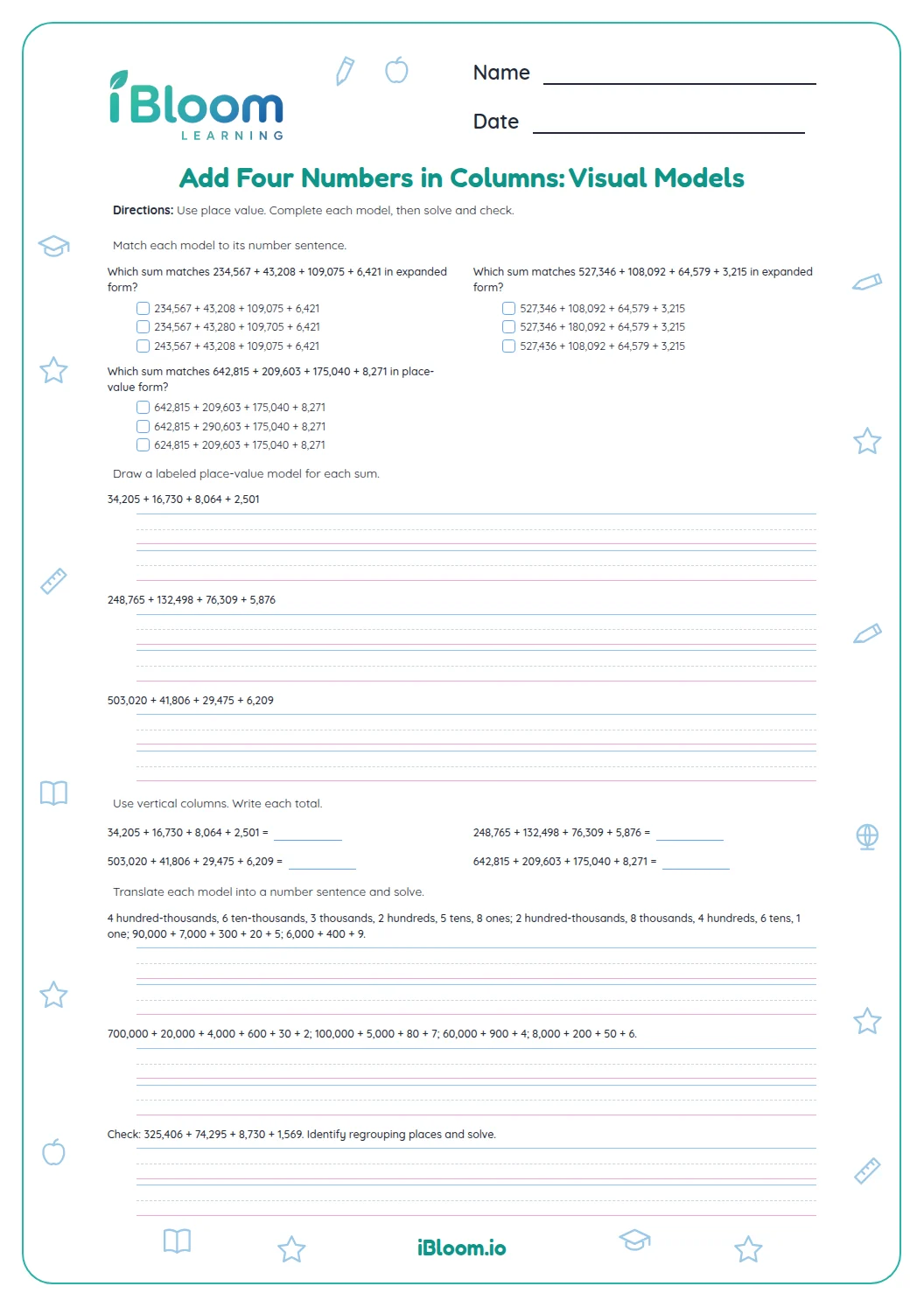
This free Grade 5 worksheet develops a careful routine for adding four large whole numbers in columns. Two opening choices check alignment and regrouping. Twelve calculations then ask children to arrange four addends on squared working space and find each sum, starting with a sum that needs no regrouping. The final problems include zeros, unequal number lengths, and a total of one million. The practice uses the standard algorithm in Common Core 4.NBT.B.4. A separate answer key gives both opening choices and all twelve sums.
Aligned to 4.NBT.B.4
Where should the shortest addend go?
Place its ones digit under the other ones digits. In question 1, 6,708 is added to five-digit numbers, so the 8 goes in the ones column. The empty space at the left has value zero.
For the calculation questions, students copy the four numbers into the squared work area before adding. Use one square for each digit and keep each place-value column straight.
Can we carry more than one?
Yes. Four digits in one column can add to twenty or thirty, even before including a carried amount. In question 2, the ones total is 26, so 6 stays in the ones column and 2 tens move to the tens column.
- 124,678 + 13,459 + 32,786 + 15,897
- 2Ones: 8 + 9 + 6 + 7 = 30; write 0, carry 3.
- 3Tens: 7 + 5 + 8 + 9 + 3 = 32; write 2, carry 3.
- 4Hundreds: 6 + 4 + 7 + 8 + 3 = 28; write 8, carry 2.
- 5Thousands: 4 + 3 + 2 + 5 + 2 = 16; write 6, carry 1.
- 6Ten-thousands: 2 + 1 + 3 + 1 + 1 = 8. Sum: 86,820.
How can children check a long sum?
Re-add the numbers in pairs and combine the two subtotals. This changes the grouping while keeping all four addends. For question 10, the first pair totals 500,000 and the second pair totals 500,000, giving 1,000,000.
Part B builds the routine with four calculations. Part C has three more sums with zeros and different number lengths. Part D finishes with a sum that reaches one million.
How to use this worksheet
- 1Name the ones, tens, hundreds, and thousands columns before Part A.
- 2Choose the correct alignment and regrouping answers in questions 1 and 2.
- 3Copy all four addends into the grid for each calculation, lining up the ones.
- 4Add from right to left and write every carry above the next column.
- 5Check each sum by adding two pairs and combining their subtotals.
Mistakes to check and how to help
The mistake
Lining up the left edges of numbers with different lengths.
The fix
Start with the ones digits at the right edge; empty places belong on the left.
The mistake
Carrying 1 whenever the column total is greater than 9.
The fix
Split the total into tens and ones: a total of 30 means write 0 and carry 3.
The mistake
Leaving a carried amount out of the next column.
The fix
Read every digit in that column aloud, including the small carry written above it.
Common Core alignment
Align four whole-number addends by place value and regroup to find their sum.
On this sheet: Children arrange four multi-digit addends in columns and carry tens or hundreds as needed.
Show the official wordingHide the official wording
Fluently add and subtract multi-digit whole numbers using the standard algorithm.
What to practice next
Make more practice
Further reading
Questions parents and teachers ask
Are the four addends already stacked?
Children arrange the four addends themselves in the squared working space. Each calculation lists all four numbers in one addition expression. Copying them into columns is part of the practice: line up the ones digits first, then check that tens and hundreds are also aligned.
Why can the carry be 2 or 3?
Four digits can total more than nineteen, so the regrouped amount can contain several tens. In question 4, the ones digits total 30. Children write 0 in the ones place and carry 3 tens. The next column must include those 3 along with its four digits.
Which calculation is a good starting point?
Question 3 is a useful first calculation because its columns can be added without regrouping. The sum is 44,569. Once the child has arranged those four addends correctly, question 4 adds the extra task of recording and including carries across several consecutive place-value columns.
How should we handle zeros inside an addend?
Keep each zero in its own place-value column when copying the number. In 205,060, for example, the zero in the hundreds place holds that position between thousands and tens. A zero contributes nothing to the sum, but its position keeps the other digits correctly aligned.
What does the answer key include?
The key gives the two correct concept choices and the sums for all twelve calculations. Compare the final answer first, then inspect individual columns if a sum differs. The worked example on this page also explains each carry in question 4, whose correct total is 86,820.