

About this worksheet
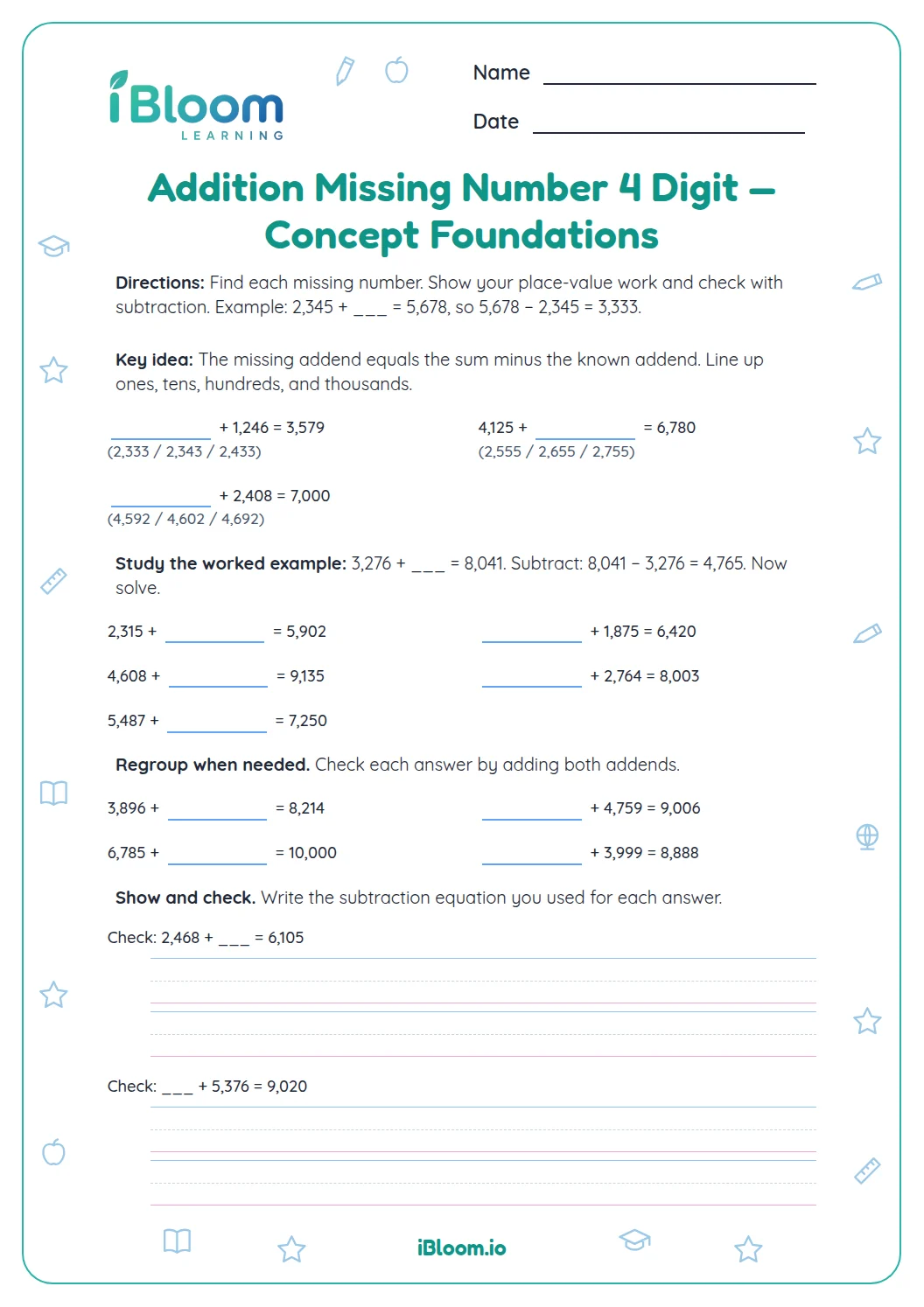
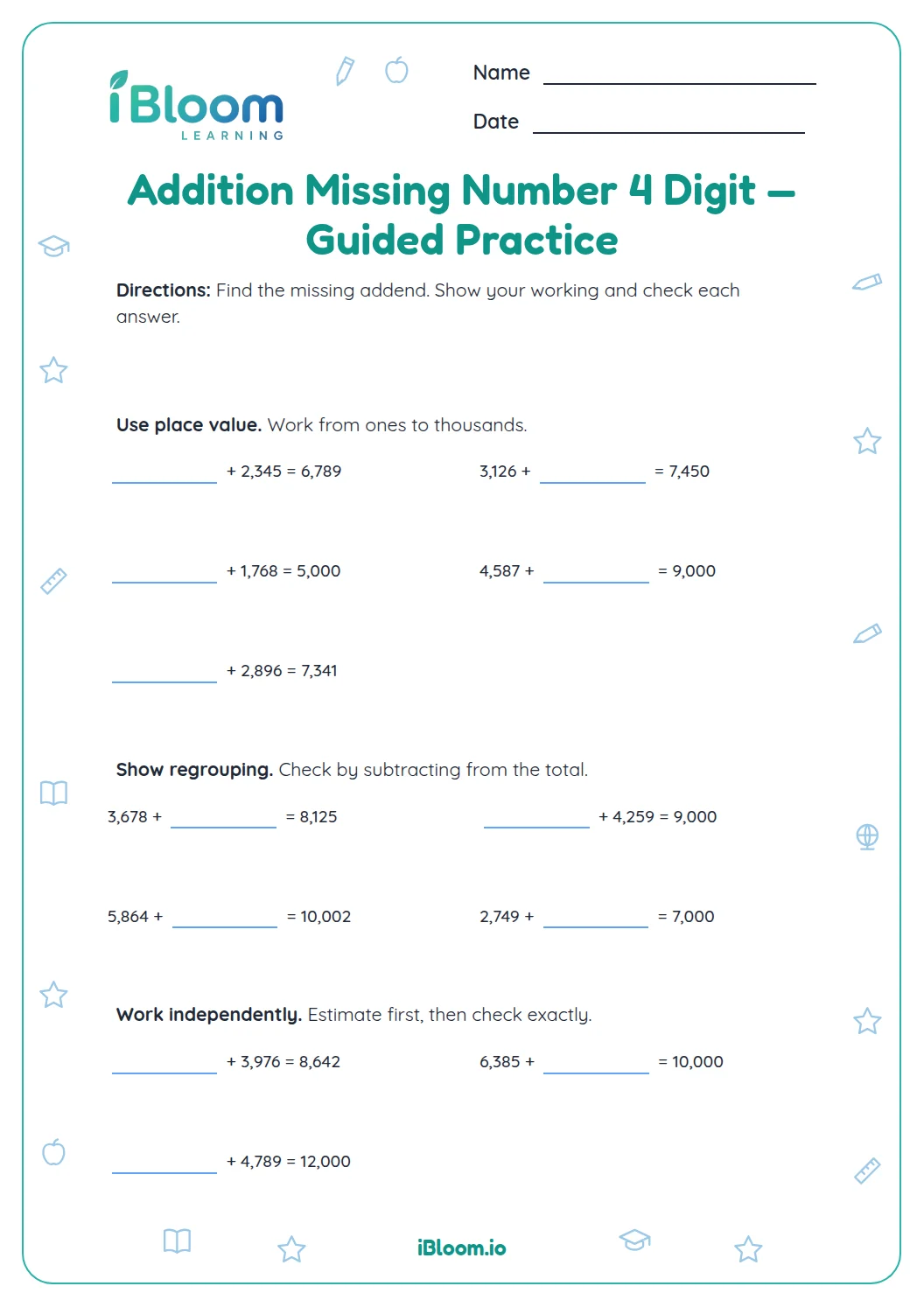
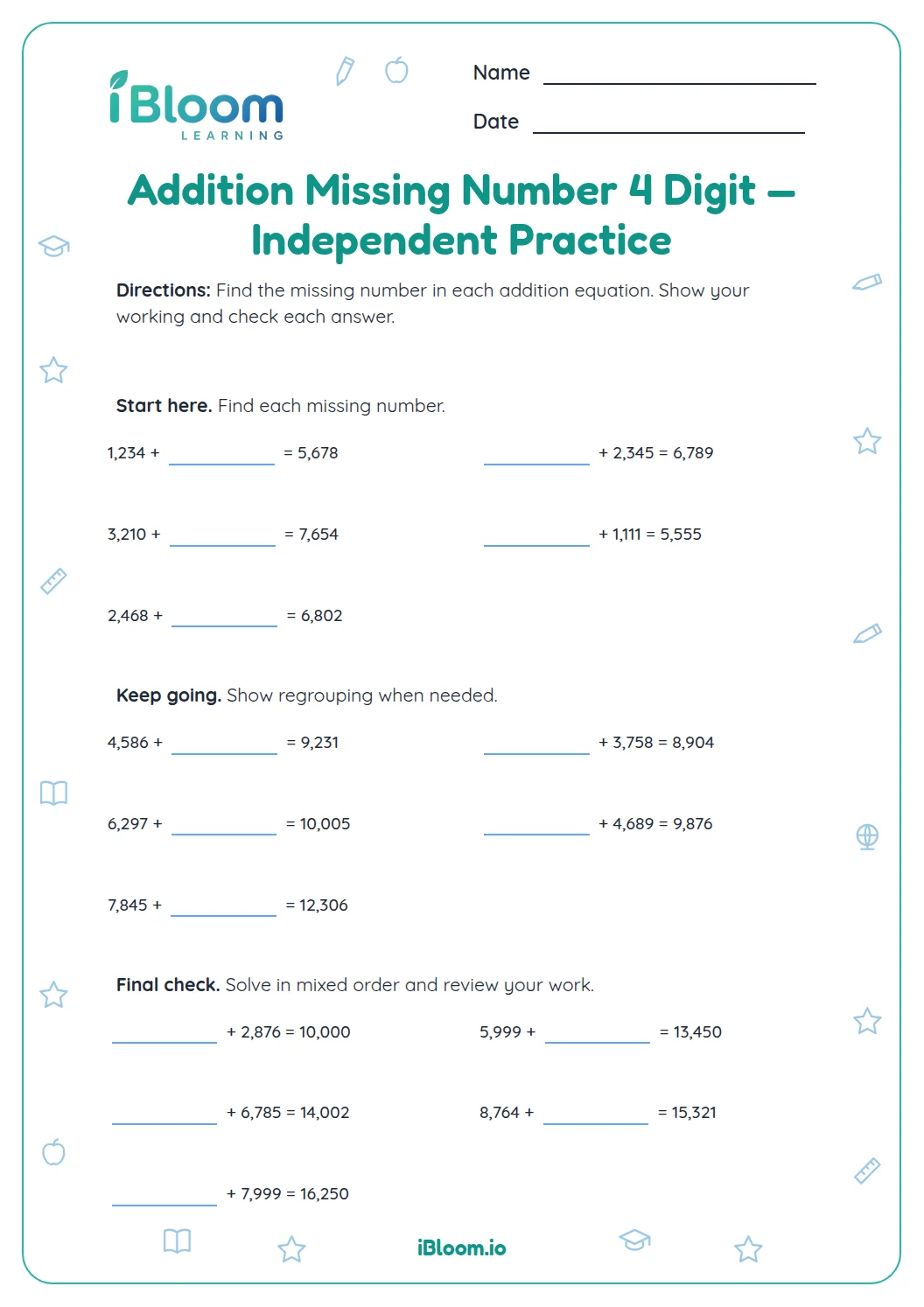
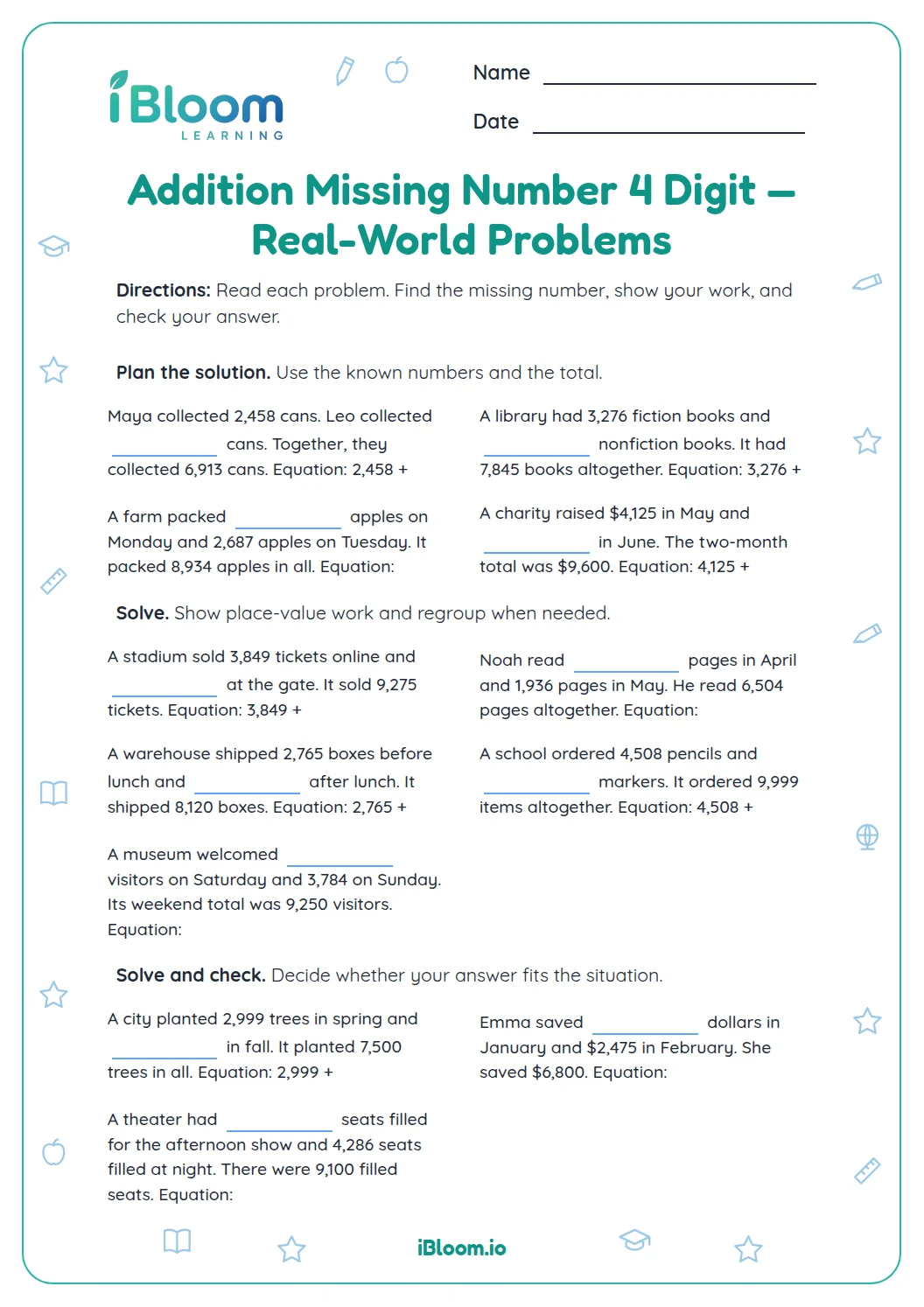
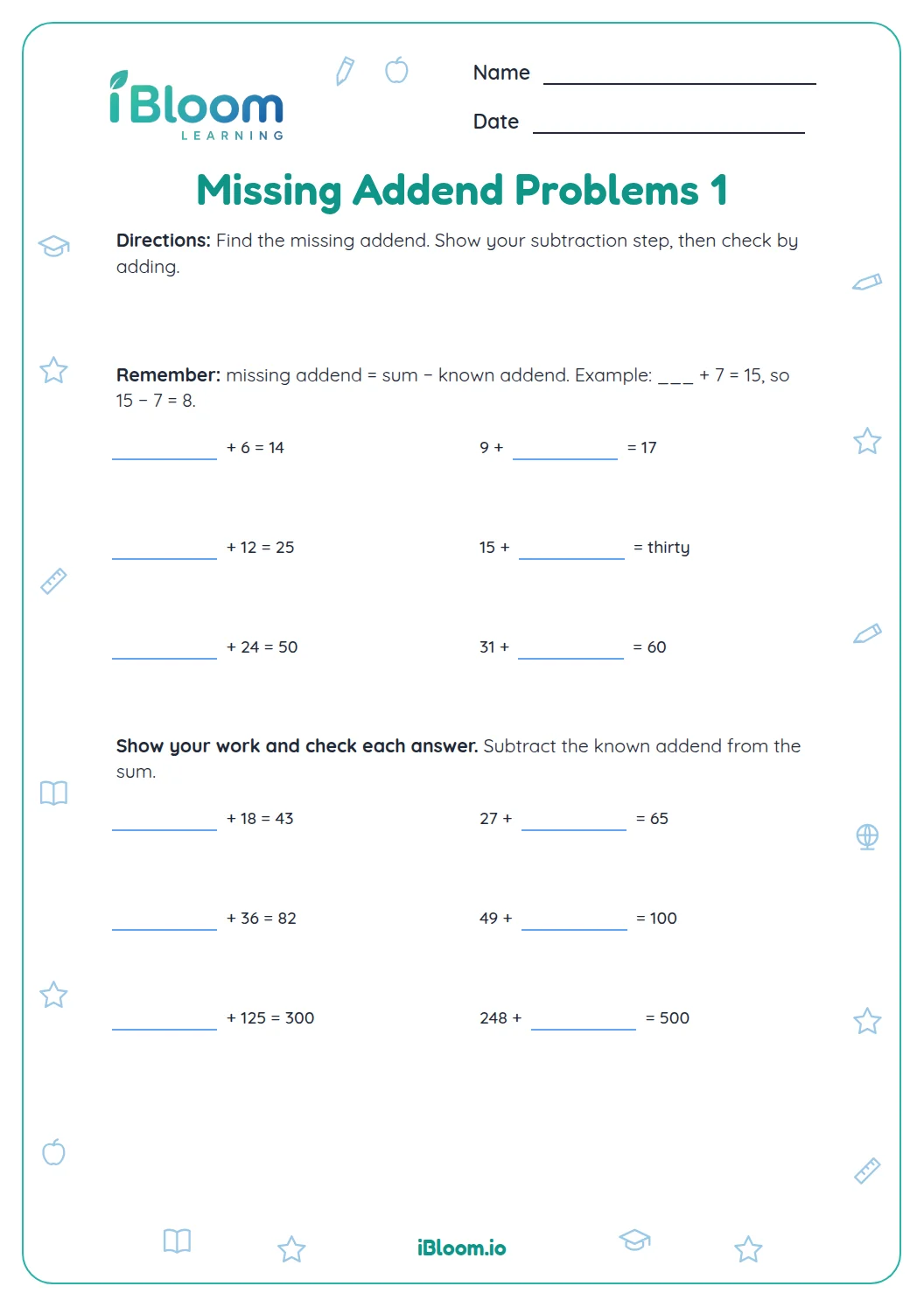
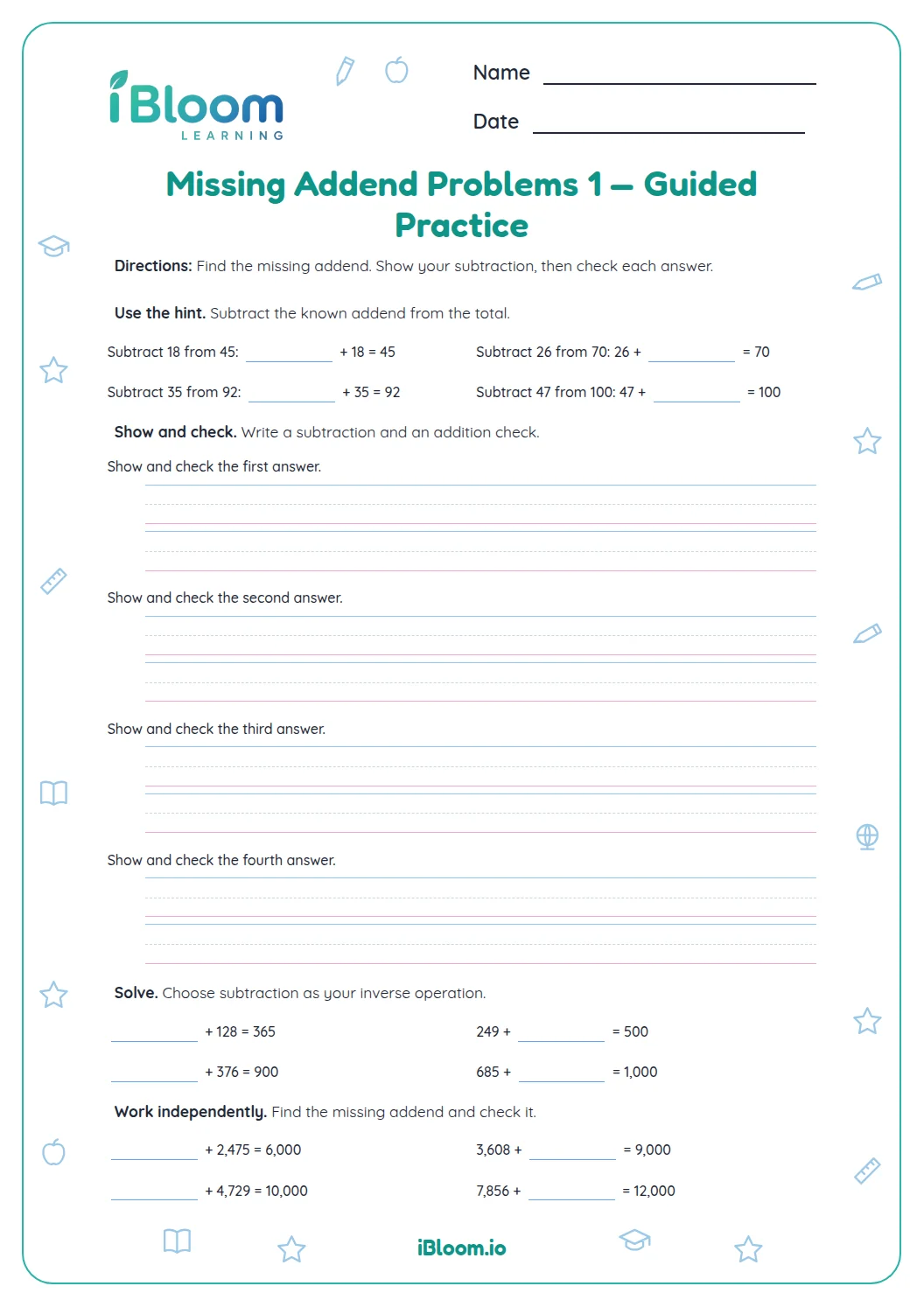
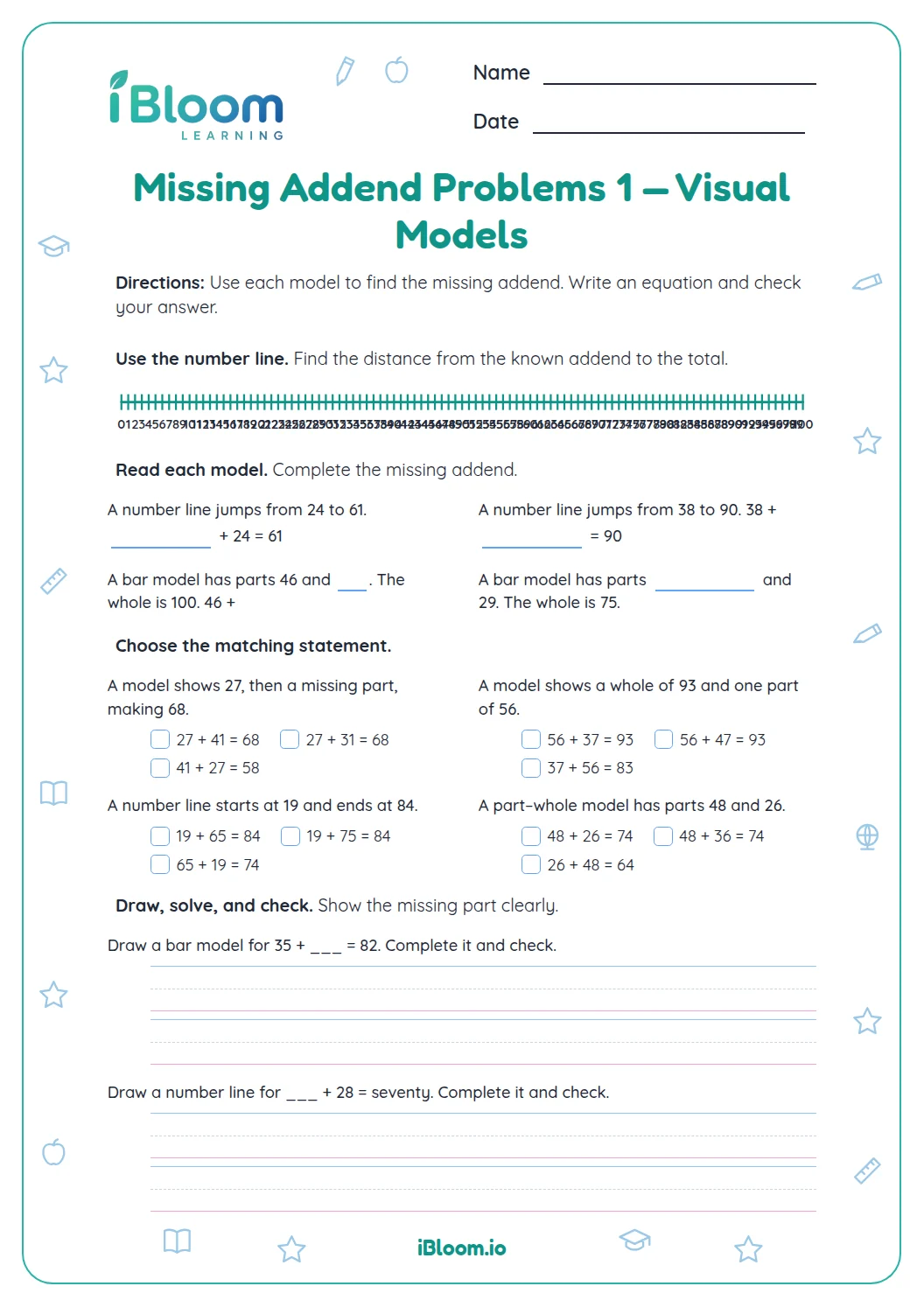
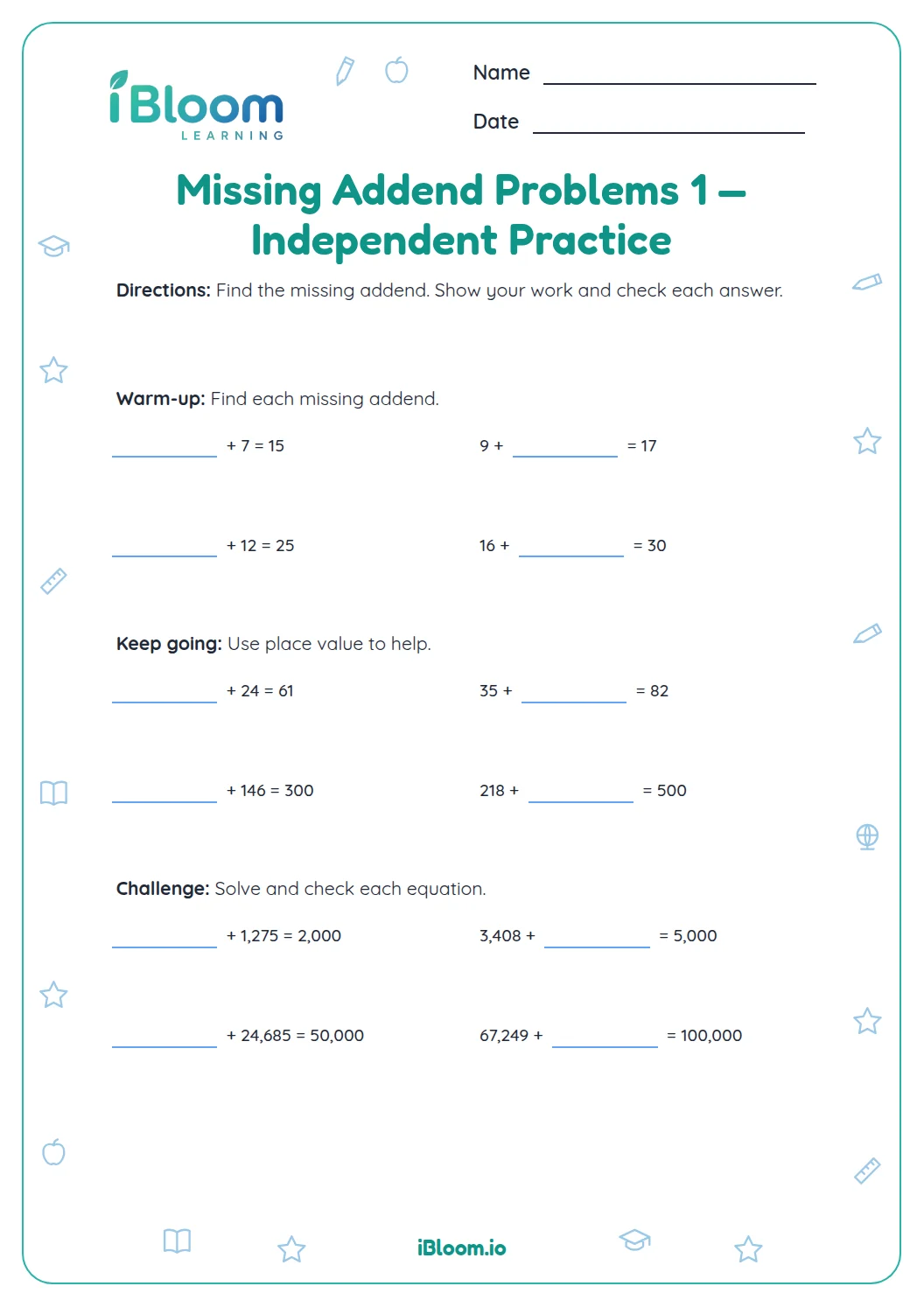
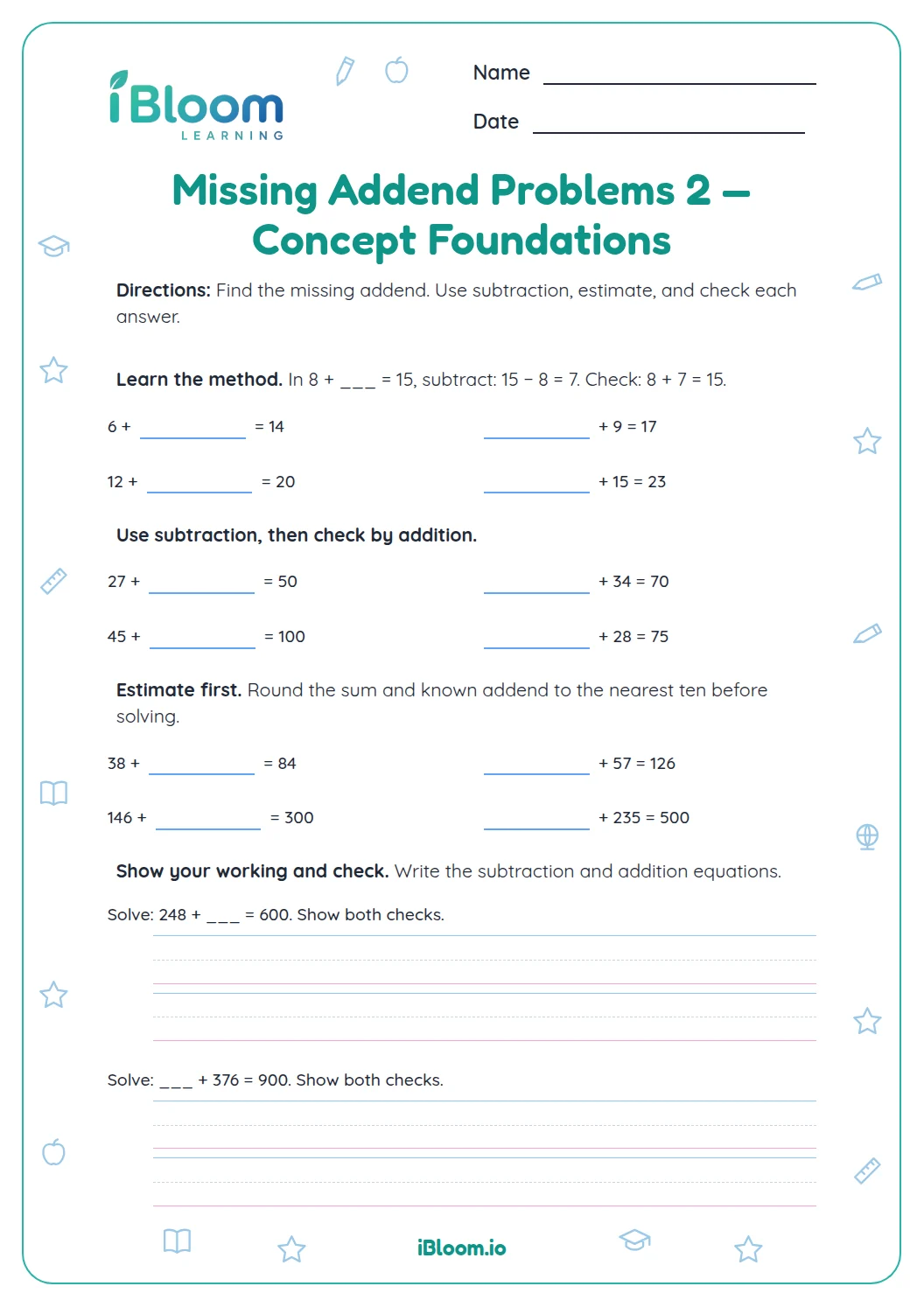
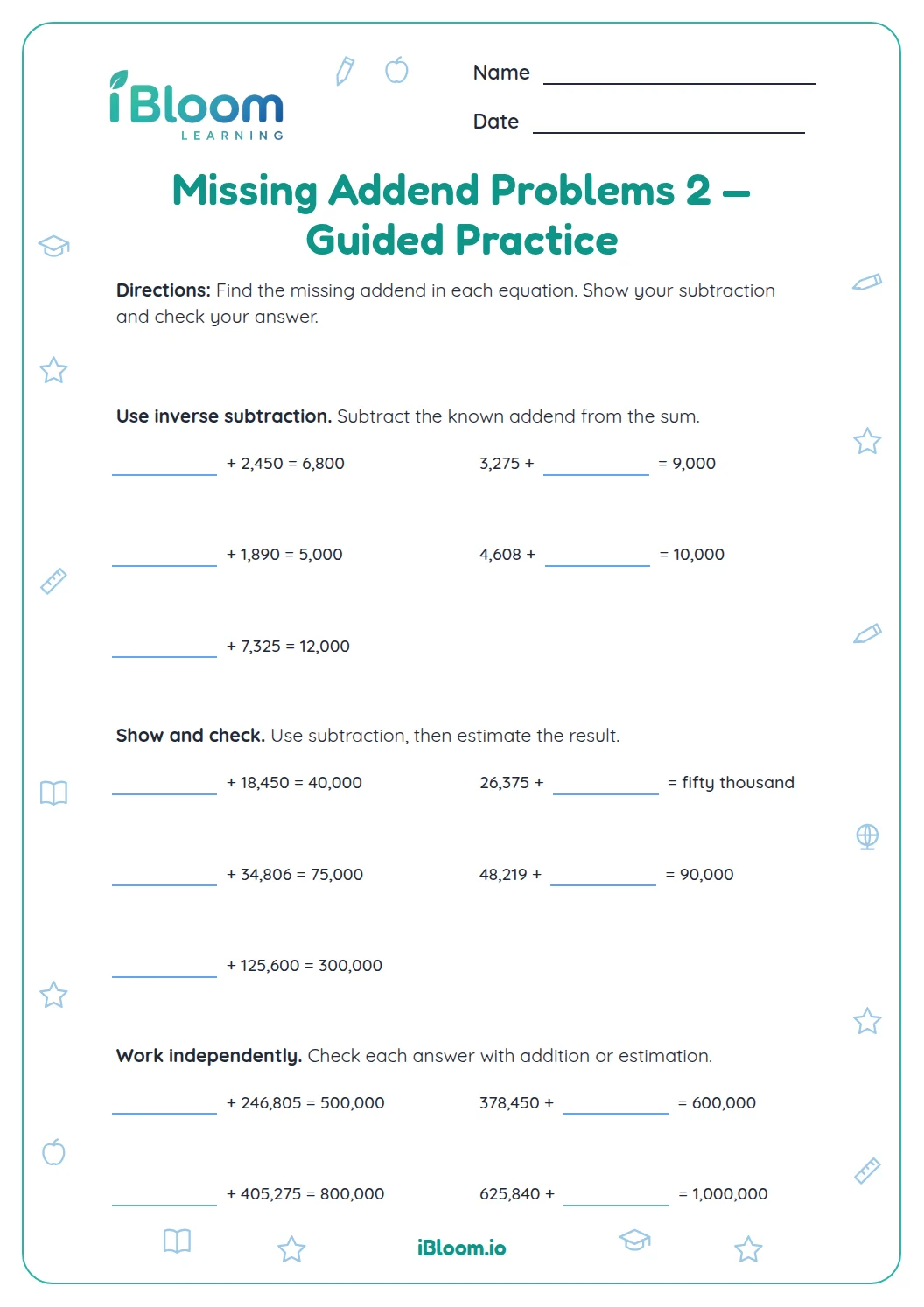
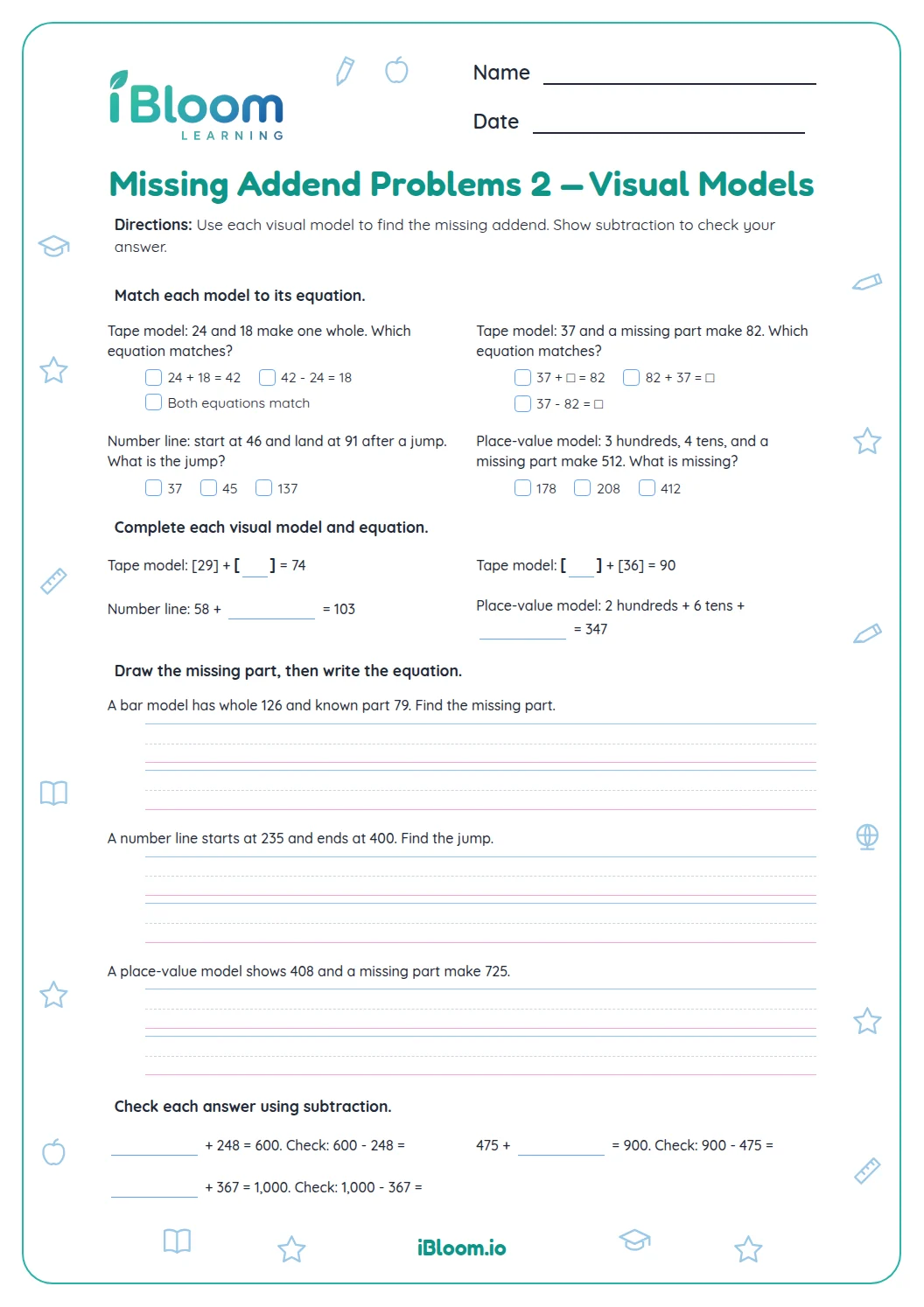
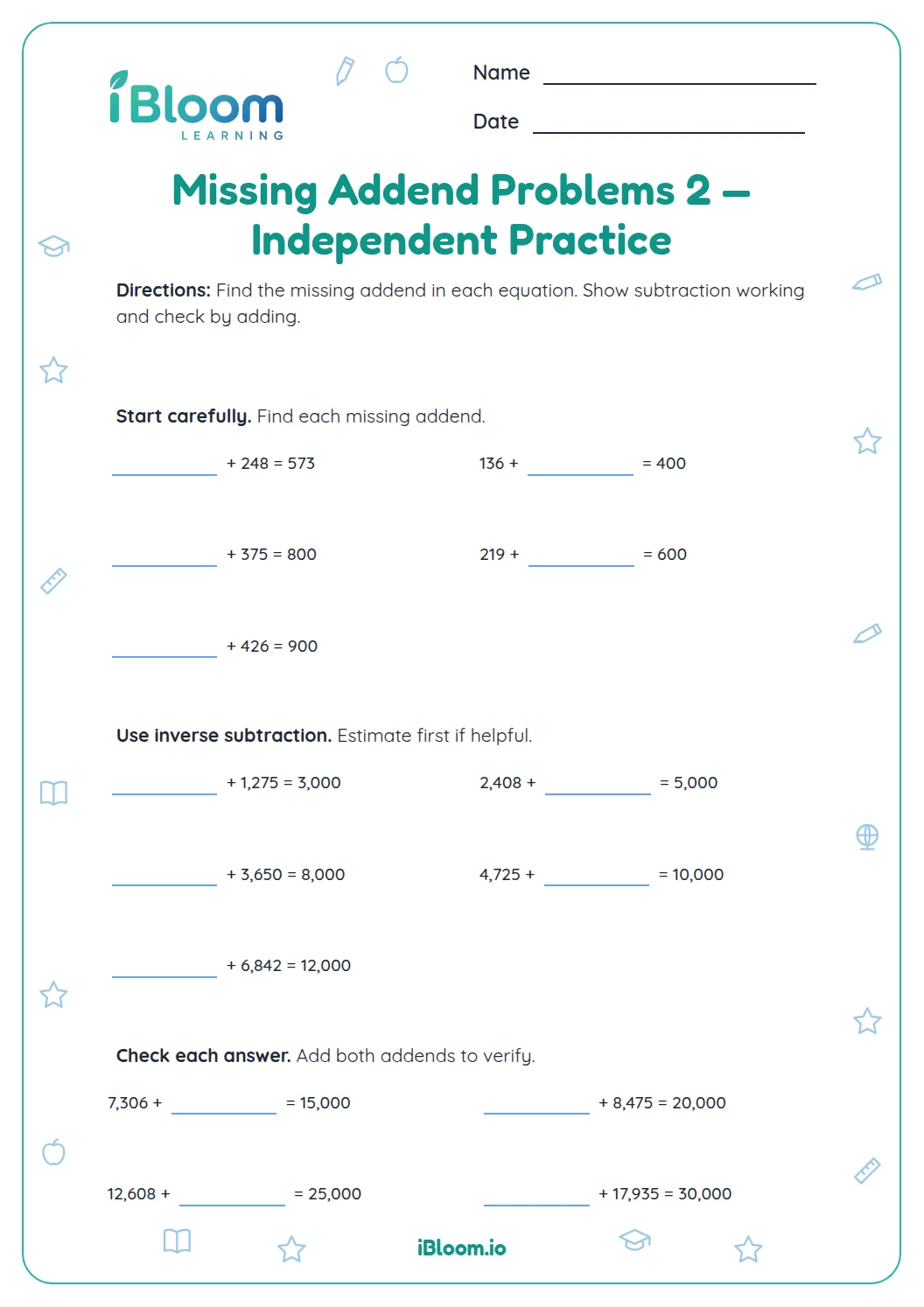
This Grade 5 printable gives students 14 four-digit missing-addend equations. Find the unknown by subtracting the known addend from the sum, then check by adding. The unknown appears on either side of the plus sign, and the examples include regrouping across place values. A separate answer key lists each missing number. The page practices multi-digit addition and subtraction with CCSS 4.NBT.B.4.
Aligned to 4.NBT.B.4
How does subtraction reveal the missing addend?
A missing addend is the amount needed to reach the sum. Subtract the known addend from the sum, lining up thousands, hundreds, tens, and ones.
- 13,995 − 1,250 = 2,745
- 2Check: 1,250 + 2,745 = 3,995
How can place-value columns help?
When the blank comes first, the subtraction still uses the total minus the known addend. In ___ + 6,204 = 8,000, find 8,000 − 6,204.
How do I check the blank?
Use the inverse operation to find the unknown, then put it back in the original equation. If the addends total the stated sum, the answer checks.
How can I use this worksheet?
- 1Copy the equation carefully.
- 2Set up subtraction with the total first.
- 3Align digits by place value.
- 4Regroup as needed and subtract.
- 5Add the result to the known addend to check.
Common mistakes and quick fixes
The mistake
Subtracting the total from the known addend.
The fix
Use total − known addend, since the missing part completes the total.
The mistake
Misaligning a digit by one place.
The fix
Line up the ones digits before calculating.
The mistake
Forgetting to check.
The fix
Substitute the answer into the addition equation and add.
Curriculum alignment
This page practices the following standard through its questions and models.
Use the standard algorithm to add and subtract multi-digit whole numbers.
On this sheet: Find each unknown addend by subtracting, then check with addition.
Show the official wordingHide the official wording
Fluently add and subtract multi-digit whole numbers using the standard algorithm.
What to practice next
Make more practice
Further reading
Questions parents and teachers ask
How do I find a missing addend?
Subtract the known addend from the sum. In 1,250 + ___ = 3,995, calculate 3,995 − 1,250 = 2,745. Then check by adding 1,250 + 2,745 to see whether it equals 3,995. This subtraction reverses the addition relationship and gives the unknown addend.
What if the blank comes before the plus sign?
The same inverse operation works. In ___ + 6,204 = 8,000, subtract 6,204 from 8,000 to get 1,796. Put 1,796 back in the equation and add to verify the sum. Recheck by adding 1,796 and 6,204 to confirm the total is 8,000.
How can place value help with four-digit numbers?
Keep the thousands, hundreds, tens, and ones in matching columns when subtracting. Regroup when a place has too few units. The place-value tables on this sheet help organize digits before finding selected missing addends. Regrouping keeps the value unchanged when a place does not have enough units to subtract.
Does this worksheet include regrouping?
Yes. Several sums and known addends require regrouping during subtraction. For example, 3,995 − 1,250 requires trading across place values. After calculating, add the two addends to check the original total. The worked answers can be checked by adding each known and missing addend.
How many problems and pages are included?
The worksheet has 14 missing-addend questions across two pages, followed by two answer-key pages. The first section gives equations with the unknown after the plus sign, and the second places it before the known addend. The key lists answers in question order for checking both printed pages.