





About this worksheet
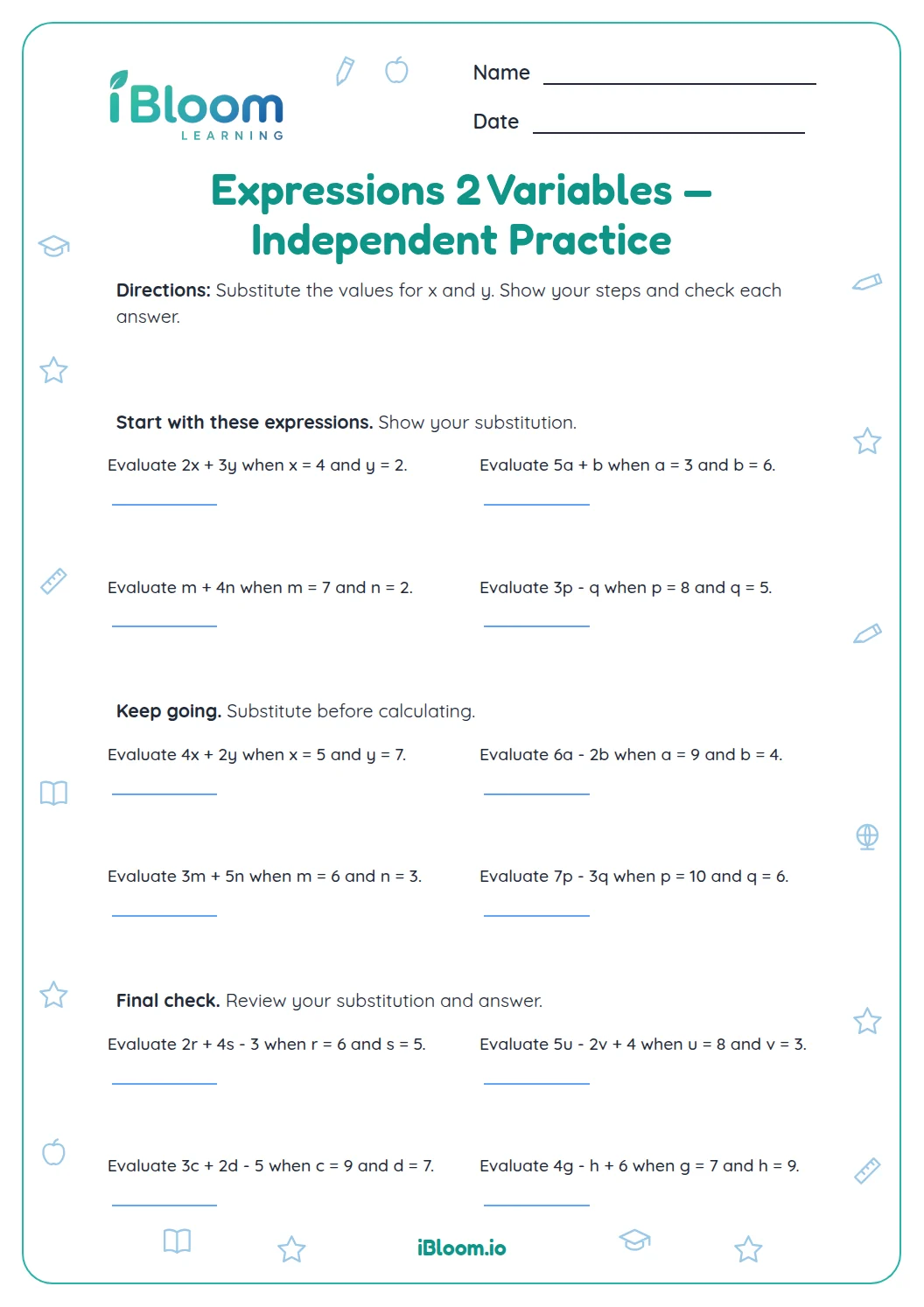
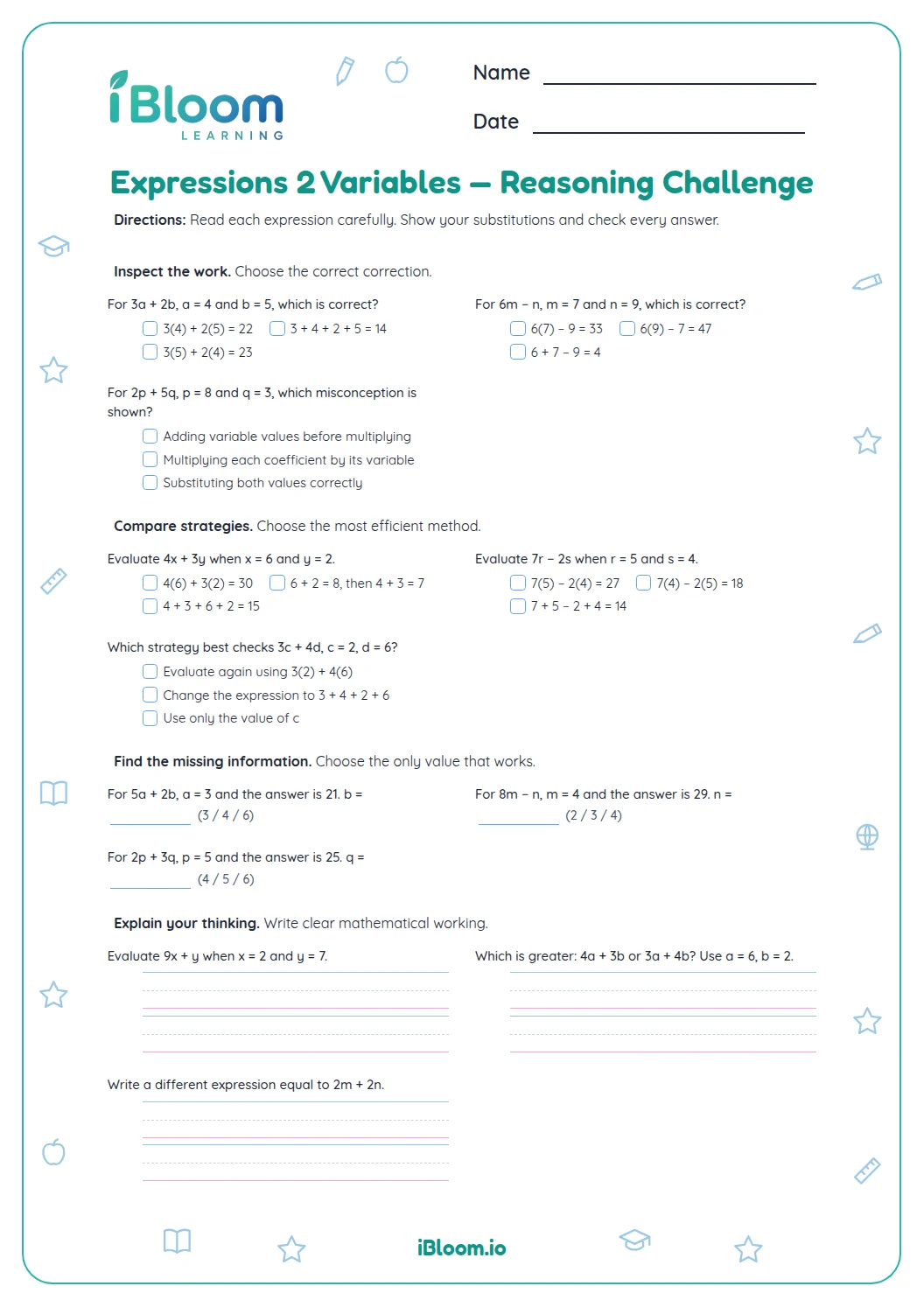
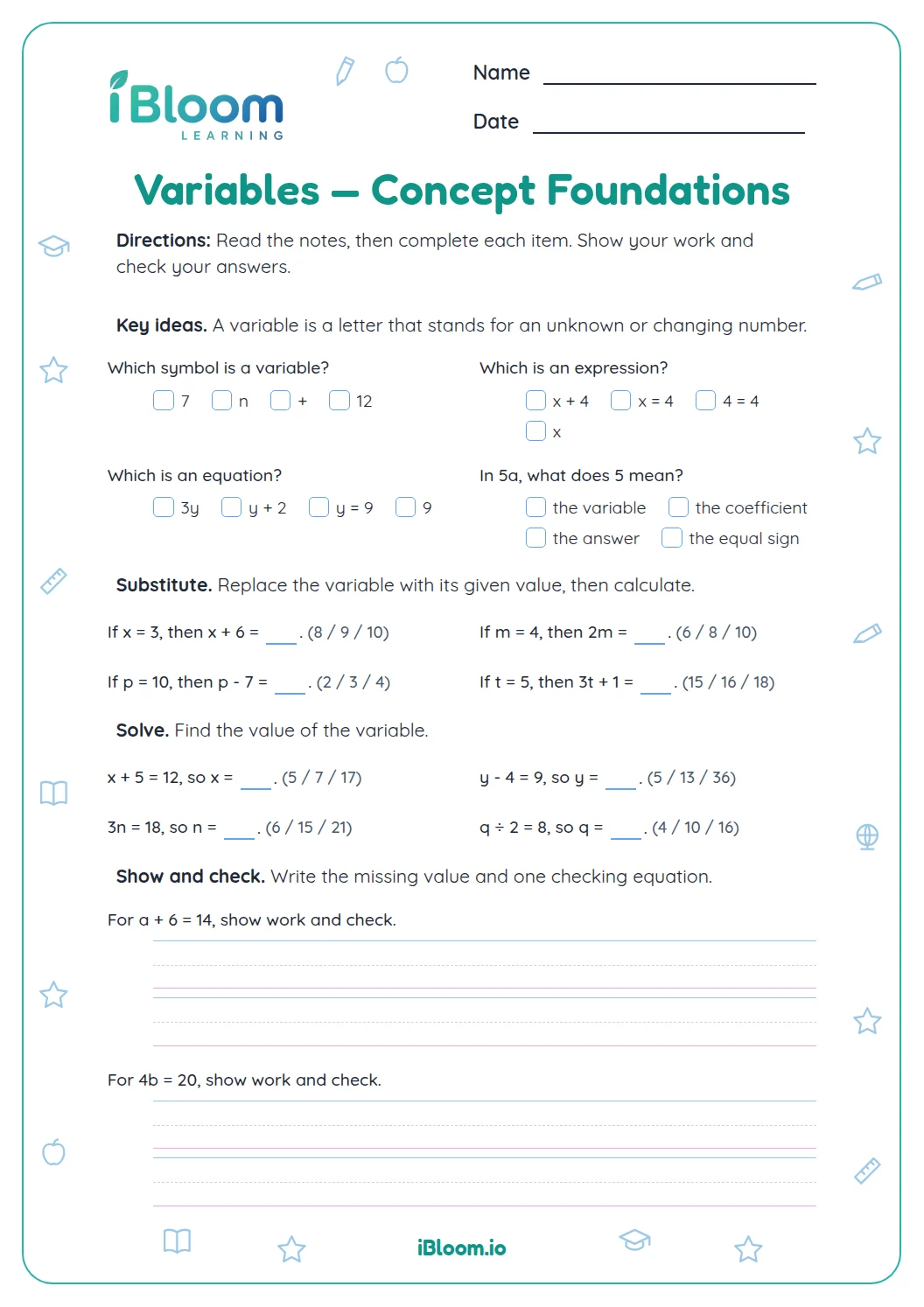
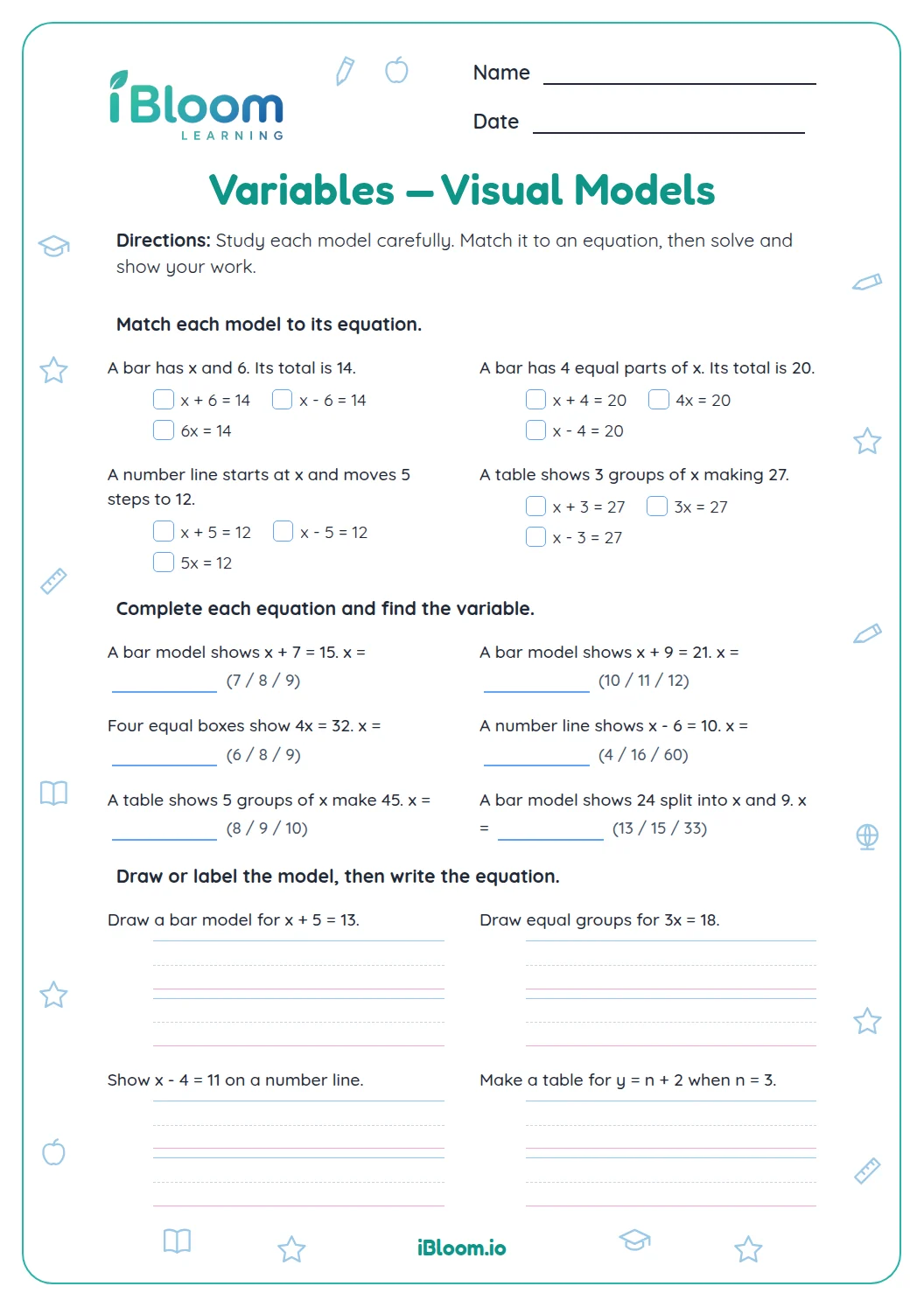
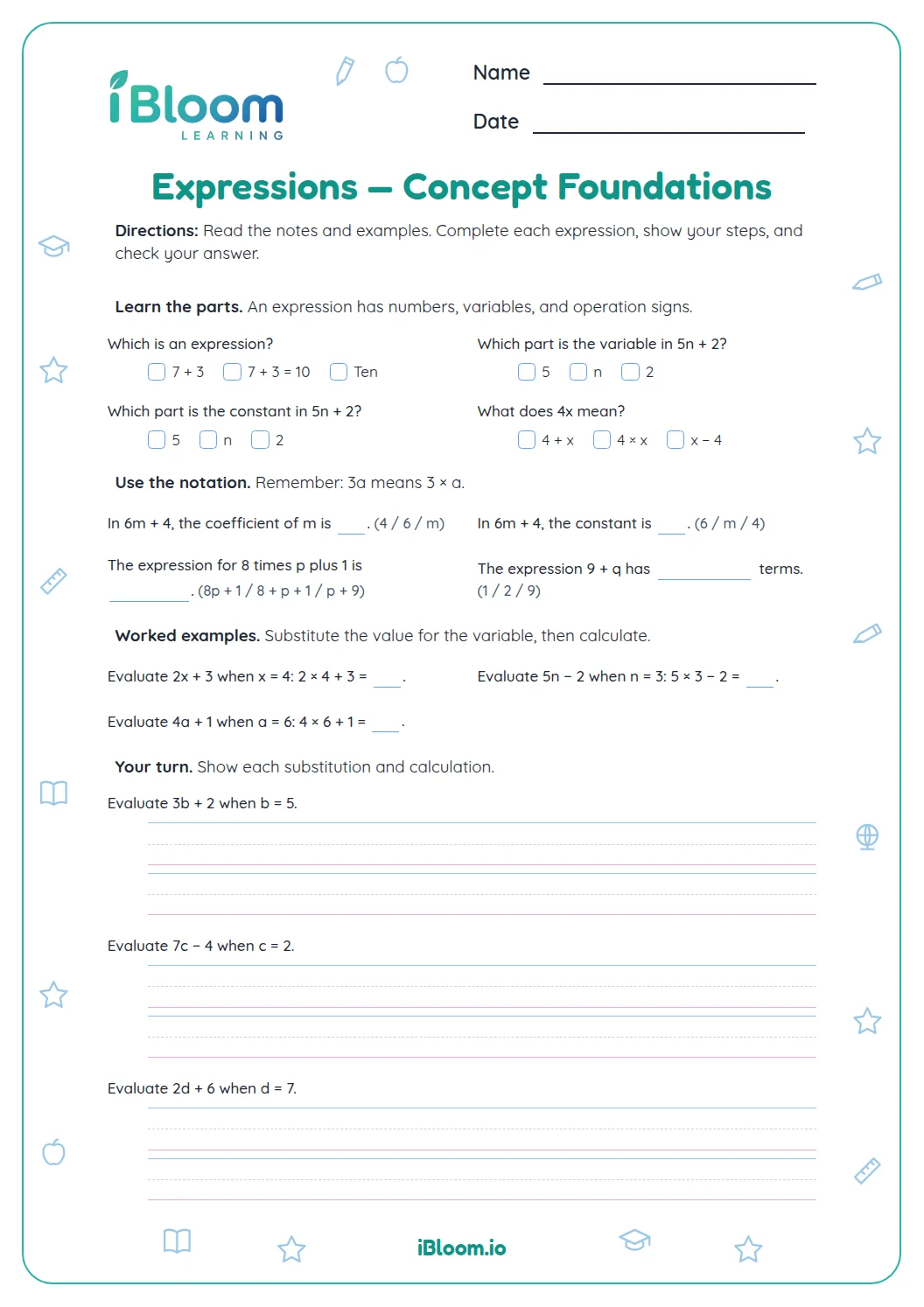
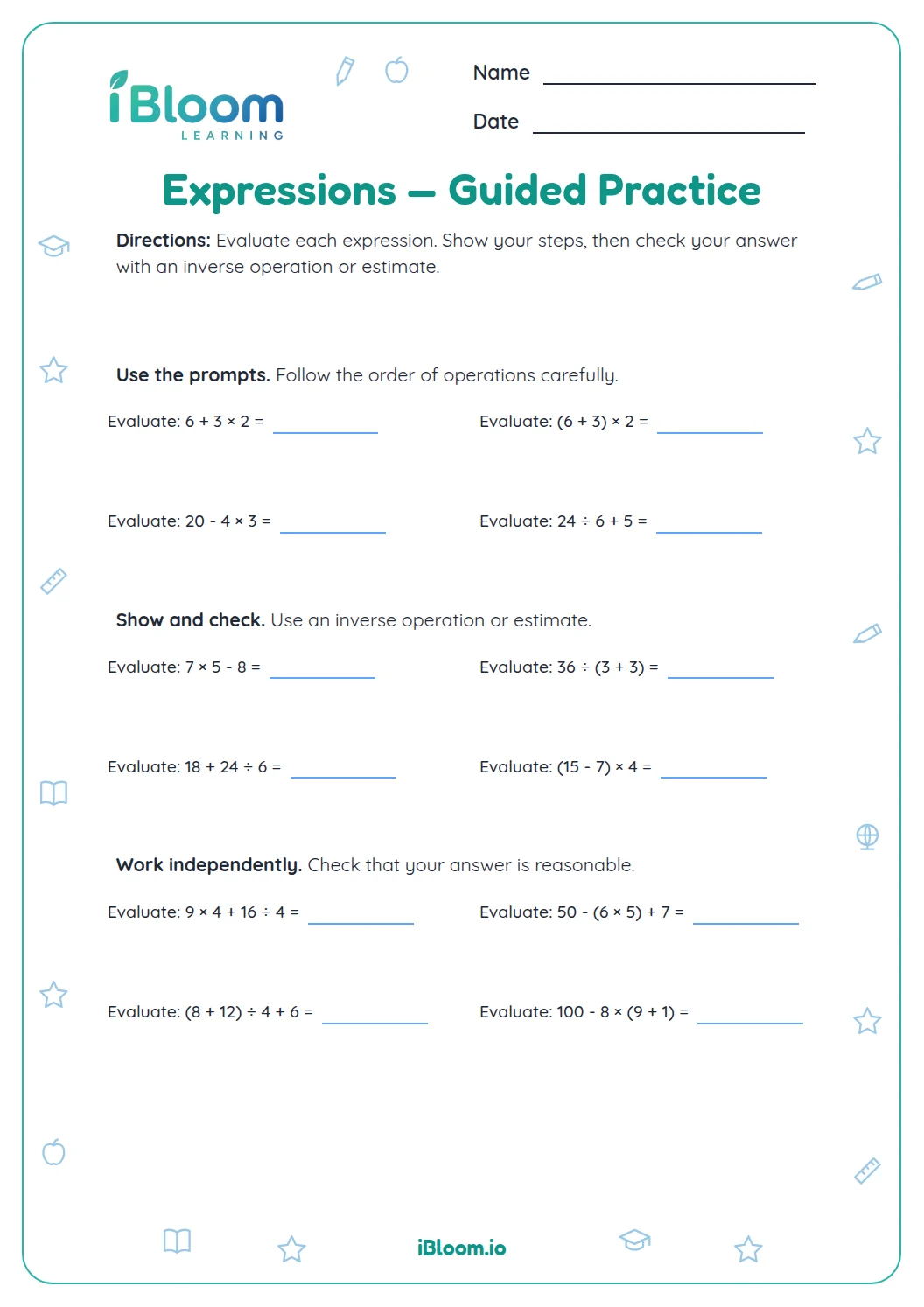
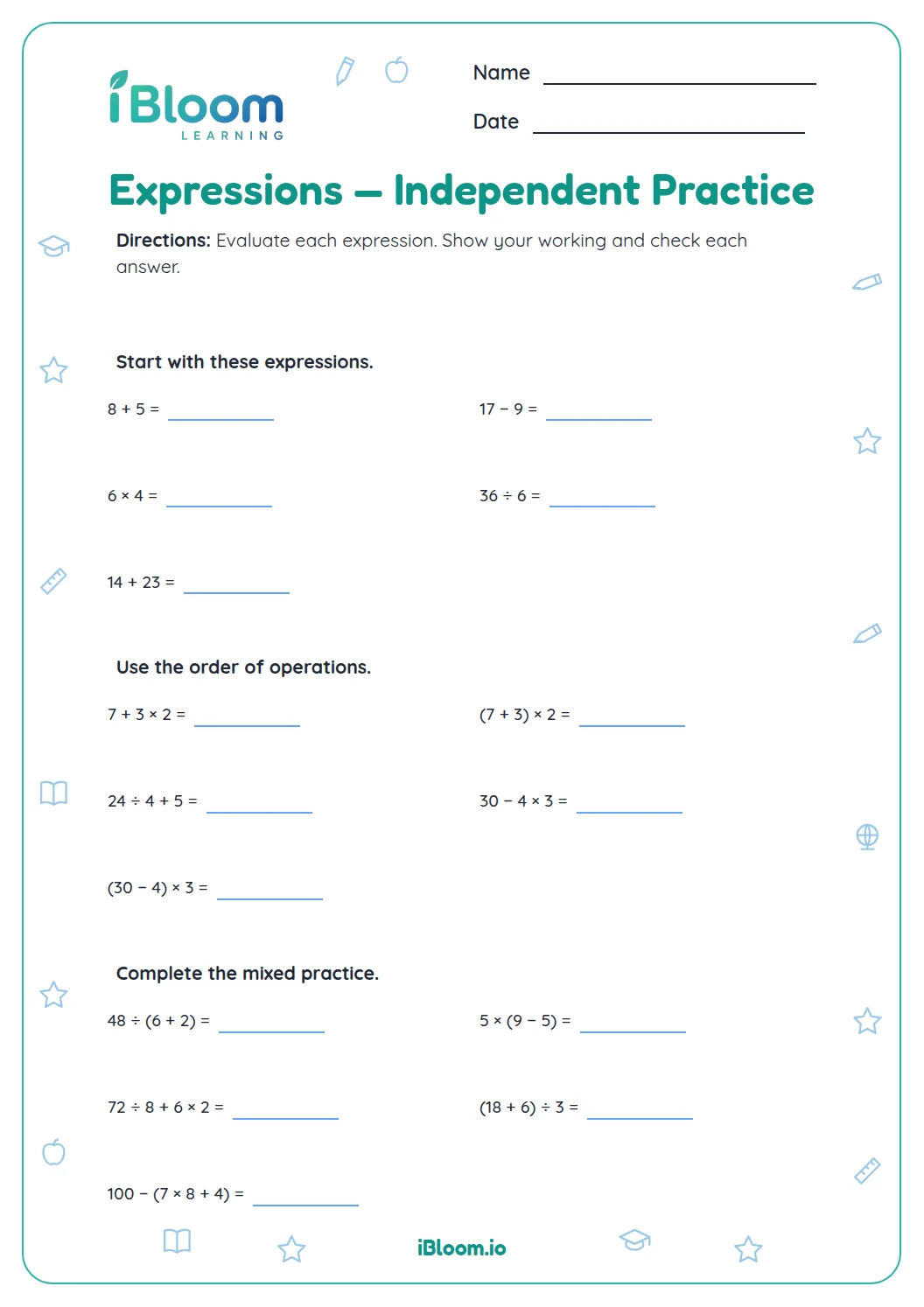
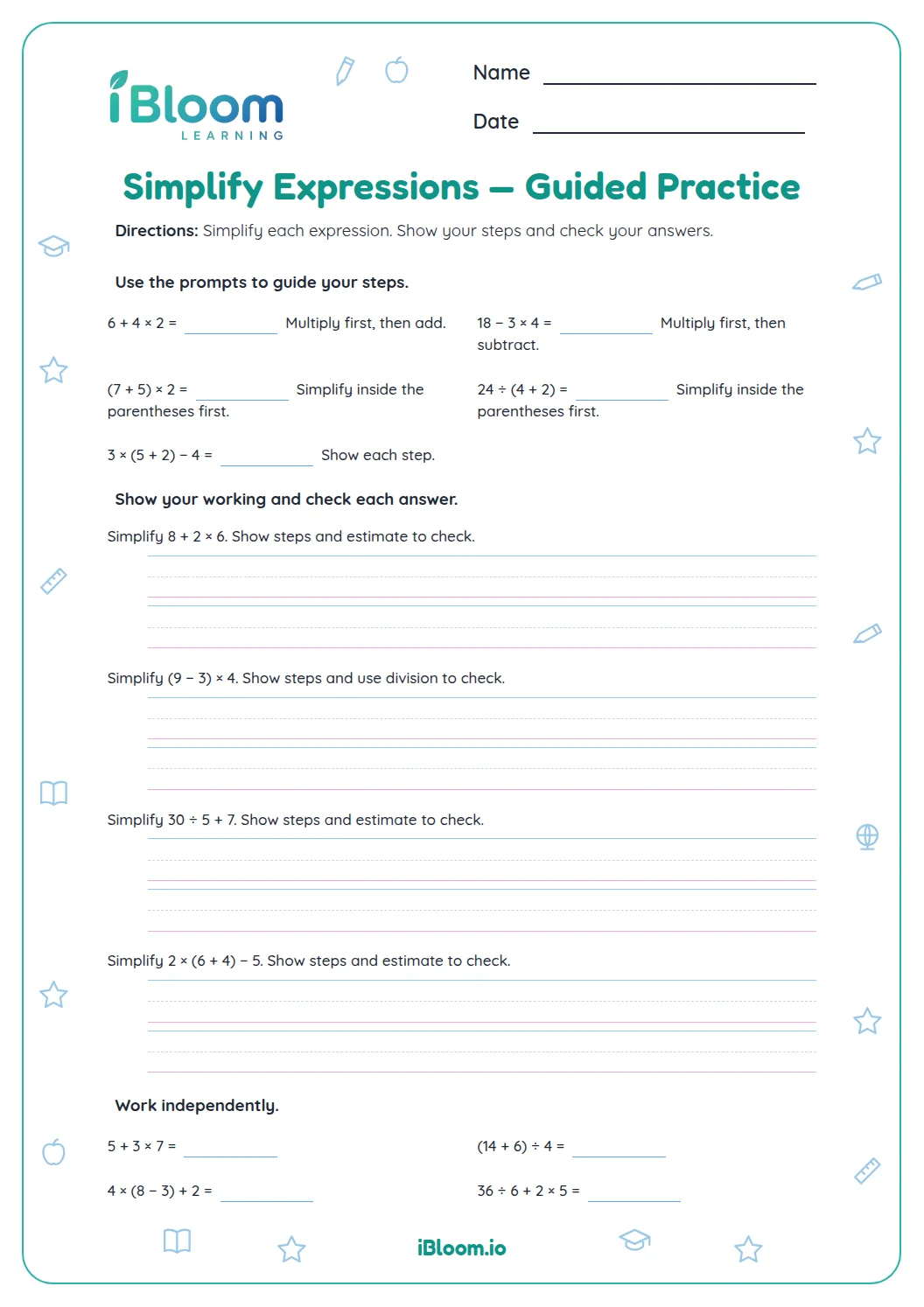
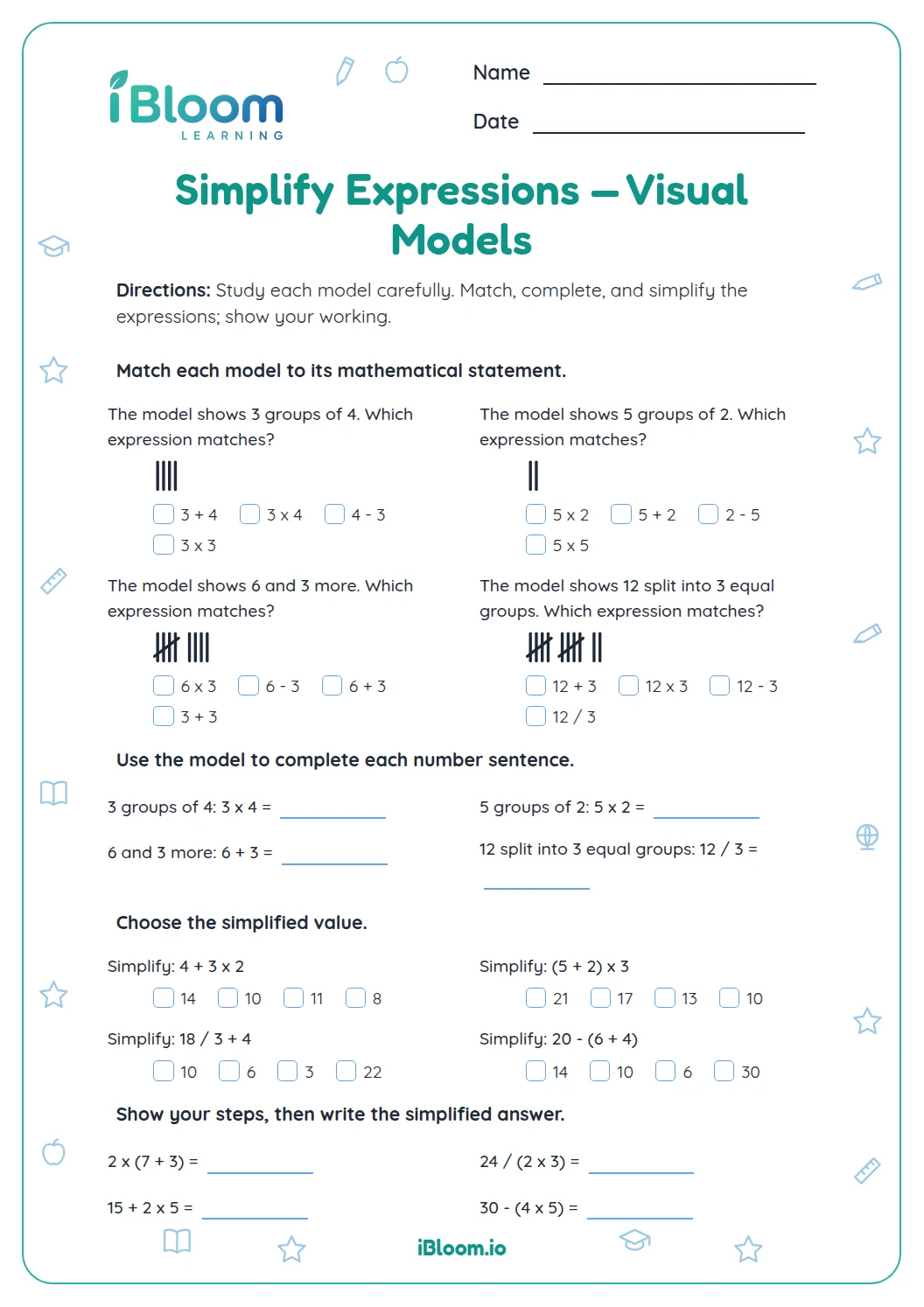
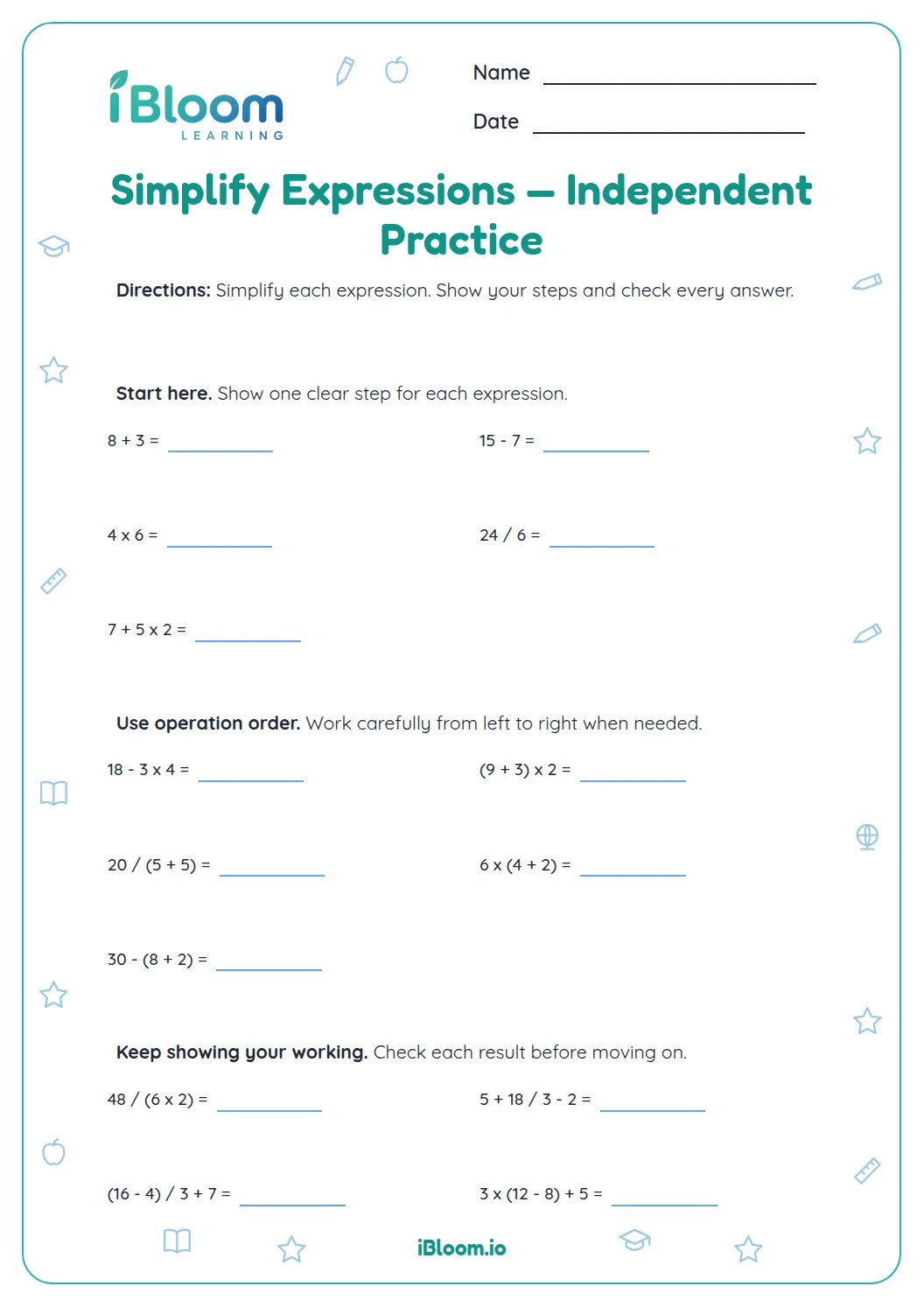
This Grade 5 worksheet builds a bridge from a model to a symbolic expression and then to its value. Students match descriptions such as “3 groups of x and 2 single units,” write expressions from grouped quantities, and substitute given values before calculating. The sequence follows the visual-model method on the earlier sheet while providing 16 fresh problems and a separate key.
How does a model become an expression?
A group of x means x is repeated that many times; a single unit is a constant. Join the terms with the operation shown by the model.
- 13 groups of x and 2 single units → 3x + 2
- 2The coefficient 3 counts groups of x; the 2 counts separate units.
What happens after the expression is written?
Replace each variable with its assigned value. Multiply each coefficient by its variable first, then add or subtract the remaining terms.
- 1If a = 4 and b = 3, then 2a + 3b = 2(4) + 3(3) = 8 + 9 = 17.
How to use this worksheet
- 1Read the model description and count each group of the variable.
- 2Write a coefficient for repeated groups and a constant for single units.
- 3For a symbolic statement, copy the terms in the same order as the model.
- 4Substitute each given value using parentheses.
- 5Multiply before adding or subtracting, then check the answer key.
Common mistakes and quick fixes
The mistake
Writing x + 3 for three groups of x.
The fix
Three equal groups of x are 3x; the coefficient tells how many groups.
The mistake
Treating 2a as 2 + a.
The fix
Read a coefficient beside a variable as multiplication: 2a = 2 × a.
The mistake
Adding before multiplying in 2a + 3b.
The fix
Substitute, multiply each term, and then combine the results.
What to practice next
Make more practice
Questions parents and teachers ask
What does a coefficient show?
A coefficient tells how many equal groups of a variable are present. In 4x + 1, the coefficient 4 means four groups of x, and the 1 is a separate unit. The model-matching section asks students to translate that group count into a term.
How is 3x + 2 different from 3(x + 2)?
In 3x + 2, only x is repeated three times, and then 2 is added. In 3(x + 2), both x and 2 are repeated three times. The model descriptions on this sheet distinguish variable groups from single units. This gives students a concrete example to revisit while checking their work.
How do I evaluate 2a + b?
Replace a and b with their assigned values, multiply 2 by a, then add b. For a = 4 and b = 3, 2a + b becomes 2(4) + 3, or 11. Keep the operation signs from the original expression. This gives students a concrete example to revisit while checking their work.
What should students check if an answer is wrong?
Check that each variable was replaced with the value given in the question. Then confirm that every coefficient was multiplied by its variable before adding or subtracting. Finally, compare the new result with the key and locate the first step that differs.
What can students practice next?
After matching models, writing expressions, and evaluating them, students can practice reading and simplifying expressions with more terms. The related Grade 5 algebra pages review variables and expressions before adding new expression structures. This gives students a concrete example to revisit while checking their work.