





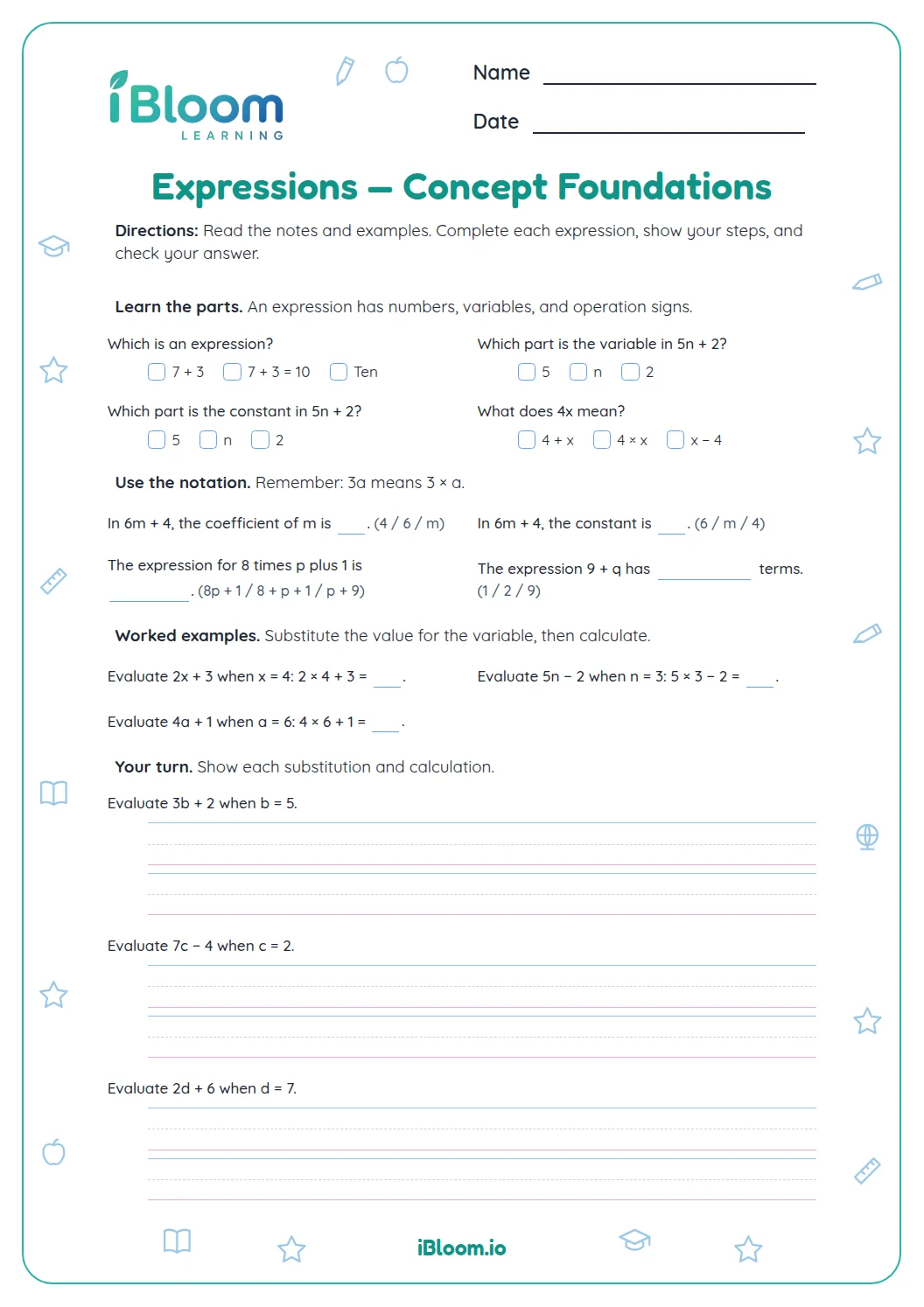
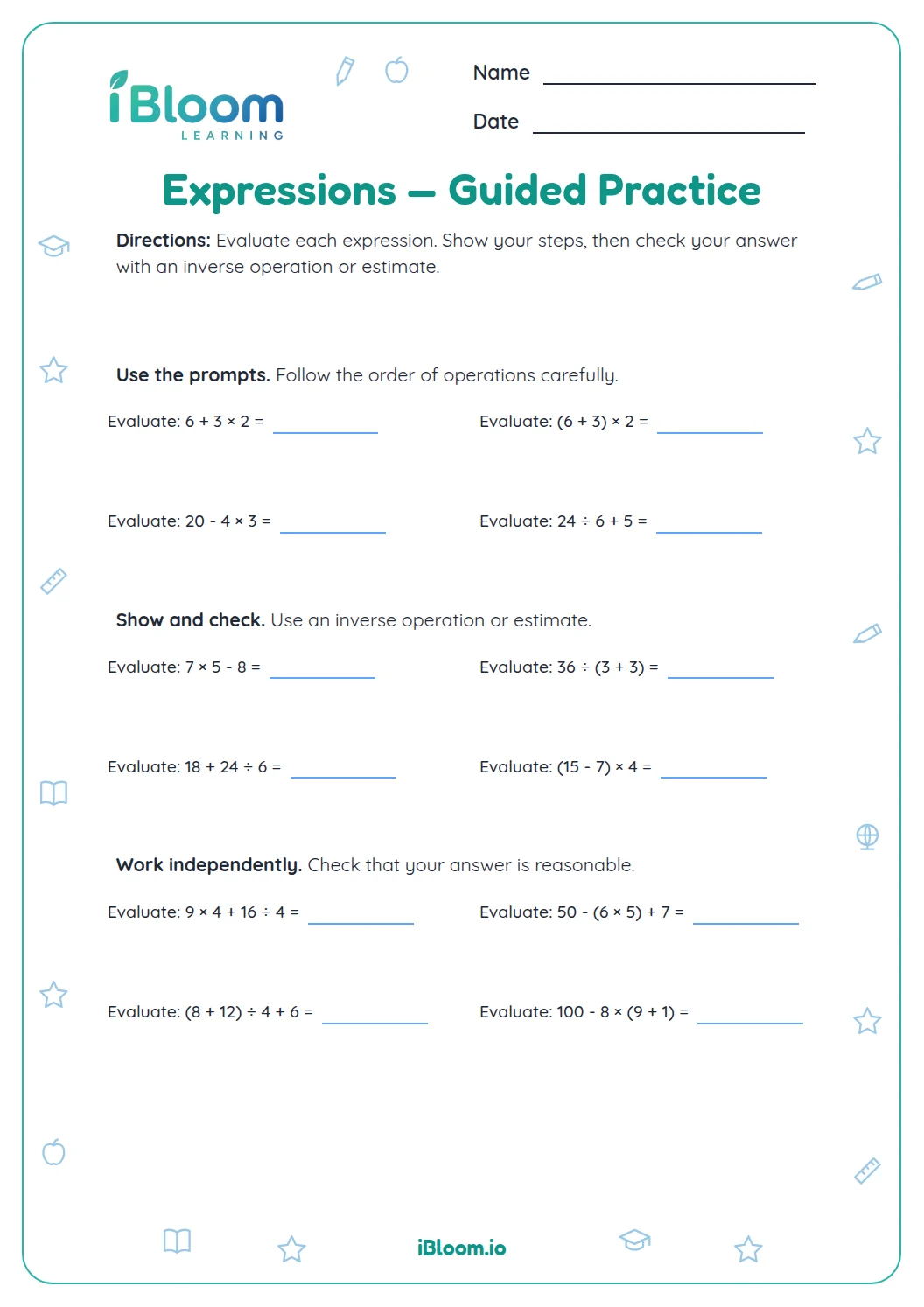

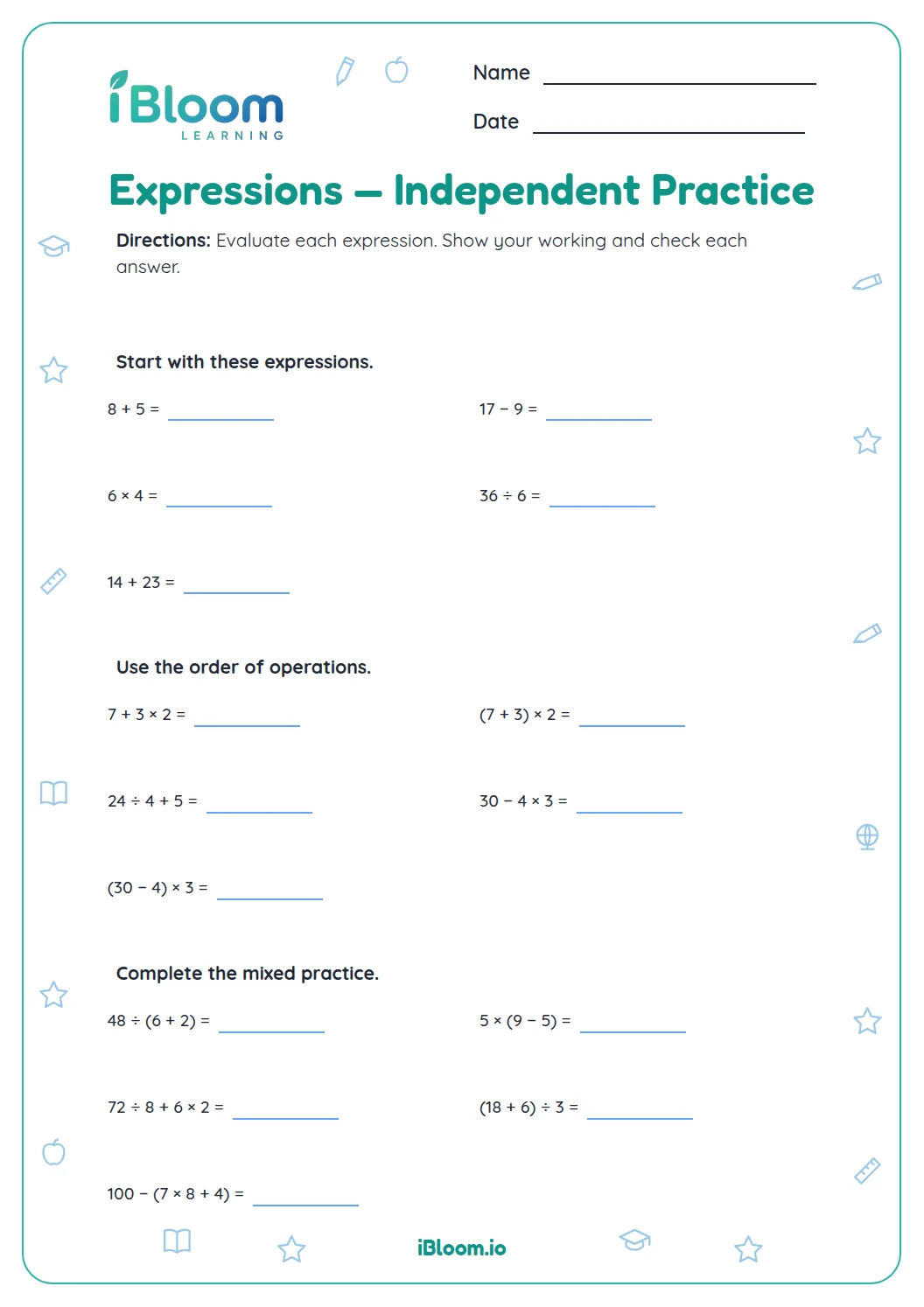
About this worksheet
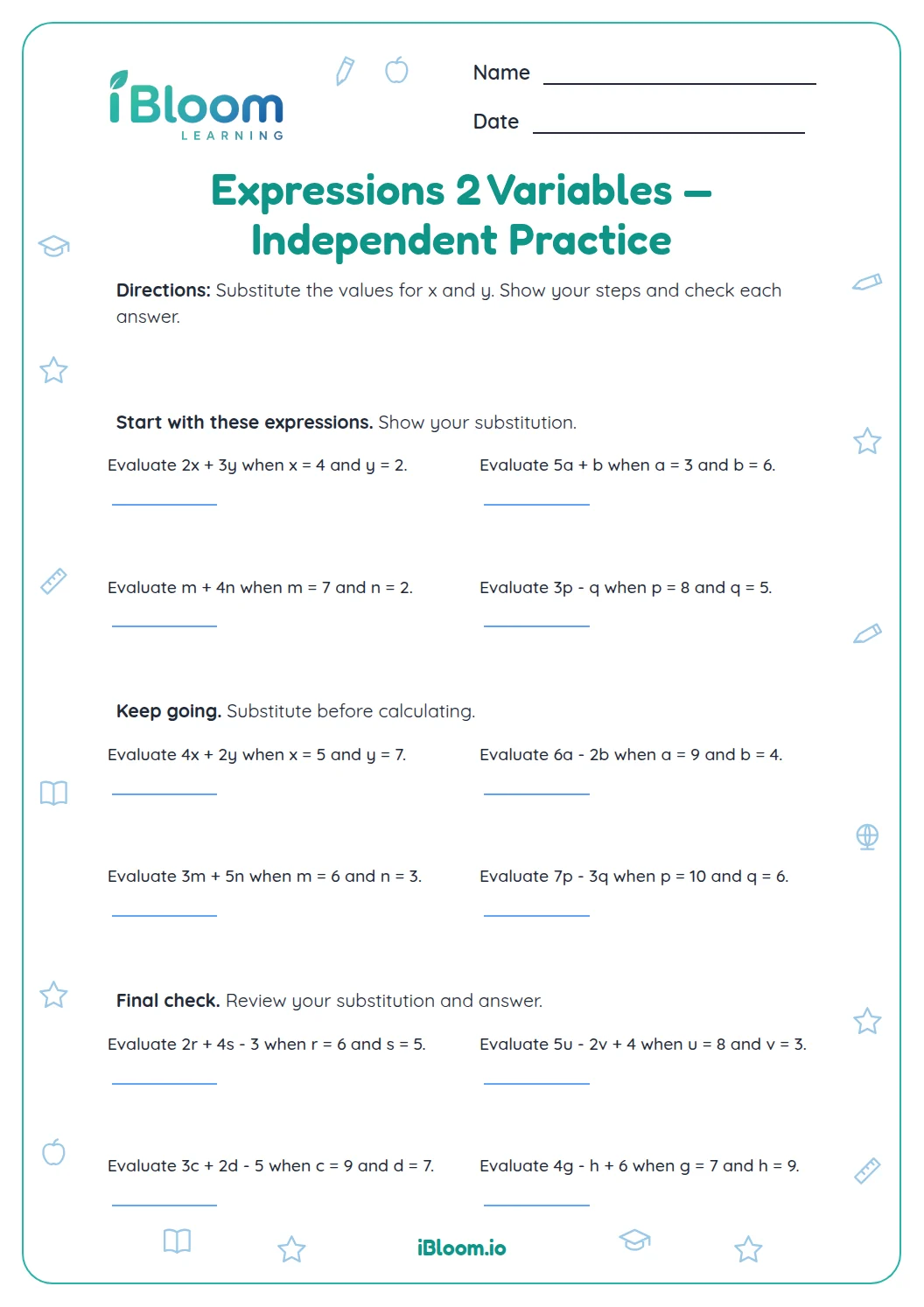
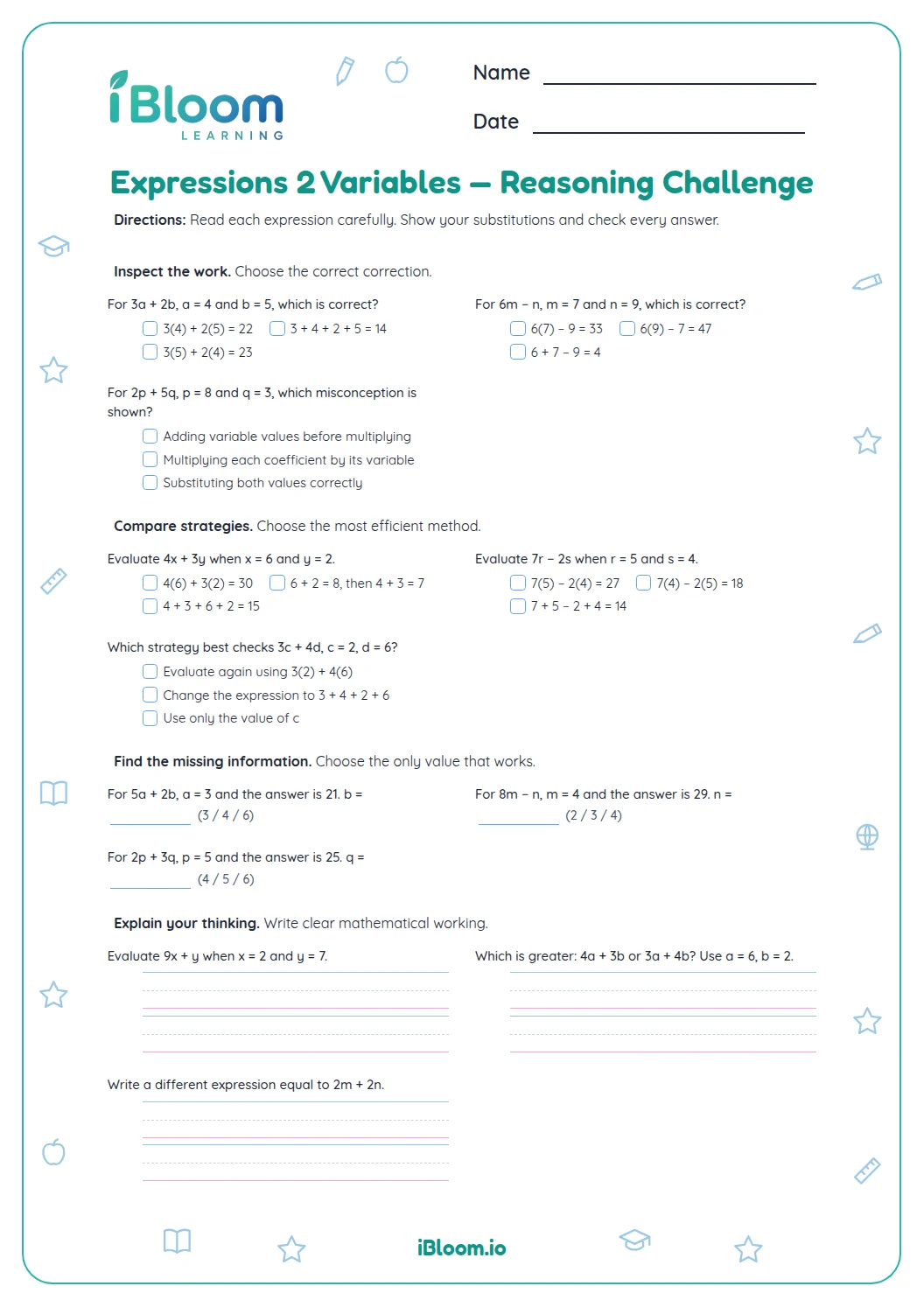
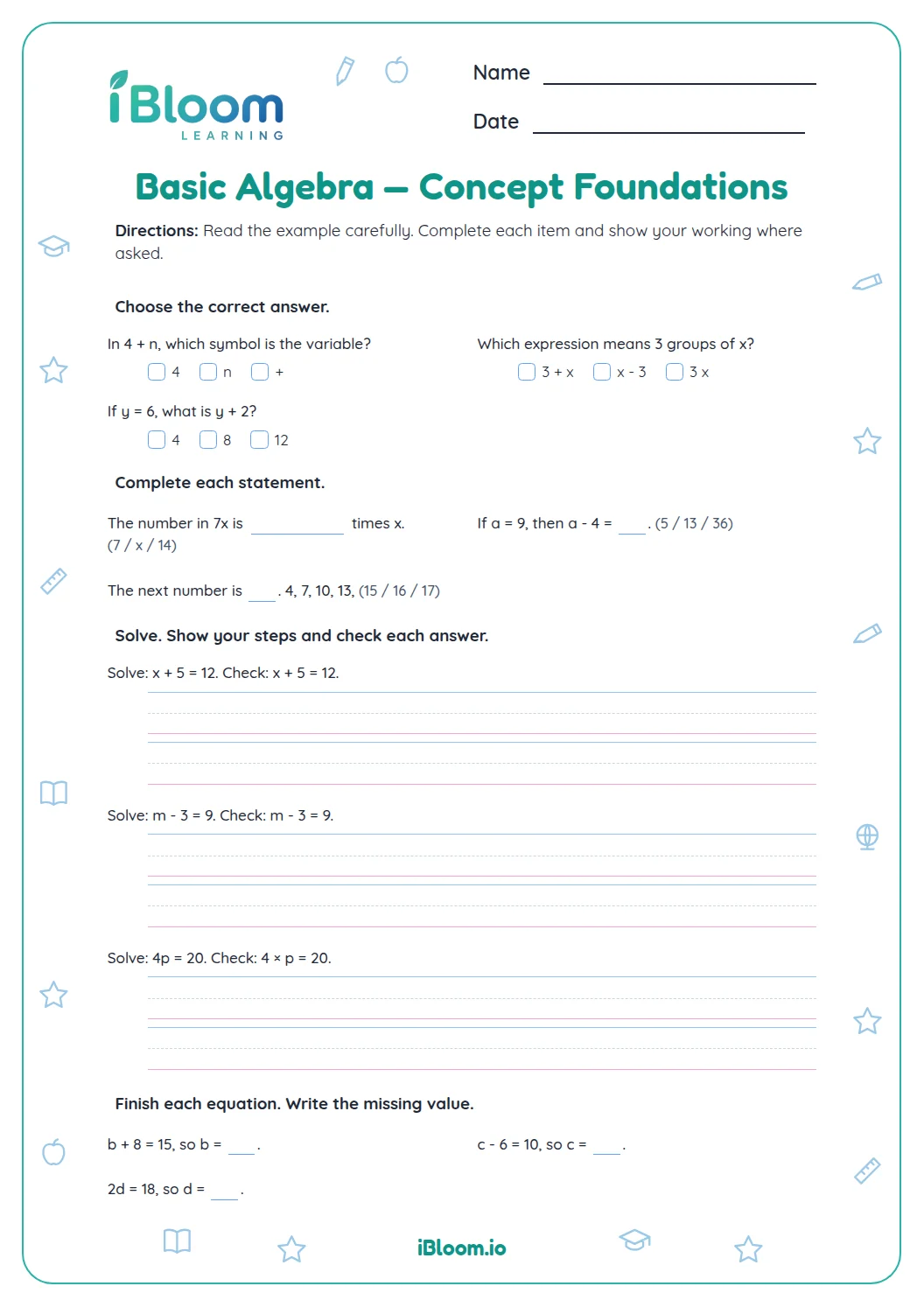
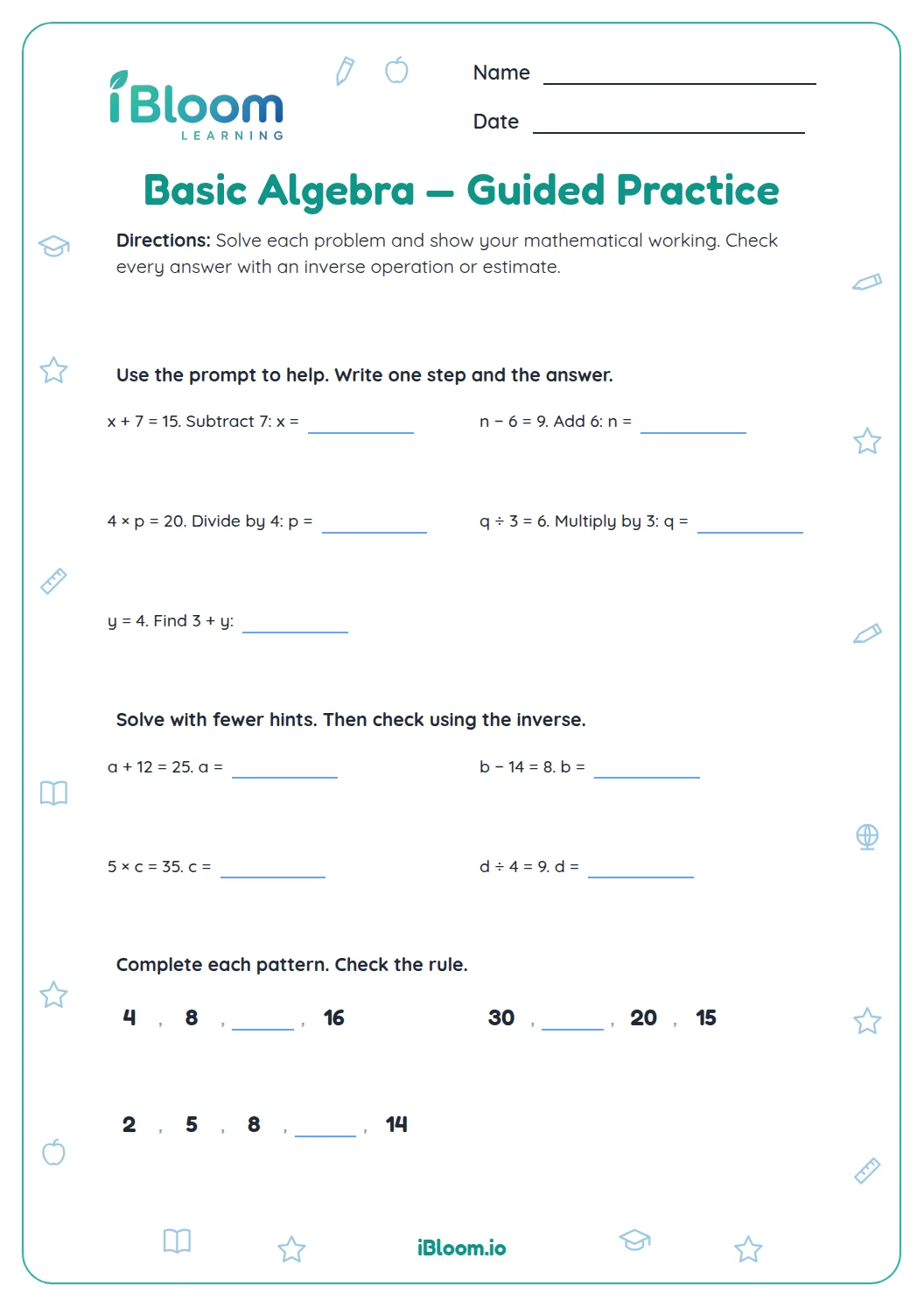
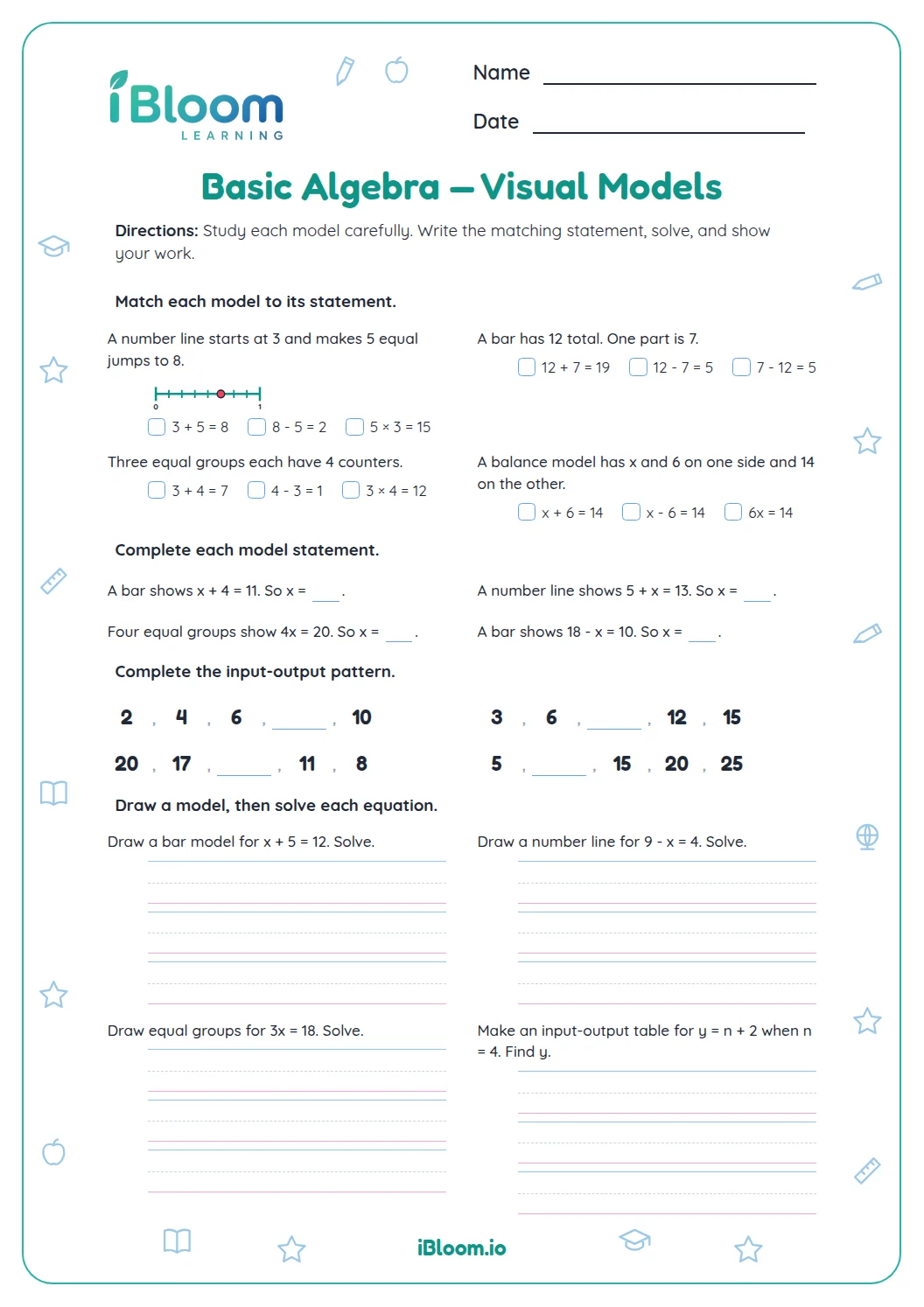
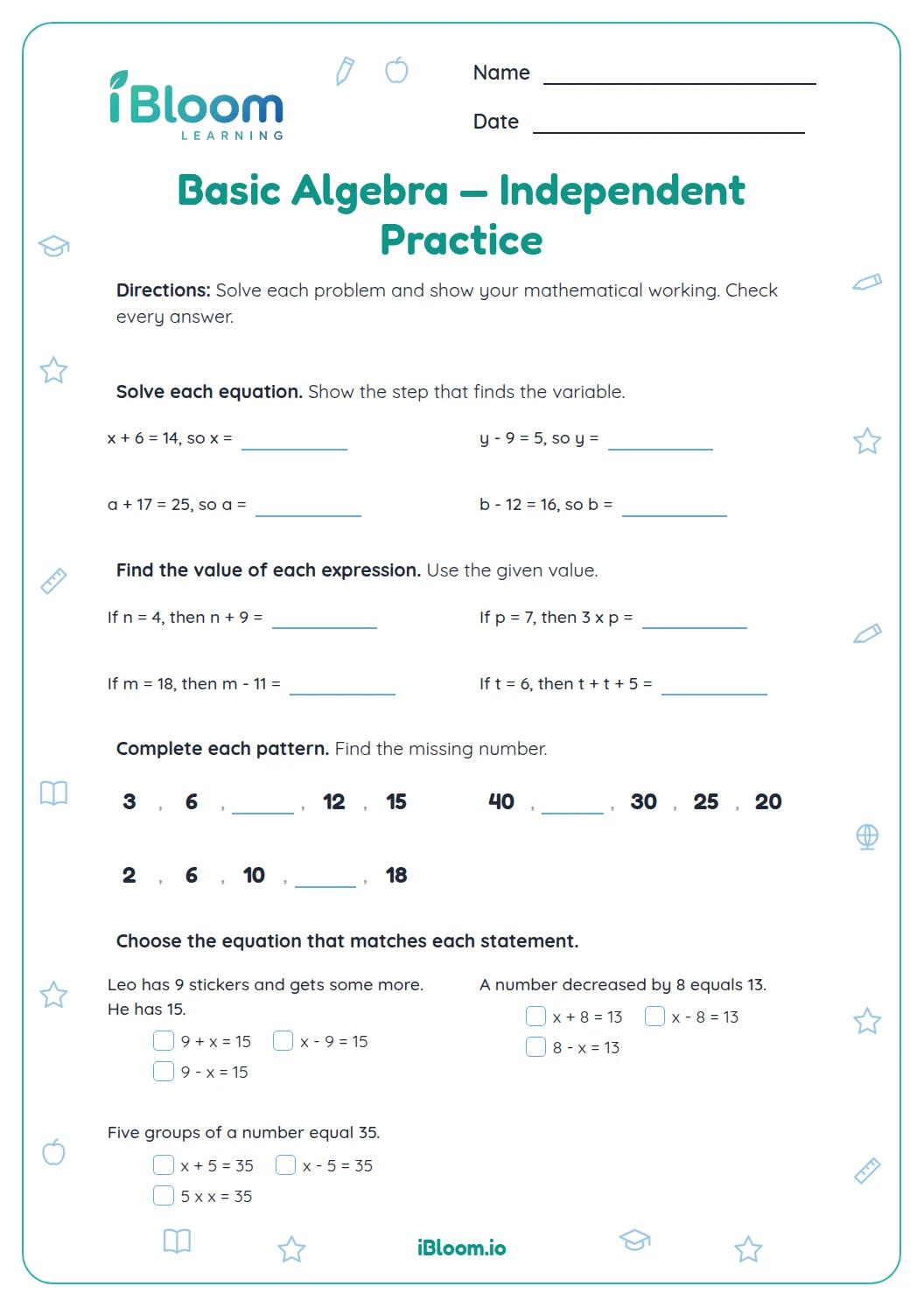
This free Grade 5 algebra worksheet introduces expressions that use two variables to represent two quantities. Students identify variables, translate phrases into expressions, evaluate with given values, and model familiar situations such as notebooks and pens. Sixteen questions progress from reading symbols to writing a model. A separate key supports checking each expression and calculation. The work practices CCSS 6.EE.A.2: writing, reading, and evaluating expressions in which letters stand for numbers.
Aligned to 6.EE.A.2
What do variables and coefficients represent?
A variable is a letter that stands for a quantity. An expression such as 4b + 3r combines two quantities: four groups of b and three groups of r. The expression names a calculation without claiming one fixed value for either letter.
A coefficient is the number multiplying a variable. In 4b, the 4 means four groups of b. Students should keep the letter attached to its coefficient when writing the expression.
- 1If m = 3 and n = 8, evaluate m + n.
- 2Replace m with 3 and n with 8.
- 33 + 8 = 11.
- 4Answer: 11
How can a situation become an expression?
Choose a variable for each changing quantity, then translate the relationship one operation at a time. If a notebook costs d dollars and a pen costs p dollars, two notebooks cost 2d and three pens cost 3p. Together their cost is 2d + 3p.
Expressions can include more than one variable because real situations can combine distinct amounts. The letters make those amounts visible while the operations show how they relate.
When should students substitute values?
Some questions provide values for the variables. Replace each letter with its value, then follow the expression’s operations. In 2a + b with a = 5 and b = 2, first find 2 × 5 and then add 2 to get 12.
How to use this worksheet
- 1Read the phrase or situation before choosing letters.
- 2Identify what each variable represents.
- 3Translate operation words such as total, twice, or extra.
- 4For evaluation, substitute every given value carefully.
- 5Check that the expression names all quantities in the situation.
Common mistakes and quick fixes
The mistake
Leaving out one variable in a total.
The fix
List each quantity in the story before writing the operation.
The mistake
Writing 2d as d + 2.
The fix
Read “2d” as two groups of d, then compare it with the phrase.
The mistake
Substituting only one of two given values.
The fix
Replace each variable with its value before calculating.
Common Core alignment
Students write, read, and evaluate expressions with letters standing for quantities.
Write, read, and evaluate expressions with letters for numbers.
On this sheet: Students write, read, and evaluate expressions that use letters to represent quantities.
Show the official wordingHide the official wording
Write, read, and evaluate expressions in which letters stand for numbers.
What to practice next
Make more practice
Further reading
Questions parents and teachers ask
What is a two-variable expression?
It is an expression that uses two letters to represent quantities. For example, g + b can represent the total number of girls and boys in a group, while 2d + 3p can represent the cost of two notebooks and three pens together.
What does a coefficient mean?
A coefficient tells how many groups of a variable are used. In 4b, the coefficient 4 means four groups of b. Students can read the expression aloud as “four times b” to connect the number and letter clearly. A coefficient is written beside its variable, with multiplication understood.
Do students solve equations on this worksheet?
The page focuses on reading, writing, and evaluating expressions. Students translate phrases and real situations into expressions, and some items give values to substitute. They do not need to solve for a variable in an equation on this page. Instead, students focus on what each expression represents.
How should a student evaluate an expression?
Replace each variable with its given value, then calculate using the operations in the expression. For 2a + b with a = 5 and b = 2, substitute to get 2 × 5 + 2, which equals 12 after multiplication and addition. Keep multiplication and addition in the written order.
Can variables stand for different kinds of quantities?
Yes. A variable can name a price, a number of people, or another amount in a situation. The question should make clear what each letter represents so the expression can show how those quantities relate. For example, letters can stand for different item prices in one total.
Is there an answer key?
Yes. A separate answer key lists the intended choices, values, and expressions for all 16 questions. For word problems, check that each response includes every quantity and relationship described in the prompt before deciding it is complete. Equivalent expressions that represent the same situation are acceptable.