




About this worksheet
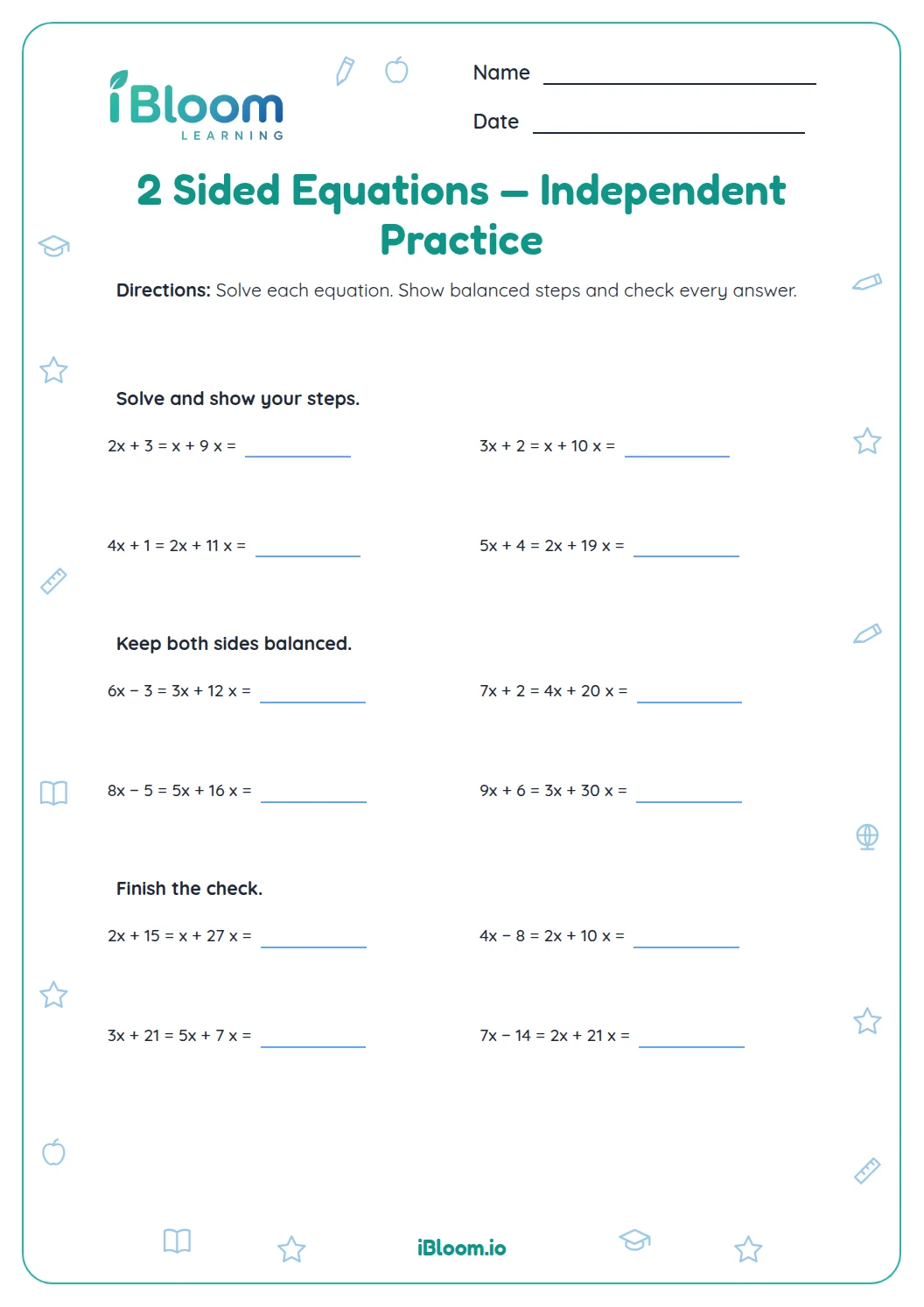
This free Grade 5 math worksheet practices equations with the unknown on both sides. In Part A, each side-by-side table names x-tiles and unit tiles, giving students a visual way to compare equal sides before solving. Part B removes the tables and asks students to solve 12 equations independently. The answer key lists each value of x. The tables rebuild the visual-model activity in a format the printable template can draw clearly.
How can tiles represent both sides?
Each x-tile stands for the same unknown value, and each unit tile stands for 1. In Part A, the table lists the tiles on each side of an equal equation. Comparing matching sides lets students remove equal x-tiles or units and isolate x.
- 12 x-tiles + 3 units = 1 x-tile + 8 units
- 2Remove one x-tile from each side: x + 3 = 8. Remove 3 units: x = 5.
What steps help solve an equation with x on each side?
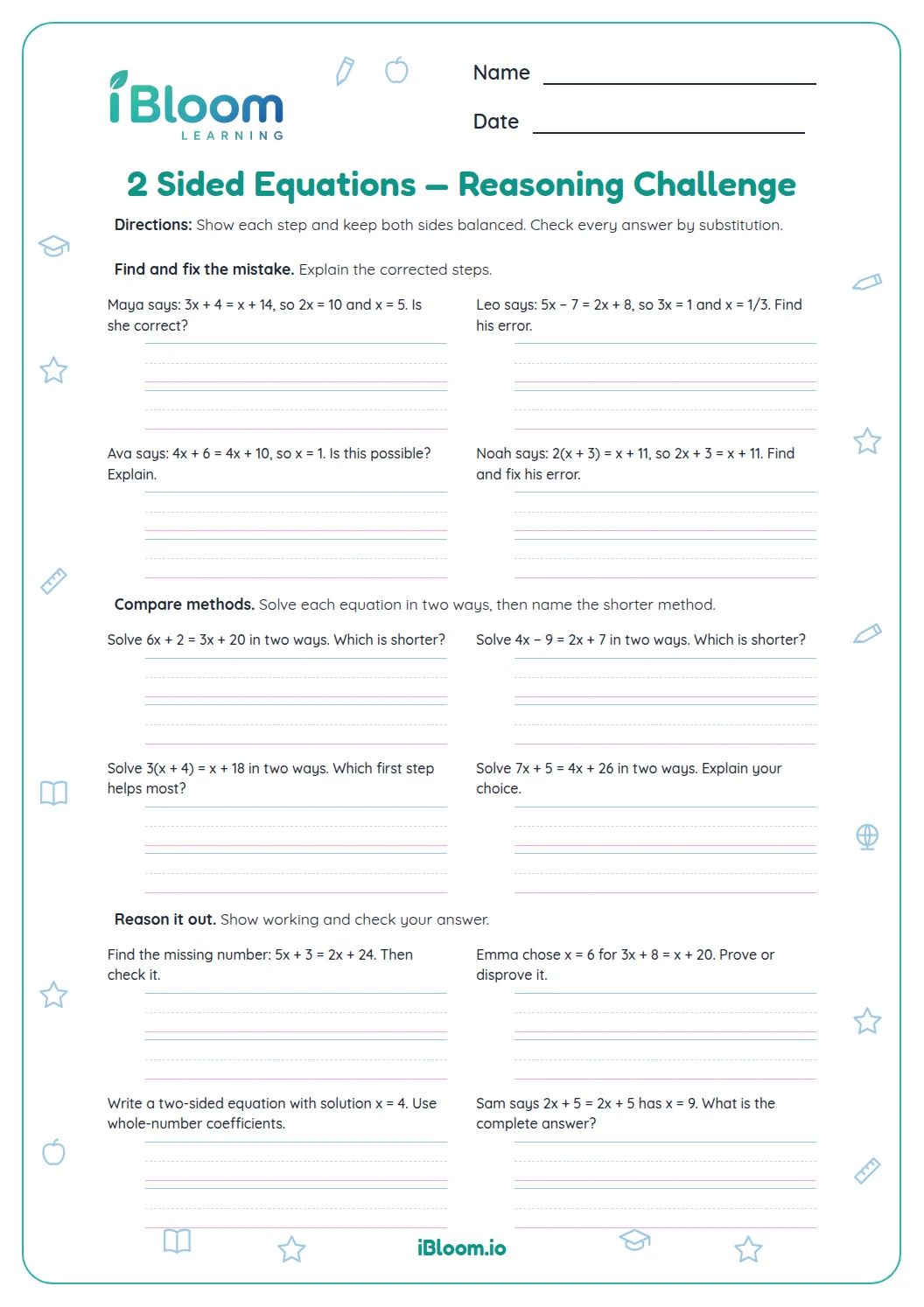
Keep an equality balanced by making the same change to both sides. Move the smaller x-group away by subtracting that amount from each side. Then remove the constant from the side with the remaining x-group.
How can students check a solution?
Substitute the proposed value for x in the original equation. If both sides produce the same number, the solution works. For the example above, x = 5 makes both sides equal 13.
How to use this worksheet
- 1Read the x-tile and unit count on each side of the Part A model.
- 2Subtract the smaller number of x-tiles from both sides.
- 3Subtract or add units equally to isolate the remaining x-tiles.
- 4Divide by the number of x-tiles if more than one remains.
- 5Substitute the solution into the original equation to check both sides.
Common mistakes and quick fixes
The mistake
Changing only one side while removing tiles.
The fix
Keep the equation balanced by subtracting the same tiles or units from each side.
The mistake
Subtracting the larger x-group from the smaller one and keeping a negative count.
The fix
Subtract the smaller x-coefficient from both sides so the remaining x-group is positive.
The mistake
Stopping at 2x = 12 and answering x = 12.
The fix
Divide both sides by 2, then check x = 6 in the original equation.
What to practice next
Make more practice
Questions parents and teachers ask
What does a two-sided equation mean here?
A two-sided equation has the unknown x on both sides of the equal sign, such as 2x + 3 = x + 8. The first four questions use side-by-side tile-count tables; the final 12 give equations to solve without a model.
How many questions are on the sheet?
There are 16 questions. The first four use tile-count tables, and the next 12 are equations with x on both sides. The answer key lists each solution. For every answer, students can substitute x into the original equation to confirm that both sides have equal values.
What does one x-tile stand for?
An x-tile represents the same unknown number wherever it appears, and a unit tile represents 1. In question 1, two x-tiles and three units balance one x-tile and eight units. Removing one x-tile and three units from both sides leaves x = 5.
Why must the same amount be removed from each side?
The equal sign means both sides have the same value. Subtracting the same number of x-tiles or units from each side preserves that equality and makes the equation simpler. Removing tiles from just one side would change the balance represented by the equation.
How can my child check an answer?
Replace x with the proposed value in the original equation and calculate each side. For question 1, x = 5 gives 2 × 5 + 3 = 13 and 1 × 5 + 8 = 13. Because both sides equal 13, the solution checks.
What if a student gets a different value?
Compare the tile counts or rewrite the equation one equal step at a time. Make the same change on both sides, then substitute the result into the original equation. If both sides match, the value is a solution; the answer key can help locate the first step to revisit.