



About this worksheet
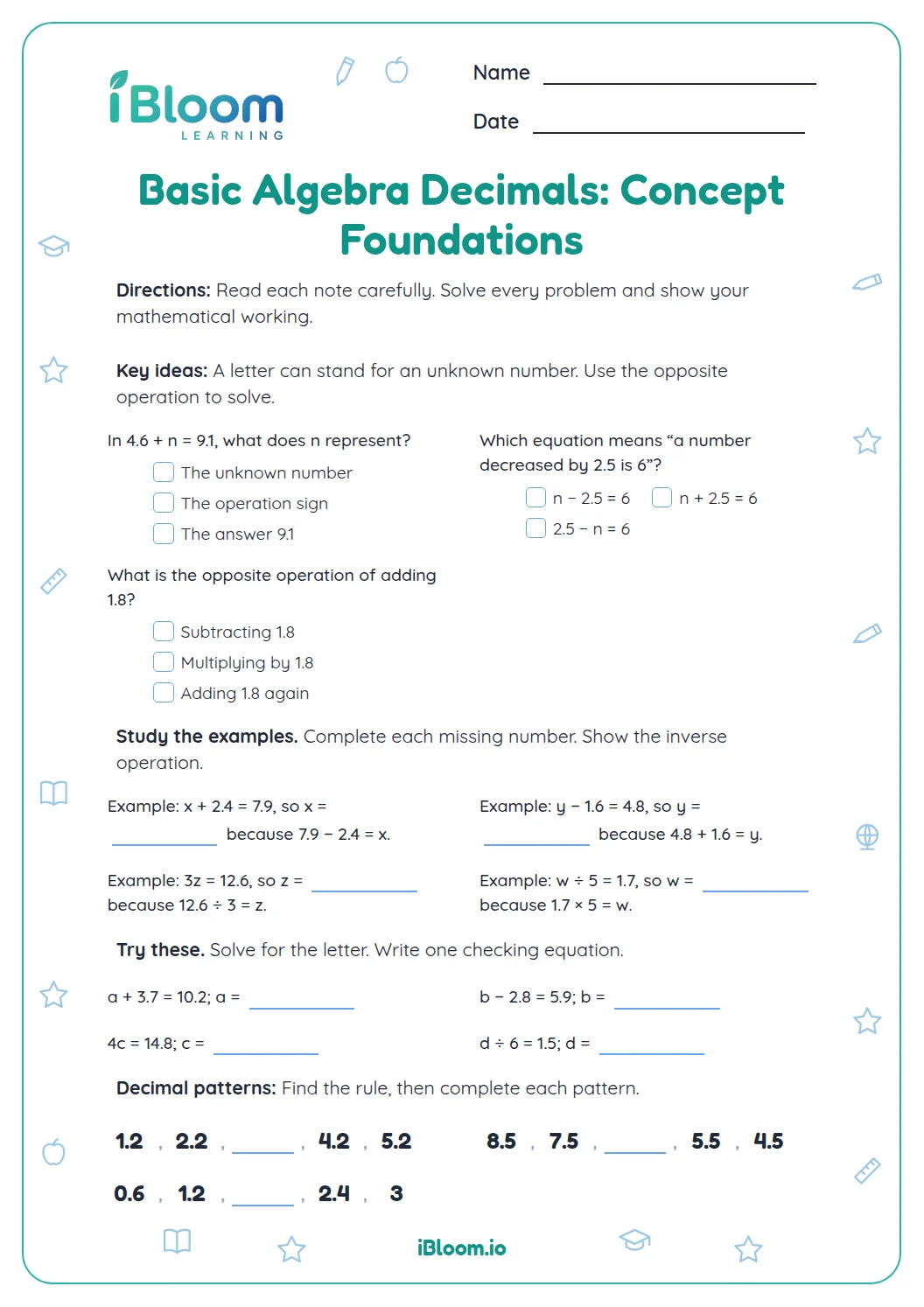
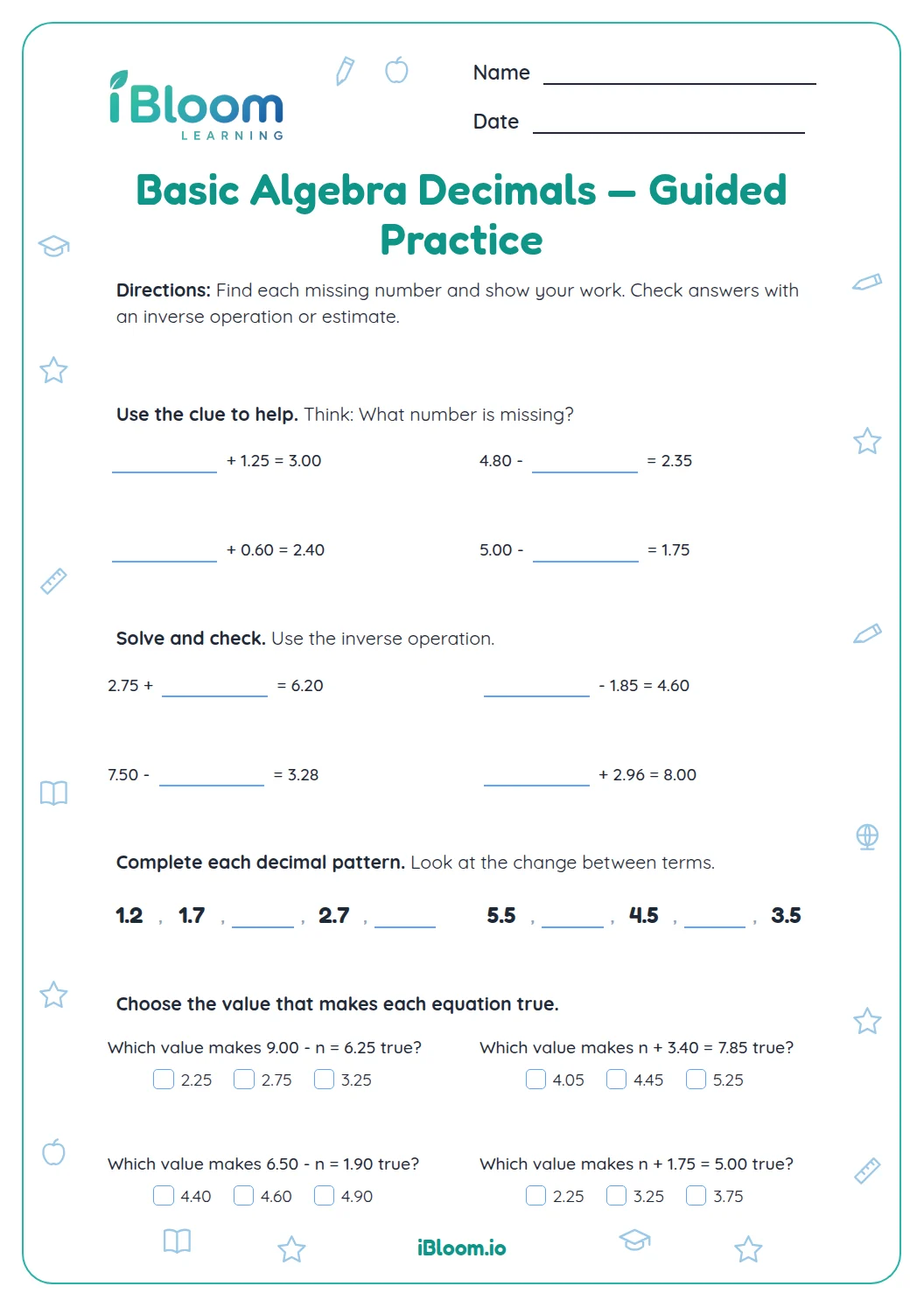
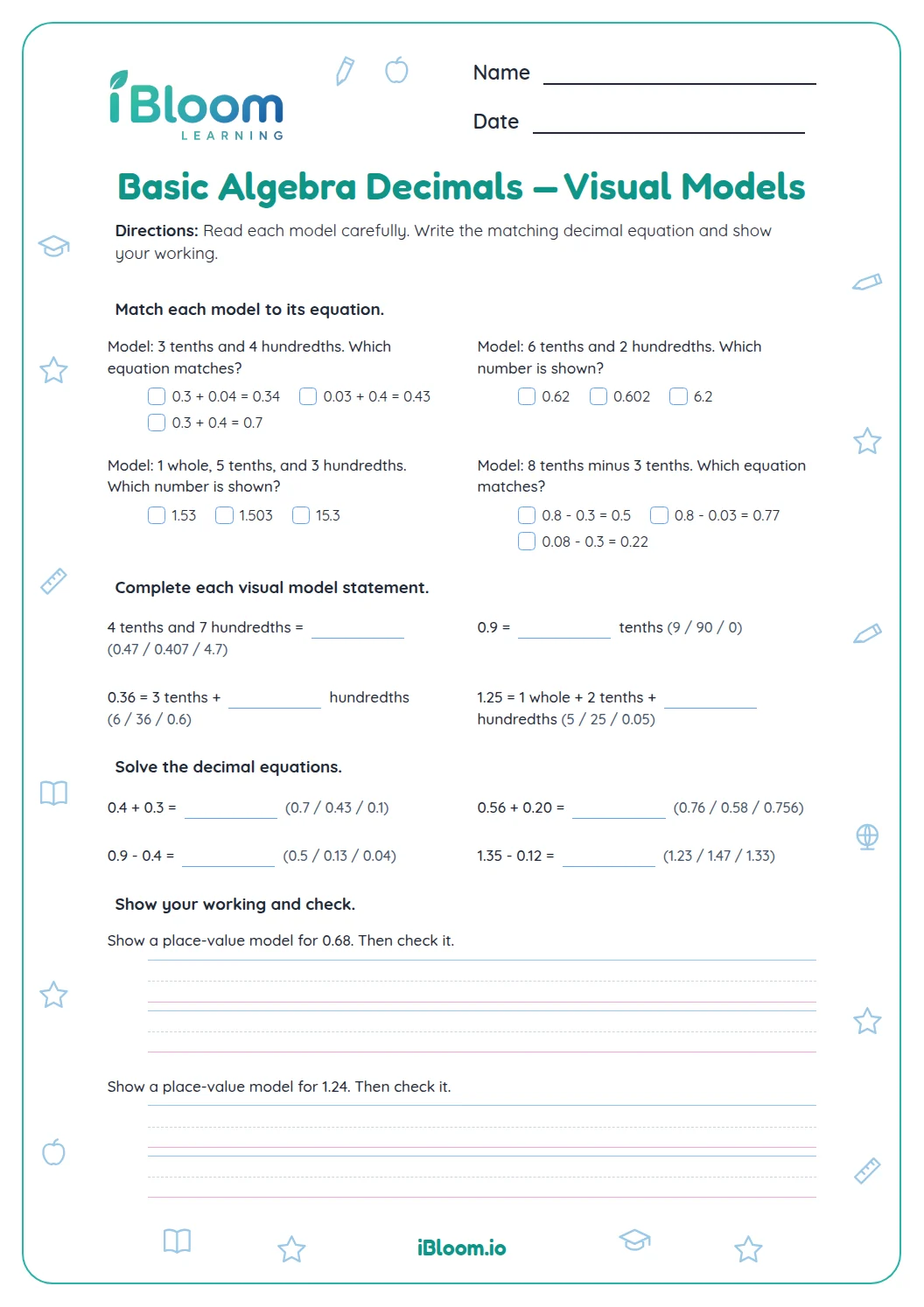
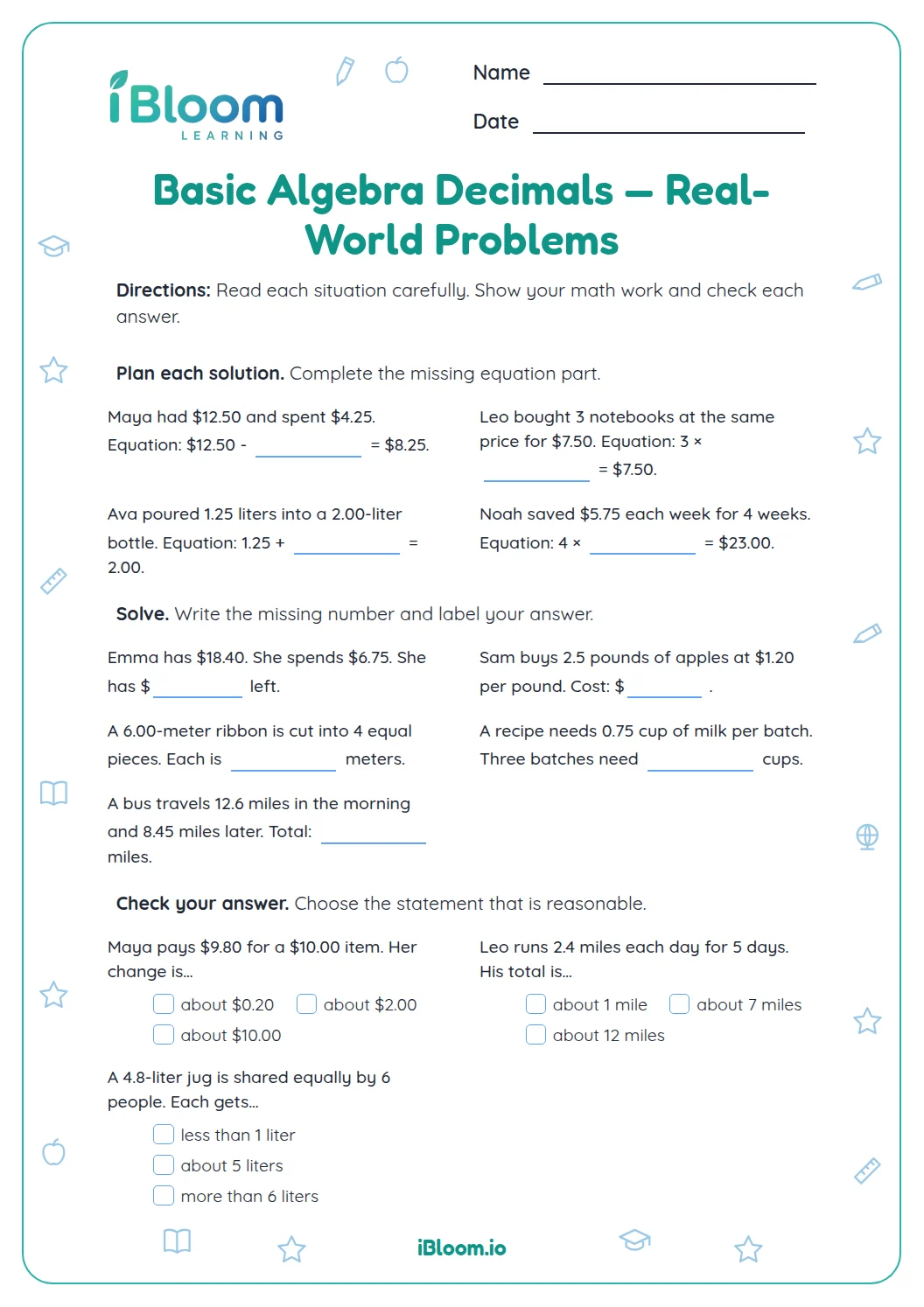
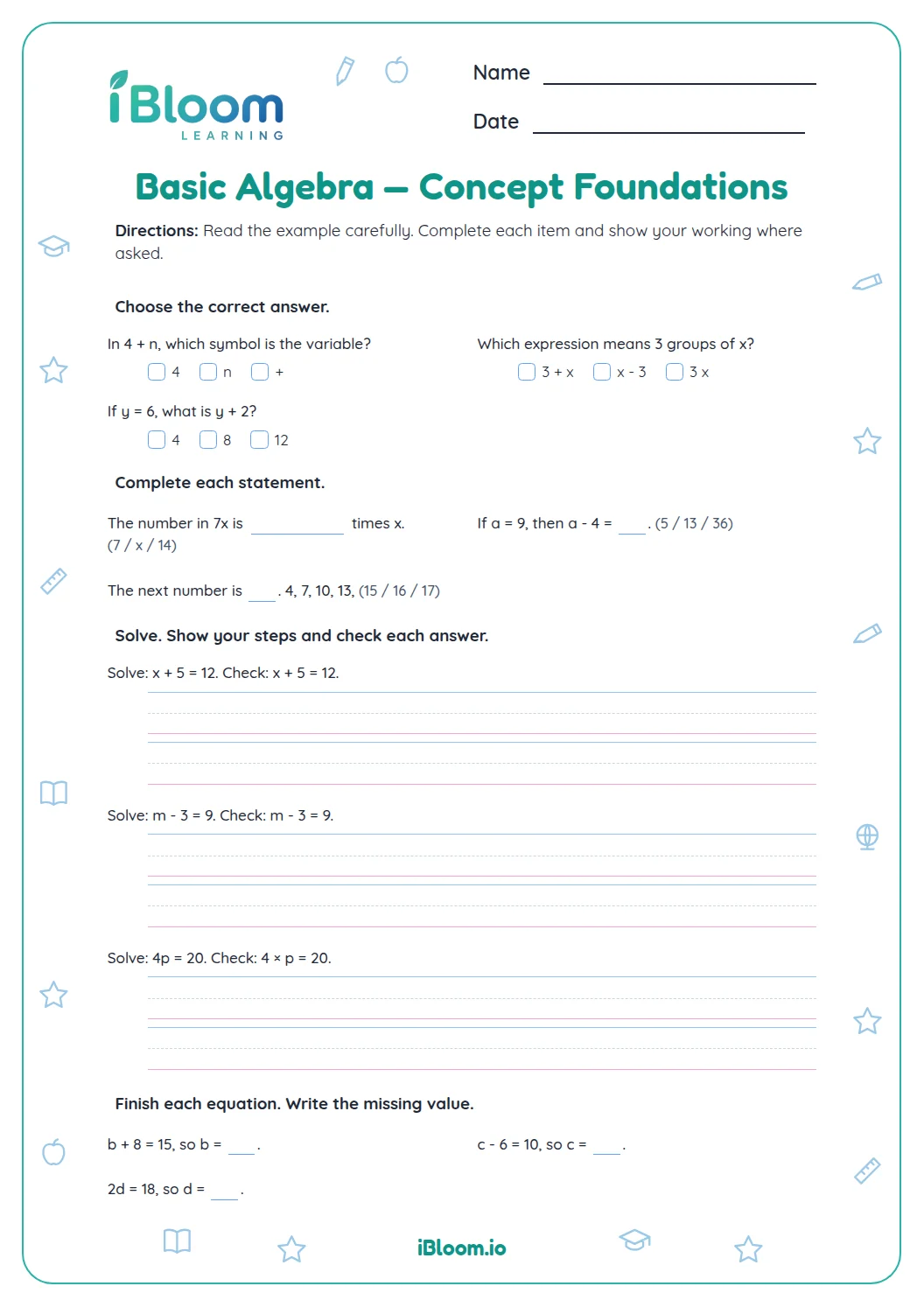
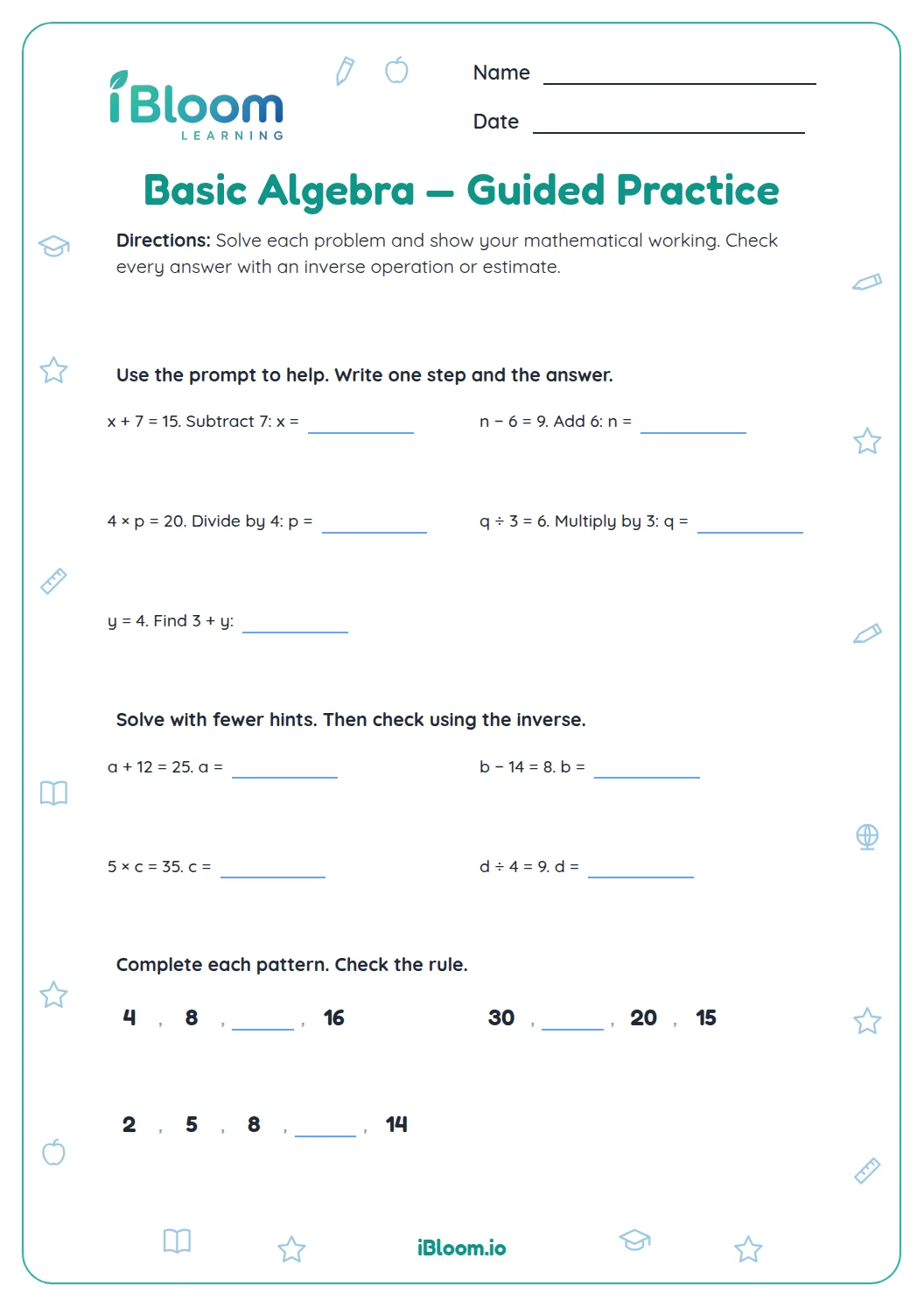
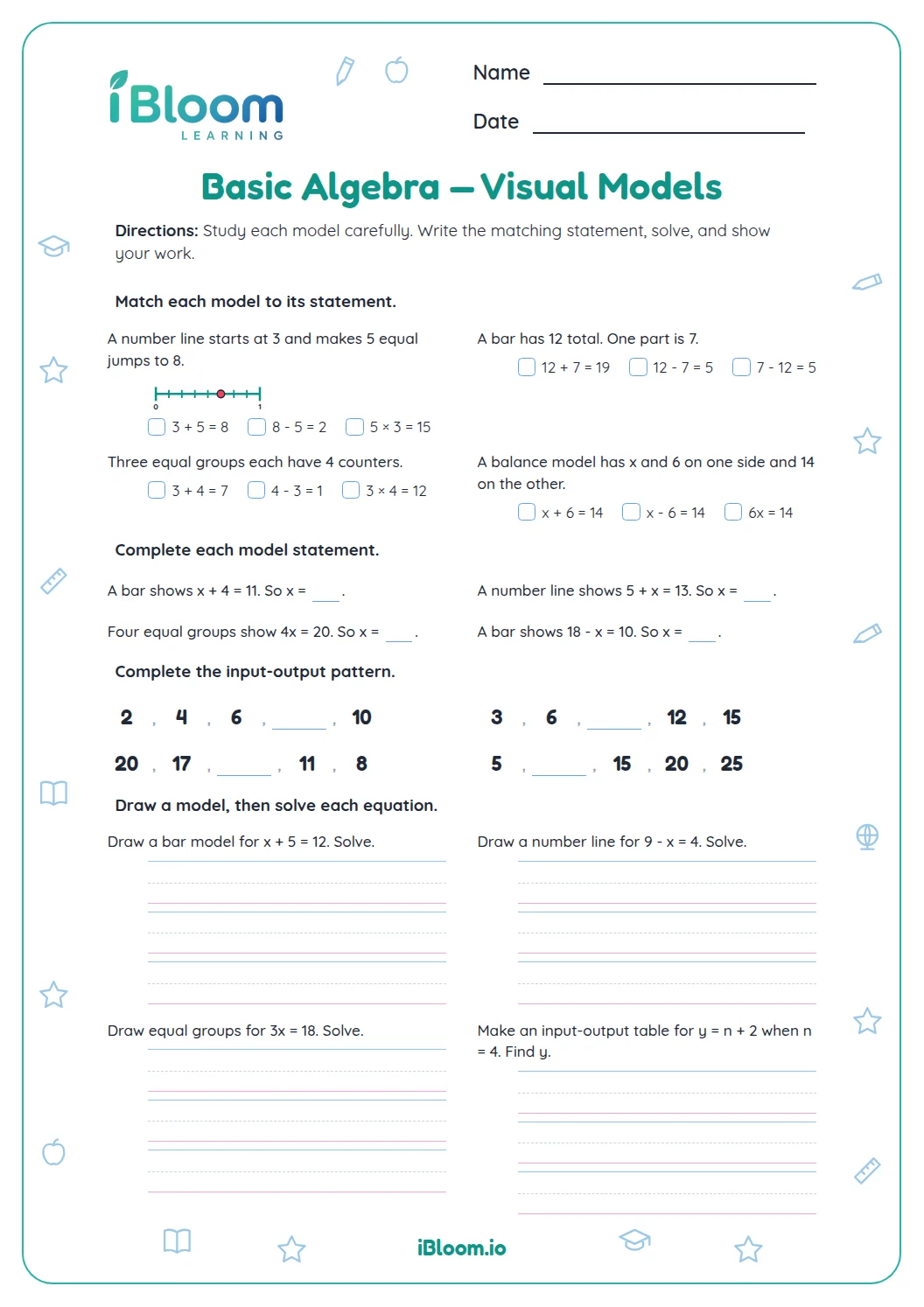
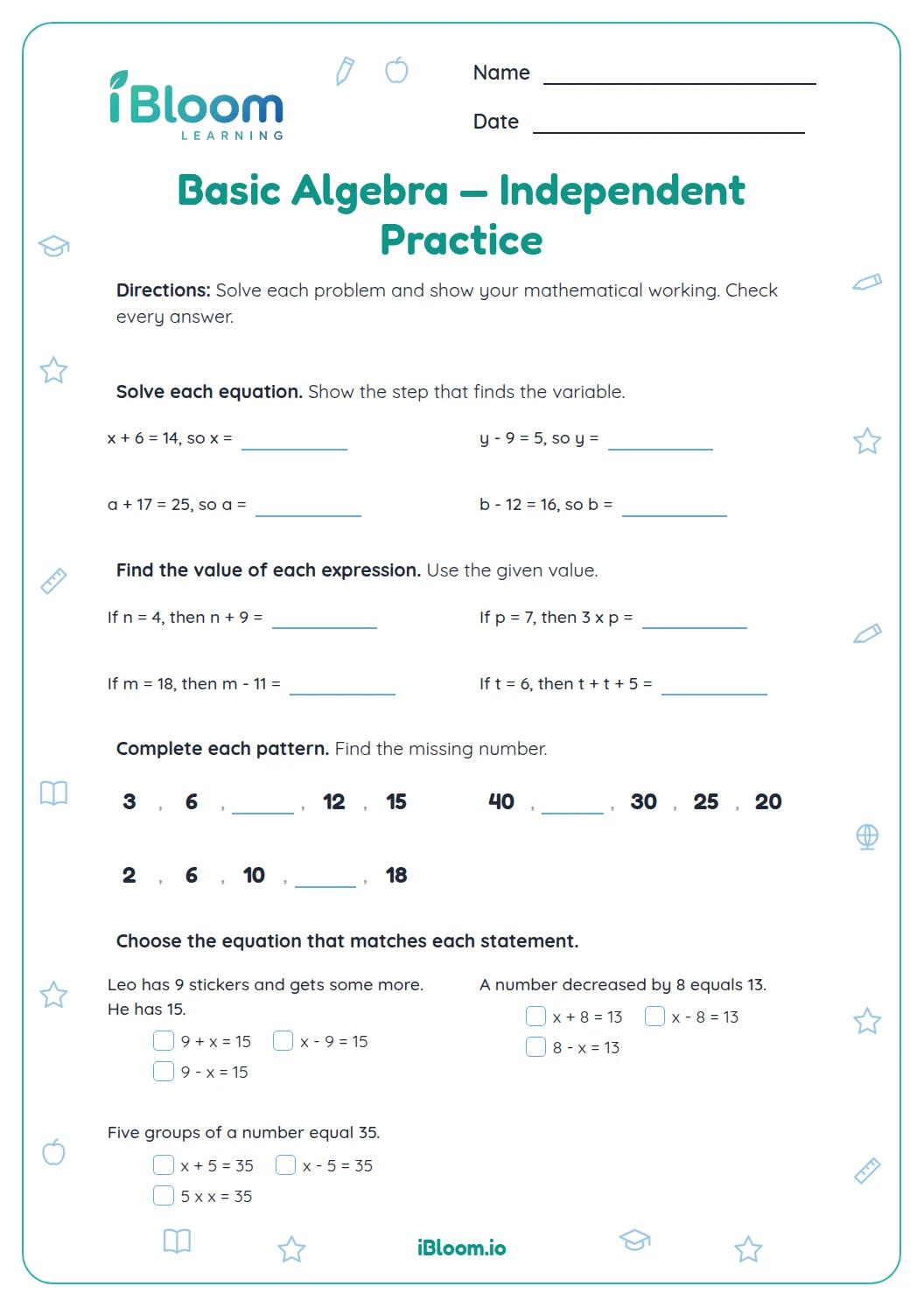
This Grade 5 independent practice sheet connects one-step algebra equations with decimal operations. Students solve for an unknown in addition, subtraction, multiplication, and division equations, then substitute a value to check it. The 16 problems use tenths and hundredths and have exact decimal answers. A separate answer key supports independent checking.
Aligned to 5.NBT.B.7
How do you isolate the unknown?
An equation stays balanced when you do the same operation to both sides. A quick way to solve a one-step equation is to use the inverse operation: addition undoes subtraction, and multiplication undoes division.
Question 1 is x + 1.4 = 5.8. Subtract 1.4 from both sides to leave x by itself.
- 1x + 1.4 = 5.8
- 2x = 5.8 − 1.4
- 3x = 4.4
- 4Check: 4.4 + 1.4 = 5.8
How do decimal operations fit in?
Treat each decimal computation by place value. Align decimal points when adding or subtracting. For multiplication or division equations, use the inverse operation and keep track of the decimal place.
What should the check look like?
Replace the letter with your answer in the original equation. If both sides have the same value, the solution works. Part A focuses on finding the unknown; Part B asks for a substitution check too.
- Addition and subtraction equations
- Multiplication and division equations
- Decimal tenths and hundredths
- A separate answer key page
Solve each equation in four moves
- 1Read the operation between the unknown and the known number.
- 2Choose its inverse to get the letter by itself.
- 3Calculate carefully, lining up decimal points for addition or subtraction.
- 4Write the value of the unknown.
- 5Substitute it into the original equation.
- 6Check that both sides are equal.
Common equation mistakes
The mistake
Using the same operation instead of its inverse.
The fix
Ask what operation will undo the one next to the unknown.
The mistake
Subtracting decimals with digits in the wrong place.
The fix
Line up decimal points before subtracting.
The mistake
Finding a value but skipping the check.
The fix
Replace the letter in the original equation and calculate both sides.
Common Core alignment
The decimal calculations in these one-step equations practice decimal operations through hundredths.
Operate with decimals to hundredths using place value and strategies.
On this sheet: Solving each equation requires decimal operations and checking the result by substitution.
Show the official wordingHide the official wording
Add, subtract, multiply, and divide decimals to hundredths, using concrete models or drawings and strategies based on place value, properties of operations, and/or the relationship between addition and subtraction; relate the strategy to a written method and explain the reasoning used.
What to practice next
Make more practice
Further reading
Questions parents and teachers ask
What does inverse operation mean?
An inverse operation undoes the operation attached to the unknown. Subtract to undo addition, add to undo subtraction, divide to undo multiplication, and multiply to undo division. Use the inverse on both sides so the equation stays balanced.
How do you solve x + 1.4 = 5.8?
Subtract 1.4 from both sides: x = 5.8 − 1.4 = 4.4. Substitute 4.4 into the original equation and check that 4.4 + 1.4 equals 5.8. The two sides match, so 4.4 is the solution. This check confirms the answer satisfies the equation, not just the subtraction.
Why should decimal points line up?
Align decimal points when adding or subtracting so tenths and hundredths remain in their place-value columns. For example, 5.8 − 1.4 gives 4.4. How could you check that difference using addition? For multiplication or division, use the matching inverse relationship to check the result.
How many equations are on the worksheet?
There are 16 one-step equations. Part A has eight equations to solve, and Part B has eight more that ask students to substitute their answers back into the original equation. Each item practices decimal calculations while isolating an unknown.
Which operations appear?
The equations use addition, subtraction, multiplication, and division with decimal values. The unknown appears in different positions, so students need to identify the operation relationship before choosing an inverse. Students can group the problems by operation before solving to notice how the inverse changes.
Does this page include answers?
Yes. The answer key lists each unknown’s value. In the solve-and-check part, students should also substitute the value into the original equation and confirm that both sides are equal. The key is most useful after students have finished each equation and tried their own check.