





About this worksheet
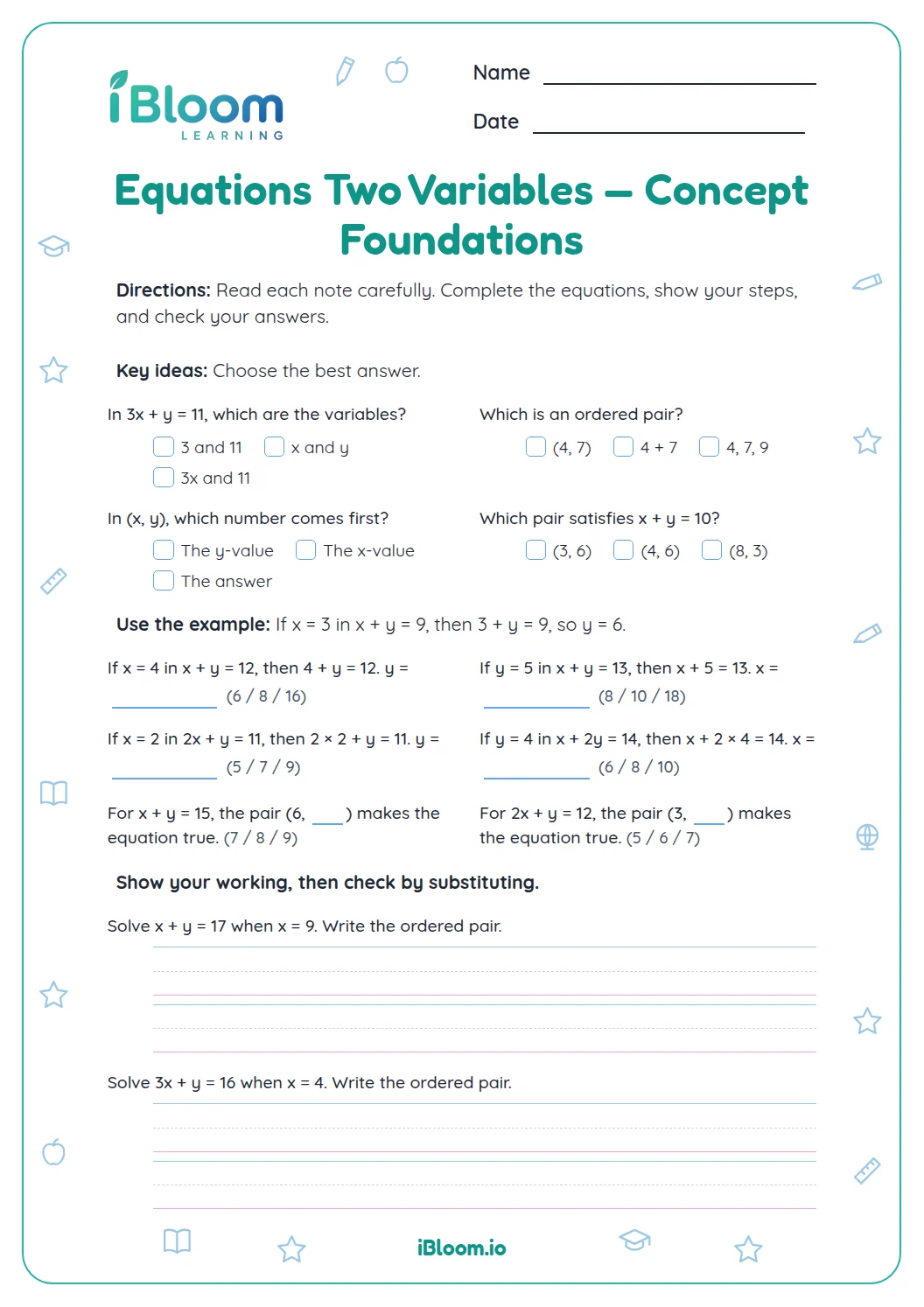
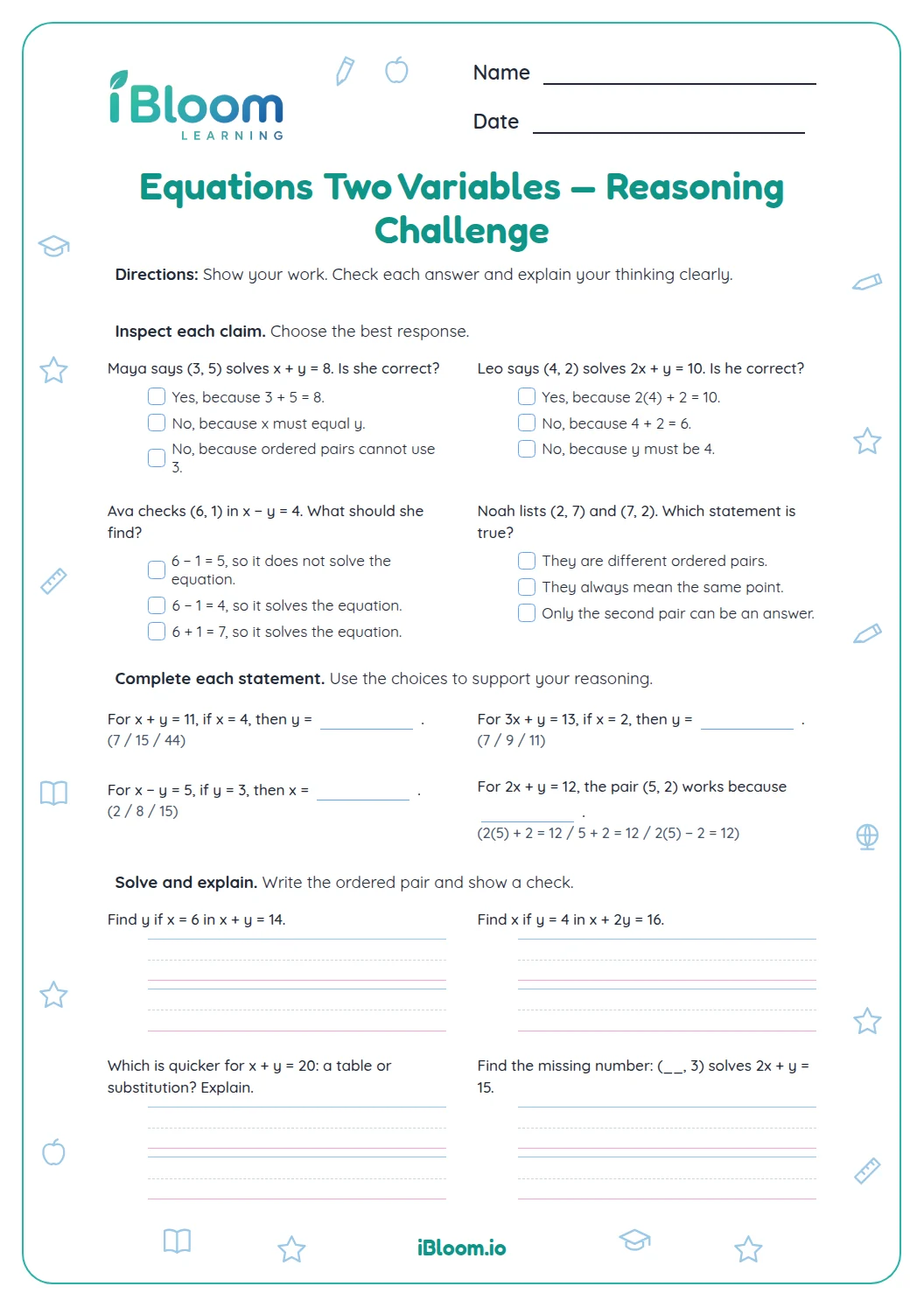
This Grade 5 algebra worksheet builds from evaluating expressions with two given values to testing ordered pairs and solving short relationship problems. Students substitute values for variables, use a rule to find a missing value, and decide whether a pair satisfies an equation. The two-page sheet has 14 questions and a separate answer key. Its examples stay with simple whole-number relationships so students can focus on what each variable represents.
What kinds of problems are on this sheet?
Part A asks students to evaluate expressions such as 2a + b and find a missing value. Part B reads a value table, checks ordered pairs against rules, and applies the same reasoning to ticket prices and points.
- 1For 2x + y = 11, test (4, 2): 2 × 4 + 2 = 10, so this pair does not work.
How do you check an ordered pair?
Treat the first number as x and the second as y. Replace each variable in the equation, then calculate both sides. The pair works only when the equation is true.
For a missing value, isolate the unknown by using the relationship. In x + y = 10 with x = 4, y must be 6 because 4 + 6 = 10.
- 1x + y = 10 and x = 4. Substitute 4: 4 + y = 10, so y = 6.
What does the last part add?
The final items connect variables to quantities: a ticket and snack total, points from goals and bonuses, and two pairs with the same sum. Ask the student to explain what each number in the pair stands for.
How should families use the answer key?
Check the arithmetic and the ordered-pair substitution, not only the final number. For the last item, several pairs can work; the key gives two valid examples, including one with zero.
How to use this worksheet
- 1Read the equation and identify what each variable means.
- 2Replace each variable with its given value.
- 3Calculate using the operations in the expression.
- 4For a pair, substitute both numbers and test the equation.
- 5Check each answer with the key and correct the step that changed the relationship.
Common mistakes and quick fixes
The mistake
Using the pair in reverse order.
The fix
Write the first coordinate for x and the second for y.
The mistake
Doing an operation before substituting.
The fix
Replace the variables first, then follow the order of operations.
The mistake
Finding a value that seems reasonable but breaks the equation.
The fix
Substitute the answer back into the original equation.
What to practice next
Make more practice
Questions parents and teachers ask
What does an ordered pair (x, y) mean?
The first number gives x and the second gives y. To test a pair, place those numbers into the equation in that order and simplify. For example, in (2, 7), use x = 2 and y = 7. The pair belongs only if the equation becomes true.
How can I check whether a pair works?
Substitute both coordinates into the equation and calculate each side. For x + y = 9, the pair (2, 7) works because 2 + 7 equals 9. If the equation is not true after substitution, the pair does not satisfy the relationship.
Why does the worksheet use two variables?
A two-variable equation describes how two quantities are related. The questions use x and y, or other letters, to represent values that can change while following a rule such as x + y = 10. Students use known values to calculate or test the other value.
Can more than one pair satisfy an equation?
Yes. One equation can have many ordered-pair solutions. For x + y = 8, both (0, 8) and (1, 7) work, because each pair adds to 8. The last question asks for two different whole-number pairs and requires one pair to include zero.
What is on the answer key?
The two-page worksheet has a separate key. It gives the selected expression values, missing values, equation checks, and sample pairs for the final question. A student can compare the arithmetic and substitution steps as well as the final answers. The final item accepts other distinct whole-number pairs if one includes zero.