



About this worksheet
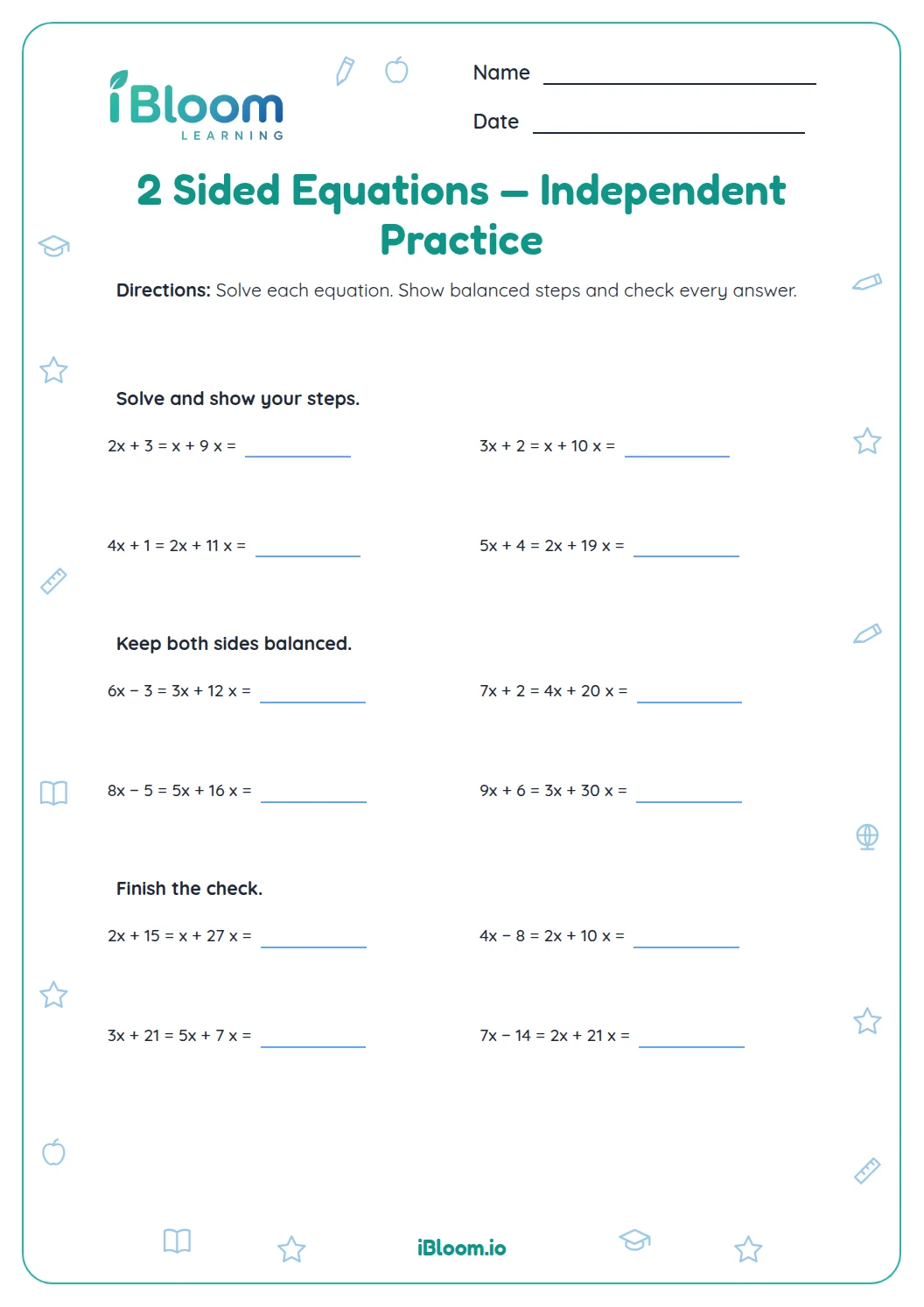
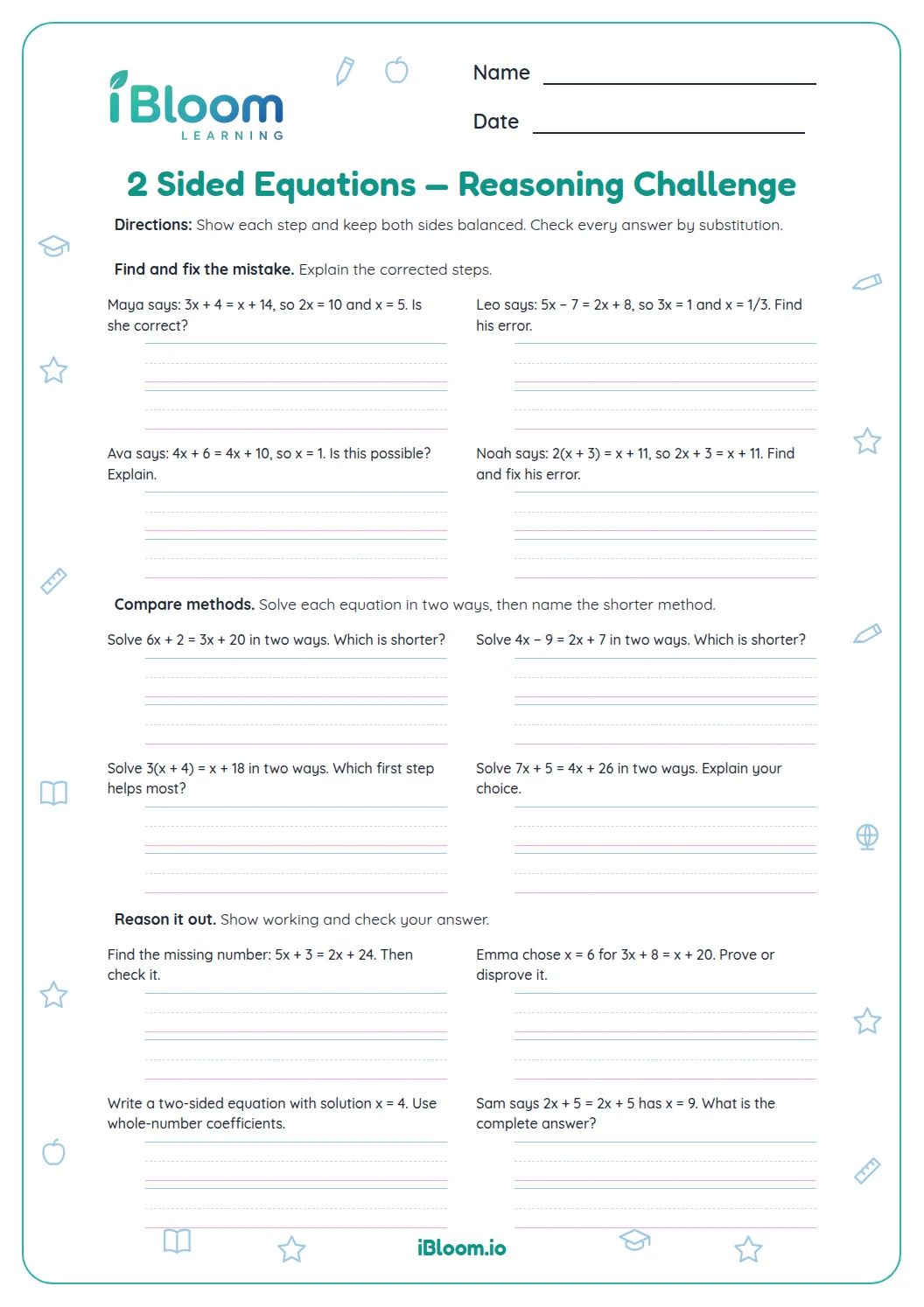
This printable gives 16 short real-world problems about two equal totals. Each story compares repeated groups and extra items, so learners can represent the situation with a variable on each side, solve for the shared group size, and check both totals. The page keeps its Grade 5 collection label and cites CCSS 8.EE.C.7, the standard aligned to solving one-variable linear equations.
Aligned to 8.EE.C.7
How do two equal totals create an equation?
A story may describe one total as four boxes of pencils plus six loose pencils and another as three boxes plus 18 loose pencils. If x is the number in each box, the equation is 4x + 6 = 3x + 18.
How do you solve for the group size?
Remove the same variable amount from each side, then isolate the remaining variable. Check by rebuilding both totals.
- 14x + 6 = 3x + 18
- 2Subtract 3x: x + 6 = 18.
- 3Subtract 6: x = 12.
- 4Check: 4(12) + 6 = 54 and 3(12) + 18 = 54.
What do the stories ask learners to find?
Each item asks for one repeated group size. The stories vary boxes, bags, rows, and other groupings while keeping the equal-total relationship central.
How can both totals be checked?
Substitute the value into each side and calculate the totals. The two totals should match, and the answer should make sense as a group size.
How to model the story
- 1Choose a variable for the amount in one repeated group.
- 2Write the first total using groups and extras.
- 3Write the equal second total with the same variable.
- 4Solve by doing the same operation on both sides.
- 5Substitute the value and check that both totals match.
Common mistakes and quick fixes
The mistake
Forgetting the extra items in one total.
The fix
Include every loose item or extra amount as a constant.
The mistake
Using different variables for the same group size.
The fix
Use one variable because the equal groups have the same size.
The mistake
Checking only one total.
The fix
Substitute into both sides and confirm the totals are equal.
Common Core alignment
This worksheet practices solving linear equations through equal-group stories.
Solve linear equations in one variable represented by equal totals.
On this sheet: Learners represent equal totals with a variable on each side, solve, and verify the group size.
Show the official wordingHide the official wording
Solve linear equations in one variable.
What to practice next
Make more practice
Further reading
Questions parents and teachers ask
Why is the same variable on both sides?
The variable represents the shared size of each group in both totals. For example, four boxes and three boxes may each contain x pencils. Use x in both expressions, then solve so the complete totals match in the story.
How do I turn a story into a two-sided equation?
Write each total as repeated groups plus any extras. If four groups and six extra items equal three groups and 18 extras, write 4x + 6 = 3x + 18. Solve, then check both totals in the original story. The group count multiplies the unknown size.
What does the answer mean?
The answer is the number of items in each repeated group. Substitute it into both descriptions and calculate each total. They should match, and the value should make sense as a group size in the situation described. Include the requested unit or item name.
How many problems are included?
The worksheet has 14 short real-world problems on two pages and a separate answer key. Every problem asks for one group size that makes two described totals equal, such as boxes, rows, or bags. Each prompt supplies the needed totals and extras.
Which standard does the sheet cite?
It cites CCSS 8.EE.C.7, which addresses solving linear equations in one variable. The page retains its Grade 5 collection label and practices the two-sided equation skill named in its title. The standard code reflects the equation skill in these stories.