



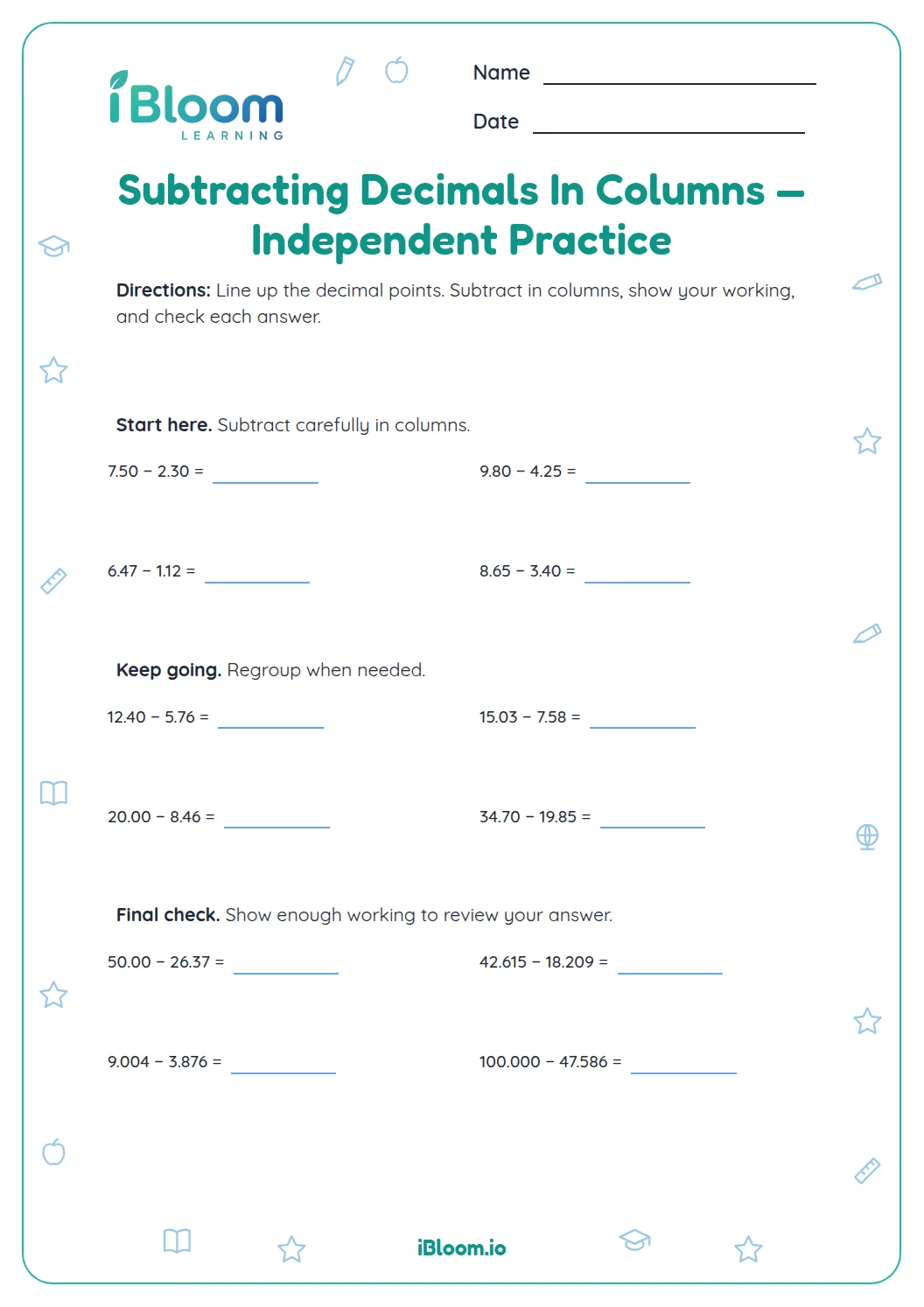
About this worksheet
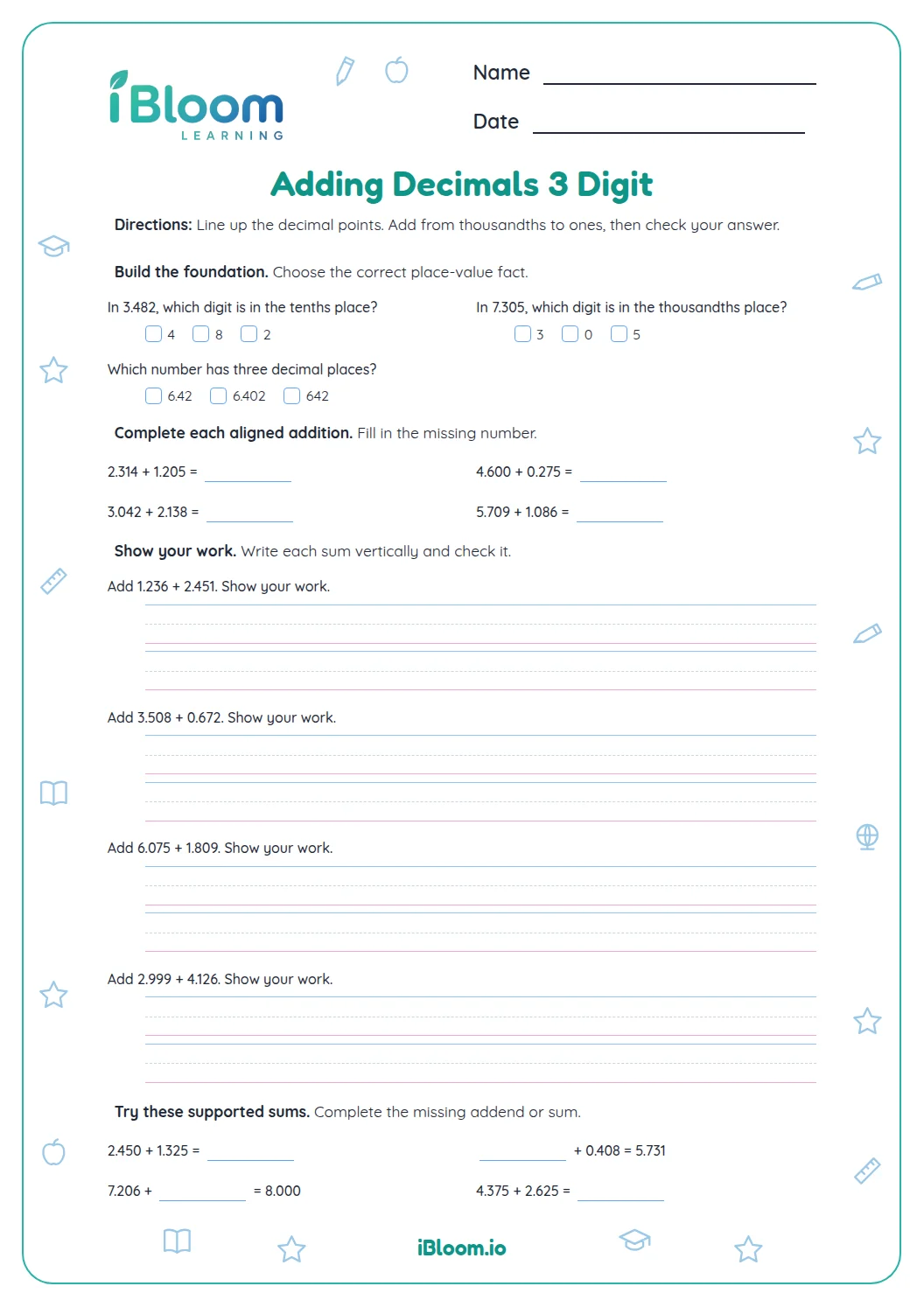
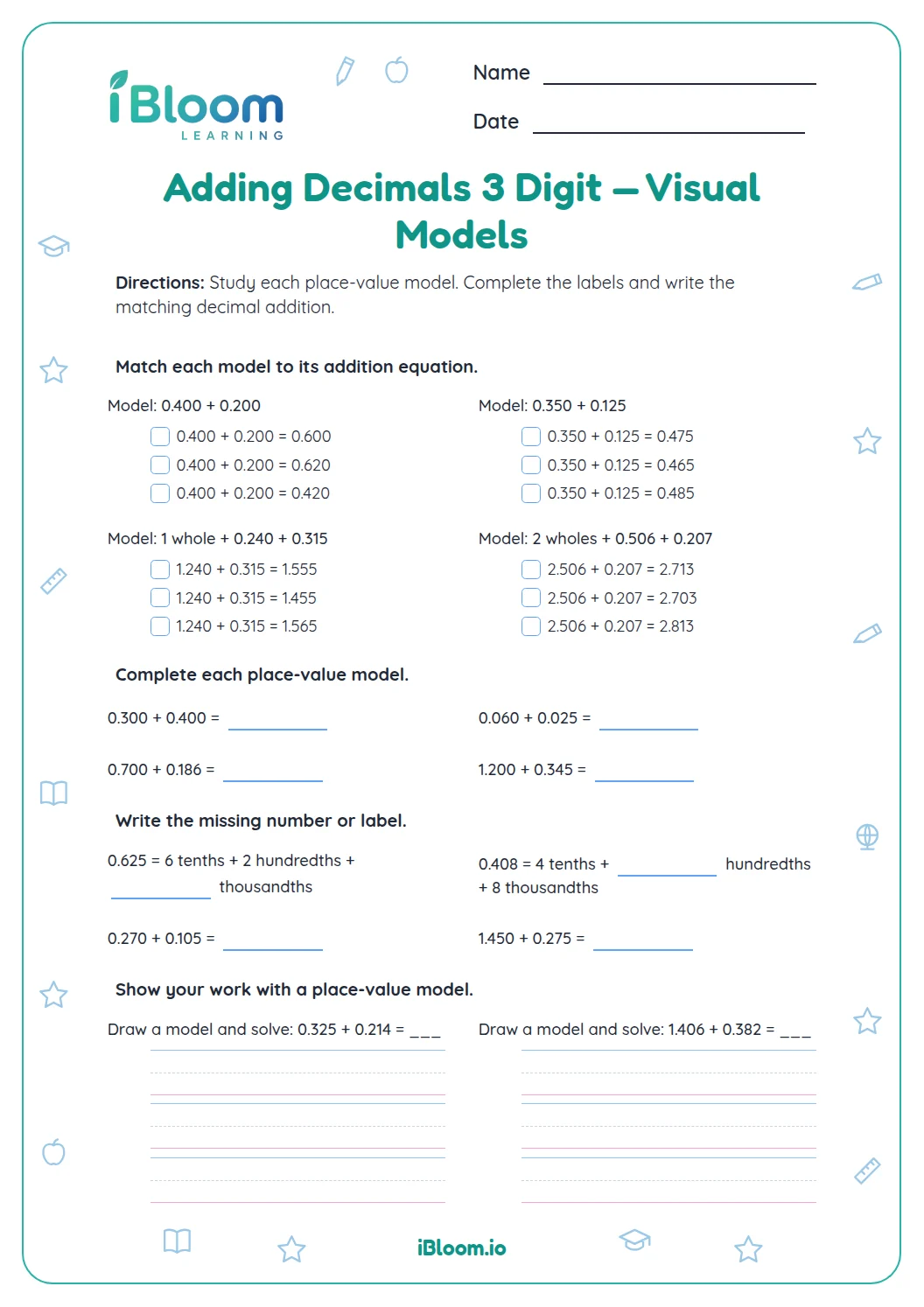
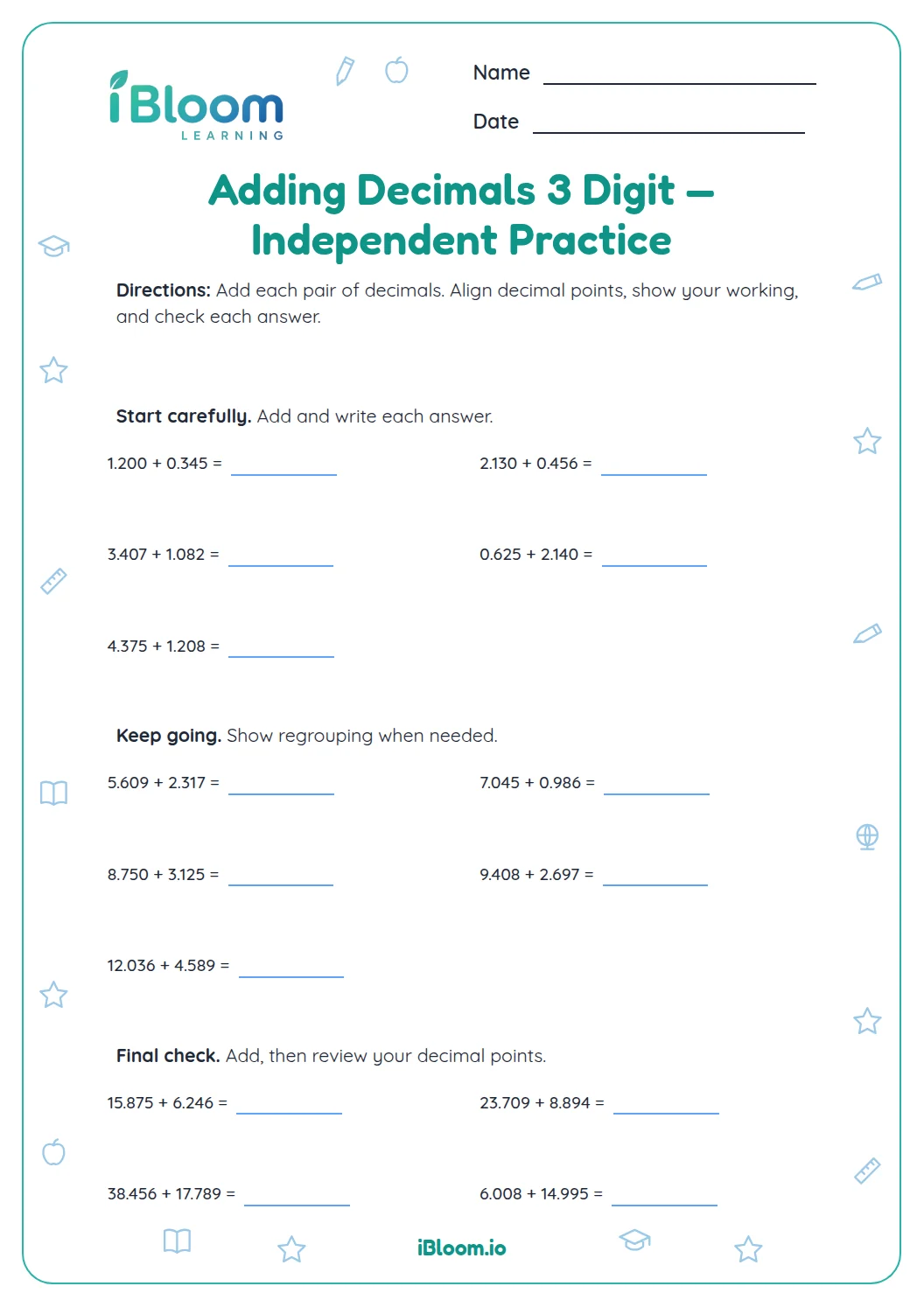
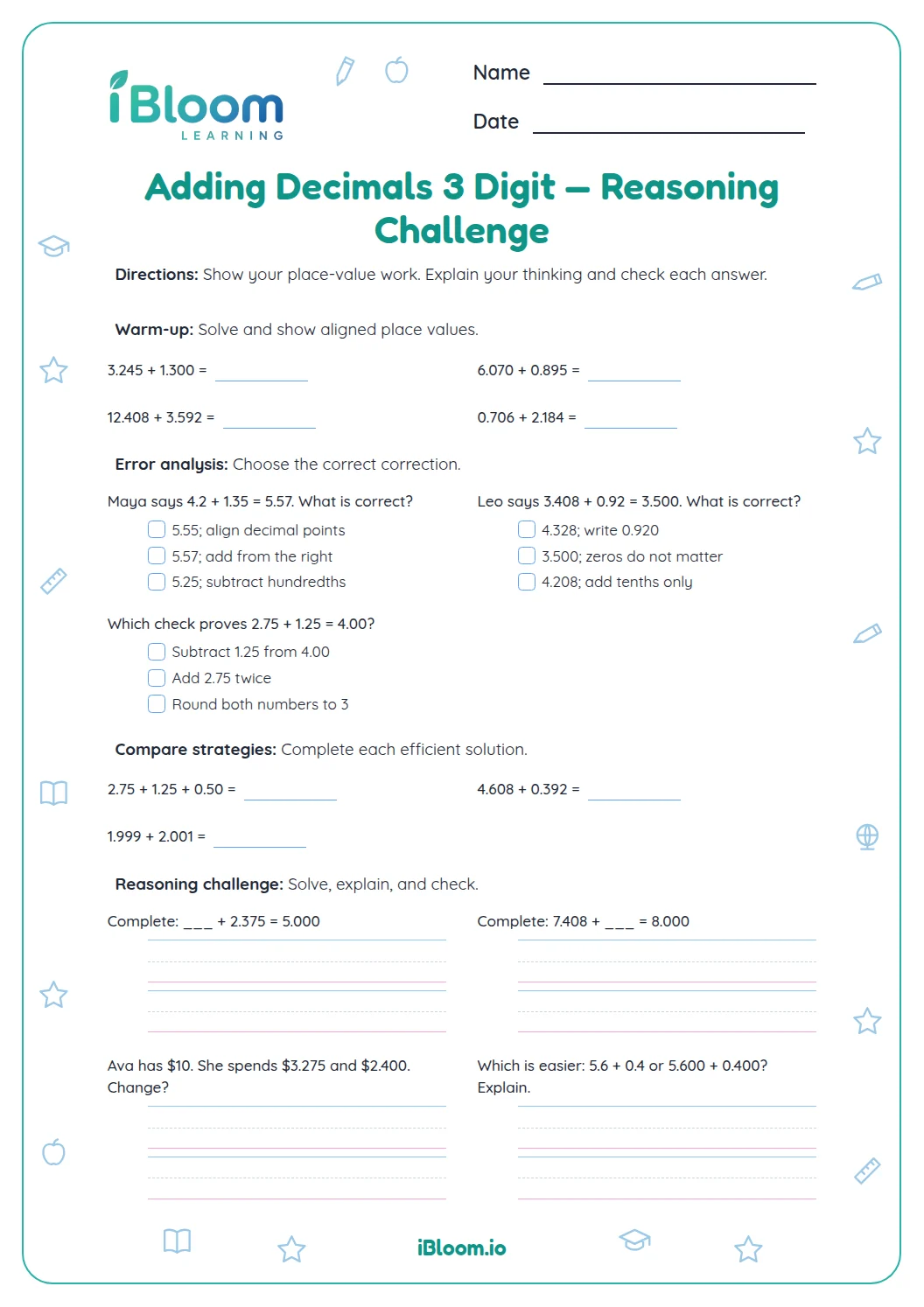
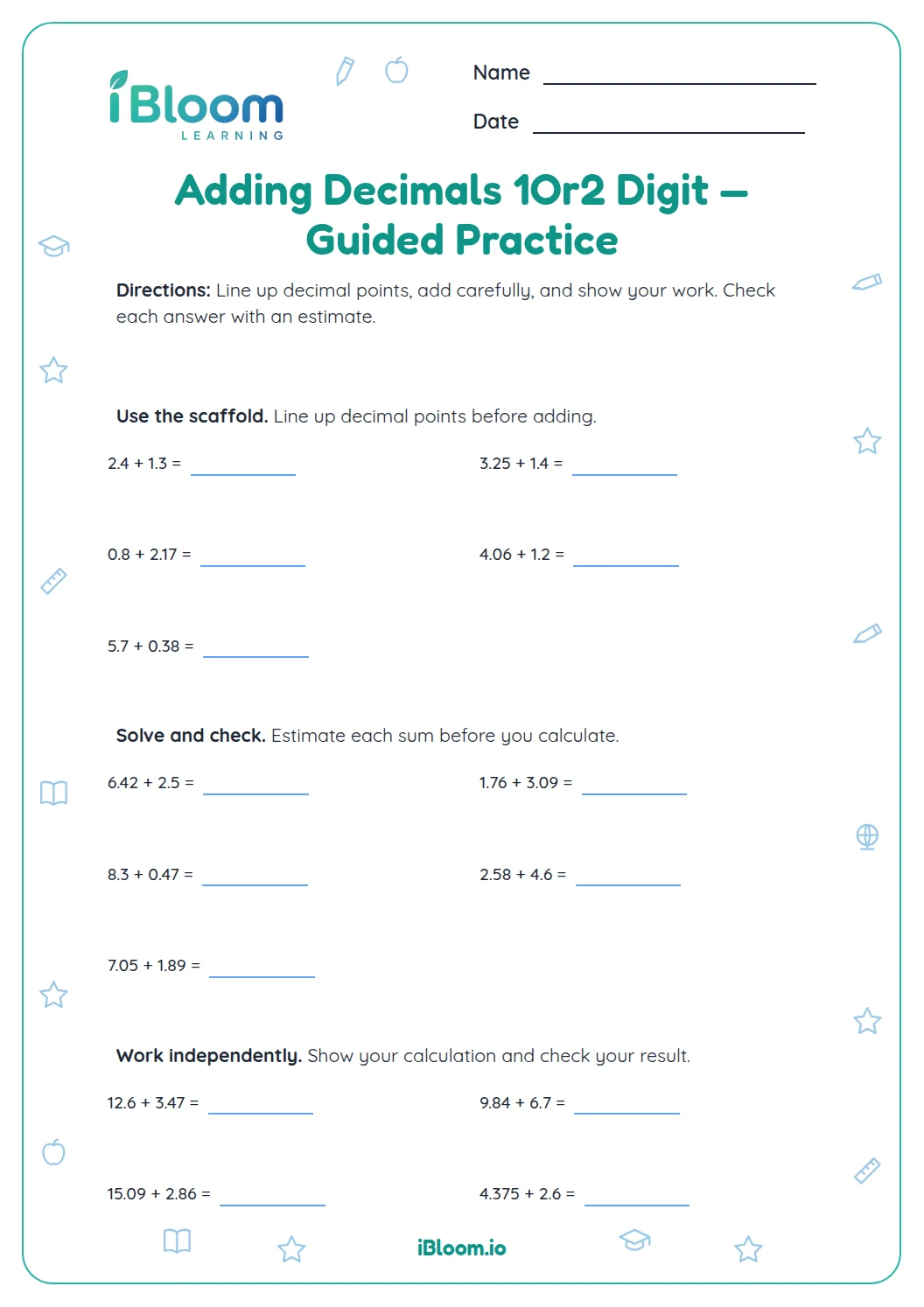
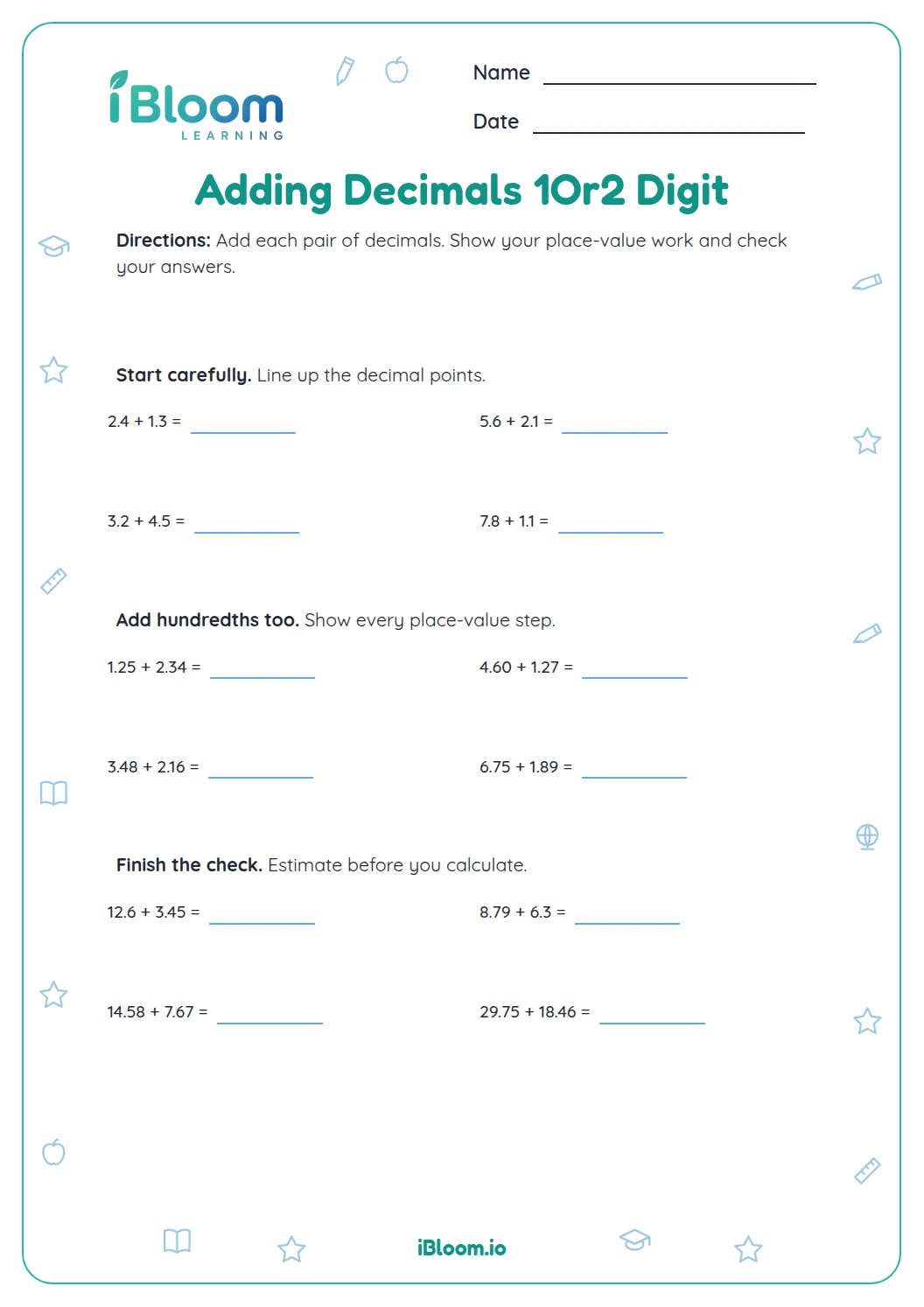
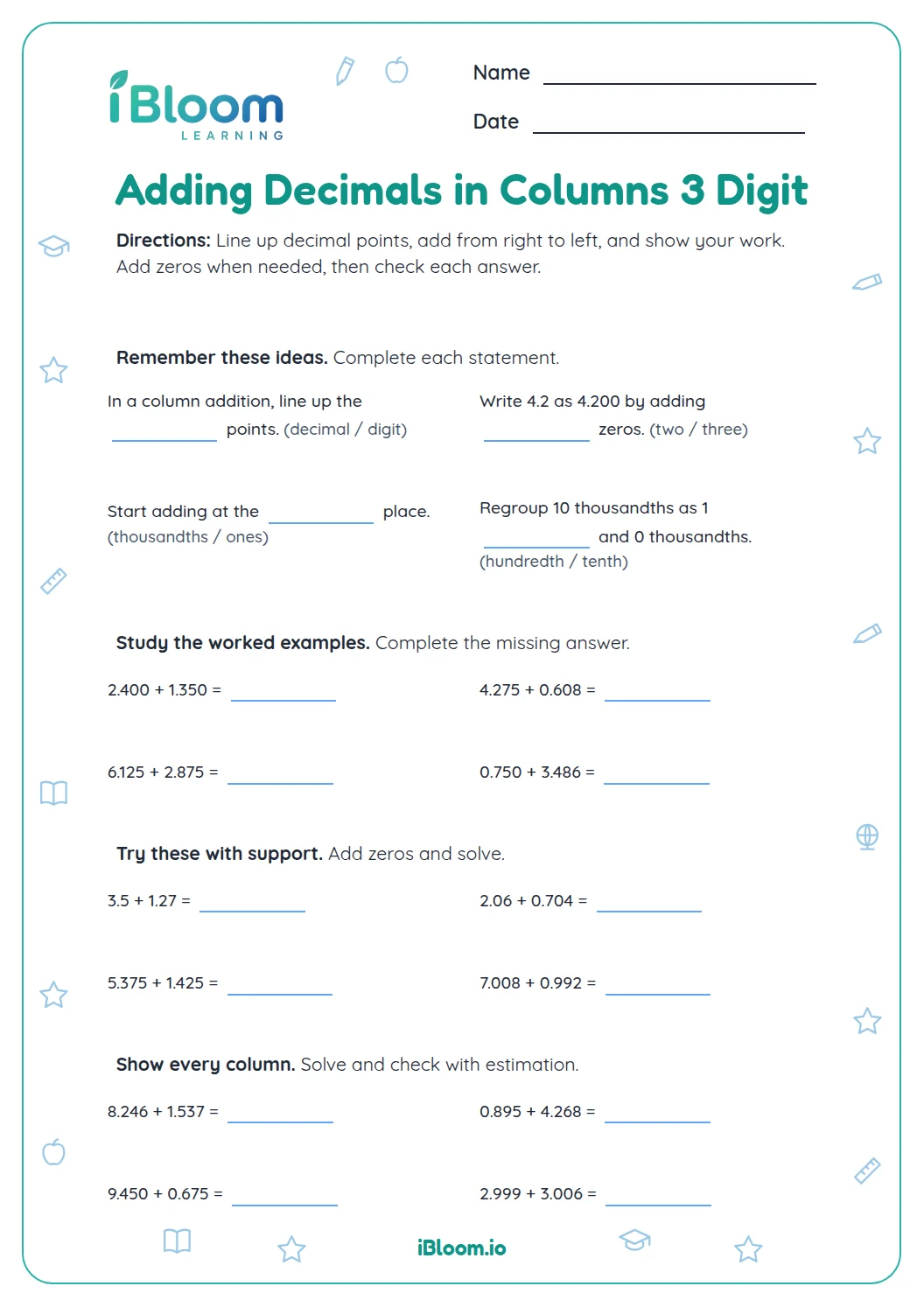
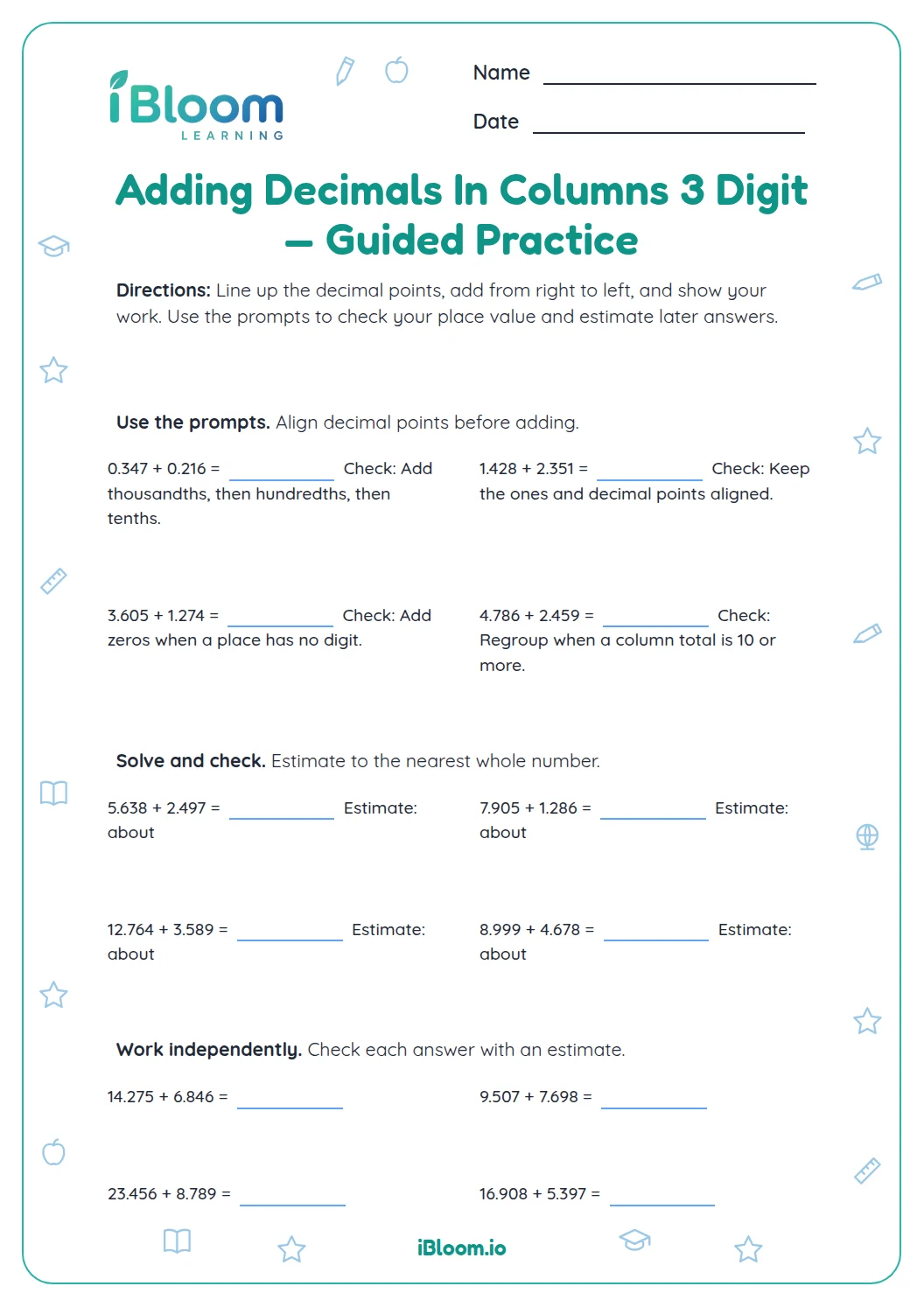
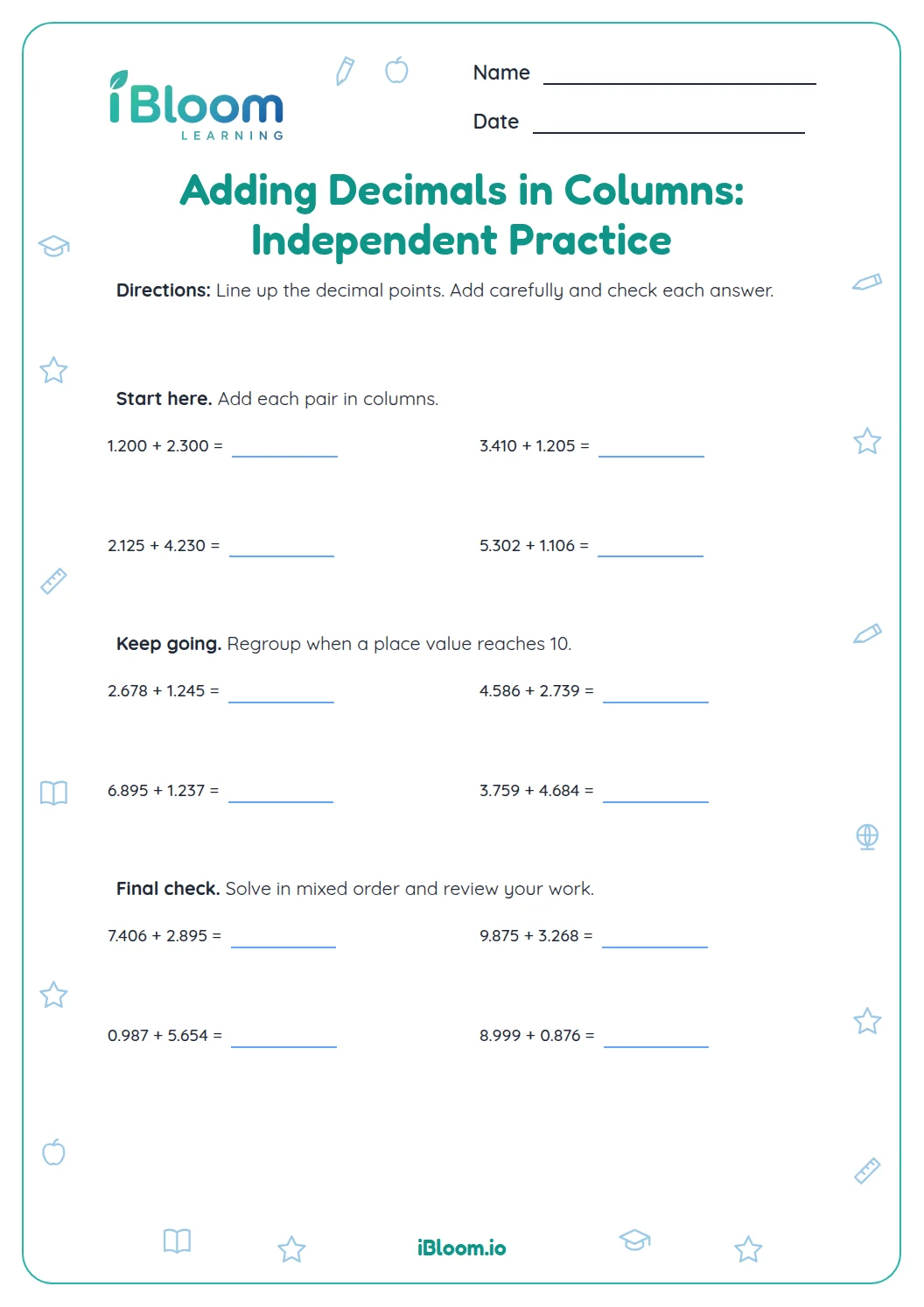
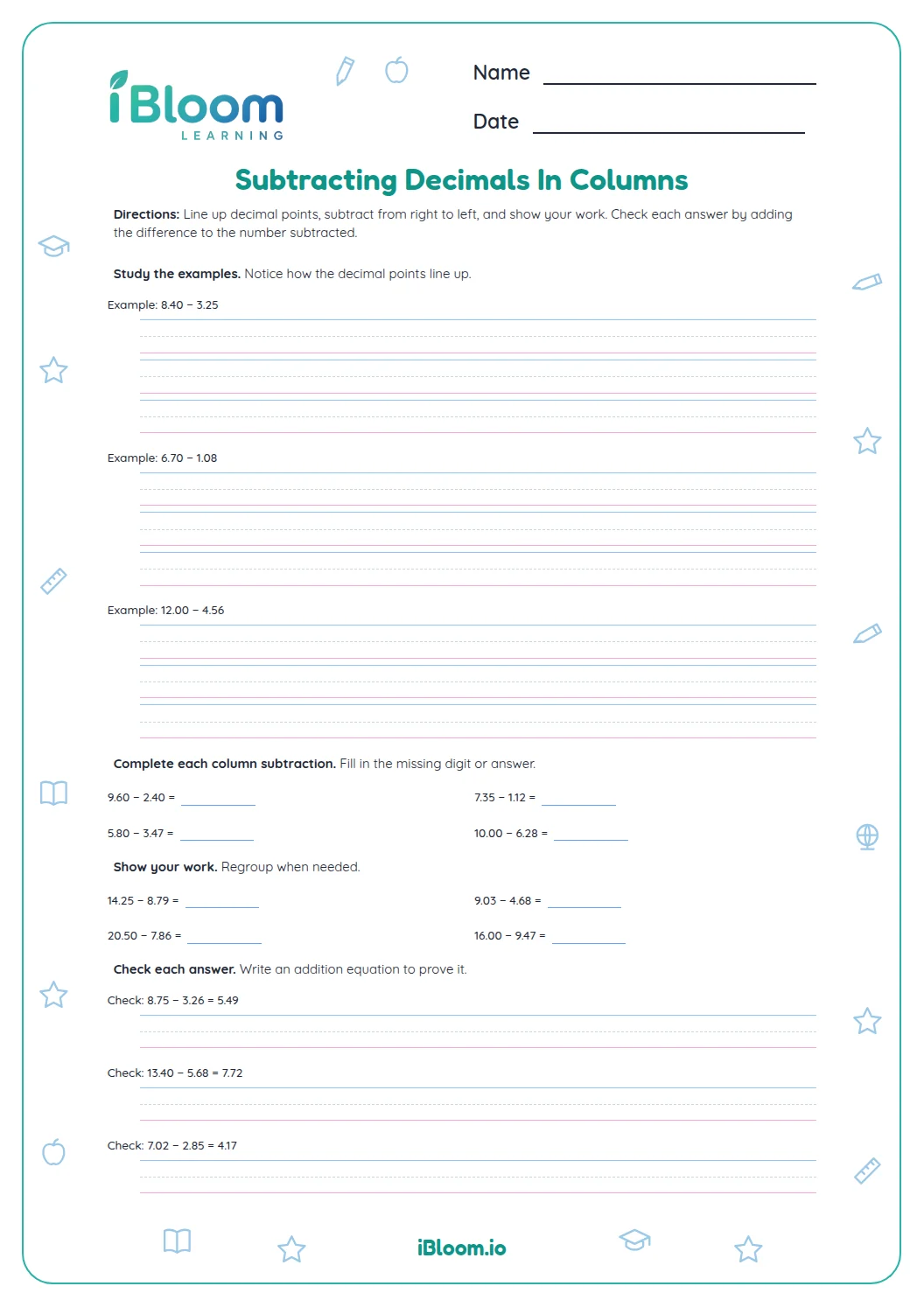
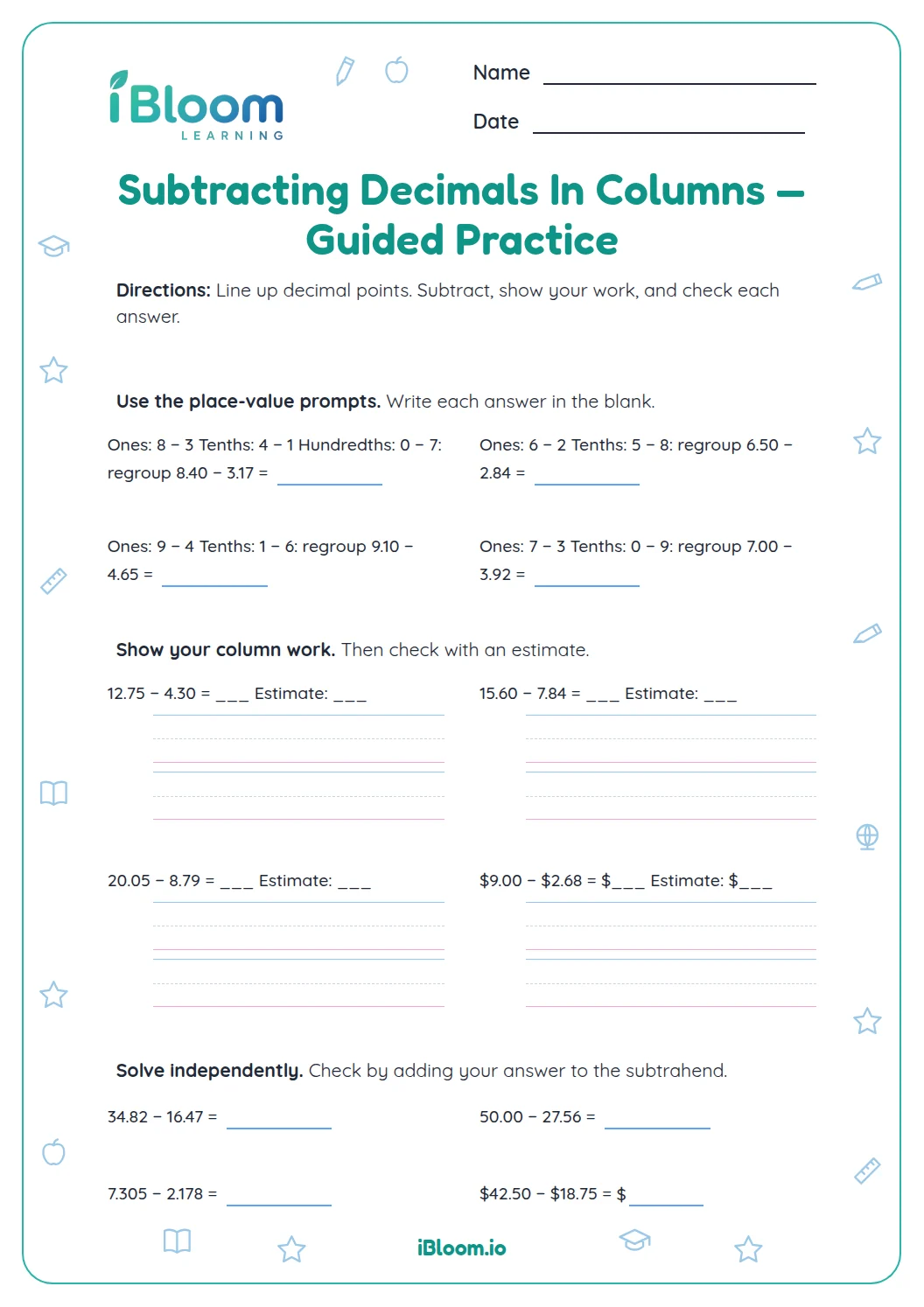
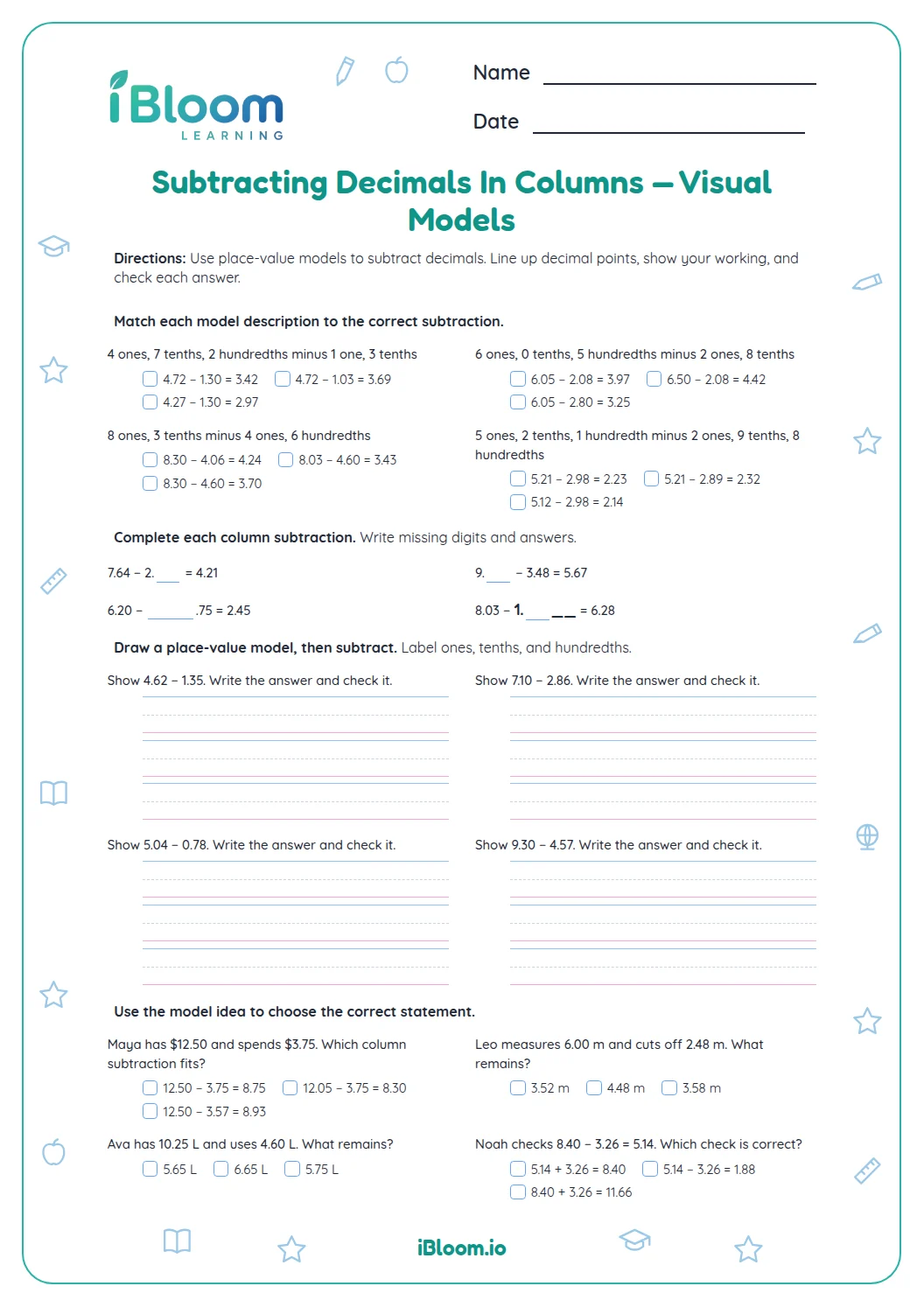
This Grade 5 guided practice sheet contains 16 decimal addition problems, including tenths, hundredths, and thousandths. Students line up decimal points, use zeros when needed to make place values visible, and check sums with an estimate or inverse operation. A separate answer key gives each sum, using equivalent decimal forms where trailing zeros do not change the value.
How do students line up decimal places?
Write the numbers so their decimal points line up. Add ones to ones, tenths to tenths, hundredths to hundredths, and thousandths to thousandths.
- 12.4 + 1.3 = 3.7
- 2The decimal points line up, so tenths are added to tenths.
- 3Estimate: 2 + 1 is about 3, which fits 3.7.
- Part A starts with tenths and hundredths.
- Part B adds values through thousandths.
- Part C mixes place lengths and asks students to check sums.
How can students check their work?
Use the answer key after the student has tried each item. Ask them to point to the value, observation, or place-value step that supports a response.
How should I use the answer key?
Print the worksheet pages for practice and keep the key separate for checking. Review any missed item by finding the step that needs correction.
How to use this worksheet
- 1Estimate the sum before calculating.
- 2Line up the decimal points vertically.
- 3Add digits in matching place-value columns.
- 4Use placeholder zeros when a number has fewer decimal places.
- 5Check that the result is close to the estimate.
Common mistakes and quick fixes
The mistake
Aligning the last digits instead of the decimal points.
The fix
Line up decimal points first, then match each place value.
The mistake
Treating 2.4 as smaller than 2.31 because it has fewer digits.
The fix
Write 2.4 as 2.40 to compare hundredths.
The mistake
Dropping a carried digit while adding.
The fix
Record each carry above the next place before continuing.
What to practice next
Make more practice
Questions parents and teachers ask
What does this worksheet teach about adding decimals?
Students add decimals with different numbers of decimal places, including thousandths. The prompts reinforce lining up decimal points so tenths, hundredths, and thousandths are added in matching places. Tenths stay aligned even when the other addend has thousandths.
How many problems are included?
There are 16 addition problems. They begin with tenths and hundredths, then include thousandths and numbers with missing decimal places that students can handle with placeholder zeros. The second page gives room to show column work for each sum.
Should students add trailing zeros?
They may use zeros as placeholders to align the places. For example, 2.4 can be written as 2.400 before adding a number to the thousandths place; the value stays the same. Adding 2.4 and 2.400 gives the same value because extra zeros are placeholders.
Does the answer key show equivalent decimal forms?
Yes. The key may show a sum without unnecessary trailing zeros, such as 9 for 9.00 or 0.98 for 0.980. Those forms represent the same value. The values 9 and 9.00 are equal; trailing zeros can be omitted.
How can students check a decimal sum?
Estimate the size of the answer first, then add the numbers in reverse order or subtract one addend from the sum. The result should be close to the estimate and recover the other addend. An estimate helps catch a misplaced decimal point before checking the answer.